

Brief

Auf einen Blick
- The service landscape is transforming, and original equipment manufacturers need to evolve the services they provide, how they provide them and how those services are purchased.
- New standards of speed and expertise and the movement toward payment based on productivity areas important to manage as digitalization.
- Original equipment manufacturers have a window of opportunity right now to use the data from their machines to create closer relationships and more valuable interactions with their customers.
A transformation is underway in industrial services. A dramatic shift in customer expectations has compelled the service organizations of original equipment manufacturers (OEMs) to move more quickly and build their expertise. Five years ago, delivering spare parts within a week was fine. Now, two days is often too long. Customers expect issues to be fixed on the first service response, and they want industrial suppliers to be experts not only in their own equipment but also to understand how those machines are deployed within the entire manufacturing landscape. Approaches to industrial services that were first deployed in high-volume, low-value environments, such as telecommunications field services or elevator maintenance, are now becoming the norm across sectors.
Those making the shift early find that the process can lead to closer, more valuable relationships with customers. Digital tools help companies meet these new standards. Industry leaders embed digital technology in their products, often in tandem with customers, using sensors to monitor machinery remotely, advanced analytics to diagnose and anticipate issues, and robotics and augmented reality to make human service smarter and cheaper. By capturing data and experiences, industrial service providers are able to tailor their offerings to their customers’ needs and knowledgeably price contracts based on their performance.
Historically, OEMs made service income when their customers lost money. Today, that is changing, with service providers more motivated to keep equipment running and sharing the risk of losses when they do not.
During a recent series of interviews with 35 service executives, it became clear that four major forces are propelling an ongoing transformation of the sector: demand for speed, digitalization, expertise and productivity (see Figure 1).
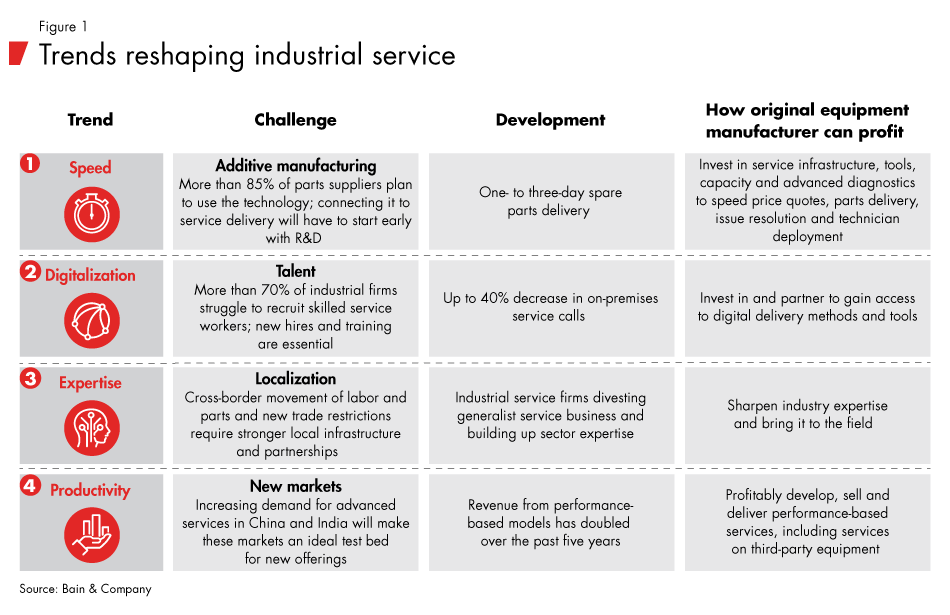
These changes have already begun, and their impact will only accelerate. By understanding what is changing and why, service providers can transform and avoid being left behind.
Speed
Digital masters such as Amazon are pushing service toward ever higher standards of speed and performance, now testing same-day delivery in some markets, for example. Using a similar model, leading maintenance repair organizations, such as Grainger and Brammer, have accelerated their own service, offering delivery of frequently used parts in one to three days.
To remain competitive, equipment manufacturers must become faster. This requires building new infrastructure and redesigning processes. Technology leader ABB has created a framework for thinking about industrial services called “1-1-1”: one hour to respond, one day to deliver and one week to invoice. This thinking led to a redesign of the way ABB treats customer events—what the company calls service episodes. The implementation of the approach has led to an elimination of inefficiencies, hence improving speed, response time and customer satisfaction. Today, this approach is the foundation of ABB’s integrated end-to-end automation of service and the main lever for the increase in customer loyalty that the company has enjoyed.
The next dramatic improvement in speed will come from the broader adoption of additive manufacturing. This technology, also called 3-D printing, has reached a tipping point, moving beyond experimentation to true operational use. The Airbus 350 XWB, for example, contains more than 1,000 3-D–printed parts.
The disruption of parts supply will come when replacements are widely printed locally rather than shipped globally. Pump maker Sulzer uses additive manufacturing in conjunction with traditional milling to create better impellers, the rotating component of a pump, and to do so more quickly. In 2016, the historical average delivery time for a Sulzer part was more than 10 weeks. With this new approach, the company expects, later this year, to be able to ship high-quality closed impellers within 48 hours of ordering.
Over the next five years, there will be many more such examples as 3-D printing alters the flow of parts and the economics of parts makers and OEMs. This has already started for spare parts that are low in volume, high in value, complex in design and for which delivery is time critical. Military forces, medical component suppliers and aerospace companies are leaders. The US Department of Defense’s most recent budget provided for more than $13 billion in spending on 3-D printing technologies for equipment such as 3-D–printed drones and the Rambo 3-D–printed grenade launcher. For defense contractors, this means moving from supplying spare parts to striking IP agreements.
Digitalization
Digitalization impacts service in many ways: the services offered, how they are paid for and how they are delivered.
Leading companies now offer services using digital data and the Internet of Things (IoT). Some pull information and insight about performance and usage from across a manufacturer’s entire installed base and then use that data to generate recommendations for individual customers. Some sell spare parts that are traceable through a production process. Others offer virtual training and assistance with augmented reality tools such as smart glasses.
New service offerings based on IoT platforms can cut operating expenditures drastically. They increase asset utilization, improve quality, increase flexibility in complex supply chains and reduce environmental impact. By combining previously stand-alone service offerings, companies can optimize an entire system with the support of advanced analytics.
One milk producer reduced waste by more than 20% after installing continuous digital measurement of the product at each phase of its packaging and processing. Before this technology, the assumption was that a certain amount of waste was simply unavoidable. In another food and beverage facility, a manufacturer began to use RFID technology to log the location of team members on the factory floor. By noticing that groups of employees would gravitate toward a certain part of the line, management was able to better understand which machines needed to be fixed or replaced, thereby improving asset utilization and lowering operating costs.
After digitalizing one of its data centers and connecting its products to an analytics-based energy consulting capability, Schneider Electric reduced energy costs by 25% and cut power outages in half. Today, 40% of critical alarms from Trane HVAC systems are detected automatically and resolved within 30 minutes using a combination of analytics and remote technicians.
As these examples show, digital tools are making it possible for manufacturers to provide better service more efficiently.
They are also bringing suppliers and customers closer together to jointly develop offerings, contracts and infrastructure. A common cooperative model today is a two-day workshop, followed by a one-month period of creating fast prototypes, followed by adaptation and rollout. This was the process undertaken for the improvement of the annual shutdown procedure for a steel mill. In the past, it was typical that a steel mill would have to shut down a production line for seven days to perform maintenance. But armed with data streaming from sensors on the production line all year long, managers now plan much more precisely for these down times. Instead of guessing what needs to be checked on, they go into the outage already knowing. Ramp-down and ramp-up is smoother, and a seven-day outage often can be reduced to two days.
In the past, many OEMs struggled to bring these kinds of innovative services to market. Today, by taking an Agile approach, with manufacturers collaborating with equipment owners and operators even before a machine has shipped, OEMs are innovating more often and more quickly.
Such a rapid shift raises challenges, however, starting with talent. The industrial service workforce has not traditionally been stocked with the digitally savvy engineers now needed to sell and deliver these new services and to collaborate with customers to develop solutions. Today, some large industrial groups have several hundred open positions for people with such skills. In order to deploy their new digital services to customers globally, service providers must hire different types of experts and make a substantial investment in training existing service staff.
Expertise
It is no longer sufficient for an equipment manufacturer to have expertise only in its own equipment.
Any robotics OEM servicing its own assembly robots deployed on an automotive assembly line will have to understand not only its robots but also their specific functionality, the underlying automation system and the overall systems environment of that line. If a failure notice were to pop up on a machine, the automotive company would need an automotive assembly robotics expert who is also knowledgeable about the control and execution platform, not a service technician who only understands the maintenance of six-axis robots.
In this network of connected equipment, there is a lot of value to capture between the machines and the steps of a production process. Increasingly, OEMs must take an end-to-end view, starting with the needs and expectations of the customers who are buying the things produced with their equipment, and then uncovering bottlenecks and opportunities to improve the overall equipment efficiency (OEE) of their manufacturing clients as they produce those things.
To meet expectations, OEMs need to build and deploy a staff that understands not only the technological and manufacturing environment in which their equipment runs but also the specific application of their machines within that environment. This leads to the development of teams of industry- and domain-specific experts. To nurture this expertise, equipment manufacturers are forming expert task forces, launching new units and making changes to their operating models. This, in turn, adds complexity to the management of the field force. Once, running a field force was a simple utilization game; the busier you kept the technicians, the more money you made. Now, service is about bringing the right person to the right situation, which, among other things, requires smarter dispatching and more off-site second-level escalation support.
OEMs that make these changes reap large benefits. As industrial process and application experts, they can more easily cover third-party equipment in their service contracts. Today, most of the producers of electrical drives and motors don’t care whether they service their units or somebody else’s because there is more value between them than in them.
Companies such as ABB and Sidel have built expert services staffs who can advise their customers on topics beyond running their own machines. Drawing from their broader industry experience, these companies can advise on effective ways to lower costs, improve productivity, reduce environmental impact, manage incoming and outgoing goods, monitor production and other topics.
Productivity
With speed, expertise and digitization has come a shift in the business model for many servicers. Service used to be billed by the part and by the hour. Over the years, industrial OEMs have successfully deployed service contracts based on different levels of support, but for most equipment manufacturers, true pay-for-performance models have been difficult to implement. Many customers balk at the prospect of sharing too much of the upside, and OEMs worry that they will have to pay for inefficiencies for which the operator is responsible.
Now, that is changing. The possibility of more accurately reading performance and usage data and predicting failures has made it possible for OEMs to take on more risk. Some manufacturers now offer dynamic warranties, extending coverage past the initial period on specific machines based on their maintenance history. Others are pioneering risk-sharing models in which they are paid based on equipment performance, typically measured in terms of OEE. Ten years ago, pioneering companies began to offer such contracts on multimillion-dollar machines. Today, the same type of contracts exist for a simple electric drive, and these performance-based service models are among the fastest growing in the industry; their share of service revenue is two times bigger than it was five years ago.
Baker Hughes’ (a General Electric company) 10-year contract valued at $180 million to monitor and maintain Transocean’s offshore rigs is tied to maximized uptime, lower operating costs and productivity improvement of 6% to 8%. In the transportation sector, Man Truck & Bus is optimizing the performance of its drivers with on-board transport analytics and assistance, and drawing fees based on distance traveled. Called “truck-as-a-service,” the benefits include improved driving performance, reduced fuel consumption and a total cost of ownership that is up to 5% lower per kilometer.
These new productivity-based service models are particularly relevant in China and India. As they have in many other industries (mobile phones and banking among them), those countries are leapfrogging long-established markets in service. While Asian manufacturers have traditionally relied on local suppliers and in-house capabilities to maintain their industrial equipment, today, the increased transparency into total cost of ownership is convincing even the most conservative firms of the financial and quality benefits of manufacturer servicing.
This opens an opportunity for technology leaders in the field to compete more effectively against lower-cost local players in fast-growth markets. In China, where service growth rates are already the highest in the world, the government is betting on digital and automated manufacturing, and increasing its global stature as a pivotal market for service.
Looking forward
Changes are really just beginning for OEMs and their service businesses. Soon, more manufacturers will follow Man Truck’s example and begin to sell equipment as a service. With analytical capabilities and processes, it is possible to contract profitably for a certain amount of output without requiring the purchase of machinery at all. For example, a contract might provide for 98% operating time. Anything above that leads to a bonus payment for the OEM; below it leads to a penalty. Or it might share the cost savings of reduced energy usage based on efficiency improvement.
As industrial systems become more advanced and more complex, technology is helping to keep their operation and utilization simple. Services took a first step toward becoming solutions for customers by combining software and hardware. That is accelerating with the testing of as-a-service offerings. The traditional boundaries between new equipment and service is blurring as the focus moves from selling a machine to jointly improving output and results. It is possible that a version of what is presently happening with decreasing levels of car or property ownership might someday apply to industrial equipment.
Today, OEMs have a unique window of opportunity—namely, the first shot at defining and controlling the data about the usage of their machines. With their access to that data, they can get a significant head start on analysis, creating a closer relationship and a more valuable interaction with their customers. By collaborating with them, OEMs have the opportunity to become experts in their customers’ eyes.
This evolution has begun and is accelerating. It is critical for OEMs to recognize the importance of robust analytical and data capabilities and invest in those now.
To understand how well positioned their company is to become an industrial leader in this new era, executives can ask themselves the following questions.
- Are we resolving service issues as quickly as customers expect?
- Are we leveraging technologies such as the Internet of Things to improve service levels?
- Which share of our spare parts business is at risk of being 3-D printed?
- Digital offers are growing quickly in important markets, including China. Are we competitive?
- Do we have, either in-house or through partnerships, the industry domain expertise and skilled practitioners we need?
- Can we meet customers’ needs in every geography with consistency of service quality and speed?
- Are we in a position to offer performance-based contracts in which we share risk with customers?
Oliver Straehle and Adrien Bron are partners with Bain & Company based in the Zurich office. Jeff Melton is a Bain partner in the Melbourne office. Melanie Oschlies is a manager with Bain based in the Zurich office.
First published in Juni 2018