

Brief
The abundant supply of shale gas in North America has reenergized the North American petrochemical industry, unleashing a wave of capital investment in new facilities. Since many shale fields contain, in addition to oil and natural gas, large quantities of natural gas liquids (NGLs), such as ethane, propane and butane, major new supplies are entering the market at low costs.
This low-cost feedstock has already shifted profit pools from gas producers and processors to petrochemical manufacturers. Still, no one knows whether or when the balance may shift back, so petrochemical executives are making long-term capital decisions in a time of tremendous uncertainty. Industry executives in Europe and elsewhere are also watching carefully as they make decisions that depend on the amount of natural gas, NGLs and poly-mers consumed in and eventually exported by the US.
While the long run looks bright, the next few years could be difficult for many players to navigate. To get a sense of what the future might bring, we evaluated supply and demand factors causing the changes. This brief examines some of those findings and considers opportunities for petrochemical producers in North America and in Europe.
Shale’s transformational effects
Not long ago, the NGLs that came out of the ground with natural gas were considered a by-product. But as horizontal drilling and fracking unlocked more than 500 trillion cubic feet of natural gas in North America, gas prices dropped from more than $12 per million British thermal units (MMBtu) in 2008 to under $2/MMBtu by early 2012 before recovering partially in 2013. Production stayed high, but producers turned their focus to wet wells, since the NGLs were more profitable than gas. Eventually, this surge caused ethane prices to collapse as supply outstripped demand. Petrochemical producers along the US Gulf Coast profited tremendously, while resource owners, gas processors and fractionators began to struggle. Many resource owners are deferring development of reserves until prices rise to an attractive level.
Gas and NGL prices are likely to recover—perhaps slowly, as growing demand absorbs the surplus in supply. Natural gas will continue to grow as an energy source due to its low cost and attractive carbon profile compared with coal. New generation facilities will come online over time as power generators move away from coal. New demand from utilities by 2030 could be about 9 billion cubic feet per day (Bcf/d) from both coal retirements and overall capacity expansions to serve a growing population. The US will also export more natural gas, first by pipeline to Mexico, tripling volumes to about 6 Bcf/d, and eventually through LNG terminals, which would add another 6 Bcf/d to 12 Bcf/d. Canada may move quicker to export vast supplies, which will affect the larger North American supply dynamic. However, this new demand will draw from a glut of available supply that can be economically produced at $4/MMBtu to $6/MMBtu. Even as natural gas prices rise slowly from these 20-year lows, we expect regional variations in price to continue and North American prices to remain below global levels for some time.
Capitalizing on the North American opportunity
The story for ethane is a little different than for gas. The increase in gas production and bias toward wet wells is creating an ethane supply bubble. Unlike methane, which can be used for multiple purposes, ethane goes almost entirely into the domestic petrochemical market, with some surplus used as fuel. This surplus has helped push the price of ethane down by half over the last two years.
Downstream facilities (such as petrochemical “crackers” that break down feedstock products to create different petrochemicals and plastic materials) will grow, especially along the Gulf Coast, but perhaps also in areas closer to newly productive gas deposits, such as Pennsylvania and Canada. This ramp-up will create significant demand for new infrastructure (including pipelines and storage) in an industry that hasn’t seen a major domestic expansion in decades.
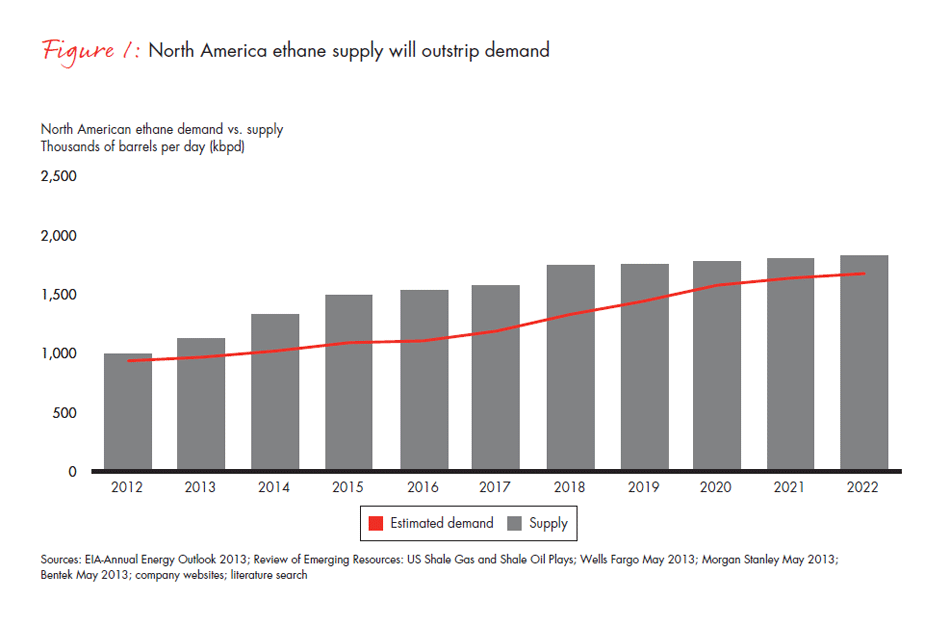
In the near term, ethane prices are likely to remain low, near gas value, until demand from newly constructed crackers begins to catch up with supply increases (see Figure 1). This pricing may sustain for some time due to the lack of alternative uses for ethane; one of the few other options is to leave the ethane in the gas stream to be burned for fuel content.
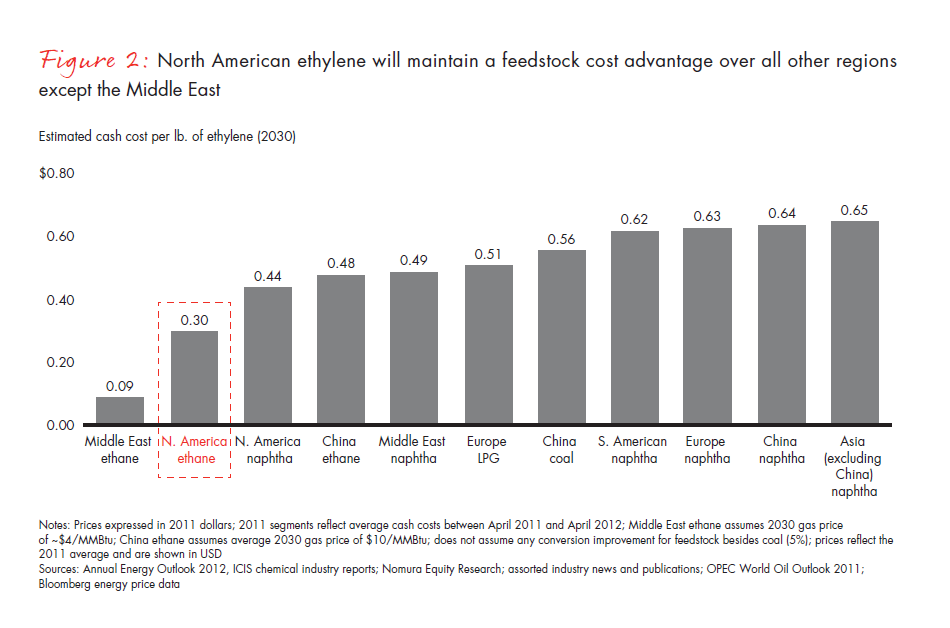
Over the longer term, access to low-cost feedstock will allow North America to keep its second-place cost position globally in petrochemicals. The Middle East’s cost advantage is likely to narrow somewhat, while North America will have a substantial cost advantage over Europe and Asia (see Figure 2).
The end result of this dramatic expansion will be the exportation of finished plastics, more than that of feedstocks. By 2017, North American polyethylene production could exceed local demand by 5 billion pounds, raising exports from historical norms of 10%-15% to 25%. This will continue into the early 2020s until North American demand grows sufficiently to absorb the local supply.
These exports will put pressure on petrochemical industries in other regions, especially Asia and Latin America. To remain competitive, companies from other regions are jumping into the fray in North America. Some are planning to build new facilities, such as South Africa’s Sasol, which announced plans in December 2012 to build a large ethane cracker in Louisiana. Others are locking down contracts to bring lower-cost NGLs to crackers in Europe, to improve their relative competitiveness ahead of the upcoming North American polyethylene capacity boom. Given these risks and opportunities, how should North American companies in natural gas and NGL extraction, production and consumption manage over the next few years?
We expect that US petrochemical companies will adopt several strategies to thrive in the shale boom.
- Guarantee access to low-cost supply. Petrochemical companies can strike very attractive contracts for ethane right now and especially over the next few years while supply outstrips demand. The better they understand the landscape and the rapidly changing NGL flows, the more likely they are to find good opportunities.
- Deliver expansion projects on time and on budget. Announced petrochemical projects along the Gulf Coast could produce an additional 15-25 billion pounds of ethylene per year. This is in addition to the announced derivatives expansions (polyethylene, ethylene dichloride, ethylene oxide) and the proposed LNG terminals and gas-to-liquids plants. With so much new capacity coming online in such a short period, the companies that ramp up production first within the financial constraints of their business will be the winners. Not surprisingly, that has created a war for talented industry professionals who have experience managing large capital projects, and we expect labor costs in the Gulf Coast to increase significantly during the boom.
- Develop export capabilities. By the end of this decade, North America will produce much more polyethylene than it demands. Companies will need to build customer relationships, distribution partnerships and supply chains to export the surplus to growing markets in Latin America and Asia (see below, "Producers in Latin America and Asia.")
- Keep costs down. The historic highs in ethylene margins will not last forever. While North America will remain very attractive for petrochemical production over the long run, companies will need to prepare to operate with much lower integrated margins than they have recently enjoyed—the days of 50-cents-per-pound margins will not last, and changes may occur rapidly as supply-demand imbalances along the value chain affect the industry’s operating rates. Many companies have seen their costs creep up over the last several years, but these have been masked by the industry’s margin expansion. These same companies must start to address this cost creep in advance of the next down cycle.
- Innovate new products and improve understanding of customer needs. Creating differentiation in the end products and services is the other way to create a cushion for when the industry slows down. Truly understanding how the product is used by customers is critical to getting the most value from the product. Companies that can point to specific attributes of their unique plastic products—shelf life improve-ment, reduced waste, improved throughput in customer production—are creating real value.
Returning European chemical producers to profitability
The relative cost position between North American and European producers has changed fundamentally—for at least the next decade. North American petrochemical producers have huge cost advantages given their broader and less expensive access to natural gas and NGLs. Europe has sizable shale reserves, but costs for shale extraction—where it’s allowed—are estimated to be about twice those in the US. Since feedstock and energy make up about 80% of the cost of petrochemical production, these advantages translate into better margins for producers in North America and the Middle East.
Most forecasts predict that global gas prices will converge to some degree over the long term—that is, they will decline in higher-priced regions like Europe, where gas prices still remain largely coupled to oil, to match prices in lower-cost areas. This shift will take time, however, and meanwhile European chemical producers are disadvantaged compared with North American producers in terms of both NGL feedstock and energy costs. Methane, for example, is substantially more expensive for European petrochemical producers than for their North American counterparts. Europeans must either import it directly (as Centrica has done), renegotiate long-term contracts tied to oil prices or buy on the spot market—though that tends to hover only slightly below contract prices. Price differences are also significant in ethane derivatives, due to a supply surplus; they are less so for derivatives of propane and butane, although there will likely be changes to interregional flows.
Given the sharp differences in cost positions, which are likely to last for a decade or more, European companies need to act to improve their performance efficiency or to reposition themselves to take advantage of lower-cost feedstocks if they are to survive.
- Reduce operating costs. Europe’s chemical producers need to get more out of their assets by increasing the capacity of their current plants (for example, by updating or modifying equipment) and by deciding which plants are most cost effective to operate. They will also need to reduce complexity within their organizations and focus on eliminating low-volume products, unprofitable grades—and even some customers.
- Reduce feedstock and power costs. Options include switching to cracking lighter feeds such as propane (possibly from North America), sourcing low-cost ethane directly from North America (as seen recently with INEOS) and negotiating more competitive long-term gas contracts, even importing LNG directly.
- Produce in less-expensive regions. To keep pushing costs down, they should investigate adding or moving facilities to lower-cost regions, such as the Middle East or North America.
- Diversify assets and pursue higher-margin chemicals aimed at specific applications. These products generally require more extensive sales, customer service and technical support, and so they can’t be considered commodities. Feedstock costs remain important, but they make up a smaller proportion of the overall realized price.
On a broader level, we see several implications for the European chemical industry. First, in addition to the improvement measures that individual companies will put into place, we expect to see consolidation in the industry, especially in the most energy-intensive businesses. Future investments are likely to flow toward North America, not only for petrochemicals but also for industries further downstream. We also recognize the need for a cross-country, regional response in several areas. Gas prices should decouple from oil prices, which is likely to affect long-term contracts. Also, we expect the industry to push for more aggressive development of Europe’s domestic shale gas industry and a coherent energy policy across the European Union. Finally, the industry should work to reduce the potential for an oversupply of petrochemical products by shuttering the least-efficient assets.
•••
Petrochemical executives in North America and Europe have widely different perspectives on the shale boom, with those in America benefiting early from access to cheap feedstock while those in Europe must reposition themselves and their assets to remain competitive. In the long run, however, companies in both regions could reap huge rewards from the vast amounts of NGLs coming out of shale, providing executives make the right decisions over the next few years.
Producers in Latin America and Asia
Latin American petrochemical producers are likely to feel the brunt of North American expansion. They will need to gain a clear picture of the competition from other regions and how it is shifting. They should also recalculate their cost position against competitive products from North America and use that to decide where to invest their capital and how to defend their business.
Producers in Asia will also need to recalculate their cost position against products and supplies from North American producers. In addition, they should monitor the development of unconventional sources of gas and NGLs in China, including shale gas and coal-to-olefins. They can take steps to protect their profitable market segments by improving the quality and reliability of their products, innovating to differentiate themselves and strengthening their relationships with local customers.
Mark Porter is a partner with Bain & Company in London and co-leader of the firm’s Global Chemicals practice. Tom Shannon and Jason McLinn are Bain partners in Chicago and are both leading members of Bain’s Global Chemicals practice.The authors would like to acknowledge the contributions of David Burns, a principal with Bain & Company in Chicago, and Valerie Pritchard, a principal with Bain in London.
First published in November 2013