
Skip to Content
  • Standorte

    Standorte

    North & Latin America
    • Atlanta
    • Austin
    • Bogota
    • Boston
    • Buenos Aires
    • Chicago
    • Dallas
    • Denver
    • Houston
    • Lisbon
    • Los Angeles
    • Mexico City
    • Minneapolis
    • Monterrey
    • Montreal
    • New York
    • Rio de Janeiro
    • San Francisco
    • Santiago
    • São Paulo
    • Seattle
    • Silicon Valley
    • Toronto
    • Washington, DC
    Europe & Africa
    • Amsterdam
    • Athens
    • Berlin
    • Brussels
    • Copenhagen
    • Düsseldorf
    • Frankfurt
    • Helsinki
    • Istanbul
    • Johannesburg
    • Kyiv
    • Lisbon
    • London
    • Madrid
    • Milan
    • München
    • Oslo
    • Paris
    • Rome
    • Stockholm
    • Warsaw
    • Wien
    • Zürich
    Middle East
    • Doha
    • Dubai
    • Riyadh
    Asia & Australia
    • Bangkok
    • Beijing
    • Bengaluru
    • Brisbane
    • Ho Chi Minh City
    • Hong Kong
    • Jakarta
    • Kuala Lumpur
    • Manila
    • Melbourne
    • Mumbai
    • New Delhi
    • Perth
    • Seoul
    • Shanghai
    • Singapore
    • Sydney
    • Tokyo
    Alle Standorte Anzeigen
  • Alumni
  • Presse
  • Newsletter
  • Kontakt
  • DACH-Region | Deutsch

    Wählen Sie Ihre Region und Sprache

    Global
    • Global (English)
    North & Latin America
    • Brazil (Português)
    • Argentina (Español)
    • Canada (Français)
    • Chile (Español)
    • Colombia (Español)
    Europe, Middle East, & Africa
    • France (Français)
    • DACH-Region (Deutsch)
    • Italy (Italiano)
    • Spain (Español)
    • Greece (Elliniká)
    Asia & Australia
    • China (中文版)
    • Korea (한국어)
    • Japan (日本語)
  • Saved items (0)
    Saved items (0)

    You have no saved items.

    Inhalte, für die Sie sich interessieren, werden hier gespeichert und können später gelesen oder weitergeleitet werden.

    Explore Bain Insights
  • Branchenkompetenzen
    Hauptmenü

    Branchenkompetenzen

    • Luft- und Raumfahrt, Verteidigung
    • Agrarwirtschaft
    • Chemieindustrie
    • Infrastruktur und Bauwirtschaft
    • Konsumgüter
    • Finanzdienstleistungen
    • Gesundheitswesen
    • Maschinen- und Anlagenbau
    • Medienwirtschaft
    • Metallindustrie
    • Bergbau
    • Öl und Gas
    • Papier- und Verpackungsindustrie
    • Private Equity
      Branchenkompetenzen
      Private Equity
      • Due Diligence
      • Exit Planning
      • Firm Strategy & Operations
      • Portfolio Value Creation
    • Öffentlicher Sektor und Sozialwesen
    • Einzelhandel
    • Technologie
    • Telekommunikation
    • Transportwesen
    • Reise- und Freizeitbranche
    • Versorgung und erneuerbare Energien
  • Managementkompetenzen
    Hauptmenü

    Managementkompetenzen

    • Customer Experience
    • ESG
    • Innovation
    • M&A
    • Operations
    • People & Organization
    • Private Equity
    • Sales & Marketing
    • Strategie
    • KI, Einblicke und Lösungen
    • Technologie
    • Transformation
  • Digital
  • Publikationen
    Hauptmenü

    Publikationen

    • Branchenthemen
    • Managementthemen
    • Bain-Bücher
    Alle Publikationen
    Ausgewählte Themen
    • Resilienz in der globalen Krise
    • M&A Report
    • Private Equity Podcast
    • Midyear Private Equity Report
    • Agile
    • Engineering Report
    • Digital Transformation
    • Elements of Value®
    • Firm of the Future
    • Nachhaltigkeitsstudie
    • Macro Trends
    • Future of Consumption
    • Weltwirtschaftsforum (WEF)
  • Über uns
    Hauptmenü

    Über uns

    • Was wir bieten
    • Unser Ansatz
    • Unser Team
    • Game Changer Award
    • Female Allstar Board
    • Messbare Ergebnisse (EN)
    • Auszeichnungen
    • Globale Partnerschaften
    • The Mission
    Further: Our global responsibility
    • Vielfalt & Chancengleichheit
    • Soziale Verantwortung
    • Sustainability
    Erfahren Sie mehr zu "Further"
  • Karriere
    Hauptmenü

    Karriere

    • Dein Einstieg
      Karriere
      Dein Einstieg
      • Find Your Place
      • Unsere Arbeitsbereiche
      • Unsere Teams
      • Angebote für Studierende
      • Praktika & Programme
      • Recruiting-Events
    • Arbeiten bei Bain
      Karriere
      Arbeiten bei Bain
      • Blog: Inside Bain
      • Karriere Stories
      • Unsere Bainies
      • Office-Standorte
      • Weiterentwicklung
      • Affinity Groups
      • Deine Benefits
    • Impact Stories
    • Deine Bewerbung
      Karriere
      Deine Bewerbung
      • Das erwartet dich
      • Der Interviewprozess
    FIND JOBS
  • Standorte
    Hauptmenü

    Standorte

    • North & Latin America
      Standorte
      North & Latin America
      • Atlanta
      • Austin
      • Bogota
      • Boston
      • Buenos Aires
      • Chicago
      • Dallas
      • Denver
      • Houston
      • Lisbon
      • Los Angeles
      • Mexico City
      • Minneapolis
      • Monterrey
      • Montreal
      • New York
      • Rio de Janeiro
      • San Francisco
      • Santiago
      • São Paulo
      • Seattle
      • Silicon Valley
      • Toronto
      • Washington, DC
    • Europe & Africa
      Standorte
      Europe & Africa
      • Amsterdam
      • Athens
      • Berlin
      • Brussels
      • Copenhagen
      • Düsseldorf
      • Frankfurt
      • Helsinki
      • Istanbul
      • Johannesburg
      • Kyiv
      • Lisbon
      • London
      • Madrid
      • Milan
      • München
      • Oslo
      • Paris
      • Rome
      • Stockholm
      • Warsaw
      • Wien
      • Zürich
    • Middle East
      Standorte
      Middle East
      • Doha
      • Dubai
      • Riyadh
    • Asia & Australia
      Standorte
      Asia & Australia
      • Bangkok
      • Beijing
      • Bengaluru
      • Brisbane
      • Ho Chi Minh City
      • Hong Kong
      • Jakarta
      • Kuala Lumpur
      • Manila
      • Melbourne
      • Mumbai
      • New Delhi
      • Perth
      • Seoul
      • Shanghai
      • Singapore
      • Sydney
      • Tokyo
    Alle Standorte Anzeigen
  • Alumni
  • Presse
  • Newsletter
  • Kontakt
  • DACH-Region | Deutsch
    Hauptmenü

    Wählen Sie Ihre Region und Sprache

    • Global
      Wählen Sie Ihre Region und Sprache
      Global
      • Global (English)
    • North & Latin America
      Wählen Sie Ihre Region und Sprache
      North & Latin America
      • Brazil (Português)
      • Argentina (Español)
      • Canada (Français)
      • Chile (Español)
      • Colombia (Español)
    • Europe, Middle East, & Africa
      Wählen Sie Ihre Region und Sprache
      Europe, Middle East, & Africa
      • France (Français)
      • DACH-Region (Deutsch)
      • Italy (Italiano)
      • Spain (Español)
      • Greece (Elliniká)
    • Asia & Australia
      Wählen Sie Ihre Region und Sprache
      Asia & Australia
      • China (中文版)
      • Korea (한국어)
      • Japan (日本語)
  • Saved items  (0)
    Hauptmenü
    Saved items (0)

    You have no saved items.

    Inhalte, für die Sie sich interessieren, werden hier gespeichert und können später gelesen oder weitergeleitet werden.

    Explore Bain Insights
  • Branchenkompetenzen
    • Branchenkompetenzen

      • Luft- und Raumfahrt, Verteidigung
      • Agrarwirtschaft
      • Chemieindustrie
      • Infrastruktur und Bauwirtschaft
      • Konsumgüter
      • Finanzdienstleistungen
      • Gesundheitswesen
      • Maschinen- und Anlagenbau
      • Medienwirtschaft
      • Metallindustrie
      • Bergbau
      • Öl und Gas
      • Papier- und Verpackungsindustrie
      • Private Equity
      • Öffentlicher Sektor und Sozialwesen
      • Einzelhandel
      • Technologie
      • Telekommunikation
      • Transportwesen
      • Reise- und Freizeitbranche
      • Versorgung und erneuerbare Energien
  • Managementkompetenzen
    • Managementkompetenzen

      • Customer Experience
      • ESG
      • Innovation
      • M&A
      • Operations
      • People & Organization
      • Private Equity
      • Sales & Marketing
      • Strategie
      • KI, Einblicke und Lösungen
      • Technologie
      • Transformation
  • Digital
  • Publikationen
    • Publikationen

      • Branchenthemen
      • Managementthemen
      • Bain-Bücher
      Alle Publikationen
      Ausgewählte Themen
      • Resilienz in der globalen Krise
      • M&A Report
      • Private Equity Podcast
      • Midyear Private Equity Report
      • Agile
      • Engineering Report
      • Digital Transformation
      • Elements of Value®
      • Firm of the Future
      • Nachhaltigkeitsstudie
      • Macro Trends
      • Future of Consumption
      • Weltwirtschaftsforum (WEF)
  • Über uns
    • Über uns

      • Was wir bieten
      • Unser Ansatz
      • Unser Team
      • Game Changer Award
      • Female Allstar Board
      • Messbare Ergebnisse (EN)
      • Auszeichnungen
      • Globale Partnerschaften
      • The Mission
      Further: Our global responsibility
      • Vielfalt & Chancengleichheit
      • Soziale Verantwortung
      • Sustainability
      Erfahren Sie mehr zu "Further"
  • Karriere
    Häufige Suchanfragen
    • Agil
    • Digital
    • Strategie
    Vorherige Suchanfragen
      Zuletzt besuchte Seiten

      Content added to saved items

      Saved items (0)

      Removed from saved items

      Saved items (0)

      Brief

      Retailers' Challenge: How to Cut Carbon Emissions as E-Commerce Soars

      Retailers' Challenge: How to Cut Carbon Emissions as E-Commerce Soars

      Some delivery channels reduce emissions and costs—and delight customers.

      Von Aaron Cheris, Casey Taylor, Jennifer Hayes and Jenny Davis-Peccoud

      • Min. Lesezeit
      }

      Brief

      Retailers' Challenge: How to Cut Carbon Emissions as E-Commerce Soars
      en

      Consumers are thrilled by the speed and flexibility of e-commerce. But the proliferation of new retail channels and choices is changing their purchasing behavior, and overall, that’s taking a negative toll on the environment.

      Online purchases in the US neared $400 billion in 2016 and now make up 8% of overall retail spending and up to 40% in some categories, such as consumer electronics. As shoppers move online en masse, their expectations also are increasing. Instead of waiting a week to receive a purchase, they want it tomorrow—or even today. That means a sharp rise in home deliveries and individual packages.

      Many retailers have begun to reduce the carbon footprint of their brick-and-mortar shops and distribution networks. But few have examined how e-commerce trends are transforming their carbon footprint. That’s no surprise: The proliferation of purchasing channels and delivery options makes the task far more challenging. When a consumer buys goods online, the main factors influencing the total carbon emissions—namely, last-mile delivery and packaging—are more difficult to measure.

      A few sustainability leaders have begun gathering data, developing new approaches and encouraging consumers to opt for more sustainable choices. As part of that effort, they discovered that rooting out carbon inefficiencies often is good for business, reducing costs and delighting customers with more convenient options. Bain analysis shows that doubling the average number of items purchased per e-commerce transaction and eliminating split shipments would reduce average per-item emissions by 30% and cut shipping costs more than 50%.

      Understanding a changing landscape


      Carbon emissions can vary significantly depending on how a customer shops. Take the case of Walmart, the largest US retailer with more than 4,000 stores and a rapidly growing e-commerce business. Walmart studied the emissions generated by its own brick-and-mortar retail stores compared with its e-commerce channel to understand the relative impact of each, on average and for specific types of purchases. It found that store purchases are more efficient on average but when customers purchase fewer items and would otherwise make a dedicated trip to the store, Walmart.com is the more efficient choice.

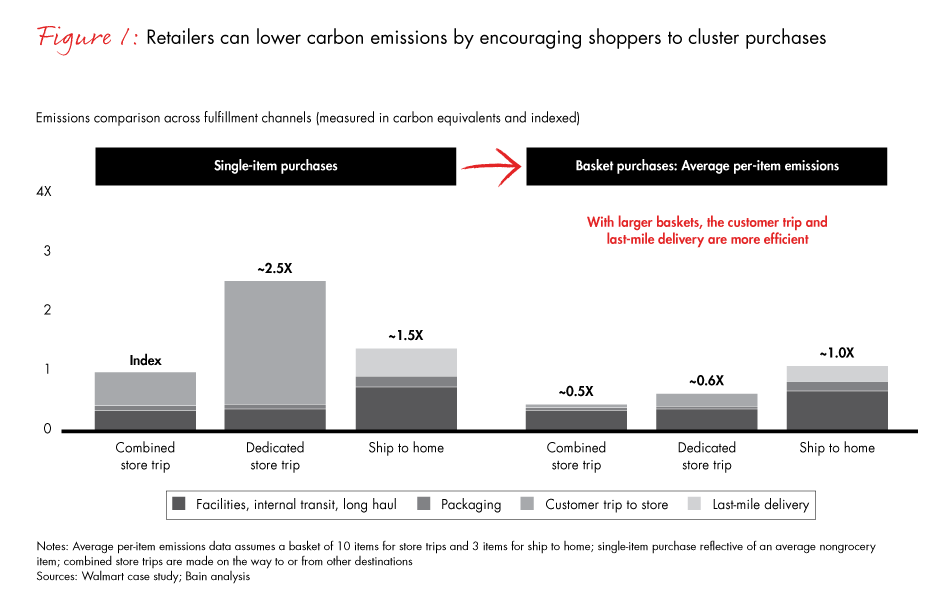
      When Walmart examined average per-item emissions, the data showed its brick-and-mortar purchases have a smaller carbon footprint since customers typically buy more items in stores than online and often combine their trip to the store with other stops. In the brick-and-mortar channel, the energy that stores consume is an important emissions contributor, but it is spread over a large volume of items. The customer’s trip to the store is another significant generator of emissions, but customers often reduce their environmental footprint by shopping on the way to or from work, school or other errands, and by purchasing multiple items (see Figure 1).

      retail-and-sustainability-fig01_embed

      The e-commerce channel, on average, tends to produce more emissions per item for three reasons: e-commerce requires additional packaging, customers purchase fewer items per online transaction, and multi-item orders often result in multiple deliveries. So achieving the purchase volume of one trip to a physical store requires multiple e-purchases and deliveries.

      For deliveries, two of the largest sources of emissions are last-mile delivery and packaging. The e-commerce channel can improve its average footprint per item by increasing the number of items shipped per order, but only if all the items can be packaged and shipped together. The Walmart study underscores the importance of shipping multiple items together and avoiding split shipments, which occur when some of the items being shipped are not available immediately from the same distribution center. The emissions of two items shipped separately are 35% higher than if the items shipped together.

      Walmart’s findings show that for grocery items, the average brick-and-mortar purchase is also more environmentally efficient than e-commerce. When customers buy groceries online, they tend to buy larger baskets of goods than with other e-purchases. However, delivering groceries is carbon intensive because retailers need to alter routes to suit customer schedules and to use refrigerated trucks or special packaging. Standard delivery by parcel requires either insulated packaging or reusable coolers that must be picked up from customers and returned to distribution facilities.

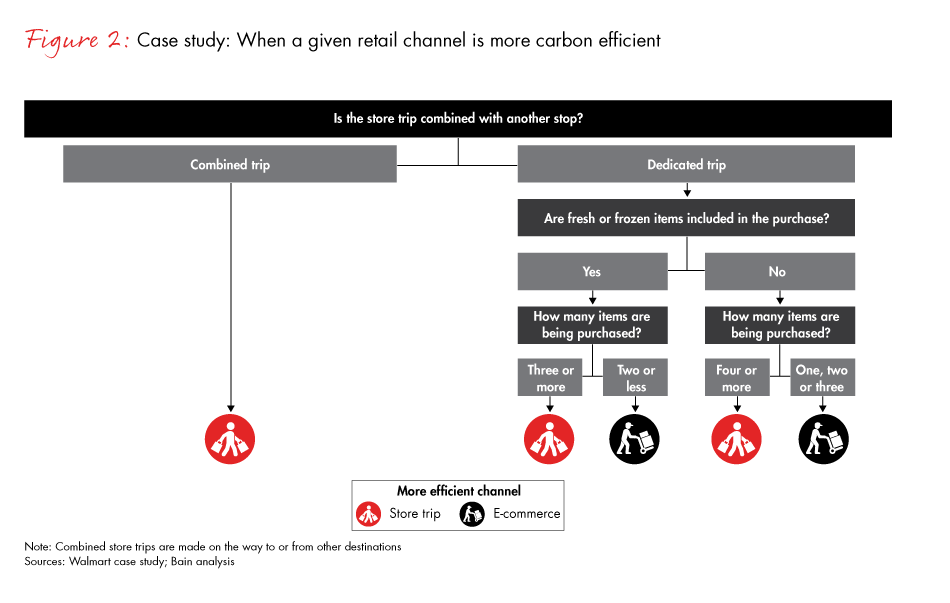
      Walmart concluded that the most efficient purchase path depends on how customers make their trip to the store and how many items they purchase (see Figure 2). For trips combined with other errands or dedicated trips to stock up on goods, brick-and-mortar is typically the most efficient channel. But for purchases of only a few items, e-commerce offers the lower-emissions delivery channel.

      retail-and-sustainability-fig02_embed

      These findings were consistent across Walmart’s rural and urban operations. However, the emissions comparison across channels will vary by retailer. Walmart’s extensive footprint limits distances traveled, and its breadth of categories encourages customers to purchase a larger number of items per shopping trip. By contrast, retailers with fewer stores, narrower assortments and fewer average items per purchase may have less environmentally efficient brick-and-mortar operations than Walmart.

      How retailers can reduce store-based emissions


      Walmart’s findings highlight the opportunities retailers have to more effectively reduce carbon emissions across channels. Within brick-and-mortar, most large retailers already focus on energy efficiency and renewables, and several have made strong commitments: IKEA Group has pledged to produce as much renewable energy as it consumes by 2020, and Walmart has announced plans to obtain 50% of its energy from renewable sources by 2025.

      One large area of potential improvement is often overlooked in sustainability audits: the customer’s trip to the store. Retailers can reduce emissions significantly by expanding the retail ecosystem in or near a store, encouraging customers to combine shopping trips. Such ecosystems may include a gas station or electric charging points in the parking lot, ATMs, or other services. Retailers also can use mobile technology to remind customers of regularly purchased items, reducing the number of solo trips resulting from forgotten items.

      A greener approach to e-commerce


      E-commerce has transformed customer expectations about the breadth of product assortment and speed of delivery. While the new panorama of choice delights shoppers, their rising expectations are increasing retailers’ carbon footprints. Vast product assortments lead to a greater number of split shipments. Low or no shipping minimums, such as those offered by Amazon Prime, incentivize smaller baskets. And expedited shipping results in more air freight. All three increase the average costs and carbon emissions to deliver an item.

      To counter that trend, leading e-commerce retailers are trying to avoid split shipments and encourage customers to cluster their purchases. They place inventory for top-selling items in all distribution centers and colocate items that are often purchased together. And they use their online interface to recommend new items, or substitute items, that would ship together. For example, Jet.com’s Smart Cart adjusts prices while a customer shops to promote additional purchases, and it does so for items that would ship together. Jet.com claims an average basket size of nearly seven, which is more than double the e-commerce industry average. Walmart acquired Jet.com in 2016.

      Infografik

      How Retailers Can Cut Emissions as E-Commerce Soars

      A look at online shopping’s effect on retailers’ carbon footprints, and four ways that omnichannel retailers can reduce emissions.

      E-commerce retailers also are looking for ways to reduce last-mile delivery costs and packaging. Amazon has placed its lockers in more than 50 metropolitan areas across the US, where customers can pick up items. And locating the lockers in heavily foot-trafficked areas in a 7-Eleven or college bookstore, for example, helps minimize dedicated customer trips to the lockers. Pickup points, however, may or may not be more efficient than home delivery purchases or store purchases. The determining factors are the customer trip, packaging and the scale of distribution networks. E-commerce retailers are also working to minimize packaging waste by increasing the assortment of cardboard box sizes to better match purchases.

      Efforts to reduce emissions often create a dual benefit, bringing down costs, too. By doubling the average number of items purchased per e-commerce transaction and avoiding split shipments, retailers can reduce average per-item emissions by 30%, and that effort cuts shipping costs by more than 50%, Bain analysis shows.

      The omnichannel advantage


      In this fast-changing retail landscape, omnichannel retailers have an edge: They can mix and match their physical and online channels to lower their environmental impact while offering customers greater flexibility. Their digital presence offers customers the convenience of online shopping while their network of physical stores and large-scale distribution networks can place goods efficiently within miles of a customer, allowing almost immediate pickup. Specifically, omnichannel retailers can wield their assets in four environmentally efficient combinations.

      Steer customers to in-store pickup. Omnichannel retailers can offer customers who shop online the option of picking up their purchases at a store the same day. That combined approach is typically more efficient in cost and carbon than shipping items to a customer’s home. Walmart offers free same-day pickup on thousands of products—bagged and ready to go—and is in the process of extending this convenience to grocery items nationwide. Kroger offers ClickList, in which customers’ digital orders are delivered to their car when they arrive at the store.

      Reduce last-mile delivery by establishing convenient pickup points. Retailers who don’t have the benefit of an extensive store network can establish their own pickup locations near customers or partner with other retailers for space. Amazon has done both with its lockers, and UPS has developed pickup points for customers. Outside the US, UK department store John Lewis, which has fewer than 50 locations nationwide, now offers click-and-collect service at its own stores as well as a broader network of more than 350 Waitrose Supermarkets (also owned by the John Lewis Partnership). Last year, John Lewis customers picked up 70% of their click-and-collect orders at a Waitrose market. The challenge is that pickup locations can sometimes create larger carbon footprints than home delivery or a trip to the store. Several factors can tip the scales and create higher emissions, including the customer’s trip to a pickup point, incremental packaging and the delivery of items to the pickup location.

      Reduce shipping impact by using in-store inventory. Shipping items to customers from a local store rather than a distribution center can minimize longer-haul shipping, especially for oversized items—reducing carbon emissions and costs. Recent Bain analysis suggests that for large retailers, the ship-from-store option could be 30% more cost efficient than shipping from a distribution center directly—and for small retailers, up to 50% more cost efficient.

      Decrease dedicated trips by using vehicles in circulation. Omnichannel retailers can offer same-day convenience without customers having to make a dedicated trip by establishing partnerships with on-demand logistics providers. Nordstrom, Rent the Runway and 1-800-Flowers partner with UberRUSH. Whole Foods, Publix, Costco and Petco partner with Instacart. Instead of the customer making a dedicated trip, these drivers can combine multiple orders and then arrange delivery routes to minimize mileage. Another option for retailers is employee delivery, in which store employees would drop off customer packages on their way home.

      Looking forward


      As e-commerce accelerates, retailers will shoulder much of the increased costs of packaging and deliveries and the emissions they produce. Delivering a swelling volume of online purchases, both general merchandise and groceries, poses a significant challenge. Retailers that understand the costs and emissions comparisons across their own retail channels will have an edge keeping both under control while giving customers greater choice.

      Aaron Cheris is a partner with Bain & Company in the San Francisco office and leader of Bain’s Retail practice. Casey Taylor and Jennifer Hayes are Bain partners in the Atlanta office. Jenny Davis-Peccoud is a partner with Bain & Company in London and leader of Bain’s Global Sustainability and Corporate Responsibility practice.

      The authors would like to thank Julia Saxonov, Casi Lumbra and Clare Tovey for their contributions to this work.


      retail-and-sustainability-fig01_full

      retail-and-sustainability-fig02_full
      Autoren
      • Headshot of Aaron Cheris
        Aaron Cheris
        Partner, San Francisco
      • Headshot of Casey Taylor
        Casey Taylor
        Partner, San Francisco
      • Headshot of Jennifer Hayes
        Jennifer Hayes
        Partner, Atlanta
      • Headshot of Jenny Davis-Peccoud
        Jenny Davis-Peccoud
        Partner, Amsterdam
      Kontaktieren Sie uns
      Verwandte Branchen
      • Einzelhandel
      Einzelhandel
      Modern Retail Supply Chains: Backbone for Omnichannel

      With Amazon setting the pace for customer service, all retailers need to radically rethink supply chains to keep up.

      Mehr erfahren
      Einzelhandel
      Die “digicale” Revolution

      Erfolgreiche Unternehmen nutzen digitale Ansätze, um ihre physischen Geschäftsmodelle weiterzuentwickeln, und schaffen so eine gute Basis für ein anhaltend profitables Wachstum.

      Mehr erfahren
      Konsumgüter
      Winning the Race for Digital Commerce

      With much of the growth now coming from online sales, brands need to follow four basic rules to capture their share.

      Mehr erfahren
      Einzelhandel
      The 2026 Retail Executive Agenda

      Here are letters to the C-suite to help strengthen strategy, catalyze collaboration, and expand value creation in the AI age.

      Mehr erfahren
      Einzelhandel
      The 2025 Chinese Personal Luxury Goods Market

      Recalibration, resurgence, and more selective consumers are edging China’s personal luxury market toward recovery.

      Mehr erfahren
      First published in April 2017
      Markierungen
      • Einzelhandel

      Wie wir unsere Kunden unterstützt haben

      With Sophisticated Customer Segmentation, a Travel Company Sets Sail

      Kundenbeispiel lesen

      Kundenstrategie und Marketing A major retailer rejuvenates sales by thinking local

      Kundenbeispiel lesen

      Digitalisierung Omnichannel strategy boosts fashion company

      Kundenbeispiel lesen

      Möchten Sie mit uns in Kontakt bleiben?

      Wir unterstützen Führungskräfte weltweit, die kritischen Themen in ihrem Unternehmen zu adressieren. Gemeinsam schaffen wir nachhaltige Veränderungen und Ergebnisse.

      Bain Insights. Unsere Perspektive auf die kritischen Themen, mit denen sich international agierende Unternehmen konfrontiert sehen, finden Sie monatlich in Ihrem Postfach.

      *Ich habe die Datenschutzerklärung gelesen und akzeptiere sie.
      Bitte lesen Sie die Datenschutzerklärung und akzeptieren Sie diese.
      Bain & Company
      Contact us Sustainability Accessibility Rechtliche Hinweise Impressum Datenschutz Cookie-Richtlinie Sitemap Log In

      © 1996-2026 Bain & Company, Inc.

      Kontaktieren Sie Bain

      Wie können wir Ihnen helfen?

      • Business inquiry
      • Career information
      • Press relations
      • Partnership request
      • Speaker request
      Alle weltweiten Büros