
Skip to Content
  • Standorte

    Standorte

    North & Latin America
    • Atlanta
    • Austin
    • Bogota
    • Boston
    • Buenos Aires
    • Chicago
    • Dallas
    • Denver
    • Houston
    • Lisbon
    • Los Angeles
    • Mexico City
    • Minneapolis
    • Monterrey
    • Montreal
    • New York
    • Rio de Janeiro
    • San Francisco
    • Santiago
    • São Paulo
    • Seattle
    • Silicon Valley
    • Toronto
    • Washington, DC
    Europe & Africa
    • Amsterdam
    • Athens
    • Berlin
    • Brussels
    • Copenhagen
    • Düsseldorf
    • Frankfurt
    • Helsinki
    • Istanbul
    • Johannesburg
    • Kyiv
    • Lisbon
    • London
    • Madrid
    • Milan
    • München
    • Oslo
    • Paris
    • Rome
    • Stockholm
    • Warsaw
    • Wien
    • Zürich
    Middle East
    • Doha
    • Dubai
    • Riyadh
    Asia & Australia
    • Bangkok
    • Beijing
    • Bengaluru
    • Brisbane
    • Ho Chi Minh City
    • Hong Kong
    • Jakarta
    • Kuala Lumpur
    • Manila
    • Melbourne
    • Mumbai
    • New Delhi
    • Perth
    • Seoul
    • Shanghai
    • Singapore
    • Sydney
    • Tokyo
    Alle Standorte Anzeigen
  • Alumni
  • Presse
  • Newsletter
  • Kontakt
  • DACH-Region | Deutsch

    Wählen Sie Ihre Region und Sprache

    Global
    • Global (English)
    North & Latin America
    • Brazil (Português)
    • Argentina (Español)
    • Canada (Français)
    • Chile (Español)
    • Colombia (Español)
    Europe, Middle East, & Africa
    • France (Français)
    • DACH-Region (Deutsch)
    • Italy (Italiano)
    • Spain (Español)
    • Greece (Elliniká)
    Asia & Australia
    • China (中文版)
    • Korea (한국어)
    • Japan (日本語)
  • Saved items (0)
    Saved items (0)

    You have no saved items.

    Inhalte, für die Sie sich interessieren, werden hier gespeichert und können später gelesen oder weitergeleitet werden.

    Explore Bain Insights
  • Branchenkompetenzen
    Hauptmenü

    Branchenkompetenzen

    • Luft- und Raumfahrt, Verteidigung
    • Agrarwirtschaft
    • Chemieindustrie
    • Infrastruktur und Bauwirtschaft
    • Konsumgüter
    • Finanzdienstleistungen
    • Gesundheitswesen
    • Maschinen- und Anlagenbau
    • Medienwirtschaft
    • Metallindustrie
    • Bergbau
    • Öl und Gas
    • Papier- und Verpackungsindustrie
    • Private Equity
      Branchenkompetenzen
      Private Equity
      • Due Diligence
      • Exit Planning
      • Firm Strategy & Operations
      • Portfolio Value Creation
    • Öffentlicher Sektor und Sozialwesen
    • Einzelhandel
    • Technologie
    • Telekommunikation
    • Transportwesen
    • Reise- und Freizeitbranche
    • Versorgung und erneuerbare Energien
  • Managementkompetenzen
    Hauptmenü

    Managementkompetenzen

    • Customer Experience
    • ESG
    • Innovation
    • M&A
    • Operations
    • People & Organization
    • Private Equity
    • Sales & Marketing
    • Strategie
    • KI, Einblicke und Lösungen
    • Technologie
    • Transformation
  • Digital
  • Publikationen
    Hauptmenü

    Publikationen

    • Branchenthemen
    • Managementthemen
    • Bain-Bücher
    Alle Publikationen
    Ausgewählte Themen
    • Resilienz in der globalen Krise
    • M&A Report
    • Private Equity Podcast
    • Midyear Private Equity Report
    • Agile
    • Engineering Report
    • Digital Transformation
    • Elements of Value®
    • Firm of the Future
    • Nachhaltigkeitsstudie
    • Macro Trends
    • Future of Consumption
    • Weltwirtschaftsforum (WEF)
  • Über uns
    Hauptmenü

    Über uns

    • Was wir bieten
    • Unser Ansatz
    • Unser Team
    • Game Changer Award
    • Female Allstar Board
    • Messbare Ergebnisse (EN)
    • Auszeichnungen
    • Globale Partnerschaften
    • The Mission
    Further: Our global responsibility
    • Vielfalt & Chancengleichheit
    • Soziale Verantwortung
    • Sustainability
    Erfahren Sie mehr zu "Further"
  • Karriere
    Hauptmenü

    Karriere

    • Dein Einstieg
      Karriere
      Dein Einstieg
      • Find Your Place
      • Unsere Arbeitsbereiche
      • Unsere Teams
      • Angebote für Studierende
      • Praktika & Programme
      • Recruiting-Events
    • Arbeiten bei Bain
      Karriere
      Arbeiten bei Bain
      • Blog: Inside Bain
      • Karriere Stories
      • Unsere Bainies
      • Office-Standorte
      • Weiterentwicklung
      • Affinity Groups
      • Deine Benefits
    • Impact Stories
    • Deine Bewerbung
      Karriere
      Deine Bewerbung
      • Das erwartet dich
      • Der Interviewprozess
    FIND JOBS
  • Standorte
    Hauptmenü

    Standorte

    • North & Latin America
      Standorte
      North & Latin America
      • Atlanta
      • Austin
      • Bogota
      • Boston
      • Buenos Aires
      • Chicago
      • Dallas
      • Denver
      • Houston
      • Lisbon
      • Los Angeles
      • Mexico City
      • Minneapolis
      • Monterrey
      • Montreal
      • New York
      • Rio de Janeiro
      • San Francisco
      • Santiago
      • São Paulo
      • Seattle
      • Silicon Valley
      • Toronto
      • Washington, DC
    • Europe & Africa
      Standorte
      Europe & Africa
      • Amsterdam
      • Athens
      • Berlin
      • Brussels
      • Copenhagen
      • Düsseldorf
      • Frankfurt
      • Helsinki
      • Istanbul
      • Johannesburg
      • Kyiv
      • Lisbon
      • London
      • Madrid
      • Milan
      • München
      • Oslo
      • Paris
      • Rome
      • Stockholm
      • Warsaw
      • Wien
      • Zürich
    • Middle East
      Standorte
      Middle East
      • Doha
      • Dubai
      • Riyadh
    • Asia & Australia
      Standorte
      Asia & Australia
      • Bangkok
      • Beijing
      • Bengaluru
      • Brisbane
      • Ho Chi Minh City
      • Hong Kong
      • Jakarta
      • Kuala Lumpur
      • Manila
      • Melbourne
      • Mumbai
      • New Delhi
      • Perth
      • Seoul
      • Shanghai
      • Singapore
      • Sydney
      • Tokyo
    Alle Standorte Anzeigen
  • Alumni
  • Presse
  • Newsletter
  • Kontakt
  • DACH-Region | Deutsch
    Hauptmenü

    Wählen Sie Ihre Region und Sprache

    • Global
      Wählen Sie Ihre Region und Sprache
      Global
      • Global (English)
    • North & Latin America
      Wählen Sie Ihre Region und Sprache
      North & Latin America
      • Brazil (Português)
      • Argentina (Español)
      • Canada (Français)
      • Chile (Español)
      • Colombia (Español)
    • Europe, Middle East, & Africa
      Wählen Sie Ihre Region und Sprache
      Europe, Middle East, & Africa
      • France (Français)
      • DACH-Region (Deutsch)
      • Italy (Italiano)
      • Spain (Español)
      • Greece (Elliniká)
    • Asia & Australia
      Wählen Sie Ihre Region und Sprache
      Asia & Australia
      • China (中文版)
      • Korea (한국어)
      • Japan (日本語)
  • Saved items  (0)
    Hauptmenü
    Saved items (0)

    You have no saved items.

    Inhalte, für die Sie sich interessieren, werden hier gespeichert und können später gelesen oder weitergeleitet werden.

    Explore Bain Insights
  • Branchenkompetenzen
    • Branchenkompetenzen

      • Luft- und Raumfahrt, Verteidigung
      • Agrarwirtschaft
      • Chemieindustrie
      • Infrastruktur und Bauwirtschaft
      • Konsumgüter
      • Finanzdienstleistungen
      • Gesundheitswesen
      • Maschinen- und Anlagenbau
      • Medienwirtschaft
      • Metallindustrie
      • Bergbau
      • Öl und Gas
      • Papier- und Verpackungsindustrie
      • Private Equity
      • Öffentlicher Sektor und Sozialwesen
      • Einzelhandel
      • Technologie
      • Telekommunikation
      • Transportwesen
      • Reise- und Freizeitbranche
      • Versorgung und erneuerbare Energien
  • Managementkompetenzen
    • Managementkompetenzen

      • Customer Experience
      • ESG
      • Innovation
      • M&A
      • Operations
      • People & Organization
      • Private Equity
      • Sales & Marketing
      • Strategie
      • KI, Einblicke und Lösungen
      • Technologie
      • Transformation
  • Digital
  • Publikationen
    • Publikationen

      • Branchenthemen
      • Managementthemen
      • Bain-Bücher
      Alle Publikationen
      Ausgewählte Themen
      • Resilienz in der globalen Krise
      • M&A Report
      • Private Equity Podcast
      • Midyear Private Equity Report
      • Agile
      • Engineering Report
      • Digital Transformation
      • Elements of Value®
      • Firm of the Future
      • Nachhaltigkeitsstudie
      • Macro Trends
      • Future of Consumption
      • Weltwirtschaftsforum (WEF)
  • Über uns
    • Über uns

      • Was wir bieten
      • Unser Ansatz
      • Unser Team
      • Game Changer Award
      • Female Allstar Board
      • Messbare Ergebnisse (EN)
      • Auszeichnungen
      • Globale Partnerschaften
      • The Mission
      Further: Our global responsibility
      • Vielfalt & Chancengleichheit
      • Soziale Verantwortung
      • Sustainability
      Erfahren Sie mehr zu "Further"
  • Karriere
    Häufige Suchanfragen
    • Agil
    • Digital
    • Strategie
    Vorherige Suchanfragen
      Zuletzt besuchte Seiten

      Content added to saved items

      Saved items (0)

      Removed from saved items

      Saved items (0)

      Gaming Report

      Level Unlocked: How Video Game Companies Can Evolve Operating Models for Growth

      Level Unlocked: How Video Game Companies Can Evolve Operating Models for Growth

      Leading companies are adapting their models to capitalize on greater scale while also maintaining connections with players.

      Von Anders Christofferson, Tom Rowland, Alex Egan, und Matt Madden

      • Min. Lesezeit
      }

      Report

      Level Unlocked: How Video Game Companies Can Evolve Operating Models for Growth
      en
      Auf einen Blick
      • Video game companies are getting bigger and more complex as they try to meet evolving consumer demand.
      • The largest companies expanded their operational footprint by an average of 13 countries over the past decade—a 28% increase.
      • The top game developers’ headcount growth slightly outpaced revenue growth during that period, implying minimal efficiency gains despite increased size.
      • Leading companies are adapting their operating models by rethinking where and how work gets done and by investing in talent and technology.

      This article is part of Bain's 2024 Gaming Report

      Explore the report

      As video game companies prepare for the industry’s next wave of growth, executives are finding that the operating model that got them to this point simply won’t work for the next chapter. That’s true for every video game company, whether it’s a small, single-game developer or a multibillion-dollar developer and publisher of AAA franchises.

      Over the past decade, the video game industry has grown significantly. So, too, has its complexity. Gamers increasingly demand multiplayer, multiplatform experiences with more social features. Additionally, media types are converging as feature film and TV series adaptations of video games continue to draw significant audiences.

      To meet evolving consumer demand, video game companies have become far larger and more complex. Eight of the top gaming companies employ people in 28% more countries than they did a decade ago, an average increase of 13 countries each. That’s according to Bain analysis of Aura Intelligence data on 12 studios operating in about 100 countries.

      These companies’ mix of capabilities is also changing. The five fastest-growing functions—privacy and security, data analytics, live operations, animation and effects, and game operations and strategy—have increased headcount at around two times the average rate of all other business functions over the past decade, according to our analysis (see Figure 1).

      Figure 1
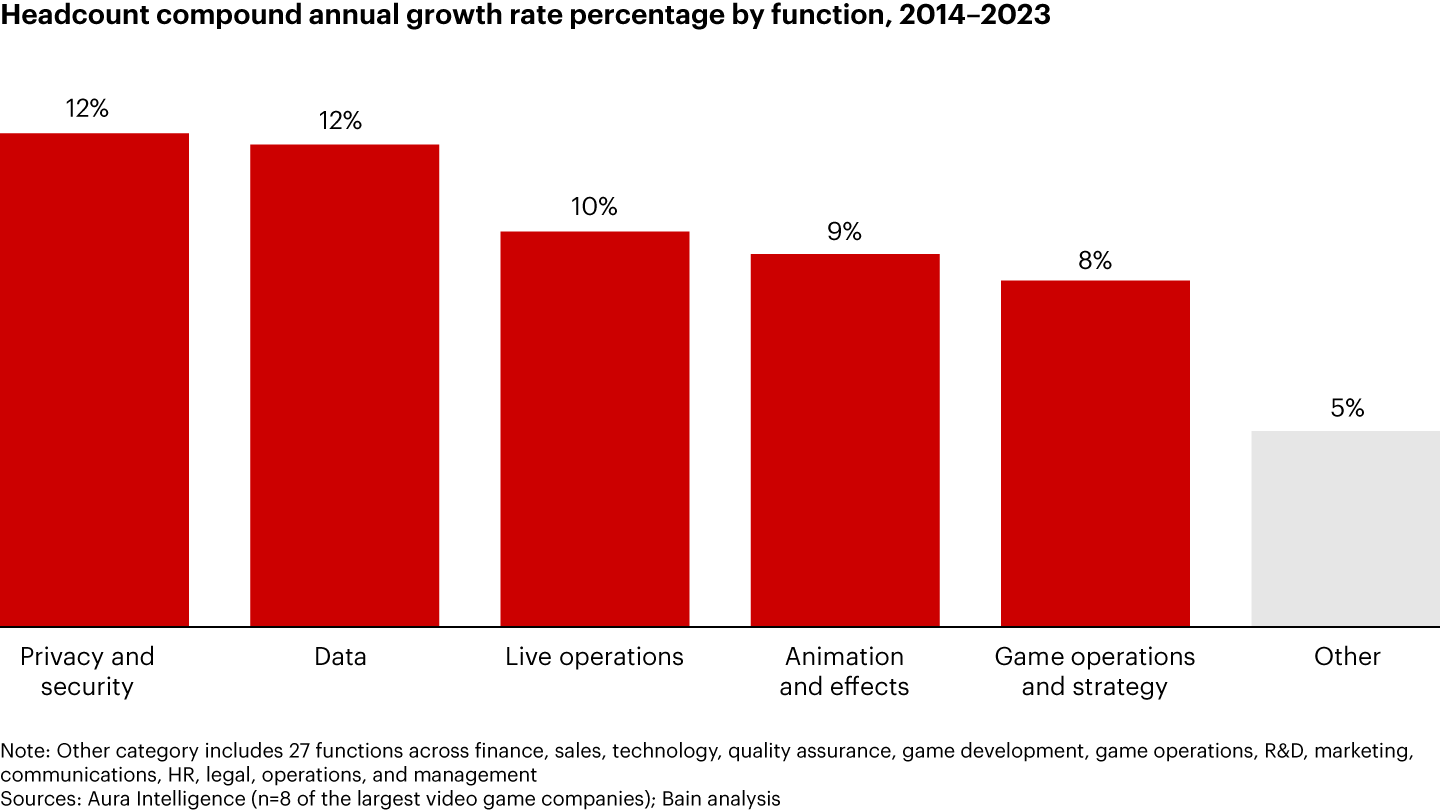
      Large video game companies are investing in a wider mix of capabilities

      The industry has reached a critical juncture. The explosive growth during the Covid-19 pandemic has subsided, leading many companies to manage costs by reducing headcount. However, we anticipate that the video game market will return to robust growth over the coming years. That means video game companies will have to adapt to the industry’s increased complexity, manage growth when it comes, and do it all with more constrained resources. They have no choice but to revamp their operating models—and quickly.

      The situation is akin to the evolution of the traditional film and TV industry over the past two decades, when studios shifted from merging with each other to joining broader entertainment conglomerates. These new companies had to rethink their operating models to leverage intellectual property across a range of media and gain efficiencies from formerly independent studios.

      Where’s the efficiency?

      An effective operating model bridges the gap between strategy and execution. It’s the organizational structure, processes, governance, technology, culture, and ways of working that enable a company to deliver on its goals.

      Many video game companies are struggling to adapt their operating model and take advantage of scale benefits as their organization grows. The average workforce size of the top video game developers we analyzed has risen 7% annually over the past decade, but their revenue has only grown 6% each year, implying minimal efficiency gains despite increased size (see Figure 2).

      Figure 2
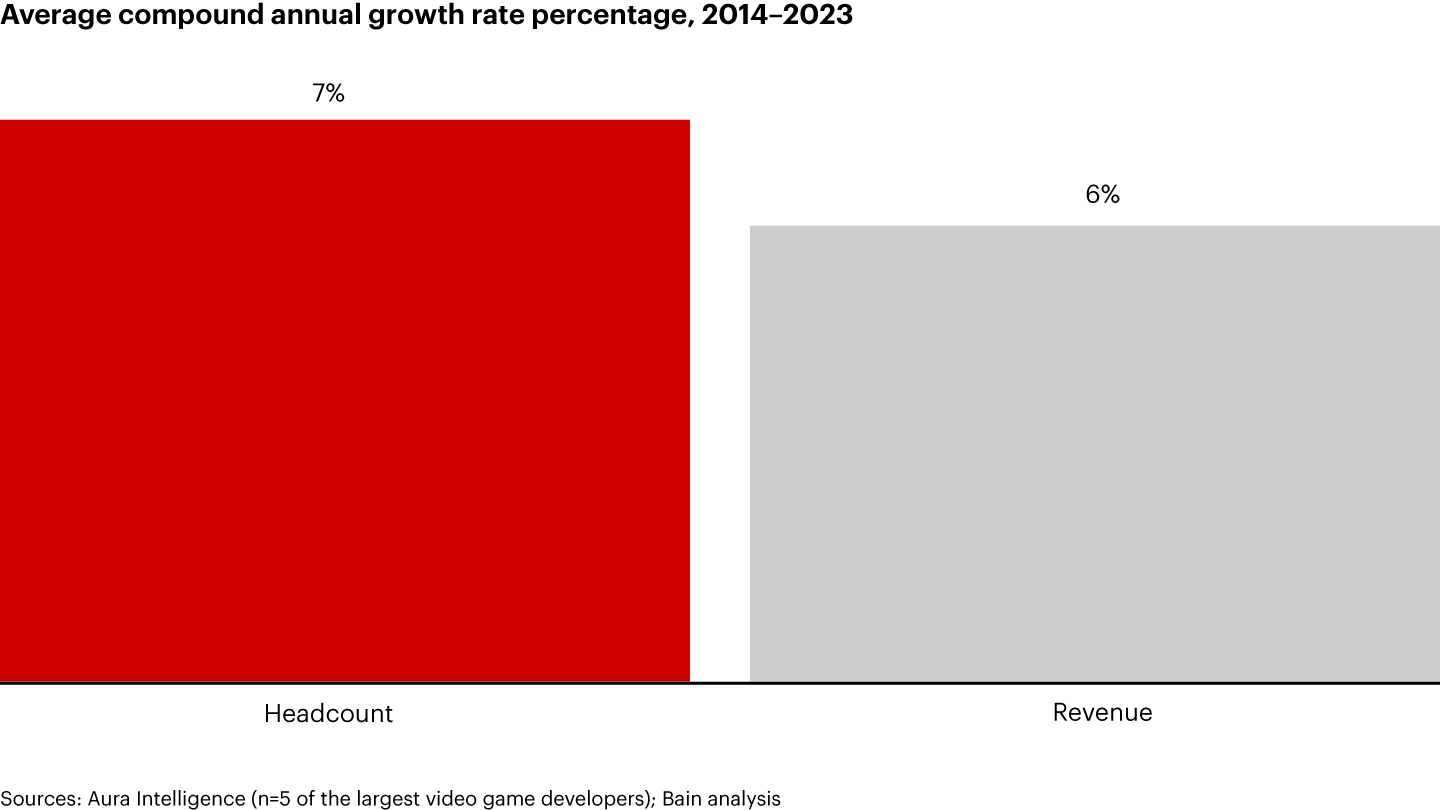
      Large video game developers’ headcount growth slightly outpaced revenue growth over the past decade

      While each company’s dynamics are unique, in our work with video game companies worldwide, we consistently hear about certain common challenges:

      • How can they take advantage of greater scale while also maintaining close connections with their players (e.g., building AAA games with more than 100 million players over multiple years while efficiently incorporating individual player feedback)?
      • How do they continue to attract the best creative talent now that they’re larger and more complex (e.g., they’re no longer the “cool start-up”)?
      • Which capabilities can be centralized within or across studios, and which would benefit from decentralization (e.g., standardizing developer tools vs. allowing each game team and studio to use their own)?
      • As the number of products grows, how do companies rethink work processes to deliver the best experiences for their players (e.g., rethinking DevOps for high-production, live-service games that require a constant stream of efficiently produced new content long after the game’s initial launch)?
      • Which capabilities and processes should they prioritize for innovation and investment (e.g., where to deploy AI tools vs. where to keep the status quo)?
      • Where should they develop capabilities in-house vs. outsource (e.g., hiring external vendors for quality assurance and testing vs. building those functions internally)?

      Adapting the operating model

      It may seem daunting, but the trajectories of some of the most successful companies across industries over the past few decades have shown that it’s possible to scale up a business while maintaining an entrepreneurial mindset and staying nimble.

      Leading companies first ensure that the business’s overall ambition and strategic direction are clear. They understand that they’re bound to fail if they pursue point solutions that don’t link to the company’s broader strategy.

      With a clearly defined and communicated strategy in place, companies are well-positioned to adapt their operating model. Here are several principles that the most effective gaming companies are keeping top of mind as they try to provide the best experience for players while balancing their bottom line and growth.

      Accept that it’s a continuous process. As games evolve from a single release to continuous live service, so, too, will operating models. Operating model redesign shouldn’t be a once-and-done overhaul every 5 to 10 years. While there will continue to be watershed moments that demand pressing the reset button, leading companies recognize it’s just as important to continuously refine their operating model to support rapidly evolving strategic imperatives (such as adding an entertainment arm or adjusting operational processes to take advantage of new technologies). Incremental, iterative improvement is less disruptive to the business, and it can deliver a lot of value.

      Rethink where work is done across the organization. As they evolve, leading companies dynamically adjust where key activities are managed across the organization. This avoids duplication of work and ensures that the work is performed by the people and functions best positioned to deliver on it. For example, as a game company expands from one studio to multiple, it typically makes sense to continue housing creative game development within the studios since they’re on the front lines and have the most insight into what players want. By contrast, work that can be standardized across game teams and has strategic value may warrant being performed closer to the organizational center.

      To efficiently deliver high-quality player experiences across its games, Riot Games created a “player platform” team charged with building standardized software and systems. These cover everything from account management and chat capabilities to the software development kits used by gaming teams companywide. Standardizing these elements across all the company’s games enabled the operating model to scale and allowed game development teams to focus on where they can deliver the greatest value: core gameplay.

      Redesign processes to simplify work and provide clear accountability. Emerging leaders aren’t afraid to radically overhaul processes to simplify how work gets done and to clarify accountability. In a bid to remain innovative and attuned to players’ feedback as it scales up, Supercell recently announced a plan to structure new game teams as entirely separate entrepreneurial units. These teams won’t be subject to the typical fixed budget nor the project greenlight process. Instead, they will commit to key timelines, milestones, and resourcing plans to reach them. The idea is that independence combined with the pressure of transparency and accountability will foster creativity and results.

      Invest in a model to attract, retain, and grow the best talent. To thrive during the next wave of growth, video game companies will need to recognize that they’re no longer competing solely against other video game companies for key talent but against the entire tech industry. Emerging leaders understand that they’ll need a more mature, comprehensive talent model that doesn’t just rely on employees’ passion for video games. They’ll need to invest in initiatives to increase employee engagement and enable them to do their jobs more effectively. This includes providing a sense of purpose; competitive compensation; work-life balance; learning opportunities; career support; and explicit environmental, social, and corporate governance commitments. (For more, read the Bain Brief “Beyond the Love of the Game: Talent in the Video Game Industry.”)

      Empower that talent with technology and tools. Similar to most industries, defining and mobilizing an AI strategy has become an urgent boardroom topic for video game companies. Generative AI and related tools have significant implications for how video game companies revise their operating models, redefine how work gets done, and prioritize investments in organizational capabilities.

      In our work with gaming and entertainment companies, those that embed generative AI within their existing operating models have largely seen progress stall and struggled to break out of experimentation mode (e.g., they have numerous disparate projects). Conversely, those that have elevated accountability and taken a more holistic approach to the opportunities that generative AI presents are starting to see early results and have a much clearer path to scaling.

      The pressure is on

      The video game industry faces a period filled with exciting opportunities but also turbulence. The pressure on video game companies to modernize their operating models is only increasing. However, if done effectively, it can lay the foundation for the next stage of growth.

      The authors wish to thank Katie Chung, Nyla Brewster, and Brandon Rogers for their contributions to this article.

      More from the report

      • Gaming Survey

      • Distribution

      • Mobile Game Marketing

      • Operating Models

      Read our 2024 Gaming Report

      Explore the report Download the PDF
      Autoren
      • Headshot of Anders Christofferson
        Anders Christofferson
        Partner, Denver
      • Headshot of Tom Rowland
        Tom Rowland
        Partner, Los Angeles
      • Headshot of Alex Egan
        Alex Egan
        Partner, Los Angeles
      • Matt Madden
        Associate Partner, Los Angeles
      Kontaktieren Sie uns
      Verwandte Branchen
      • Gaming
      • Medienwirtschaft
      Ähnliche Beratungsangebote
      • Organisation
      Gaming Report
      Gamer Survey: Great Gameplay Is No Longer Enough

      Top games are winning with community building, user-generated content, and innovative revenue models.

      Mehr erfahren
      Medienwirtschaft
      Not Yet, Robots: How to Win in Media’s Flooded Era

      As AI floods the market with cheap content, human creativity will stand out—and new tech tools might even help.

      Mehr erfahren
      Organisation
      Want More Out of Your AI Investments? Think People First

      To unlock AI’s exponential productivity potential, companies must modernize workflow and workforce in tandem.

      Mehr erfahren
      Gaming Report
      Winning Beyond the Game

      For companies with a hit video game, building a long-term strategy to extend IP beyond gameplay is the next frontier of competitive advantage.

      Mehr erfahren
      Gaming Report
      Squeezed in the Middle: AAA Gaming Studios Must Adapt

      Indies and “games-as-a-platform” are gaining share. Here’s how AAA studios can win in the reshaped gaming landscape.

      Mehr erfahren
      First published in August 2024
      Markierungen
      • Gaming
      • Gaming Report
      • Medienwirtschaft
      • Organisation

      Wie wir unsere Kunden unterstützt haben

      Organisation A Video Game Company Levels Up With a New Operating Model

      Kundenbeispiel lesen

      Performance Improvement Turning around a major newspaper publisher

      Kundenbeispiel lesen

      Advanced Analytics Analytics guide an entertainment company's growth strategy

      Kundenbeispiel lesen

      Möchten Sie mit uns in Kontakt bleiben?

      Wir unterstützen Führungskräfte weltweit, die kritischen Themen in ihrem Unternehmen zu adressieren. Gemeinsam schaffen wir nachhaltige Veränderungen und Ergebnisse.

      Bain Insights. Unsere Perspektive auf die kritischen Themen, mit denen sich international agierende Unternehmen konfrontiert sehen, finden Sie monatlich in Ihrem Postfach.

      *Ich habe die Datenschutzerklärung gelesen und akzeptiere sie.
      Bitte lesen Sie die Datenschutzerklärung und akzeptieren Sie diese.
      Bain & Company
      Contact us Sustainability Accessibility Rechtliche Hinweise Impressum Datenschutz Cookie-Richtlinie Sitemap Log In

      © 1996-2026 Bain & Company, Inc.

      Kontaktieren Sie Bain

      Wie können wir Ihnen helfen?

      • Business inquiry
      • Career information
      • Press relations
      • Partnership request
      • Speaker request
      Alle weltweiten Büros