
Skip to Content
  • Standorte

    Standorte

    North & Latin America
    • Atlanta
    • Austin
    • Bogota
    • Boston
    • Buenos Aires
    • Chicago
    • Dallas
    • Denver
    • Houston
    • Lisbon
    • Los Angeles
    • Mexico City
    • Minneapolis
    • Monterrey
    • Montreal
    • New York
    • Rio de Janeiro
    • San Francisco
    • Santiago
    • São Paulo
    • Seattle
    • Silicon Valley
    • Toronto
    • Washington, DC
    Europe & Africa
    • Amsterdam
    • Athens
    • Berlin
    • Brussels
    • Copenhagen
    • Düsseldorf
    • Frankfurt
    • Helsinki
    • Istanbul
    • Johannesburg
    • Kyiv
    • Lisbon
    • London
    • Madrid
    • Milan
    • München
    • Oslo
    • Paris
    • Rome
    • Stockholm
    • Warsaw
    • Wien
    • Zürich
    Middle East
    • Doha
    • Dubai
    • Riyadh
    Asia & Australia
    • Bangkok
    • Beijing
    • Bengaluru
    • Brisbane
    • Ho Chi Minh City
    • Hong Kong
    • Jakarta
    • Kuala Lumpur
    • Manila
    • Melbourne
    • Mumbai
    • New Delhi
    • Perth
    • Seoul
    • Shanghai
    • Singapore
    • Sydney
    • Tokyo
    Alle Standorte Anzeigen
  • Alumni
  • Presse
  • Newsletter
  • Kontakt
  • DACH-Region | Deutsch

    Wählen Sie Ihre Region und Sprache

    Global
    • Global (English)
    North & Latin America
    • Brazil (Português)
    • Argentina (Español)
    • Canada (Français)
    • Chile (Español)
    • Colombia (Español)
    Europe, Middle East, & Africa
    • France (Français)
    • DACH-Region (Deutsch)
    • Italy (Italiano)
    • Spain (Español)
    • Greece (Elliniká)
    Asia & Australia
    • China (中文版)
    • Korea (한국어)
    • Japan (日本語)
  • Saved items (0)
    Saved items (0)

    You have no saved items.

    Inhalte, für die Sie sich interessieren, werden hier gespeichert und können später gelesen oder weitergeleitet werden.

    Explore Bain Insights
  • Branchenkompetenzen
    Hauptmenü

    Branchenkompetenzen

    • Luft- und Raumfahrt, Verteidigung
    • Agrarwirtschaft
    • Chemieindustrie
    • Infrastruktur und Bauwirtschaft
    • Konsumgüter
    • Finanzdienstleistungen
    • Gesundheitswesen
    • Maschinen- und Anlagenbau
    • Medienwirtschaft
    • Metallindustrie
    • Bergbau
    • Öl und Gas
    • Papier- und Verpackungsindustrie
    • Private Equity
      Branchenkompetenzen
      Private Equity
      • Due Diligence
      • Exit Planning
      • Firm Strategy & Operations
      • Portfolio Value Creation
    • Öffentlicher Sektor und Sozialwesen
    • Einzelhandel
    • Technologie
    • Telekommunikation
    • Transportwesen
    • Reise- und Freizeitbranche
    • Versorgung und erneuerbare Energien
  • Managementkompetenzen
    Hauptmenü

    Managementkompetenzen

    • Customer Experience
    • ESG
    • Innovation
    • M&A
    • Operations
    • People & Organization
    • Private Equity
    • Sales & Marketing
    • Strategie
    • KI, Einblicke und Lösungen
    • Technologie
    • Transformation
  • Digital
  • Publikationen
    Hauptmenü

    Publikationen

    • Branchenthemen
    • Managementthemen
    • Bain-Bücher
    Alle Publikationen
    Ausgewählte Themen
    • Resilienz in der globalen Krise
    • M&A Report
    • Private Equity Podcast
    • Midyear Private Equity Report
    • Agile
    • Engineering Report
    • Digital Transformation
    • Elements of Value®
    • Firm of the Future
    • Nachhaltigkeitsstudie
    • Macro Trends
    • Future of Consumption
    • Weltwirtschaftsforum (WEF)
  • Über uns
    Hauptmenü

    Über uns

    • Was wir bieten
    • Unser Ansatz
    • Unser Team
    • Game Changer Award
    • Female Allstar Board
    • Messbare Ergebnisse (EN)
    • Auszeichnungen
    • Globale Partnerschaften
    • The Mission
    Further: Our global responsibility
    • Vielfalt & Chancengleichheit
    • Soziale Verantwortung
    • Sustainability
    Erfahren Sie mehr zu "Further"
  • Karriere
    Hauptmenü

    Karriere

    • Dein Einstieg
      Karriere
      Dein Einstieg
      • Find Your Place
      • Unsere Arbeitsbereiche
      • Unsere Teams
      • Angebote für Studierende
      • Praktika & Programme
      • Recruiting-Events
    • Arbeiten bei Bain
      Karriere
      Arbeiten bei Bain
      • Blog: Inside Bain
      • Karriere Stories
      • Unsere Bainies
      • Office-Standorte
      • Weiterentwicklung
      • Affinity Groups
      • Deine Benefits
    • Impact Stories
    • Deine Bewerbung
      Karriere
      Deine Bewerbung
      • Das erwartet dich
      • Der Interviewprozess
    FIND JOBS
  • Standorte
    Hauptmenü

    Standorte

    • North & Latin America
      Standorte
      North & Latin America
      • Atlanta
      • Austin
      • Bogota
      • Boston
      • Buenos Aires
      • Chicago
      • Dallas
      • Denver
      • Houston
      • Lisbon
      • Los Angeles
      • Mexico City
      • Minneapolis
      • Monterrey
      • Montreal
      • New York
      • Rio de Janeiro
      • San Francisco
      • Santiago
      • São Paulo
      • Seattle
      • Silicon Valley
      • Toronto
      • Washington, DC
    • Europe & Africa
      Standorte
      Europe & Africa
      • Amsterdam
      • Athens
      • Berlin
      • Brussels
      • Copenhagen
      • Düsseldorf
      • Frankfurt
      • Helsinki
      • Istanbul
      • Johannesburg
      • Kyiv
      • Lisbon
      • London
      • Madrid
      • Milan
      • München
      • Oslo
      • Paris
      • Rome
      • Stockholm
      • Warsaw
      • Wien
      • Zürich
    • Middle East
      Standorte
      Middle East
      • Doha
      • Dubai
      • Riyadh
    • Asia & Australia
      Standorte
      Asia & Australia
      • Bangkok
      • Beijing
      • Bengaluru
      • Brisbane
      • Ho Chi Minh City
      • Hong Kong
      • Jakarta
      • Kuala Lumpur
      • Manila
      • Melbourne
      • Mumbai
      • New Delhi
      • Perth
      • Seoul
      • Shanghai
      • Singapore
      • Sydney
      • Tokyo
    Alle Standorte Anzeigen
  • Alumni
  • Presse
  • Newsletter
  • Kontakt
  • DACH-Region | Deutsch
    Hauptmenü

    Wählen Sie Ihre Region und Sprache

    • Global
      Wählen Sie Ihre Region und Sprache
      Global
      • Global (English)
    • North & Latin America
      Wählen Sie Ihre Region und Sprache
      North & Latin America
      • Brazil (Português)
      • Argentina (Español)
      • Canada (Français)
      • Chile (Español)
      • Colombia (Español)
    • Europe, Middle East, & Africa
      Wählen Sie Ihre Region und Sprache
      Europe, Middle East, & Africa
      • France (Français)
      • DACH-Region (Deutsch)
      • Italy (Italiano)
      • Spain (Español)
      • Greece (Elliniká)
    • Asia & Australia
      Wählen Sie Ihre Region und Sprache
      Asia & Australia
      • China (中文版)
      • Korea (한국어)
      • Japan (日本語)
  • Saved items  (0)
    Hauptmenü
    Saved items (0)

    You have no saved items.

    Inhalte, für die Sie sich interessieren, werden hier gespeichert und können später gelesen oder weitergeleitet werden.

    Explore Bain Insights
  • Branchenkompetenzen
    • Branchenkompetenzen

      • Luft- und Raumfahrt, Verteidigung
      • Agrarwirtschaft
      • Chemieindustrie
      • Infrastruktur und Bauwirtschaft
      • Konsumgüter
      • Finanzdienstleistungen
      • Gesundheitswesen
      • Maschinen- und Anlagenbau
      • Medienwirtschaft
      • Metallindustrie
      • Bergbau
      • Öl und Gas
      • Papier- und Verpackungsindustrie
      • Private Equity
      • Öffentlicher Sektor und Sozialwesen
      • Einzelhandel
      • Technologie
      • Telekommunikation
      • Transportwesen
      • Reise- und Freizeitbranche
      • Versorgung und erneuerbare Energien
  • Managementkompetenzen
    • Managementkompetenzen

      • Customer Experience
      • ESG
      • Innovation
      • M&A
      • Operations
      • People & Organization
      • Private Equity
      • Sales & Marketing
      • Strategie
      • KI, Einblicke und Lösungen
      • Technologie
      • Transformation
  • Digital
  • Publikationen
    • Publikationen

      • Branchenthemen
      • Managementthemen
      • Bain-Bücher
      Alle Publikationen
      Ausgewählte Themen
      • Resilienz in der globalen Krise
      • M&A Report
      • Private Equity Podcast
      • Midyear Private Equity Report
      • Agile
      • Engineering Report
      • Digital Transformation
      • Elements of Value®
      • Firm of the Future
      • Nachhaltigkeitsstudie
      • Macro Trends
      • Future of Consumption
      • Weltwirtschaftsforum (WEF)
  • Über uns
    • Über uns

      • Was wir bieten
      • Unser Ansatz
      • Unser Team
      • Game Changer Award
      • Female Allstar Board
      • Messbare Ergebnisse (EN)
      • Auszeichnungen
      • Globale Partnerschaften
      • The Mission
      Further: Our global responsibility
      • Vielfalt & Chancengleichheit
      • Soziale Verantwortung
      • Sustainability
      Erfahren Sie mehr zu "Further"
  • Karriere
    Häufige Suchanfragen
    • Agil
    • Digital
    • Strategie
    Vorherige Suchanfragen
      Zuletzt besuchte Seiten

      Content added to saved items

      Saved items (0)

      Removed from saved items

      Saved items (0)

      Brief

      How Your Engineering Team Can Help Solve the Chip Shortage

      How Your Engineering Team Can Help Solve the Chip Shortage

      Companies are rethinking product design to ease the current supply chain disruption, and the ones sure to follow.

      Von Peter Hanbury, Bill Radzevych, und Ben Grant

      • Min. Lesezeit
      }

      Brief

      How Your Engineering Team Can Help Solve the Chip Shortage
      en
      At a Glance
      • Companies have tried to weather the global semiconductor shortage by stockpiling product inventory, paying fees to expedite shipments, and improving their demand forecasting, along with other tactics.
      • But many have overlooked the critical role the engineering team can play in helping companies manage through the shortage.
      • Leading companies are redesigning products both to increase availability during the current chip shortage and to be more resilient during future supply chain shocks.

      Leadership teams are pulling out all the stops to blunt the damage of the global semiconductor chip shortage on their businesses, including increasing order volumes, stockpiling product inventory, and paying fees to expedite shipments. But many are overlooking a critical factor that can position their company for a much smoother ride through this turbulent period: the engineering team.

      The scope and magnitude of the current chip shortage is unprecedented. With chips now playing integral roles in all kinds of products, the shortage has hampered nearly every industry, from automotive to home goods, and industrial equipment to consumer technology products. Despite companies’ best efforts to counter its effects, some manufacturers were forced to cut their annual production volume by as much as 25%.

      The problem, as many executives are painfully aware, is there are no quick fixes to the shortage (see Figure 1). Although there’s now a light at the end of the tunnel, we expect the current shortage to last at least through the second quarter of 2022, if not longer.

      Figure 1
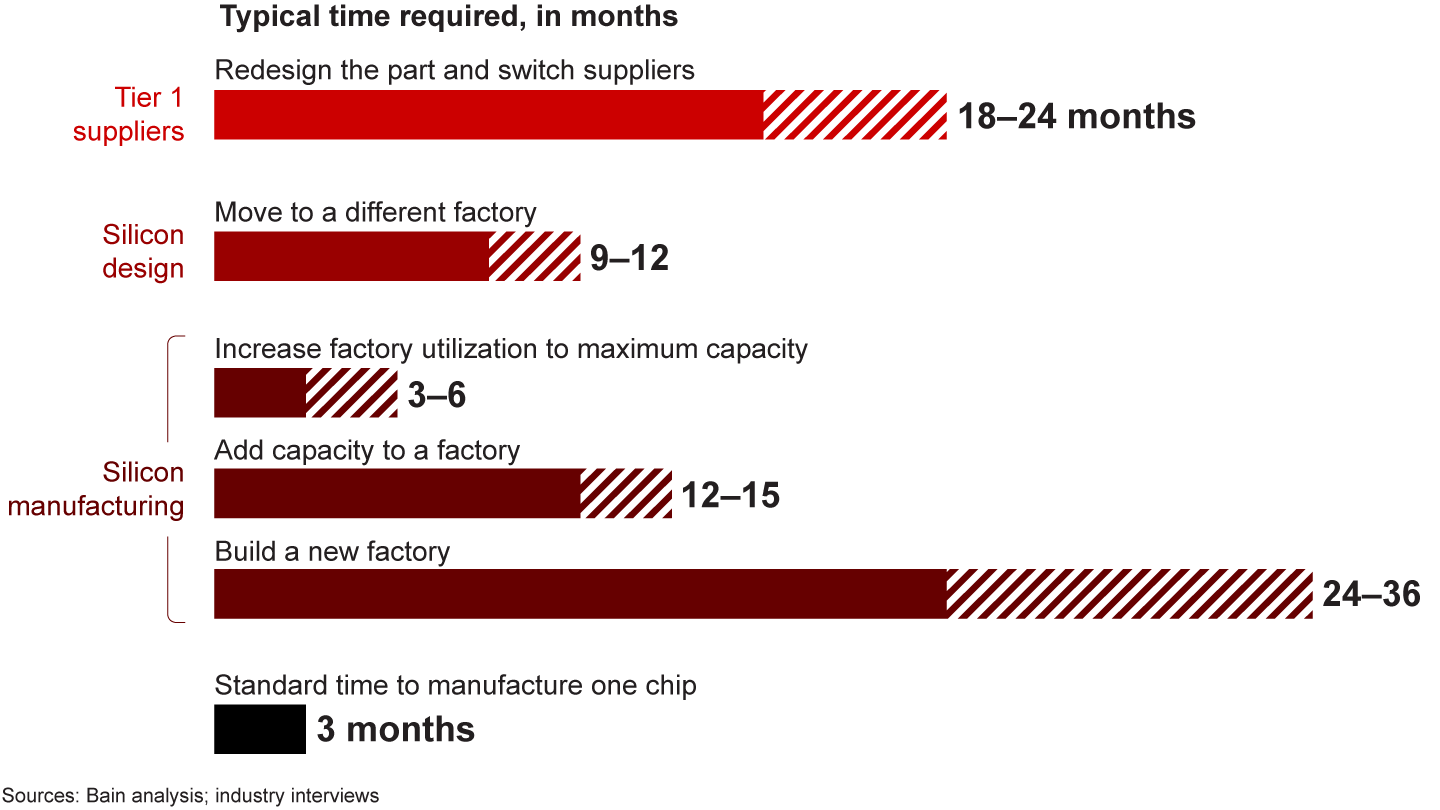
      Most solutions to the chip shortage have long lead times

      Furthermore, the reality is we’re going to see more of these kinds of global supply chain disruptions in the future, and likely not only among semiconductors.

      Most leadership teams are using a range of tactics to address the shortage’s immediate effects. They stood up “war rooms” early in the shortage to map their response and revamp their supply chain strategy. Many expanded their product stockpile to create a buffer against shortfalls. Companies have also boosted the accuracy and length of demand forecasts, and some have used pricing to steer customers toward their more widely available products.

      These tactics have certainly made a difference, but at this point, they’re table stakes and don’t address the root of the problem. Leading companies are going a step further. They’re turning to their engineering team to quickly adjust the way the company designs its products, in order to more rapidly and effectively mitigate supply chain shocks, with a focus on two key capabilities: resilience and availability. 

      Redesigning product design

      The difficult lessons of the chip shortage have pushed more executives to prioritize resilience at the core of their product design strategy. At the same time, they’re trying to strengthen their company’s ability to quickly adapt products to increase availability when a short-term supply shock hits and they’re actively (or imminently) losing sales.

      When successful, the company quickly returns a nearly identical product to market. Even a single, simple adjustment could make a difference. During the recent chip shortage, automaker Stellantis swapped out digital speedometers for analog ones in one of its Peugeot models, allowing the company to sidestep a significant production hurdle.

      Leading companies also constantly refine their products to increase resilience. But if a company hasn’t made this a central piece of its engineering approach to date, a deeper, fundamental product redesign might make sense. The key considerations: Does the engineering team have the mandate and skills to rethink product architecture to decrease reliance on at-risk components that are custom-made or depend on a small number of suppliers? Is the company willing to sacrifice any features that depend on the vulnerable components? Is the company confident it has ample time to procure needed components for as long as the redesign will take?

      Companies with more resilient product portfolios can weather future supply shocks more effectively than the competition, which allows them to minimize their exposure to the disruption and makes it easier to quickly respond and adjust their products, if needed. Indeed, at its most successful, the design for resilience effort may go completely unnoticed by the outside world because component shortages seem not to affect the company’s product or business.

      Designing for resilience

      Each engineering capability requires a different set of levers for success. Designing for resilience involves a consistent approach across the entire organization to prioritize product flexibility and reduce reliance on any one part or supplier. In our work with clients, we’ve found that several specific attributes tend to improve a resilience strategy’s odds of success.

      First, the leading companies decouple software from hardware. In a chip shortage, for example, the fewer “hooks” the product has into silicon, the better. When it’s not possible to control the hardware, leading firms make the hardware less critical to the product and increase reliance on software by adding a flexible middleware layer on top of the firmware.

      Second, design modularity can pay huge dividends. Leading companies use standard approaches and flexible product architecture wherever possible, including building in additional time to test and qualify multiple acceptable parts. They also limit the number of custom parts and rely on parts with a proven history of performance and availability. For example, Acer, the Taiwanese hardware and electronics company, said, in October, it intends to design a “different kind of product” that will give it a wider selection of device component resources, as the company looks to counter the current chip shortage and rising semiconductor prices.

      Third, companies look for ways to insulate a product’s components. With fewer interdependencies between teams and products, the work required to redesign a single part in the event of a shortage becomes self-contained and less daunting.

      Finally, reducing a product’s number of parts and reusing components wherever possible can make the product less susceptible to supply chain hitches.

      To enshrine these resilience principles into product design, here’s what leading companies are doing:

      • Creating design guides for engineers. For example, a US-based industrial company has built design guide compliance into its stage-gate process for product review. Throughout the product design process, engineers have to confirm they’ve consulted and stuck to the relevant internal best practices. If they haven’t, they’re expected to justify their alternative approach and get it approved. If they identify a better solution, the design guide gets modified.
      • Integrating standard, approved parts into their product design and computer-aided design (CAD) toolkits. This can encourage reuse of parts across products.
      • Setting key performance indicators (KPIs) and incentives aligned with desired outcomes, such as the percentage of reused or custom parts in a product.
      • Establishing strong links between the engineering, sales, and procurement teams to encourage better communication and collaboration. A key goal is to ensure rigorous prioritization of customer requests, especially in areas requiring customization.
      • Working directly with suppliers to design critical components and ensure their availability and reliability.

      The result should be a long-term roadmap and understanding of how to simplify product architecture and move away from parts or components that could become supply chain bottlenecks.

      Designing for availability

       Companies that are effective at designing products for resilience set themselves up well to respond to supply chain shocks that require more urgent product adjustments. But designing for availability requires a different set of capabilities.

      The most successful companies start by deploying an Agile team, with the right skills to quickly and effectively achieve the redesign, and give it a set of clear goals and incentives to deliver on the project. This type of effort should be focused solely on ameliorating areas affected by the supply shortage and doesn’t usually warrant a full-size product design team.

      Similar to designing for resilience, close ties with the procurement, sales, and marketing teams can make the Agile engineering team more effective. The procurement department can help engineers identify and qualify available substitute parts. Sales and marketing can help the engineering team understand what features can be removed or adjusted without damaging customer relationships. Leading companies also send engineers and product managers to key suppliers to more closely collaborate on the redesign, ensuring feasibility and speed of change.

      Once ready to execute the redesign, the most effective teams rapidly modify software to accommodate new parts, adjust the current product to free up resources for more important features, and use rapid prototyping and testing to validate the new designs. Companies can give engineers more flexibility by identifying elements of the organization’s standard product design protocols that can be relaxed during design-for-availability projects.

      How can companies strengthen their design-for-availability muscles? One useful tactic is to continue using Agile teams in other strategic ways even after the supply shock has passed. For example, having them continuously refine products to lower costs. That way, these teams continue adding value while remaining ready to spring into action when the next disruption hits.

      Tesla’s investments in designing products both for resilience and availability have paid off during the current chip shortage, and the company’s experience demonstrates how the two engineering capabilities can reinforce each other. The electric vehicle maker’s decision to use standard semiconductor hardware but to develop in-house the software running on those chips has given the company more flexibility in the components to manufacture its vehicles. When it faced a shortage of its typical microcontroller units (MCUs), the company’s Agile software development capabilities and modular technology architecture helped it to rapidly develop and validate 19 new, alternative MCUs, while simultaneously developing firmware for new chips made by new suppliers.

      Executives increasingly recognize that being able to design for both availability and resilience can help their companies handle short-term supply shocks and prepare for future ones. But the most successful companies will become so effective at designing for resilience that they’ll rarely need to design for availability; if they do, it’ll be a much faster, smoother process. The result will be companies that are better equipped to handle any supply chain disruption that comes their way.

      The authors wish to thank Alex Smyth for his contributions to this article.

      Autoren
      • Headshot of Peter Hanbury
        Peter Hanbury
        Partner, San Francisco
      • Headshot of Bill Radzevych
        Bill Radzevych
        Partner, Seattle
      • Headshot of Ben Grant
        Ben Grant
        Partner, Seattle
      Kontaktieren Sie uns
      Verwandte Branchen
      • Automotive und Mobilität
      • Hardware
      • Semiconductors
      • Software
      • Technologie
      CIO Insights
      Despite Tech Layoffs, Competition for Talent Remains Fierce

      Tech workers increasingly value career development opportunities and remote or hybrid work options, while compensation has soared.

      Mehr erfahren
      CIO Insights
      Four Ways Leaders Can Make AI Redesigns Stick

      As companies redesign to scale AI, these four lessons help leaders ensure their organizations actually live the new operating model.

      Mehr erfahren
      Technologie
      Will AI Disrupt Tech’s Most Valuable Companies?

      Hyperscalers and other market leaders have adapted well to technology shifts, but generative AI poses new challenges.

      Mehr erfahren
      CIO Insights
      The 2026 Retail Executive Agenda

      Here are letters to the C-suite to help strengthen strategy, catalyze collaboration, and expand value creation in the AI age.

      Mehr erfahren
      Technologie
      Humanoid Robots: From Demos to Deployment

      With capabilities evolving rapidly, now is the time to begin assessing when and how bipedal robots may change industries.

      Mehr erfahren
      First published in November 2021
      Markierungen
      • Automotive und Mobilität
      • CIO Insights
      • Hardware
      • Semiconductors
      • Software
      • Technologie

      Wie wir unsere Kunden unterstützt haben

      Nachhaltigkeit Can Microchips Turbocharge Sustainability Improvement?

      Kundenbeispiel lesen

      Helping a Midsize ERP Player Compete against the Giants

      Kundenbeispiel lesen

      Kundenstrategie und Marketing Video: A Marketing Transformation Puts a Software Leader Back on Top

      Kundenbeispiel lesen

      Möchten Sie mit uns in Kontakt bleiben?

      Wir unterstützen Führungskräfte weltweit, die kritischen Themen in ihrem Unternehmen zu adressieren. Gemeinsam schaffen wir nachhaltige Veränderungen und Ergebnisse.

      Bain Insights. Unsere Perspektive auf die kritischen Themen, mit denen sich international agierende Unternehmen konfrontiert sehen, finden Sie monatlich in Ihrem Postfach.

      *Ich habe die Datenschutzerklärung gelesen und akzeptiere sie.
      Bitte lesen Sie die Datenschutzerklärung und akzeptieren Sie diese.
      Bain & Company
      Contact us Sustainability Accessibility Rechtliche Hinweise Impressum Datenschutz Cookie-Richtlinie Sitemap Log In

      © 1996-2026 Bain & Company, Inc.

      Kontaktieren Sie Bain

      Wie können wir Ihnen helfen?

      • Business inquiry
      • Career information
      • Press relations
      • Partnership request
      • Speaker request
      Alle weltweiten Büros