
Skip to Content
  • Standorte

    Standorte

    North & Latin America
    • Atlanta
    • Austin
    • Bogota
    • Boston
    • Buenos Aires
    • Chicago
    • Dallas
    • Denver
    • Houston
    • Lisbon
    • Los Angeles
    • Mexico City
    • Minneapolis
    • Monterrey
    • Montreal
    • New York
    • Rio de Janeiro
    • San Francisco
    • Santiago
    • São Paulo
    • Seattle
    • Silicon Valley
    • Toronto
    • Washington, DC
    Europe & Africa
    • Amsterdam
    • Athens
    • Berlin
    • Brussels
    • Copenhagen
    • Düsseldorf
    • Frankfurt
    • Helsinki
    • Istanbul
    • Johannesburg
    • Kyiv
    • Lisbon
    • London
    • Madrid
    • Milan
    • München
    • Oslo
    • Paris
    • Rome
    • Stockholm
    • Warsaw
    • Wien
    • Zürich
    Middle East
    • Doha
    • Dubai
    • Riyadh
    Asia & Australia
    • Bangkok
    • Beijing
    • Bengaluru
    • Brisbane
    • Ho Chi Minh City
    • Hong Kong
    • Jakarta
    • Kuala Lumpur
    • Manila
    • Melbourne
    • Mumbai
    • New Delhi
    • Perth
    • Seoul
    • Shanghai
    • Singapore
    • Sydney
    • Tokyo
    Alle Standorte Anzeigen
  • Alumni
  • Presse
  • Newsletter
  • Kontakt
  • DACH-Region | Deutsch

    Wählen Sie Ihre Region und Sprache

    Global
    • Global (English)
    North & Latin America
    • Brazil (Português)
    • Argentina (Español)
    • Canada (Français)
    • Chile (Español)
    • Colombia (Español)
    Europe, Middle East, & Africa
    • France (Français)
    • DACH-Region (Deutsch)
    • Italy (Italiano)
    • Spain (Español)
    • Greece (Elliniká)
    Asia & Australia
    • China (中文版)
    • Korea (한국어)
    • Japan (日本語)
  • Saved items (0)
    Saved items (0)

    You have no saved items.

    Inhalte, für die Sie sich interessieren, werden hier gespeichert und können später gelesen oder weitergeleitet werden.

    Explore Bain Insights
  • Branchenkompetenzen
    Hauptmenü

    Branchenkompetenzen

    • Luft- und Raumfahrt, Verteidigung
    • Agrarwirtschaft
    • Chemieindustrie
    • Infrastruktur und Bauwirtschaft
    • Konsumgüter
    • Finanzdienstleistungen
    • Gesundheitswesen
    • Maschinen- und Anlagenbau
    • Medienwirtschaft
    • Metallindustrie
    • Bergbau
    • Öl und Gas
    • Papier- und Verpackungsindustrie
    • Private Equity
      Branchenkompetenzen
      Private Equity
      • Due Diligence
      • Exit Planning
      • Firm Strategy & Operations
      • Portfolio Value Creation
    • Öffentlicher Sektor und Sozialwesen
    • Einzelhandel
    • Technologie
    • Telekommunikation
    • Transportwesen
    • Reise- und Freizeitbranche
    • Versorgung und erneuerbare Energien
  • Managementkompetenzen
    Hauptmenü

    Managementkompetenzen

    • Customer Experience
    • ESG
    • Innovation
    • M&A
    • Operations
    • People & Organization
    • Private Equity
    • Sales & Marketing
    • Strategie
    • KI, Einblicke und Lösungen
    • Technologie
    • Transformation
  • Digital
  • Publikationen
    Hauptmenü

    Publikationen

    • Branchenthemen
    • Managementthemen
    • Bain-Bücher
    Alle Publikationen
    Ausgewählte Themen
    • Resilienz in der globalen Krise
    • M&A Report
    • Private Equity Podcast
    • Midyear Private Equity Report
    • Agile
    • Engineering Report
    • Digital Transformation
    • Elements of Value®
    • Firm of the Future
    • Nachhaltigkeitsstudie
    • Macro Trends
    • Future of Consumption
    • Weltwirtschaftsforum (WEF)
  • Über uns
    Hauptmenü

    Über uns

    • Was wir bieten
    • Unser Ansatz
    • Unser Team
    • Game Changer Award
    • Female Allstar Board
    • Messbare Ergebnisse (EN)
    • Auszeichnungen
    • Globale Partnerschaften
    • The Mission
    Further: Our global responsibility
    • Vielfalt & Chancengleichheit
    • Soziale Verantwortung
    • Sustainability
    Erfahren Sie mehr zu "Further"
  • Karriere
    Hauptmenü

    Karriere

    • Dein Einstieg
      Karriere
      Dein Einstieg
      • Find Your Place
      • Unsere Arbeitsbereiche
      • Unsere Teams
      • Angebote für Studierende
      • Praktika & Programme
      • Recruiting-Events
    • Arbeiten bei Bain
      Karriere
      Arbeiten bei Bain
      • Blog: Inside Bain
      • Karriere Stories
      • Unsere Bainies
      • Office-Standorte
      • Weiterentwicklung
      • Affinity Groups
      • Deine Benefits
    • Impact Stories
    • Deine Bewerbung
      Karriere
      Deine Bewerbung
      • Das erwartet dich
      • Der Interviewprozess
    FIND JOBS
  • Standorte
    Hauptmenü

    Standorte

    • North & Latin America
      Standorte
      North & Latin America
      • Atlanta
      • Austin
      • Bogota
      • Boston
      • Buenos Aires
      • Chicago
      • Dallas
      • Denver
      • Houston
      • Lisbon
      • Los Angeles
      • Mexico City
      • Minneapolis
      • Monterrey
      • Montreal
      • New York
      • Rio de Janeiro
      • San Francisco
      • Santiago
      • São Paulo
      • Seattle
      • Silicon Valley
      • Toronto
      • Washington, DC
    • Europe & Africa
      Standorte
      Europe & Africa
      • Amsterdam
      • Athens
      • Berlin
      • Brussels
      • Copenhagen
      • Düsseldorf
      • Frankfurt
      • Helsinki
      • Istanbul
      • Johannesburg
      • Kyiv
      • Lisbon
      • London
      • Madrid
      • Milan
      • München
      • Oslo
      • Paris
      • Rome
      • Stockholm
      • Warsaw
      • Wien
      • Zürich
    • Middle East
      Standorte
      Middle East
      • Doha
      • Dubai
      • Riyadh
    • Asia & Australia
      Standorte
      Asia & Australia
      • Bangkok
      • Beijing
      • Bengaluru
      • Brisbane
      • Ho Chi Minh City
      • Hong Kong
      • Jakarta
      • Kuala Lumpur
      • Manila
      • Melbourne
      • Mumbai
      • New Delhi
      • Perth
      • Seoul
      • Shanghai
      • Singapore
      • Sydney
      • Tokyo
    Alle Standorte Anzeigen
  • Alumni
  • Presse
  • Newsletter
  • Kontakt
  • DACH-Region | Deutsch
    Hauptmenü

    Wählen Sie Ihre Region und Sprache

    • Global
      Wählen Sie Ihre Region und Sprache
      Global
      • Global (English)
    • North & Latin America
      Wählen Sie Ihre Region und Sprache
      North & Latin America
      • Brazil (Português)
      • Argentina (Español)
      • Canada (Français)
      • Chile (Español)
      • Colombia (Español)
    • Europe, Middle East, & Africa
      Wählen Sie Ihre Region und Sprache
      Europe, Middle East, & Africa
      • France (Français)
      • DACH-Region (Deutsch)
      • Italy (Italiano)
      • Spain (Español)
      • Greece (Elliniká)
    • Asia & Australia
      Wählen Sie Ihre Region und Sprache
      Asia & Australia
      • China (中文版)
      • Korea (한국어)
      • Japan (日本語)
  • Saved items  (0)
    Hauptmenü
    Saved items (0)

    You have no saved items.

    Inhalte, für die Sie sich interessieren, werden hier gespeichert und können später gelesen oder weitergeleitet werden.

    Explore Bain Insights
  • Branchenkompetenzen
    • Branchenkompetenzen

      • Luft- und Raumfahrt, Verteidigung
      • Agrarwirtschaft
      • Chemieindustrie
      • Infrastruktur und Bauwirtschaft
      • Konsumgüter
      • Finanzdienstleistungen
      • Gesundheitswesen
      • Maschinen- und Anlagenbau
      • Medienwirtschaft
      • Metallindustrie
      • Bergbau
      • Öl und Gas
      • Papier- und Verpackungsindustrie
      • Private Equity
      • Öffentlicher Sektor und Sozialwesen
      • Einzelhandel
      • Technologie
      • Telekommunikation
      • Transportwesen
      • Reise- und Freizeitbranche
      • Versorgung und erneuerbare Energien
  • Managementkompetenzen
    • Managementkompetenzen

      • Customer Experience
      • ESG
      • Innovation
      • M&A
      • Operations
      • People & Organization
      • Private Equity
      • Sales & Marketing
      • Strategie
      • KI, Einblicke und Lösungen
      • Technologie
      • Transformation
  • Digital
  • Publikationen
    • Publikationen

      • Branchenthemen
      • Managementthemen
      • Bain-Bücher
      Alle Publikationen
      Ausgewählte Themen
      • Resilienz in der globalen Krise
      • M&A Report
      • Private Equity Podcast
      • Midyear Private Equity Report
      • Agile
      • Engineering Report
      • Digital Transformation
      • Elements of Value®
      • Firm of the Future
      • Nachhaltigkeitsstudie
      • Macro Trends
      • Future of Consumption
      • Weltwirtschaftsforum (WEF)
  • Über uns
    • Über uns

      • Was wir bieten
      • Unser Ansatz
      • Unser Team
      • Game Changer Award
      • Female Allstar Board
      • Messbare Ergebnisse (EN)
      • Auszeichnungen
      • Globale Partnerschaften
      • The Mission
      Further: Our global responsibility
      • Vielfalt & Chancengleichheit
      • Soziale Verantwortung
      • Sustainability
      Erfahren Sie mehr zu "Further"
  • Karriere
    Häufige Suchanfragen
    • Agil
    • Digital
    • Strategie
    Vorherige Suchanfragen
      Zuletzt besuchte Seiten

      Content added to saved items

      Saved items (0)

      Removed from saved items

      Saved items (0)

      Brief

      Operational Excellence: Maintaining Focus in a Time of Oil Price Volatility

      Operational Excellence: Maintaining Focus in a Time of Oil Price Volatility

      As margins tighten, operators look for ways to cut costs. But drawing back on operational excellence activities is the wrong move, as it will raise costs over the long term.

      Von Francesco Cigala, John McCreery and John Norton

      • Min. Lesezeit

      Brief

      Operational Excellence: Maintaining Focus in a Time of Oil Price Volatility
      en

      Even before oil’s steep price drop in late 2014, oil and gas companies around the world were committed to profitability and growth targets that would have been difficult to achieve. Cost inflation had driven down margins per barrel, public companies had promised dividend growth and share buybacks, and national oil companies had made major commitments to fund their national budgets.

      Lower prices make this environment even more challenging, inducing oil and gas companies to follow a well–trodden path to cost–cutting. At the first sign of a downturn, most ask suppliers to lower rates, reduce day rates paid to short–term contractors, delay and defer projects, and slow down commitments and R&D programs. These measures are all well and good—and relatively easy to implement—but more sustainable and thoughtful moves that tackle structural cost and productivity are needed to reset the industry cost base.

      Companies may also consider cutting back or delaying activities around operational excellence (OE) programs, which address the inherent risks in oil and gas operations in a cost–effective and transparent way. But that would be a mistake. Now is not the time to draw back on efforts that will improve performance efficiency and reduce costs over the long term.

      Short–term cost cuts may deliver immediate relief, but the wrong cuts can threaten the balance of safety, reliability and cost leadership that OE programs put in place. In previous downturns, companies that reduced costs by cutting corners on maintenance or by releasing valuable talent paid for it later. Industry–wide efforts to reduce costs often did as much harm as good—take, for example, those in the North Sea in the 1990s. As executives look for savings in the current low–price environment, they must take care not to throw the baby out with the bath water.

      Operational excellence remains more important than ever

      Companies that have invested in excellence have raised performance efficiency and now are seeing the benefits in leaner operations, lower costs and higher productivity—all tremendously beneficial during a time of significant price weakness. (For more, see the Bain Brief “Integrated planning: The key to upstream operational excellence.”) Many have focused on building OE management systems to overcome deficiencies in their operations or as a response to incidents; others, to build their reputation with stakeholders and to obtain some consistency in approach—which is particularly important as less experienced workers take over from the retiring wave of experts. (See the Bain Brief “What ‘good’ looks like: Creating an operational excellence management system.”)

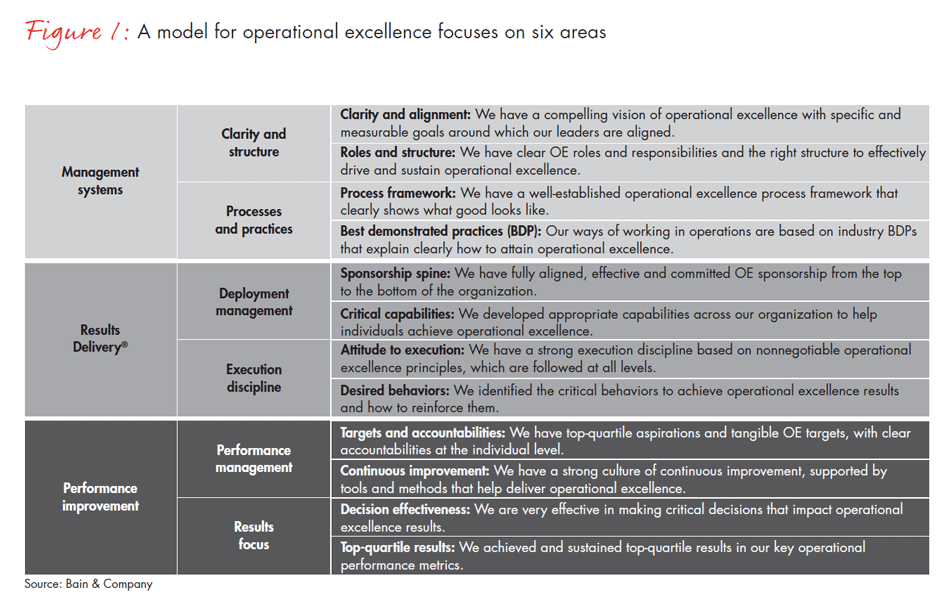
      Operational excellence allows oil and gas leaders to confidently say and prove that they are running their assets safely, reliably, sustainably and cost–effectively. Our model scopes the effort in six areas: two that involve setting up management systems, two that focus on Results Delivery® and two that drive performance improvement (see Figure 1).

      maintaining-focus-oil-price-volatility-fig01_embed

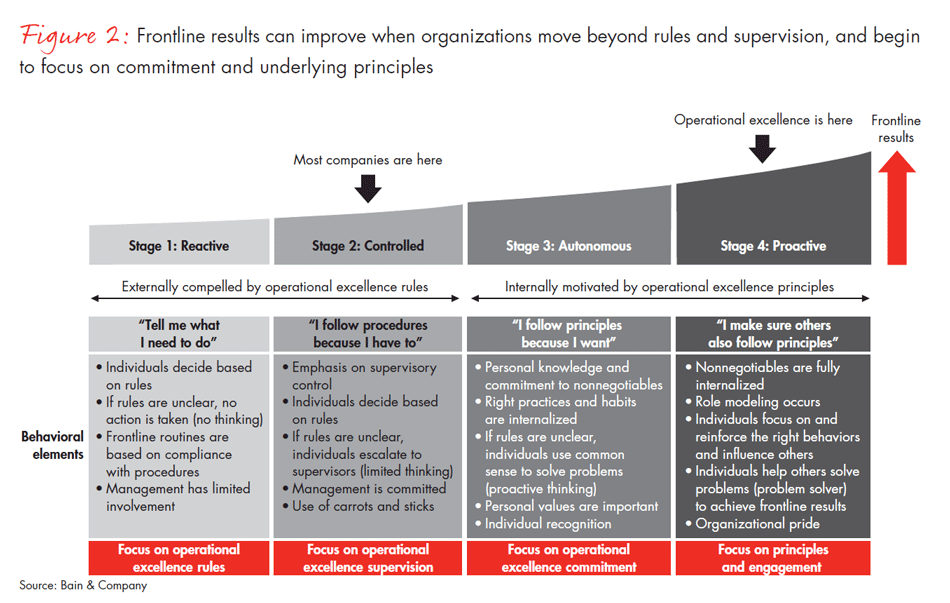
      Decisions affecting results and performance are typically more effective in organizations that have clear principles in place and that assign responsibility for decisions to experienced managers on the front line (see Figure 2). This differs from the growing trend of organizations and regulatory bodies that anticipate every contingency using rules–based programs that dictate the decisions to make in certain situations. Several things hinder such rules–based organizations. Managers shift accountability to the central authority assigning rules. And experts at the asset level begin to restrict their own ability to make principle–based decisions as conditions dictate. Rules, of course, are a necessary part of industry processes, essential to the safe and efficient operation of complex and expensive equipment, and especially important at the front line, where clear ways of working are essential. Many of these rules exist to improve safety and compliance. But they can sometimes have the opposite effect if they prevent managers from responding to dynamic situations based on their experience and on the broader organization’s principles of accountability. Simple, straightforward and universal principles—for example, the notion that if you can’t do something safely, don’t do it—are an important complement to the rules catalog.

      maintaining-focus-oil-price-volatility-fig02_embed

      What separates the best from the rest?

      Too many companies focus most of their efforts on the first elements of an OE system. Successful companies, on the other hand, focus most of their efforts on implementing the system, executing desired behaviors, linking investments in operational excellence to targets and outcomes, making effective decisions and improving continuously. The corporate center provides the management systems, while assets, the managers on site, are typically responsible for delivering results and improving performance. This is where the action is: It is where OE systems are customized for local needs and where safety, operational performance and cost performance meet.

      Leaders focus on process and outcomes, balancing between the structure of an OE program and the results it achieves. Successful programs distribute effort across the system, deployment, compliance and results. The OE management system becomes the lifeblood of the organization, not a side corporate initiative.

      Transparency and accountability in cost and compliance are also key success factors for OE programs, particularly in a low–price environment. In many companies, increased complexity has obscured financial lines, and often it is not clear what is getting charged to whom. As low oil prices squeeze margins, it remains more important than ever to identify who owns every dollar. Clear budget ownership and cost transparency allow effective monitoring, and the consequences of cost–cutting—or overspending—become apparent immediately. Increasing financial accountability often reduces costs by as much as 20%, without cutting essential programs or personnel. Transparency in compliance is also critical: Leading companies empower workers to observe and challenge one another in the interests of safety, compliance and efficiency. Operational excellence in this area isn’t an option; it’s essential.

      Obstacles to excellence

      Some operational excellence programs fail to enlist sponsorship from the senior ranks, but successful OE programs are led and managed from the top. Industry leaders that have been implementing operational excellence for 10 or more years recognize the need to reinvigorate commitment from senior executives to encourage the next wave of improvement. This way, pro-grams don’t slip down the organizational agenda and become delegated to middle–ranking managers.

      In other cases, companies fail to adapt or modify generic OE programs to their specific situations. A cocreation process, which enlists not only the OE experts but also management and the front line, can help companies define the right objectives and find appropriate solutions. Adaptation is vital as the industry adopts fit–for–purpose solutions for different operating environments, as in North America, where global companies are discovering that what is standard practice for deepwater is not necessarily the best solution in an unconventional play in North Dakota or East Texas. Adopting experience–based and pragmatic adaptation is key, where applicable—and not merely as an excuse to ignore what headquarters has implemented elsewhere.

      In the implementation phase, some programs don’t connect with frontline workers, who must adopt new behaviors, shed old habits and really make a difference in the safety and performance of the organization. No program can hope to succeed without a successful rollout, which includes road shows that feature senior managers explaining the rationale for the program to ensure buy–in from the front line.

      Onshore operations as a model for pragmatic application of operational excellence

      Operational excellence doesn’t always require a massive and costly program. As operators around the world consider ways to continue improving production while becoming more efficient, they can look to onshore operations in North America, where programs often emerge iteratively as something the culture adopts from the top to the front line. Onshore operators work with fast feedback loops: An improvement in one area (for example, a modified drilling procedure, a better understanding of the causes of downtime or a streamlined support process) becomes applicable across the business. This rapid permeation of insights is a valuable way to boost performance and is demonstrably more important than the central upfront thinking that went into the program’s design. Texas–based Pioneer Natural Resources attributes the success of its OE program, in part, to an acknowledgment that one size does not fit all. It also credits a pragmatic approach based on experience and adapting generic OE principles to specific situations in the operational excellence program it uses internally and with contractors.

      Since the industry depends heavily on contractors, the interface between the operator and the contractor becomes important for communicating the principles of operational excellence. In high–cost operations like deepwater, operators can justify placing a company representative on a contractor’s team to ensure compliance with OE principles. However, in an onshore unconventional environment where a contractor may be drilling and managing hundreds of wells, operators simply may not have the coverage. Companies need creative ways to bring contractors on board and find incentives to improve performance—particularly in a low–price environment where operator and contractor need to work closely to deliver at costs the operator can bear and with margins that can sustain the contractor.

      Times are tough in the oil and gas industry, and low oil prices may endure for some time. Industry players will have to continue to plan and perform under great volatility and uncertainty. (See the Bain Brief "What the recent oil price shock teaches about managing uncertainty.") Now is the time to hold the line with OE programs. Cost and productivity programs are part and parcel, not separate initiatives. Senior leaders must work to ensure the correct balance between operational excellence setup, Results Delivery (deployment and disciplined implementation) and continuous performance improvement. Only then can they sleep soundly at night and say with confidence, “Our assets are safe, reliable and cost–effective. We know it, and we can prove it.”

      Francesco Cigala is a Bain & Company partner based in Kuala Lumpur. John McCreery and John Norton are Bain partners based in Houston. All three work in Bain’s Oil & Gas practice.


      maintaining-focus-oil-price-volatility-fig01_full

      maintaining-focus-oil-price-volatility-fig02_full
      Autoren
      • Headshot of Francesco Cigala
        Francesco Cigala
        Partner, Kuala Lumpur
      • John McCreery
        Alumni, Houston
      • Headshot of John Norton
        John Norton
        Alumni, Houston
      Kontaktieren Sie uns
      Verwandte Branchen
      • Energiewirtschaft
      • Öl und Gas
      Öl und Gas
      Operational Excellence: Managing Performance in the Oil and Gas Industry

      Go beyond benchmarks to decisions and action.

      Mehr erfahren
      Öl und Gas
      Steering Through the Oil Storm

      Oil and gas industry executives cannot control prices, but they can take action to be in a better position when the upturn comes.

      Mehr erfahren
      Öl und Gas
      When a New Organizational Structure Isn’t Enough: How to Truly Live Your Operating Model

      The goal of any organizational redesign is for people to work differently, but that only happens if leaders invest in changing the work itself.

      Mehr erfahren
      Öl und Gas
      Oil & Gas M&A

      Why some companies are winning by a wider margin.

      Mehr erfahren
      Öl und Gas
      Fueling the Future: How Business, Finance, and Policy Can Accelerate the Clean Fuels Market

      Why global clean fuel ambitions are outpacing investment, and what leaders must do to unlock capital and scale viable projects.

      Mehr erfahren
      First published in Mai 2015
      Markierungen
      • Energiewirtschaft
      • Öl und Gas

      Wie wir unsere Kunden unterstützt haben

      Nachhaltigkeit An Oil and Gas Leader Creates a New Clean Energy Business

      Kundenbeispiel lesen

      Organisation Centralization boosts performance for an energy giant

      Kundenbeispiel lesen

      Mergers & Acquisitions Forecast backs a bet on shale services

      Kundenbeispiel lesen

      Möchten Sie mit uns in Kontakt bleiben?

      Wir unterstützen Führungskräfte weltweit, die kritischen Themen in ihrem Unternehmen zu adressieren. Gemeinsam schaffen wir nachhaltige Veränderungen und Ergebnisse.

      Bain Insights. Unsere Perspektive auf die kritischen Themen, mit denen sich international agierende Unternehmen konfrontiert sehen, finden Sie monatlich in Ihrem Postfach.

      *Ich habe die Datenschutzerklärung gelesen und akzeptiere sie.
      Bitte lesen Sie die Datenschutzerklärung und akzeptieren Sie diese.
      Bain & Company
      Contact us Sustainability Accessibility Rechtliche Hinweise Impressum Datenschutz Cookie-Richtlinie Sitemap Log In

      © 1996-2026 Bain & Company, Inc.

      Kontaktieren Sie Bain

      Wie können wir Ihnen helfen?

      • Business inquiry
      • Career information
      • Press relations
      • Partnership request
      • Speaker request
      Alle weltweiten Büros