
Skip to Content
  • Standorte

    Standorte

    North & Latin America
    • Atlanta
    • Austin
    • Bogota
    • Boston
    • Buenos Aires
    • Chicago
    • Dallas
    • Denver
    • Houston
    • Lisbon
    • Los Angeles
    • Mexico City
    • Minneapolis
    • Monterrey
    • Montreal
    • New York
    • Rio de Janeiro
    • San Francisco
    • Santiago
    • São Paulo
    • Seattle
    • Silicon Valley
    • Toronto
    • Washington, DC
    Europe & Africa
    • Amsterdam
    • Athens
    • Berlin
    • Brussels
    • Copenhagen
    • Düsseldorf
    • Frankfurt
    • Helsinki
    • Istanbul
    • Johannesburg
    • Kyiv
    • Lisbon
    • London
    • Madrid
    • Milan
    • München
    • Oslo
    • Paris
    • Rome
    • Stockholm
    • Warsaw
    • Wien
    • Zürich
    Middle East
    • Doha
    • Dubai
    • Riyadh
    Asia & Australia
    • Bangkok
    • Beijing
    • Bengaluru
    • Brisbane
    • Ho Chi Minh City
    • Hong Kong
    • Jakarta
    • Kuala Lumpur
    • Manila
    • Melbourne
    • Mumbai
    • New Delhi
    • Perth
    • Seoul
    • Shanghai
    • Singapore
    • Sydney
    • Tokyo
    Alle Standorte Anzeigen
  • Alumni
  • Presse
  • Newsletter
  • Kontakt
  • DACH-Region | Deutsch

    Wählen Sie Ihre Region und Sprache

    Global
    • Global (English)
    North & Latin America
    • Brazil (Português)
    • Argentina (Español)
    • Canada (Français)
    • Chile (Español)
    • Colombia (Español)
    Europe, Middle East, & Africa
    • France (Français)
    • DACH-Region (Deutsch)
    • Italy (Italiano)
    • Spain (Español)
    • Greece (Elliniká)
    Asia & Australia
    • China (中文版)
    • Korea (한국어)
    • Japan (日本語)
  • Saved items (0)
    Saved items (0)

    You have no saved items.

    Inhalte, für die Sie sich interessieren, werden hier gespeichert und können später gelesen oder weitergeleitet werden.

    Explore Bain Insights
  • Branchenkompetenzen
    Hauptmenü

    Branchenkompetenzen

    • Luft- und Raumfahrt, Verteidigung
    • Agrarwirtschaft
    • Chemieindustrie
    • Infrastruktur und Bauwirtschaft
    • Konsumgüter
    • Finanzdienstleistungen
    • Gesundheitswesen
    • Maschinen- und Anlagenbau
    • Medienwirtschaft
    • Metallindustrie
    • Bergbau
    • Öl und Gas
    • Papier- und Verpackungsindustrie
    • Private Equity
      Branchenkompetenzen
      Private Equity
      • Due Diligence
      • Exit Planning
      • Firm Strategy & Operations
      • Portfolio Value Creation
    • Öffentlicher Sektor und Sozialwesen
    • Einzelhandel
    • Technologie
    • Telekommunikation
    • Transportwesen
    • Reise- und Freizeitbranche
    • Versorgung und erneuerbare Energien
  • Managementkompetenzen
    Hauptmenü

    Managementkompetenzen

    • Customer Experience
    • ESG
    • Innovation
    • M&A
    • Operations
    • People & Organization
    • Private Equity
    • Sales & Marketing
    • Strategie
    • KI, Einblicke und Lösungen
    • Technologie
    • Transformation
  • Digital
  • Publikationen
    Hauptmenü

    Publikationen

    • Branchenthemen
    • Managementthemen
    • Bain-Bücher
    Alle Publikationen
    Ausgewählte Themen
    • Resilienz in der globalen Krise
    • M&A Report
    • Private Equity Podcast
    • Midyear Private Equity Report
    • Agile
    • Engineering Report
    • Digital Transformation
    • Elements of Value®
    • Firm of the Future
    • Nachhaltigkeitsstudie
    • Macro Trends
    • Future of Consumption
    • Weltwirtschaftsforum (WEF)
  • Über uns
    Hauptmenü

    Über uns

    • Was wir bieten
    • Unser Ansatz
    • Unser Team
    • Game Changer Award
    • Female Allstar Board
    • Messbare Ergebnisse (EN)
    • Auszeichnungen
    • Globale Partnerschaften
    • The Mission
    Further: Our global responsibility
    • Vielfalt & Chancengleichheit
    • Soziale Verantwortung
    • Sustainability
    Erfahren Sie mehr zu "Further"
  • Karriere
    Hauptmenü

    Karriere

    • Dein Einstieg
      Karriere
      Dein Einstieg
      • Find Your Place
      • Unsere Arbeitsbereiche
      • Unsere Teams
      • Angebote für Studierende
      • Praktika & Programme
      • Recruiting-Events
    • Arbeiten bei Bain
      Karriere
      Arbeiten bei Bain
      • Blog: Inside Bain
      • Karriere Stories
      • Unsere Bainies
      • Office-Standorte
      • Weiterentwicklung
      • Affinity Groups
      • Deine Benefits
    • Impact Stories
    • Deine Bewerbung
      Karriere
      Deine Bewerbung
      • Das erwartet dich
      • Der Interviewprozess
    FIND JOBS
  • Standorte
    Hauptmenü

    Standorte

    • North & Latin America
      Standorte
      North & Latin America
      • Atlanta
      • Austin
      • Bogota
      • Boston
      • Buenos Aires
      • Chicago
      • Dallas
      • Denver
      • Houston
      • Lisbon
      • Los Angeles
      • Mexico City
      • Minneapolis
      • Monterrey
      • Montreal
      • New York
      • Rio de Janeiro
      • San Francisco
      • Santiago
      • São Paulo
      • Seattle
      • Silicon Valley
      • Toronto
      • Washington, DC
    • Europe & Africa
      Standorte
      Europe & Africa
      • Amsterdam
      • Athens
      • Berlin
      • Brussels
      • Copenhagen
      • Düsseldorf
      • Frankfurt
      • Helsinki
      • Istanbul
      • Johannesburg
      • Kyiv
      • Lisbon
      • London
      • Madrid
      • Milan
      • München
      • Oslo
      • Paris
      • Rome
      • Stockholm
      • Warsaw
      • Wien
      • Zürich
    • Middle East
      Standorte
      Middle East
      • Doha
      • Dubai
      • Riyadh
    • Asia & Australia
      Standorte
      Asia & Australia
      • Bangkok
      • Beijing
      • Bengaluru
      • Brisbane
      • Ho Chi Minh City
      • Hong Kong
      • Jakarta
      • Kuala Lumpur
      • Manila
      • Melbourne
      • Mumbai
      • New Delhi
      • Perth
      • Seoul
      • Shanghai
      • Singapore
      • Sydney
      • Tokyo
    Alle Standorte Anzeigen
  • Alumni
  • Presse
  • Newsletter
  • Kontakt
  • DACH-Region | Deutsch
    Hauptmenü

    Wählen Sie Ihre Region und Sprache

    • Global
      Wählen Sie Ihre Region und Sprache
      Global
      • Global (English)
    • North & Latin America
      Wählen Sie Ihre Region und Sprache
      North & Latin America
      • Brazil (Português)
      • Argentina (Español)
      • Canada (Français)
      • Chile (Español)
      • Colombia (Español)
    • Europe, Middle East, & Africa
      Wählen Sie Ihre Region und Sprache
      Europe, Middle East, & Africa
      • France (Français)
      • DACH-Region (Deutsch)
      • Italy (Italiano)
      • Spain (Español)
      • Greece (Elliniká)
    • Asia & Australia
      Wählen Sie Ihre Region und Sprache
      Asia & Australia
      • China (中文版)
      • Korea (한국어)
      • Japan (日本語)
  • Saved items  (0)
    Hauptmenü
    Saved items (0)

    You have no saved items.

    Inhalte, für die Sie sich interessieren, werden hier gespeichert und können später gelesen oder weitergeleitet werden.

    Explore Bain Insights
  • Branchenkompetenzen
    • Branchenkompetenzen

      • Luft- und Raumfahrt, Verteidigung
      • Agrarwirtschaft
      • Chemieindustrie
      • Infrastruktur und Bauwirtschaft
      • Konsumgüter
      • Finanzdienstleistungen
      • Gesundheitswesen
      • Maschinen- und Anlagenbau
      • Medienwirtschaft
      • Metallindustrie
      • Bergbau
      • Öl und Gas
      • Papier- und Verpackungsindustrie
      • Private Equity
      • Öffentlicher Sektor und Sozialwesen
      • Einzelhandel
      • Technologie
      • Telekommunikation
      • Transportwesen
      • Reise- und Freizeitbranche
      • Versorgung und erneuerbare Energien
  • Managementkompetenzen
    • Managementkompetenzen

      • Customer Experience
      • ESG
      • Innovation
      • M&A
      • Operations
      • People & Organization
      • Private Equity
      • Sales & Marketing
      • Strategie
      • KI, Einblicke und Lösungen
      • Technologie
      • Transformation
  • Digital
  • Publikationen
    • Publikationen

      • Branchenthemen
      • Managementthemen
      • Bain-Bücher
      Alle Publikationen
      Ausgewählte Themen
      • Resilienz in der globalen Krise
      • M&A Report
      • Private Equity Podcast
      • Midyear Private Equity Report
      • Agile
      • Engineering Report
      • Digital Transformation
      • Elements of Value®
      • Firm of the Future
      • Nachhaltigkeitsstudie
      • Macro Trends
      • Future of Consumption
      • Weltwirtschaftsforum (WEF)
  • Über uns
    • Über uns

      • Was wir bieten
      • Unser Ansatz
      • Unser Team
      • Game Changer Award
      • Female Allstar Board
      • Messbare Ergebnisse (EN)
      • Auszeichnungen
      • Globale Partnerschaften
      • The Mission
      Further: Our global responsibility
      • Vielfalt & Chancengleichheit
      • Soziale Verantwortung
      • Sustainability
      Erfahren Sie mehr zu "Further"
  • Karriere
    Häufige Suchanfragen
    • Agil
    • Digital
    • Strategie
    Vorherige Suchanfragen
      Zuletzt besuchte Seiten

      Content added to saved items

      Saved items (0)

      Removed from saved items

      Saved items (0)

      Artikel

      Quitting or Refitting? Solving the Great Resignation

      Quitting or Refitting? Solving the Great Resignation

      Reskilling is the answer to both rising job insecurity and mounting talent shortages.

      Von Eric Garton, James Root, Andrew Schwedel, und Karen Harris

      • Min. Lesezeit
      }

      Artikel

      Quitting or Refitting? Solving the Great Resignation
      en

      The concept of lifetime employment has been dying a slow death over the past 50 years. While average tenures in the US have risen in the last few decades as the workforce has aged, the average person will change jobs 12 times in their lifetime. The pandemic dealt another blow. In Europe, government subsidies were aimed mainly at firms that retained furloughed workers. But in the US, most of the benefits were distributed directly to the dislocated workers themselves, widening the schism between workers and employers.

      Related

      The Working Future: More Human, Not Less

      It’s time to change how we think about work.

      More than 50 million Americans quit their jobs from January 2021 to February 2022. Some call it the Great Resignation. At a minimum, it is a Great Reassessment: Our research found that 58% of workers globally are rethinking their work-life balance as a result of the pandemic. Many workers are reconsidering what they want from a job; firms are reconsidering how they can create the workforce they need for the bumpy and uncertain road ahead. That turbulence includes the job market’s robust recovery from Covid-related dislocations, rising inflation, and the mounting risk of recession.

      Recently, much has been done to address pay and flexibility in response to the pandemic and the Great Resignation. Much less has been done to address job security. That’s a mistake. Security is one of the top three factors that matter most to employees, according to a recent survey by Bain & Company on worker preferences (see Figure 1). The factors that define the content of work or the nature of the working environment are important, but much lower in the preference order.

      Figure 1
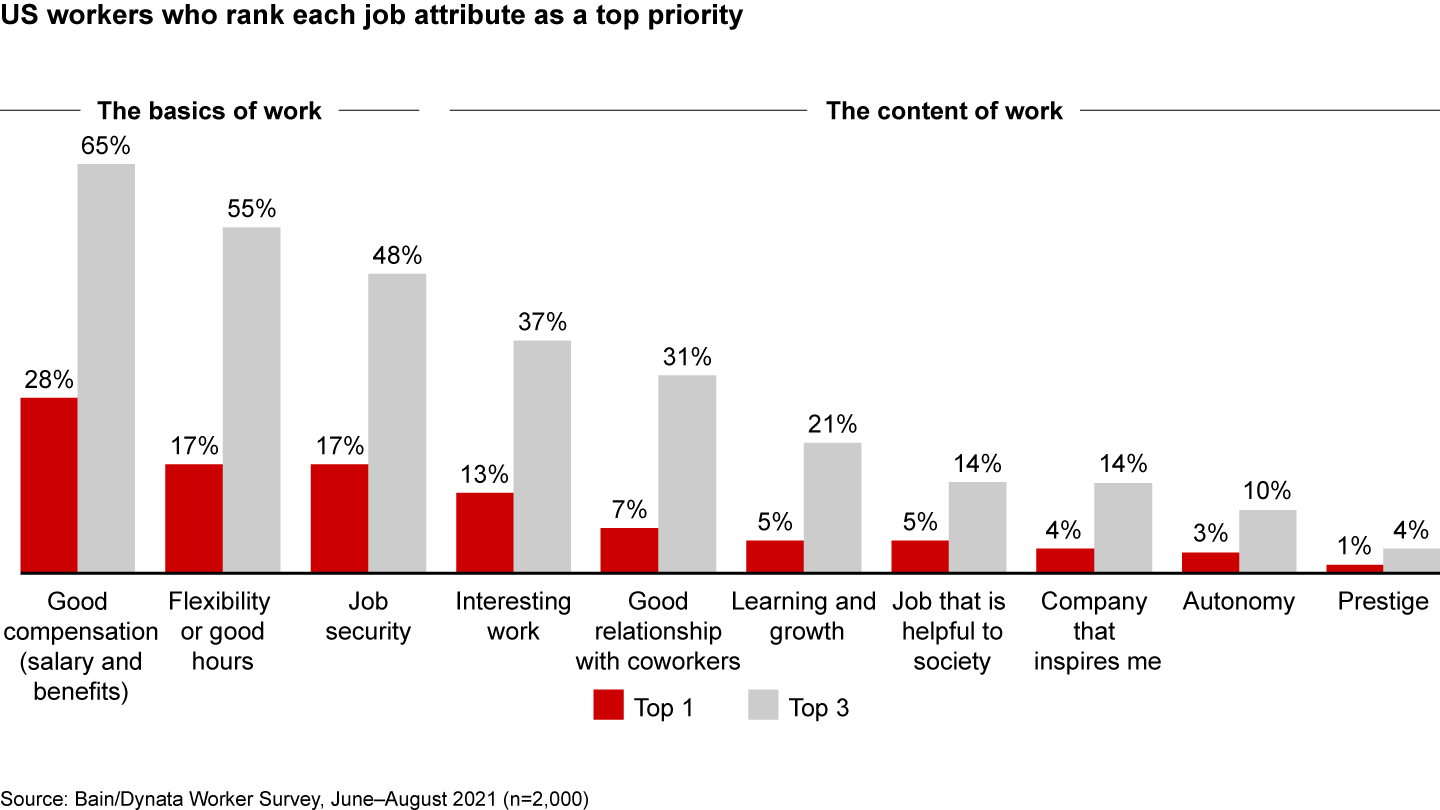
      Pay, flexibility, and security matter most to employees
      Pay, flexibility, and security matter most to employees
      Pay, flexibility, and security matter most to employees

      Historically, job security was at the heart of the social contract between the worker and the firm. Long-term trends in outsourcing, offshoring, and automation took an axe to that contract for many blue-collar workers. Digitalization and accelerated automation have been doing the same for white-collar workers in knowledge jobs. When your “human” activity is one algorithm away from being fulfilled by a computer, job security craters. Such insecurity is one of the primary reasons that workers are looking for new jobs.

      At the same time, the costs of preparing to enter the workforce have risen far faster than wages in the US. According to the National Center for Education Statistics, the average cost of annual in-state tuition and fees at a public, nonprofit university grew by a staggering 2,580% between 1970 and 2020. The federal minimum wage grew by 353% over the same 50-year period. What’s more, new jobs often demand new skills. Today, many employers believe the skills acquired through formal training and education are only able to keep workers market-relevant for perhaps five years, or even less in highly dynamic job disciplines.

      There is good news. Yes, digitalization and technology are changing and displacing millions of jobs, but millions more are being created as the composition of the workforce shifts. These new jobs tend to pay more and offer better career opportunities. Many of them draw on skills like empathy, creative problem solving, judgment, or personal communication—those skills where humans have a distinct advantage over machines.

      The challenge is that employers are struggling to fill those jobs, and young people are struggling to attain them. Most roles require more than a high school education, as well as specific skills and experiences that can be difficult to acquire and demonstrate. 

      Often, the first reaction of firms is to increase external hiring, but this can be slow and expensive in a tight job market. It frequently comes with high failure rates, particularly for experienced workers who may struggle to fit into their new firm’s culture.

      Instead, we believe firms need to look within and reskill their employees at a much faster rate than ever before. The changing nature of work and the employee-employer relationship has led to lower engagement in general, with more stress and burnout. According to our survey, 63% of US workers under the age of 35 describe feeling overwhelmed or stressed out. Regardless of the macroeconomy and overall worker participation rates, these secular trends will continue to reduce the quality of work—and of the workforce—if unaddressed. Continuous skill development is vital to reducing job insecurity for workers and creating the workforce firms need.

      Leading employers are moving quickly to rethink their views on meaningful credentials and experience, adapt new hiring and talent-development practices, and invest more in developing their future workforce. Some employers—like Walmart, through its Live Better U program, and Amazon, through its Career Choice program—have recently decided to pay in full for employees to receive college degrees or skill certifications from other organizations, such as coding bootcamps. Walmart and Amazon alone will each invest a billion dollars or more to upskill their employees into high-demand professions over the next few years.

      Other companies have taken it a step further. Boeing, which also has an extensive tuition reimbursement program, works with high schools and colleges to increase interest in STEM and engineering careers. By targeting those who are still in school, Boeing can help shape their educational curriculum and supplement it with internships and experiential learning. Boeing has also removed degree requirements from some positions, recognizing the importance of nontraditional career paths. This holistic approach is geared toward creating the inclusive and capable workforce that the organization needs today and in the future.  

      In some industries where future worker shortages are even more severe, companies are relying on backward integration, expanding into training and development. For instance, United Airlines recently acquired a flight school to train future pilots in order to meet projections for the 10,000 new pilots that the airline expects to hire over the next decade.

      These leading firms are pivoting from talent-taking to talent-making, cultivating individual jobs and career paths that provide continuous development with just-in-time skill building. This resembles a return to the past: Employers are creating the possibility of lifetime employment or at least lifetime skill building.

      The benefits are shared. Employees can more frequently and affordably develop new skills, reducing economic uncertainty. Employers get a workforce that’s more dynamic and loyal.

      The firm’s scarcest resources have always been the time, talent, and energy of its workforce. Building and sustaining a high-performance culture by designing jobs, career paths, and work environments that embrace flexibility, interesting work, and continuous learning will be enough to get miles ahead of competition. It could even have the powerful additional advantage of increasing social cohesion, making workers once again feel like they benefit from being part of the system.

      Autoren
      • Headshot of Eric Garton
        Eric Garton
        Partner, Chicago
      • Headshot of James Root
        James Root
        Partner, Hong Kong
      • Headshot of Andrew Schwedel
        Andrew Schwedel
        Partner, New York
      • Headshot of Karen Harris
        Karen Harris
        Managing Director, Macro Trends Group, New York
      Kontaktieren Sie uns
      Ähnliche Beratungsangebote
      • Leadership & Talent
      • Organisation
      CEO Agenda
      Working Women and the War for Talent

      By addressing deeply rooted gender imbalances, firms can overcome the labor shortage.

      Mehr erfahren
      CEO Agenda
      AI and Power: A Marriage of Necessity

      Tech and utilities are an unlikely pair, but how well they balance data center electricity demand and finite energy resources will have huge implications.

      Mehr erfahren
      Organisation
      Leading with Dynamism: AI and the Future of Top Teams

      In the age of AI, dynamic leadership—not just digital tools—is a true competitive advantage.

      Mehr erfahren
      CEO Agenda
      How to Feed AI’s Hunger for Power

      The explosive growth of artificial intelligence will need a lot of electricity from a utility industry that hasn’t seen demand grow for 20 years.

      Mehr erfahren
      Organisation
      The Great Talent Recalibration: How Macroeconomic Shifts Are Reshaping the CHRO Agenda

      Insights from Bain’s Chief People Officer Forum with economist Karen Harris, covering geopolitics, automation, demographic decline, and the future of global talent.

      Mehr erfahren
      First published in Juli 2022
      Markierungen
      • CEO Agenda
      • Das Unternehmen der Zukunft
      • Leadership & Talent
      • Organisation

      Wie wir unsere Kunden unterstützt haben

      Strategie A Bold New Strategy Restores a Bank to a Leadership Position

      Kundenbeispiel lesen

      Organisation Centralization boosts performance for an energy giant

      Kundenbeispiel lesen

      Organisation A Regional Operating Model Lifts European Sales for a Medical Device Maker

      Kundenbeispiel lesen

      Möchten Sie mit uns in Kontakt bleiben?

      Wir unterstützen Führungskräfte weltweit, die kritischen Themen in ihrem Unternehmen zu adressieren. Gemeinsam schaffen wir nachhaltige Veränderungen und Ergebnisse.

      Bain Insights. Unsere Perspektive auf die kritischen Themen, mit denen sich international agierende Unternehmen konfrontiert sehen, finden Sie monatlich in Ihrem Postfach.

      *Ich habe die Datenschutzerklärung gelesen und akzeptiere sie.
      Bitte lesen Sie die Datenschutzerklärung und akzeptieren Sie diese.
      Bain & Company
      Contact us Sustainability Accessibility Rechtliche Hinweise Impressum Datenschutz Cookie-Richtlinie Sitemap Log In

      © 1996-2026 Bain & Company, Inc.

      Kontaktieren Sie Bain

      Wie können wir Ihnen helfen?

      • Business inquiry
      • Career information
      • Press relations
      • Partnership request
      • Speaker request
      Alle weltweiten Büros