
Skip to Content
  • Standorte

    Standorte

    North & Latin America
    • Atlanta
    • Austin
    • Bogota
    • Boston
    • Buenos Aires
    • Chicago
    • Dallas
    • Denver
    • Houston
    • Lisbon
    • Los Angeles
    • Mexico City
    • Minneapolis
    • Monterrey
    • Montreal
    • New York
    • Rio de Janeiro
    • San Francisco
    • Santiago
    • São Paulo
    • Seattle
    • Silicon Valley
    • Toronto
    • Washington, DC
    Europe & Africa
    • Amsterdam
    • Athens
    • Berlin
    • Brussels
    • Copenhagen
    • Düsseldorf
    • Frankfurt
    • Helsinki
    • Istanbul
    • Johannesburg
    • Kyiv
    • Lisbon
    • London
    • Madrid
    • Milan
    • München
    • Oslo
    • Paris
    • Rome
    • Stockholm
    • Warsaw
    • Wien
    • Zürich
    Middle East
    • Doha
    • Dubai
    • Riyadh
    Asia & Australia
    • Bangkok
    • Beijing
    • Bengaluru
    • Brisbane
    • Ho Chi Minh City
    • Hong Kong
    • Jakarta
    • Kuala Lumpur
    • Manila
    • Melbourne
    • Mumbai
    • New Delhi
    • Perth
    • Seoul
    • Shanghai
    • Singapore
    • Sydney
    • Tokyo
    Alle Standorte Anzeigen
  • Alumni
  • Presse
  • Newsletter
  • Kontakt
  • DACH-Region | Deutsch

    Wählen Sie Ihre Region und Sprache

    Global
    • Global (English)
    North & Latin America
    • Brazil (Português)
    • Argentina (Español)
    • Canada (Français)
    • Chile (Español)
    • Colombia (Español)
    Europe, Middle East, & Africa
    • France (Français)
    • DACH-Region (Deutsch)
    • Italy (Italiano)
    • Spain (Español)
    • Greece (Elliniká)
    Asia & Australia
    • China (中文版)
    • Korea (한국어)
    • Japan (日本語)
  • Saved items (0)
    Saved items (0)

    You have no saved items.

    Inhalte, für die Sie sich interessieren, werden hier gespeichert und können später gelesen oder weitergeleitet werden.

    Explore Bain Insights
  • Branchenkompetenzen
    Hauptmenü

    Branchenkompetenzen

    • Luft- und Raumfahrt, Verteidigung
    • Agrarwirtschaft
    • Chemieindustrie
    • Infrastruktur und Bauwirtschaft
    • Konsumgüter
    • Finanzdienstleistungen
    • Gesundheitswesen
    • Maschinen- und Anlagenbau
    • Medienwirtschaft
    • Metallindustrie
    • Bergbau
    • Öl und Gas
    • Papier- und Verpackungsindustrie
    • Private Equity
      Branchenkompetenzen
      Private Equity
      • Due Diligence
      • Exit Planning
      • Firm Strategy & Operations
      • Portfolio Value Creation
    • Öffentlicher Sektor und Sozialwesen
    • Einzelhandel
    • Technologie
    • Telekommunikation
    • Transportwesen
    • Reise- und Freizeitbranche
    • Versorgung und erneuerbare Energien
  • Managementkompetenzen
    Hauptmenü

    Managementkompetenzen

    • Customer Experience
    • ESG
    • Innovation
    • M&A
    • Operations
    • People & Organization
    • Private Equity
    • Sales & Marketing
    • Strategie
    • KI, Einblicke und Lösungen
    • Technologie
    • Transformation
  • Digital
  • Publikationen
    Hauptmenü

    Publikationen

    • Branchenthemen
    • Managementthemen
    • Bain-Bücher
    Alle Publikationen
    Ausgewählte Themen
    • Resilienz in der globalen Krise
    • M&A Report
    • Private Equity Podcast
    • Midyear Private Equity Report
    • Agile
    • Engineering Report
    • Digital Transformation
    • Elements of Value®
    • Firm of the Future
    • Nachhaltigkeitsstudie
    • Macro Trends
    • Future of Consumption
    • Weltwirtschaftsforum (WEF)
  • Über uns
    Hauptmenü

    Über uns

    • Was wir bieten
    • Unser Ansatz
    • Unser Team
    • Game Changer Award
    • Female Allstar Board
    • Messbare Ergebnisse (EN)
    • Auszeichnungen
    • Globale Partnerschaften
    • The Mission
    Further: Our global responsibility
    • Vielfalt & Chancengleichheit
    • Soziale Verantwortung
    • Sustainability
    Erfahren Sie mehr zu "Further"
  • Karriere
    Hauptmenü

    Karriere

    • Dein Einstieg
      Karriere
      Dein Einstieg
      • Find Your Place
      • Unsere Arbeitsbereiche
      • Unsere Teams
      • Angebote für Studierende
      • Praktika & Programme
      • Recruiting-Events
    • Arbeiten bei Bain
      Karriere
      Arbeiten bei Bain
      • Karriere Stories
      • Unsere Bainies
      • Office-Standorte
      • Weiterentwicklung
      • Affinity Groups
      • Deine Benefits
    • Impact Stories
    • Deine Bewerbung
      Karriere
      Deine Bewerbung
      • Das erwartet dich
      • Der Interviewprozess
    FIND JOBS
  • Standorte
    Hauptmenü

    Standorte

    • North & Latin America
      Standorte
      North & Latin America
      • Atlanta
      • Austin
      • Bogota
      • Boston
      • Buenos Aires
      • Chicago
      • Dallas
      • Denver
      • Houston
      • Lisbon
      • Los Angeles
      • Mexico City
      • Minneapolis
      • Monterrey
      • Montreal
      • New York
      • Rio de Janeiro
      • San Francisco
      • Santiago
      • São Paulo
      • Seattle
      • Silicon Valley
      • Toronto
      • Washington, DC
    • Europe & Africa
      Standorte
      Europe & Africa
      • Amsterdam
      • Athens
      • Berlin
      • Brussels
      • Copenhagen
      • Düsseldorf
      • Frankfurt
      • Helsinki
      • Istanbul
      • Johannesburg
      • Kyiv
      • Lisbon
      • London
      • Madrid
      • Milan
      • München
      • Oslo
      • Paris
      • Rome
      • Stockholm
      • Warsaw
      • Wien
      • Zürich
    • Middle East
      Standorte
      Middle East
      • Doha
      • Dubai
      • Riyadh
    • Asia & Australia
      Standorte
      Asia & Australia
      • Bangkok
      • Beijing
      • Bengaluru
      • Brisbane
      • Ho Chi Minh City
      • Hong Kong
      • Jakarta
      • Kuala Lumpur
      • Manila
      • Melbourne
      • Mumbai
      • New Delhi
      • Perth
      • Seoul
      • Shanghai
      • Singapore
      • Sydney
      • Tokyo
    Alle Standorte Anzeigen
  • Alumni
  • Presse
  • Newsletter
  • Kontakt
  • DACH-Region | Deutsch
    Hauptmenü

    Wählen Sie Ihre Region und Sprache

    • Global
      Wählen Sie Ihre Region und Sprache
      Global
      • Global (English)
    • North & Latin America
      Wählen Sie Ihre Region und Sprache
      North & Latin America
      • Brazil (Português)
      • Argentina (Español)
      • Canada (Français)
      • Chile (Español)
      • Colombia (Español)
    • Europe, Middle East, & Africa
      Wählen Sie Ihre Region und Sprache
      Europe, Middle East, & Africa
      • France (Français)
      • DACH-Region (Deutsch)
      • Italy (Italiano)
      • Spain (Español)
      • Greece (Elliniká)
    • Asia & Australia
      Wählen Sie Ihre Region und Sprache
      Asia & Australia
      • China (中文版)
      • Korea (한국어)
      • Japan (日本語)
  • Saved items  (0)
    Hauptmenü
    Saved items (0)

    You have no saved items.

    Inhalte, für die Sie sich interessieren, werden hier gespeichert und können später gelesen oder weitergeleitet werden.

    Explore Bain Insights
  • Branchenkompetenzen
    • Branchenkompetenzen

      • Luft- und Raumfahrt, Verteidigung
      • Agrarwirtschaft
      • Chemieindustrie
      • Infrastruktur und Bauwirtschaft
      • Konsumgüter
      • Finanzdienstleistungen
      • Gesundheitswesen
      • Maschinen- und Anlagenbau
      • Medienwirtschaft
      • Metallindustrie
      • Bergbau
      • Öl und Gas
      • Papier- und Verpackungsindustrie
      • Private Equity
      • Öffentlicher Sektor und Sozialwesen
      • Einzelhandel
      • Technologie
      • Telekommunikation
      • Transportwesen
      • Reise- und Freizeitbranche
      • Versorgung und erneuerbare Energien
  • Managementkompetenzen
    • Managementkompetenzen

      • Customer Experience
      • ESG
      • Innovation
      • M&A
      • Operations
      • People & Organization
      • Private Equity
      • Sales & Marketing
      • Strategie
      • KI, Einblicke und Lösungen
      • Technologie
      • Transformation
  • Digital
  • Publikationen
    • Publikationen

      • Branchenthemen
      • Managementthemen
      • Bain-Bücher
      Alle Publikationen
      Ausgewählte Themen
      • Resilienz in der globalen Krise
      • M&A Report
      • Private Equity Podcast
      • Midyear Private Equity Report
      • Agile
      • Engineering Report
      • Digital Transformation
      • Elements of Value®
      • Firm of the Future
      • Nachhaltigkeitsstudie
      • Macro Trends
      • Future of Consumption
      • Weltwirtschaftsforum (WEF)
  • Über uns
    • Über uns

      • Was wir bieten
      • Unser Ansatz
      • Unser Team
      • Game Changer Award
      • Female Allstar Board
      • Messbare Ergebnisse (EN)
      • Auszeichnungen
      • Globale Partnerschaften
      • The Mission
      Further: Our global responsibility
      • Vielfalt & Chancengleichheit
      • Soziale Verantwortung
      • Sustainability
      Erfahren Sie mehr zu "Further"
  • Karriere
    Häufige Suchanfragen
    • Agil
    • Digital
    • Strategie
    Vorherige Suchanfragen
      Zuletzt besuchte Seiten

      Content added to saved items

      Saved items (0)

      Removed from saved items

      Saved items (0)

      Brief

      Rightsizing Your Way to the Cloud

      Rightsizing Your Way to the Cloud

      Many companies fail to realize the savings they expected when they migrate workloads to the public cloud. It doesn’t have to be that way.

      Von Mark Brinda und Kate Woolley

      • Min. Lesezeit
      }

      Brief

      Rightsizing Your Way to the Cloud
      en
      Auf einen Blick
      • Poorly planned direct-match migration to the public cloud can cost 10% to 15% more than keeping workloads on-premise, leaving many companies disappointed and frustrated.
      • Eighty-four percent of workloads on-premise are overprovisioned, meaning that when companies migrate a workload to the cloud, they’re sending excess capacity along with it.
      • Companies that “rightsize” their workloads to eliminate overprovisioning can cut costs by as much as 30% to 60%.
      • Rightsizing creates opportunities for vendors as well—to help their customers scale, automate, and operate using public, private, and hybrid cloud models.

      Written in collaboration with

      Written in collaboration with

      blobid3.jpg


      Why are companies often disappointed when they migrate their workloads to the public cloud? Many times, the promised efficiencies and savings just don’t materialize. In fact, when companies don’t do the necessary preparatory work, so-called direct-match migration to the public cloud—the like-for-like transfer of existing data, services, and applications—can be 10% to 15% more expensive that keeping the work in a legacy, on-premise environment, according to an analysis of more than 60,000 workloads by Bain & Company and Amazon Web Services (AWS). In other words, for all the vaunted promise of the cloud, it actually can be cheaper to keep things unchanged.

      When we asked more than 350 IT decision makers what aspects of their cloud deployment had been the most disappointing, their top complaint was that the cost of ownership had not declined.

      What’s gone wrong? Drawing on AWS Migration Evaluator, the migration assessment service for workload optimization, we have found that 84% of on-premise workloads are overprovisioned (see Figure 1). That means that when companies migrate a workload to the cloud, they're sending excess computing and storage capacity right along with it. Instead of becoming more efficient, they're merely transferring their existing inefficiencies to a new location. This practice is known among IT experts as “lift and shift.”

      Figure 1
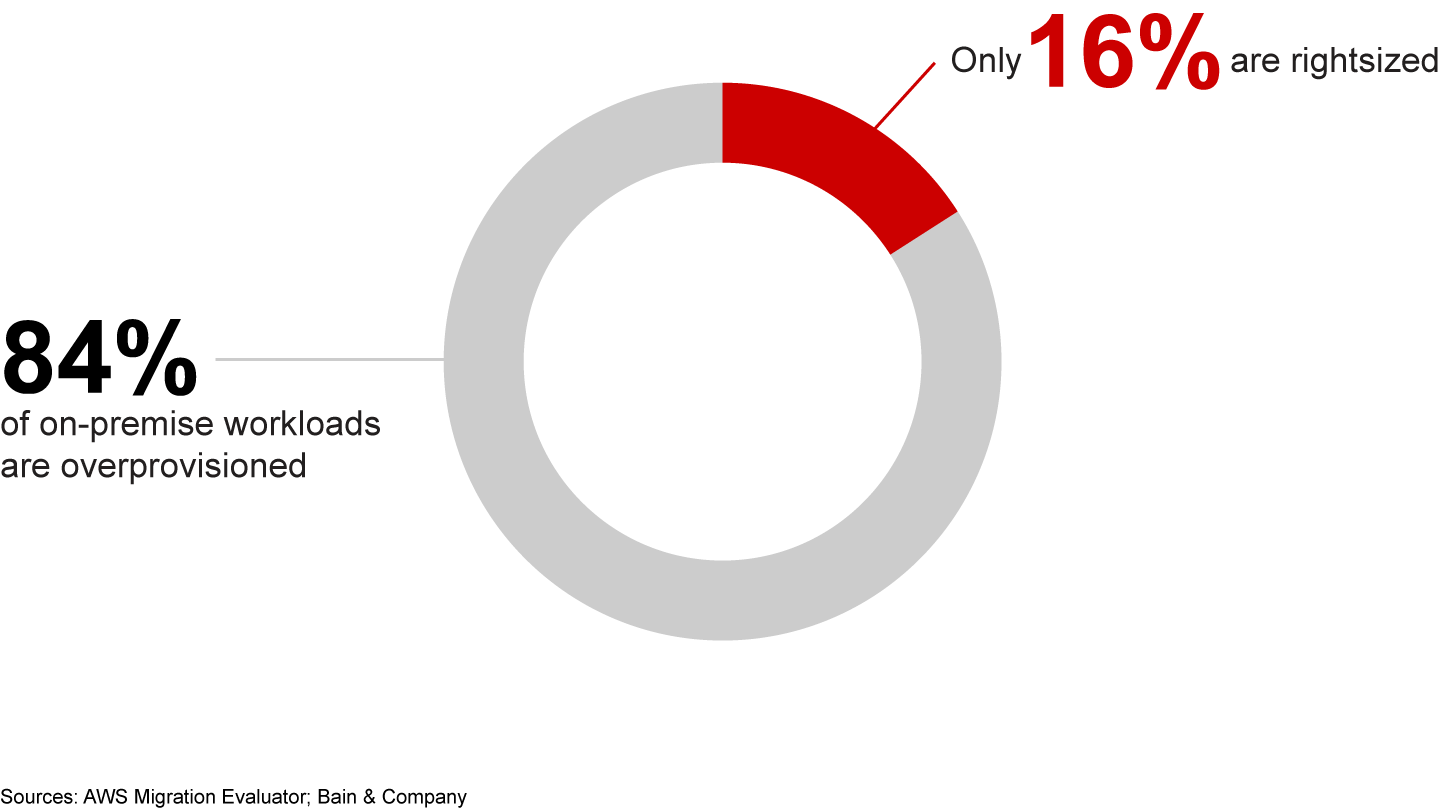
      When companies send their workload to the cloud, most send excess capacity along with it

      But there’s another way to do it. Companies that have mastered the art of migration to the public cloud take a disciplined approach to “rightsizing” their workloads. They view migration as an opportunity to thoroughly assess computing and storage practices throughout the company. They often find a great deal of fragmentation and duplication, with workloads scattered across machines and data centers. Records can be incomplete and outdated. Some companies discover “zombie servers,” computers that are no longer needed, but have never been purged or deactivated.

      Our experience shows that companies that rightsize their workloads can cut costs by as much as 30% to 60% when they migrate them to the public cloud. Companies that achieve the highest savings have existing Microsoft SQL relational database-management-system licenses that can be migrated to the cloud. However, even companies without transferable licenses can generate considerable savings by rightsizing their workloads. That means eliminating zombie servers, winding down unnecessary activities, and accurately provisioning all the migrated work. Many companies find that they can more tightly provision their workloads if they establish a reserve of excess capacity that can be drawn on when needed for surges in activity—or so-called burstable instances (see Figure 2).

      Figure 2
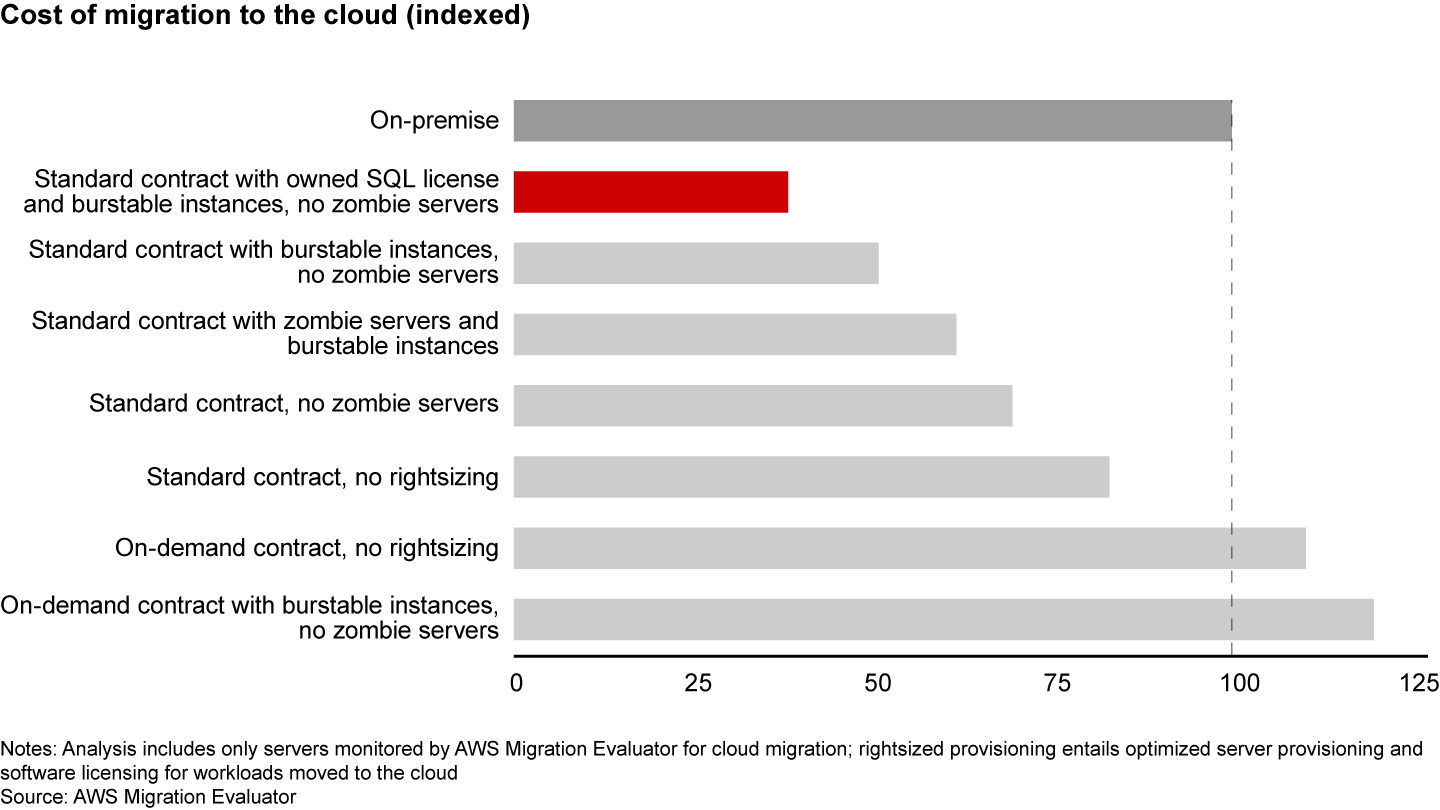
      Rightsizing workloads can reduce migration costs by as much as 60%

      Companies that rightsize the right way carefully assess usage patterns. They study the intensity and duration of average peak computing demand, so they can make informed decisions about downsizing server capacity and accommodating some of that excess demand with burstable instances. They take a similar look at storage patterns, evaluating average and peak memory usage and proximity to the server so they can more effectively downsize. They also aim to rationalize the number of core processors they need, so they can optimize spending on software licensing fees that are tied to processor counts.

      Smart companies also recognize that migration doesn’t treat all workloads equally. Companies are likely to save more when they migrate nonproduction workloads to the public cloud than when they migrate production workloads. That’s because the computing usage in nonproduction workloads tends to be more volatile and thus more likely to benefit from the flexibility the public cloud provides. Also, for testing and development activities, migration can help companies reduce software licensing fees that are tied to core processor counts. In addition, companies usually can achieve greater savings migrating nonvirtualized workloads rather than virtualized workloads. That’s because virtualization offers many of the same benefits the public cloud provides in terms of efficiency and flexibility.

      The economics of cloud migration have notable implications for technology vendors. Customers are increasingly able to implement a cloud-transition roadmap that identifies and eliminates unused capacity in their on-premise environment. This can create a headwind for technology vendors, since rightsizing reduces demand for their systems and software. On the other hand, this presents an opportunity for vendors, which are well-positioned to help their customers face the enormous challenge of managing in a hybrid environment, with a mix of cloud and on-premise technologies.

      There are signs that vendors recognize the potential of the cloud-migration opportunity, as demonstrated by IBM’s acquisition of Red Hat, a leading provider of cloud software. Companies are still in the early stages of cloud migration, and the complexity that they must manage is only increasing.

      One company that has benefited from a rightsized migration to the public cloud is Morningstar, the financial research firm. The company faced a decision regarding contracts with multiple worldwide data centers that were set to expire. Should it renew data-center arrangements or should it migrate some or all workloads to the public cloud? Morningstar worked with AWS Migration Evaluator to evaluate the potential costs and benefits of migration, bearing in mind that Morningstar had a substantial on-premise infrastructure. By rightsizing its workloads, Morningstar found that the majority of its instances would cost 30% less if operated in the cloud.

      Rightsizing can make a dramatic difference. AWS Migration Evaluator’s experience shows that direct-match migration of 105,000 server instances and 20 terabytes of storage on-premise would increase costs by 22%, while rightsizing those workloads would reduce costs by 36%.

      These results demonstrate that migration to the public cloud doesn't have to be disappointing. The public cloud offers great benefits to companies trying to keep pace with digital innovation. It’s easy to use and can be scaled on demand; it’s reliable and features continuous uptime; and companies don’t have to spend a penny on maintenance. When companies rightsize their workloads, they can reap all these benefits of the public cloud and actually save money in the process.

      Written in collaboration with AWS Migration Evaluator

      AWS Migration Evaluator (formerly TSO Logic) provided data, insights, and analysis used in this report. AWS Migration Evaluator’s services optimizes cloud planning to support a data-based business case for transformation.

      Autoren
      • Headshot of Mark Brinda
        Mark Brinda
        Partner, New York
      • Kate Woolley
        Alumni, New York
      Kontaktieren Sie uns
      Verwandte Branchen
      • Technologie
      Ähnliche Beratungsangebote
      • Informationstechnologie
      Wie wir Sie unterstützen können
      • Systems & Architecture
      Technologie
      How Bank CIOs Can Build a Solid Foundation for Generative AI

      A comprehensive approach, not siloed proofs of concept, will allow a bank to serve customers better and improve its economics.

      Mehr erfahren
      Technologie
      Software M&A

      The good news: Most deal best practices still apply to AI acquisitions.

      Mehr erfahren
      Systems & Architecture
      Tech Execs Lack Confidence in System Integrators

      Only 6% said that they would recommend their system integrators for an enterprise resource planning (ERP) transformation.

      Mehr erfahren
      Technologie
      How Businesses Can Prepare for Post-Quantum Cybersecurity Threats

      Your company will soon face attackers armed with quantum technology. Will you be ready?

      Mehr erfahren
      Technologie
      Exploring AI for Packaging Circularity

      AI is already creating value across the packaging lifecycle, from optimising design and reducing material use to improving sorting and traceability.

      Mehr erfahren
      First published in Dezember 2018
      Markierungen
      • Informationstechnologie
      • Systems & Architecture
      • Technologie

      Wie wir unsere Kunden unterstützt haben

      Helping a Midsize ERP Player Compete against the Giants

      Kundenbeispiel lesen

      Performance Improvement Aggressively growing an IT service provider with a high-performance culture

      Kundenbeispiel lesen

      Kundenstrategie und Marketing When the price is right, customers respond

      Kundenbeispiel lesen

      Möchten Sie mit uns in Kontakt bleiben?

      Wir unterstützen Führungskräfte weltweit, die kritischen Themen in ihrem Unternehmen zu adressieren. Gemeinsam schaffen wir nachhaltige Veränderungen und Ergebnisse.

      Bain Insights. Unsere Perspektive auf die kritischen Themen, mit denen sich international agierende Unternehmen konfrontiert sehen, finden Sie monatlich in Ihrem Postfach.

      *Ich habe die Datenschutzerklärung gelesen und akzeptiere sie.
      Bitte lesen Sie die Datenschutzerklärung und akzeptieren Sie diese.
      Bain & Company
      Contact us Sustainability Accessibility Rechtliche Hinweise Impressum Datenschutz Cookie-Richtlinie Sitemap Log In

      © 1996-2026 Bain & Company, Inc.

      Kontaktieren Sie Bain

      Wie können wir Ihnen helfen?

      • Business inquiry
      • Career information
      • Press relations
      • Partnership request
      • Speaker request
      Alle weltweiten Büros