
Skip to Content
  • Standorte

    Standorte

    North & Latin America
    • Atlanta
    • Austin
    • Bogota
    • Boston
    • Buenos Aires
    • Chicago
    • Dallas
    • Denver
    • Houston
    • Lisbon
    • Los Angeles
    • Mexico City
    • Minneapolis
    • Monterrey
    • Montreal
    • New York
    • Rio de Janeiro
    • San Francisco
    • Santiago
    • São Paulo
    • Seattle
    • Silicon Valley
    • Toronto
    • Washington, DC
    Europe & Africa
    • Amsterdam
    • Athens
    • Berlin
    • Brussels
    • Copenhagen
    • Düsseldorf
    • Frankfurt
    • Helsinki
    • Istanbul
    • Johannesburg
    • Kyiv
    • Lisbon
    • London
    • Madrid
    • Milan
    • München
    • Oslo
    • Paris
    • Rome
    • Stockholm
    • Warsaw
    • Wien
    • Zürich
    Middle East
    • Doha
    • Dubai
    • Riyadh
    Asia & Australia
    • Bangkok
    • Beijing
    • Bengaluru
    • Brisbane
    • Ho Chi Minh City
    • Hong Kong
    • Jakarta
    • Kuala Lumpur
    • Manila
    • Melbourne
    • Mumbai
    • New Delhi
    • Perth
    • Seoul
    • Shanghai
    • Singapore
    • Sydney
    • Tokyo
    Alle Standorte Anzeigen
  • Alumni
  • Presse
  • Newsletter
  • Kontakt
  • DACH-Region | Deutsch

    Wählen Sie Ihre Region und Sprache

    Global
    • Global (English)
    North & Latin America
    • Brazil (Português)
    • Argentina (Español)
    • Canada (Français)
    • Chile (Español)
    • Colombia (Español)
    Europe, Middle East, & Africa
    • France (Français)
    • DACH-Region (Deutsch)
    • Italy (Italiano)
    • Spain (Español)
    • Greece (Elliniká)
    Asia & Australia
    • China (中文版)
    • Korea (한국어)
    • Japan (日本語)
  • Saved items (0)
    Saved items (0)

    You have no saved items.

    Inhalte, für die Sie sich interessieren, werden hier gespeichert und können später gelesen oder weitergeleitet werden.

    Explore Bain Insights
  • Branchenkompetenzen
    Hauptmenü

    Branchenkompetenzen

    • Luft- und Raumfahrt, Verteidigung
    • Agrarwirtschaft
    • Chemieindustrie
    • Infrastruktur und Bauwirtschaft
    • Konsumgüter
    • Finanzdienstleistungen
    • Gesundheitswesen
    • Maschinen- und Anlagenbau
    • Medienwirtschaft
    • Metallindustrie
    • Bergbau
    • Öl und Gas
    • Papier- und Verpackungsindustrie
    • Private Equity
      Branchenkompetenzen
      Private Equity
      • Due Diligence
      • Exit Planning
      • Firm Strategy & Operations
      • Portfolio Value Creation
    • Öffentlicher Sektor und Sozialwesen
    • Einzelhandel
    • Technologie
    • Telekommunikation
    • Transportwesen
    • Reise- und Freizeitbranche
    • Versorgung und erneuerbare Energien
  • Managementkompetenzen
    Hauptmenü

    Managementkompetenzen

    • Customer Experience
    • ESG
    • Innovation
    • M&A
    • Operations
    • People & Organization
    • Private Equity
    • Sales & Marketing
    • Strategie
    • KI, Einblicke und Lösungen
    • Technologie
    • Transformation
  • Digital
  • Publikationen
    Hauptmenü

    Publikationen

    • Branchenthemen
    • Managementthemen
    • Bain-Bücher
    Alle Publikationen
    Ausgewählte Themen
    • Resilienz in der globalen Krise
    • M&A Report
    • Private Equity Podcast
    • Midyear Private Equity Report
    • Agile
    • Engineering Report
    • Digital Transformation
    • Elements of Value®
    • Firm of the Future
    • Nachhaltigkeitsstudie
    • Macro Trends
    • Future of Consumption
    • Weltwirtschaftsforum (WEF)
  • Über uns
    Hauptmenü

    Über uns

    • Was wir bieten
    • Unser Ansatz
    • Unser Team
    • Game Changer Award
    • Female Allstar Board
    • Messbare Ergebnisse (EN)
    • Auszeichnungen
    • Globale Partnerschaften
    • The Mission
    Further: Our global responsibility
    • Vielfalt & Chancengleichheit
    • Soziale Verantwortung
    • Sustainability
    Erfahren Sie mehr zu "Further"
  • Karriere
    Hauptmenü

    Karriere

    • Dein Einstieg
      Karriere
      Dein Einstieg
      • Find Your Place
      • Unsere Arbeitsbereiche
      • Unsere Teams
      • Angebote für Studierende
      • Praktika & Programme
      • Recruiting-Events
    • Arbeiten bei Bain
      Karriere
      Arbeiten bei Bain
      • Karriere Stories
      • Unsere Bainies
      • Office-Standorte
      • Weiterentwicklung
      • Affinity Groups
      • Deine Benefits
    • Impact Stories
    • Deine Bewerbung
      Karriere
      Deine Bewerbung
      • Das erwartet dich
      • Der Interviewprozess
    FIND JOBS
  • Standorte
    Hauptmenü

    Standorte

    • North & Latin America
      Standorte
      North & Latin America
      • Atlanta
      • Austin
      • Bogota
      • Boston
      • Buenos Aires
      • Chicago
      • Dallas
      • Denver
      • Houston
      • Lisbon
      • Los Angeles
      • Mexico City
      • Minneapolis
      • Monterrey
      • Montreal
      • New York
      • Rio de Janeiro
      • San Francisco
      • Santiago
      • São Paulo
      • Seattle
      • Silicon Valley
      • Toronto
      • Washington, DC
    • Europe & Africa
      Standorte
      Europe & Africa
      • Amsterdam
      • Athens
      • Berlin
      • Brussels
      • Copenhagen
      • Düsseldorf
      • Frankfurt
      • Helsinki
      • Istanbul
      • Johannesburg
      • Kyiv
      • Lisbon
      • London
      • Madrid
      • Milan
      • München
      • Oslo
      • Paris
      • Rome
      • Stockholm
      • Warsaw
      • Wien
      • Zürich
    • Middle East
      Standorte
      Middle East
      • Doha
      • Dubai
      • Riyadh
    • Asia & Australia
      Standorte
      Asia & Australia
      • Bangkok
      • Beijing
      • Bengaluru
      • Brisbane
      • Ho Chi Minh City
      • Hong Kong
      • Jakarta
      • Kuala Lumpur
      • Manila
      • Melbourne
      • Mumbai
      • New Delhi
      • Perth
      • Seoul
      • Shanghai
      • Singapore
      • Sydney
      • Tokyo
    Alle Standorte Anzeigen
  • Alumni
  • Presse
  • Newsletter
  • Kontakt
  • DACH-Region | Deutsch
    Hauptmenü

    Wählen Sie Ihre Region und Sprache

    • Global
      Wählen Sie Ihre Region und Sprache
      Global
      • Global (English)
    • North & Latin America
      Wählen Sie Ihre Region und Sprache
      North & Latin America
      • Brazil (Português)
      • Argentina (Español)
      • Canada (Français)
      • Chile (Español)
      • Colombia (Español)
    • Europe, Middle East, & Africa
      Wählen Sie Ihre Region und Sprache
      Europe, Middle East, & Africa
      • France (Français)
      • DACH-Region (Deutsch)
      • Italy (Italiano)
      • Spain (Español)
      • Greece (Elliniká)
    • Asia & Australia
      Wählen Sie Ihre Region und Sprache
      Asia & Australia
      • China (中文版)
      • Korea (한국어)
      • Japan (日本語)
  • Saved items  (0)
    Hauptmenü
    Saved items (0)

    You have no saved items.

    Inhalte, für die Sie sich interessieren, werden hier gespeichert und können später gelesen oder weitergeleitet werden.

    Explore Bain Insights
  • Branchenkompetenzen
    • Branchenkompetenzen

      • Luft- und Raumfahrt, Verteidigung
      • Agrarwirtschaft
      • Chemieindustrie
      • Infrastruktur und Bauwirtschaft
      • Konsumgüter
      • Finanzdienstleistungen
      • Gesundheitswesen
      • Maschinen- und Anlagenbau
      • Medienwirtschaft
      • Metallindustrie
      • Bergbau
      • Öl und Gas
      • Papier- und Verpackungsindustrie
      • Private Equity
      • Öffentlicher Sektor und Sozialwesen
      • Einzelhandel
      • Technologie
      • Telekommunikation
      • Transportwesen
      • Reise- und Freizeitbranche
      • Versorgung und erneuerbare Energien
  • Managementkompetenzen
    • Managementkompetenzen

      • Customer Experience
      • ESG
      • Innovation
      • M&A
      • Operations
      • People & Organization
      • Private Equity
      • Sales & Marketing
      • Strategie
      • KI, Einblicke und Lösungen
      • Technologie
      • Transformation
  • Digital
  • Publikationen
    • Publikationen

      • Branchenthemen
      • Managementthemen
      • Bain-Bücher
      Alle Publikationen
      Ausgewählte Themen
      • Resilienz in der globalen Krise
      • M&A Report
      • Private Equity Podcast
      • Midyear Private Equity Report
      • Agile
      • Engineering Report
      • Digital Transformation
      • Elements of Value®
      • Firm of the Future
      • Nachhaltigkeitsstudie
      • Macro Trends
      • Future of Consumption
      • Weltwirtschaftsforum (WEF)
  • Über uns
    • Über uns

      • Was wir bieten
      • Unser Ansatz
      • Unser Team
      • Game Changer Award
      • Female Allstar Board
      • Messbare Ergebnisse (EN)
      • Auszeichnungen
      • Globale Partnerschaften
      • The Mission
      Further: Our global responsibility
      • Vielfalt & Chancengleichheit
      • Soziale Verantwortung
      • Sustainability
      Erfahren Sie mehr zu "Further"
  • Karriere
    Häufige Suchanfragen
    • Agil
    • Digital
    • Strategie
    Vorherige Suchanfragen
      Zuletzt besuchte Seiten

      Content added to saved items

      Saved items (0)

      Removed from saved items

      Saved items (0)

      Brief

      Technology Cost: Making Hard Choices for Savings That Stick

      Technology Cost: Making Hard Choices for Savings That Stick

      Reducing technology costs is inherently difficult, and never harder than today.

      Von Danielle Burgs Escobar, Nigel Cornish, und Doug Fallon

      • Min. Lesezeit
      }

      Brief

      Technology Cost: Making Hard Choices for Savings That Stick
      en
      At a Glance
      • Macroeconomic headwinds are challenging CIOs to cut costs even as businesses increasingly require technology investments to keep pace with innovation.
      • Most cost programs fail to reach their targets due to a lack of discipline and rigor in finding opportunities, taking cost out, and preventing it from creeping back in.
      • To achieve savings and support long-term strategy, CIOs need to improve spending visibility and develop a roadmap for savings and trade-offs over time, while also anticipating potential pitfalls.
      • A series of quick wins can build momentum and confidence, while helping to fund more extensive savings.

      CIOs know that technology is more central than ever to business competitiveness. To that end, they are investing in critical new technologies, spurred on in some cases by the return of employees to offices and their demands for better tech to serve customers.

      At the same time, they are reducing costs in anticipation of a possible recession while also facing inflationary increases in hardware, applications, and people costs. Most have already made the easy cuts; now they need to wrestle with difficult trade-offs among cost, service quality, risk, and strategic investments.

      Compounding the challenge, most cost programs fail to reach their targets. Bain’s research finds that while 90% of companies have run tech cost programs in recent years, three out of four didn’t achieve their cost productivity targets. Nearly half missed their targets by more than 50%. And costs that are saved often creep back in, leaving the need to go back to the well and find more savings a year or two down the line.

      Our work with clients across industries affirms that successful cost transformations can have a positive, long-term effect on spending and can prevent costs from returning. They can help CIOs balance investments in business needs while dramatically improving the efficiency of the tech function. Companies that achieve these savings in ways that support and strengthen their long-term strategic goals tend to share a few habits (see Figure 1).

      Figure 1
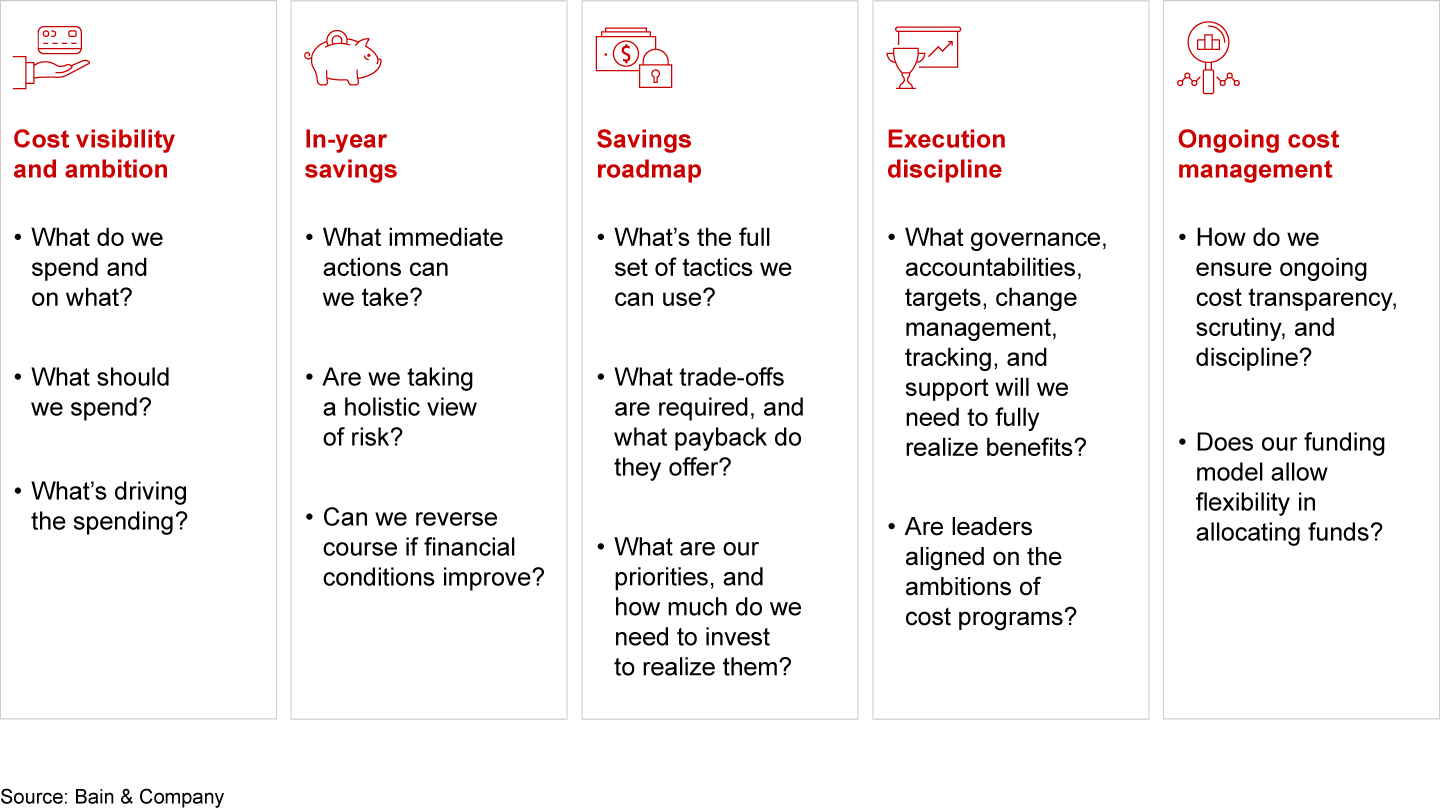
      Effective technology cost transformations show five traits

      Combining visibility, in-year savings, a savings roadmap, execution discipline, and ongoing cost management creates a virtuous cycle for the IT function. Trying to tackle all of this at once can be impractical or unaffordable, and not every situation requires a deep dive on every component. Deciding where to focus depends on ambition, cost constraints, and technology maturity. 

      Cost visibility and ambition. Enhancing visibility can mean different things, depending on the company’s starting point. For some it involves getting a full picture by synthesizing tech spending across the organization, including “shadow IT” staff that don’t sit within the tech function but spend time on tech projects. Shadow IT can represent significant additional costs, not just in direct spending but also in its vulnerability to cyberattacks and in accumulating technical debt from point solutions and a lack of architectural alignment. In companies that already have a comprehensive view, the next step may be drilling down to understand the real causes of spending.

      Comparisons with market and competitor benchmarks can be instructional, but also require context and thoughtful interpretation. Finding the right benchmarks, taking into consideration the industry mix, size, and peer group, can help companies set the appropriate ambition. Top-quartile cost reduction may not be the right goal for a company that relies on technology for strategic differentiation. In some spending categories, “best-in-cost” might be the right target, while in others, “best-in-class” should be the aspiration.    

      Benchmarks can also show where organizations have too few or too many of certain roles. Analyzing role ratios, for example, the number of testers per developer, can sometimes reveal opportunities to rebalance the workforce (see the Bain interactive “A Critical Ratio That Every CIO Should Be Thinking About”). Outsourcing nonstrategic commodity work and shifting roles to lower-cost locations remain effective tactics to dramatically reduce IT workforce costs.

      This top-down and bottom-up visibility helps CIOs understand performance and identify savings opportunities. For example, bottom-up cost analysis helped a major financial services player identify disproportionate spending on a set of end-user devices by correctly allocating labor and support costs. Similarly, a life sciences company that obtained a view of the total cost of its enterprise resource planning (ERP) platform benchmarked it to market norms and identified a 25% savings opportunity.

      In-year savings. CIOs can be required to make rapid, in-year cuts to alleviate immediate financial pressure in a tough trading period or to fund a more profound cost transformation. The urgency and depth of savings dictate the level of risk they must assume. What differentiates leading CIOs is their ability to take a holistic view of risk and balance near-term considerations, such as business and execution risks, and long-term ones, like strategy and reversibility.

      • Business risk: What risks would this cost-cutting initiative expose the company to, and what would be the downside internally and externally? How will this affect our customer experience, revenue-generating operations, and reputation?
      • Execution risk: Will we realize value from this cost-cutting initiative in the required time frame? Can our teams manage the change and absorb any new requirements?
      • Strategic implications: Does realizing these savings today jeopardize our strategic ambition for tomorrow? Where are we relative to our competitors, and what would this change imply?
      • Reversibility: Can we reverse course if financial conditions improve? At what cost? For example, it’s much easier to flex capacity with third-party labor than with internal talent. But there are still costs to onboarding vendor talent and managing the knowledge transfer from one vendor to another or to the company.

      Less complex, quick wins are the first step. These are easy to execute with minimal investment or performance degradation—for example, eliminating underutilized contractors, stopping discretionary projects, and extending refresh cycles. Many companies have already implemented these tactics and are turning to more aggressive actions (e.g., reducing headcount or cutting strategic programs), which can deliver deeper savings but also cut into the organization’s strengths. One insurer facing double-digit percentage cuts for its in-year budget had to “break the glass” when the quick wins were exhausted. With a focus on protecting business and execution risk, leaders first adjusted previously untouchable commitments such as cybersecurity. They then prioritized reversible actions like eliminating contractors and paused their cloud migration, while protecting projects linked directly to revenue. In doing so they achieved their cost target without disrupting core business operations.

      Savings roadmap. In-year savings can solve a budget gap, but often represent only a small portion of the full efficiency potential. Steadily increasing needs for shifting “run” spending into “grow” means CIOs need an executable portfolio of initiatives across time horizons, complete with required timelines, trade-offs, and investment commitments. These initiatives can be clustered across three waves: reducing costs with short-term actions, replacing technology with more efficient options, and rethinking architecture and operating models to make long-term sustainable change.

      • Reduce (less than 12 months): These initiatives can be carried out quickly and show results by the year’s end. Many of these are business decisions (freezing hiring, pausing nonstrategic projects, tightening spending), while others are technology decisions (squeezing higher utilization rates from servers and storage). Managing demand is key to any reduction program.
      • Replace (12 to 18 months): These medium-term replacements swap out technology costs for lower-priced alternatives and lead the organization to buy better—for example, replacing on-premise software with SaaS applications or optimizing vendor spend.
      • Rethink (18 months or more): These long-term changes reimagine the business, often changing processes, technology architectures, and sometimes operating and business models to deliver more efficiency, spend better, and drive sustainable cost savings.

      An energy company built a plan for 20% overall IT savings over two years, with immediate savings through a 20% cut in spending on managed services with its two largest vendors. Longer-term savings came from setting up a process to identify and retire redundant and duplicative apps—an App Kill Factory.

      In a similar vein, a life sciences player identified about 15% overall IT savings over three years, doubling its insourced staff count to drive savings and reduce reliance on vendors, optimizing its application and cloud spending, and refining its approach to vendors.

      Execution discipline. Even the best-laid plans can fail to yield results without a robust program structure and processes to ensure effective change, as evidenced by the high failure rate referenced above. These include a lack of leadership alignment, accountability for execution, disciplined decision-making drumbeat, and proactive risk mitigation.

      Leaders must align on the ambition of cost programs and take ownership of initiatives, establishing clear sponsorship, accountabilities, and targets. This paves the way for Agile governance structures with a clear decision-making drumbeat. Initiatives should be paired with clearly defined targets and key performance indicators (KPIs), enabling tracking and focused change management to deliver results. Proactive efforts to surface and mitigate risks limits firefighting and the preventable disruptions that otherwise undermine the initiative.

      This disciplined approach in turn kicks off an ongoing pipeline of savings opportunities that allows steady prioritization and action to deliver the ambition. The energy company pursuing a longer-term savings roadmap paired its initiatives with a new managed-service governance structure to sustain long-term cost savings efforts. In parallel, the company established a capability transfer within the enterprise architecture team to run and scale the App Kill Factory program while identifying risks along the way.  

      Ongoing cost management. At many organizations, costs creep back in despite these efforts. Traditional budget programs lack the continuous improvement discipline required to address this problem, creating room for bloat by overlooking underlying spending drivers, enabling funding of projects with low strategic importance, and not having sufficient spending controls to catch errant spending on shadow IT. Funding processes should improve clarity and accountability to ensure that every dollar spent serves the broader business strategy.

      The most successful programs start with ongoing cost discipline in mind. Formats can vary based on organizational structure, such as zero-based budgeting or an Agile funding model for product-led organizations. A zero-based approach focuses on cost drivers, starting the budgeting process at zero, aligning incentives across profit-and-loss centers and project owners, and tying every dollar to clear objectives. Over the year, performance is measured against granular KPIs to ensure accountability and monitor spend. In turn, an Agile funding model ensures accountability, flexibility, and autonomy in its allocation of funds by installing a clear business case, stage-gating funds, and enabling reallocation tied to progress against key milestones. Installing cloud-based cost management tools like Apptio and its Cloudability platform, either on their own or with a budgeting process, can provide the ongoing spending visibility and detailed cost per unit needed to drive accountability.

      There is no one-size-fits-all approach for cost transformation, as it must be tailored to an organization’s starting point and level of ambition. This requires CIOs to delicately “tune the dials” across a range of considerations about where to focus and at what depth. By focusing on the areas of highest priority, CIOs can make the right set of hard choices and ensure that those savings stick.

      Autoren
      • Headshot of Danielle Burgs Escobar
        Danielle Burgs Escobar
        Partner, London
      • Headshot of Nigel Cornish
        Nigel Cornish
        Partner, London
      • Headshot of Doug Fallon
        Doug Fallon
        Partner, Boston
      Kontaktieren Sie uns
      Ähnliche Beratungsangebote
      • Digitalisierung
      • Informationstechnologie
      Wie wir Sie unterstützen können
      • Technology Cost Management
      CIO Insights
      Scaling AI to Transform the Enterprise

      Five insights from Gartner IT Symposium/Xpo 2025.

      Mehr erfahren
      CIO Insights
      The 2026 Retail Executive Agenda

      Here are letters to the C-suite to help strengthen strategy, catalyze collaboration, and expand value creation in the AI age.

      Mehr erfahren
      Informationstechnologie
      Reimagining Merchandising in the Era of Agentic AI

      The future of merchandising is not better analysis, but faster, smarter execution—and agentic AI is what makes that possible.

      Mehr erfahren
      CIO Insights
      What Business Leaders Need to Know About AI Sovereignty

      Aligning business strategy with national AI priorities is necessary to compete and scale.

      Mehr erfahren
      CIO Insights
      Gen AI in Finance Isn’t Failing—It’s Working Where It’s Built In

      The fastest payback comes from automating workflows, not piloting experiments.

      Mehr erfahren
      First published in Juni 2023
      Markierungen
      • CIO Insights
      • Digitalisierung
      • Informationstechnologie
      • Technology Cost Management

      Wie wir unsere Kunden unterstützt haben

      Informationstechnologie Cost Transparency Helps Insurer Strengthen Tech Expense Management Capability

      Kundenbeispiel lesen

      Digitalisierung A European Banking Giant Rises to the Fintech Challenge

      Kundenbeispiel lesen

      Informationstechnologie An Appliance Maker Transforms its Technology Architecture and Strategy

      Kundenbeispiel lesen

      Möchten Sie mit uns in Kontakt bleiben?

      Wir unterstützen Führungskräfte weltweit, die kritischen Themen in ihrem Unternehmen zu adressieren. Gemeinsam schaffen wir nachhaltige Veränderungen und Ergebnisse.

      Bain Insights. Unsere Perspektive auf die kritischen Themen, mit denen sich international agierende Unternehmen konfrontiert sehen, finden Sie monatlich in Ihrem Postfach.

      *Ich habe die Datenschutzerklärung gelesen und akzeptiere sie.
      Bitte lesen Sie die Datenschutzerklärung und akzeptieren Sie diese.
      Bain & Company
      Contact us Sustainability Accessibility Rechtliche Hinweise Impressum Datenschutz Cookie-Richtlinie Sitemap Log In

      © 1996-2026 Bain & Company, Inc.

      Kontaktieren Sie Bain

      Wie können wir Ihnen helfen?

      • Business inquiry
      • Career information
      • Press relations
      • Partnership request
      • Speaker request
      Alle weltweiten Büros