

Brief

Auf einen Blick
- Advances in digital technology and the evolving demands of customers will spark a rapid transformation within the telecommunications industry.
- Three trends will define the sector’s next decade: The reinvention of the asset-light carrier model will generate a new wave of stronger competitors, telcos’ enterprise businesses will rebound, and the liberation of network infrastructure will accelerate and create a range of different business models.
- Companies that embrace the coming changes and that make audacious investments quickly will lead in this new era.
Borders are irrelevant. Artificial intelligence (AI) and software power everything. Businesses are global but specialized, having shed old strategies and formed new alliances. This is the telecommunications industry of 2030, and it’s time to start preparing for it.
While the sector has never stood still, it also has never been easy to make quick or large-scale adjustments within massive companies that deploy well-established business models and capital-intensive infrastructure to serve hundreds of millions of customers.
But the changes coming over the next decade are different than those in past eras. The next wave of shifts won’t require new network technologies that take 5 years to develop and 10 years to deploy. Most of the impending changes are software-based and require scale that telcos lack in some parts of their businesses. They will happen in a time frame that will feel almost overnight to a traditional telco. AI and other digital technologies are evolving so rapidly that they will actually force telecom carriers to make strategic choices that will reshape their business models, products and services, and workforces.
While a host of changes will transform the sector over the next decade, three in particular stand out.
- The reinvention of the asset-light carrier model will generate a new wave of stronger competitors.
- Telcos’ enterprise businesses will rebound.
- The liberation of network infrastructure will accelerate and create a range of different business models.
Telcos have critical decisions to make about how to handle these and other shifts, and they still have time to stay a step ahead. But the classic telco wait-and-see approach is likely a losing strategy this time. Companies that move quickly to make bold investments and experiment with new approaches will lead in this new era.
Reinvention of asset-light carriers
By 2030, expect to see a new breed of asset-light carriers that have built more sustainable businesses as technology advances and evolving consumer demands reduce costs across even more facets of their operations. The upshot: The break-even threshold for asset-light carriers will drop from a range of 2.5 percentage points to 5.5 percentage points of market share to as low as 1 percentage point of market share over the next decade, creating opportunities for new competitors to enter the market. The outlook also improves for existing asset-light telcos, which could more than quadruple their historic profit margins, enabling them to achieve operating cash flow margins exceeding 20% (see Figure 1).
Figure 1
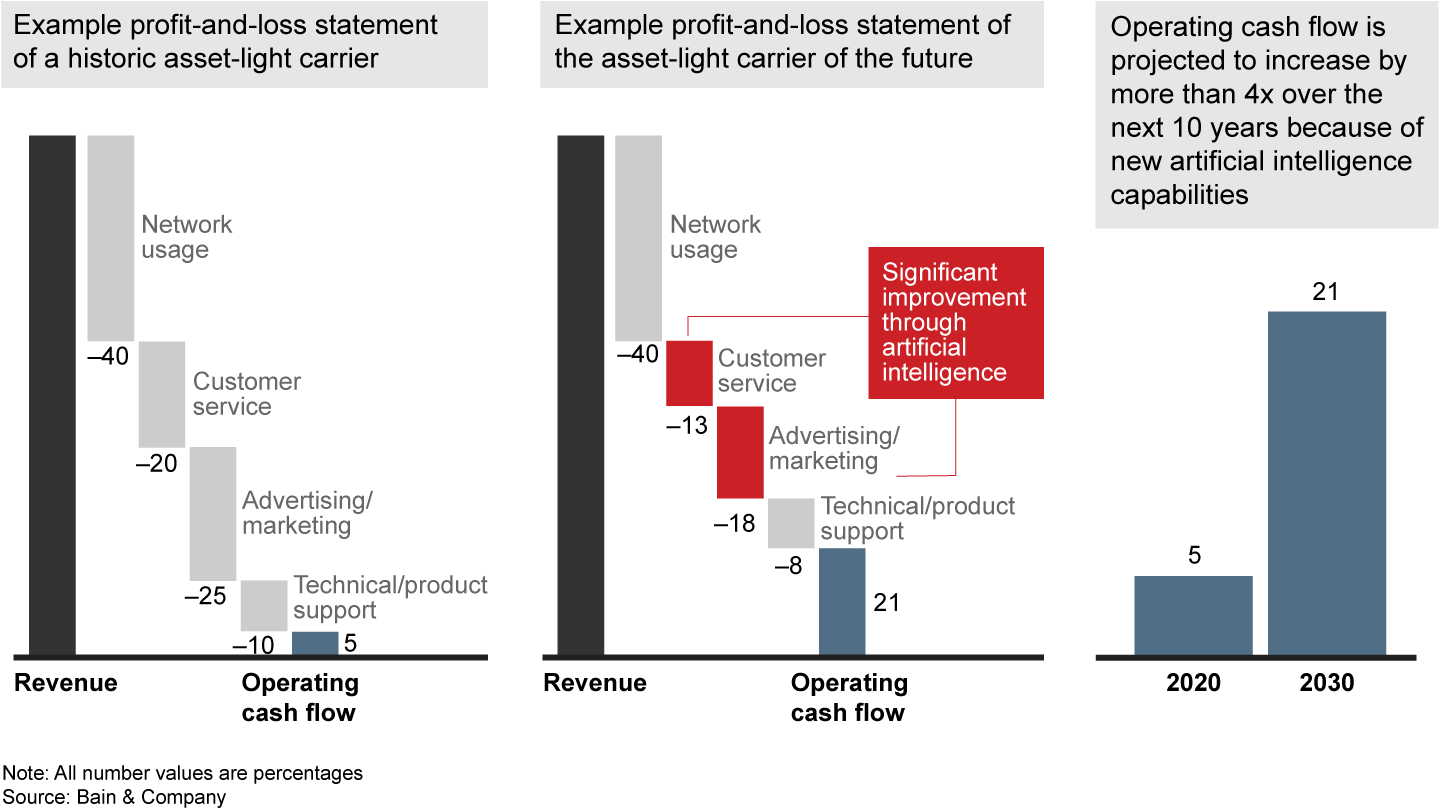

In the past, asset-light telcos were light because they didn’t invest in their own networks but looked like a classic carrier across the rest of their operating costs. Now, their entire model is about to get revamped.
What’s different this time? AI and other digital technologies can now enable asset-light carriers to operate their customer-facing functions at a radically lower cost than ever before by substituting computer processing power for people.
And this is not just about getting more efficient. Customers (both consumers and businesses) are increasingly comfortable with (and many actually prefer) digitally delivered self-service options, providing an advantage to carriers that build their businesses this way.
Taken to its extreme, carriers could successfully operate with no stores, no call centers and significantly fewer field technicians, leaving slow-moving incumbents who don’t adapt with a heavy drag on their cost structure and turning a historical competitive advantage into a ball and chain.
This has already played out in an adjacent sector: Witness the rise of Netflix, Hulu and now Disney+, which are essentially completely digital, over-the-top video-streaming services that are rapidly displacing traditional cable and satellite media delivery businesses. The new players have no physical stores and don’t rely on paper-based bills. Because of the simplicity of their services, many of their customers have probably never interacted with a company employee.
We are seeing early experimentation with this in telecommunications. There are digital-only wireless services from large incumbents (Verizon’s Visible plan in the US), small start-ups (Circles.Life in Singapore) and harder-to-deliver services, such as fixed wireless broadband (Starry’s people-light model in the US).
Over the next decade, this shift toward digitalization and automation could spark a chain reaction that shakes up the telecom market.
A proliferation of new asset-light carriers will deploy this strategy first, and their lower break-even point will allow them to focus on targeted, smaller slices of the market. These carriers will be either standalone businesses or new arms of existing companies in other sectors that have strong branding and distribution that they can use to push a telecom offering.
The enhanced profitability of these new market entrants will put pressure on traditional telcos’ price points and revenue, forcing them to respond with their own digital front ends. The benefits of this digitalization and simplification are apparent from the handful of telcos worldwide already pursuing this approach: The average Net Promoter Score® for these early adopters has risen by more than 20 percentage points, driving up revenue by as much as 10% while ratcheting down customer-facing costs by 30% or more.
Traditional carriers, especially those with larger regional or global customer bases, could take advantage of their scale, spreading out the development costs for powerful new digital platforms and using their deeper data sets to train more sophisticated AI algorithms. Ultimately, this could spur a reconsolidation of the marketplace by incumbent telcos, either through M&A or market share gains that force the smaller players out of business.
The wild card in all this remains the digital disrupters—namely, tech giants such as Facebook, Amazon, Apple, Netflix and Google. If they leverage their global digital platforms and massive customer connections in the right way, they could prove even more effective at implementing the “processing power over people” strategy in telecommunications, emerging as the new market share winners in the digital-heavy, asset-light future.
As new asset-light carriers begin to emerge, there will be three critical developments to watch.
- Can the new asset-light carriers kick-start the market with an enhanced business model?
- How rapidly will traditional telcos adopt new technologies to enhance their value proposition?
- How much traction will the digital disrupters get if they apply the new asset-light carrier playbook on top of their platforms?
Rebound of the enterprise
Despite decades of eroding revenue and profits, carriers shouldn’t write off their enterprise businesses because the pendulum is about to swing back the other way. The cause of the reversal? Telcos’ enterprise customers are digitalizing their operations, and, as a consequence, the quality of connectivity and the value of hosting critical digital platforms within the network will matter immensely to them.
In fact, we are already seeing evidence that the enterprise decline will bottom out over the next year or two in the US. Soon thereafter, we expect US carriers’ enterprise revenue trajectory to turn upward, reaching a 4% annual growth rate by 2028 (see Figure 2). And there are signs in some European markets that this resurgence of the enterprise business has already begun.
Figure 2
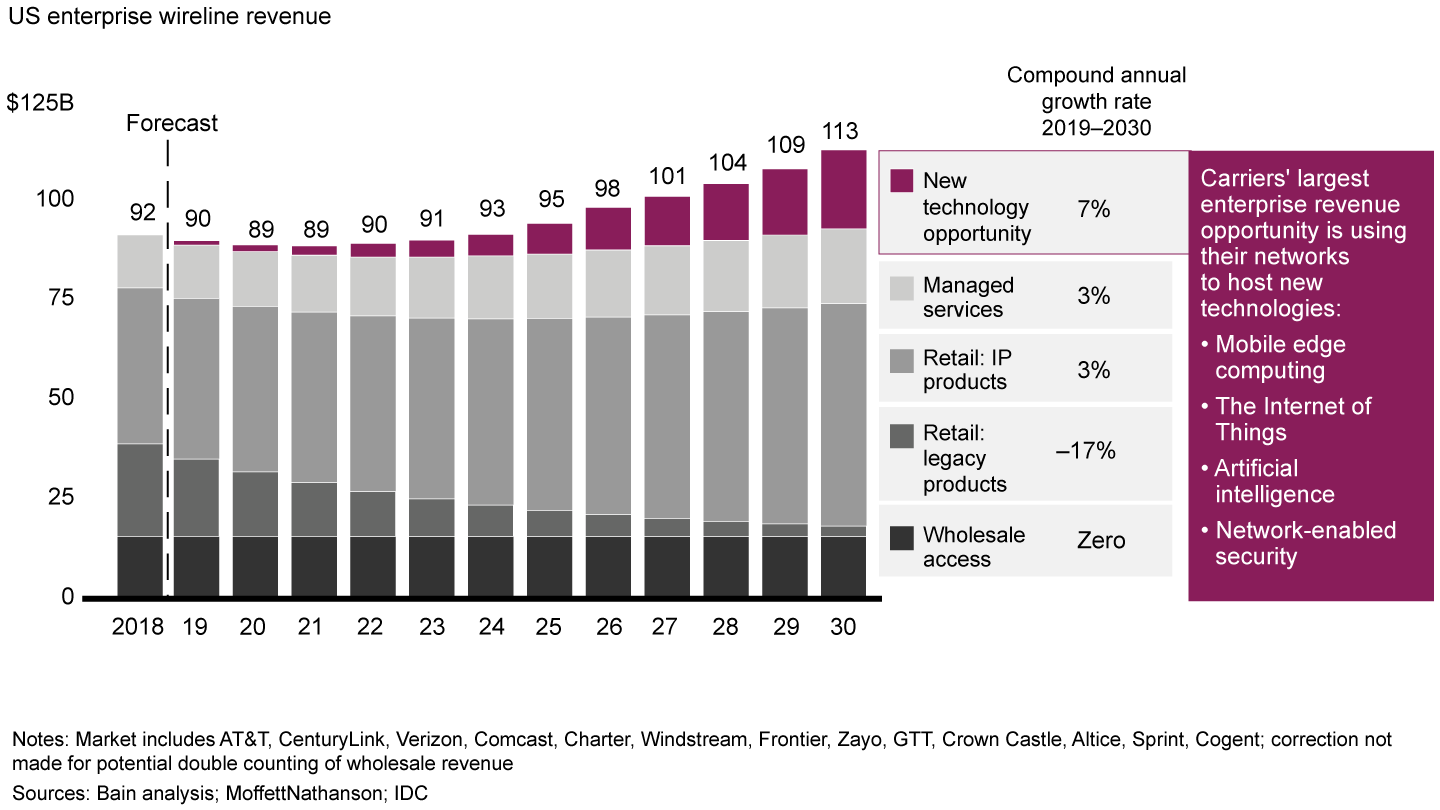

The primary catalyst will be the astronomical growth in traffic on the network from new types of business activities that require heavy data usage—for instance, cloud computing, AI and connected devices. Perhaps the best news for telcos is that enterprise customers’ increased investment in these and other new technologies will create revenue opportunities that will more than offset continuing price declines in their legacy enterprise products and services.
Let’s unpack telcos’ opportunity in more detail. As enterprises deliver more of their products and services over the web, having speedy, reliable, always-available connectivity becomes even more critical. A network glitch, let alone an outage, becomes fatal to the business rather than just an annoying inconvenience. Most enterprises will be willing to pay higher prices for demonstrated reliability. Traffic on the network will also fluctuate more dramatically so that carriers with the capability can adjust the amount of bandwidth sold to a customer based on the time of day or day of the year, and they can charge more for that flexibility.
Beyond demand for raw connectivity, there is an immediate opportunity for telcos to aid business customers with network and IT services, such as more effectively integrating their telephone systems, wireless capabilities and computers. Many carriers already are pursuing this, and it’s partly responsible for the nascent turnaround in their enterprise businesses. At the same time, enterprises’ network needs are becoming more complex because they’re pouring tons of money into new technologies: mobile edge computing, the Internet of Things (IoT), network-enabled security, AI, autonomous vehicles, advanced logistics systems and more. These technologies run on cloud-based platforms, some of which are well suited to be hosted inside telcos’ distributed networks, which can improve data transfer speeds, responsiveness, security and reliability. This could create additional revenue streams for carriers if they move quickly to capitalize on the opportunity before others grab it.
The key to building these in-network platforms will be effective network orchestration that enables customers to operate mobile, fixed and IoT-specific networks seamlessly across their entire geographical footprint, even if that involves data that travels across international borders and between multiple carriers. (For example, imagine an automotive company trying to enable autonomous driving across all of Europe or the entire globe.)
Additionally, the opportunity to bundle enhanced connectivity, network services and network-hosted platforms should create a difficult-to-match offer that increases telcos’ enterprise revenue.
By 2030, we will see the emergence of specialized enterprise solutions and platform providers that can serve the more complex and global needs of enterprise customers.
These trends are mostly good news for traditional telcos, but they have some difficult decisions to make about the future of their enterprise businesses. They could try to become truly global carriers by building these capabilities organically and through acquisitions. They could form federations with other carriers to amass the scale required to satisfy enterprise customers. They could collaborate with cloud and IT service providers outside of the industry, allowing them to host solutions by embedding them inside the network. Or they could choose instead to focus on purely providing connectivity services, betting that the shifts underway will still make that a profitable business. Any of these paths could prove successful, but it will require carriers to decide early and invest boldly in their chosen strategy.
Liberation of network infrastructure
The basis of competition in telecommunications is fundamentally shifting. While network quality will always be important, improvements in network technology and infrastructure have made it less practical or necessary for each carrier to have its own differentiated network. That makes customer experience the new competitive battleground, which is not historically a strong suit for carriers.
The need to invest more in customer service will push carriers to find ways to reduce costs elsewhere, including within the network—for instance, by selling excess network capacity (perhaps to the new asset-light carriers), by sharing costs with other carriers or by separating the network assets into separate entities.
And there are other strategic factors at play here. For one, 5G and edge computing both require larger-scale networks that many carriers can only afford by sharing networks, or at least key elements of networks.
In addition, some carriers see value in simplifying their focus. It’s difficult for one management team to effectively run two businesses that have starkly different time horizons. Networking businesses make investments with an eye toward the next 5 to 10 years, and the business is difficult to reposition quickly. By contrast, retail operations (especially digital ones) are constantly adjusting their sales and marketing tactics, and the impact of decisions can be felt within weeks.
We expect these trends to accelerate, resulting in more carriers hiving off their networks as separate businesses, in layers or in full. Historically, telecom companies did this in response to regulatory pressure, but voluntary separations are becoming more common—for instance, see moves over the past five years by European telcos O2 Czech Republic and TDC.
There is evidence that capital markets reward these separations. For instance, from 2009 through 2019, the return on invested capital of communications infrastructure companies SBA Communications, American Tower Corporation and Crown Castle outpaced the returns of some major wireless carriers (see Figure 3).
Figure 3
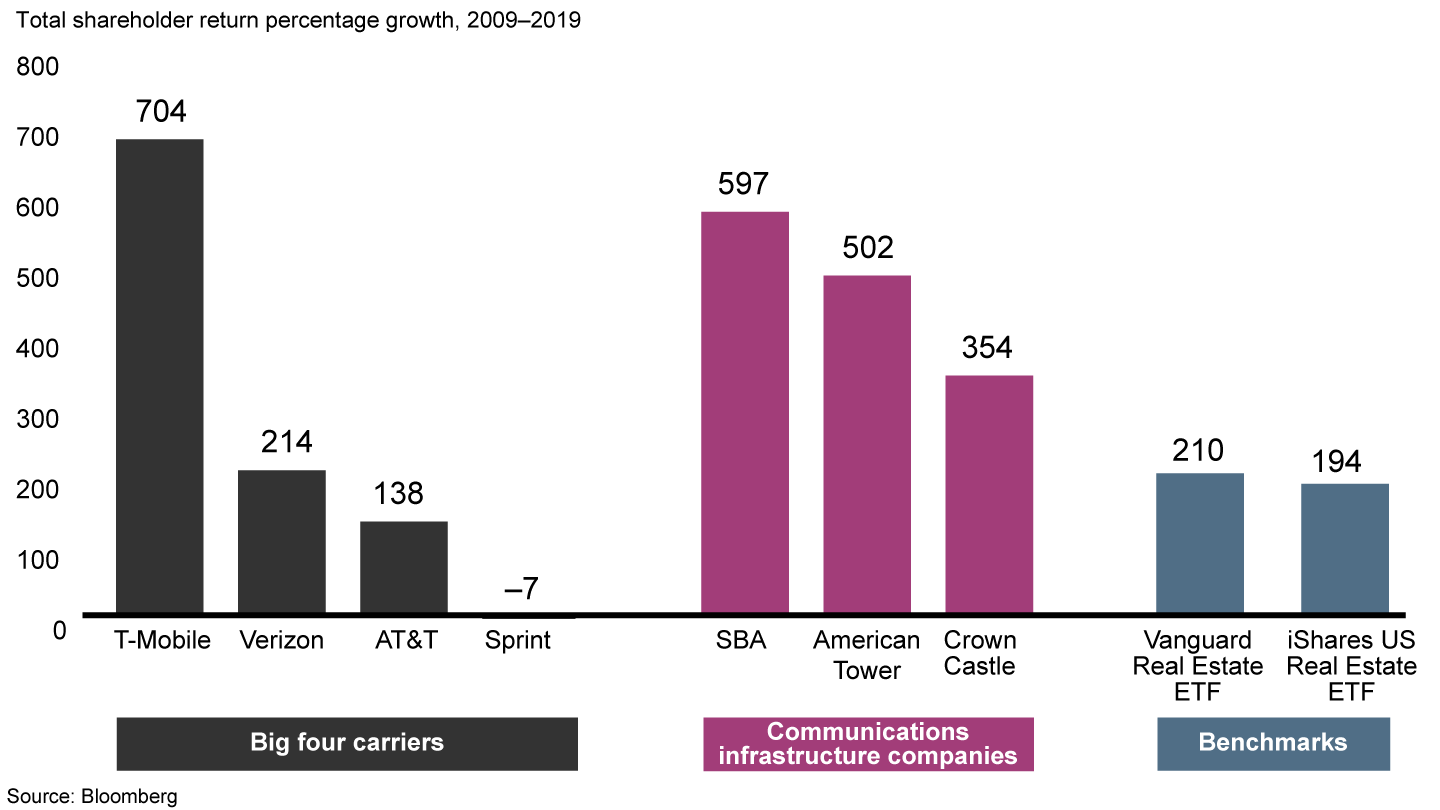

Nevertheless, chasing a financial boost from public market investors probably should not be the sole rationale to carve off network assets. But it’s not a bad idea when there are also strong strategic reasons for doing so.
Large, integrated carriers are sitting on a hugely valuable asset, and separating out part or all of their networks will enable them to raise capital for the investments they need to make in the coming years, such as developing 5G, deploying fiber infrastructure and building AI capabilities. This also frees the network assets to become new business entities with significant value. Carriers might choose to maintain a sizable minority or even majority stake to continue enjoying the upside of the network assets while sharpening the focus of their customer-facing businesses.
By 2030, there might be, at most, a few network providers in each market. A big, global carrier could wholesale its national networks. One to two local incumbents could keep their networks proprietary, but they will more likely wholesale or share them. In some instances, infrastructure companies, whose entire businesses consist of the provision of wholesale networks or discrete layers of those networks, could provide networks.
An interesting side effect of all this is it would strengthen the prospects of the new wave of asset-light carriers by providing them rental access to multiple networks.
How to respond
Change is coming to the telecommunications industry—faster and more consequential than in recent memory. By 2030, it will be unrecognizable in many ways. How will today’s telcos respond?
Some carriers (likely a handful or fewer) will try to continue operating within the old model of a national, vertically integrated carrier that delivers both the network and customer-facing products and services. These players will struggle unless they can achieve meaningful scale. And even then, they will still be forced to adapt to industry shifts.
Even the telcos that embrace the coming changes won’t have an easy path. The shifts will require deftly integrating software into many key facets of the business, but telcos aren’t typically adept at software. They are often slow to adopt digital technologies, not inclined to experiment and thus weak at testing and learning such capabilities. Unless they can improve quickly in this area, they will be vulnerable to competition from big tech companies.
Furthermore, the reality is that many telcos don’t have the resources or bandwidth to effectively tackle all of the impending industry shifts simultaneously. They face tough choices, but the upshot is that carriers have the power to control their own destiny. If they make bold moves more quickly than their competitors do, they can give themselves the best possible opportunity to thrive in the sector’s next era.
The following questions could serve as a helpful starting point for telecom leadership teams planning their roadmap to 2030:
- Which industry shifts pose the most imminent threats to my company? When, where and how might those shifts affect us?
- What investments could we make to respond to the most urgent challenges? Which of those actions are most feasible given our strengths and the resources at our disposal?
- What steps can we take to adopt software effectively within our operations and enable the digital transformations of our enterprise customers?
- How quickly can we execute our plan?
Paul Smith is chairman of Bain & Company’s Global Communications practice, and he is based in the firm’s San Francisco office. Herbert Blum leads the firm’s Global Communications practice, and he is based in the Toronto office.
Net Promoter®, Net Promoter System®, Net Promoter Score® and NPS® are registered trademarks of Bain & Company, Inc., Fred Reichheld and Satmetrix Systems, Inc.
First published in Februar 2020