

Brief

Auf einen Blick
- Despite providing indispensable services during the pandemic, telecommunications companies last year couldn’t reverse one of the industry’s persistent challenges: They created less value for shareholders than nearly every other sector.
- Meanwhile, the virtualization of network connectivity and other long-term industry trends are accelerating, reshaping the basis for competition.
- All of this creates more urgency for strategic moves by telcos to adapt—or even transform—their businesses.
For people around the world, telecommunications services have become even more critical to everyday life since the outbreak of Covid-19. Communication networks have allowed many employees to work from home. Fixed and mobile broadband have enabled an unprecedented rise in video conferencing, a vital tool for communication and social connection amid lockdowns and physical distancing. Healthcare and retail services have increasingly shifted online. Telcos have helped governments monitor and fight the spread of the virus. In short, telcos’ networks have helped keep societies and economies going.
Paradoxically, telcos’ crucial societal role hasn’t translated into strong returns for their shareholders.
During the pandemic, telcos have created less value for shareholders than every sector but one, financial services (see Figure 1). From last February to mid-December, telcos’ total shareholder return (TSR)—which measures the total return a shareholder receives from share price changes and dividends over a certain time period—trailed the average of all sectors by 16 percentage points (see Figure 2). What’s more, telcos have fallen further behind the longer the pandemic continues. From April to mid-December, telecommunications was the worst-performing sector as measured by TSR.
Figure 1
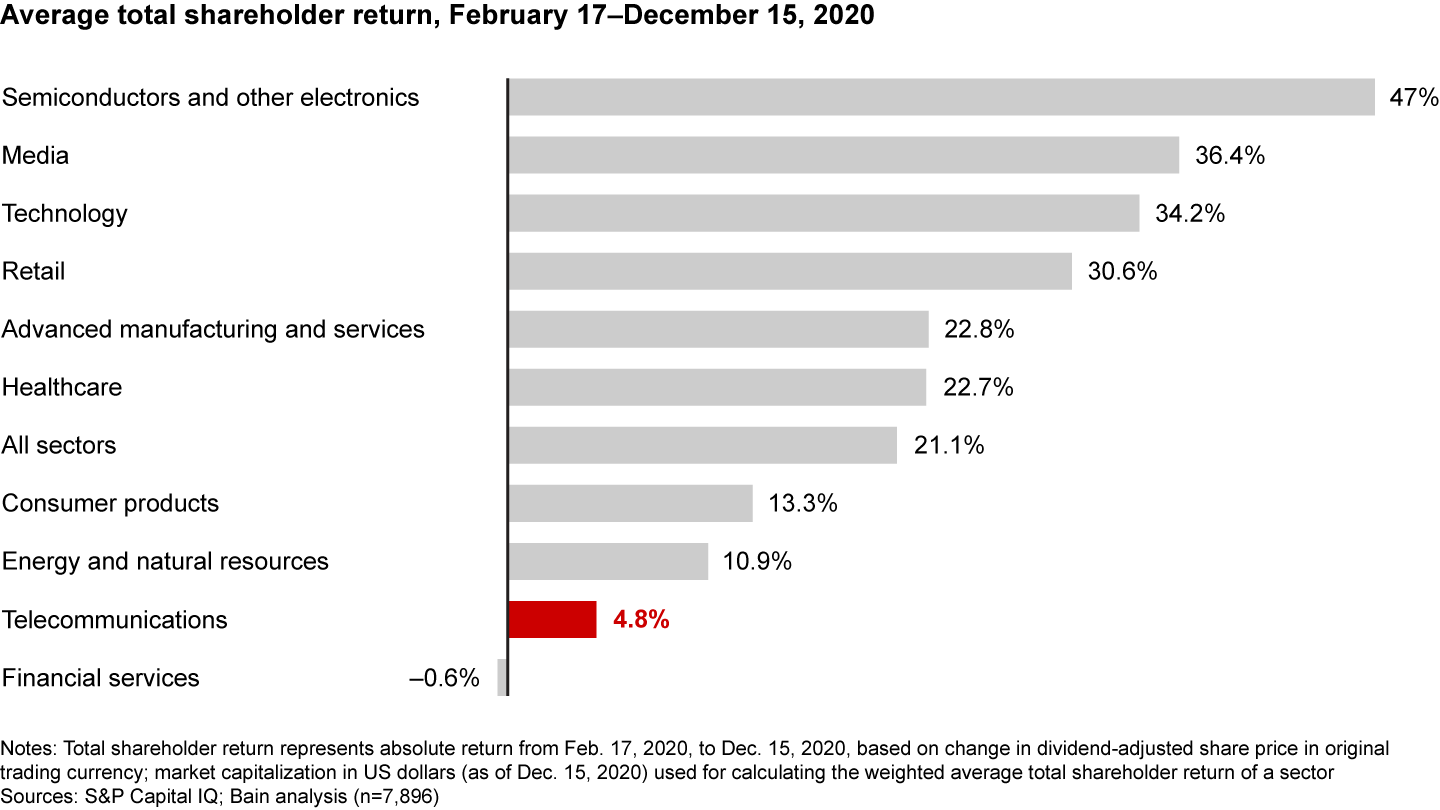

Figure 2
That means the pandemic has only exacerbated a trend that has frustrated industry stakeholders for years: Despite telcos’ massive investments in infrastructure and services aimed at realizing the vision of a digital economy, the financial rewards appear to accrue to others. The stark contrast between the sense of pride that many telco leadership teams and employees have deservedly felt about their pandemic response, and the subsequent financial outcomes, is telling.
The road ahead won’t be easier. As we look to the coming year and beyond, telcos face unprecedented challenges in responding to the continuing Covid-19 crisis while simultaneously trying to stay ahead of a rapid industry transformation that began before the pandemic. Leading companies will navigate this tumultuous period by making strategic choices to secure the future of their business and improve their value creation—even if it requires a bold transformation.
Seismic shifts
Telcos, like all businesses, started this year surrounded by immense uncertainty. The trajectory of the pandemic remains the single most important factor for economic growth. In 2020, global GDP contracted sharply and trailed the prepandemic forecast by $6 trillion. Recovery from this health and economic crisis will be uneven. While many large economies are expected to return to growth in 2021, the timing and rate of recovery will likely vary widely. Telcos that carefully monitor the impact of the uneven recovery on their customers, employees, and partners can position themselves to respond more effectively.
Notably, TSR wasn’t poor for all telcos last year. In fact, the top quartile of telcos managed to outperform the cross-industry TSR average by 9 percentage points, according to our analysis.
Yet even the telcos that have fared better can’t afford to sit still. That’s because the sector’s basis for competition is fundamentally shifting, as we outlined in our perspective on what the telco industry of 2030 will look like. And these emerging changes in technologies, customers, market structures, and regulation will further accelerate in 2021, with a few dynamics standing out in particular.
Good news for telcos is that many digital advancements brought on by the pandemic are likely to stick. Last year accelerated the digital progress in many sectors, sometimes achieving within a few months what was previously expected within years. Many telco customers have adopted digital sales and service channels at scale. Going forward, consumer and enterprise customers’ service needs and patterns of use will further evolve as pandemic restrictions ease and economies open again. Enterprises’ growing demand for the Internet of Things, automated operations, and edge computing will require many telcos to augment their capabilities across networks and services.
In order to better serve customers’ new demands, we expect telcos to continue making large infrastructure investments in areas such as 5G, fiber-network expansion, and network virtualization. We view assertive capital expenditures (capex) as a positive for the industry, on balance. One of the big questions is how to fund these investments. We believe the most feasible capex funding source over the next decade will be reductions in operating costs.
This will present a big challenge in two ways. First, some industry analysts expect telcos’ global operating expenditures to increase by billions of dollars this year. Second, the next wave of material reductions in operating costs will likely come from substituting computer processing power for people. For many telco carriers, this will involve a difficult transition and represent an enormous political challenge, as they’ll no longer be among the largest employers in their markets. However, unless they can meaningfully reduce operating expenditures, many telcos will face a high-wire balancing act to secure higher capex investments while simultaneously protecting cash flows to fund both debt-laden balance sheets and dividends.
Another heightened challenge for telco operators will be managing the infrastructure supplier network in light of geopolitical tensions. For example, trade conflicts and cybersecurity concerns are affecting the role of Chinese manufacturers in the telecom network buildout in many regions. At the same time, telcos will likely face more questions from investors, employees, and business partners about their long-term strategies to meet global challenges involving sustainability and diversity, equity, and inclusion. Increasing their focus on public relations and managing government relationships can help companies navigate these issues while strengthening their reputation and their business.
On top of these challenges, telco executives are staring down tectonic industry shifts. Over the next decade, we expect the industry to experience some of the most profound changes since the wave of deregulation in the 1990s. At the root of this bedrock transformation is the virtualization of connectivity, similar to what began happening to compute and storage more than a decade ago.
Specifically, the communications infrastructure is no longer required to serve as the linchpin without which communications services and capabilities couldn’t function. For example, Internet-enabled video services no longer need complex systems to reserve bandwidth and assure the quality of experience. Today, the capabilities of over-the-top media architectures surpass minimum quality-of-experience requirements, while also allowing for easier add-on functionality. This significantly enhances the overall customer experience. Going forward, communication services will no longer depend on fit-for-purpose networks, thus opening a new chapter in the telecommunications market.
In a world where network infrastructure is divorced from the service layer, integrated telco carriers become less essential. Thus, we’ll see a growing number of infrastructure-focused telecom businesses and a more vibrant industry model for wholesale networks. Concurrently, owning the network will become less critical to providing telecom services, spurring the rise of more “asset-light” carriers. This shift in market structure will be profound, and companies that move quickly will be in the best position to succeed.
Strategic choices
As carve-outs of network infrastructure proliferate, they’ll open up a range of business models available to telcos, each with different objectives and financial profiles. With the market structure shifting, telcos are under intensifying pressure to start making strategic choices about how they can best compete in the future.
We see six primary business models that will underpin the profound changes in the communications industry’s market structure over the next decade.
1. Integrated. Competition will further intensify among companies that adhere to the traditional model of the integrated telco that provides a comprehensive set of services. Premium product bundles typically attract most of the value, which will likely push telcos to integrate fixed and mobile services, and accelerate market consolidation. In addition, many of these integrated telcos will start bundling third-party services with their core offerings, while at the same time opening their networks to other enterprises for use in their respective businesses.
2. Value-focused. As standalone connectivity further commoditizes, customers will increasingly opt for lower-cost, “good-enough” services. As a result, a value-focused set of telcos will choose to compete by shedding some of the most costly aspects of the traditional model and focusing on more concentrated coverage, narrow product lines, and customer service functions powered by automation and self-service tools.
3. Pure infrastructure. The separation of network assets into standalone entities is becoming more common. Compared with integrated carriers, pure-play telecom infrastructure companies’ advantages include the ability to more freely resell their assets and raise the utilization rate of their networks. This creates value that accrues to all participants. Despite the recent merger-and-acquisition activity and the high prices in this segment of the industry, we view the current phase as only the beginning for pure infrastructure companies.
4. Asset-light. As network infrastructure becomes more widely available, it will be possible to rent capital-intensive network assets only when needed. This will give rise to a class of asset-light telcos that can earn sufficient profit through services that more than cover the costs of network rents. The result will be the proliferation of asset-light models not only in connectivity, such as providing managed network services, but also in consumer and enterprise network security, communications services for healthcare, and many other segments.
5. Smart platform. As digital economies advance, demand for core, network-centric telecom capabilities will surge. Telcos have the chance to play an important role in the growth of digital-enabled economies by configuring their capabilities so that they’re easy for technology and digital service companies to discover, consume, and scale up. Yet telcos probably cannot build and orchestrate these platforms alone. In order to capture a meaningful share of the future wealth creation, the most successful telcos will forge the right partnerships with established and rising digital leaders.
6. Digital niche. As smart platforms proliferate and power digital economies, starting and running a digital-focused business is going to be easier than ever. Less capital will be needed for upfront technology investment. Far fewer specialized employees with niche talents will be required. Fixed costs will decrease as resources can be rented or purchased as needed. With the barriers of entry lowered, telcos can more easily experiment with new businesses focused on digital-powered products and services adjacent to the sector’s traditional model. Edge and cloud computing, the Internet of Things, and digital media are just a few examples of rapidly evolving sectors that open up opportunities for many companies, including telcos, to design and scale up new ventures.
Some of these models are gaining traction now, while others remain a few years out—or less. Nevertheless, their catalysts are already well underway. That means telcos have an opening now to tap into new sources of value and put their companies in a strong position for the future.
Creating a bridge
While the next decade is filled with potential for telcos, right now many executives might find it difficult to look past the current situation and feel energized about the future. The pandemic continues to devastate communities, and as we peer into 2021, the state of the world remains highly uncertain. For the telecom industry, the pandemic has only accentuated its systemic challenges.
How can executives create a bridge from here to the other side of the crisis, with all its potential? The following questions can help telco leadership teams guide their organizations through these turbulent times.
- The current crisis. How can we best support our stakeholders? How can we continue to provide bedrock services that help society cope with the pandemic, while ensuring the safety of our customers and employees? How can we also meet the obligations to our investors?
- Keeping digital momentum. Do we have a clear and ambitious digital transformation roadmap to not only preserve all the pandemic-driven advances in digital consumption, but also build upon them in ways that will delight our customers, reduce operating costs, and fund the right investments?
- The 30-month horizon. How robust is our current growth and value-creation plan in light of the changes our industry is going through? Do we have a sound long-term business strategy?
- The emerging market structure. Which macroeconomic and industry dynamics are most relevant for our customers, employees, and organization? How quickly will these dynamics progress and how will they affect our company? If these dynamics call for adapting our business, which of the six models makes the most sense for our company? How do we prepare?
- Internal readiness. Do we have the right capabilities to execute these plans?
First published in Februar 2021