
Skip to Content
  • Standorte

    Standorte

    North & Latin America
    • Atlanta
    • Austin
    • Bogota
    • Boston
    • Buenos Aires
    • Chicago
    • Dallas
    • Denver
    • Houston
    • Lisbon
    • Los Angeles
    • Mexico City
    • Minneapolis
    • Monterrey
    • Montreal
    • New York
    • Rio de Janeiro
    • San Francisco
    • Santiago
    • São Paulo
    • Seattle
    • Silicon Valley
    • Toronto
    • Washington, DC
    Europe & Africa
    • Amsterdam
    • Athens
    • Berlin
    • Brussels
    • Copenhagen
    • Düsseldorf
    • Frankfurt
    • Helsinki
    • Istanbul
    • Johannesburg
    • Kyiv
    • Lisbon
    • London
    • Madrid
    • Milan
    • München
    • Oslo
    • Paris
    • Rome
    • Stockholm
    • Warsaw
    • Wien
    • Zürich
    Middle East
    • Doha
    • Dubai
    • Riyadh
    Asia & Australia
    • Bangkok
    • Beijing
    • Bengaluru
    • Brisbane
    • Ho Chi Minh City
    • Hong Kong
    • Jakarta
    • Kuala Lumpur
    • Manila
    • Melbourne
    • Mumbai
    • New Delhi
    • Perth
    • Seoul
    • Shanghai
    • Singapore
    • Sydney
    • Tokyo
    Alle Standorte Anzeigen
  • Alumni
  • Presse
  • Newsletter
  • Kontakt
  • DACH-Region | Deutsch

    Wählen Sie Ihre Region und Sprache

    Global
    • Global (English)
    North & Latin America
    • Brazil (Português)
    • Argentina (Español)
    • Canada (Français)
    • Chile (Español)
    • Colombia (Español)
    Europe, Middle East, & Africa
    • France (Français)
    • DACH-Region (Deutsch)
    • Italy (Italiano)
    • Spain (Español)
    • Greece (Elliniká)
    Asia & Australia
    • China (中文版)
    • Korea (한국어)
    • Japan (日本語)
  • Saved items (0)
    Saved items (0)

    You have no saved items.

    Inhalte, für die Sie sich interessieren, werden hier gespeichert und können später gelesen oder weitergeleitet werden.

    Explore Bain Insights
  • Branchenkompetenzen
    Hauptmenü

    Branchenkompetenzen

    • Luft- und Raumfahrt, Verteidigung
    • Agrarwirtschaft
    • Chemieindustrie
    • Infrastruktur und Bauwirtschaft
    • Konsumgüter
    • Finanzdienstleistungen
    • Gesundheitswesen
    • Maschinen- und Anlagenbau
    • Medienwirtschaft
    • Metallindustrie
    • Bergbau
    • Öl und Gas
    • Papier- und Verpackungsindustrie
    • Private Equity
      Branchenkompetenzen
      Private Equity
      • Due Diligence
      • Exit Planning
      • Firm Strategy & Operations
      • Portfolio Value Creation
    • Öffentlicher Sektor und Sozialwesen
    • Einzelhandel
    • Technologie
    • Telekommunikation
    • Transportwesen
    • Reise- und Freizeitbranche
    • Versorgung und erneuerbare Energien
  • Managementkompetenzen
    Hauptmenü

    Managementkompetenzen

    • Customer Experience
    • ESG
    • Innovation
    • M&A
    • Operations
    • People & Organization
    • Private Equity
    • Sales & Marketing
    • Strategie
    • KI, Einblicke und Lösungen
    • Technologie
    • Transformation
  • Digital
  • Publikationen
    Hauptmenü

    Publikationen

    • Branchenthemen
    • Managementthemen
    • Bain-Bücher
    Alle Publikationen
    Ausgewählte Themen
    • Resilienz in der globalen Krise
    • M&A Report
    • Private Equity Podcast
    • Midyear Private Equity Report
    • Agile
    • Engineering Report
    • Digital Transformation
    • Elements of Value®
    • Firm of the Future
    • Nachhaltigkeitsstudie
    • Macro Trends
    • Future of Consumption
    • Weltwirtschaftsforum (WEF)
  • Über uns
    Hauptmenü

    Über uns

    • Was wir bieten
    • Unser Ansatz
    • Unser Team
    • Game Changer Award
    • Female Allstar Board
    • Messbare Ergebnisse (EN)
    • Auszeichnungen
    • Globale Partnerschaften
    • The Mission
    Further: Our global responsibility
    • Vielfalt & Chancengleichheit
    • Soziale Verantwortung
    • Sustainability
    Erfahren Sie mehr zu "Further"
  • Karriere
    Hauptmenü

    Karriere

    • Dein Einstieg
      Karriere
      Dein Einstieg
      • Find Your Place
      • Unsere Arbeitsbereiche
      • Unsere Teams
      • Angebote für Studierende
      • Praktika & Programme
      • Recruiting-Events
    • Arbeiten bei Bain
      Karriere
      Arbeiten bei Bain
      • Blog: Inside Bain
      • Karriere Stories
      • Unsere Bainies
      • Office-Standorte
      • Weiterentwicklung
      • Affinity Groups
      • Deine Benefits
    • Impact Stories
    • Deine Bewerbung
      Karriere
      Deine Bewerbung
      • Das erwartet dich
      • Der Interviewprozess
    FIND JOBS
  • Standorte
    Hauptmenü

    Standorte

    • North & Latin America
      Standorte
      North & Latin America
      • Atlanta
      • Austin
      • Bogota
      • Boston
      • Buenos Aires
      • Chicago
      • Dallas
      • Denver
      • Houston
      • Lisbon
      • Los Angeles
      • Mexico City
      • Minneapolis
      • Monterrey
      • Montreal
      • New York
      • Rio de Janeiro
      • San Francisco
      • Santiago
      • São Paulo
      • Seattle
      • Silicon Valley
      • Toronto
      • Washington, DC
    • Europe & Africa
      Standorte
      Europe & Africa
      • Amsterdam
      • Athens
      • Berlin
      • Brussels
      • Copenhagen
      • Düsseldorf
      • Frankfurt
      • Helsinki
      • Istanbul
      • Johannesburg
      • Kyiv
      • Lisbon
      • London
      • Madrid
      • Milan
      • München
      • Oslo
      • Paris
      • Rome
      • Stockholm
      • Warsaw
      • Wien
      • Zürich
    • Middle East
      Standorte
      Middle East
      • Doha
      • Dubai
      • Riyadh
    • Asia & Australia
      Standorte
      Asia & Australia
      • Bangkok
      • Beijing
      • Bengaluru
      • Brisbane
      • Ho Chi Minh City
      • Hong Kong
      • Jakarta
      • Kuala Lumpur
      • Manila
      • Melbourne
      • Mumbai
      • New Delhi
      • Perth
      • Seoul
      • Shanghai
      • Singapore
      • Sydney
      • Tokyo
    Alle Standorte Anzeigen
  • Alumni
  • Presse
  • Newsletter
  • Kontakt
  • DACH-Region | Deutsch
    Hauptmenü

    Wählen Sie Ihre Region und Sprache

    • Global
      Wählen Sie Ihre Region und Sprache
      Global
      • Global (English)
    • North & Latin America
      Wählen Sie Ihre Region und Sprache
      North & Latin America
      • Brazil (Português)
      • Argentina (Español)
      • Canada (Français)
      • Chile (Español)
      • Colombia (Español)
    • Europe, Middle East, & Africa
      Wählen Sie Ihre Region und Sprache
      Europe, Middle East, & Africa
      • France (Français)
      • DACH-Region (Deutsch)
      • Italy (Italiano)
      • Spain (Español)
      • Greece (Elliniká)
    • Asia & Australia
      Wählen Sie Ihre Region und Sprache
      Asia & Australia
      • China (中文版)
      • Korea (한국어)
      • Japan (日本語)
  • Saved items  (0)
    Hauptmenü
    Saved items (0)

    You have no saved items.

    Inhalte, für die Sie sich interessieren, werden hier gespeichert und können später gelesen oder weitergeleitet werden.

    Explore Bain Insights
  • Branchenkompetenzen
    • Branchenkompetenzen

      • Luft- und Raumfahrt, Verteidigung
      • Agrarwirtschaft
      • Chemieindustrie
      • Infrastruktur und Bauwirtschaft
      • Konsumgüter
      • Finanzdienstleistungen
      • Gesundheitswesen
      • Maschinen- und Anlagenbau
      • Medienwirtschaft
      • Metallindustrie
      • Bergbau
      • Öl und Gas
      • Papier- und Verpackungsindustrie
      • Private Equity
      • Öffentlicher Sektor und Sozialwesen
      • Einzelhandel
      • Technologie
      • Telekommunikation
      • Transportwesen
      • Reise- und Freizeitbranche
      • Versorgung und erneuerbare Energien
  • Managementkompetenzen
    • Managementkompetenzen

      • Customer Experience
      • ESG
      • Innovation
      • M&A
      • Operations
      • People & Organization
      • Private Equity
      • Sales & Marketing
      • Strategie
      • KI, Einblicke und Lösungen
      • Technologie
      • Transformation
  • Digital
  • Publikationen
    • Publikationen

      • Branchenthemen
      • Managementthemen
      • Bain-Bücher
      Alle Publikationen
      Ausgewählte Themen
      • Resilienz in der globalen Krise
      • M&A Report
      • Private Equity Podcast
      • Midyear Private Equity Report
      • Agile
      • Engineering Report
      • Digital Transformation
      • Elements of Value®
      • Firm of the Future
      • Nachhaltigkeitsstudie
      • Macro Trends
      • Future of Consumption
      • Weltwirtschaftsforum (WEF)
  • Über uns
    • Über uns

      • Was wir bieten
      • Unser Ansatz
      • Unser Team
      • Game Changer Award
      • Female Allstar Board
      • Messbare Ergebnisse (EN)
      • Auszeichnungen
      • Globale Partnerschaften
      • The Mission
      Further: Our global responsibility
      • Vielfalt & Chancengleichheit
      • Soziale Verantwortung
      • Sustainability
      Erfahren Sie mehr zu "Further"
  • Karriere
    Häufige Suchanfragen
    • Agil
    • Digital
    • Strategie
    Vorherige Suchanfragen
      Zuletzt besuchte Seiten

      Content added to saved items

      Saved items (0)

      Removed from saved items

      Saved items (0)

      Brief

      Your company is connected—but can it make and execute good decisions?

      Your company is connected—but can it make and execute good decisions?

      The connected enterprise presents huge opportunities. If you focus on decisions first and connectivity second, you will be well positioned to capitalize on them.

      Von Chris Brahm and Eric Garton

      • Min. Lesezeit

      Brief

      Your company is connected—but can it make and execute good decisions?
      en

      Not long ago, we studied 2,300 managers at an industrial company with 14,000 employees around the globe. As a group, these individuals sent and received more than 260,000 emails a month, just with one other. But high levels of email communication did not prevent meeting proliferation. The typical manager devoted eight hours each week to meetings—for senior managers the figure was more like 20 hours—and the volume was growing. During the average meeting, we found that about a quarter of attendees were sending at least two emails every 30 minutes.  

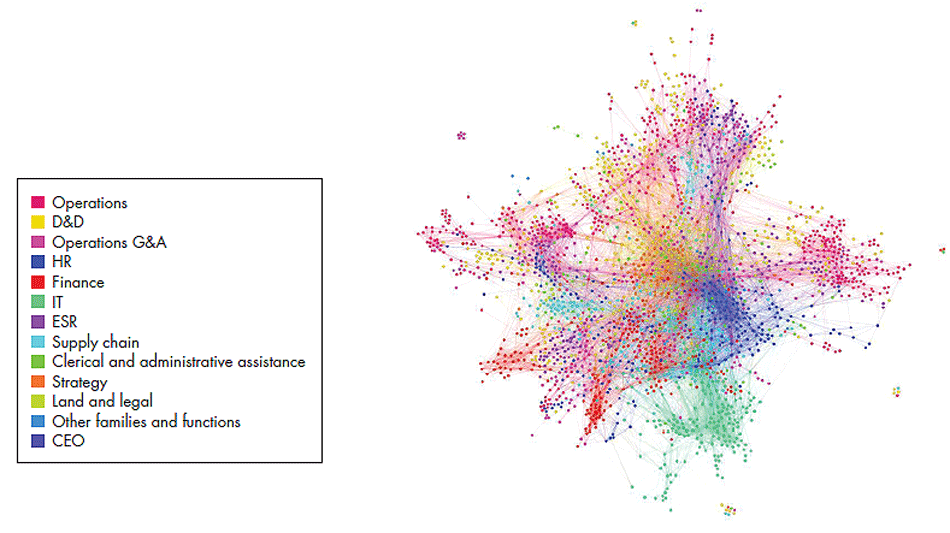
      This is today’s connected enterprise: always on, everyone linked to everyone else, a flood of information coursing through its electronic arteries (see “The connected enterprise” below). The enterprise is partly a creature of collaborative technologies, including not just email but also instant messages, anywhere-anytime phone calls and meetings, Web-based conferencing, internal social networks and so on. It’s also a creature of globalization, capability sourcing and partnerships that extend beyond a company’s walls. Many people and teams around the world, often from different employers, collaborate physically and virtually on nearly everything they do. 

      All this information and collaboration should make companies far more agile than they used to be, and they should be able to respond nimbly and decisively to new ideas and market developments. 

      In practice, the opposite is often the case. The organization grows more complex, not less. Critical decisions slow to a crawl, trapped in an endless cycle of data collection and debate. An invitation to collaborate has blurred the distinction between participative and consensus styles of decision making and risks turning every decision into a referendum.

      In the industrial company we studied, for example, operating expenses were growing faster than sales—a sure sign of trouble. A survey showed that only 18% of employees thought that the company’s decision processes led to good decisions. As one respondent said, “There are far too many people involved with the decision making process…too many meetings and too much email being circulated.” And this company isn’t alone. Typically, people in a connected enterprise are aware of what’s going on, and many believe they should have a say in whatever issue is at hand. But no one seems to know who’s really responsible for decisions and actions. 


      the-connected-enterprise-callout

      The connected enterprise

      Today’s technology allows you to map your company’s connectivity. Maps such as the one pictured to the right can highlight functions, regions or individuals that are isolated from others, as well as those that are most plugged in. 

      Learn more


      Fortunately, things don’t have to be that way. Many companies have already learned how to create streamlined, decisive organizations. They make good decisions day in and day out, make them quickly and translate them into action promptly and effectively. Organizations like these outperform their competitors. They’re also great places to work, and they attract the kind of employee who likes to get things done. Companies with that kind of organization nearly always find that connectivity is a boon. It turbocharges performance, and it helps people do their jobs more effectively than ever.  

      It’s when the organization itself is needlessly complex— when decision processes are murky and decision rights unclear—that connectivity causes trouble. If you expect social technologies and interconnections to cut through this complexity all by themselves, you’re in for a disappointment.

      So what follows are four principles that can help a company to keep its priorities straight. The connected enterprise, after all, presents huge opportunities. If you focus on decisions first and connectivity second, you will be well positioned to capitalize on them.

      1. Keep the organization simple. Simple organizational structures and decision-making models nearly always outperform competitors. Effective companies design their processes so that key decisions are made quickly and repeatedly by a relative handful of people. They keep spans broad and layers few. They never have large decision-making meetings, and they eliminate organizational fragmentation.

      Simplicity and clarity of this sort pay off quickly in a connected world. A global technology company, for instance, found that its spending on marketing was increasing at 1.5 times the rate of revenue growth, while market share was declining. Its headcount had also increased, its programs had proliferated and its decision making had slowed down. To attack the problem, the company consolidated its marketing functions, reduced the number of managerial layers and centralized key decisions. The moves contributed to 10% faster revenue growth and a 30% reduction in marketing expense.

      2. Align management forums. Companies that are best at decisions foster cross-boundary collaboration whenever it creates high value, such as in R&D or sales. But even in this context, they keep decision-making authority simple. They also create efficient management forums for key decisions. A $2 billion Internet services company had grown by acquisition, but synergies were scarce and margins, flat. Thanks to connectivity, the company could replace its fragmented senior management forum, which was business unit-based, with 10 or more people involved—with a core team of just three, including the CEO, head of products and head of sales. Decision making and execution improved radically, and margins rose by more than 30%.

      3. Target technology and information. Companies with simple structures and well-aligned decision processes rely on social technologies whenever those technologies accelerate decision making and execution—for a complex technical issue, for instance, that needs as many brains as possible. But they don’t do social for the sake of social. They understand what information they need for key decision processes and don’t flood participants with unnecessary data. They find ways to reduce email information overload while ensuring maximum access to pull-oriented collaboration sites.

      Technology can often help decisions about innovation, but only up to a point. A $3 billion software and financial services company, for instance, used collaboration technology to encourage and capture new business and product ideas from individuals throughout the organization. Participants generated more than 700 new ideas in one area alone, providing decision makers with a host of good possibilities for innovation. Still, the company didn’t rely wholly on this technology: It used the collaboration tool to augment the normal product development and decision-making process, not to supplant it.

      4. Keep connectivity in perspective. Virtual is fine for many purposes, but nothing can replace direct human interaction. So these companies instill—and invest in— cultural norms that reinforce face-to-face communication. They also structure meetings to encourage and reinforce the exchange of ideas. When a new CEO took over a struggling software company, he learned that people in the organization universally complained about unfocused and frustrating meetings, despite vast numbers of elaborate PowerPoint presentations. The new CEO quickly instituted a no-presentation, working-session-only rule, with printed documents distributed and no laptops allowed. The leadership team almost immediately noticed a change in energy level, focus and meeting effectiveness.

      As organizations strive to have less rigid boundaries, there is one thing you can be sure of: Connectivity has already taken hold in the fabric of your organization. It’s a powerful force, and it can either boost performance or get in the way. The critical question is whether you are creating an organizational model that can capitalize on its promise.

      Chris Brahm is a partner with Bain & Company and leads the firm’s Technology practice for the Americas in San Francisco. Eric Garton is a partner in Bain’s Chicago office and is the leader of Bain’s Industrial practice in the Americas.


      The connected enterprise

      Today’s technology allows you to map your company’s connectivity. This image shows connections among 2,300 individuals—all the corporate managers and the first six layers of regional managers—at a large industrial company. Any two people are connected on the image if they attended at least 10 meetings together over the course of a year (excluding town halls and other large meetings). The more meetings they attended together, the closer the dots are.

      The dots in this image are colored by function, but they can be colored by any attribute that is useful, including management layer, type of site and so on. The map can highlight functions, regions or individuals that are isolated from others, as well as those that are most plugged in.
      the-connected-enterprise-chart_embed


      Warning signs

      Is your organization prepared to benefit from connectivity? If you’re noticing some of these symptoms, the answer may be no.

      • Your meetings are over attended and ineffective
      • Your decision-making processes are slow and often involve managing “stakeholder mountains”
      • Accountability is hard to pinpoint in your core, high-value processes
      • You’re often unable to connect the best resources to the most important initiatives
      • Your organization’s execution capability is eroding as complexity impairs consistency

      the-connected-enterprise-chart_full
      Autoren
      • Headshot of Chris Brahm
        Chris Brahm
        Alumni, San Francisco
      • Headshot of Eric Garton
        Eric Garton
        Partner, Chicago
      Kontaktieren Sie uns
      Ähnliche Beratungsangebote
      • Organisation
      Organisation
      Committees that work

      Committees can be time sinks and morale killers, but they don’t have to be. With facts in hand, you can tackle the tyranny of bad committees.

      Mehr erfahren
      Organisation
      Measuring decision effectiveness

      Good, fast decision making and execution produce good financial results.

      Mehr erfahren
      Organisation
      Want More Out of Your AI Investments? Think People First

      To unlock AI’s exponential productivity potential, companies must modernize workflow and workforce in tandem.

      Mehr erfahren
      Organisation
      Stay Relevant, Spark Energy: Pedro Arnt, CEO dLocal

      How can a hyperscaler grow at lightning speed without losing its soul? 

      Mehr erfahren
      Organisation
      When a New Organizational Structure Isn’t Enough: How to Truly Live Your Operating Model

      The goal of any organizational redesign is for people to work differently, but that only happens if leaders invest in changing the work itself.

      Mehr erfahren
      First published in Oktober 2012
      Markierungen
      • Organisation

      Wie wir unsere Kunden unterstützt haben

      Strategie A Bold New Strategy Restores a Bank to a Leadership Position

      Kundenbeispiel lesen

      Organisation Centralization boosts performance for an energy giant

      Kundenbeispiel lesen

      Organisation A Regional Operating Model Lifts European Sales for a Medical Device Maker

      Kundenbeispiel lesen

      Möchten Sie mit uns in Kontakt bleiben?

      Wir unterstützen Führungskräfte weltweit, die kritischen Themen in ihrem Unternehmen zu adressieren. Gemeinsam schaffen wir nachhaltige Veränderungen und Ergebnisse.

      Bain Insights. Unsere Perspektive auf die kritischen Themen, mit denen sich international agierende Unternehmen konfrontiert sehen, finden Sie monatlich in Ihrem Postfach.

      *Ich habe die Datenschutzerklärung gelesen und akzeptiere sie.
      Bitte lesen Sie die Datenschutzerklärung und akzeptieren Sie diese.
      Bain & Company
      Contact us Sustainability Accessibility Rechtliche Hinweise Impressum Datenschutz Cookie-Richtlinie Sitemap Log In

      © 1996-2026 Bain & Company, Inc.

      Kontaktieren Sie Bain

      Wie können wir Ihnen helfen?

      • Business inquiry
      • Career information
      • Press relations
      • Partnership request
      • Speaker request
      Alle weltweiten Büros