
Skip to Content
  • Standorte

    Standorte

    North & Latin America
    • Atlanta
    • Austin
    • Bogota
    • Boston
    • Buenos Aires
    • Chicago
    • Dallas
    • Denver
    • Houston
    • Lisbon
    • Los Angeles
    • Mexico City
    • Minneapolis
    • Monterrey
    • Montreal
    • New York
    • Rio de Janeiro
    • San Francisco
    • Santiago
    • São Paulo
    • Seattle
    • Silicon Valley
    • Toronto
    • Washington, DC
    Europe & Africa
    • Amsterdam
    • Athens
    • Berlin
    • Brussels
    • Copenhagen
    • Düsseldorf
    • Frankfurt
    • Helsinki
    • Istanbul
    • Johannesburg
    • Kyiv
    • Lisbon
    • London
    • Madrid
    • Milan
    • München
    • Oslo
    • Paris
    • Rome
    • Stockholm
    • Warsaw
    • Wien
    • Zürich
    Middle East
    • Doha
    • Dubai
    • Riyadh
    Asia & Australia
    • Bangkok
    • Beijing
    • Bengaluru
    • Brisbane
    • Ho Chi Minh City
    • Hong Kong
    • Jakarta
    • Kuala Lumpur
    • Manila
    • Melbourne
    • Mumbai
    • New Delhi
    • Perth
    • Seoul
    • Shanghai
    • Singapore
    • Sydney
    • Tokyo
    Alle Standorte Anzeigen
  • Alumni
  • Presse
  • Newsletter
  • Kontakt
  • DACH-Region | Deutsch

    Wählen Sie Ihre Region und Sprache

    Global
    • Global (English)
    North & Latin America
    • Brazil (Português)
    • Argentina (Español)
    • Canada (Français)
    • Chile (Español)
    • Colombia (Español)
    Europe, Middle East, & Africa
    • France (Français)
    • DACH-Region (Deutsch)
    • Italy (Italiano)
    • Spain (Español)
    • Greece (Elliniká)
    Asia & Australia
    • China (中文版)
    • Korea (한국어)
    • Japan (日本語)
  • Saved items (0)
    Saved items (0)

    You have no saved items.

    Inhalte, für die Sie sich interessieren, werden hier gespeichert und können später gelesen oder weitergeleitet werden.

    Explore Bain Insights
  • Branchenkompetenzen
    Hauptmenü

    Branchenkompetenzen

    • Luft- und Raumfahrt, Verteidigung
    • Agrarwirtschaft
    • Chemieindustrie
    • Infrastruktur und Bauwirtschaft
    • Konsumgüter
    • Finanzdienstleistungen
    • Gesundheitswesen
    • Maschinen- und Anlagenbau
    • Medienwirtschaft
    • Metallindustrie
    • Bergbau
    • Öl und Gas
    • Papier- und Verpackungsindustrie
    • Private Equity
      Branchenkompetenzen
      Private Equity
      • Due Diligence
      • Exit Planning
      • Firm Strategy & Operations
      • Portfolio Value Creation
    • Öffentlicher Sektor und Sozialwesen
    • Einzelhandel
    • Technologie
    • Telekommunikation
    • Transportwesen
    • Reise- und Freizeitbranche
    • Versorgung und erneuerbare Energien
  • Managementkompetenzen
    Hauptmenü

    Managementkompetenzen

    • Customer Experience
    • ESG
    • Innovation
    • M&A
    • Operations
    • People & Organization
    • Private Equity
    • Sales & Marketing
    • Strategie
    • KI, Einblicke und Lösungen
    • Technologie
    • Transformation
  • Digital
  • Publikationen
    Hauptmenü

    Publikationen

    • Branchenthemen
    • Managementthemen
    • Bain-Bücher
    Alle Publikationen
    Ausgewählte Themen
    • Resilienz in der globalen Krise
    • M&A Report
    • Private Equity Podcast
    • Midyear Private Equity Report
    • Agile
    • Engineering Report
    • Digital Transformation
    • Elements of Value®
    • Firm of the Future
    • Nachhaltigkeitsstudie
    • Macro Trends
    • Future of Consumption
    • Weltwirtschaftsforum (WEF)
  • Über uns
    Hauptmenü

    Über uns

    • Was wir bieten
    • Unser Ansatz
    • Unser Team
    • Game Changer Award
    • Female Allstar Board
    • Messbare Ergebnisse (EN)
    • Auszeichnungen
    • Globale Partnerschaften
    • The Mission
    Further: Our global responsibility
    • Vielfalt & Chancengleichheit
    • Soziale Verantwortung
    • Sustainability
    Erfahren Sie mehr zu "Further"
  • Karriere
    Hauptmenü

    Karriere

    • Dein Einstieg
      Karriere
      Dein Einstieg
      • Find Your Place
      • Unsere Arbeitsbereiche
      • Unsere Teams
      • Angebote für Studierende
      • Praktika & Programme
      • Recruiting-Events
    • Arbeiten bei Bain
      Karriere
      Arbeiten bei Bain
      • Blog: Inside Bain
      • Karriere Stories
      • Unsere Bainies
      • Office-Standorte
      • Weiterentwicklung
      • Affinity Groups
      • Deine Benefits
    • Impact Stories
    • Deine Bewerbung
      Karriere
      Deine Bewerbung
      • Das erwartet dich
      • Der Interviewprozess
    FIND JOBS
  • Standorte
    Hauptmenü

    Standorte

    • North & Latin America
      Standorte
      North & Latin America
      • Atlanta
      • Austin
      • Bogota
      • Boston
      • Buenos Aires
      • Chicago
      • Dallas
      • Denver
      • Houston
      • Lisbon
      • Los Angeles
      • Mexico City
      • Minneapolis
      • Monterrey
      • Montreal
      • New York
      • Rio de Janeiro
      • San Francisco
      • Santiago
      • São Paulo
      • Seattle
      • Silicon Valley
      • Toronto
      • Washington, DC
    • Europe & Africa
      Standorte
      Europe & Africa
      • Amsterdam
      • Athens
      • Berlin
      • Brussels
      • Copenhagen
      • Düsseldorf
      • Frankfurt
      • Helsinki
      • Istanbul
      • Johannesburg
      • Kyiv
      • Lisbon
      • London
      • Madrid
      • Milan
      • München
      • Oslo
      • Paris
      • Rome
      • Stockholm
      • Warsaw
      • Wien
      • Zürich
    • Middle East
      Standorte
      Middle East
      • Doha
      • Dubai
      • Riyadh
    • Asia & Australia
      Standorte
      Asia & Australia
      • Bangkok
      • Beijing
      • Bengaluru
      • Brisbane
      • Ho Chi Minh City
      • Hong Kong
      • Jakarta
      • Kuala Lumpur
      • Manila
      • Melbourne
      • Mumbai
      • New Delhi
      • Perth
      • Seoul
      • Shanghai
      • Singapore
      • Sydney
      • Tokyo
    Alle Standorte Anzeigen
  • Alumni
  • Presse
  • Newsletter
  • Kontakt
  • DACH-Region | Deutsch
    Hauptmenü

    Wählen Sie Ihre Region und Sprache

    • Global
      Wählen Sie Ihre Region und Sprache
      Global
      • Global (English)
    • North & Latin America
      Wählen Sie Ihre Region und Sprache
      North & Latin America
      • Brazil (Português)
      • Argentina (Español)
      • Canada (Français)
      • Chile (Español)
      • Colombia (Español)
    • Europe, Middle East, & Africa
      Wählen Sie Ihre Region und Sprache
      Europe, Middle East, & Africa
      • France (Français)
      • DACH-Region (Deutsch)
      • Italy (Italiano)
      • Spain (Español)
      • Greece (Elliniká)
    • Asia & Australia
      Wählen Sie Ihre Region und Sprache
      Asia & Australia
      • China (中文版)
      • Korea (한국어)
      • Japan (日本語)
  • Saved items  (0)
    Hauptmenü
    Saved items (0)

    You have no saved items.

    Inhalte, für die Sie sich interessieren, werden hier gespeichert und können später gelesen oder weitergeleitet werden.

    Explore Bain Insights
  • Branchenkompetenzen
    • Branchenkompetenzen

      • Luft- und Raumfahrt, Verteidigung
      • Agrarwirtschaft
      • Chemieindustrie
      • Infrastruktur und Bauwirtschaft
      • Konsumgüter
      • Finanzdienstleistungen
      • Gesundheitswesen
      • Maschinen- und Anlagenbau
      • Medienwirtschaft
      • Metallindustrie
      • Bergbau
      • Öl und Gas
      • Papier- und Verpackungsindustrie
      • Private Equity
      • Öffentlicher Sektor und Sozialwesen
      • Einzelhandel
      • Technologie
      • Telekommunikation
      • Transportwesen
      • Reise- und Freizeitbranche
      • Versorgung und erneuerbare Energien
  • Managementkompetenzen
    • Managementkompetenzen

      • Customer Experience
      • ESG
      • Innovation
      • M&A
      • Operations
      • People & Organization
      • Private Equity
      • Sales & Marketing
      • Strategie
      • KI, Einblicke und Lösungen
      • Technologie
      • Transformation
  • Digital
  • Publikationen
    • Publikationen

      • Branchenthemen
      • Managementthemen
      • Bain-Bücher
      Alle Publikationen
      Ausgewählte Themen
      • Resilienz in der globalen Krise
      • M&A Report
      • Private Equity Podcast
      • Midyear Private Equity Report
      • Agile
      • Engineering Report
      • Digital Transformation
      • Elements of Value®
      • Firm of the Future
      • Nachhaltigkeitsstudie
      • Macro Trends
      • Future of Consumption
      • Weltwirtschaftsforum (WEF)
  • Über uns
    • Über uns

      • Was wir bieten
      • Unser Ansatz
      • Unser Team
      • Game Changer Award
      • Female Allstar Board
      • Messbare Ergebnisse (EN)
      • Auszeichnungen
      • Globale Partnerschaften
      • The Mission
      Further: Our global responsibility
      • Vielfalt & Chancengleichheit
      • Soziale Verantwortung
      • Sustainability
      Erfahren Sie mehr zu "Further"
  • Karriere
    Häufige Suchanfragen
    • Agil
    • Digital
    • Strategie
    Vorherige Suchanfragen
      Zuletzt besuchte Seiten

      Content added to saved items

      Saved items (0)

      Removed from saved items

      Saved items (0)

      Brief

      Trouble in Store

      Trouble in Store

      A receding tide exposes the problems in China’s retail distribution system.

      Von James Root and Weiwei Xing

      • Min. Lesezeit
      }

      Brief

      Trouble in Store
      en

      It’s no secret that the past few years have been a rude awakening for consumer goods companies in China. After riding a massive wave of surging consumer demand for two decades, companies in fast-moving consumer goods (FMCG)—from beer and cigarettes to diapers and dish soap—find themselves scrounging for growth. Growth in China’s FMCG market, which we estimate at about $900 billion per year based on Euromonitor data, plummeted from nearly 12% in 2012 to about 3.5% in 2015, according to the Bain-Kantar China Shopper Report. The sharp drop is a result of China’s slowing economy and shifting consumer behavior. It’s a two-speed China today, with some categories continuing to prosper while others, such as instant noodles, are getting whacked with sales declines of more than 5%, according to market researcher Kantar Worldpanel.

      Lurking below the surface is another huge challenge to the performance of consumer goods manufacturers: China’s antiquated, fragmented distribution system. It’s costly, inefficient, and provides only a hazy line of sight to the consumer. Instead of acting as a partner that can help manufacturers pull sales through retail channels when demand falters, the distribution system in China compounds the problems of slower growth. Without a major transformation of the distribution system, both global and local Chinese consumer product companies could be facing years of struggle to reaccelerate growth.

      Nobody gave much thought to the distribution system when the economy was booming and consumer brands scrambled to keep up with demand. Indeed, the fact that the system could expeditiously deliver merchandise to millions of stores across an enormous land mass and grow spontaneously to accommodate rising demand was something of a logistics miracle. But manufacturers also knew that eventually they would need a modern distribution system that could help them drive sales.

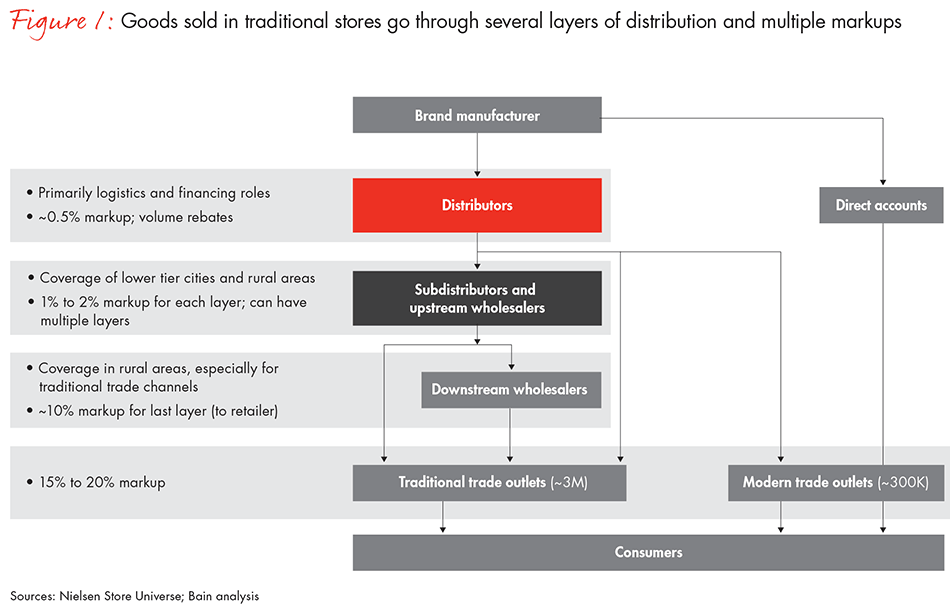
      The critical flaw in the current system—and a growing business problem for manufacturers—is the way it connects manufacturers to what Nielsen estimates to be more than 3 million traditional stores that dot the Chinese landscape. We estimate that these tiny shops in urban neighborhoods and rural areas still account for at least 40% of FMCG sales in China. To move an item, say a can of tomato paste, from a plant near Shanghai to a corner grocery in rural Gansu Province might require several handoffs. The first is to the primary distributor, who takes goods from the factory and passes them to sub-distributors or regional wholesalers, who in turn often rely on one or more layers of sub-distributors. From there, the tomato paste would go to any of the more than 10,000 local wholesalers that deliver goods to traditional stores.

      Now, the day of reckoning has arrived. The receding tide—sales were flat or down in half of FMCG categories from 2014 to 2015—has exposed the bleak economics and dysfunction of the distribution system. At each step, somebody takes a markup on the tomato paste, from about 0.5% for the primary distributor to 10% for the local wholesaler (see Figure 1). By the time the can reaches the shelf in Gansu, we estimate that the markup is easily 15% to 20%. Because of all these layers, when it comes to the millions of traditional shops that handle more than $350 billion in sales every year, manufacturers are flying blind.

      trouble-in-store-fig-01_embed

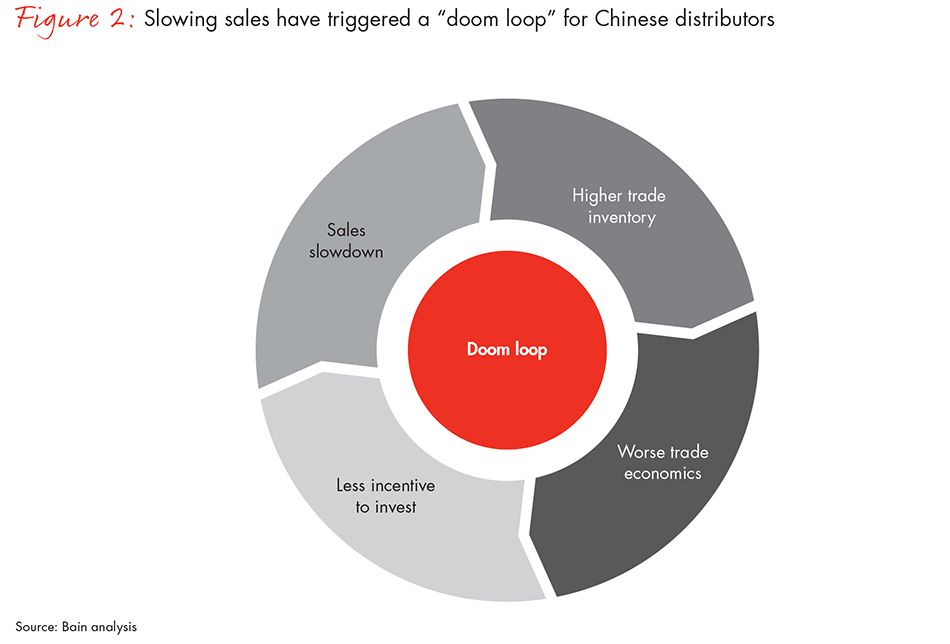
      This distribution system is now showing signs of stress. Many of the primary distributors that manufacturers rely on are poorly capitalized and lack capabilities beyond order taking and basic logistics. In the past, manufacturers simply added more of these distributors to grow sales: Most brands have hundreds of primary distributors. As sales slowed in recent years, manufacturers pushed more goods to these distributors, who turned around and jammed the channels below them, leaving a vast but unknown quantity of merchandise stranded. With thin margins and no capital cushion, some subscale distributors have already exited the business (see Figure 2). There is also constant churn among the sub-distributors and regional wholesalers that move product into smaller cities and rural areas. For one company in the beverage sector, distributor churn exceeded 15% in one of its largest regions last year; a company in packaged food had over 30% churn among its national distributors during a year of significant sales declines.

      trouble-in-store-fig-02_embed

      The woes of China’s distributors are approaching crisis proportions just when brands need them most. Today, only distributors can move products cost effectively to the smaller cities and rural areas where the best growth opportunities are found. Until 2015, when growth moderated, retail sales in Tier-3, Tier-4 and Tier-5 cities were rising by 8% a year, about four times the rate in Tier-1 and Tier-2 cities, according to the Bain-Kantar China Shopper Report. The report shows that even as modern formats such as hypermarkets lose momentum—hypermarket traffic dropped by 4.6% in 2015—growth continues in smaller modern-format grocery and convenience stores, which also rely on distributors.

      All this suggests a long period of rebuilding for China’s retail distribution system. At the end of the process, many of today’s primary distributors will not be around. Those that survive will have invested in the capabilities that brand owners value most: efficient distribution of the product and support in sell-through. At the same time, new digital business platforms are taking root to address the inefficiencies of the current “many brands to many stores” route-to-market (RTM) system. We count at least 50 such e-RTM businesses today, and they could help China leapfrog to a retail distribution system that is more efficient than what we see in some advanced economies. These platforms, however, are stuck in a catch-22: Operators need enough traditional trade outlets to join their platforms so that brand owners will be willing to abandon the old model while retailers want to see enough brands on a platform before they switch from distributors they have used for decades.

      James Root, a partner in the Consumer Products practice, discusses the challenges that brand owners and retailers now face, as well as the emerging digital platforms that could supplant distributors.

      These new platforms promise enormous potential prizes for both retailers and brand owners. Traditional store owners could vastly simplify their lives with one-stop shopping, rather than dealing with dozens of distributors or wholesalers. Brand owners could reduce their RTM costs and improve access to hard-to-reach outlets while gaining perfect visibility of their product during its distribution journey. For distributors and wholesalers, however, the outlook is not encouraging. The $100 billion of markup that Bain estimates flows to them every year in the current model would come under threat. Worse, in some emerging e-RTM models, there is little role for the distributors at all.

      This is all in the future. For the time being, FMCG manufacturers cannot count on distributors of any kind to help them win in a much more challenging Chinese consumer market.

      James Root is a partner in Bain & Company’s Hong Kong office and leader of the firm’s Asia-Pacific Organization practice. Weiwei Xing is a Bain manager also based in Hong Kong.


      trouble-in-store-fig-01_full

      trouble-in-store-fig-02_full
      Autoren
      • Headshot of James Root
        James Root
        Partner, Hong Kong
      • Headshot of Weiwei Xing
        Weiwei Xing
        Alumni, Hong Kong
      Kontaktieren Sie uns
      Verwandte Branchen
      • Konsumgüter
      Ähnliche Beratungsangebote
      • Organisation
      Konsumgüter
      The Hottest Brand in China Is Australia

      How can Australian consumer goods companies profit from China’s hunger for natural, safe and healthy products?

      Mehr erfahren
      Konsumgüter
      Dealing with Two-Speed China

      How China's fast-moving consumer goods market is effectively operating on two speeds across multiple dimensions.

      Mehr erfahren
      Konsumgüter
      Can Southeast Asia Live Up to Its E-commerce Potential?

      With a huge and digitally sophisticated population, Southeast Asia is on the verge of becoming a haven for e-commerce. Winning starts by understanding how consumer behavior here is quickly evolving.

      Mehr erfahren
      Konsumgüter
      Shift to Vertical: David Haines, Group CEO, Flora Food Group

      What does it take to stay connected to your customers when scale and complexity threaten to pull you away? 

      Mehr erfahren
      Konsumgüter
      US Consumer Health Update

      Consumers at every income level entered the year on weaker footing, with the downside risks continuing to grow.

      Mehr erfahren
      First published in November 2016
      Markierungen
      • Konsumgüter
      • Organisation

      Wie wir unsere Kunden unterstützt haben

      Digitalisierung A Strategic Separation Enables New Growth for GSK and Haleon

      Kundenbeispiel lesen

      Kundenstrategie und Marketing Food Co. jump-starts growth with return to core brands

      Kundenbeispiel lesen

      Strategie Focus on core delivers growth for retailer

      Kundenbeispiel lesen

      Möchten Sie mit uns in Kontakt bleiben?

      Wir unterstützen Führungskräfte weltweit, die kritischen Themen in ihrem Unternehmen zu adressieren. Gemeinsam schaffen wir nachhaltige Veränderungen und Ergebnisse.

      Bain Insights. Unsere Perspektive auf die kritischen Themen, mit denen sich international agierende Unternehmen konfrontiert sehen, finden Sie monatlich in Ihrem Postfach.

      *Ich habe die Datenschutzerklärung gelesen und akzeptiere sie.
      Bitte lesen Sie die Datenschutzerklärung und akzeptieren Sie diese.
      Bain & Company
      Contact us Sustainability Accessibility Rechtliche Hinweise Impressum Datenschutz Cookie-Richtlinie Sitemap Log In

      © 1996-2026 Bain & Company, Inc.

      Kontaktieren Sie Bain

      Wie können wir Ihnen helfen?

      • Business inquiry
      • Career information
      • Press relations
      • Partnership request
      • Speaker request
      Alle weltweiten Büros