
Skip to Content
  • Standorte

    Standorte

    North & Latin America
    • Atlanta
    • Austin
    • Bogota
    • Boston
    • Buenos Aires
    • Chicago
    • Dallas
    • Denver
    • Houston
    • Lisbon
    • Los Angeles
    • Mexico City
    • Minneapolis
    • Monterrey
    • Montreal
    • New York
    • Rio de Janeiro
    • San Francisco
    • Santiago
    • São Paulo
    • Seattle
    • Silicon Valley
    • Toronto
    • Washington, DC
    Europe & Africa
    • Amsterdam
    • Athens
    • Berlin
    • Brussels
    • Copenhagen
    • Düsseldorf
    • Frankfurt
    • Helsinki
    • Istanbul
    • Johannesburg
    • Kyiv
    • Lisbon
    • London
    • Madrid
    • Milan
    • München
    • Oslo
    • Paris
    • Rome
    • Stockholm
    • Warsaw
    • Wien
    • Zürich
    Middle East
    • Doha
    • Dubai
    • Riyadh
    Asia & Australia
    • Bangkok
    • Beijing
    • Bengaluru
    • Brisbane
    • Ho Chi Minh City
    • Hong Kong
    • Jakarta
    • Kuala Lumpur
    • Manila
    • Melbourne
    • Mumbai
    • New Delhi
    • Perth
    • Seoul
    • Shanghai
    • Singapore
    • Sydney
    • Tokyo
    Alle Standorte Anzeigen
  • Alumni
  • Presse
  • Newsletter
  • Kontakt
  • DACH-Region | Deutsch

    Wählen Sie Ihre Region und Sprache

    Global
    • Global (English)
    North & Latin America
    • Brazil (Português)
    • Argentina (Español)
    • Canada (Français)
    • Chile (Español)
    • Colombia (Español)
    Europe, Middle East, & Africa
    • France (Français)
    • DACH-Region (Deutsch)
    • Italy (Italiano)
    • Spain (Español)
    • Greece (Elliniká)
    Asia & Australia
    • China (中文版)
    • Korea (한국어)
    • Japan (日本語)
  • Saved items (0)
    Saved items (0)

    You have no saved items.

    Inhalte, für die Sie sich interessieren, werden hier gespeichert und können später gelesen oder weitergeleitet werden.

    Explore Bain Insights
  • Branchenkompetenzen
    Hauptmenü

    Branchenkompetenzen

    • Luft- und Raumfahrt, Verteidigung
    • Agrarwirtschaft
    • Chemieindustrie
    • Infrastruktur und Bauwirtschaft
    • Konsumgüter
    • Finanzdienstleistungen
    • Gesundheitswesen
    • Maschinen- und Anlagenbau
    • Medienwirtschaft
    • Metallindustrie
    • Bergbau
    • Öl und Gas
    • Papier- und Verpackungsindustrie
    • Private Equity
      Branchenkompetenzen
      Private Equity
      • Due Diligence
      • Exit Planning
      • Firm Strategy & Operations
      • Portfolio Value Creation
    • Öffentlicher Sektor und Sozialwesen
    • Einzelhandel
    • Technologie
    • Telekommunikation
    • Transportwesen
    • Reise- und Freizeitbranche
    • Versorgung und erneuerbare Energien
  • Managementkompetenzen
    Hauptmenü

    Managementkompetenzen

    • Customer Experience
    • ESG
    • Innovation
    • M&A
    • Operations
    • People & Organization
    • Private Equity
    • Sales & Marketing
    • Strategie
    • KI, Einblicke und Lösungen
    • Technologie
    • Transformation
  • Digital
  • Publikationen
    Hauptmenü

    Publikationen

    • Branchenthemen
    • Managementthemen
    • Bain-Bücher
    Alle Publikationen
    Ausgewählte Themen
    • Resilienz in der globalen Krise
    • M&A Report
    • Private Equity Podcast
    • Midyear Private Equity Report
    • Agile
    • Engineering Report
    • Digital Transformation
    • Elements of Value®
    • Firm of the Future
    • Nachhaltigkeitsstudie
    • Macro Trends
    • Future of Consumption
    • Weltwirtschaftsforum (WEF)
  • Über uns
    Hauptmenü

    Über uns

    • Was wir bieten
    • Unser Ansatz
    • Unser Team
    • Game Changer Award
    • Female Allstar Board
    • Messbare Ergebnisse (EN)
    • Auszeichnungen
    • Globale Partnerschaften
    • The Mission
    Further: Our global responsibility
    • Vielfalt & Chancengleichheit
    • Soziale Verantwortung
    • Sustainability
    Erfahren Sie mehr zu "Further"
  • Karriere
    Hauptmenü

    Karriere

    • Dein Einstieg
      Karriere
      Dein Einstieg
      • Find Your Place
      • Unsere Arbeitsbereiche
      • Unsere Teams
      • Angebote für Studierende
      • Praktika & Programme
      • Recruiting-Events
    • Arbeiten bei Bain
      Karriere
      Arbeiten bei Bain
      • Blog: Inside Bain
      • Karriere Stories
      • Unsere Bainies
      • Office-Standorte
      • Weiterentwicklung
      • Affinity Groups
      • Deine Benefits
    • Impact Stories
    • Deine Bewerbung
      Karriere
      Deine Bewerbung
      • Das erwartet dich
      • Der Interviewprozess
    FIND JOBS
  • Standorte
    Hauptmenü

    Standorte

    • North & Latin America
      Standorte
      North & Latin America
      • Atlanta
      • Austin
      • Bogota
      • Boston
      • Buenos Aires
      • Chicago
      • Dallas
      • Denver
      • Houston
      • Lisbon
      • Los Angeles
      • Mexico City
      • Minneapolis
      • Monterrey
      • Montreal
      • New York
      • Rio de Janeiro
      • San Francisco
      • Santiago
      • São Paulo
      • Seattle
      • Silicon Valley
      • Toronto
      • Washington, DC
    • Europe & Africa
      Standorte
      Europe & Africa
      • Amsterdam
      • Athens
      • Berlin
      • Brussels
      • Copenhagen
      • Düsseldorf
      • Frankfurt
      • Helsinki
      • Istanbul
      • Johannesburg
      • Kyiv
      • Lisbon
      • London
      • Madrid
      • Milan
      • München
      • Oslo
      • Paris
      • Rome
      • Stockholm
      • Warsaw
      • Wien
      • Zürich
    • Middle East
      Standorte
      Middle East
      • Doha
      • Dubai
      • Riyadh
    • Asia & Australia
      Standorte
      Asia & Australia
      • Bangkok
      • Beijing
      • Bengaluru
      • Brisbane
      • Ho Chi Minh City
      • Hong Kong
      • Jakarta
      • Kuala Lumpur
      • Manila
      • Melbourne
      • Mumbai
      • New Delhi
      • Perth
      • Seoul
      • Shanghai
      • Singapore
      • Sydney
      • Tokyo
    Alle Standorte Anzeigen
  • Alumni
  • Presse
  • Newsletter
  • Kontakt
  • DACH-Region | Deutsch
    Hauptmenü

    Wählen Sie Ihre Region und Sprache

    • Global
      Wählen Sie Ihre Region und Sprache
      Global
      • Global (English)
    • North & Latin America
      Wählen Sie Ihre Region und Sprache
      North & Latin America
      • Brazil (Português)
      • Argentina (Español)
      • Canada (Français)
      • Chile (Español)
      • Colombia (Español)
    • Europe, Middle East, & Africa
      Wählen Sie Ihre Region und Sprache
      Europe, Middle East, & Africa
      • France (Français)
      • DACH-Region (Deutsch)
      • Italy (Italiano)
      • Spain (Español)
      • Greece (Elliniká)
    • Asia & Australia
      Wählen Sie Ihre Region und Sprache
      Asia & Australia
      • China (中文版)
      • Korea (한국어)
      • Japan (日本語)
  • Saved items  (0)
    Hauptmenü
    Saved items (0)

    You have no saved items.

    Inhalte, für die Sie sich interessieren, werden hier gespeichert und können später gelesen oder weitergeleitet werden.

    Explore Bain Insights
  • Branchenkompetenzen
    • Branchenkompetenzen

      • Luft- und Raumfahrt, Verteidigung
      • Agrarwirtschaft
      • Chemieindustrie
      • Infrastruktur und Bauwirtschaft
      • Konsumgüter
      • Finanzdienstleistungen
      • Gesundheitswesen
      • Maschinen- und Anlagenbau
      • Medienwirtschaft
      • Metallindustrie
      • Bergbau
      • Öl und Gas
      • Papier- und Verpackungsindustrie
      • Private Equity
      • Öffentlicher Sektor und Sozialwesen
      • Einzelhandel
      • Technologie
      • Telekommunikation
      • Transportwesen
      • Reise- und Freizeitbranche
      • Versorgung und erneuerbare Energien
  • Managementkompetenzen
    • Managementkompetenzen

      • Customer Experience
      • ESG
      • Innovation
      • M&A
      • Operations
      • People & Organization
      • Private Equity
      • Sales & Marketing
      • Strategie
      • KI, Einblicke und Lösungen
      • Technologie
      • Transformation
  • Digital
  • Publikationen
    • Publikationen

      • Branchenthemen
      • Managementthemen
      • Bain-Bücher
      Alle Publikationen
      Ausgewählte Themen
      • Resilienz in der globalen Krise
      • M&A Report
      • Private Equity Podcast
      • Midyear Private Equity Report
      • Agile
      • Engineering Report
      • Digital Transformation
      • Elements of Value®
      • Firm of the Future
      • Nachhaltigkeitsstudie
      • Macro Trends
      • Future of Consumption
      • Weltwirtschaftsforum (WEF)
  • Über uns
    • Über uns

      • Was wir bieten
      • Unser Ansatz
      • Unser Team
      • Game Changer Award
      • Female Allstar Board
      • Messbare Ergebnisse (EN)
      • Auszeichnungen
      • Globale Partnerschaften
      • The Mission
      Further: Our global responsibility
      • Vielfalt & Chancengleichheit
      • Soziale Verantwortung
      • Sustainability
      Erfahren Sie mehr zu "Further"
  • Karriere
    Häufige Suchanfragen
    • Agil
    • Digital
    • Strategie
    Vorherige Suchanfragen
      Zuletzt besuchte Seiten

      Content added to saved items

      Saved items (0)

      Removed from saved items

      Saved items (0)

      Brief

      Turn your supply chain into a profitable growth engine

      Turn your supply chain into a profitable growth engine

      The power of taking an unconstrained view of supply chains.

      Von Lee Delaney, Russ Torres, Adam Borchert and Miltiadis Athanassiou

      • Min. Lesezeit

      Brief

      Turn your supply chain into a profitable growth engine
      en

      It’s a simple question that has huge consequences. If you cannot answer it with a definitive “yes,” your company will struggle. Yet it’s a question that many consumer products executives fail to ask, much less answer.

      The question—does our supply chain provide a competitive advantage?—is powerful because its answer can predict how successfully a company will grow. If the answer is “yes,” it means the company is well positioned for commercial success. If it’s “maybe” or “no,” your company is likely in or near a vicious cycle of slow growth and financial underperformance.

      That may sound like a bold statement, but a downward spiral is the natural result of an underperforming supply chain. The growth formula for any consumer goods company is a balanced mix of innovation, advertising and pricing optimization. If the supply chain is not working properly, it undermines each one. Poor networks and aging plants hamper the flexibility necessary for profitable innovation, the funding needed for advertising and the efficiency that enables competitive pricing. And once growth starts to slow, the pressures on the supply chain only get worse, making the decline hard to stop.

      Companies have plenty of reasons for neglecting the big questions about their supply chains. They believe that dramatic changes would be prohibitively expensive and returns would be hard to quantify. They worry that the risk of business disruption would outweigh any efficiencies and efforts to close or move plants could create public relations disasters. So instead of looking for system-wide fixes, they task supply executives with squeezing incre-mental gains out of a disadvantaged network.

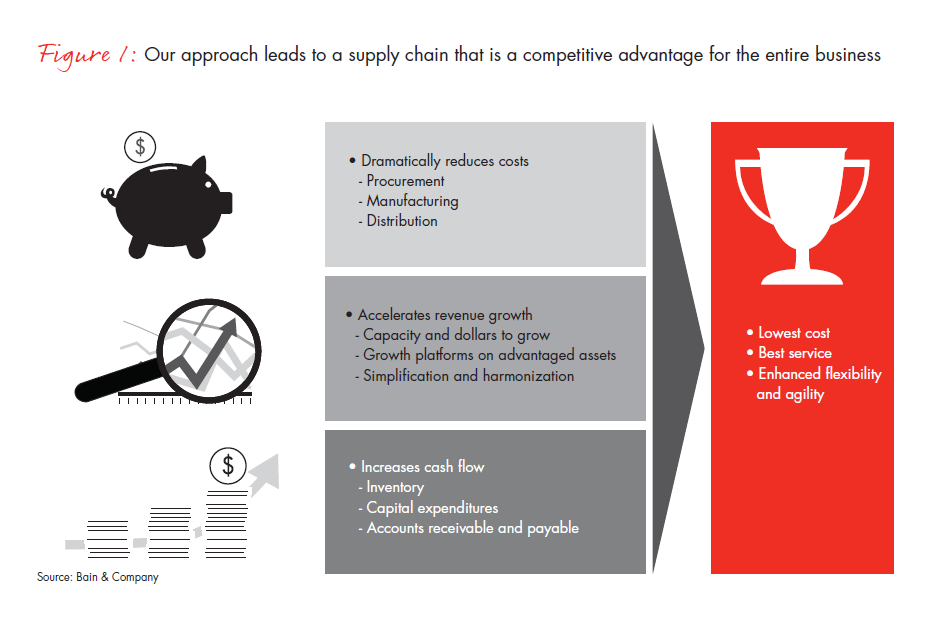
      In our experience, that thinking is almost always dead wrong. The economics of a full transformation can be extremely attractive, and the risks, manageable. And after the transformation, companies see extraordinary results that include 5 to 10 percentage point reductions in the cost of goods sold, hundreds of millions of dollars in additional revenues and a significant increase in available cash (see Figure 1). What’s more, the vicious cycle becomes a virtuous one.

      turn-your-supply-chain-into-fig-01_embed

      How did we get here? The messy state of supply chains

      Supply chains can suffer for a variety of reasons. In developed markets, most consumer products companies designed their supply chains decades ago and have expanded them ad hoc through acquisitions. The result is a patchwork of assets that reflect outdated supply chain principles. It’s not uncommon, for example, to find factories in high-wage locations with multi-floor layouts, nonstandard production equipment across locations, nonstrategic supplier relationships and distribution systems with excess inventory—all of which contribute to elevated costs.

      In developing markets, companies often rush to install new capacity to meet skyrocketing demand. But the need for speed has caused some to skip the crucial step of creating an integrated supply chain vision, which has ultimately meant they missed opportunities to gain more of a competitive advantage.

      Regardless of the cause, the result is often a jumble of networks that are not coordinated with one another. How can a company get from that state of disorder to an optimal supply chain? It starts with rethinking fundamental supply chain assumptions around another simple question: What would it take to win?

      In this short video, Russ Torres, a partner in Bain's Performance Improvement practice, explains why rethinking supply chains can have a tremendous payoff.

      The power of taking an unconstrained view

      To begin the process of rethinking assumptions, we ask executives to take a clean sheet of paper and design a winning supply chain, from scratch. That may sound impractical, and executives frequently balk. Their initial reaction is to pick a smaller, easier problem to tackle or to stay confined within their current constraints.

      Rather than fixing a particular problem, though, the point of the exercise is to consider the integrated whole. Designing to win means illustrating a scenario in which the company produces its ideal product portfolio with the most collaborative supplier base, employing a perfect labor model and state-of-the-art production equipment, and delivering it via the optimal route to the customer. This approach pushes executives to break free of incremental approaches and typically sheds new light on how to unlock value.

      Imagining the best possible design requires a number of steps:

      • Sales and marketing teams define how they will grow and what they need to win, including details such as desired packaging flexibility and target price points. This produces a crisp articulation of commercial needs, which is the bedrock of any good supply chain plan.
      • The full management team works together to define the right level of assortment and promotional complexity, from the shelf back to sourcing.
      • Procurement, manufacturing and logistics teams take an integrated view of the end-to-end supply chain and identify ways to optimize everything from supplier agreements to customer deliveries.
      • Engineering teams imagine state-of-the-art technology that delivers breakthrough performance at lower cost.
      • Human resource teams look for innovative ways to design high-performance work systems.
      • Finance quantifies the benefits available to supply chain transformation, including cost reductions, revenue growth and cash reduction.

      A leading food company’s experience shows how powerful this approach can be. Though it had iconic brands, the company was suffering from a disadvantaged supply chain and delivering mediocre top-line growth and profitability as a result. When executives at the firm started with a clean sheet of paper, however, they uncovered enormous potential. The first step was to simplify the portfolio and either exit or reformulate a group of SKUs that created a disproportionate amount of complexity for the 10% of revenues it produced. From there, the plan they developed revealed the chance to increase the top-line growth rate, reduce costs by 750 basis points and speed the cash conversion cycle. Even more surprising was that the capital investments needed for the overhaul were not significantly greater than what the company would have invested to keep its old, inefficient facilities operating.

      The obvious question, of course, is, how much of the potential opportunity can a company actually capture? The good news: A company can enjoy most, and sometimes all, of the value it sketches out, provided it takes a phased approach that leverages some natural inflection points, such as contract expirations and capital equipment replacement cycles.

      How to get there from here—capturing the full potential value

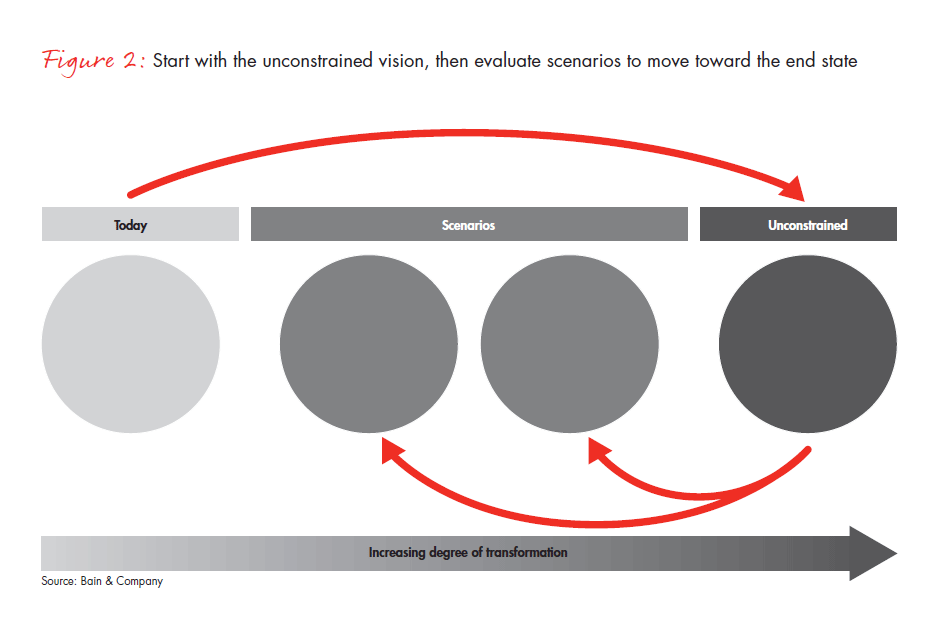
      Once a company defines its unconstrained vision— and only then—should it identify scenarios to test the risk-reward trade-offs inherent in different degrees of transformation (see Figure 2). The irony of taking an unconstrained view is that it typically eliminates many of the barriers that historically prevented action and often prompts managers to gravitate to the more aggressive scenarios.

      turn-your-supply-chain-into-fig-02_embed

      Having a vision that informs the specific scenarios can change the entire conversation. Consider the food company. When executives had a clear sense of the value that lay in recapitalizing their operations with state-of-the-art technologies in new, low-cost geographies, the risks associated with the plan became risks worth taking. Instead of questioning the magnitude of change, people began to ask, “What will it take to change?” They made plans to exit existing facilities over time to take advantage of contract expirations and other cyclical components, which eliminated large chunks of restructuring costs, and found new government incentives to reduce the cost of building new facilities. With this, the company finally broke its decades-old cycle of investing in bad technologies in bad locations.

      To move from today’s supply chain to the desired future scenario, the team then develops detailed action plans for the transformation. Those plans incorporate changes to the physical supply chain, as well as the required organizational capabilities, relationships and processes that need to change in order to best operate the reinvented supply chain. The unconstrained vision becomes a guidepost as the team makes day-to-day decisions, helping them to ensure strategic alignment with the long-term vision.

      The lasting impact on the entire business

      The unconstrained approach yields both a long-term destination for the supply chain and a pragmatic road map for how to get there. The result is a much more competitive position and the capacity to consistently win for the foreseeable future.

      Within four years of beginning its supply chain transformation, the food company saw extraordinary results. The top-line growth rate nearly doubled to 6% per year— thanks to a more efficient supply chain and the additional marketing efforts it spurred and enabled. On the operational front, plant capacity improved by 38%, labor costs dropped by 20% per pound produced and inventories shrank dramatically. Financial results followed suit. Within six years, operating income increased by 750 basis points, the stock delivered more than a 100% return to shareholders and the company became an industry darling in the view of the analysts who cover it.

      If it’s not clear that your supply chain provides an advantage to your business, we encourage you to break out a clean sheet of paper. Though transforming the supply chain is never easy, the payoff can be tremendous.

      Lee Delaney is a Bain partner based in Boston and leads the firm’s Consumer Products practice in the Americas. Russ Torres is a Bain partner based in Chicago. Adam Borchert is a Bain partner based in Boston. Miltiadis Athanassiou is a Bain partner based in Zurich. Andrew Rostami, a principal in the Boston office, also contributed to this report.


      turn-your-supply-chain-into-fig-01_full

      turn-your-supply-chain-into-fig-02_full
      Autoren
      • Headshot of Adam Borchert
        Adam Borchert
        Partner, Boston
      • Headshot of Miltiadis Athanassiou
        Miltiadis Athanassiou
        Partner, Zürich
      Kontaktieren Sie uns
      Verwandte Branchen
      • Konsumgüter
      Ähnliche Beratungsangebote
      • Supply Chain
      Performance Improvement
      Supply-chain barriers harm global trade more than tariffs

      Governments and companies need to focus on the supply-chain barriers that have become the biggest obstacle to free trade.

      Mehr erfahren
      Konsumgüter
      Growth through simplicity: How the best consumer goods players are getting bigger by getting smaller

      By focusing only on winning products, consumer goods companies are finding a way to outperform.

      Mehr erfahren
      Adam Borchert: Reinventing supply chains

      Partner Adam Borchert explains the benefits of a finely honed supply chain in this short video.

      Mehr erfahren
      Konsumgüter
      Tariff Turbulence: What Consumer Goods Companies Need to Know

      How leaders will turn tariff risk into strategic advantage.

      Mehr erfahren
      Konsumgüter
      Insurgent Q&A: Chomps Cofounder Rashid Ali

      “Our retail expansion story isn’t about taking share—it’s about growing the category.”

      Mehr erfahren
      First published in Oktober 2013
      Markierungen
      • Konsumgüter
      • Supply Chain

      Wie wir unsere Kunden unterstützt haben

      Digitalisierung A Strategic Separation Enables New Growth for GSK and Haleon

      Kundenbeispiel lesen

      Kundenstrategie und Marketing Food Co. jump-starts growth with return to core brands

      Kundenbeispiel lesen

      Strategie Focus on core delivers growth for retailer

      Kundenbeispiel lesen

      Möchten Sie mit uns in Kontakt bleiben?

      Wir unterstützen Führungskräfte weltweit, die kritischen Themen in ihrem Unternehmen zu adressieren. Gemeinsam schaffen wir nachhaltige Veränderungen und Ergebnisse.

      Bain Insights. Unsere Perspektive auf die kritischen Themen, mit denen sich international agierende Unternehmen konfrontiert sehen, finden Sie monatlich in Ihrem Postfach.

      *Ich habe die Datenschutzerklärung gelesen und akzeptiere sie.
      Bitte lesen Sie die Datenschutzerklärung und akzeptieren Sie diese.
      Bain & Company
      Contact us Sustainability Accessibility Rechtliche Hinweise Impressum Datenschutz Cookie-Richtlinie Sitemap Log In

      © 1996-2026 Bain & Company, Inc.

      Kontaktieren Sie Bain

      Wie können wir Ihnen helfen?

      • Business inquiry
      • Career information
      • Press relations
      • Partnership request
      • Speaker request
      Alle weltweiten Büros