
Skip to Content
  • Uffici

    Uffici

    Nord e Sud America
    • Atlanta
    • Austin
    • Bogota
    • Boston
    • Buenos Aires
    • Chicago
    • Dallas
    • Denver
    • Houston
    • Los Angeles
    • Mexico City
    • Minneapolis
    • Monterrey
    • Montreal
    • New York
    • Rio de Janeiro
    • San Francisco
    • Santiago
    • São Paulo
    • Seattle
    • Silicon Valley
    • Toronto
    • Washington, DC
    Europa, Medio Oriente e Africa
    • Amsterdam
    • Athens
    • Berlin
    • Brussels
    • Copenhagen
    • Doha
    • Dubai
    • Dusseldorf
    • Frankfurt
    • Helsinki
    • Istanbul
    • Johannesburg
    • Kyiv
    • Lisbon
    • London
    • Madrid
    • Milan
    • Munich
    • Oslo
    • Paris
    • Riyadh
    • Rome
    • Stockholm
    • Vienna
    • Warsaw
    • Zurich
    Asia e Australia
    • Bangkok
    • Beijing
    • Bengaluru
    • Brisbane
    • Ho Chi Minh City
    • Hong Kong
    • Jakarta
    • Kuala Lumpur
    • Manila
    • Melbourne
    • Mumbai
    • New Delhi
    • Perth
    • Seoul
    • Shanghai
    • Singapore
    • Sydney
    • Tokyo
    Guarda tutti gli uffici
  • Alumni
  • Media Center
  • Iscriviti
  • Contattaci
  • Italy | Italiano

    Seleziona il tuo Paese e la tua lingua

    Global
    • Global (English)
    Nord e Sud America
    • Brazil (Português)
    • Argentina (Español)
    • Canada (Français)
    • Chile (Español)
    • Colombia (Español)
    Europa, Medio Oriente e Africa
    • France (Français)
    • DACH Region (Deutsch)
    • Italy (Italiano)
    • Spain (Español)
    • Greece (Elliniká)
    Asia e Australia
    • China (中文版)
    • Korea (한국어)
    • Japan (日本語)
  • Saved items (0)
    Saved items (0)

    You have no saved items.

    Contrassegna il contenuto che ti interessa e verrà salvato qui. Potrai leggerlo o condividerlo in seguito.

    Explore Bain Insights
  • Settori
    Menu principale

    Settori

    • Aerospazio e Difesa
    • Agribusiness
    • Chimica
    • Infrastrutture e Costruzioni
    • Beni di Largo Consumo
    • Servizi Finanziari
    • Sanità
    • Macchinari Industriali
    • Media & Intrattenimento
    • Industria Metallurgica
    • Industria Mineraria
    • Petrolio e Gas
    • Industria Cartaria e Packaging
    • Private Equity
    • Settore Sociale & Pubblico
    • Retail
    • Tecnologia
    • Telecomunicazioni
    • Compagnie Aeree & Trasporti
    • Viaggi e Svago
    • Utility e Rinnovabili
  • Servizi di Consulenza
    Menu principale

    Servizi di Consulenza

    • Customer Experience
    • ESG
    • Innovation
    • M&A and Divestitures
    • Operation
    • People & Organization
    • Private Equity
    • Sales & Marketing
    • Strategia
    • IA, Approfondimenti e Soluzioni
    • Tecnologia
    • Trasformazione
  • Digital
  • Tematiche
  • Informazioni su Bain
    Menu principale

    Informazioni su Bain

    • Che Cosa Facciamo
    • Quello in Cui Crediamo
    • Le Nostre Persone e la Leadership
    • Risultati
    • Premi e Riconoscimenti
    • Organizzazioni Globali
    Further: Our global responsibility
    • Diversità e Inclusione
    • Social Impact
    • Sustainability
    • World Economic Forum
    Learn more about Further
  • Careers
    Menu principale

    Careers

    • Work with Us
      Careers
      Work with Us
      • Find Your Place
      • Our Work Areas
      • Integrated Teams
      • Students
      • Internships & Programs
      • Recruiting Events
    • Life at Bain
      Careers
      Life at Bain
      • Blog: Inside Bain
      • Career Stories
      • Our People
      • Where We Work
      • Supporting Your Growth
      • Affinity Groups
      • Benefits
    • Impact Stories
    • Hiring Process
      Careers
      Hiring Process
      • What to Expect
      • Interviewing
    FIND JOBS
  • Uffici
    Menu principale

    Uffici

    • Nord e Sud America
      Uffici
      Nord e Sud America
      • Atlanta
      • Austin
      • Bogota
      • Boston
      • Buenos Aires
      • Chicago
      • Dallas
      • Denver
      • Houston
      • Los Angeles
      • Mexico City
      • Minneapolis
      • Monterrey
      • Montreal
      • New York
      • Rio de Janeiro
      • San Francisco
      • Santiago
      • São Paulo
      • Seattle
      • Silicon Valley
      • Toronto
      • Washington, DC
    • Europa, Medio Oriente e Africa
      Uffici
      Europa, Medio Oriente e Africa
      • Amsterdam
      • Athens
      • Berlin
      • Brussels
      • Copenhagen
      • Doha
      • Dubai
      • Dusseldorf
      • Frankfurt
      • Helsinki
      • Istanbul
      • Johannesburg
      • Kyiv
      • Lisbon
      • London
      • Madrid
      • Milan
      • Munich
      • Oslo
      • Paris
      • Riyadh
      • Rome
      • Stockholm
      • Vienna
      • Warsaw
      • Zurich
    • Asia e Australia
      Uffici
      Asia e Australia
      • Bangkok
      • Beijing
      • Bengaluru
      • Brisbane
      • Ho Chi Minh City
      • Hong Kong
      • Jakarta
      • Kuala Lumpur
      • Manila
      • Melbourne
      • Mumbai
      • New Delhi
      • Perth
      • Seoul
      • Shanghai
      • Singapore
      • Sydney
      • Tokyo
    Guarda tutti gli uffici
  • Alumni
  • Media Center
  • Iscriviti
  • Contattaci
  • Italy | Italiano
    Menu principale

    Seleziona il tuo Paese e la tua lingua

    • Global
      Seleziona il tuo Paese e la tua lingua
      Global
      • Global (English)
    • Nord e Sud America
      Seleziona il tuo Paese e la tua lingua
      Nord e Sud America
      • Brazil (Português)
      • Argentina (Español)
      • Canada (Français)
      • Chile (Español)
      • Colombia (Español)
    • Europa, Medio Oriente e Africa
      Seleziona il tuo Paese e la tua lingua
      Europa, Medio Oriente e Africa
      • France (Français)
      • DACH Region (Deutsch)
      • Italy (Italiano)
      • Spain (Español)
      • Greece (Elliniká)
    • Asia e Australia
      Seleziona il tuo Paese e la tua lingua
      Asia e Australia
      • China (中文版)
      • Korea (한국어)
      • Japan (日本語)
  • Saved items  (0)
    Menu principale
    Saved items (0)

    You have no saved items.

    Contrassegna il contenuto che ti interessa e verrà salvato qui. Potrai leggerlo o condividerlo in seguito.

    Explore Bain Insights
  • Settori
    • Settori

      • Aerospazio e Difesa
      • Agribusiness
      • Chimica
      • Infrastrutture e Costruzioni
      • Beni di Largo Consumo
      • Servizi Finanziari
      • Sanità
      • Macchinari Industriali
      • Media & Intrattenimento
      • Industria Metallurgica
      • Industria Mineraria
      • Petrolio e Gas
      • Industria Cartaria e Packaging
      • Private Equity
      • Settore Sociale & Pubblico
      • Retail
      • Tecnologia
      • Telecomunicazioni
      • Compagnie Aeree & Trasporti
      • Viaggi e Svago
      • Utility e Rinnovabili
  • Servizi di Consulenza
    • Servizi di Consulenza

      • Customer Experience
      • ESG
      • Innovation
      • M&A and Divestitures
      • Operation
      • People & Organization
      • Private Equity
      • Sales & Marketing
      • Strategia
      • IA, Approfondimenti e Soluzioni
      • Tecnologia
      • Trasformazione
  • Digital
  • Tematiche
  • Informazioni su Bain
    • Informazioni su Bain

      • Che Cosa Facciamo
      • Quello in Cui Crediamo
      • Le Nostre Persone e la Leadership
      • Risultati
      • Premi e Riconoscimenti
      • Organizzazioni Globali
      Further: Our global responsibility
      • Diversità e Inclusione
      • Social Impact
      • Sustainability
      • World Economic Forum
      Learn more about Further
  • Careers
    Ricerche più popolari
    • Agile
    • Digitale
    • Strategia
    La tue ricerche precedenti
      Pagine visitate

      Content added to saved items

      Saved items (0)

      Removed from saved items

      Saved items (0)

      Report

      Due Diligence: Evolving Approaches Boost the Odds of Success

      Due Diligence: Evolving Approaches Boost the Odds of Success

      Poor diligence is the root cause of deal failure.

      Di Les Baird, David Harding, Andrei Vorobyov. Martin Holzapfel and Shikha Dhar

      • Tempo di lettura min.
      }

      Report

      Due Diligence: Evolving Approaches Boost the Odds of Success
      en
      In evidenza
      • The root cause of most deal failures can be traced back to the beginning—the diligence phase.
      • The best acquirers improve their odds of getting it right through clean teams and cross-functional teaming, especially in scale deals.
      • Scope deals, primarily done for growth and capabilities, are even harder to get right, sources of value creation and risk are less predictable, and outcomes can vary a lot from the base-case expectation.
      • As such, scope deal diligence requires a deeper assessment in two areas: standalone asset quality and joint value-creation potential. The latter is particularly challenging and elusive.

      This article is Section 4.2 of Bain's 2020 Global Corporate M&A Report. Explore our latest annual M&A report here.

      Most deals failures can be traced back to poor diligence

      We have said this before. Although failed integrations grab the headlines, poor diligence is the most common root cause of deal failure. We surveyed senior executives earlier this decade, when scale deals were the norm, about the reasons for their disappointing deal outcomes. Almost 60% of executives attributed deal failure to poor due diligence that did not identify critical issues.

      Not much has changed since then. Our 2019 survey of senior executives confirms that this finding holds true for scope deals as much as it does for scale deals. Failure of due diligence to highlight issues around asset quality was the No. 1 reason for unsuccessful capability deals. Similarly, success of capability deals was attributed in great part to a deeper diligence process. The key factors for deal success and failure have not changed much, even as M&A trends shift toward scope deals.

      Before we dive into the bespoke approach for scope deal diligence, let’s recap some of the basics of good diligence for all deal types.

      Getting the basics right

      Experienced and successful acquirers take a systematic approach to diligence (see Figure 4.3). They start with a clearly articulated and testable deal thesis that guides where diligence efforts should focus. Beyond market growth drivers, competitive assessment and customer feedback, seasoned acquirers assess big swing factors such as a recession scenario or digital disruption risk.

      In scope deals, starting with an independent deal thesis and assessing the outcomes for different scenarios takes on added importance. The outcomes can vary by significantly greater degrees of magnitude from the base case than they can in scale deals. Usually, things will be much better or much worse than you expect. Even so, we see many acquirers not paying enough attention to the downside scenario and the need to think through potential responses.

      In scale and scope deals alike, the best acquirers assess both the standalone target’s attractiveness (playing defense) and the full potential for joint value creation under their ownership (playing offense). In scope deals, at today’s valuation levels, playing offense is increasingly the norm to stay in the game. Corporates desperate for growth are indeed stretching the bounds of valuations that can be justified based on reasonable and tangible synergy assumptions alone. This raises the bar to be creative in the search for the joint value-creation potential.

      Figure 4.3
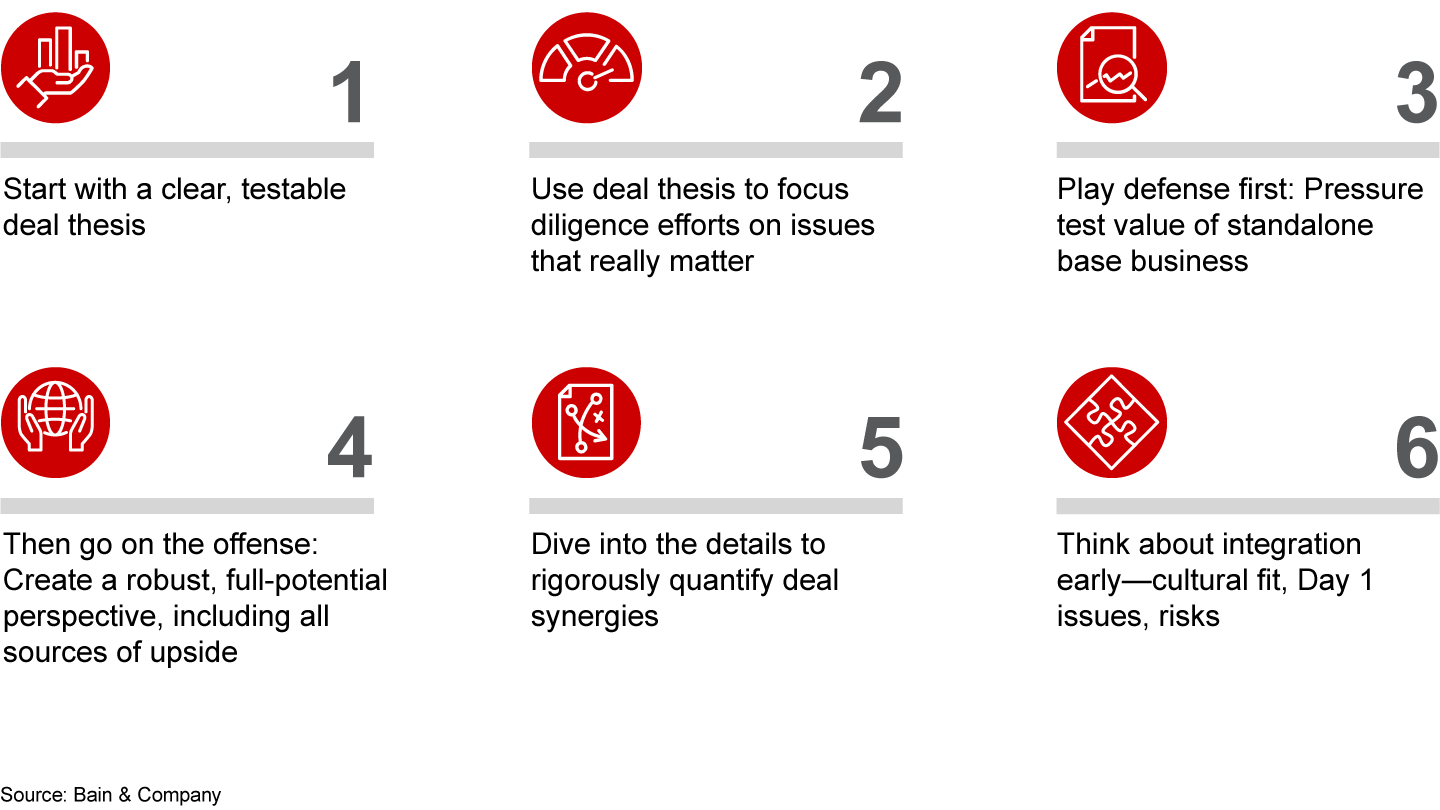
      Classic good diligence approach
      Classic good diligence approach
      Classic good diligence approach

      When the stakes get higher, get the odds on your side

      Especially in scale deals, we now see more companies relying on cross-functional teaming and clean teams to make better value assessments at the diligence stage. By bringing together functional experts, acquirers go deeper on key sources of value and risks. Within strict legal protocols, clean teams enable sharing certain types of data between the prospective acquirer and the target company. This enables an analysis of specific value drivers, such as cost positions, customer overlap, salesforce coverage and procurement spending, to identify and quantify synergies before signing the deal. These approaches enable better synergy assessment and faster realization, greatly improving deal outcomes in scale deals.

      For example, a global chemical company was considering its largest acquisition. The acquirer’s five-month diligence effort, with the help of 13 cross-functional teams, included extensive commercial and cost synergy sizing. The level of rigor enabled it to get a handle on specific value-creation opportunities. The cross-functional teaming delivered added benefits—namely, early buy-in for the deal across the organization and the identification of potential integration risks.

      Similarly, a due diligence clean team was instrumental when a US medical device maker pursued a target with an innovative neurology product line and strong sales relationships. During the six-month diligence effort, the clean team analyzed both companies' sales data and confirmed key deal value assumptions on dis-synergies such as account overlaps and salesforce compensation differences.

      What’s unique about assessing the value in scope deals?

      To recap what we discussed in last year’s report, in scale combinations, the buyer intimately knows the industry and the rules of the road. There is a well-established playbook for diligence and integration. After all, the primary value-creation levers are market position, cost synergies and operational efficiencies.

      It is different with scope deals. They carry higher deal premiums and yield much lower cost synergies. The sources of value often come from revenue synergies and capability transfer. The risk of disrupting the target’s base business is equally high in both types, but talent flight risk is a bigger concern in scope deals. An acquirer does not know the target’s business and cannot run it with its own talent. These unique considerations need to be assessed at the time of diligence.

      Scope deal diligence involves a much deeper dive into the target’s industry attractiveness, business model, keystone capabilities, standalone growth potential and the caliber of the management team. Value assessment tends to be more forward looking around revenue synergies and future option value.

      Scope deals require playing defense and offense (see Figure 4.4). First, you need to be able to assess the standalone asset quality well: How robust are its value proposition and business model? What do customers say about it? That’s the defense. Next, you play offense by understanding the combined value-creation potential: How can you accelerate the target’s growth or the growth of your own related businesses? What value can you create over and above the target’s standalone potential?

      Evaluating and quantifying the joint value-creation potential in a scope deal is tough. Cost synergies are hard enough to assess, but revenue synergies are even more elusive. In many deal models, revenue synergies are rightly assigned low probabilities. On the other hand, we also see scope deals at high valuations that can only be justified by revenue upside. Getting a better handle on how to assess and realize the value greatly improves the outcomes from scope deals.

      Figure 4.4
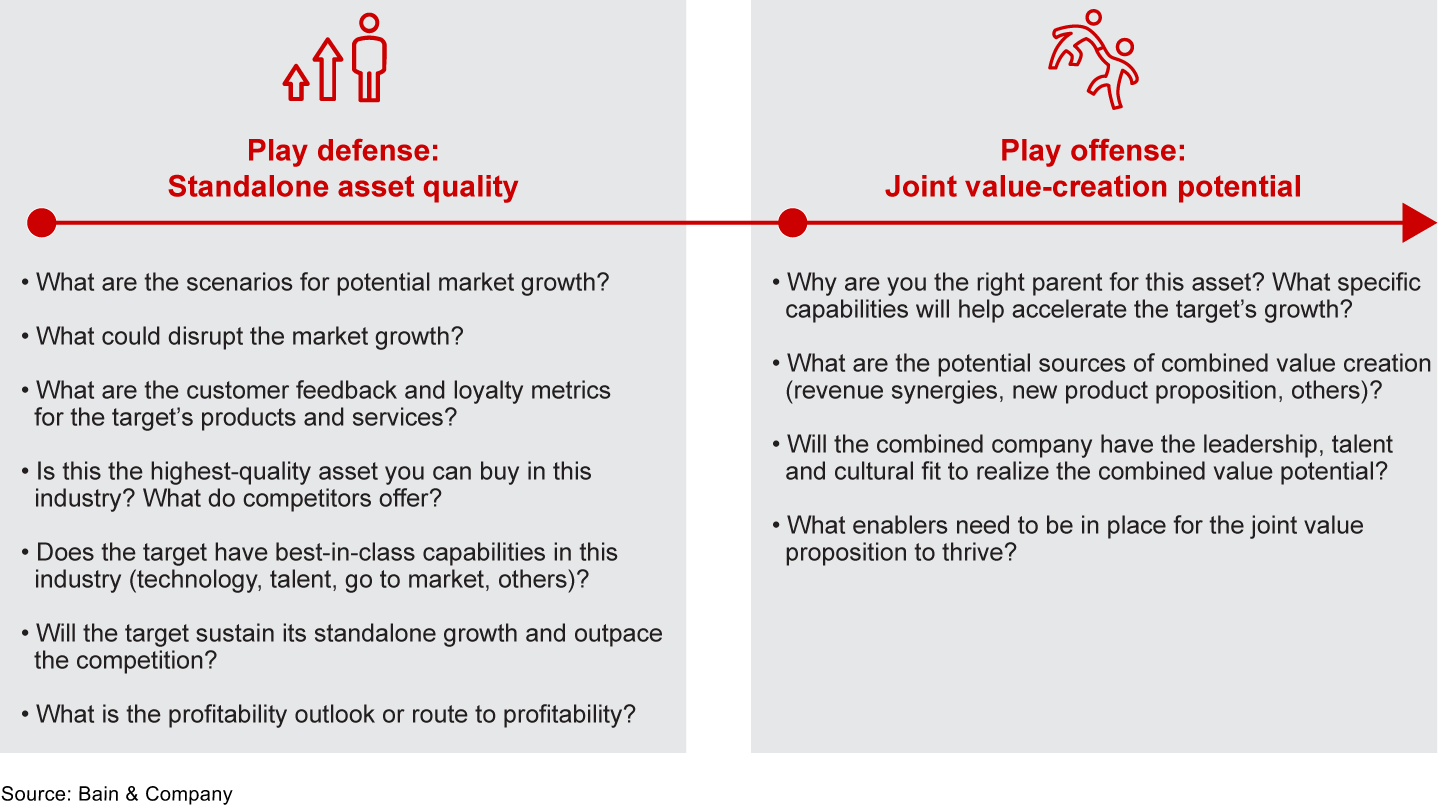
      Assessing the value in scope deals
      Assessing the value in scope deals
      Assessing the value in scope deals

      For example, a European industrials company that makes tools for the automotive industry wanted to strengthen its product portfolio. During diligence on the standalone asset quality, the acquirer quickly narrowed its focus to very specific questions by involving a group of relevant experts and business leaders early in the process. Among the big questions: How good is the capability when compared with competitors’ technology? How future-proof is it? How complex would it be to integrate the target’s capabilities with existing products?

      External validation through customer interviews helped confirm the products’ reputation and feedback. By involving in-house technical professionals early in the process, the company was also able to estimate the R&D investment that would be required to further refine the target’s technology and integrate with the existing product range. Given the high valuation levels, the company also identified some quick wins—for example, cross-selling opportunities that would help to show early momentum on value creation.

      In another example, a global personal care brand acquired a premium skincare company operating in four European countries and China. The target was a young, high-growth company with a strong brand image for quality. It was growing rapidly and profitably on a standalone basis. The ability to outline the joint value-creation potential was the key to winning this hotly contested deal. The acquirer’s proposition included leveraging its global distribution network to enable the target company to enter new geographies while also benefiting from the latter’s presence in China. Given the deal’s high multiple, it is clear that a large part of the valuation hinged on the ability to accelerate the target’s growth through combined capabilities.

      Scope deals represent investments typically outside your immediate industry boundaries. As such, it takes longer to understand the target’s industry, competitive dynamics, business model and capabilities. Also, it is harder to assess revenue synergies and other sources of combined value creation. The best acquirers apply the same rigor in assessing revenue synergies as they would for cost synergies.

      Ultimately, investing the time and energy to pressure test and articulate a robust deal thesis is a no-regrets move. Either you dodge the bullet on an overvalued deal, or you set yourself up with a strong plan for successful integration later.

      This article is part of Bain’s 2020 Global Corporate M&A Report. Explore the contents of the report here or download the PDF to read the full report.

      Read the Next Section

      Integration: Why Less Is More in Capability Deals

      Autori
      • Headshot of Les Baird
        Les Baird
        Partner, Boston
      • Headshot of David Harding
        David Harding
        Advisory Partner, Boston
      • Andrei Vorobyov
        Alumni, Copenhagen
      Contattaci
      Servizi di consulenza collegati
      • M&A Due Diligence
      • Mergers and Acquisitions
      • Post-Merger Integration
      Come possiamo aiutarti
      • Due Diligence
      • M&A Capability
      Mergers and Acquisitions
      Integration: Why Less Is More in Capability Deals

      Capability acquirers win by learning from the target and its leadership.

      Leggi di più
      M&A Due Diligence
      Martin Holzapfel: Strategic Due Diligence

      Executives need to take a systematic approach when doing due diligence.

      Leggi di più
      M&A Capability
      Mining M&A

      The next frontier isn’t about avoiding failure; it’s about mastering repeatable success.

      Leggi di più
      M&A Capability
      The Coming Wave of Banking M&A

      Covid-19 will spur further consolidation, and the most active acquirers have a leg up.

      Leggi di più
      Mergers and Acquisitions
      Defense M&A

      Bold moves will determine the winners as a continent rearms.

      Leggi di più
      First published in gennaio 2020
      Tags
      • Due Diligence
      • M&A Capability
      • M&A Due Diligence
      • Mergers and Acquisitions
      • Post-Merger Integration

      Come abbiamo aiutato i nostri clienti

      An EPC Leader Transforms Itself Amid Intense Volatility

      Leggi un caso di studio

      Quick due diligence results in a well-timed purchase

      Leggi un caso di studio

      Strategia A cable TV acquisition nets 70% IRR

      Leggi un caso di studio

      Vuoi continuare la conversazione?

      Aiutiamo i leader globali e le loro aziende ad affrontare problemi e a cogliere le opportunità. Sosteniamo cambiamenti e otteniamo risultati duraturi.

      Bain Insights. Le nostre idee e punti di vista sulle tematiche che le aziende globali affrontano ogni giorno, arrivano nella tua email tutti i mesi.

      *Ho letto l'Informativa sulla Privacy e accetto i termini e le condizioni.

      Si prega di leggere e accettare l’Informativa sulla Privacy
      Bain & Company
      Contattaci Sustainability Accessibility Condizioni d’uso Privacy Cookie Policy Sitemap Log In

      © 1996-2026 Bain & Company, Inc.

      Contatta Bain

      Come posso aiutarti?

      • Business inquiry
      • Career information
      • Press relations
      • Partnership request
      • Speaker request
      Guarda tutti gli uffici