
Skip to Content
  • Uffici

    Uffici

    Nord e Sud America
    • Atlanta
    • Austin
    • Bogota
    • Boston
    • Buenos Aires
    • Chicago
    • Dallas
    • Denver
    • Houston
    • Los Angeles
    • Mexico City
    • Minneapolis
    • Monterrey
    • Montreal
    • New York
    • Rio de Janeiro
    • San Francisco
    • Santiago
    • São Paulo
    • Seattle
    • Silicon Valley
    • Toronto
    • Washington, DC
    Europa, Medio Oriente e Africa
    • Amsterdam
    • Athens
    • Berlin
    • Brussels
    • Copenhagen
    • Doha
    • Dubai
    • Dusseldorf
    • Frankfurt
    • Helsinki
    • Istanbul
    • Johannesburg
    • Kyiv
    • Lisbon
    • London
    • Madrid
    • Milan
    • Munich
    • Oslo
    • Paris
    • Riyadh
    • Rome
    • Stockholm
    • Vienna
    • Warsaw
    • Zurich
    Asia e Australia
    • Bangkok
    • Beijing
    • Bengaluru
    • Brisbane
    • Ho Chi Minh City
    • Hong Kong
    • Jakarta
    • Kuala Lumpur
    • Manila
    • Melbourne
    • Mumbai
    • New Delhi
    • Perth
    • Seoul
    • Shanghai
    • Singapore
    • Sydney
    • Tokyo
    Guarda tutti gli uffici
  • Alumni
  • Media Center
  • Iscriviti
  • Contattaci
  • Italy | Italiano

    Seleziona il tuo Paese e la tua lingua

    Global
    • Global (English)
    Nord e Sud America
    • Brazil (Português)
    • Argentina (Español)
    • Canada (Français)
    • Chile (Español)
    • Colombia (Español)
    Europa, Medio Oriente e Africa
    • France (Français)
    • DACH Region (Deutsch)
    • Italy (Italiano)
    • Spain (Español)
    • Greece (Elliniká)
    Asia e Australia
    • China (中文版)
    • Korea (한국어)
    • Japan (日本語)
  • Saved items (0)
    Saved items (0)

    You have no saved items.

    Contrassegna il contenuto che ti interessa e verrà salvato qui. Potrai leggerlo o condividerlo in seguito.

    Explore Bain Insights
  • Settori
    Menu principale

    Settori

    • Aerospazio e Difesa
    • Agribusiness
    • Chimica
    • Infrastrutture e Costruzioni
    • Beni di Largo Consumo
    • Servizi Finanziari
    • Sanità
    • Macchinari Industriali
    • Media & Intrattenimento
    • Industria Metallurgica
    • Industria Mineraria
    • Petrolio e Gas
    • Industria Cartaria e Packaging
    • Private Equity
    • Settore Sociale & Pubblico
    • Retail
    • Tecnologia
    • Telecomunicazioni
    • Compagnie Aeree & Trasporti
    • Viaggi e Svago
    • Utility e Rinnovabili
  • Servizi di Consulenza
    Menu principale

    Servizi di Consulenza

    • Customer Experience
    • ESG
    • Innovation
    • M&A and Divestitures
    • Operation
    • People & Organization
    • Private Equity
    • Sales & Marketing
    • Strategia
    • IA, Approfondimenti e Soluzioni
    • Tecnologia
    • Trasformazione
  • Digital
  • Tematiche
  • Informazioni su Bain
    Menu principale

    Informazioni su Bain

    • Che Cosa Facciamo
    • Quello in Cui Crediamo
    • Le Nostre Persone e la Leadership
    • Risultati
    • Premi e Riconoscimenti
    • Organizzazioni Globali
    Further: Our global responsibility
    • Diversità e Inclusione
    • Social Impact
    • Sustainability
    • World Economic Forum
    Learn more about Further
  • Careers
    Menu principale

    Careers

    • Work with Us
      Careers
      Work with Us
      • Find Your Place
      • Our Work Areas
      • Integrated Teams
      • Students
      • Internships & Programs
      • Recruiting Events
    • Life at Bain
      Careers
      Life at Bain
      • Blog: Inside Bain
      • Career Stories
      • Our People
      • Where We Work
      • Supporting Your Growth
      • Affinity Groups
      • Benefits
    • Impact Stories
    • Hiring Process
      Careers
      Hiring Process
      • What to Expect
      • Interviewing
    FIND JOBS
  • Uffici
    Menu principale

    Uffici

    • Nord e Sud America
      Uffici
      Nord e Sud America
      • Atlanta
      • Austin
      • Bogota
      • Boston
      • Buenos Aires
      • Chicago
      • Dallas
      • Denver
      • Houston
      • Los Angeles
      • Mexico City
      • Minneapolis
      • Monterrey
      • Montreal
      • New York
      • Rio de Janeiro
      • San Francisco
      • Santiago
      • São Paulo
      • Seattle
      • Silicon Valley
      • Toronto
      • Washington, DC
    • Europa, Medio Oriente e Africa
      Uffici
      Europa, Medio Oriente e Africa
      • Amsterdam
      • Athens
      • Berlin
      • Brussels
      • Copenhagen
      • Doha
      • Dubai
      • Dusseldorf
      • Frankfurt
      • Helsinki
      • Istanbul
      • Johannesburg
      • Kyiv
      • Lisbon
      • London
      • Madrid
      • Milan
      • Munich
      • Oslo
      • Paris
      • Riyadh
      • Rome
      • Stockholm
      • Vienna
      • Warsaw
      • Zurich
    • Asia e Australia
      Uffici
      Asia e Australia
      • Bangkok
      • Beijing
      • Bengaluru
      • Brisbane
      • Ho Chi Minh City
      • Hong Kong
      • Jakarta
      • Kuala Lumpur
      • Manila
      • Melbourne
      • Mumbai
      • New Delhi
      • Perth
      • Seoul
      • Shanghai
      • Singapore
      • Sydney
      • Tokyo
    Guarda tutti gli uffici
  • Alumni
  • Media Center
  • Iscriviti
  • Contattaci
  • Italy | Italiano
    Menu principale

    Seleziona il tuo Paese e la tua lingua

    • Global
      Seleziona il tuo Paese e la tua lingua
      Global
      • Global (English)
    • Nord e Sud America
      Seleziona il tuo Paese e la tua lingua
      Nord e Sud America
      • Brazil (Português)
      • Argentina (Español)
      • Canada (Français)
      • Chile (Español)
      • Colombia (Español)
    • Europa, Medio Oriente e Africa
      Seleziona il tuo Paese e la tua lingua
      Europa, Medio Oriente e Africa
      • France (Français)
      • DACH Region (Deutsch)
      • Italy (Italiano)
      • Spain (Español)
      • Greece (Elliniká)
    • Asia e Australia
      Seleziona il tuo Paese e la tua lingua
      Asia e Australia
      • China (中文版)
      • Korea (한국어)
      • Japan (日本語)
  • Saved items  (0)
    Menu principale
    Saved items (0)

    You have no saved items.

    Contrassegna il contenuto che ti interessa e verrà salvato qui. Potrai leggerlo o condividerlo in seguito.

    Explore Bain Insights
  • Settori
    • Settori

      • Aerospazio e Difesa
      • Agribusiness
      • Chimica
      • Infrastrutture e Costruzioni
      • Beni di Largo Consumo
      • Servizi Finanziari
      • Sanità
      • Macchinari Industriali
      • Media & Intrattenimento
      • Industria Metallurgica
      • Industria Mineraria
      • Petrolio e Gas
      • Industria Cartaria e Packaging
      • Private Equity
      • Settore Sociale & Pubblico
      • Retail
      • Tecnologia
      • Telecomunicazioni
      • Compagnie Aeree & Trasporti
      • Viaggi e Svago
      • Utility e Rinnovabili
  • Servizi di Consulenza
    • Servizi di Consulenza

      • Customer Experience
      • ESG
      • Innovation
      • M&A and Divestitures
      • Operation
      • People & Organization
      • Private Equity
      • Sales & Marketing
      • Strategia
      • IA, Approfondimenti e Soluzioni
      • Tecnologia
      • Trasformazione
  • Digital
  • Tematiche
  • Informazioni su Bain
    • Informazioni su Bain

      • Che Cosa Facciamo
      • Quello in Cui Crediamo
      • Le Nostre Persone e la Leadership
      • Risultati
      • Premi e Riconoscimenti
      • Organizzazioni Globali
      Further: Our global responsibility
      • Diversità e Inclusione
      • Social Impact
      • Sustainability
      • World Economic Forum
      Learn more about Further
  • Careers
    Ricerche più popolari
    • Agile
    • Digitale
    • Strategia
    La tue ricerche precedenti
      Pagine visitate

      Content added to saved items

      Saved items (0)

      Removed from saved items

      Saved items (0)

      Report

      The One-Two Punch: Virtual Selling and Sales Playbooks

      The One-Two Punch: Virtual Selling and Sales Playbooks

      Technology companies don’t need to hit the streets to hit their quotas.

      Di Mark Kovac e Dianne Ledingham

      • Tempo di lettura min.
      }

      Report

      The One-Two Punch: Virtual Selling and Sales Playbooks
      en

      This article is Chapter 12 of Bain’s global Technology Report 2020. Explore the contents of the report here or download the PDF to read the full report.

      Covid-19 has profoundly affected the sales and marketing organizations of technology companies. Every sales representative became a remote, virtual seller overnight, just as the normal stream of customer requests went haywire.  

      Some software-as-a-service (SaaS) providers, for example, fielded requests from up to one-third of their customers to skip payments or extend terms. Renewals in software and managed-services businesses suddenly experienced higher levels of risk. Decision making within many buyer organizations seized up for a while, which stalled activity for frontline reps. As a result, productivity took a hit among many sellers. Those fortunate to be in markets where demand spiked had to learn new motions to enable virtual selling and create surge capacity.

      With so many people still working from home, the pandemic highlights two capabilities that have gained importance over the past few years and are poised to continue: prescriptive sales playbooks and virtual selling—even for complex buying cycles. While many technology executives recognize these capabilities can boost revenues, misconceptions about both abound and prevent companies from using them to full advantage.

      Come in and play

      Many technology companies believe they run sales plays, but few reap the full potential value from this approach, because it requires rigorous, consistent execution. A sales play consists of a prescriptive, coordinated set of sales and marketing actions orchestrated to create and then win an opportunity with a specific customer or prospect. For example, a cross-sell play could target customers who have a specific product configuration with a managed-service offering.

      Each play can specify up to 20 elements to support execution, including the activities of each role on the sales team, marketing messages, promotional pricing, customer testimonials, call scripts and key performance indicators. This level of specificity, in our experience, raises the odds of success on each play.

      In the early weeks of the pandemic, an information management provider created a detailed sales play for its offering of a digital mail room, which had gained a new relevance in the market. This play has spurred nearly $30 million of opportunities in the pipeline at a time when customers had frozen their decisions on many of the company’s other offerings.

      The most sophisticated organizations have moved beyond plays that simply include sales collateral and steps to orchestrate an account team. They’re building a full-fledged capability with the play serving as the linchpin of a go-to-market system behind everything from marketing campaigns to coaching to pipeline reviews. Based on our work with technology companies, those that reap the most value from sales plays share a few characteristics that other companies can cultivate to their advantage:

      Money map. Effective selling organizations maintain a map of how much each customer spends across major categories in their product portfolio (see Figure 1). This allows providers to quantify where and how much customers can increase spending in these categories, as well as potential spending by prospects. A map of spending by individual customer and category is far more useful than a rough sense of market size. Such a map helped one fiber technology company more than double the size of its addressable market, by evaluating how much each current and prospective customer could spend in each category.

      Figure 1
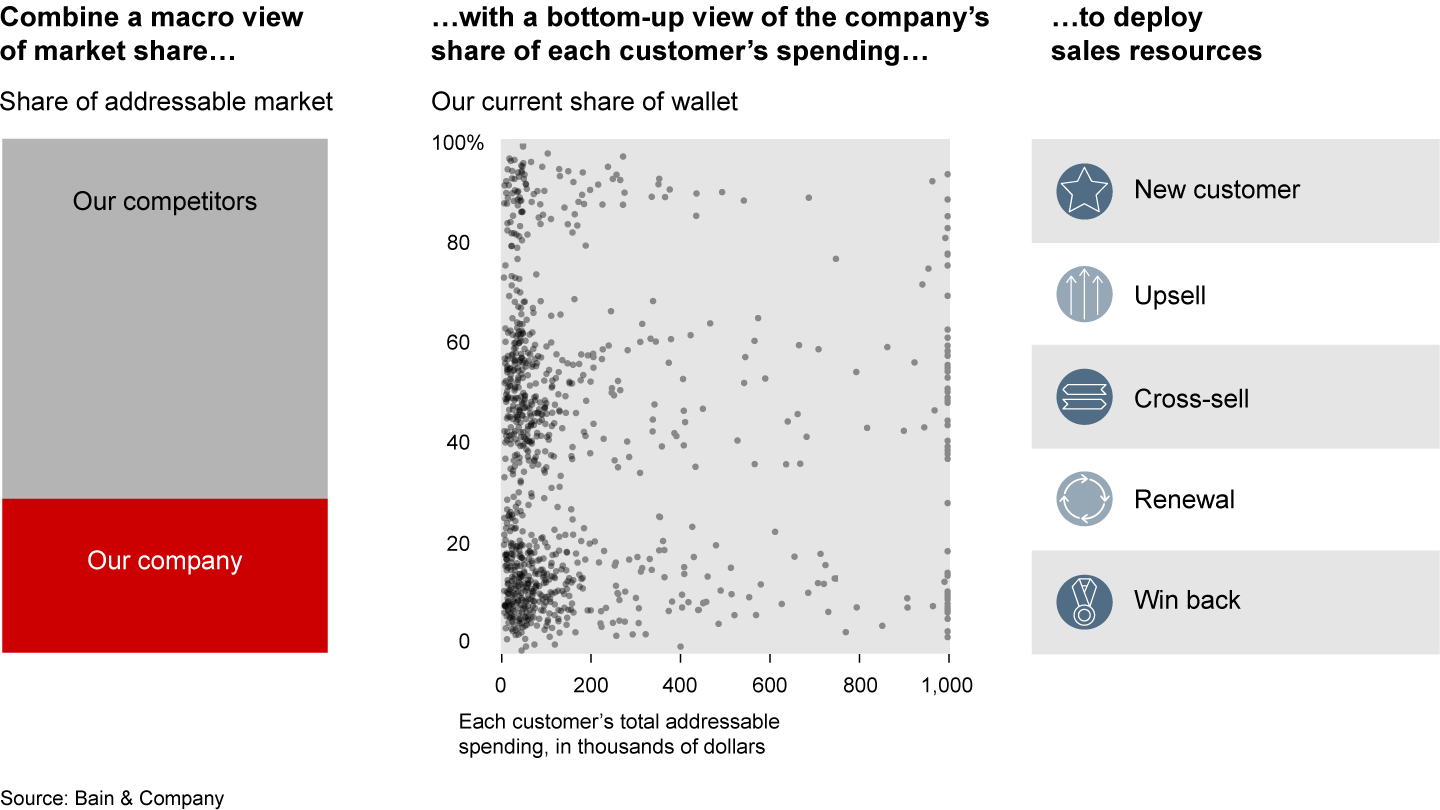
      A money map reveals the best revenue opportunities so a company can choose which sales plays to run
      A money map reveals the best revenue opportunities so a company can choose which sales plays to run
      A money map reveals the best revenue opportunities so a company can choose which sales plays to run

      Win room. Companies that get a return from sales plays invest in a clearinghouse to orchestrate and track play execution. A cross-functional team in the win room takes the money map analysis, adds the latest intelligence from field reps, rapidly reorients sales capacity to critical areas, and measures how effectively each play has expanded the pipeline and converted opportunities into closed deals.

      The team also ranks the backlog of sales plays, and prompts sales support resources to develop market-ready plays. The plays themselves are developed in a sales play “factory” by teams typically composed of subject-matter experts from product management, marketing, sales enablement and frontline reps. 

      One infrastructure software provider relied on a money map and a win room to improve customer renewals. The team was able to identify high-priority, at-risk renewals. This new approach led to the immediate retention of more than $5 million of accounts previously deemed lost, putting the company on a path to improve renewal rates by 15 percentage points.   

      One-on-one. A third attribute of companies that excel in play-based selling is the discipline they bring to frontline management and coaching. They rigorously track play deployment, progress and performance. And they take full advantage of weekly one-on-one meetings between sales managers and reps to steer the execution of plays.  

      Our recent survey of 260 sales reps in the US, Canada and the UK finds that reps at companies that sustainably grow revenue and market share are 50% more likely than lagging firms to have a consistent weekly meeting with their manager. Reps that get the most value from these meetings report that their managers spend more time on deal strategy and coaching. By contrast, those at lagging firms said their managers focus on process and administrative topics. In the current moment of great uncertainty, there is a premium on clear, practical guidance to the front line, which prescriptive sales plays can provide.

      We’re all virtual now

      Covid-19 instantly accelerated a longer-term trend of B2B companies shifting their sales capacity from field-based to virtual models. Sometimes unwittingly, companies are discovering the advantages of virtual selling. It can provide customers with a better experience, with self-serve options for simple interactions, on-demand support or ready access to expertise. Virtual channels, whether for leads or end-to-end sales, raise productivity and lower selling costs. And win rates rise and sales cycles shorten with well-orchestrated virtual channels.

      A recent survey, conducted with Dynata, of more than 300 B2B buyers and sellers in the US, UK and Canada found that half of sales transactions already were taking place virtually before the pandemic. The reason: Many buyers believe virtual channels are just as effective as face-to-face for large, complex purchases (see Figure 2).

      Figure 2
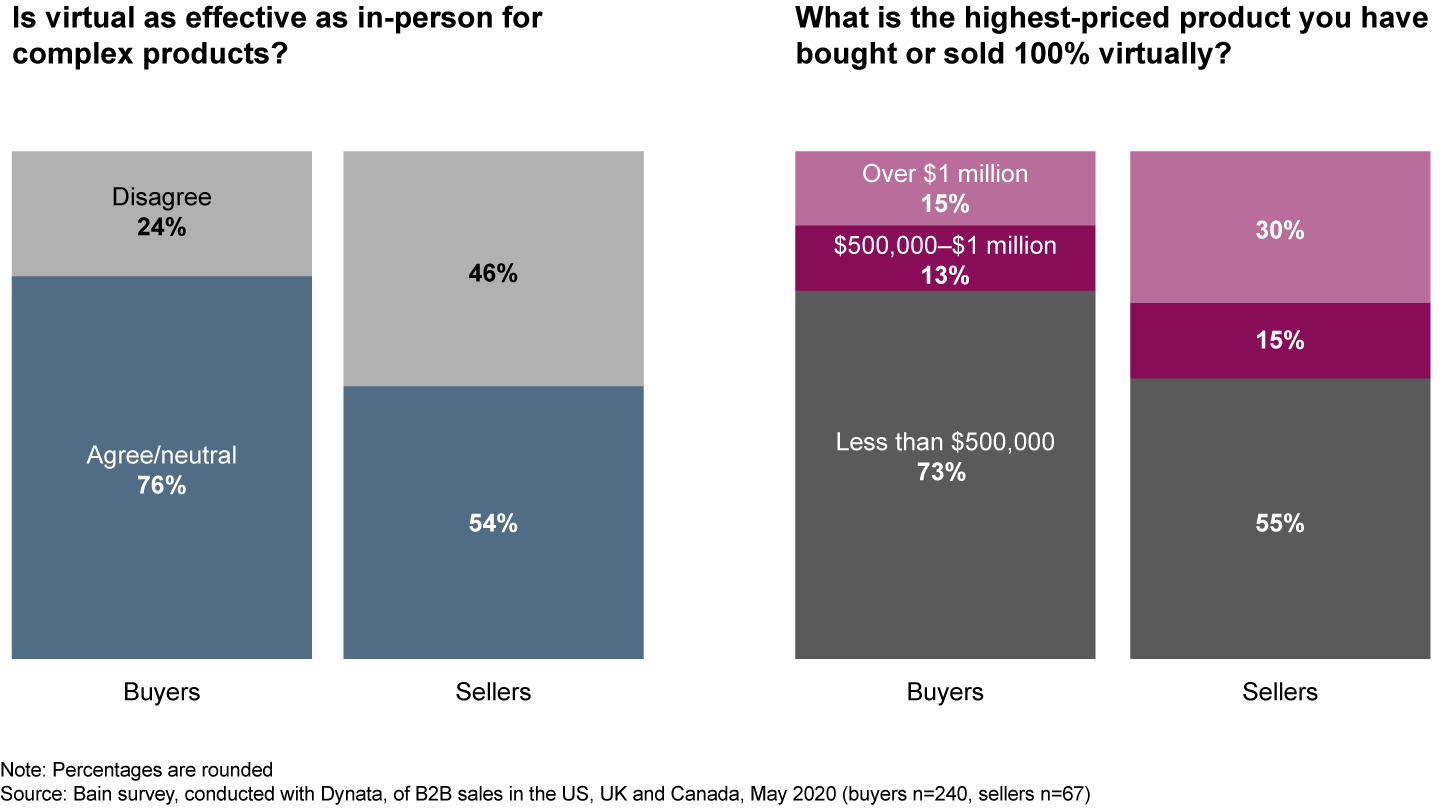
      Many buyers and sellers believe virtual sales are as effective as in-person sales
      Many buyers and sellers believe virtual sales are as effective as in-person sales
      Many buyers and sellers believe virtual sales are as effective as in-person sales

      Indeed, more than one-fourth of buyer respondents have virtually purchased products priced over $500,000. Moreover, most buyers and sellers expect a sustained increase in virtual interactions. In Bain’s recent survey of 153 software buyers in Europe and the US, 54% said they prefer all-virtual purchases, with another 37% preferring largely virtual with select on-site visits.

      One telecommunications provider, for example, has migrated important aspects of its B2B sales to virtual channels, using marketing automation to create leads and installing an online self-service portal. After the first year of this migration, the new model increased revenues by 5% and reduced selling, general and administrative costs by 10%, at the same level of customer service. It cut the time to deliver a quote from days to minutes, all while sharply improving the company’s overall customer loyalty score.

      A global technology company has seen more customer interactions during the pandemic and plans to keep a sizable share of sales operating virtually. Much of its field force will employ virtual selling practices between one-quarter to three-quarters of the time, depending on the nature of the role and opportunity. The company is investing in new digital tools, upgrading its digital purchase experience and introducing new recruiting and training methods. 

      Getting virtual sales right involves far more than using digital tools. You have to deploy the right people and other resources through the right channels at different points in the buying process. This implies that you understand the experience and information your customers need at each step, which channel they want to engage in, and how to provide the best support. It also requires the right operating model, with the right roles, metrics, sales motions, talent strategy, experience sharing and location strategy. Ultimately, the tech company mentioned above anticipates a marked improvement in sales productivity through greater use of virtual.

      Granted, building a successful virtual sales engine hinges on winning over a sometimes skeptical sales team. In our recent survey, 55% of respondents said field reps would be demoralized or quit if asked to change to a primarily virtual model, while only 25% said they would be excited. Fortunately, reps and managers have a rich set of tools available, including voice analytics that can enable virtual coaching to platforms that can get the right collateral in front of the right sellers and customers. 

      What cannot be sold virtually?

      Commercial executives can scope out an effective virtual sales engine by answering a set of questions:  

      • Where should we focus—which products, customer segments and steps of the “discover, try, buy, expand, renew” sequence?
      • Which roles, metrics and processes should be standardized across regions? What skills are required?  
      • What is our digital hub strategy and how does it relate to the rest of the organization?
      • What technology infrastructure and digital tools will best enable our mission?
      • How should we stage our remix of direct channels and foster the required changes in behavior?
      • What are the major risks that could slow or derail our effort?  

      The salient question overall now becomes, what cannot be sold virtually? For a major new prospective account, or a complex sales cycle with multiple influencers, it may still be important to hold a collaborative workshop on-site at critical points. But as the recovery from the pandemic and economic recession keeps getting pushed back, commercial leaders in technology companies should assume that everything can be sold virtually, then design a model that accommodates the specific opportunities that demand a face-to-face visit during the process. Combining virtual selling with a strong sales playbook will allow companies to adapt and keep generating revenues no matter what twists and turns lie ahead.

      Read the Next Chapter

      Buying Boosts Building in Tech M&A


      Autori
      • Headshot of Mark Kovac
        Mark Kovac
        Advisory Partner, Dallas
      • Headshot of Dianne Ledingham
        Dianne Ledingham
        Advisory Partner, Boston
      Contattaci
      Industry collegate
      • Software
      • Tecnologia
      Servizi di consulenza collegati
      • Digital
      • Enterprise Technology
      • Go-to-Market Strategy
      • Performance Improvement
      Technology Report
      How Technology Companies Can Sharpen Their Operational Advantages

      Leading companies are investing in supply chains, process automation, go-to-market strategies and M&A.

      Leggi di più
      Technology Report
      Will Agentic AI Disrupt SaaS?

      Disruption is mandatory. Obsolescence is optional.

      Leggi di più
      Tecnologia
      Why SaaS Stocks Have Dropped—and What It Signals for Software’s Next Chapter

      A sharp reset in valuations reflects AI-driven disruption, slowing retention, and a growing divide between incumbents and future winners.

      Leggi di più
      Performance Improvement
      Building the AI-Ready Enterprise

      Five insights from SAP Sapphire 2025.

      Leggi di più
      Technology Report
      State of the Art of Agentic AI Transformation

      Tech-forward enterprises have cracked the code on ROI for AI. Falling behind is riskier than ever as the next wave of agentic AI raises the stakes.

      Leggi di più
      First published in ottobre 2020
      Tags
      • Digital
      • Enterprise Technology
      • Go-to-Market Strategy
      • Performance Improvement
      • Software
      • Technology Report
      • Tecnologia
      • Virtual Selling

      Come abbiamo aiutato i nostri clienti

      Sostenibilità e Corporate Responsibility Can Microchips Turbocharge Sustainability Improvement?

      Leggi un caso di studio

      Helping a Midsize ERP Player Compete against the Giants

      Leggi un caso di studio

      Video: A Marketing Transformation Puts a Software Leader Back on Top

      Leggi un caso di studio

      Vuoi continuare la conversazione?

      Aiutiamo i leader globali e le loro aziende ad affrontare problemi e a cogliere le opportunità. Sosteniamo cambiamenti e otteniamo risultati duraturi.

      Bain Insights. Le nostre idee e punti di vista sulle tematiche che le aziende globali affrontano ogni giorno, arrivano nella tua email tutti i mesi.

      *Ho letto l'Informativa sulla Privacy e accetto i termini e le condizioni.

      Si prega di leggere e accettare l’Informativa sulla Privacy
      Bain & Company
      Contattaci Sustainability Accessibility Condizioni d’uso Privacy Cookie Policy Sitemap Log In

      © 1996-2026 Bain & Company, Inc.

      Contatta Bain

      Come posso aiutarti?

      • Business inquiry
      • Career information
      • Press relations
      • Partnership request
      • Speaker request
      Guarda tutti gli uffici