

Brief

In evidenza
- Customers want products that are simple and digital, but telcos are mired in complex legacy processes and systems.
- Forward-looking telcos are investing in providing customer experiences that are personalized and radically simple and digital.
- Getting there requires an overhaul of the company’s entire commercial engine.
- Telcos that lead in simple and digital outperform their peers in customer loyalty and both top- and bottom-line growth.
Telcos are losing touch with the evolving needs of their busy, demanding and digitally oriented customers. Customer priorities are changing. Time has become the new price. Customers want services that are simple to explore, use and pay for. They’re looking for a digital-first experience that allows them to navigate seamlessly between online and offline channels, as well as personalized service that is suited to their specific needs. Digital companies such as Amazon, Netflix and Uber have set a new standard for personalized, simple and digital experiences, and customers expect the same from their telecom providers.
Yet, while customers crave simplicity, telcos have become mired in complexity. In their zeal to provide individual customer experiences to millions, telcos have fragmented their marketing and sales efforts, effectively creating products so targeted that they serve a segment of one. As they devise new price plans and services, they retain old ones, along with the channels and IT systems needed to sustain them, which leads to a cycle of ever-increasing complexity.
Many telcos now find themselves burdened by a commercial engine that is complex to manage, customer journeys and service models that are challenging to execute, and an underlying IT operation that is balky and unwieldy. Not surprisingly, when that happens, customer experiences deteriorate, and employee motivation falls. As telcos struggle to overcome these obstacles, they face pressure from a new breed of radically simple and digital-first insurgents that are not weighed down by legacy products, journeys and channels.
To address these challenges, forward-looking telcos are investing in providing personalized, simple and digital-first customer experiences.
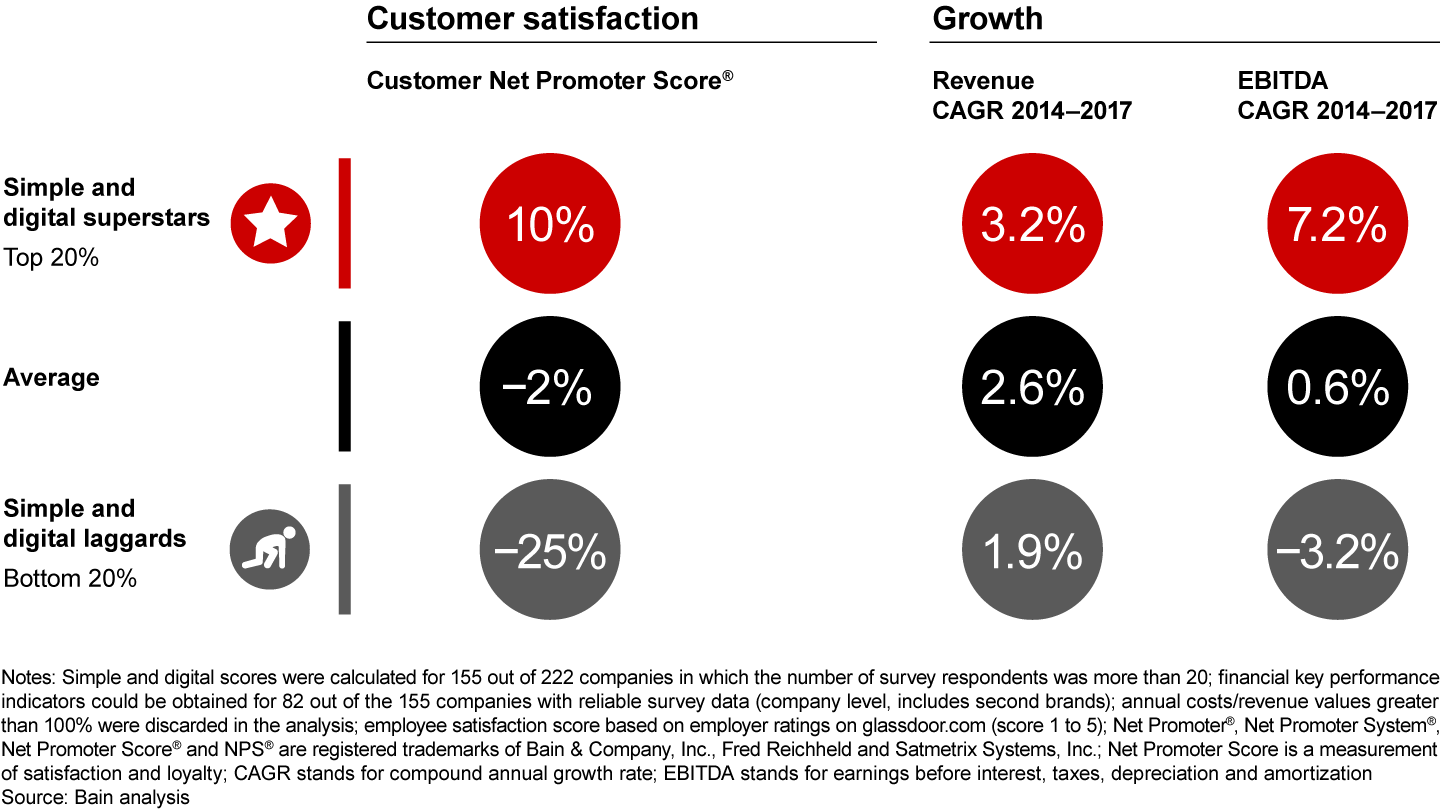
Bain & Company analysis of more than 150 telcos in 12 markets shows that telcos that have embraced an approach to products and processes that is simple and digital outperform their peers in customer loyalty and both top- and bottom-line growth. The simple and digital superstars, those in the top 20% of our sample, had an average Net Promoter Score® (a measurement of satisfaction and loyalty) that was 35 percentage points higher than the simple and digital laggards, those in the bottom 20%. In addition, simple and digital superstars experienced annual revenue growth that was 1.3 percentage points higher than that of the laggards and annual margin growth that was 10.4 percentage points higher (see Figure 1).
Figure 1

Reigniting the commercial engine
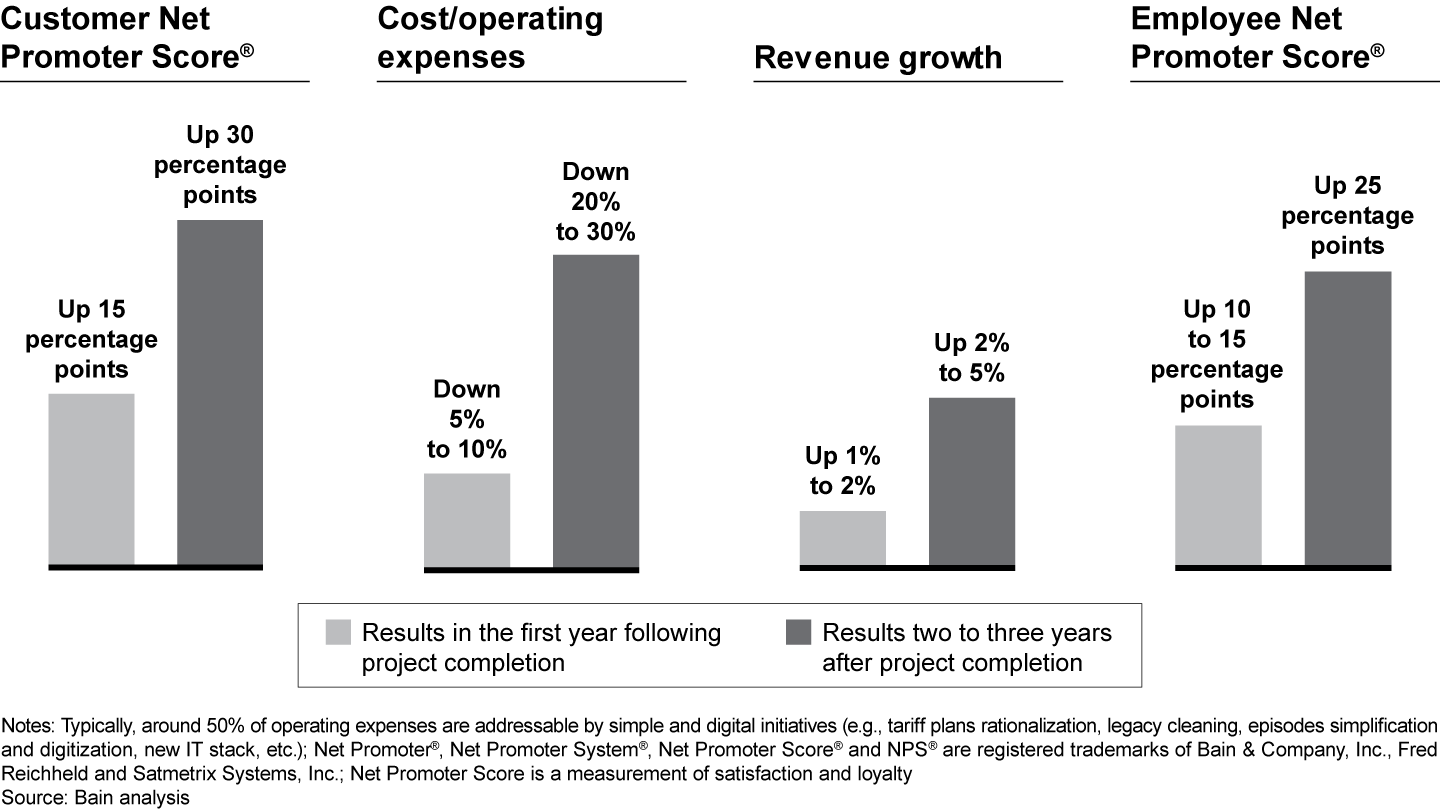
The analysis also points to opportunities for laggards to gain ground. Telcos that are lagging their peers can substantially boost their results through simplification and digitalization of their core commercial engines—namely, products, services, customer episodes and channels. In our experience, they can achieve an uplift of 30 percentage points or more in customer Net Promoter Scores, reduce their addressable operating costs by as much as 30%, grow revenue by an additional 2% to 5% and increase employee Net Promoter Scores by 25 percentage points (see Figure 2).
Figure 2

Consumers now expect to be able to research and buy almost anything with a few touches on their smartphones. Customers want clear and simple choices, not a large selection of complicated options. And they want simple and digital interactions. Telcos have done so much to enable the digital revolution across industries, but they have yet to fully embrace and capture the benefits from digitalization themselves.
Telcos that want to please their customers have discovered that simplicity isn’t always simple.
Most telcos have a multitude of pricing plans, both for new customers (front book) and existing customers (back book). The companies manage these plans through a complex and sometimes conflicting array of business rules covering promotions, discounts and contract terms. This proliferation of plans and rules leads not only to increased complexity and cost but it also presents significant hurdles to providing seamless customer episodes and stymies efforts by companies to become more digital.
The opportunity here lies in constructing a new portfolio based on a limited and well-defined set of modular product building blocks that can easily and rapidly meet the needs of customers. At the same time, companies make hard decisions to phase out legacy product and technology platforms, such as older versions of digital subscriber lines and public switched telephone networks. Telcos that embrace simple and digital aggressively attack complexity, redundancy and conflict in their business rules as well, bringing new rationality to pricing, discounting, promotion, contract terms and renewals. Finally, they put the mechanisms in place to prevent complexity from creeping back in.
Frédéric Debruyne, who leads Bain's Telecommunications practice in Europe, the Middle East and Africa, explains the key elements of successful transformations and what these companies can gain by being faster and stronger.
Telcos that take these steps can capture significant cost benefits and eliminate important hurdles to digitalization. The exercise is about making bold decisions and executing on them. For many leadership teams, it’s also about adopting a realistic view of the value at stake and risks of product simplification. But the payoff is large: Done well, a simplified portfolio becomes a competitive advantage in attracting and retaining customers.
Delivering world-class customer episodes
The key unit of change in a simple and digital transformation is the customer episode (see Figure 3). Telcos learn to view everything their customers do through the lens of discrete episodes, including I search and explore, I buy, I use, I pay, I manage, I get help, and I leave. Companies that consistently deliver smooth, seamless and distinctive episodes can boost their Net Promoter Scores and differentiate themselves from competitors.
Figure 3
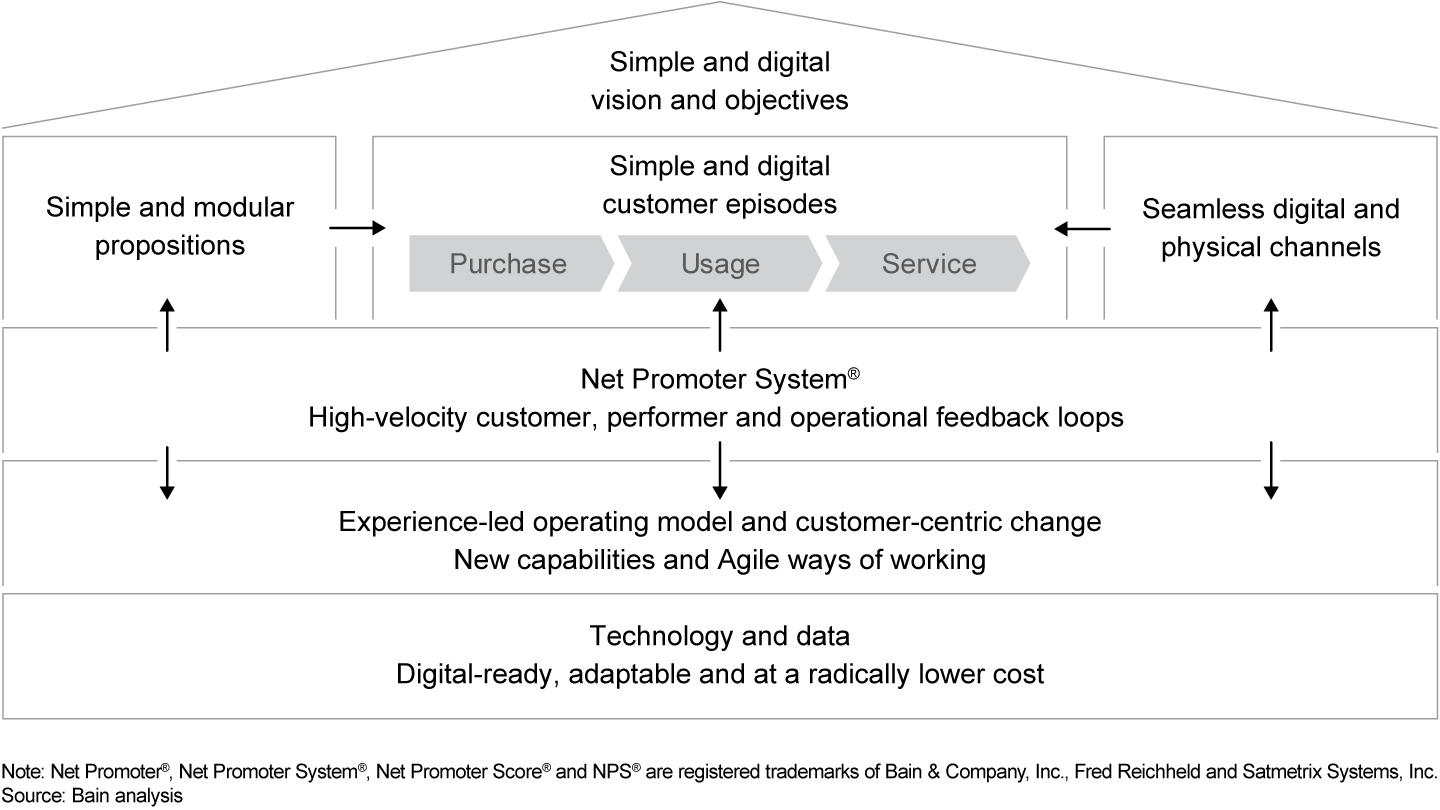

Leading telcos are rethinking episodes by envisioning customer needs in the future. They construct a taxonomy of episodes ranked by their importance to the customer and the company. They look for answers to a series of questions: How frequently does each episode happen, and how much does it cost? How much does the episode matter to customers? How much could we improve our Net Promoter Score if we focus on a particular episode?
One major European telco recently completed a deep dive into customer experiences, learning which episodes contributed the most to its Net Promoter Score—for detractors as well as promoters. That research led the company to overhaul the way it duns customers whose payments are overdue. First, it recognized that customers who normally pay punctually and who are only occasionally late should be given a longer grace period than those customers who are habitually in arrears. If you treat good customers well, they will reward you with loyalty and additional business.
The company also began sending warning text messages to customers whose service was at risk of being cut off because of nonpayment, and it made it easier for customers whose service had been blocked to get it restored quickly by making a payment in a shop. The company also empowered frontline associates to arrange special payment agreements without needing higher-level management approval.
The billing reforms have been a win for both the customers and the company. The company now makes half as many monthly dunning calls as it did previously, and the number of customers blocked each month has fallen by 35%. The amount of the company’s outstanding bad debt has been cut in half, and involuntary customer churn—that is, customers permanently cut off because of unpaid bills—has dropped by 15%.
The company’s success in reforming its dunning episodes and other critical episodes underscores that incremental steps are often not sufficient; radical redesign is called for. The company achieved a substantial lift in its Net Promoter Score and cut episode costs in half, with roughly 60% of those savings coming from digitalization and the rest from simplification. For companies aspiring to become significantly simple and digital, episodes are the true unit of transformation.
Sébastien Meeus, a partner with Bain's Telecommunications practice, discusses how a simple and digital approach can help telcos revamp their operations.
It’s not only about the app
A key part of creating simple and digital experiences for customers is devising a digital-first omnichannel strategy. That involves defining a vision that puts the telco’s digital footprint (websites, microsites, apps, voice assistants and bots) at the center of everyday marketing, sales and service transactions. Telcos aim to establish digital experiences that are so smooth and simple that customers discover that it is quicker, easier and more satisfying than doing the same thing offline. Companies nudge customers toward digital channels with a well-thought-through communication strategy and carefully crafted incentives.
That does not mean physical channels should be neglected. Customers who do want to use other channels should find the experience seamless as they move back and forth between web, app, social networks, stores and contact centers. As the company’s digital-first strategy unfolds, it will be able to optimize its investments in stores and contact centers.
To make this digital-first vision a reality, telcos need to invest in underlying analytical and technology platforms. They also need to reorient their marketing from a traditional push model that often relies on human outreach to a pull approach that is more suited to digital channels.
In our experience, telcos that take these steps can dramatically reduce volumes of calls that come into contact centers by 50% or more. Telcos can also significantly cut costs by shrinking their physical store footprint and pulling back on sales through third-party retailers. Leading players strive to have more than half of their sales transactions and more than 80% of their service transactions take place in digital channels.
The importance of IT, data and Agile ways of working
Telcos are unlikely to achieve customer-centric simplification and digitalization until they tackle the issues of legacy IT and organizational complexity. Companies that successfully transform their commercial engine reboot their IT systems, embrace the importance of data and artificial intelligence (AI), and significantly overhaul their operating models.
Incumbent telcos typically have outdated and complex IT stacks. Rethinking their IT architectures allows them to deliver the business capabilities they need to provide a customer-centric, radically simple and digital-first customer experience.
Telcos need to invest heavily in building data, advanced analytics (AA) and machine learning capabilities. While telcos have vast amounts of customer data, most of it is fragmented and underutilized. By more effectively harnessing that data, telcos can glean sharper insights into customer needs and behaviors. Using AI and AA to monitor interactions through multiple touchpoints—including websites, apps, social media, contact centers and chats—telcos can gain a 360-degree view of their customers. Using machine learning, companies can offer personalized products to discrete segments of customers. As companies and their customers become more digitally adept, more transactions will be handled by voice and chat bots, saving time for the customer and reducing costs for the company.
Fixing IT and understanding data are essential, but there’s also a third critical element: the operating model. Simple and digital leaders revamp their operating model so that marketing, products, operations and IT act in unison. This requires a customer-centric organization in which there is clear end-to-end ownership of customer journeys and Agile ways of working to bring products and services to the market quickly. Commercial and technical roadmaps must be in sync, meaning chief marketing officers need to think like chief information officers, and vice versa.
Bart Delmulle, a partner with Bain's Telecommunications practice, explains the three things that companies need to do in unison in order to make measurable change happen.
Telenor Sweden’s road to simple and digital
One company that has confronted its own complexity is Telenor Sweden, the country’s third-largest mobile operator and third-largest provider of fixed broadband. The company, a wholly owned subsidiary of Norway-based Telenor Group, set out to use simple and digital as a means to improve customer experiences, lift its Net Promoter Score, expand revenue, contain costs, and boost earnings before interest, taxes, depreciation and amortization (EBITDA).
As part of a large-scale simple and digital transformation, Telenor Sweden identified pain points from the perspective of its “victims”—namely, customers, frontline associates and product managers.
The company then embarked on an end-to-end push for simplicity, including combining its mobile and fixed operations and brands, and revamping its product portfolio. It scaled back or exited legacy activities that were costly to maintain and served few customers. It introduced modular pricing, featuring a limited number of services, including a revamped calling plan for families and a small suite of add-on features. It redesigned episodes to make them simple and digital, launched a new website and app, and used digital tools to develop a real-time, 360-degree view of customers across channels. It also initiated an Agile transformation of its organization—in essence, a complete overhaul of its commercial engine. As a result of simple and digital efforts such as these, Telenor Sweden reduced addressable operating costs by a cumulative 7% through 2018 from their 2016 level.
“Today forward, future back”
Complexity that has accumulated over years, even decades, takes time and effort to unravel. Telcos have different starting points, but each company has the potential to improve its competitive position by becoming simple and digital.
Companies that successfully embark on a simple and digital transformation start with a “today forward, future back” approach. Instead of trying to solve discrete problems one by one—an approach that can actually lead to even more complexity—telcos such as Telenor Sweden lay out a bold vision of the future and then methodically determine how to get there. They develop a holistic and cross-functional approach that encompasses products, customer episodes and channels—a seamless union of strategy and operations. There are no sacred cows. These companies involve IT from the outset, not just as partners working side by side with operating units but also as agents of change.
Leading telcos devise a pragmatic, well-choreographed program that often spans two to three years. The primary mission is to determine customers’ needs and then figure out how to meet them. They can then align the company’s commercial, operational, IT, and financial capabilities and aspirations.
These simple and digital transformations require a leadership team committed to challenging established thinking. Companies form handpicked, cross-functional teams that adopt a customer-centric, Agile way of working. On the agenda is nothing less than an overhaul of the entire commercial engine. Telcos that take these steps see substantial benefits in terms of cost, revenue, margins and customer loyalty. These results give them the confidence to push their efforts even further—thus replacing the endless loop of complexity and despair with a cycle of simplicity, growth and success.
Frédéric Debruyne leads Bain & Company’s Telecommunications practice in Europe, the Middle East and Africa, and he is based in Brussels. Bart Delmulle and Sébastien Meeus are partners with the firm’s Telecommunications practice, and they also are based in Brussels.
Net Promoter®, Net Promoter System®, Net Promoter Score® and NPS® are registered trademarks of Bain & Company, Inc., Fred Reichheld and Satmetrix Systems, Inc.
First published in gennaio 2019