

Software Leadership in the Age of AI

Auf einen Blick
- Rising AI costs are squeezing margins at software companies, putting pressure on the Rule of 40.
- Companies and investors may need to settle for smaller margins as they reinvest to stay competitive with AI-native rivals.
- SaaS companies face a strategic choice: optimize for cash today or invest to win in a future shaped by AI.
This is the first in a five-part series on the software industry in the age of AI.
Software companies and investors have long used the Rule of 40—that a software company’s growth rate plus profit margin should exceed 40%—as a target for high performers to hit. The rule forces management teams and investors to confront the trade-off between investing for growth and delivering returns.
Hitting that 40% target has never been easy, but the rise of AI could make it just that much harder, at least for a while.
Two reasons stand out:
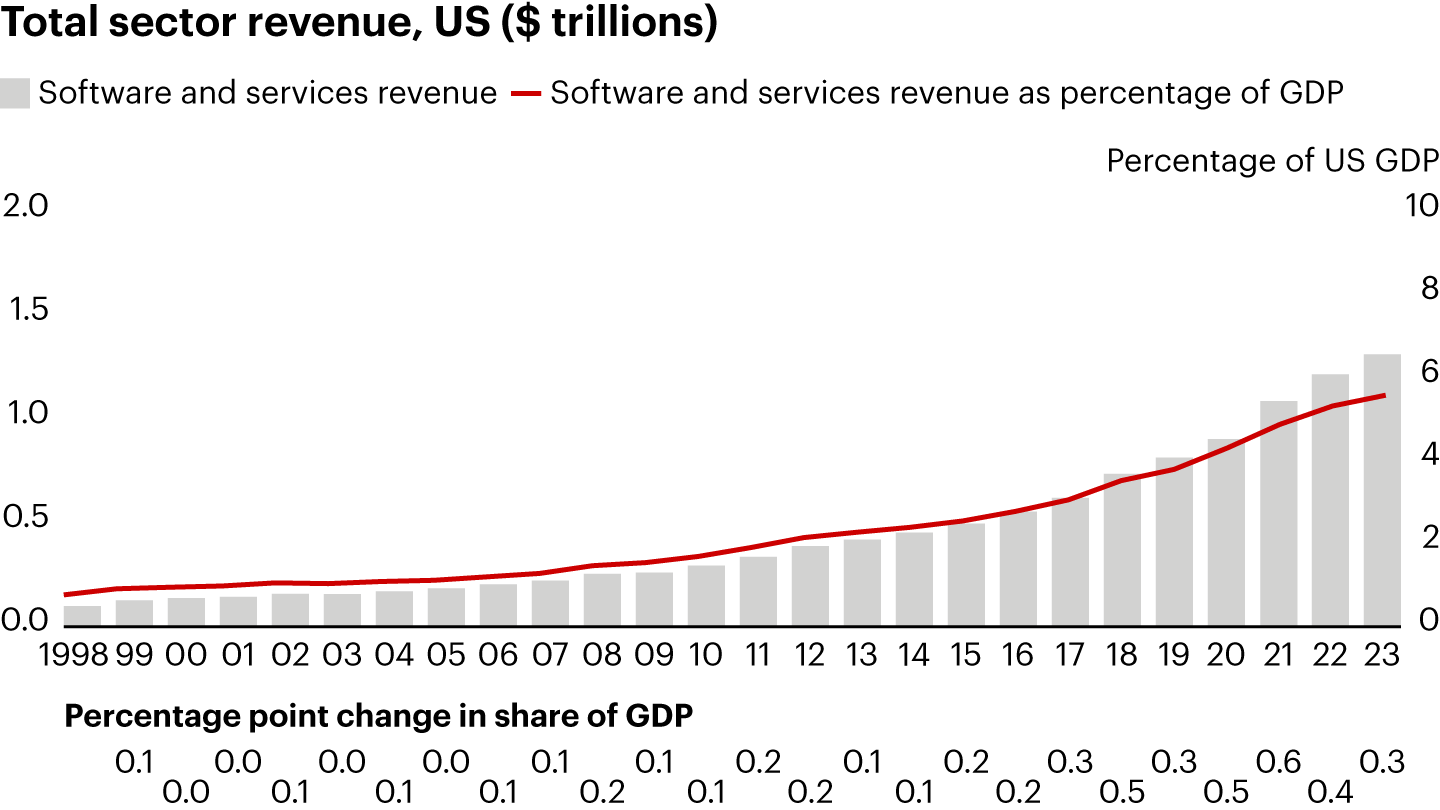
- Market growth for software-as-a-service (SaaS) companies is slowing as markets mature and penetration maxes out in some categories (see Figures 1 and 2).
- Rising costs are squeezing profit margins. SaaS companies have long benefited from low marginal costs. The need to invest in AI inference, infrastructure, and model access introduces real variable costs into previously high-margin businesses. In many cases, the cost of goods sold is rising, particularly as usage scales. For example, a high-growth marketing technology company’s revenue rose 38% between Q3 2024 and Q3 2025 while its costs increased 349%, due in part to spending on new AI infrastructure and hosting (see Figure 3).
Figure 1

Anmerkungen Shows base year 2019 inflation-adjusted dollar values; includes exports
Sources: S&P Global; US Federal Reserve Bank
Figure 2
Figure 3
This doesn’t mean AI isn’t financially viable. It just means that margin growth won’t come automatically and will need to be designed for, actively managed, and re-earned.
Re-earning comes through reinvestment. AI lowers the barrier to building software and accelerates feature parity, rendering basic functionality less valuable. Unless companies reinvest to improve their products and processes with AI, they’ll fall behind competitors who are investing for the future.
AI’s tailwinds (eventually)
AI can boost productivity in sales and marketing, general administrative tasks, and R&D. Companies that have figured out how to transform their business are gaining an edge, with some achieving 10% to 25% increases in EBITDA. But most aren’t there yet. Real productivity is hard, and most companies have yet to see true efficiency improvements in operations.
Over time, AI could be the key to higher growth again. CIOs are slowing the growth of their core technology budgets while increasing their investments in AI. Where AI can replace labor costs, the total market for some software categories will grow significantly, possibly doubling. Forward-looking companies are investing and building now to capture that growth. Software companies that enhance their products with agents that can automate tasks, make better decisions, and expand the scope of what software does could see higher usage and new revenue streams. Thanks to their existing customer relationships, embedded workflows, and systems of record, incumbents may have an advantage over AI-native point solutions.
AI also creates greater opportunities for pricing to outcomes rather than user numbers. Over time, this shifts the revenue pool from fixed software seats to the much larger economics of labor, operations, and services. However, these models take time to design, test, and scale, so they can’t offset costs immediately.
A strategic fork in the road
SaaS leadership teams and their investors will need to choose between two paths:
- Financialize the business. Limit AI investment, focus on efficiency, protect existing business, and operate the company as a durable cash generator. For some companies, this will make sense, particularly in mature categories, but it limits future relevance and growth.
- Invest to grow. Accept the short-term pressure on profit margins, invest aggressively in AI across product and operations, and aim to reemerge with stronger growth and differentiation. This path is harder, riskier, and more volatile, but it preserves the chance to excel five years out.
The answer depends on the dynamics of your market and your ambitions within it. In legacy markets, optimizing for margin may preserve value. But in categories dependent on innovation, reinvestment is essential. Investors still care about balanced growth and profitability. But SaaS leadership teams may need to risk spending some time with a less ambitious benchmark—the Rule of 30—if they want to compete with AI-native players.
First published in April 2026