
Skip to Content
  • Standorte

    Standorte

    North & Latin America
    • Atlanta
    • Austin
    • Bogota
    • Boston
    • Buenos Aires
    • Chicago
    • Dallas
    • Denver
    • Houston
    • Lisbon
    • Los Angeles
    • Mexico City
    • Minneapolis
    • Monterrey
    • Montreal
    • New York
    • Rio de Janeiro
    • San Francisco
    • Santiago
    • São Paulo
    • Seattle
    • Silicon Valley
    • Toronto
    • Washington, DC
    Europe & Africa
    • Amsterdam
    • Athens
    • Berlin
    • Brussels
    • Copenhagen
    • Düsseldorf
    • Frankfurt
    • Helsinki
    • Istanbul
    • Johannesburg
    • Kyiv
    • Lisbon
    • London
    • Madrid
    • Milan
    • München
    • Oslo
    • Paris
    • Rome
    • Stockholm
    • Warsaw
    • Wien
    • Zürich
    Middle East
    • Doha
    • Dubai
    • Riyadh
    Asia & Australia
    • Bangkok
    • Beijing
    • Bengaluru
    • Brisbane
    • Ho Chi Minh City
    • Hong Kong
    • Jakarta
    • Kuala Lumpur
    • Manila
    • Melbourne
    • Mumbai
    • New Delhi
    • Perth
    • Seoul
    • Shanghai
    • Singapore
    • Sydney
    • Tokyo
    Alle Standorte Anzeigen
  • Alumni
  • Presse
  • Newsletter
  • Kontakt
  • DACH-Region | Deutsch

    Wählen Sie Ihre Region und Sprache

    Global
    • Global (English)
    North & Latin America
    • Brazil (Português)
    • Argentina (Español)
    • Canada (Français)
    • Chile (Español)
    • Colombia (Español)
    Europe, Middle East, & Africa
    • France (Français)
    • DACH-Region (Deutsch)
    • Italy (Italiano)
    • Spain (Español)
    • Greece (Elliniká)
    Asia & Australia
    • China (中文版)
    • Korea (한국어)
    • Japan (日本語)
  • Saved items (0)
    Saved items (0)

    You have no saved items.

    Inhalte, für die Sie sich interessieren, werden hier gespeichert und können später gelesen oder weitergeleitet werden.

    Explore Bain Insights
  • Branchenkompetenzen
    Hauptmenü

    Branchenkompetenzen

    • Luft- und Raumfahrt, Verteidigung
    • Agrarwirtschaft
    • Chemieindustrie
    • Infrastruktur und Bauwirtschaft
    • Konsumgüter
    • Finanzdienstleistungen
    • Gesundheitswesen
    • Maschinen- und Anlagenbau
    • Medienwirtschaft
    • Metallindustrie
    • Bergbau
    • Öl und Gas
    • Papier- und Verpackungsindustrie
    • Private Equity
      Branchenkompetenzen
      Private Equity
      • Due Diligence
      • Exit Planning
      • Firm Strategy & Operations
      • Portfolio Value Creation
    • Öffentlicher Sektor und Sozialwesen
    • Einzelhandel
    • Technologie
    • Telekommunikation
    • Transportwesen
    • Reise- und Freizeitbranche
    • Versorgung und erneuerbare Energien
  • Managementkompetenzen
    Hauptmenü

    Managementkompetenzen

    • Customer Experience
    • ESG
    • Innovation
    • M&A
    • Operations
    • People & Organization
    • Private Equity
    • Sales & Marketing
    • Strategie
    • KI, Einblicke und Lösungen
    • Technologie
    • Transformation
  • Digital
  • Publikationen
    Hauptmenü

    Publikationen

    • Branchenthemen
    • Managementthemen
    • Bain-Bücher
    Alle Publikationen
    Ausgewählte Themen
    • Resilienz in der globalen Krise
    • M&A Report
    • Private Equity Podcast
    • Midyear Private Equity Report
    • Agile
    • Engineering Report
    • Digital Transformation
    • Elements of Value®
    • Firm of the Future
    • Nachhaltigkeitsstudie
    • Macro Trends
    • Future of Consumption
    • Weltwirtschaftsforum (WEF)
  • Über uns
    Hauptmenü

    Über uns

    • Was wir bieten
    • Unser Ansatz
    • Unser Team
    • Game Changer Award
    • Female Allstar Board
    • Messbare Ergebnisse (EN)
    • Auszeichnungen
    • Globale Partnerschaften
    • The Mission
    Further: Our global responsibility
    • Vielfalt & Chancengleichheit
    • Soziale Verantwortung
    • Sustainability
    Erfahren Sie mehr zu "Further"
  • Karriere
    Hauptmenü

    Karriere

    • Dein Einstieg
      Karriere
      Dein Einstieg
      • Find Your Place
      • Unsere Arbeitsbereiche
      • Unsere Teams
      • Angebote für Studierende
      • Praktika & Programme
      • Recruiting-Events
    • Arbeiten bei Bain
      Karriere
      Arbeiten bei Bain
      • Karriere Stories
      • Unsere Bainies
      • Office-Standorte
      • Weiterentwicklung
      • Affinity Groups
      • Deine Benefits
    • Impact Stories
    • Deine Bewerbung
      Karriere
      Deine Bewerbung
      • Das erwartet dich
      • Der Interviewprozess
    FIND JOBS
  • Standorte
    Hauptmenü

    Standorte

    • North & Latin America
      Standorte
      North & Latin America
      • Atlanta
      • Austin
      • Bogota
      • Boston
      • Buenos Aires
      • Chicago
      • Dallas
      • Denver
      • Houston
      • Lisbon
      • Los Angeles
      • Mexico City
      • Minneapolis
      • Monterrey
      • Montreal
      • New York
      • Rio de Janeiro
      • San Francisco
      • Santiago
      • São Paulo
      • Seattle
      • Silicon Valley
      • Toronto
      • Washington, DC
    • Europe & Africa
      Standorte
      Europe & Africa
      • Amsterdam
      • Athens
      • Berlin
      • Brussels
      • Copenhagen
      • Düsseldorf
      • Frankfurt
      • Helsinki
      • Istanbul
      • Johannesburg
      • Kyiv
      • Lisbon
      • London
      • Madrid
      • Milan
      • München
      • Oslo
      • Paris
      • Rome
      • Stockholm
      • Warsaw
      • Wien
      • Zürich
    • Middle East
      Standorte
      Middle East
      • Doha
      • Dubai
      • Riyadh
    • Asia & Australia
      Standorte
      Asia & Australia
      • Bangkok
      • Beijing
      • Bengaluru
      • Brisbane
      • Ho Chi Minh City
      • Hong Kong
      • Jakarta
      • Kuala Lumpur
      • Manila
      • Melbourne
      • Mumbai
      • New Delhi
      • Perth
      • Seoul
      • Shanghai
      • Singapore
      • Sydney
      • Tokyo
    Alle Standorte Anzeigen
  • Alumni
  • Presse
  • Newsletter
  • Kontakt
  • DACH-Region | Deutsch
    Hauptmenü

    Wählen Sie Ihre Region und Sprache

    • Global
      Wählen Sie Ihre Region und Sprache
      Global
      • Global (English)
    • North & Latin America
      Wählen Sie Ihre Region und Sprache
      North & Latin America
      • Brazil (Português)
      • Argentina (Español)
      • Canada (Français)
      • Chile (Español)
      • Colombia (Español)
    • Europe, Middle East, & Africa
      Wählen Sie Ihre Region und Sprache
      Europe, Middle East, & Africa
      • France (Français)
      • DACH-Region (Deutsch)
      • Italy (Italiano)
      • Spain (Español)
      • Greece (Elliniká)
    • Asia & Australia
      Wählen Sie Ihre Region und Sprache
      Asia & Australia
      • China (中文版)
      • Korea (한국어)
      • Japan (日本語)
  • Saved items  (0)
    Hauptmenü
    Saved items (0)

    You have no saved items.

    Inhalte, für die Sie sich interessieren, werden hier gespeichert und können später gelesen oder weitergeleitet werden.

    Explore Bain Insights
  • Branchenkompetenzen
    • Branchenkompetenzen

      • Luft- und Raumfahrt, Verteidigung
      • Agrarwirtschaft
      • Chemieindustrie
      • Infrastruktur und Bauwirtschaft
      • Konsumgüter
      • Finanzdienstleistungen
      • Gesundheitswesen
      • Maschinen- und Anlagenbau
      • Medienwirtschaft
      • Metallindustrie
      • Bergbau
      • Öl und Gas
      • Papier- und Verpackungsindustrie
      • Private Equity
      • Öffentlicher Sektor und Sozialwesen
      • Einzelhandel
      • Technologie
      • Telekommunikation
      • Transportwesen
      • Reise- und Freizeitbranche
      • Versorgung und erneuerbare Energien
  • Managementkompetenzen
    • Managementkompetenzen

      • Customer Experience
      • ESG
      • Innovation
      • M&A
      • Operations
      • People & Organization
      • Private Equity
      • Sales & Marketing
      • Strategie
      • KI, Einblicke und Lösungen
      • Technologie
      • Transformation
  • Digital
  • Publikationen
    • Publikationen

      • Branchenthemen
      • Managementthemen
      • Bain-Bücher
      Alle Publikationen
      Ausgewählte Themen
      • Resilienz in der globalen Krise
      • M&A Report
      • Private Equity Podcast
      • Midyear Private Equity Report
      • Agile
      • Engineering Report
      • Digital Transformation
      • Elements of Value®
      • Firm of the Future
      • Nachhaltigkeitsstudie
      • Macro Trends
      • Future of Consumption
      • Weltwirtschaftsforum (WEF)
  • Über uns
    • Über uns

      • Was wir bieten
      • Unser Ansatz
      • Unser Team
      • Game Changer Award
      • Female Allstar Board
      • Messbare Ergebnisse (EN)
      • Auszeichnungen
      • Globale Partnerschaften
      • The Mission
      Further: Our global responsibility
      • Vielfalt & Chancengleichheit
      • Soziale Verantwortung
      • Sustainability
      Erfahren Sie mehr zu "Further"
  • Karriere
    Häufige Suchanfragen
    • Agil
    • Digital
    • Strategie
    Vorherige Suchanfragen
      Zuletzt besuchte Seiten

      Content added to saved items

      Saved items (0)

      Removed from saved items

      Saved items (0)

      Expert Commentary

      An Alternative Methodology for Demand Forecasting with Small Data Sets

      An Alternative Methodology for Demand Forecasting with Small Data Sets

      Nested bivariate regressions can provide confidence in situations containing multiple predictors.

      Von Marco Meyer und Jose von Roth

      • Min. Lesezeit
      }

      Artikel

      An Alternative Methodology for Demand Forecasting with Small Data Sets
      en
      At a Glance
      • When a company tries to assess future demand, in many situations, the available data contains only a small number of observations. In these cases, traditional modeling methods don’t work well.
      • We devised an alternative approach that employs a nested bivariate regression technique.
      • This novel approach is both comprehensible and adaptable, with room for refinements by inputting expert opinions.

      Assessing future product demand in different markets is critical for any company’s growth aspirations. Strategic decisions entail not only identifying which markets are expanding and which are saturated but also considering the effects of future demographic changes on market dynamics.

      From a modeling perspective, many methods could be applied to this type of data when the number of observations is large, ranging from traditional time series models, such as ARIMA(X), to more sophisticated approaches, such as vector autoregressive (VAR) models, system dynamics, or other machine learning (ML) approaches.

      For many business challenges, however, the available data sources contain only a small number of observations. Products or industries might be too young to generate much historical data. Macroeconomic indicators across markets often are limited to annual data. In such cases, analysts cannot treat the modeling task as a multivariate regression problem, using multiple indicators simultaneously to predict demand. Moreover, small N situations don’t accommodate using ML to assess the model accuracy on a holdout validation data set. In other words, one cannot check for the extent of potential overfitting in the model.

      To advance the accuracy and power of demand prediction, we have devised a proof of concept to deliver forecasts both at a product line and individual product level. This commentary details how we applied the methodology to forecast insurance premiums, but the proof of concept applies to any situation in which a company must contend with a small number of data points.

      The setting: Near-term developments based on economic measures

      Given the nature of the available data, this forecast task could be considered as a time series model with annual insurance premiums as the dependent variable and several potential variables (also captured annually) as predictive factors. Our goal was to come up with a forecast to 2025 in an effort to evaluate near-term developments for different markets vs. long-term developments that might be influenced by factors other than those from the past.

      The candidate set of testable predictors included a mix of economic indicators, such as gross domestic product and disposable income, along with product-specific data. For instance, in auto insurance, we included data such as the number of vehicles purchased, whereas in property insurance, we relied on housing- and rent-related predictors. For all these predictors, we already had forecasts from external sources such as Oxford Economics and Euromonitor, thus we could project their historical impact in the future. As these forecasts included Covid-19 effects, they set up the model to cover developments created by the pandemic shock as well as likely recovery patterns.

      We needed to use a methodology that is both easy to understand and that works with a very small number of observations (namely, annual values) for the economic predictors and the insurance premiums. That N clearly was too small for multivariate modeling or tree-based algorithms.

      Getting creative through a nested approach

      Evaluating our analytical possibilities, we ruled out two options. First, the option of narrowing down the number of candidate predictors in order to arrive at a longer time series. That gain often amounted only to a few years, which was not enough to allow a multivariate modeling. Second, solely relying on one predictor per type of insurance would have neglected valuable information from other predictors.

      Instead, we focused on an alternative approach aiming for a proof of concept. In order to apply regressions that would be capable of integrating several predictors simultaneously, even with a limited N, we employed a nested bivariate regression technique (see Figure 1). Starting with the historical time series as an outcome variable, the approach considers the whole candidate set of independent variables and selects one bivariate regression with the highest explanatory power. We then store those predictions and make the respective residuals the new dependent variable for the next iteration, in which we again check all candidate predictors. Repeating this second step, we aim to reduce the error that our model generates, resembling ensemble learners that give model errors from previous iterations a higher weight in subsequent stages. After this training stage, all stored estimations are summed up to arrive at the final prediction values and calculate actual raw demand.

      Figure 1
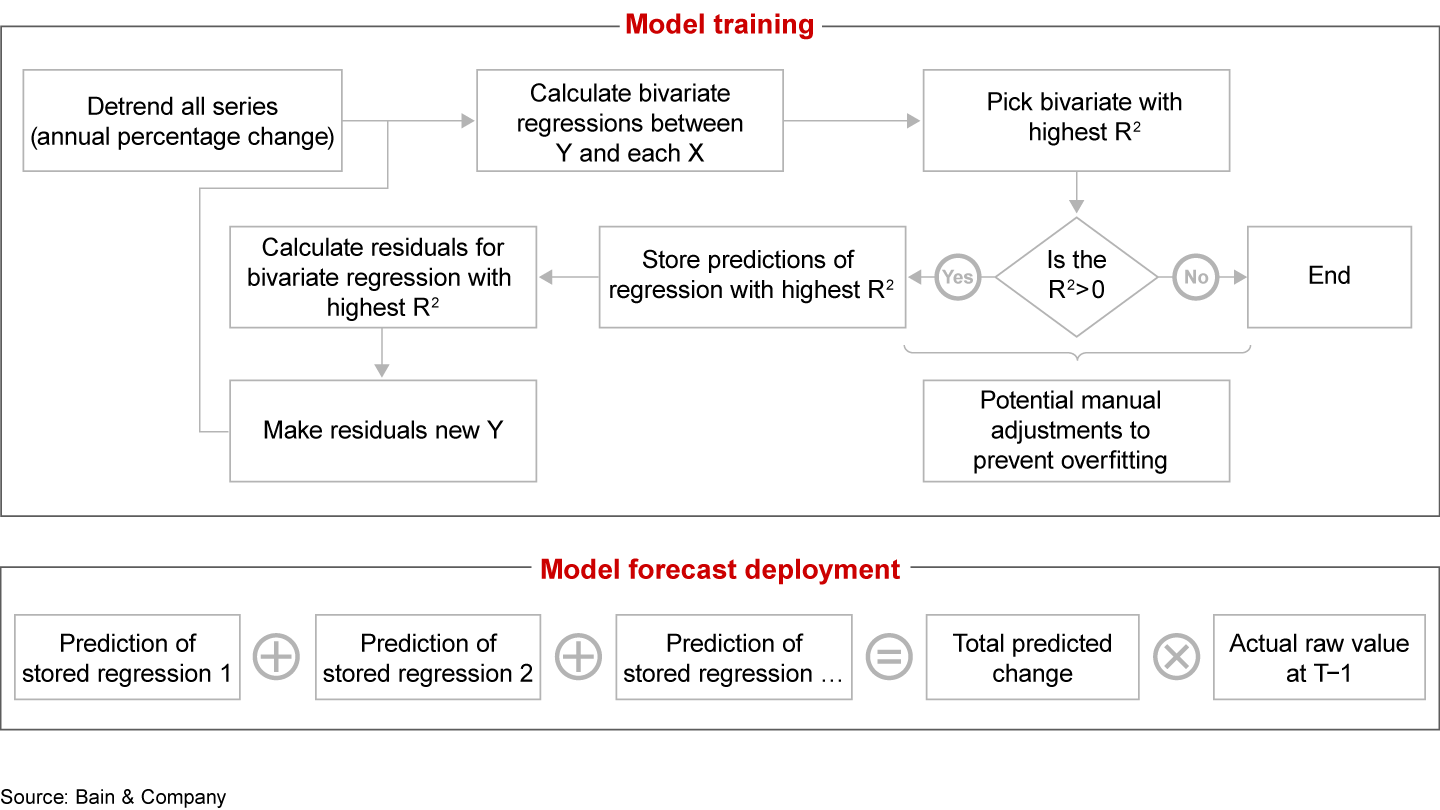
      The algorithmic flow of our approach

      Still, this approach was not automatic enough to tackle our second challenge—namely, evaluating the model against holdout test data. To manually adjust for potential overfitting, we compared models with different candidate sets of predictors by triangulating three methodologies: visual inspection of how the prediction fits the historical curve, R² values, and the Akaike information criterion (AIC). The AIC can be a particularly valuable relative measure for prediction accuracy across several models when a test holdout set is not feasible. It measures how well the model can fit the data, and it penalizes models with a higher number of parameters. That’s a desirable feature because increasing the number of parameters raises the likelihood of overfitting.

      Similar to other forecasts, but with insightful deviations

      With the above measures in place, we could model and explain several insurance products in high-priority markets. Our work within the property and casualty market demonstrates how our stepwise-improved prediction better fits the historical series vs. the prediction taken from the first bivariate regression (see Figure 2).

      Figure 2
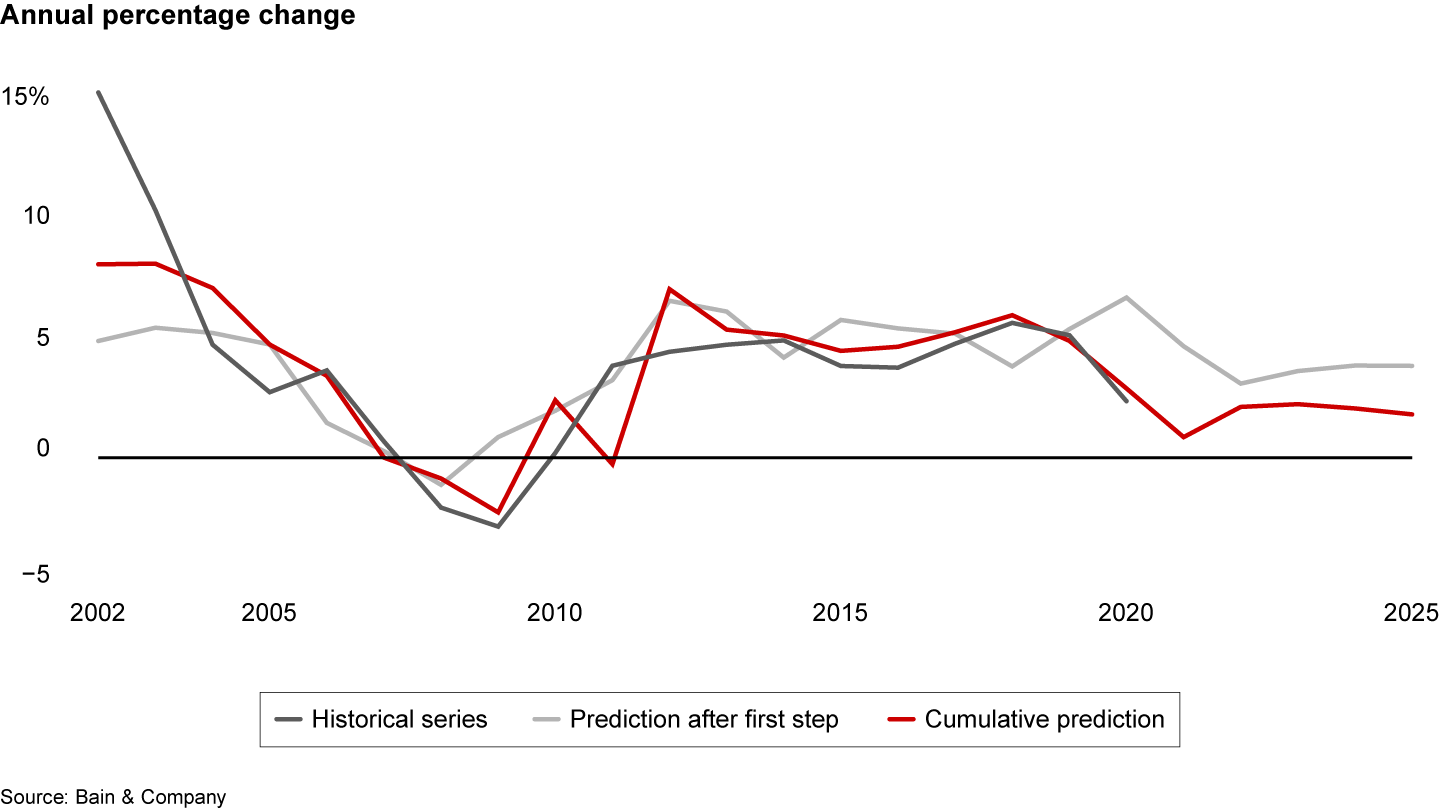
      In P&C insurance, our cumulative prediction fits the historical series better than the prediction from the first bivariate regression
      In P&C insurance, our cumulative prediction fits the historical series better than the prediction from the first bivariate regression
      In P&C insurance, our cumulative prediction fits the historical series better than the prediction from the first bivariate regression

      And one sort of robustness check uses forecasts from an external source. Our models often showed both similarities and interesting deviations from other forecasts (see Figure 3).

      Figure 3
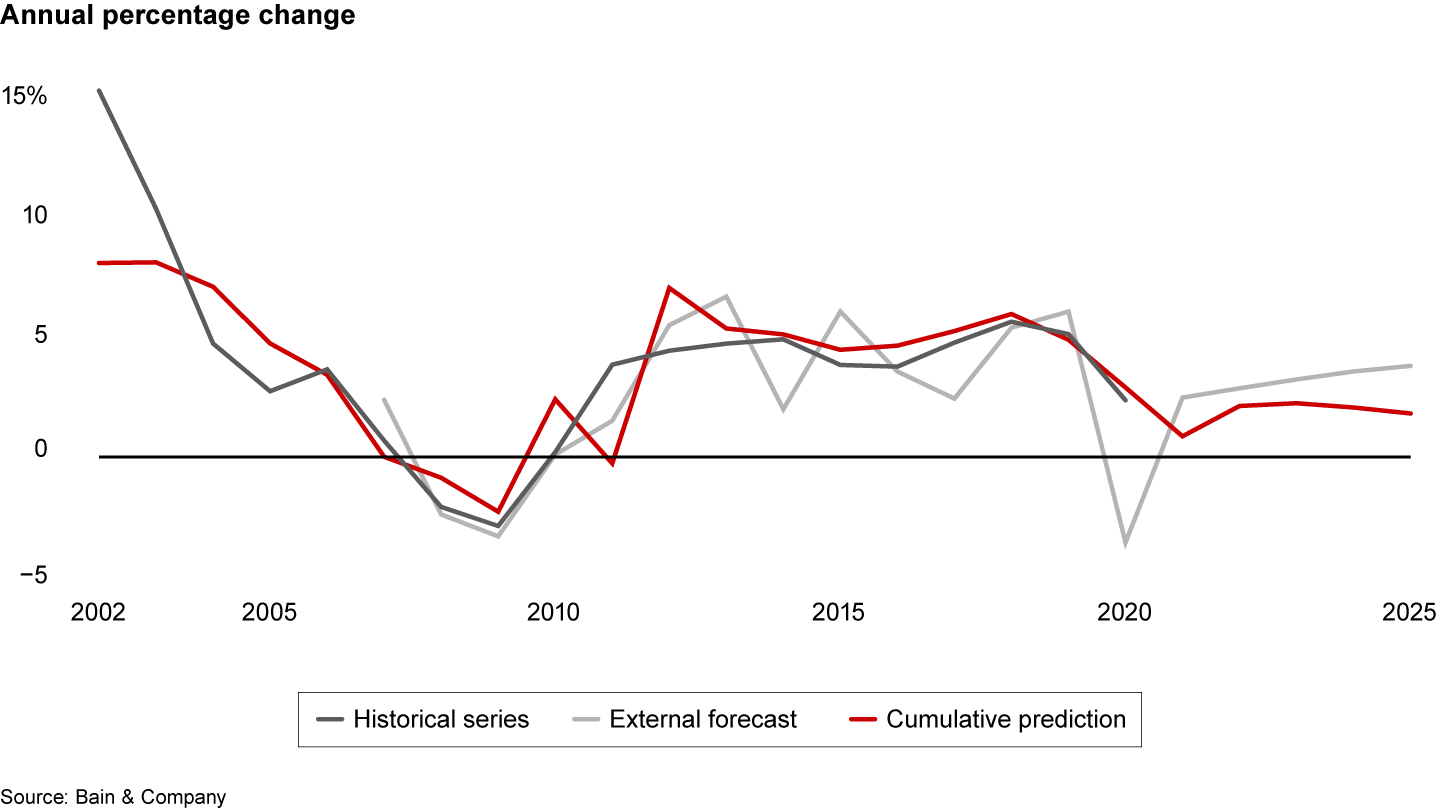
      We can compare our cumulative prediction with forecasts from external vendors
      We can compare our cumulative prediction with forecasts from external vendors
      We can compare our cumulative prediction with forecasts from external vendors

      Refining the approach

      The strengths of this novel approach lie in its comprehensibility and adaptability, both of which offer promising room for refinement. Expert opinions will feed into the reevaluation of models both in terms of fit and the choice of predictors. And in the tradition of bootstrap aggregation, we plan to accompany these inputs with a treatment of single years in our time series as random holdout years in order to better validate the accuracy of our models. These measures will allow us to hone the strengths and address the limitations of the approach as part of an expanded toolkit for small N time series in any industry where it’s relevant.

      Autoren
      • Marco Meyer
        Expert Senior Manager, Data Science, München
      • Headshot of Jose von Roth
        Jose von Roth
        Alumni, Berlin
      Kontaktieren Sie uns
      Ähnliche Beratungsangebote
      • Advanced Analytics
      Advanced Analytics
      Defining the Intelligent Enterprise

      A recap from DeepLearning.AI’s AI Dev 25 × NYC.

      Mehr erfahren
      Advanced Analytics
      Retailers Have a Secret Weapon in AI-Powered Shopping: Trust

      US consumers would be more comfortable with AI buying on their behalf if a familiar retailer were involved.

      Mehr erfahren
      Advanced Analytics
      Making Friends with Collinearity: How Driver Interactions Can Inform Targeted Interventions

      Driver analysis helps inform decisions on which drivers deserve the greatest effort.

      Mehr erfahren
      Advanced Analytics
      How AI Is Starting to Transform Circular Packaging

      There are 15 AI use cases companies across the value chain can use today to accelerate circularity.

      Mehr erfahren
      Advanced Analytics
      Mission Possible: Driver Analysis with Collinear Variables

      Many commonly used methods have serious limitations when assessing the variable importance of collinear drivers.

      Mehr erfahren
      First published in November 2021
      Markierungen
      • Advanced Analytics
      • Advanced Analytics

      Wie wir unsere Kunden unterstützt haben

      Advanced Analytics Advanced Analytics Breakthrough Lets Metals Company Optimize Yield Cost

      Kundenbeispiel lesen

      Advanced Analytics Advanced Analytics powers up UtilityCo’s reliability, and customers notice

      Kundenbeispiel lesen

      Kundenstrategie und Marketing Direct marketing excellence through experimental design

      Kundenbeispiel lesen

      Möchten Sie mit uns in Kontakt bleiben?

      Wir unterstützen Führungskräfte weltweit, die kritischen Themen in ihrem Unternehmen zu adressieren. Gemeinsam schaffen wir nachhaltige Veränderungen und Ergebnisse.

      Bain Insights. Unsere Perspektive auf die kritischen Themen, mit denen sich international agierende Unternehmen konfrontiert sehen, finden Sie monatlich in Ihrem Postfach.

      *Ich habe die Datenschutzerklärung gelesen und akzeptiere sie.
      Bitte lesen Sie die Datenschutzerklärung und akzeptieren Sie diese.
      Bain & Company
      Contact us Sustainability Accessibility Rechtliche Hinweise Impressum Datenschutz Cookie-Richtlinie Sitemap Log In

      © 1996-2026 Bain & Company, Inc.

      Kontaktieren Sie Bain

      Wie können wir Ihnen helfen?

      • Business inquiry
      • Career information
      • Press relations
      • Partnership request
      • Speaker request
      Alle weltweiten Büros