
Skip to Content
  • Standorte

    Standorte

    North & Latin America
    • Atlanta
    • Austin
    • Bogota
    • Boston
    • Buenos Aires
    • Chicago
    • Dallas
    • Denver
    • Houston
    • Lisbon
    • Los Angeles
    • Mexico City
    • Minneapolis
    • Monterrey
    • Montreal
    • New York
    • Rio de Janeiro
    • San Francisco
    • Santiago
    • São Paulo
    • Seattle
    • Silicon Valley
    • Toronto
    • Washington, DC
    Europe & Africa
    • Amsterdam
    • Athens
    • Berlin
    • Brussels
    • Copenhagen
    • Düsseldorf
    • Frankfurt
    • Helsinki
    • Istanbul
    • Johannesburg
    • Kyiv
    • Lisbon
    • London
    • Madrid
    • Milan
    • München
    • Oslo
    • Paris
    • Rome
    • Stockholm
    • Warsaw
    • Wien
    • Zürich
    Middle East
    • Doha
    • Dubai
    • Riyadh
    Asia & Australia
    • Bangkok
    • Beijing
    • Bengaluru
    • Brisbane
    • Ho Chi Minh City
    • Hong Kong
    • Jakarta
    • Kuala Lumpur
    • Manila
    • Melbourne
    • Mumbai
    • New Delhi
    • Perth
    • Seoul
    • Shanghai
    • Singapore
    • Sydney
    • Tokyo
    Alle Standorte Anzeigen
  • Alumni
  • Presse
  • Newsletter
  • Kontakt
  • DACH-Region | Deutsch

    Wählen Sie Ihre Region und Sprache

    Global
    • Global (English)
    North & Latin America
    • Brazil (Português)
    • Argentina (Español)
    • Canada (Français)
    • Chile (Español)
    • Colombia (Español)
    Europe, Middle East, & Africa
    • France (Français)
    • DACH-Region (Deutsch)
    • Italy (Italiano)
    • Spain (Español)
    • Greece (Elliniká)
    Asia & Australia
    • China (中文版)
    • Korea (한국어)
    • Japan (日本語)
  • Saved items (0)
    Saved items (0)

    You have no saved items.

    Inhalte, für die Sie sich interessieren, werden hier gespeichert und können später gelesen oder weitergeleitet werden.

    Explore Bain Insights
  • Branchenkompetenzen
    Hauptmenü

    Branchenkompetenzen

    • Luft- und Raumfahrt, Verteidigung
    • Agrarwirtschaft
    • Chemieindustrie
    • Infrastruktur und Bauwirtschaft
    • Konsumgüter
    • Finanzdienstleistungen
    • Gesundheitswesen
    • Maschinen- und Anlagenbau
    • Medienwirtschaft
    • Metallindustrie
    • Bergbau
    • Öl und Gas
    • Papier- und Verpackungsindustrie
    • Private Equity
      Branchenkompetenzen
      Private Equity
      • Due Diligence
      • Exit Planning
      • Firm Strategy & Operations
      • Portfolio Value Creation
    • Öffentlicher Sektor und Sozialwesen
    • Einzelhandel
    • Technologie
    • Telekommunikation
    • Transportwesen
    • Reise- und Freizeitbranche
    • Versorgung und erneuerbare Energien
  • Managementkompetenzen
    Hauptmenü

    Managementkompetenzen

    • Customer Experience
    • ESG
    • Innovation
    • M&A
    • Operations
    • People & Organization
    • Private Equity
    • Sales & Marketing
    • Strategie
    • KI, Einblicke und Lösungen
    • Technologie
    • Transformation
  • Digital
  • Publikationen
    Hauptmenü

    Publikationen

    • Branchenthemen
    • Managementthemen
    • Bain-Bücher
    Alle Publikationen
    Ausgewählte Themen
    • Resilienz in der globalen Krise
    • M&A Report
    • Private Equity Podcast
    • Midyear Private Equity Report
    • Agile
    • Engineering Report
    • Digital Transformation
    • Elements of Value®
    • Firm of the Future
    • Nachhaltigkeitsstudie
    • Macro Trends
    • Future of Consumption
    • Weltwirtschaftsforum (WEF)
  • Über uns
    Hauptmenü

    Über uns

    • Was wir bieten
    • Unser Ansatz
    • Unser Team
    • Game Changer Award
    • Female Allstar Board
    • Messbare Ergebnisse (EN)
    • Auszeichnungen
    • Globale Partnerschaften
    • The Mission
    Further: Our global responsibility
    • Vielfalt & Chancengleichheit
    • Soziale Verantwortung
    • Sustainability
    Erfahren Sie mehr zu "Further"
  • Karriere
    Hauptmenü

    Karriere

    • Dein Einstieg
      Karriere
      Dein Einstieg
      • Find Your Place
      • Unsere Arbeitsbereiche
      • Unsere Teams
      • Angebote für Studierende
      • Praktika & Programme
      • Recruiting-Events
    • Arbeiten bei Bain
      Karriere
      Arbeiten bei Bain
      • Blog: Inside Bain
      • Karriere Stories
      • Unsere Bainies
      • Office-Standorte
      • Weiterentwicklung
      • Affinity Groups
      • Deine Benefits
    • Impact Stories
    • Deine Bewerbung
      Karriere
      Deine Bewerbung
      • Das erwartet dich
      • Der Interviewprozess
    FIND JOBS
  • Standorte
    Hauptmenü

    Standorte

    • North & Latin America
      Standorte
      North & Latin America
      • Atlanta
      • Austin
      • Bogota
      • Boston
      • Buenos Aires
      • Chicago
      • Dallas
      • Denver
      • Houston
      • Lisbon
      • Los Angeles
      • Mexico City
      • Minneapolis
      • Monterrey
      • Montreal
      • New York
      • Rio de Janeiro
      • San Francisco
      • Santiago
      • São Paulo
      • Seattle
      • Silicon Valley
      • Toronto
      • Washington, DC
    • Europe & Africa
      Standorte
      Europe & Africa
      • Amsterdam
      • Athens
      • Berlin
      • Brussels
      • Copenhagen
      • Düsseldorf
      • Frankfurt
      • Helsinki
      • Istanbul
      • Johannesburg
      • Kyiv
      • Lisbon
      • London
      • Madrid
      • Milan
      • München
      • Oslo
      • Paris
      • Rome
      • Stockholm
      • Warsaw
      • Wien
      • Zürich
    • Middle East
      Standorte
      Middle East
      • Doha
      • Dubai
      • Riyadh
    • Asia & Australia
      Standorte
      Asia & Australia
      • Bangkok
      • Beijing
      • Bengaluru
      • Brisbane
      • Ho Chi Minh City
      • Hong Kong
      • Jakarta
      • Kuala Lumpur
      • Manila
      • Melbourne
      • Mumbai
      • New Delhi
      • Perth
      • Seoul
      • Shanghai
      • Singapore
      • Sydney
      • Tokyo
    Alle Standorte Anzeigen
  • Alumni
  • Presse
  • Newsletter
  • Kontakt
  • DACH-Region | Deutsch
    Hauptmenü

    Wählen Sie Ihre Region und Sprache

    • Global
      Wählen Sie Ihre Region und Sprache
      Global
      • Global (English)
    • North & Latin America
      Wählen Sie Ihre Region und Sprache
      North & Latin America
      • Brazil (Português)
      • Argentina (Español)
      • Canada (Français)
      • Chile (Español)
      • Colombia (Español)
    • Europe, Middle East, & Africa
      Wählen Sie Ihre Region und Sprache
      Europe, Middle East, & Africa
      • France (Français)
      • DACH-Region (Deutsch)
      • Italy (Italiano)
      • Spain (Español)
      • Greece (Elliniká)
    • Asia & Australia
      Wählen Sie Ihre Region und Sprache
      Asia & Australia
      • China (中文版)
      • Korea (한국어)
      • Japan (日本語)
  • Saved items  (0)
    Hauptmenü
    Saved items (0)

    You have no saved items.

    Inhalte, für die Sie sich interessieren, werden hier gespeichert und können später gelesen oder weitergeleitet werden.

    Explore Bain Insights
  • Branchenkompetenzen
    • Branchenkompetenzen

      • Luft- und Raumfahrt, Verteidigung
      • Agrarwirtschaft
      • Chemieindustrie
      • Infrastruktur und Bauwirtschaft
      • Konsumgüter
      • Finanzdienstleistungen
      • Gesundheitswesen
      • Maschinen- und Anlagenbau
      • Medienwirtschaft
      • Metallindustrie
      • Bergbau
      • Öl und Gas
      • Papier- und Verpackungsindustrie
      • Private Equity
      • Öffentlicher Sektor und Sozialwesen
      • Einzelhandel
      • Technologie
      • Telekommunikation
      • Transportwesen
      • Reise- und Freizeitbranche
      • Versorgung und erneuerbare Energien
  • Managementkompetenzen
    • Managementkompetenzen

      • Customer Experience
      • ESG
      • Innovation
      • M&A
      • Operations
      • People & Organization
      • Private Equity
      • Sales & Marketing
      • Strategie
      • KI, Einblicke und Lösungen
      • Technologie
      • Transformation
  • Digital
  • Publikationen
    • Publikationen

      • Branchenthemen
      • Managementthemen
      • Bain-Bücher
      Alle Publikationen
      Ausgewählte Themen
      • Resilienz in der globalen Krise
      • M&A Report
      • Private Equity Podcast
      • Midyear Private Equity Report
      • Agile
      • Engineering Report
      • Digital Transformation
      • Elements of Value®
      • Firm of the Future
      • Nachhaltigkeitsstudie
      • Macro Trends
      • Future of Consumption
      • Weltwirtschaftsforum (WEF)
  • Über uns
    • Über uns

      • Was wir bieten
      • Unser Ansatz
      • Unser Team
      • Game Changer Award
      • Female Allstar Board
      • Messbare Ergebnisse (EN)
      • Auszeichnungen
      • Globale Partnerschaften
      • The Mission
      Further: Our global responsibility
      • Vielfalt & Chancengleichheit
      • Soziale Verantwortung
      • Sustainability
      Erfahren Sie mehr zu "Further"
  • Karriere
    Häufige Suchanfragen
    • Agil
    • Digital
    • Strategie
    Vorherige Suchanfragen
      Zuletzt besuchte Seiten

      Content added to saved items

      Saved items (0)

      Removed from saved items

      Saved items (0)

      Brief

      Battle of the Banks: The Fight for Profitable Business Models in Europe

      Battle of the Banks: The Fight for Profitable Business Models in Europe

      Why European banks are still failing and what it takes to win.

      Von João Soares

      • Min. Lesezeit
      }

      Brief

      Battle of the Banks: The Fight for Profitable Business Models in Europe
      en

      European banks as a whole are running hard just to stand still. Sure, in light of the higher capital buffers they have erected, the banks might appear to be fairly resilient when viewed through recent stress tests by regulators. But in reality, reflections on average for European banks are next to useless in a continent of many distinct markets. A select group of banks that are performing well on a range of indicators have been increasing their lead over persistent laggards—particularly in the multiple accorded by equity investors. Indeed, the listed winners have more than a four times price-to-book ratio advantage over those banks at greatest risk of failure or bailout.

      Yet the past decade has shown that any bank at any point along the spectrum can return to good health through a proven formula—that is, if the regulators, board and senior executive team have the commitment to carry out the hard decisions required over three to five years.

      These conclusions emerge from Bain & Company’s 2017 health check of the banking system, the fourth annual analysis covering 111 banks in the base study. Our health check scoring model derives from three dimensions, two of which represent banks’ robustness (see the sidebar, “How the scoring model works”):

      • profitability and efficiency;

      • asset and liability health (here, we give a relatively heavy weighting to asset quality as essential for future earnings); and

      • stability of the operating environment.

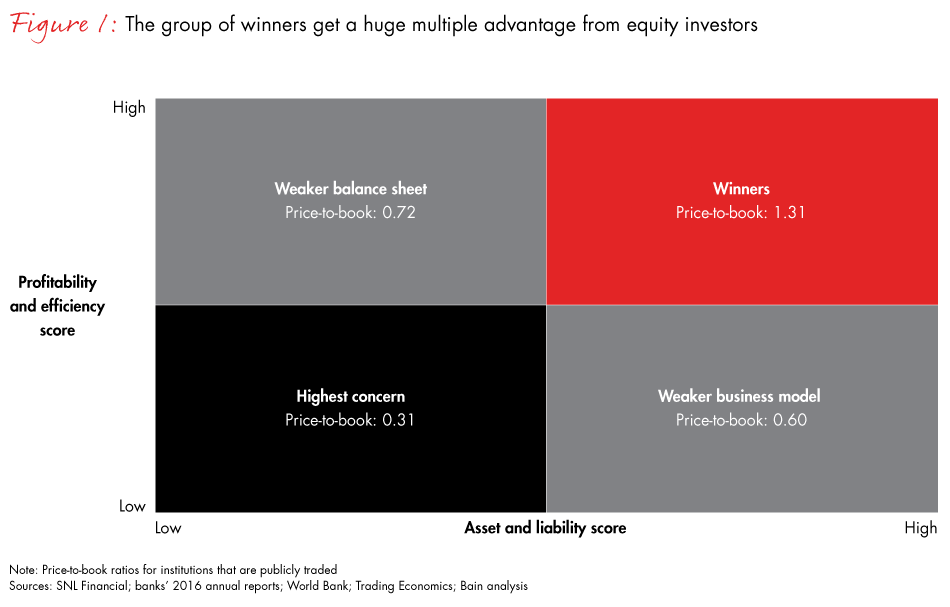
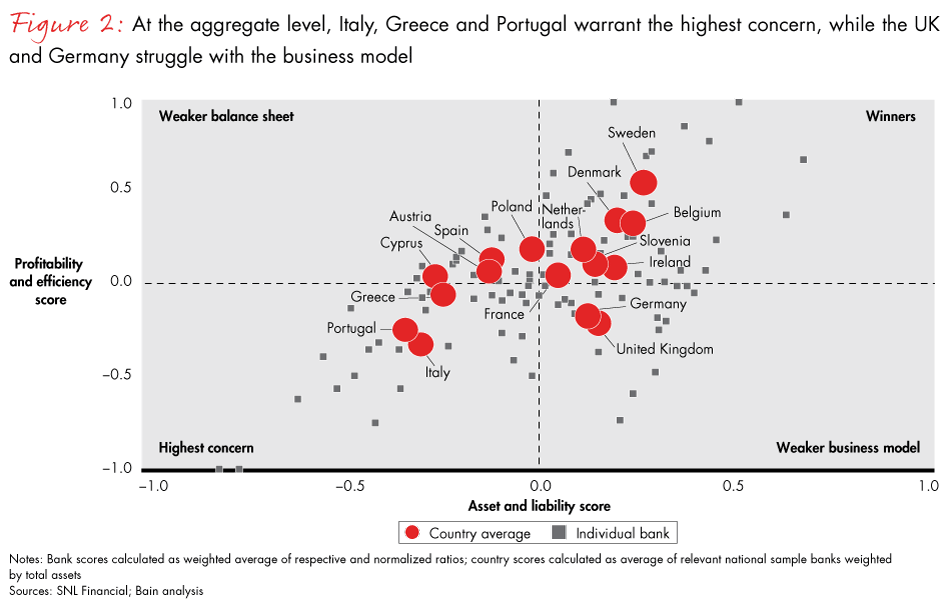
      Our scoring brings together data from financial providers such as SNL Financial and Moody’s and combines their findings with banks’ own financial statements. The health check provides a uniquely integrated view, which stands in contrast to looking only at a balance sheet or income statement. Based on the combination of the critical financial ratios, we calculate a score for each bank and place it in one of four categories (see Figures 1 and 2).

      João Soares, a partner with Bain's Financial Services practice, outlines a proven formula that can help any bank become a winner in three to five years.

      Winners. Some 38% of banks have attained this strong position. Scandinavian, Belgian and Dutch banks figure prominently in this group, outperforming on virtually all financial indicators.

      Weaker business model. Banks in this quadrant continue to represent about 17% of the total. What may surprise some observers is the number of UK and German banks, including names that used to be references for good health, struggling to find a viable business model. In fact, virtually all the large German names fall into this category as their profitability and efficiency sit at a level comparable with their Greek counterparts.

      Weaker balance sheet. Some 17% of banks have a priority to fix weak balance sheets, compared with 21% in 2013. Over the years, banks in this quadrant have shown vulnerabilities not yet fully reflected in their profit and loss statements. A leading Spanish lender, for instance, moved from this quadrant to the quadrant of highest concern in just two years.

      Highest concern. Of the total base, 28% of banks flash a high-risk signal, up from 26% in 2013. Banks in Italy, Greece, Portugal and Spain form the bulk of this quadrant and have become a breed apart in continued distress. Every single bank that has failed in the past decade and for which there are financial statements available, as well as many banks that have merged into other entities, such as Spanish cajas or savings banks, fell into this quadrant before their demise. Executives at many of these banks either lacked an integrated view or were in denial about the warning signs.
      battle-of-the-banks-fig01_embed


      battle-of-the-banks-fig02_embed

      The cost of inertia is striking, with investors rewarding the winners with a 1.31 price-to-book ratio and punishing the high-concern banks with a 0.31 price-to-book ratio. Equity markets also seem to reward banks with weak balance sheets, assigning them a slightly higher price-to-book ratio of 0.72 vs. banks with weak in-year profitability and efficiency, which were assigned a price-to-book ratio of 0.60.

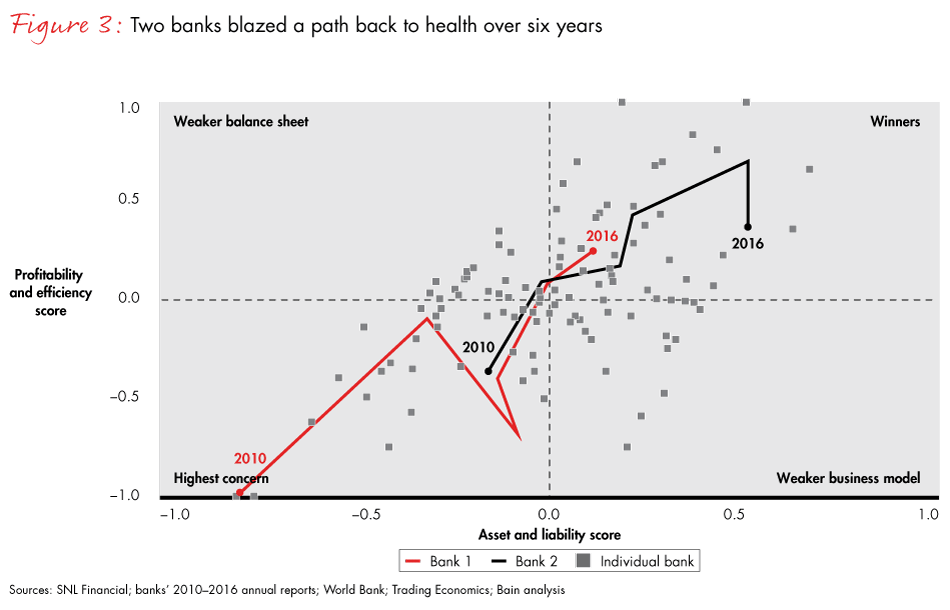
      Ultimately, the health check should prove its usefulness by helping banks analytically determine their relative position and thus get clarity about how to improve that position on a number of fronts. To that end, there is a proven formula for moving up—even from the dark reaches of highest concern to the promised land of winners. The experiences of two banks illustrate that migration (see Figure 3). Their journeys were difficult and required painful choices, but ultimately paid off with much more robust, stable and profitable institutions. What follows are examples of actions that the two banks took.

      battle-of-the-banks-fig03_embed

      • Significant shrinkage of the balance sheet. Both reduced their risk-weighted assets by about 50%, their gross loan amounts by between 25% and 30%, and their problem loans by 70% to 75%. Restructuring troubled loans took a major commitment of time and effort as bankers had to figure out how to dispose of repossessed factories and other assets. They persisted, having realized that allowing nonperforming assets to sit on the balance sheet would require more capital every month and further impair the enterprise.

      • Growing revenue by improving customer loyalty and advocacy in the new digital world. Net interest margin as a share of risk-weighted assets more than doubled. This occurred after both banks embarked on an ambitious reassessment of the markets in which they operate for their retail and business segments. They discarded legacy bets and focused on new profit pools.

        These new models involved a systematic mapping of customer episodes in both personal banking and business banking. (An episode consists of the interactions customers perform when they have a task to complete or a need to fulfill.) Episodes that the banks redesigned ranged from new ways of risk pricing and attracting new card customers to speeding up the process of onboarding corporate customers. By adopting highly digital business models and improving various customer episodes, both banks achieved significant increases in customer loyalty and business. One saw an increase of 30 points over three years in its Net Promoter Score®, a key metric of loyalty.

      • Adjusting the cost base to reinvest in new activities. Both banks decided to pursue cost reductions through what we would now call zero-based redesign programs. This differs from traditional budgeting processes by examining all expenses for each new period, not just incremental expenditures in obvious areas. A zero-based approach puts the onus on managers to justify the costs that need to be kept—a subtle but powerful shift in perspective from what should be removed. As a result, one of the banks that published its performance results reduced its cost base by around 30%. Zero-basing freed up funds (up to one-third of the original savings) to reinvest in a more simple and digital business model featuring remote account management, straight-through processing and simpler product suites aimed at more carefully selected segments of customers.

      • Changes to the mix of funding. The two banks’ deposit levels rose by 20% to 25%, while they reduced wholesale funding by between 70% and 80%. Reduced dependency on wholesale funding marked a major departure from the previous makeup of the balance sheets.

      With relatively new and ever-increasing regulatory frameworks from the European authorities taking hold, including the Supervisory Review and Evaluation Process and greater scrutiny of nonperforming exposures, European banks cannot afford to ignore any of the data that signals vulnerable points within the institution. Taking an integrated view is essential for understanding how to return to robust health. The good news: Troubled banks can likely quadruple their market value by taking the right actions.


      Infografik

      How European Banks Can Get Stronger

      Many European banks continue to struggle. But there is a proven formula that banks can use to right themselves.

      How the scoring model works


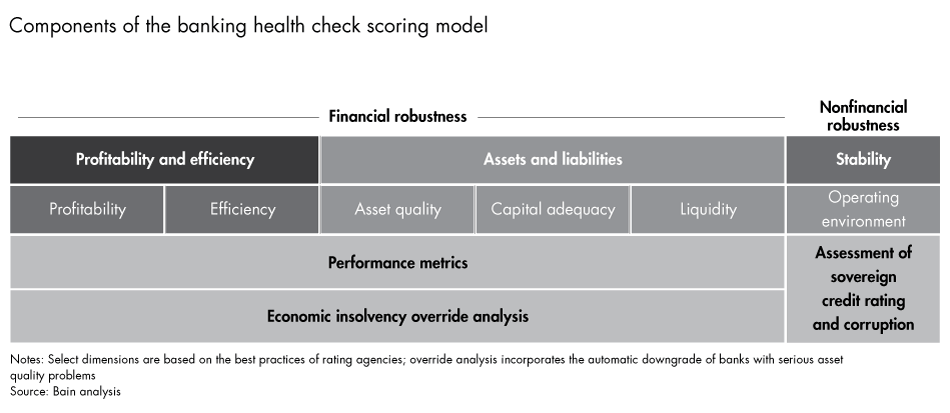
      The scoring model in Bain’s health check of the banking system gathers data in six areas, with the heaviest weighting on asset quality (see figure).

      Profitability: The key determinant of sustainable success or failure, it measures the ability to create economic value and to preserve or improve risk protection for creditors. Performance metrics include pre-provision income as a percentage of risk-weighted assets and net income as a percentage of risk-weighted assets.

      Efficiency: Cost containment is a strategic focal point; it allows banks to satisfy stakeholders’ requirements without overly aggressive risk taking. Performance metrics include operating expenses as a percentage of net revenue.

      Asset quality: A main factor in future earnings and capital generation or erosion, loan quality is a key to determining a bank’s stability. Nonperforming loans predict future losses. Performance metrics as a percentage of gross loans include problem loans, loan-loss provisions and corporate loans.

      Capital adequacy: Banks typically fail due to losses in the loan portfolio, poor business models or fraud—all of which lead to a decline in capital. In the case of low profitability, capital is the most important buffer for absorbing risk costs. Performance metrics include Tier 1 capital as a percentage of risk-weighted assets and tangible common equity as a percentage of average risk-weighted assets.

      Liquidity: Illiquidity is often a proximate cause of failure as banks might not any longer be able to finance themselves under pressure. Access to market funding may not be based on long-term relationships but rather on creditworthiness. Performance metrics include gross loans as a percentage of total deposits and total debt—that is, liquid assets as a percentage of total assets.

      Operating environment: Bank performance is often constrained by violent economic cycles, adverse political decisions or weak legal systems. Declines in economic growth correlate highly with worsening asset quality. Performance metrics include assessment of sovereign credit rating and corruption.

      battle-of-the-banks-sidebar_embed

      João Soares is a partner with Bain & Company’s Financial Services practice. He is based in London.

      Net Promoter®, Net Promoter System®, Net Promoter Score® and NPS® are registered trademarks of Bain & Company, Inc., Fred Reichheld and Satmetrix Systems, Inc.


      battle-of-the-banks-fig01_full

      battle-of-the-banks-fig02_full

      battle-of-the-banks-fig03_full

      battle-of-the-banks-sidebar_full
      Autoren
      • Headshot of João Soares
        João Soares
        Partner, New York
      Kontaktieren Sie uns
      Verwandte Branchen
      • Finanzdienstleistungen
      Wie wir Sie unterstützen können
      • Digital Transformation
      • Zero-based Budgeting
      Finanzdienstleistungen
      New Bank Strategies Require New Operating Models

      It’s high time to shake up creaky structures and ways of working.

      Mehr erfahren
      Finanzdienstleistungen
      Unprofitable Firmenkunden und wie Banken darauf reagieren können

      Die anhaltend niedrigen Zinsen decken die Schwächen der Banken im bisher noch profitablen Corporate-Banking auf.

      Mehr erfahren
      Finanzdienstleistungen
      João Soares: Battle of the Banks in Europe

      European banks can follow a proven formula to become a winner.

      Mehr erfahren
      Zukunft des Bankenwesens
      Perform Today, Prove Tomorrow, Propel the Stock Valuation

      Leading banks build credibility with investors by aligning their strategy, execution, and equity story.

      Mehr erfahren
      Finanzdienstleistungen
      Six Threats Demand a New Playbook for Banks in Wealth and Asset Management

      AI, direct-to-consumer models, and the return of local priorities are redrawing industry lines.

      Mehr erfahren
      First published in September 2017
      Markierungen
      • Digital Transformation
      • Finanzdienstleistungen
      • Zero-based Budgeting
      • Zukunft des Bankenwesens

      Wie wir unsere Kunden unterstützt haben

      Informationstechnologie Cost Transparency Helps Insurer Strengthen Tech Expense Management Capability

      Kundenbeispiel lesen

      Strategie A financial services leader gains market confidence

      Kundenbeispiel lesen

      Change & Implementation The change process unlocks potential and profits

      Kundenbeispiel lesen

      Möchten Sie mit uns in Kontakt bleiben?

      Wir unterstützen Führungskräfte weltweit, die kritischen Themen in ihrem Unternehmen zu adressieren. Gemeinsam schaffen wir nachhaltige Veränderungen und Ergebnisse.

      Bain Insights. Unsere Perspektive auf die kritischen Themen, mit denen sich international agierende Unternehmen konfrontiert sehen, finden Sie monatlich in Ihrem Postfach.

      *Ich habe die Datenschutzerklärung gelesen und akzeptiere sie.
      Bitte lesen Sie die Datenschutzerklärung und akzeptieren Sie diese.
      Bain & Company
      Contact us Sustainability Accessibility Rechtliche Hinweise Impressum Datenschutz Cookie-Richtlinie Sitemap Log In

      © 1996-2026 Bain & Company, Inc.

      Kontaktieren Sie Bain

      Wie können wir Ihnen helfen?

      • Business inquiry
      • Career information
      • Press relations
      • Partnership request
      • Speaker request
      Alle weltweiten Büros