
Skip to Content
  • Standorte

    Standorte

    North & Latin America
    • Atlanta
    • Austin
    • Bogota
    • Boston
    • Buenos Aires
    • Chicago
    • Dallas
    • Denver
    • Houston
    • Lisbon
    • Los Angeles
    • Mexico City
    • Minneapolis
    • Monterrey
    • Montreal
    • New York
    • Rio de Janeiro
    • San Francisco
    • Santiago
    • São Paulo
    • Seattle
    • Silicon Valley
    • Toronto
    • Washington, DC
    Europe & Africa
    • Amsterdam
    • Athens
    • Berlin
    • Brussels
    • Copenhagen
    • Düsseldorf
    • Frankfurt
    • Helsinki
    • Istanbul
    • Johannesburg
    • Kyiv
    • Lisbon
    • London
    • Madrid
    • Milan
    • München
    • Oslo
    • Paris
    • Rome
    • Stockholm
    • Warsaw
    • Wien
    • Zürich
    Middle East
    • Doha
    • Dubai
    • Riyadh
    Asia & Australia
    • Bangkok
    • Beijing
    • Bengaluru
    • Brisbane
    • Ho Chi Minh City
    • Hong Kong
    • Jakarta
    • Kuala Lumpur
    • Manila
    • Melbourne
    • Mumbai
    • New Delhi
    • Perth
    • Seoul
    • Shanghai
    • Singapore
    • Sydney
    • Tokyo
    Alle Standorte Anzeigen
  • Alumni
  • Presse
  • Newsletter
  • Kontakt
  • DACH-Region | Deutsch

    Wählen Sie Ihre Region und Sprache

    Global
    • Global (English)
    North & Latin America
    • Brazil (Português)
    • Argentina (Español)
    • Canada (Français)
    • Chile (Español)
    • Colombia (Español)
    Europe, Middle East, & Africa
    • France (Français)
    • DACH-Region (Deutsch)
    • Italy (Italiano)
    • Spain (Español)
    • Greece (Elliniká)
    Asia & Australia
    • China (中文版)
    • Korea (한국어)
    • Japan (日本語)
  • Saved items (0)
    Saved items (0)

    You have no saved items.

    Inhalte, für die Sie sich interessieren, werden hier gespeichert und können später gelesen oder weitergeleitet werden.

    Explore Bain Insights
  • Branchenkompetenzen
    Hauptmenü

    Branchenkompetenzen

    • Luft- und Raumfahrt, Verteidigung
    • Agrarwirtschaft
    • Chemieindustrie
    • Infrastruktur und Bauwirtschaft
    • Konsumgüter
    • Finanzdienstleistungen
    • Gesundheitswesen
    • Maschinen- und Anlagenbau
    • Medienwirtschaft
    • Metallindustrie
    • Bergbau
    • Öl und Gas
    • Papier- und Verpackungsindustrie
    • Private Equity
      Branchenkompetenzen
      Private Equity
      • Due Diligence
      • Exit Planning
      • Firm Strategy & Operations
      • Portfolio Value Creation
    • Öffentlicher Sektor und Sozialwesen
    • Einzelhandel
    • Technologie
    • Telekommunikation
    • Transportwesen
    • Reise- und Freizeitbranche
    • Versorgung und erneuerbare Energien
  • Managementkompetenzen
    Hauptmenü

    Managementkompetenzen

    • Customer Experience
    • ESG
    • Innovation
    • M&A
    • Operations
    • People & Organization
    • Private Equity
    • Sales & Marketing
    • Strategie
    • KI, Einblicke und Lösungen
    • Technologie
    • Transformation
  • Digital
  • Publikationen
    Hauptmenü

    Publikationen

    • Branchenthemen
    • Managementthemen
    • Bain-Bücher
    Alle Publikationen
    Ausgewählte Themen
    • Resilienz in der globalen Krise
    • M&A Report
    • Private Equity Podcast
    • Midyear Private Equity Report
    • Agile
    • Engineering Report
    • Digital Transformation
    • Elements of Value®
    • Firm of the Future
    • Nachhaltigkeitsstudie
    • Macro Trends
    • Future of Consumption
    • Weltwirtschaftsforum (WEF)
  • Über uns
    Hauptmenü

    Über uns

    • Was wir bieten
    • Unser Ansatz
    • Unser Team
    • Game Changer Award
    • Female Allstar Board
    • Messbare Ergebnisse (EN)
    • Auszeichnungen
    • Globale Partnerschaften
    • The Mission
    Further: Our global responsibility
    • Vielfalt & Chancengleichheit
    • Soziale Verantwortung
    • Sustainability
    Erfahren Sie mehr zu "Further"
  • Karriere
    Hauptmenü

    Karriere

    • Dein Einstieg
      Karriere
      Dein Einstieg
      • Find Your Place
      • Unsere Arbeitsbereiche
      • Unsere Teams
      • Angebote für Studierende
      • Praktika & Programme
      • Recruiting-Events
    • Arbeiten bei Bain
      Karriere
      Arbeiten bei Bain
      • Blog: Inside Bain
      • Karriere Stories
      • Unsere Bainies
      • Office-Standorte
      • Weiterentwicklung
      • Affinity Groups
      • Deine Benefits
    • Impact Stories
    • Deine Bewerbung
      Karriere
      Deine Bewerbung
      • Das erwartet dich
      • Der Interviewprozess
    FIND JOBS
  • Standorte
    Hauptmenü

    Standorte

    • North & Latin America
      Standorte
      North & Latin America
      • Atlanta
      • Austin
      • Bogota
      • Boston
      • Buenos Aires
      • Chicago
      • Dallas
      • Denver
      • Houston
      • Lisbon
      • Los Angeles
      • Mexico City
      • Minneapolis
      • Monterrey
      • Montreal
      • New York
      • Rio de Janeiro
      • San Francisco
      • Santiago
      • São Paulo
      • Seattle
      • Silicon Valley
      • Toronto
      • Washington, DC
    • Europe & Africa
      Standorte
      Europe & Africa
      • Amsterdam
      • Athens
      • Berlin
      • Brussels
      • Copenhagen
      • Düsseldorf
      • Frankfurt
      • Helsinki
      • Istanbul
      • Johannesburg
      • Kyiv
      • Lisbon
      • London
      • Madrid
      • Milan
      • München
      • Oslo
      • Paris
      • Rome
      • Stockholm
      • Warsaw
      • Wien
      • Zürich
    • Middle East
      Standorte
      Middle East
      • Doha
      • Dubai
      • Riyadh
    • Asia & Australia
      Standorte
      Asia & Australia
      • Bangkok
      • Beijing
      • Bengaluru
      • Brisbane
      • Ho Chi Minh City
      • Hong Kong
      • Jakarta
      • Kuala Lumpur
      • Manila
      • Melbourne
      • Mumbai
      • New Delhi
      • Perth
      • Seoul
      • Shanghai
      • Singapore
      • Sydney
      • Tokyo
    Alle Standorte Anzeigen
  • Alumni
  • Presse
  • Newsletter
  • Kontakt
  • DACH-Region | Deutsch
    Hauptmenü

    Wählen Sie Ihre Region und Sprache

    • Global
      Wählen Sie Ihre Region und Sprache
      Global
      • Global (English)
    • North & Latin America
      Wählen Sie Ihre Region und Sprache
      North & Latin America
      • Brazil (Português)
      • Argentina (Español)
      • Canada (Français)
      • Chile (Español)
      • Colombia (Español)
    • Europe, Middle East, & Africa
      Wählen Sie Ihre Region und Sprache
      Europe, Middle East, & Africa
      • France (Français)
      • DACH-Region (Deutsch)
      • Italy (Italiano)
      • Spain (Español)
      • Greece (Elliniká)
    • Asia & Australia
      Wählen Sie Ihre Region und Sprache
      Asia & Australia
      • China (中文版)
      • Korea (한국어)
      • Japan (日本語)
  • Saved items  (0)
    Hauptmenü
    Saved items (0)

    You have no saved items.

    Inhalte, für die Sie sich interessieren, werden hier gespeichert und können später gelesen oder weitergeleitet werden.

    Explore Bain Insights
  • Branchenkompetenzen
    • Branchenkompetenzen

      • Luft- und Raumfahrt, Verteidigung
      • Agrarwirtschaft
      • Chemieindustrie
      • Infrastruktur und Bauwirtschaft
      • Konsumgüter
      • Finanzdienstleistungen
      • Gesundheitswesen
      • Maschinen- und Anlagenbau
      • Medienwirtschaft
      • Metallindustrie
      • Bergbau
      • Öl und Gas
      • Papier- und Verpackungsindustrie
      • Private Equity
      • Öffentlicher Sektor und Sozialwesen
      • Einzelhandel
      • Technologie
      • Telekommunikation
      • Transportwesen
      • Reise- und Freizeitbranche
      • Versorgung und erneuerbare Energien
  • Managementkompetenzen
    • Managementkompetenzen

      • Customer Experience
      • ESG
      • Innovation
      • M&A
      • Operations
      • People & Organization
      • Private Equity
      • Sales & Marketing
      • Strategie
      • KI, Einblicke und Lösungen
      • Technologie
      • Transformation
  • Digital
  • Publikationen
    • Publikationen

      • Branchenthemen
      • Managementthemen
      • Bain-Bücher
      Alle Publikationen
      Ausgewählte Themen
      • Resilienz in der globalen Krise
      • M&A Report
      • Private Equity Podcast
      • Midyear Private Equity Report
      • Agile
      • Engineering Report
      • Digital Transformation
      • Elements of Value®
      • Firm of the Future
      • Nachhaltigkeitsstudie
      • Macro Trends
      • Future of Consumption
      • Weltwirtschaftsforum (WEF)
  • Über uns
    • Über uns

      • Was wir bieten
      • Unser Ansatz
      • Unser Team
      • Game Changer Award
      • Female Allstar Board
      • Messbare Ergebnisse (EN)
      • Auszeichnungen
      • Globale Partnerschaften
      • The Mission
      Further: Our global responsibility
      • Vielfalt & Chancengleichheit
      • Soziale Verantwortung
      • Sustainability
      Erfahren Sie mehr zu "Further"
  • Karriere
    Häufige Suchanfragen
    • Agil
    • Digital
    • Strategie
    Vorherige Suchanfragen
      Zuletzt besuchte Seiten

      Content added to saved items

      Saved items (0)

      Removed from saved items

      Saved items (0)

      Brief

      Digital Opportunities for Chemical Producers

      Digital Opportunities for Chemical Producers

      Executives, awash with digital possibilities, need to identify and focus on those that will help them meet customer needs.

      Von Mark Porter, Nathan Anderson, Francesco Cigala and Peter Guarraia

      • Min. Lesezeit
      }

      Brief

      Digital Opportunities for Chemical Producers
      en

      Chemical producers were among the first to use digital technologies extensively. From the days of the earliest digital plant controllers, they have used data to improve their operations. Their R&D teams have tapped large data sets in their search for better molecules and processes. And for at least 40 years, engineers have used computer-aided design (CAD) systems to design their plants.

      However, in recent years, the chemicals sector has fallen behind companies in banking, retail, media and telecom that have explored innovative ways to use digital technology to improve their businesses—not only in running their operations, but also in engaging customers and generating new value. Now, chemical companies are innovating again to catch up. As the traditional sources of competitive advantage (access to feedstock, scale assets, process technology and market access) become well-established, new business models are emerging that threaten to disrupt traditional value chains.

      In our work with chemical executives, we see a range of ways that they are seeking to use digital technologies to create new sustainable advantage for their industry. These executives want to understand how their world will be different in five to 10 years so they can take advantage of the changes, or at least future-proof their companies. At the same time, they need to identify their short-term priorities. Bombarded by unfiltered ideas, they need to frame and prioritize the opportunities to use digital technologies to improve operations and develop topline opportunities, including new products and services.

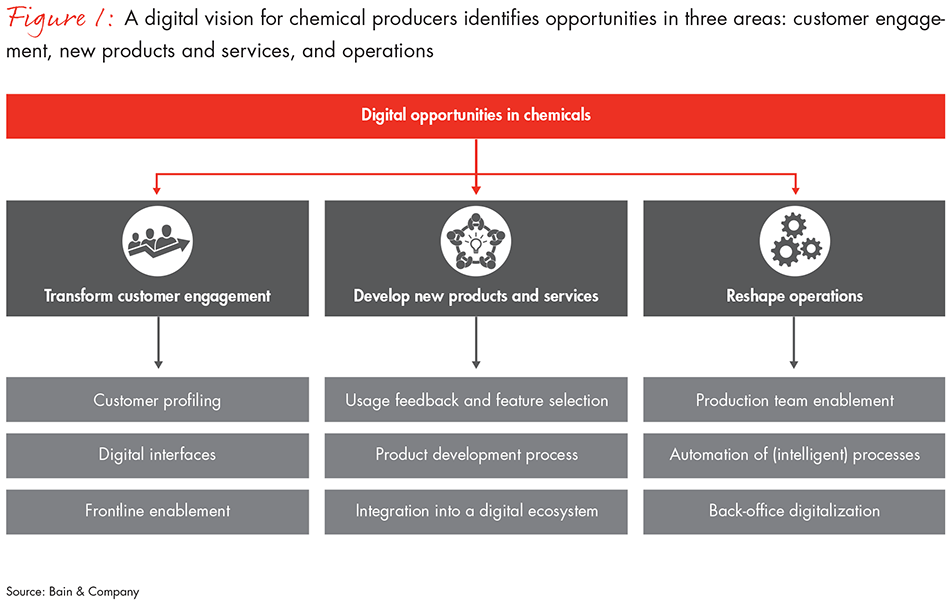
      Bain’s research on this topic identifies three areas where digital technologies show potential: customer engagement, products and services, and operations (see Figure 1). To seize these opportunities, companies will need a comprehensive digital vision supported by new capabilities, platforms, data analytics and changes in business and operating model.

      digital-opportunities-chemical-producers-fig01_embed

      Customer engagement


      Mobile, social and web interfaces give customers (businesses and consumers) greater transparency into their suppliers, including specifications, product availability, performance ratings and alternative suppliers. Digitalization provides an opportunity for chemical producers to rethink the customer relationship, to take a more customer-centric view and to focus on improving the customer experience. Analyzing customer interactions across the value chain, from shopping through purchasing and after-sales interactions, makes it possible to understand customers and their businesses better, anticipating their needs and helping them improve the way they use products and services.

      Customers use new technologies differently, depending on factors like geography and age. Bain research found that while only half of UK customers look online before buying coatings, 90% of China’s buyers do. UK customers checked out paint colors and prices, while in China they were more interested in design ideas and ratings of suppliers.

      Of course, chemical producers will need to revisit how they interact with their business customers, too. Digital technologies will help reconfigure supply chains to reduce inventory and speed up transactions. Companies will digitize and automate core business processes such as order-to-cash. They will equip salesforce teams with tools that simulate how their products will improve life for customers. Marketing and planning teams will have access to richer flows of real-time information to facilitate decision making.

      Some chemical companies are already using digital technologies in creative ways to improve salesforce effectiveness. One lubricant producer that equipped its salesforce with computer tablets found that this not only improved the quality of sales presentations but, more important, it also enabled it to collect data on how the salesforce was spending time with customers. It then used this information to fine tune its customer segmentation and provide better coaching to individual salespeople.

      New products and services


      Digital technology opens the way for new products and services. At its most basic, the rise of digital technologies creates demand for associated chemicals, such as ultra-pure chemicals used in electronics production, battery chemicals, and ABS or PLA filaments,1 which are used in 3-D printing.

      Beyond producing molecules, suppliers increasingly want to offer “molecules plus service” to strengthen customer loyalty and capture greater margin. This will disrupt and reform value chains, and existing models may prove inefficient. Some chemical producers are moving into completely new territory, such as software as a service (SaaS), which they bundle with products to help customers convey a value proposition while reducing costs.

      Industrial gases might be perceived as the purest form of the commodity chemicals business. One retail application is supplying oxygen cylinders to patients with chronic lung conditions in their own homes. Digital technologies allow oxygen suppliers to collect huge amounts of data on these distributed cylinders, allowing them to anticipate replacement cycles and perhaps develop related pharmaceutical products. This can help reduce patients’ healthcare costs while also creating the potential for new revenue.

      The pace of change is accelerating in chemicals and other industries, and product development cycles are condensing. New development processes, including rapid prototyping and parallel experimentation supported by data analytics, can help companies respond.

      Peter Guarraia, who leads Bain's Chemicals practice in the Americas, identifies three areas that chemical companies must address to successfully capitalize on the emerging opportunities in digital.

      Core operations


      For decades, chemical producers have used remote sensing and communications technologies such as supervisory control and data acquisition to run their plants and optimize production processes. Condition monitoring of critical plant items has improved the predictability of maintenance. The main change brought on by digitalization is that the number of sensors and the amount of data that operators must manage are increasing by one or two orders of magnitude.

      As the costs of thermal and vibration sensors have dropped, their use has grown. Chemical companies have more data than ever to improve product quality and yield, while reducing costs. Engineers can monitor plant operations to ensure they are within the design parameters, and they can see when equipment shows risks of failure—all of which helps improve plant reliability.

      While the opportunity to improve operations grows, so does the challenge of extracting meaningful information from volumes of data. Companies need to develop new analytic capabilities to draw meaningful insights, and a whole industry of third-party solution providers that can help make the most out of their data has risen up. Already, those insights are helping producers make better decisions about when to perform maintenance or replace parts or equipment. Increasingly, these insights will help them monitor the production of chemicals in real time, offering recommendations or even adjusting processes to optimize the mix.

      Digitalization also helps improve resource management, particularly with the field force. Custom apps on mobile phones and wireless tablets can help keep the entire team informed about who is where doing what job and with what capabilities. This can raise productivity by intelligently routing techs from one task to the next without the need to return to the dispatch point or warehouse. Companies can pre-stage repairs more efficiently to make better use of skilled workers’ time. In fact, with better resource management, wrench time could rise from as low as one-third of working hours to as high as two-thirds, based on Bain research.

      Priorities for different chemical businesses


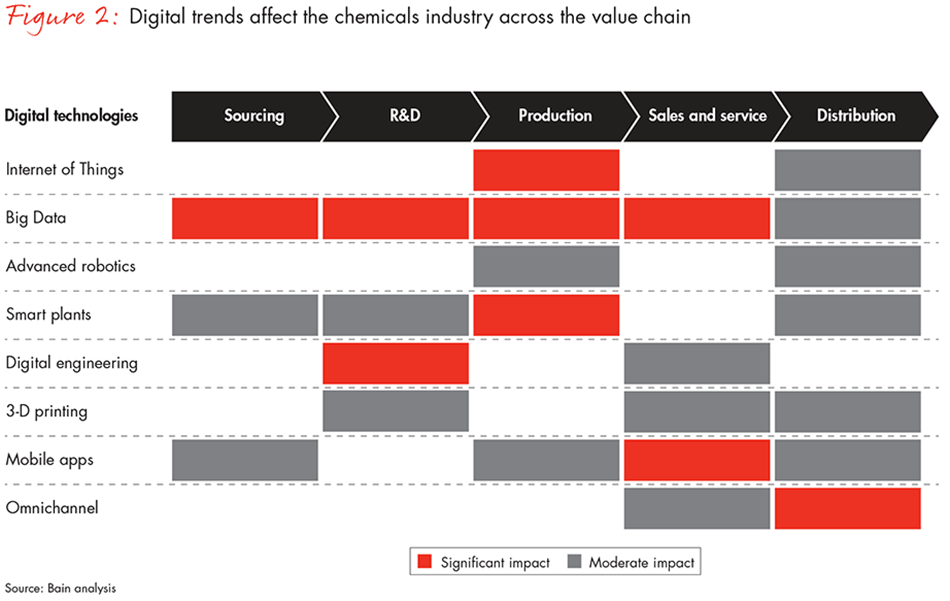
      Chemical executives must decide where and how to invest in digital technologies, depending on their priorities and their place in the market. Deciding on the sequencing and pace of a digital transformation is a strategic exercise that depends on the goals of the business and the source of its competitive advantage, rather than the availability of new technology. As a result, no single size fits all (see Figure 2).

      digital-opportunities-chemical-producers-fig02_embed

      For some, customer interactions are the top priority. Data analytics and digital technologies enable sharper segmentation, higher value solutions and new customer-interaction models. Other companies may focus on improving operations: connected sensors and better analysis can help reduce downtime and speed up processes.

      Another option is to invest in end-to-end digital technologies and interfaces between value chain steps. Data and analytics help producers recognize patterns and specific events, and they can apply these findings through mobile apps. These apps can provide better information in sourcing and production, or to the salesforce members who can use it to tailor offers more specifically to individual customers.

      Finally, some companies may find specific opportunities at a given point in the value chain—for example, growth in 3-D printing has led to the demand for compounded and extruded filaments that retail around $30 per kilogram, compared with a base ABS polymer price around $2 to $3 per kilogram.

      Making the transition


      Successful transformations start by examining how digital is changing customer needs, the value chain and competitive offers. Given the bewildering array of digital solutions on offer from vendors, the critical question is “how can we better serve customers?” not “what can digital do for us?” Companies should assess their own digital initiatives (current and planned) and identify their capability gaps, their readiness for change, and the execution risks. Those risks include investing too thinly in digital initiatives, chasing too many opportunities at once, failing to develop the right roles with decision rights to put plans into action, and making do with existing IT talent where new digital capabilities are sorely needed.

      With this assessment in hand, executives can begin to prioritize their digital initiatives for better customer engagement, new products and services and optimized operations. A blueprint with clear responsibilities and timelines can help focus teams and accelerate progress on the actions most likely to increase margins and raise share price.

      In all cases, chemical producers should take a top-down, cross-functional approach that includes:

      • Assessing opportunities and threats, by business and by function.
      • Reconfiguring the operating model, the organizational design and business processes to support a digital company.
      • Identifying capability gaps and learning to see technology and data skills as advantages rather than as back-office functions.
      • Finding the right partners—not just technology vendors, but also those supplying complementary products. Most producers should partner with analytics service providers, rather than trying to build world-class analytics capabilities in house.
      • Allocating capital and people where they can add the most value, setting targets and tracking progress with performance metrics.

      Digital transformation offers a massive opportunity for chemical companies, but success requires thoughtful prioritization and investment in new talent and capabilities. Senior executives must be deliberate about picking opportunities for their market and regulatory environment. They should think of this as a multiyear journey, even though one of the most important aspects of this change will be acquiring the ability to innovate in short cycles and deploy new products and services more rapidly.


      1 ABS is acrylonitrile butadiene styrene; PLA stands for polylactic acid. Both are thermoplastics used as material for 3-D printing. (For more information, see “Five Questions to Shape a Winning 3-D Printing Strategy.”)

      Mark Porter is a partner with Bain & Company in London. Nathan Anderson and Peter Guarraia are Bain partners in Chicago. Francesco Cigala is a partner in Bain’s Kuala Lumpur office. All work with Bain’s Global Chemicals practice, which Guarraia leads in the Americas and Porter leads globally.


      digital-opportunities-chemical-producers-fig01_full

      digital-opportunities-chemical-producers-fig02_full
      Autoren
      • Headshot of Mark Porter
        Mark Porter
        Partner, London
      • Headshot of Nate Anderson
        Nate Anderson
        Partner, Chicago
      • Headshot of Francesco Cigala
        Francesco Cigala
        Partner, Kuala Lumpur
      • Headshot of Peter Guarraia
        Peter Guarraia
        Alumni, Houston
      Kontaktieren Sie uns
      Verwandte Branchen
      • Chemieindustrie
      Ähnliche Beratungsangebote
      • Digitalisierung
      • Performance Improvement
      Wie wir Sie unterstützen können
      • Capability Sourcing
      Luft- und Raumfahrt, Verteidigung, Öffentlicher Sektor
      Fünf Säulen einer erfolgreichen Strategie für 3D-Druck

      Der 3D-Druck, auch Additive Manufacturing (AM) genannt, hat den Schritt aus dem akademischen Bereich und den Hobbywerkstätten heraus geschafft und Einzug in Unternehmen gehalten.

      Mehr erfahren
      Private Equity
      Measuring a Company's Digital Competence

      Sector-specific scorecards give private equity firms a critical edge in digital due diligence and value creation.

      Mehr erfahren
      Technologie
      Was die Pioniere der Digitalisierung ausmacht

      Digitale Technologien werden in Zeiten von Digitalisierung und Industrie 4.0 auch in traditionellen Unternehmen zum Standard - getrieben von disruptiven Innovationen neuer Anbieter.

      Mehr erfahren
      Chemieindustrie
      Demystifying R&D Performance in Chemicals

      A robust assessment of R&D can help companies understand how their performance compares to others and focus investment where it matters most.

      Mehr erfahren
      Chemieindustrie
      Sustaining Capital: From Chaos to Discipline

      Fragmented budgets, poor visibility, and missed forecasts are fixable with the right approach.

      Mehr erfahren
      First published in August 2016
      Markierungen
      • Capability Sourcing
      • Chemieindustrie
      • Digitalisierung
      • Performance Improvement

      Wie wir unsere Kunden unterstützt haben

      Kundenstrategie und Marketing A Manufacturer Catalyzes Growth with Sales Plays

      Kundenbeispiel lesen

      Change & Implementation Mobilization Efforts Help a Chemical Company Implement and Sustain 15% Cost Reduction

      Kundenbeispiel lesen

      Informationstechnologie An Energy and Chemical Company Rebuilds Its Technology Foundation

      Kundenbeispiel lesen

      Möchten Sie mit uns in Kontakt bleiben?

      Wir unterstützen Führungskräfte weltweit, die kritischen Themen in ihrem Unternehmen zu adressieren. Gemeinsam schaffen wir nachhaltige Veränderungen und Ergebnisse.

      Bain Insights. Unsere Perspektive auf die kritischen Themen, mit denen sich international agierende Unternehmen konfrontiert sehen, finden Sie monatlich in Ihrem Postfach.

      *Ich habe die Datenschutzerklärung gelesen und akzeptiere sie.
      Bitte lesen Sie die Datenschutzerklärung und akzeptieren Sie diese.
      Bain & Company
      Contact us Sustainability Accessibility Rechtliche Hinweise Impressum Datenschutz Cookie-Richtlinie Sitemap Log In

      © 1996-2026 Bain & Company, Inc.

      Kontaktieren Sie Bain

      Wie können wir Ihnen helfen?

      • Business inquiry
      • Career information
      • Press relations
      • Partnership request
      • Speaker request
      Alle weltweiten Büros