
Skip to Content
  • Standorte

    Standorte

    North & Latin America
    • Atlanta
    • Austin
    • Bogota
    • Boston
    • Buenos Aires
    • Chicago
    • Dallas
    • Denver
    • Houston
    • Lisbon
    • Los Angeles
    • Mexico City
    • Minneapolis
    • Monterrey
    • Montreal
    • New York
    • Rio de Janeiro
    • San Francisco
    • Santiago
    • São Paulo
    • Seattle
    • Silicon Valley
    • Toronto
    • Washington, DC
    Europe & Africa
    • Amsterdam
    • Athens
    • Berlin
    • Brussels
    • Copenhagen
    • Düsseldorf
    • Frankfurt
    • Helsinki
    • Istanbul
    • Johannesburg
    • Kyiv
    • Lisbon
    • London
    • Madrid
    • Milan
    • München
    • Oslo
    • Paris
    • Rome
    • Stockholm
    • Warsaw
    • Wien
    • Zürich
    Middle East
    • Doha
    • Dubai
    • Riyadh
    Asia & Australia
    • Bangkok
    • Beijing
    • Bengaluru
    • Brisbane
    • Ho Chi Minh City
    • Hong Kong
    • Jakarta
    • Kuala Lumpur
    • Manila
    • Melbourne
    • Mumbai
    • New Delhi
    • Perth
    • Seoul
    • Shanghai
    • Singapore
    • Sydney
    • Tokyo
    Alle Standorte Anzeigen
  • Alumni
  • Presse
  • Newsletter
  • Kontakt
  • DACH-Region | Deutsch

    Wählen Sie Ihre Region und Sprache

    Global
    • Global (English)
    North & Latin America
    • Brazil (Português)
    • Argentina (Español)
    • Canada (Français)
    • Chile (Español)
    • Colombia (Español)
    Europe, Middle East, & Africa
    • France (Français)
    • DACH-Region (Deutsch)
    • Italy (Italiano)
    • Spain (Español)
    • Greece (Elliniká)
    Asia & Australia
    • China (中文版)
    • Korea (한국어)
    • Japan (日本語)
  • Saved items (0)
    Saved items (0)

    You have no saved items.

    Inhalte, für die Sie sich interessieren, werden hier gespeichert und können später gelesen oder weitergeleitet werden.

    Explore Bain Insights
  • Branchenkompetenzen
    Hauptmenü

    Branchenkompetenzen

    • Luft- und Raumfahrt, Verteidigung
    • Agrarwirtschaft
    • Chemieindustrie
    • Infrastruktur und Bauwirtschaft
    • Konsumgüter
    • Finanzdienstleistungen
    • Gesundheitswesen
    • Maschinen- und Anlagenbau
    • Medienwirtschaft
    • Metallindustrie
    • Bergbau
    • Öl und Gas
    • Papier- und Verpackungsindustrie
    • Private Equity
      Branchenkompetenzen
      Private Equity
      • Due Diligence
      • Exit Planning
      • Firm Strategy & Operations
      • Portfolio Value Creation
    • Öffentlicher Sektor und Sozialwesen
    • Einzelhandel
    • Technologie
    • Telekommunikation
    • Transportwesen
    • Reise- und Freizeitbranche
    • Versorgung und erneuerbare Energien
  • Managementkompetenzen
    Hauptmenü

    Managementkompetenzen

    • Customer Experience
    • ESG
    • Innovation
    • M&A
    • Operations
    • People & Organization
    • Private Equity
    • Sales & Marketing
    • Strategie
    • KI, Einblicke und Lösungen
    • Technologie
    • Transformation
  • Digital
  • Publikationen
    Hauptmenü

    Publikationen

    • Branchenthemen
    • Managementthemen
    • Bain-Bücher
    Alle Publikationen
    Ausgewählte Themen
    • Resilienz in der globalen Krise
    • M&A Report
    • Private Equity Podcast
    • Midyear Private Equity Report
    • Agile
    • Engineering Report
    • Digital Transformation
    • Elements of Value®
    • Firm of the Future
    • Nachhaltigkeitsstudie
    • Macro Trends
    • Future of Consumption
    • Weltwirtschaftsforum (WEF)
  • Über uns
    Hauptmenü

    Über uns

    • Was wir bieten
    • Unser Ansatz
    • Unser Team
    • Game Changer Award
    • Female Allstar Board
    • Messbare Ergebnisse (EN)
    • Auszeichnungen
    • Globale Partnerschaften
    • The Mission
    Further: Our global responsibility
    • Vielfalt & Chancengleichheit
    • Soziale Verantwortung
    • Sustainability
    Erfahren Sie mehr zu "Further"
  • Karriere
    Hauptmenü

    Karriere

    • Dein Einstieg
      Karriere
      Dein Einstieg
      • Find Your Place
      • Unsere Arbeitsbereiche
      • Unsere Teams
      • Angebote für Studierende
      • Praktika & Programme
      • Recruiting-Events
    • Arbeiten bei Bain
      Karriere
      Arbeiten bei Bain
      • Karriere Stories
      • Unsere Bainies
      • Office-Standorte
      • Weiterentwicklung
      • Affinity Groups
      • Deine Benefits
    • Impact Stories
    • Deine Bewerbung
      Karriere
      Deine Bewerbung
      • Das erwartet dich
      • Der Interviewprozess
    FIND JOBS
  • Standorte
    Hauptmenü

    Standorte

    • North & Latin America
      Standorte
      North & Latin America
      • Atlanta
      • Austin
      • Bogota
      • Boston
      • Buenos Aires
      • Chicago
      • Dallas
      • Denver
      • Houston
      • Lisbon
      • Los Angeles
      • Mexico City
      • Minneapolis
      • Monterrey
      • Montreal
      • New York
      • Rio de Janeiro
      • San Francisco
      • Santiago
      • São Paulo
      • Seattle
      • Silicon Valley
      • Toronto
      • Washington, DC
    • Europe & Africa
      Standorte
      Europe & Africa
      • Amsterdam
      • Athens
      • Berlin
      • Brussels
      • Copenhagen
      • Düsseldorf
      • Frankfurt
      • Helsinki
      • Istanbul
      • Johannesburg
      • Kyiv
      • Lisbon
      • London
      • Madrid
      • Milan
      • München
      • Oslo
      • Paris
      • Rome
      • Stockholm
      • Warsaw
      • Wien
      • Zürich
    • Middle East
      Standorte
      Middle East
      • Doha
      • Dubai
      • Riyadh
    • Asia & Australia
      Standorte
      Asia & Australia
      • Bangkok
      • Beijing
      • Bengaluru
      • Brisbane
      • Ho Chi Minh City
      • Hong Kong
      • Jakarta
      • Kuala Lumpur
      • Manila
      • Melbourne
      • Mumbai
      • New Delhi
      • Perth
      • Seoul
      • Shanghai
      • Singapore
      • Sydney
      • Tokyo
    Alle Standorte Anzeigen
  • Alumni
  • Presse
  • Newsletter
  • Kontakt
  • DACH-Region | Deutsch
    Hauptmenü

    Wählen Sie Ihre Region und Sprache

    • Global
      Wählen Sie Ihre Region und Sprache
      Global
      • Global (English)
    • North & Latin America
      Wählen Sie Ihre Region und Sprache
      North & Latin America
      • Brazil (Português)
      • Argentina (Español)
      • Canada (Français)
      • Chile (Español)
      • Colombia (Español)
    • Europe, Middle East, & Africa
      Wählen Sie Ihre Region und Sprache
      Europe, Middle East, & Africa
      • France (Français)
      • DACH-Region (Deutsch)
      • Italy (Italiano)
      • Spain (Español)
      • Greece (Elliniká)
    • Asia & Australia
      Wählen Sie Ihre Region und Sprache
      Asia & Australia
      • China (中文版)
      • Korea (한국어)
      • Japan (日本語)
  • Saved items  (0)
    Hauptmenü
    Saved items (0)

    You have no saved items.

    Inhalte, für die Sie sich interessieren, werden hier gespeichert und können später gelesen oder weitergeleitet werden.

    Explore Bain Insights
  • Branchenkompetenzen
    • Branchenkompetenzen

      • Luft- und Raumfahrt, Verteidigung
      • Agrarwirtschaft
      • Chemieindustrie
      • Infrastruktur und Bauwirtschaft
      • Konsumgüter
      • Finanzdienstleistungen
      • Gesundheitswesen
      • Maschinen- und Anlagenbau
      • Medienwirtschaft
      • Metallindustrie
      • Bergbau
      • Öl und Gas
      • Papier- und Verpackungsindustrie
      • Private Equity
      • Öffentlicher Sektor und Sozialwesen
      • Einzelhandel
      • Technologie
      • Telekommunikation
      • Transportwesen
      • Reise- und Freizeitbranche
      • Versorgung und erneuerbare Energien
  • Managementkompetenzen
    • Managementkompetenzen

      • Customer Experience
      • ESG
      • Innovation
      • M&A
      • Operations
      • People & Organization
      • Private Equity
      • Sales & Marketing
      • Strategie
      • KI, Einblicke und Lösungen
      • Technologie
      • Transformation
  • Digital
  • Publikationen
    • Publikationen

      • Branchenthemen
      • Managementthemen
      • Bain-Bücher
      Alle Publikationen
      Ausgewählte Themen
      • Resilienz in der globalen Krise
      • M&A Report
      • Private Equity Podcast
      • Midyear Private Equity Report
      • Agile
      • Engineering Report
      • Digital Transformation
      • Elements of Value®
      • Firm of the Future
      • Nachhaltigkeitsstudie
      • Macro Trends
      • Future of Consumption
      • Weltwirtschaftsforum (WEF)
  • Über uns
    • Über uns

      • Was wir bieten
      • Unser Ansatz
      • Unser Team
      • Game Changer Award
      • Female Allstar Board
      • Messbare Ergebnisse (EN)
      • Auszeichnungen
      • Globale Partnerschaften
      • The Mission
      Further: Our global responsibility
      • Vielfalt & Chancengleichheit
      • Soziale Verantwortung
      • Sustainability
      Erfahren Sie mehr zu "Further"
  • Karriere
    Häufige Suchanfragen
    • Agil
    • Digital
    • Strategie
    Vorherige Suchanfragen
      Zuletzt besuchte Seiten

      Content added to saved items

      Saved items (0)

      Removed from saved items

      Saved items (0)

      Brief

      Electric Cars Could Recharge Growth for Utilities

      Electric Cars Could Recharge Growth for Utilities

      The rise of electric and autonomous vehicles creates new opportunities for energy companies.

      Von Christophe Guille, Joe Herger and Joseph Scalise

      • Min. Lesezeit
      }

      Brief

      Electric Cars Could Recharge Growth for Utilities
      en
      Auf einen Blick
      • Electric and autonomous vehicles are poised to transform urban mobility over the next decade. Their rise coincides with an evolution toward cleaner, more decentralized and digital energy systems.
      • Utilities stand to play a significant role in this transformation. After years of stagnant electricity load growth, the need to charge millions of EVs will cause electricity loads to grow again and will create opportunities for new services.
      • To tap into these opportunities, utilities should build out charging infrastructure based on future rather than present patterns of mobility, and they should develop strategies to identify and capture new sources of value.

      Urban mobility will change rapidly in the next decade as electric vehicles (EVs) become more affordable, ride sharing continues to grow and autonomous vehicles (AVs) enter urban fleets. These changes coincide with an evolution toward cleaner, more decentralized and digitalized energy systems and services, along with increasing electrification in transportation and other sectors. Cities around the world see these changes coming, and many are experimenting with ways to improve air quality, reduce congestion, and provide clean, reliable and affordable energy to their growing populations.

      Utilities and other energy companies will play a significant role in this transformation. The decisions of policymakers may determine the pace and scope of change, but energy executives are in a position to shape the dialogue and to identify valuable opportunities for their companies and customers.

      These are among the findings of Bain & Company's recent research with the World Economic Forum's Future of Electricity initiative. Our 2018 report, Electric Vehicles for Smarter Cities: The Future of Energy and Mobility, identifies three primary benefits of the electrification of urban mobility.

      • Reduced carbon emissions. The electrification of transport supports national and local ambitions for cleaner mobility. Even without significant changes in the sources of electricity generation—primarily coal, natural gas and renewables—EVs can still reduce CO2 emissions by 60% compared with internal combustion engines. In the US, more than 20% of emissions come from light-duty vehicles, so encouraging EVs could improve air quality and the health of urban residents

      • Lower mobility costs. As battery prices fall, EVs will soon provide cheaper mobility for fleets and individuals. Factoring in lower maintenance and operating costs, the total cost of ownership for EVs—that is, how much owners spend over a vehicle's useful life—should reach parity with internal combustion vehicles over the next five years and continue to decrease.

      • Increased asset utilization and ancillary services. EVs will make better use of the electricity system's assets through "smart" loading—provided they charge when system demand is low and discharge during peak demand times. Large fleets of EVs may also provide ancillary services, by supplying the electricity stored in their batteries to buildings or the grid.

      To capture the benefits, policymakers, citizens and stakeholders across sectors will have to decide how aggressively to encourage these changes. Our research identified two clear paths.

      Maximizing the potential


      The current path toward the electrification of urban mobility has been a steady, gradual change, which we call proliferation. In many locations, economic incentives encourage the purchase of privately owned EVs, which spend 95% of their time parked, limiting the volume of miles actually electrified.

      Current approaches also deploy EV charging infrastructure based on today's patterns of privately owned vehicles, primarily in residential and business areas. A poorly integrated network of charging stations could hinder the business case for charging operators and lead to grid instability if too many EVs charge at the same time—especially if that coincides with peak demand times, like weekday evenings.

      Forward-thinking cities will take an approach that envisions future mobility patterns, as AVs and ride sharing become more commonplace. In this paradigm, which we call the mobility transformation, much of the charging infrastructure being built today may become obsolete. Cities that focus on accelerating the transformation will encourage electrification of high-use vehicles, especially fleets of shared AVs, to increase the volume of miles electrified. They will deploy charging stations to meet the needs of future mobility patterns and integrate at logical points with the electricity grid. And they will consider the energy-generation mix that will fuel these EVs, to facilitate smart charging at optimal times. Transformation could bring the share of electrified miles up to 35% in some US cities by 2030 and decrease the cost per mile by up to 40% while also reducing congestion (see Figure 1).
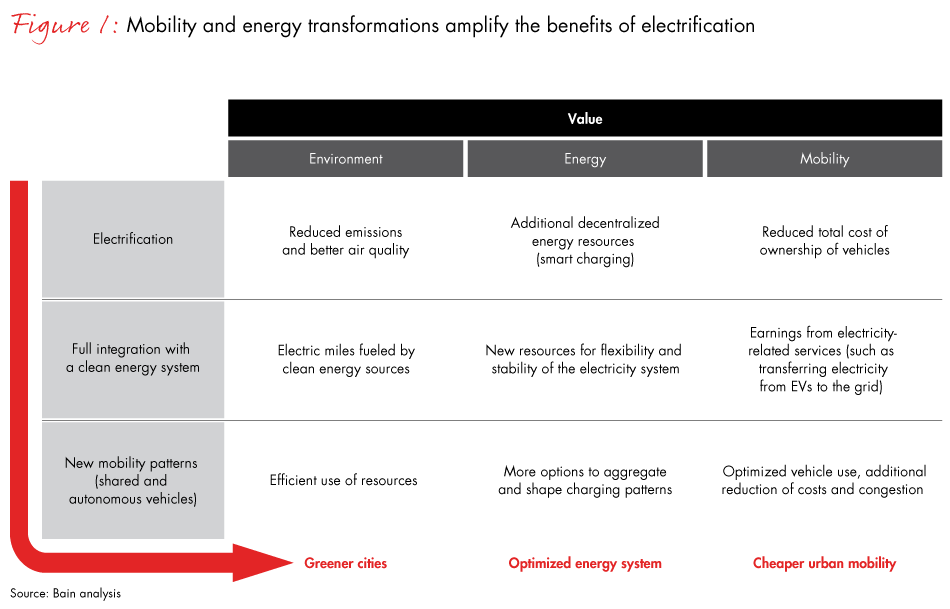

      utilities-and-urban-mobility-fig01_embed

      Fleets that are integrated to charge where and when clean, non-dispatchable generation resources are producing will boost consumption of electricity generated by solar and wind, decreasing the need to curtail production and further reducing total emissions. Public and commercial fleets of electrified vehicles will help flatten demand curves through smarter charging, optimizing electricity consumption and generation. At scale, large fleets of EVs may also provide valuable ancillary services to the grid.

      Taken together, the benefits of transformation could quadruple the value of new mobility patterns for society, compared with proliferation. Utilities and energy companies have a chance to accelerate this transformation and capture a substantial part of the associated value. Major opportunities will include:

      • Smart charging. Dynamic electricity prices and integration with smart grids are necessary to maximize the value from smart charging of EVs. Integration with other grid-edge technologies (such as solar panels) will also offer more flexibility. Utilities would not only benefit from smart charging revenues but also from reducing renewable curtailment, limiting negative power-pricing events and lowering the cost to serve peak loads (see Figure 2).
      • New capital investments. In markets where utilities are responsible for deploying new charging infrastructure, these investments will contribute to growth of their rate-based assets. Associated upgrades to substation and wires infrastructure to support new demands of EV charging will also present capital investment opportunities for electric utilities.
      • New services. With the deployment of the charging infrastructure, new business models emerge, from supporting artificial intelligence in buildings to supplying vehicle owners with mobility goods and services. These market opportunities will be accessible to innovative and customer-centric utilities.
      • Additional load. The power demand from a growing EV market represents an opportunity for utilities and energy companies to capture additional revenues from electricity sales, or to reduce the kWh rate if electricity demand grows more quickly than a utility's total revenue requirement.
      • Ancillary services. EV fleet operators with predictable capacity could supply the excess electricity stored in the vehicles' batteries to buildings or the electricity grid. Such services may not provide as much value as smart charging, but they can help expand the value proposition of EVs to grid operators.
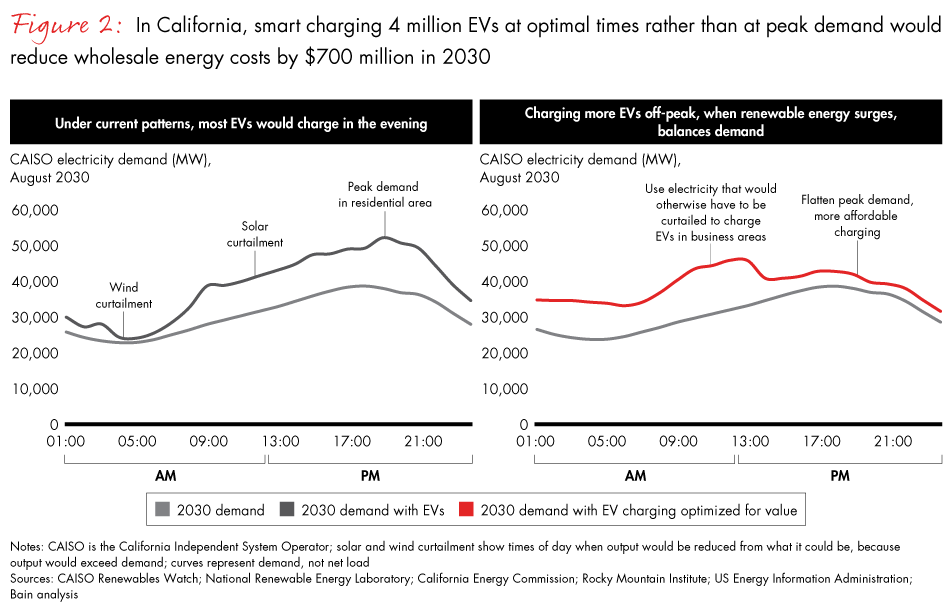
      utilities-and-urban-mobility-fig02_embed

      Planning to capture value


      For utility and energy executives, this broad transformation leads to several large opportunities—some that strengthen current positions (greater asset utilization, less renewable curtailment) and others that suggest new potential (load growth, investments in charging infrastructure, expanded customer relationships). Three principles will help executives capture these sources of value.

      • Begin the build-out of charging infrastructure today, but anticipate that tomorrow will be different. The growth of mobility services and autonomous fleets will alter urban mobility patterns, reducing the number of vehicles on the road while increasing the use of those vehicles. Utilities and other energy companies should plan accordingly when investing in assets like charging stations. Today, most are installed where EV owners charge their private vehicles, at homes and businesses. It's critical to continue building infrastructure to enable the proliferation phase. However, those charging stations could become underused assets as mobility patterns change. As more EVs roll out in fleets, some as AVs, the locations for charging will change, favoring deployment of charging infrastructure where fleets will recharge, and along highway routes for quick charging on long trips.
      • Develop strategies that are customized to your location. No one size will fit all. The optimal integration of energy and mobility systems will vary greatly based on the energy-generation mix, the shape of the daily load curve, the density of the city, current commuting patterns and public transit infrastructure, among other factors. In Paris, for example, the public transit system accommodates half of all commutes, so it makes sense to invest in electrifying and connecting EVs to public transit hubs as a way to optimize energy use. Contrast this with the San Francisco Bay Area, where most commuters still ride in private vehicles—a mobility pattern that calls for different strategies. Each city will need to customize the way it deploys EV infrastructure to best fit with its environment and maximize improvements to congestion, carbon emissions and grid reliability.

        Utility and energy executives should also consider the lessons learned in the past and communicate with regulators to ensure that incentives generate the most efficient investments. Misaligned incentives in the European Union in the 2000s encouraged investments in renewables with too little regard for the comparative advantages of regions, resulting in too many solar panels in the north and too many wind farms in the south. Proper incentives that consider the best locations for each type of renewable could have saved Europe as much as $140 billion.

      • Identify how and where value will come, and prioritize investments to capture it. Thoughtful integration of mobility with the electricity system and grid-edge technologies will create new value for utilities, mostly from smart management of demand, as well as transmission and distribution (T&D) upgrades. Charging EVs at optimal times and locations could reduce the need for investments in peak generation and improve the stability of the grid, resulting in $100–$200 in deferred capex and energy savings per EV for utilities each year. New load from EVs could help mitigate the flat load growth seen in recent years.

        Realizing these benefits will require a thorough understanding of the value provided based on load patterns and customer characteristics. Utilities can create incentives for customers with dynamic pricing that better reflects the cost of electricity generation. Innovative, digitalized business models will be needed to monetize these new services.

        New partnerships with customers, fleet operators, public agencies and others can help maximize value. These partnerships will build out networks of charging stations that facilitate better charging patterns for EVs, using their batteries to store capacity and, when needed, return it to the grid. Data sharing may help create new business models.

      The proliferation of EVs offers utilities opportunities to deploy new strategies to maximize their benefits. Each utility will want to adapt its approaches to local conditions, in order to produce the greatest benefits for the electricity system. In this way, utilities can ensure that their investments in charging and T&D infrastructure will create the most value for the system over the long run.

      Christophe Guille is a principal, and Joe Herger and Joseph Scalise are partners, with Bain & Company in San Francisco. All three work with Bain's Global Utilities & Renewables practice, which Joseph leads.

      The authors would like to thank Stephane Rousselet for his contributions to this work.

      Copyright © 2018 Bain & Company, Inc. All rights reserved.


      utilities-and-urban-mobility-fig01_full

      utilities-and-urban-mobility-fig02_full
      Autoren
      • Headshot of Christophe Guille
        Christophe Guille
        Partner, Los Angeles
      • Headshot of Joe Herger
        Joe Herger
        Partner, San Francisco
      • Headshot of Joe Scalise
        Joe Scalise
        Partner, San Francisco
      Kontaktieren Sie uns
      Verwandte Branchen
      • Automotive und Mobilität
      • Energieversorgung
      • Energiewirtschaft
      • Industriegüter und -services
      Ähnliche Beratungsangebote
      • Nachhaltigkeit
      Energieversorgung
      Electric Vehicles for Smarter Cities: The Future of Energy and Mobility

      Public and private sectors can adapt three principles to converge mobility and energy, enabling cities to provide several benefits to citizens.

      Mehr erfahren
      Energieversorgung
      How to Win Clean Hydrogen Bids

      As competitive projects ramp up worldwide, here are five keys to developing successful bids.

      Mehr erfahren
      Energieversorgung
      Five Predictions for the 2030 EV Battery Market

      Which battery chemistries will pull ahead—and how should OEMs proceed?

      Mehr erfahren
      Nachhaltigkeit
      How AI Is Starting to Transform Circular Packaging

      There are 15 AI use cases companies across the value chain can use today to accelerate circularity.

      Mehr erfahren
      Energieversorgung
      Navigating the EV Battery Ecosystem

      The choice of battery for electric vehicles is increasingly critical and complex, and requires a flexible strategy.

      Mehr erfahren
      First published in April 2018
      Markierungen
      • Automotive und Mobilität
      • Energieversorgung
      • Energiewirtschaft
      • Industriegüter und -services
      • Nachhaltigkeit

      Wie wir unsere Kunden unterstützt haben

      Strategie A Conglomerate Charts a New Global Strategy

      Kundenbeispiel lesen

      An Automaker Reinvents Customer Experience with a Focus on Key Episodes

      Kundenbeispiel lesen

      Performance Improvement Streamlining engine assembly boosts output

      Kundenbeispiel lesen

      Möchten Sie mit uns in Kontakt bleiben?

      Wir unterstützen Führungskräfte weltweit, die kritischen Themen in ihrem Unternehmen zu adressieren. Gemeinsam schaffen wir nachhaltige Veränderungen und Ergebnisse.

      Bain Insights. Unsere Perspektive auf die kritischen Themen, mit denen sich international agierende Unternehmen konfrontiert sehen, finden Sie monatlich in Ihrem Postfach.

      *Ich habe die Datenschutzerklärung gelesen und akzeptiere sie.
      Bitte lesen Sie die Datenschutzerklärung und akzeptieren Sie diese.
      Bain & Company
      Contact us Sustainability Accessibility Rechtliche Hinweise Impressum Datenschutz Cookie-Richtlinie Sitemap Log In

      © 1996-2026 Bain & Company, Inc.

      Kontaktieren Sie Bain

      Wie können wir Ihnen helfen?

      • Business inquiry
      • Career information
      • Press relations
      • Partnership request
      • Speaker request
      Alle weltweiten Büros