
Skip to Content
  • Standorte

    Standorte

    North & Latin America
    • Atlanta
    • Austin
    • Bogota
    • Boston
    • Buenos Aires
    • Chicago
    • Dallas
    • Denver
    • Houston
    • Lisbon
    • Los Angeles
    • Mexico City
    • Minneapolis
    • Monterrey
    • Montreal
    • New York
    • Rio de Janeiro
    • San Francisco
    • Santiago
    • São Paulo
    • Seattle
    • Silicon Valley
    • Toronto
    • Washington, DC
    Europe & Africa
    • Amsterdam
    • Athens
    • Berlin
    • Brussels
    • Copenhagen
    • Düsseldorf
    • Frankfurt
    • Helsinki
    • Istanbul
    • Johannesburg
    • Kyiv
    • Lisbon
    • London
    • Madrid
    • Milan
    • München
    • Oslo
    • Paris
    • Rome
    • Stockholm
    • Warsaw
    • Wien
    • Zürich
    Middle East
    • Doha
    • Dubai
    • Riyadh
    Asia & Australia
    • Bangkok
    • Beijing
    • Bengaluru
    • Brisbane
    • Ho Chi Minh City
    • Hong Kong
    • Jakarta
    • Kuala Lumpur
    • Manila
    • Melbourne
    • Mumbai
    • New Delhi
    • Perth
    • Seoul
    • Shanghai
    • Singapore
    • Sydney
    • Tokyo
    Alle Standorte Anzeigen
  • Alumni
  • Presse
  • Newsletter
  • Kontakt
  • DACH-Region | Deutsch

    Wählen Sie Ihre Region und Sprache

    Global
    • Global (English)
    North & Latin America
    • Brazil (Português)
    • Argentina (Español)
    • Canada (Français)
    • Chile (Español)
    • Colombia (Español)
    Europe, Middle East, & Africa
    • France (Français)
    • DACH-Region (Deutsch)
    • Italy (Italiano)
    • Spain (Español)
    • Greece (Elliniká)
    Asia & Australia
    • China (中文版)
    • Korea (한국어)
    • Japan (日本語)
  • Saved items (0)
    Saved items (0)

    You have no saved items.

    Inhalte, für die Sie sich interessieren, werden hier gespeichert und können später gelesen oder weitergeleitet werden.

    Explore Bain Insights
  • Branchenkompetenzen
    Hauptmenü

    Branchenkompetenzen

    • Luft- und Raumfahrt, Verteidigung
    • Agrarwirtschaft
    • Chemieindustrie
    • Infrastruktur und Bauwirtschaft
    • Konsumgüter
    • Finanzdienstleistungen
    • Gesundheitswesen
    • Maschinen- und Anlagenbau
    • Medienwirtschaft
    • Metallindustrie
    • Bergbau
    • Öl und Gas
    • Papier- und Verpackungsindustrie
    • Private Equity
      Branchenkompetenzen
      Private Equity
      • Due Diligence
      • Exit Planning
      • Firm Strategy & Operations
      • Portfolio Value Creation
    • Öffentlicher Sektor und Sozialwesen
    • Einzelhandel
    • Technologie
    • Telekommunikation
    • Transportwesen
    • Reise- und Freizeitbranche
    • Versorgung und erneuerbare Energien
  • Managementkompetenzen
    Hauptmenü

    Managementkompetenzen

    • Customer Experience
    • ESG
    • Innovation
    • M&A
    • Operations
    • People & Organization
    • Private Equity
    • Sales & Marketing
    • Strategie
    • KI, Einblicke und Lösungen
    • Technologie
    • Transformation
  • Digital
  • Publikationen
    Hauptmenü

    Publikationen

    • Branchenthemen
    • Managementthemen
    • Bain-Bücher
    Alle Publikationen
    Ausgewählte Themen
    • Resilienz in der globalen Krise
    • M&A Report
    • Private Equity Podcast
    • Midyear Private Equity Report
    • Agile
    • Engineering Report
    • Digital Transformation
    • Elements of Value®
    • Firm of the Future
    • Nachhaltigkeitsstudie
    • Macro Trends
    • Future of Consumption
    • Weltwirtschaftsforum (WEF)
  • Über uns
    Hauptmenü

    Über uns

    • Was wir bieten
    • Unser Ansatz
    • Unser Team
    • Game Changer Award
    • Female Allstar Board
    • Messbare Ergebnisse (EN)
    • Auszeichnungen
    • Globale Partnerschaften
    • The Mission
    Further: Our global responsibility
    • Vielfalt & Chancengleichheit
    • Soziale Verantwortung
    • Sustainability
    Erfahren Sie mehr zu "Further"
  • Karriere
    Hauptmenü

    Karriere

    • Dein Einstieg
      Karriere
      Dein Einstieg
      • Find Your Place
      • Unsere Arbeitsbereiche
      • Unsere Teams
      • Angebote für Studierende
      • Praktika & Programme
      • Recruiting-Events
    • Arbeiten bei Bain
      Karriere
      Arbeiten bei Bain
      • Blog: Inside Bain
      • Karriere Stories
      • Unsere Bainies
      • Office-Standorte
      • Weiterentwicklung
      • Affinity Groups
      • Deine Benefits
    • Impact Stories
    • Deine Bewerbung
      Karriere
      Deine Bewerbung
      • Das erwartet dich
      • Der Interviewprozess
    FIND JOBS
  • Standorte
    Hauptmenü

    Standorte

    • North & Latin America
      Standorte
      North & Latin America
      • Atlanta
      • Austin
      • Bogota
      • Boston
      • Buenos Aires
      • Chicago
      • Dallas
      • Denver
      • Houston
      • Lisbon
      • Los Angeles
      • Mexico City
      • Minneapolis
      • Monterrey
      • Montreal
      • New York
      • Rio de Janeiro
      • San Francisco
      • Santiago
      • São Paulo
      • Seattle
      • Silicon Valley
      • Toronto
      • Washington, DC
    • Europe & Africa
      Standorte
      Europe & Africa
      • Amsterdam
      • Athens
      • Berlin
      • Brussels
      • Copenhagen
      • Düsseldorf
      • Frankfurt
      • Helsinki
      • Istanbul
      • Johannesburg
      • Kyiv
      • Lisbon
      • London
      • Madrid
      • Milan
      • München
      • Oslo
      • Paris
      • Rome
      • Stockholm
      • Warsaw
      • Wien
      • Zürich
    • Middle East
      Standorte
      Middle East
      • Doha
      • Dubai
      • Riyadh
    • Asia & Australia
      Standorte
      Asia & Australia
      • Bangkok
      • Beijing
      • Bengaluru
      • Brisbane
      • Ho Chi Minh City
      • Hong Kong
      • Jakarta
      • Kuala Lumpur
      • Manila
      • Melbourne
      • Mumbai
      • New Delhi
      • Perth
      • Seoul
      • Shanghai
      • Singapore
      • Sydney
      • Tokyo
    Alle Standorte Anzeigen
  • Alumni
  • Presse
  • Newsletter
  • Kontakt
  • DACH-Region | Deutsch
    Hauptmenü

    Wählen Sie Ihre Region und Sprache

    • Global
      Wählen Sie Ihre Region und Sprache
      Global
      • Global (English)
    • North & Latin America
      Wählen Sie Ihre Region und Sprache
      North & Latin America
      • Brazil (Português)
      • Argentina (Español)
      • Canada (Français)
      • Chile (Español)
      • Colombia (Español)
    • Europe, Middle East, & Africa
      Wählen Sie Ihre Region und Sprache
      Europe, Middle East, & Africa
      • France (Français)
      • DACH-Region (Deutsch)
      • Italy (Italiano)
      • Spain (Español)
      • Greece (Elliniká)
    • Asia & Australia
      Wählen Sie Ihre Region und Sprache
      Asia & Australia
      • China (中文版)
      • Korea (한국어)
      • Japan (日本語)
  • Saved items  (0)
    Hauptmenü
    Saved items (0)

    You have no saved items.

    Inhalte, für die Sie sich interessieren, werden hier gespeichert und können später gelesen oder weitergeleitet werden.

    Explore Bain Insights
  • Branchenkompetenzen
    • Branchenkompetenzen

      • Luft- und Raumfahrt, Verteidigung
      • Agrarwirtschaft
      • Chemieindustrie
      • Infrastruktur und Bauwirtschaft
      • Konsumgüter
      • Finanzdienstleistungen
      • Gesundheitswesen
      • Maschinen- und Anlagenbau
      • Medienwirtschaft
      • Metallindustrie
      • Bergbau
      • Öl und Gas
      • Papier- und Verpackungsindustrie
      • Private Equity
      • Öffentlicher Sektor und Sozialwesen
      • Einzelhandel
      • Technologie
      • Telekommunikation
      • Transportwesen
      • Reise- und Freizeitbranche
      • Versorgung und erneuerbare Energien
  • Managementkompetenzen
    • Managementkompetenzen

      • Customer Experience
      • ESG
      • Innovation
      • M&A
      • Operations
      • People & Organization
      • Private Equity
      • Sales & Marketing
      • Strategie
      • KI, Einblicke und Lösungen
      • Technologie
      • Transformation
  • Digital
  • Publikationen
    • Publikationen

      • Branchenthemen
      • Managementthemen
      • Bain-Bücher
      Alle Publikationen
      Ausgewählte Themen
      • Resilienz in der globalen Krise
      • M&A Report
      • Private Equity Podcast
      • Midyear Private Equity Report
      • Agile
      • Engineering Report
      • Digital Transformation
      • Elements of Value®
      • Firm of the Future
      • Nachhaltigkeitsstudie
      • Macro Trends
      • Future of Consumption
      • Weltwirtschaftsforum (WEF)
  • Über uns
    • Über uns

      • Was wir bieten
      • Unser Ansatz
      • Unser Team
      • Game Changer Award
      • Female Allstar Board
      • Messbare Ergebnisse (EN)
      • Auszeichnungen
      • Globale Partnerschaften
      • The Mission
      Further: Our global responsibility
      • Vielfalt & Chancengleichheit
      • Soziale Verantwortung
      • Sustainability
      Erfahren Sie mehr zu "Further"
  • Karriere
    Häufige Suchanfragen
    • Agil
    • Digital
    • Strategie
    Vorherige Suchanfragen
      Zuletzt besuchte Seiten

      Content added to saved items

      Saved items (0)

      Removed from saved items

      Saved items (0)

      M&A Report

      M&A in Energy and Natural Resources: Beating the Odds in Energy Transition Deals

      M&A in Energy and Natural Resources: Beating the Odds in Energy Transition Deals

      What can companies be doing better in scope deals for their energy transition?

      Von Whit Keuer und Arnaud Leroi

      • Min. Lesezeit
      }

      Report

      M&A in Energy and Natural Resources: Beating the Odds in Energy Transition Deals
      en
      Auf einen Blick
      • Acquisitions to advance an energy transition now represent 27% of all deals in energy and natural resources.
      • This comes at a time when energy and natural resources companies are more flush with cash than any other industry, depending on the sector or region.
      • Energy transition deals have different risk/return profiles than previous deals, and they require fundamentally different approaches to value creation.
      • It is critical to focus attention on revenue synergies, identifying business model opportunities by geography, product line, market, and specific customer.

      This article is part of Bain's 2023 M&A Report.

      Explore the report

      How rapidly are energy and natural resources (ENR) portfolios changing? Our recent survey of M&A practitioners found that 80% of energy industry respondents have proactively evaluated separating or spinning off parts of the business. In the first nine months of 2022, divestitures activity totaled $250 billion—that’s more than any other industry.

      Indeed, companies are racing to dispose of carbon-heavy assets. Enel, a global energy company based in Italy, recently announced plans to sell assets valued at $21.5 billion, representing 15% to 20% of the company’s enterprise value. The move was part of a strategy to streamline its business and push electrification across the full value chain in Europe, the US, and Latin America as well as to cut debt. In oil and gas, TotalEnergies is spinning off its Canadian oil sands operations and plans to list the new company on the Toronto Stock Exchange. The assets simply don’t fit with the company’s new low-emissions strategy.

      While these spin-offs are happening, acquisitions related to the energy transition as a percentage of all deal volume is steadily growing, from 21% in 2021 to 27% in the first three quarters of 2022 (see Figure 1). We think this trend toward portfolio rebalancing will accelerate in 2023 and the coming years. In the Bain M&A Practitioners’ 2023 Outlook Survey, 72% of energy and natural resources respondents said the most common investment thesis will be either expanding into new areas of business or building new engines of growth. (We refer to them as an Engine 2, a new business within an existing company that uses the scale benefits of the core business to grow faster than an independent start-up could.) This comes at a time when ENR companies are flush with more cash than any other industry ($300 billion), although with some discrepancies between sectors and regions. This will fuel their investments in the energy transition.

      Figure 1
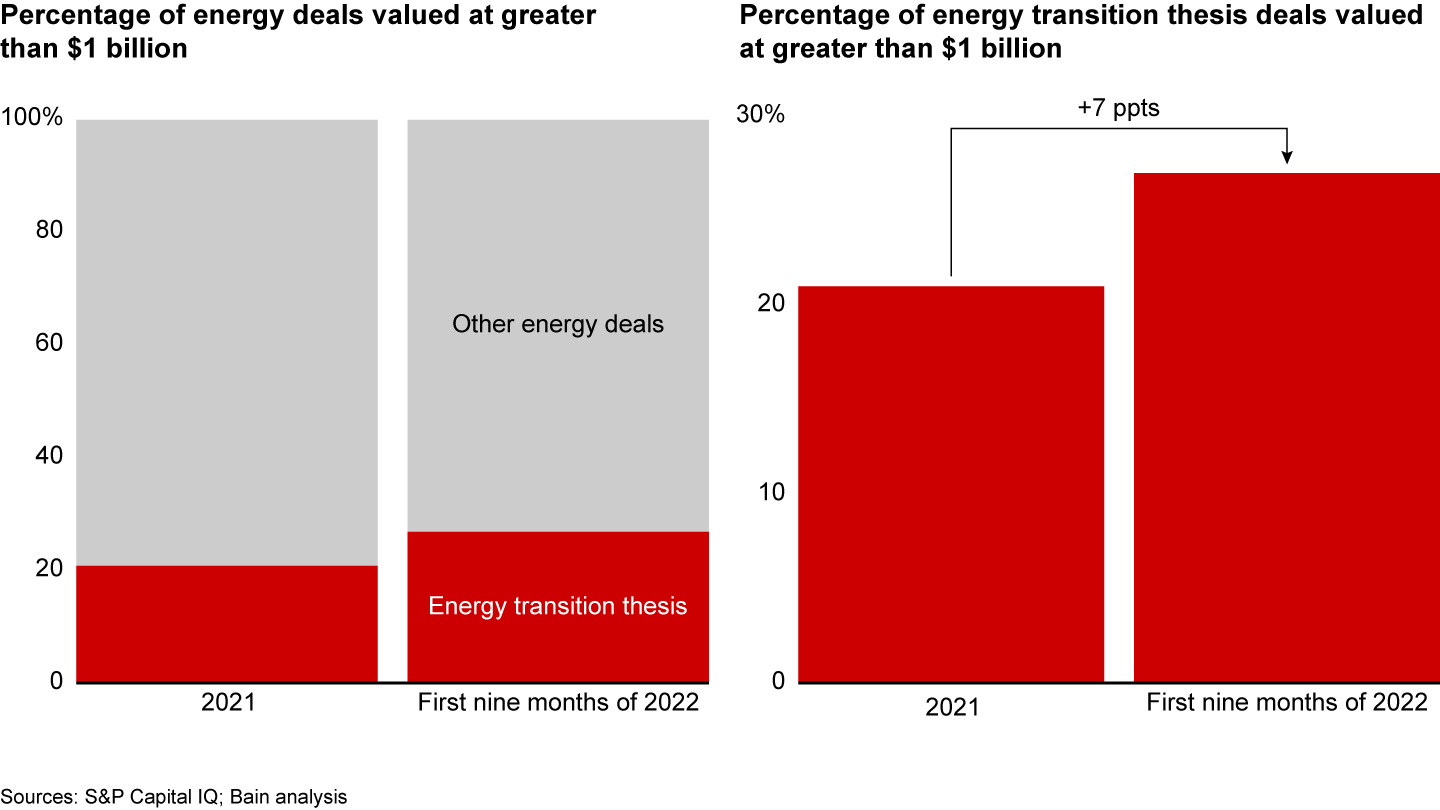
      Energy transition is increasingly driving M&A deal theses
      Energy transition is increasingly driving M&A deal theses
      Energy transition is increasingly driving M&A deal theses

      New types of deals, new challenges

      In last year’s M&A report, we talked about why these deals are becoming so important. Now, we focus on the how. The new wave of M&A—namely, scope deals to enable energy transition—is becoming more competitive and has a different risk/return profile than previous deals, requiring fundamentally different approaches to value creation. Scale deals succeed based on rapid overall integration, capture of cost synergies, and full cultural integration. Scope deals, however, require a much more tailored approach when it comes to deciding what to preserve, what to integrate, and how to evolve the business strategy to make the most of the core strengths of the acquirer (if possible).

      Scope deals to enable an energy transition are becoming more competitive.

      In the chemical industry, for example, LyondellBasell formed a joint venture called Source One Plastics to build an energy-efficient, advanced plastic waste sorting and recycling facility in Germany, using LyondellBasell’s proprietary MoReTec technology and working with its customers, who are increasingly demanding renewable and circular solutions. Recognizing that the business model requires greater investment in technology and interaction with customers than its legacy commodity business, LyondellBasell created a separate business unit with its own leadership team, management processes, and salesforce.

      Bain’s experience from hundreds of scope M&A transactions indicates that while returns can be comparable to scale M&A, there is a much wider range of outcomes. Three features of scope deals make them more difficult:

      • By definition, scope deals occur outside the acquirer’s core business, geographies, or competencies. The risk is that the acquirer stumbles as it learns to manage an unfamiliar business.
      • Scope deals often involve finding and knitting together new capabilities that serve as the source of competitive advantage in Engine 2 activities. This requires the acquirer to think several steps ahead and identify other potential businesses and companies to bolt on to the one currently being acquired. As transaction multiples have increased in recent years, we’ve observed the more aggressive acquirers being willing to incorporate anticipated synergies from future acquisitions into the purchase price of their initial deals.
      • Scope deals are typically aimed at generating revenue synergies, which inherently come with more risk and less control than cost synergies. In a 2021 Bain survey, M&A practitioners in energy and natural resources cited overestimated revenue synergies as the top reason for deal failure (see Figure 2). Among the causes: In scale transactions, companies are selling into familiar territory, often global commodity markets with established supply and demand patterns; in scope deals, customer needs and market dynamics are not as well known.
      Figure 2
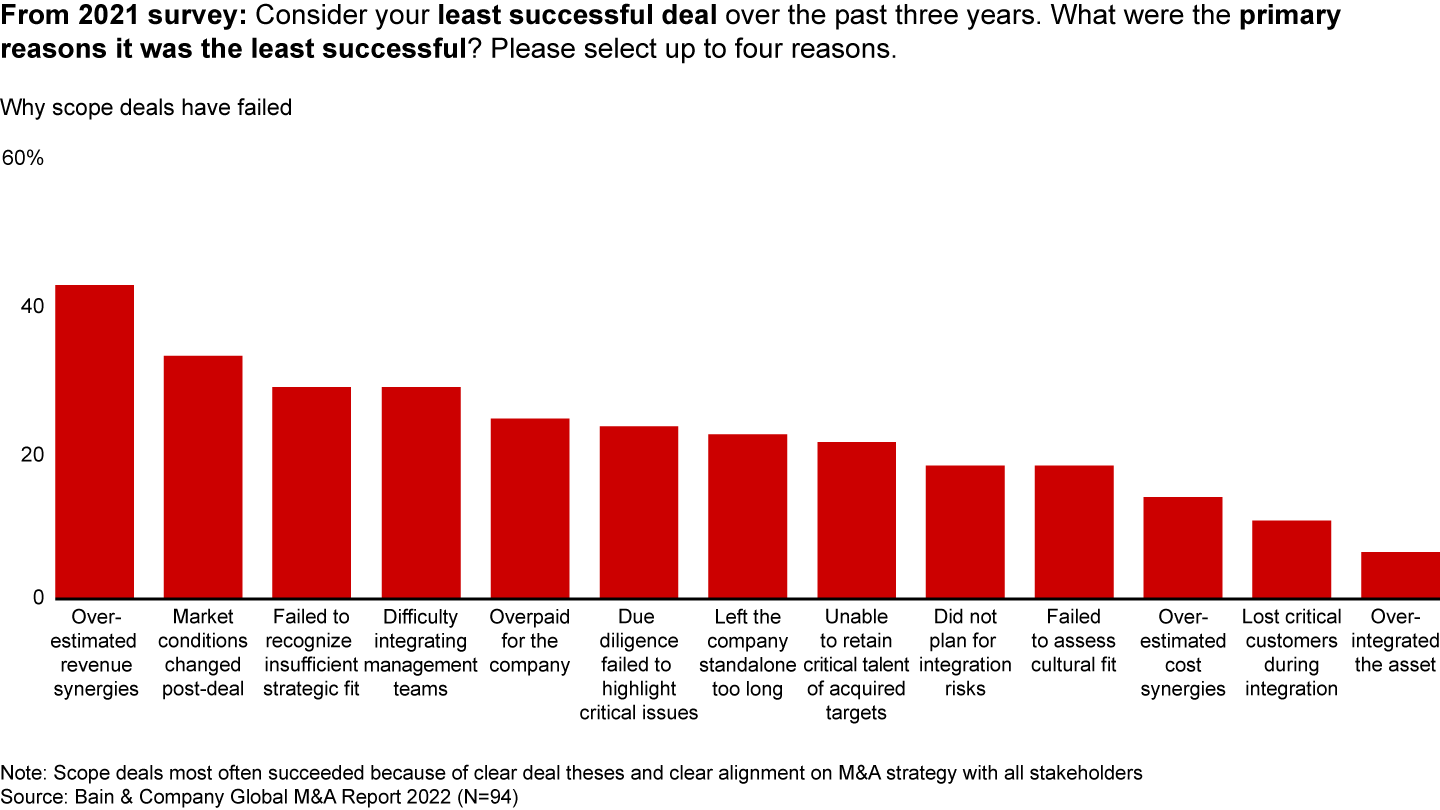
      Scope deals most often fail because of overestimation of revenue synergies, changing market conditions, and insufficient strategic fit
      Scope deals most often fail because of overestimation of revenue synergies, changing market conditions, and insufficient strategic fit
      Scope deals most often fail because of overestimation of revenue synergies, changing market conditions, and insufficient strategic fit

      Evolving the M&A playbook for energy transition scope deals

      Energy companies are relatively less experienced in energy transition scope deals than scale deals, but the reverse is becoming true in other industries as scope transactions represented roughly half of all deals valued in excess of $1 billion in 2021. Those industries have gained a head start in evolving a strong playbook for scope transactions. As a result, energy and natural resources industry dealmakers can learn from what works in other industries.

      Reimagine your entire M&A process. Every element of the deal cycle, from M&A strategy to deal thesis to diligence and valuation to merger integration, must be managed differently. The starting point is a rigorous due diligence process. Revenue synergies, for example, have traditionally been treated in diligence as something of an art by dealmakers compared with the relatively more scientific approach common to cost synergies.

      In scope transactions, it is critical to devote much more attention to revenue synergies, identifying opportunities by geography, product line, market, and specific customer. In the energy transition, customer requirements are changing, and it is important to develop a proprietary view into where and how that demand is changing—and over what time period. This can be developed through in-depth customer research and speaking to teams on the front line, as well as by using the pre-close period to develop more granular revenue targets for the new combined salesforce. For example, construction chemicals company Sika used focused sales plays to achieve ambitious revenue synergies. Immediately after closing the Parex deal, Sika systematically prioritized and introduced flagship stock-keeping units in these distribution channels, generating quick revenue synergies from a laser focus on what to cross-sell and to whom.

      Scope deals require more attention to revenue synergies by geography, product line, market, and specific customer.

      Build an integrated value chain to deliver energy transition products and services. Too many scope deals become one-off acquisitions as companies hope to gain access to new profit pools or high-growth markets but then fail to build out a complete portfolio. It’s necessary to define the desired target portfolio of integrated assets and then identify what will be accomplished organically and inorganically. Consider how Shell is building out its footprint of electric vehicle (EV) charging stations globally through its acquisition of ubitricity and others. Shell acquired Greenlots, which provides a software operating platform for EV charging companies that includes real-time charger health status, utilization data, dynamic pricing capabilities, and predictive analytics. Shell also bought a minority stake in microgrid developer GI Energy. Shell has an integrated oil and gas value chain that extends from production, refineries, pipelines, and ultimately through its retail gas stations. These recent EV-related acquisitions in combination show how Shell is following a similar integrated value chain approach, this time for renewable power generation all the way through delivery to the ultimate end user.

      In another example, many energy companies are exploring carbon capture, utilization, and storage (CCUS) technologies to both abate the carbon emissions of their existing portfolio while they also develop new lines of business. In 2020, Petronas announced its ambition to achieve net-zero carbon emissions by 2050, recognizing the important role CCUS would have in achieving these targets. Petronas identified 19 potential sites to manage a carbon storage portfolio for emissions produced by its operations and establish a regional storage hub for carbon emissions as a revenue generator. Since that initial announcement, it has engaged in different acquisitions or partnerships, giving Petronas access to new and cost-effective CCUS technologies to capture the carbon emissions as well as transportation to market liquified carbon dioxide in the Asia-Pacific and Oceania regions. Petronas’s goal is to create a full CCUS ecosystem, and M&A and strategic partnerships have been a critical accelerator of these plans.

      Start with a clear integration thesis, and integrate where it matters. Scope deals succeed when the acquirer preserves the unique attributes of the company it has just bought, integrating the two only where it matters—as well as when the two businesses begin to cross-pollinate, creating platforms for future growth. Shell is using its capabilities for developing oil and gas projects in harsh environments to build offshore wind farms. In November, Shell formed a partnership with Alternergy, a renewable energy company, to develop an initial one gigawatt of generation capacity in the Philippines. Shell’s experience with megaprojects brings industry-leading project capabilities and a global supply chain to more rapidly scale the new development.

      As the industry turns to M&A to speed the energy transition, companies that achieve the most success will be those that acknowledge how different these deals are from the traditional scale deals that proliferated in their industry for decades. And they will master a new playbook, one that is thoughtfully revised for this time of historic possibilities.

      Read the Next Chapter

      M&A in Healthcare and Life Sciences: Why the Industry’s Wait-and-See Days Will End

      Read our 2023 M&A Report

      Download the PDF Explore the report
      Autoren
      • Headshot of Whit Keuer
        Whit Keuer
        Partner, Dallas
      • Headshot of Arnaud Leroi
        Arnaud Leroi
        Partner, Paris
      Kontaktieren Sie uns
      Verwandte Branchen
      • Energiewirtschaft
      Ähnliche Beratungsangebote
      • Mergers & Acquisitions
      M&A Report
      Oil & Gas M&A

      Why some companies are winning by a wider margin.

      Mehr erfahren
      M&A Report
      Defense M&A

      Bold moves will determine the winners as a continent rearms.

      Mehr erfahren
      Energiewirtschaft
      When a New Organizational Structure Isn’t Enough: How to Truly Live Your Operating Model

      The goal of any organizational redesign is for people to work differently, but that only happens if leaders invest in changing the work itself.

      Mehr erfahren
      Mergers & Acquisitions
      What Agency Consolidation Means for CMOs

      As agency holding companies get bigger and deeper, CMOs must rethink ownership, integration, and how to stay in control.

      Mehr erfahren
      M&A Report
      Building Products M&A

      Why more companies are acquiring for scope.

      Mehr erfahren

      Overview

      • Looking Back at M&A in 2022

      • Looking Ahead to M&A in 2023

      Hot Topics

      • M&A in Times of Turbulence: Lessons from the Last Recession

      • When Buying (vs. Building) Is the Right Move for Engine 2

      • Tougher Times: Putting the Diligence Back in Due Diligence

      • How to Avoid the Fault Lines Sending Tremors through Cultural Integration in M&A

      Industry Views

      • Aerospace and Defense M&A

      • Automotive and Mobility M&A

      • Banking M&A

      • Consumer Goods M&A

      • Diversified Industrials M&A

      • Energy and Natural Resources M&A

      • Healthcare and Life Sciences M&A

      • Insurance M&A

      • Media and Entertainment M&A

      • Payments M&A

      • Retail M&A

      • Technology M&A

      • Telecommunications M&A

      • Wealth and Asset Management M&A

      Regional Perspectives

      • Brazil M&A

      • India M&A

      • Japan M&A

      • Middle East M&A

      First published in Januar 2023
      Markierungen
      • Energiewirtschaft
      • M&A Report
      • Mergers & Acquisitions

      Wie wir unsere Kunden unterstützt haben

      An Environmental Services Company Captures Massive Savings from a Merger

      Kundenbeispiel lesen

      Strategie New products propel profitability for metals manufacturer

      Kundenbeispiel lesen

      Kundenstrategie und Marketing Revitalizing a utility's market position with customer loyalty

      Kundenbeispiel lesen

      Möchten Sie mit uns in Kontakt bleiben?

      Wir unterstützen Führungskräfte weltweit, die kritischen Themen in ihrem Unternehmen zu adressieren. Gemeinsam schaffen wir nachhaltige Veränderungen und Ergebnisse.

      Bain Insights. Unsere Perspektive auf die kritischen Themen, mit denen sich international agierende Unternehmen konfrontiert sehen, finden Sie monatlich in Ihrem Postfach.

      *Ich habe die Datenschutzerklärung gelesen und akzeptiere sie.
      Bitte lesen Sie die Datenschutzerklärung und akzeptieren Sie diese.
      Bain & Company
      Contact us Sustainability Accessibility Rechtliche Hinweise Impressum Datenschutz Cookie-Richtlinie Sitemap Log In

      © 1996-2026 Bain & Company, Inc.

      Kontaktieren Sie Bain

      Wie können wir Ihnen helfen?

      • Business inquiry
      • Career information
      • Press relations
      • Partnership request
      • Speaker request
      Alle weltweiten Büros