
Skip to Content
  • Standorte

    Standorte

    North & Latin America
    • Atlanta
    • Austin
    • Bogota
    • Boston
    • Buenos Aires
    • Chicago
    • Dallas
    • Denver
    • Houston
    • Lisbon
    • Los Angeles
    • Mexico City
    • Minneapolis
    • Monterrey
    • Montreal
    • New York
    • Rio de Janeiro
    • San Francisco
    • Santiago
    • São Paulo
    • Seattle
    • Silicon Valley
    • Toronto
    • Washington, DC
    Europe & Africa
    • Amsterdam
    • Athens
    • Berlin
    • Brussels
    • Copenhagen
    • Düsseldorf
    • Frankfurt
    • Helsinki
    • Istanbul
    • Johannesburg
    • Kyiv
    • Lisbon
    • London
    • Madrid
    • Milan
    • München
    • Oslo
    • Paris
    • Rome
    • Stockholm
    • Warsaw
    • Wien
    • Zürich
    Middle East
    • Doha
    • Dubai
    • Riyadh
    Asia & Australia
    • Bangkok
    • Beijing
    • Bengaluru
    • Brisbane
    • Ho Chi Minh City
    • Hong Kong
    • Jakarta
    • Kuala Lumpur
    • Manila
    • Melbourne
    • Mumbai
    • New Delhi
    • Perth
    • Seoul
    • Shanghai
    • Singapore
    • Sydney
    • Tokyo
    Alle Standorte Anzeigen
  • Alumni
  • Presse
  • Newsletter
  • Kontakt
  • DACH-Region | Deutsch

    Wählen Sie Ihre Region und Sprache

    Global
    • Global (English)
    North & Latin America
    • Brazil (Português)
    • Argentina (Español)
    • Canada (Français)
    • Chile (Español)
    • Colombia (Español)
    Europe, Middle East, & Africa
    • France (Français)
    • DACH-Region (Deutsch)
    • Italy (Italiano)
    • Spain (Español)
    • Greece (Elliniká)
    Asia & Australia
    • China (中文版)
    • Korea (한국어)
    • Japan (日本語)
  • Saved items (0)
    Saved items (0)

    You have no saved items.

    Inhalte, für die Sie sich interessieren, werden hier gespeichert und können später gelesen oder weitergeleitet werden.

    Explore Bain Insights
  • Branchenkompetenzen
    Hauptmenü

    Branchenkompetenzen

    • Luft- und Raumfahrt, Verteidigung
    • Agrarwirtschaft
    • Chemieindustrie
    • Infrastruktur und Bauwirtschaft
    • Konsumgüter
    • Finanzdienstleistungen
    • Gesundheitswesen
    • Maschinen- und Anlagenbau
    • Medienwirtschaft
    • Metallindustrie
    • Bergbau
    • Öl und Gas
    • Papier- und Verpackungsindustrie
    • Private Equity
      Branchenkompetenzen
      Private Equity
      • Due Diligence
      • Exit Planning
      • Firm Strategy & Operations
      • Portfolio Value Creation
    • Öffentlicher Sektor und Sozialwesen
    • Einzelhandel
    • Technologie
    • Telekommunikation
    • Transportwesen
    • Reise- und Freizeitbranche
    • Versorgung und erneuerbare Energien
  • Managementkompetenzen
    Hauptmenü

    Managementkompetenzen

    • Customer Experience
    • ESG
    • Innovation
    • M&A
    • Operations
    • People & Organization
    • Private Equity
    • Sales & Marketing
    • Strategie
    • KI, Einblicke und Lösungen
    • Technologie
    • Transformation
  • Digital
  • Publikationen
    Hauptmenü

    Publikationen

    • Branchenthemen
    • Managementthemen
    • Bain-Bücher
    Alle Publikationen
    Ausgewählte Themen
    • Resilienz in der globalen Krise
    • M&A Report
    • Private Equity Podcast
    • Midyear Private Equity Report
    • Agile
    • Engineering Report
    • Digital Transformation
    • Elements of Value®
    • Firm of the Future
    • Nachhaltigkeitsstudie
    • Macro Trends
    • Future of Consumption
    • Weltwirtschaftsforum (WEF)
  • Über uns
    Hauptmenü

    Über uns

    • Was wir bieten
    • Unser Ansatz
    • Unser Team
    • Game Changer Award
    • Female Allstar Board
    • Messbare Ergebnisse (EN)
    • Auszeichnungen
    • Globale Partnerschaften
    • The Mission
    Further: Our global responsibility
    • Vielfalt & Chancengleichheit
    • Soziale Verantwortung
    • Sustainability
    Erfahren Sie mehr zu "Further"
  • Karriere
    Hauptmenü

    Karriere

    • Dein Einstieg
      Karriere
      Dein Einstieg
      • Find Your Place
      • Unsere Arbeitsbereiche
      • Unsere Teams
      • Angebote für Studierende
      • Praktika & Programme
      • Recruiting-Events
    • Arbeiten bei Bain
      Karriere
      Arbeiten bei Bain
      • Karriere Stories
      • Unsere Bainies
      • Office-Standorte
      • Weiterentwicklung
      • Affinity Groups
      • Deine Benefits
    • Impact Stories
    • Deine Bewerbung
      Karriere
      Deine Bewerbung
      • Das erwartet dich
      • Der Interviewprozess
    FIND JOBS
  • Standorte
    Hauptmenü

    Standorte

    • North & Latin America
      Standorte
      North & Latin America
      • Atlanta
      • Austin
      • Bogota
      • Boston
      • Buenos Aires
      • Chicago
      • Dallas
      • Denver
      • Houston
      • Lisbon
      • Los Angeles
      • Mexico City
      • Minneapolis
      • Monterrey
      • Montreal
      • New York
      • Rio de Janeiro
      • San Francisco
      • Santiago
      • São Paulo
      • Seattle
      • Silicon Valley
      • Toronto
      • Washington, DC
    • Europe & Africa
      Standorte
      Europe & Africa
      • Amsterdam
      • Athens
      • Berlin
      • Brussels
      • Copenhagen
      • Düsseldorf
      • Frankfurt
      • Helsinki
      • Istanbul
      • Johannesburg
      • Kyiv
      • Lisbon
      • London
      • Madrid
      • Milan
      • München
      • Oslo
      • Paris
      • Rome
      • Stockholm
      • Warsaw
      • Wien
      • Zürich
    • Middle East
      Standorte
      Middle East
      • Doha
      • Dubai
      • Riyadh
    • Asia & Australia
      Standorte
      Asia & Australia
      • Bangkok
      • Beijing
      • Bengaluru
      • Brisbane
      • Ho Chi Minh City
      • Hong Kong
      • Jakarta
      • Kuala Lumpur
      • Manila
      • Melbourne
      • Mumbai
      • New Delhi
      • Perth
      • Seoul
      • Shanghai
      • Singapore
      • Sydney
      • Tokyo
    Alle Standorte Anzeigen
  • Alumni
  • Presse
  • Newsletter
  • Kontakt
  • DACH-Region | Deutsch
    Hauptmenü

    Wählen Sie Ihre Region und Sprache

    • Global
      Wählen Sie Ihre Region und Sprache
      Global
      • Global (English)
    • North & Latin America
      Wählen Sie Ihre Region und Sprache
      North & Latin America
      • Brazil (Português)
      • Argentina (Español)
      • Canada (Français)
      • Chile (Español)
      • Colombia (Español)
    • Europe, Middle East, & Africa
      Wählen Sie Ihre Region und Sprache
      Europe, Middle East, & Africa
      • France (Français)
      • DACH-Region (Deutsch)
      • Italy (Italiano)
      • Spain (Español)
      • Greece (Elliniká)
    • Asia & Australia
      Wählen Sie Ihre Region und Sprache
      Asia & Australia
      • China (中文版)
      • Korea (한국어)
      • Japan (日本語)
  • Saved items  (0)
    Hauptmenü
    Saved items (0)

    You have no saved items.

    Inhalte, für die Sie sich interessieren, werden hier gespeichert und können später gelesen oder weitergeleitet werden.

    Explore Bain Insights
  • Branchenkompetenzen
    • Branchenkompetenzen

      • Luft- und Raumfahrt, Verteidigung
      • Agrarwirtschaft
      • Chemieindustrie
      • Infrastruktur und Bauwirtschaft
      • Konsumgüter
      • Finanzdienstleistungen
      • Gesundheitswesen
      • Maschinen- und Anlagenbau
      • Medienwirtschaft
      • Metallindustrie
      • Bergbau
      • Öl und Gas
      • Papier- und Verpackungsindustrie
      • Private Equity
      • Öffentlicher Sektor und Sozialwesen
      • Einzelhandel
      • Technologie
      • Telekommunikation
      • Transportwesen
      • Reise- und Freizeitbranche
      • Versorgung und erneuerbare Energien
  • Managementkompetenzen
    • Managementkompetenzen

      • Customer Experience
      • ESG
      • Innovation
      • M&A
      • Operations
      • People & Organization
      • Private Equity
      • Sales & Marketing
      • Strategie
      • KI, Einblicke und Lösungen
      • Technologie
      • Transformation
  • Digital
  • Publikationen
    • Publikationen

      • Branchenthemen
      • Managementthemen
      • Bain-Bücher
      Alle Publikationen
      Ausgewählte Themen
      • Resilienz in der globalen Krise
      • M&A Report
      • Private Equity Podcast
      • Midyear Private Equity Report
      • Agile
      • Engineering Report
      • Digital Transformation
      • Elements of Value®
      • Firm of the Future
      • Nachhaltigkeitsstudie
      • Macro Trends
      • Future of Consumption
      • Weltwirtschaftsforum (WEF)
  • Über uns
    • Über uns

      • Was wir bieten
      • Unser Ansatz
      • Unser Team
      • Game Changer Award
      • Female Allstar Board
      • Messbare Ergebnisse (EN)
      • Auszeichnungen
      • Globale Partnerschaften
      • The Mission
      Further: Our global responsibility
      • Vielfalt & Chancengleichheit
      • Soziale Verantwortung
      • Sustainability
      Erfahren Sie mehr zu "Further"
  • Karriere
    Häufige Suchanfragen
    • Agil
    • Digital
    • Strategie
    Vorherige Suchanfragen
      Zuletzt besuchte Seiten

      Content added to saved items

      Saved items (0)

      Removed from saved items

      Saved items (0)

      Brief

      For Financial Services Firms, Time for Agile Methods to Bust Through IT Walls

      For Financial Services Firms, Time for Agile Methods to Bust Through IT Walls

      Broader benefits hinge on orchestrating real IT business-unit collaboration.

      Von Fabian Delava, Yacine Berrada, Michael Withers, und Steve Berez

      • Min. Lesezeit
      }

      Brief

      For Financial Services Firms, Time for Agile Methods to Bust Through IT Walls
      en
      Auf einen Blick
      • Agile development in financial services firms has mostly remained within IT departments, which means the firms struggle to assemble truly cross-functional teams that can deliver working solutions every few weeks.
      • As a result, they’re falling short of full potential in speed, quality, cost, and customer satisfaction.
      • Some banks and insurers, however, have managed to transition to cross-functional Agile teams.
      • These institutions typically extend Agile throughout the enterprise in three phases: establishing the foundations; organizing around IT assets’ Agile readiness; and pushing the broader Agile agenda.

      The past year or so has seen a significant increase in companies using Agile practices outside the traditional IT domain. Agile adoption in non-IT lines of business has doubled in 2021 from the year-earlier period, Digital.ai reports.

      Many companies have come to recognize that they can continuously improve products and services by employing the Agile method, which creates small, cross-functional teams that operate in short “sprints” to develop and test solutions to discrete problems. Yet Agile development within banks, insurers, and other financial services firms traditionally has originated and remained in technology departments. These firms have struggled to assemble truly cross-functional teams, composed of both business and IT people, and gather all of the competencies required to deliver working solutions every few weeks. The orchestration challenge is not trivial.

      Expanding Agile beyond the IT incubator is a critical feature of high-performing Agile enterprises. In Bain’s Agility Quotient survey of more than 1,000 companies, the vast majority of top-performing companies agree that “our technology people are proficient enough on business and strategy—and our business people are versed in technology topics.”

      Consider the experience of a global insurer. The IT department was an early adopter of Agile ways of working, adjusting its internal operating model while preserving established processes and interfaces with the rest of the organization. Each team was led by a proxy product owner—an IT member who gathered business needs and fed IT teams.

      Although Agile methods within IT made for shorter cycles in project development, testing, and sometimes deployment, the insurer kept Agile in the IT silo. Several problems have persisted:

      • low business-unit involvement, with requests sent to IT that forced an iterative waterfall approach;
      • rigid planning and budgeting of new initiatives;
      • support and control functions hindering rather than maximizing throughput; and
      • a command-and-control culture that undermined creativity and innovation.

      The early successes of Agile in IT, combined with the desire to address the persisting challenges, led the company to pilot end-to-end agility on a small set of initiatives that will catalyze a broader transformation.

      For companies that have successfully expanded Agile out of the IT silo, the benefits have been substantial. A large UK bank has been rolling out a cross-functional model throughout its business areas, with dramatic results: Over a 3-year period, the bank’s Net Promoter Score℠ has risen 5 points, employee engagement scores have risen by 9 points, the cost-to-income ratio has dropped by one-third, and the return on equity has more than doubled.

      Impediments to Agile expansion

      Several reasons typically account for the slow transition to fully cross-functional Agile teams. When the head of IT for a pan-European bank’s local entity sought to expand Agile practices beyond the technology group, he faced significant hurdles:

      • IT was still viewed by the business units as the weakest link to improving products and services, fostering a silo mentality.
      • Technology teams were organized along IT assets, while business teams were organized along products and business areas, which prevented an end-to-end understanding of how to deliver value to customers.
      • The head of IT had no mandate to interfere with business operations, despite poor business-IT collaboration.
      • It was unclear how the IT group’s Agile transformation could be parlayed to expand Agile practices across the business units.

      Fortunately for this bank, the group COO, the entity CEO, and the executive committee had learned enough about Agile in other industries that they saw the potential of integrating business and IT into cross-functional Agile teams. They were convinced this would yield benefits in speed, quality, cost, and customer satisfaction.

      How a bank broke through

      The bank’s expansion from Agile in IT to Agile throughout the enterprise took place in three phases.

      Establishing the foundations. Business leaders of the bank developed a taxonomy of customer experiences, which guided the organization of Agile teams. At the same time, the technology architects assessed the readiness of IT assets, sorting them into three categories (see Figure 1):

      • assets that support a well-defined set of customer experiences and meet specific agility criteria, hence can be immediately managed by cross-functional teams, such as customer-facing channels;
      • assets that support a well-defined set of customer experiences but don’t fully meet agility criteria, hence must be improved by IT teams before they can be managed by cross-functional teams, such as core product factories; and
      • assets that support a broad set of experiences, require a specific technology expertise, or enable technology, and thus will remain managed by the IT group, such as a web-development framework.
      Figure 1
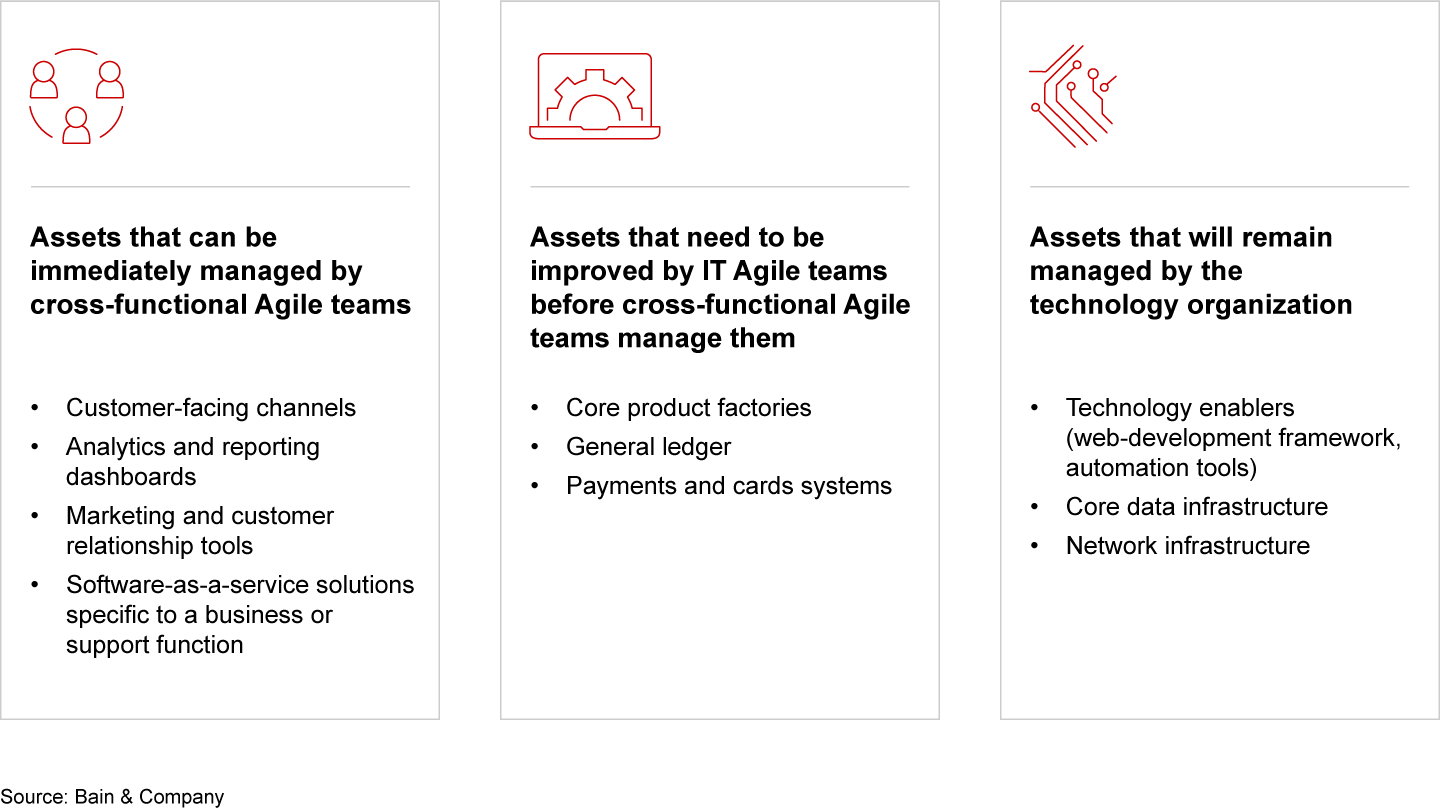
      IT assets can be assessed on their Agile readiness
      IT assets can be assessed on their Agile readiness
      IT assets can be assessed on their Agile readiness

      Organizing around IT assets’ Agile readiness. Based on the taxonomy of customer experiences and Agile maturity of IT assets, the bank’s business and IT teams started to reorganize. Cross-functional teams were established to handle the more Agile IT assets. Some existing IT teams focused temporarily on modernizing assets that weren’t fully Agile-ready, then transitioned into cross-functional teams. Other IT teams remained focused on IT assets that didn’t need to be managed by cross-functional teams.

      Across all the teams, the bank established “communities” of people with common technical or business expertise, led by a senior individual of the community, and reporting to their respective functional leader. For instance, IT-related communities composed of analysts, developers, and testers report to leaders in the IT function, while business-related communities such as product owners, marketers, and user-interface designers report to leaders in the business functions.

      Pushing the broader Agile agenda. Achieving the full benefits of agility at scale required the IT department and the whole bank to embrace a much broader change agenda than just setting up Agile teams.

      To cite a few examples, the bank needed to use technology to accelerate development work, through standard and cutting-edge components, application programming interfaces, and other means. The general mindset had to shift from “projects” to a “product teams and backlogs.” Agile management processes had to catch on at the corporate level, in order to make decisions on strategic priorities, budgets, and other issues. Rather than waiting to review and amend project requirements, the support functions had to actively contribute to sprint planning and backlog refinement. Moreover, Agile practices had to involve the network of external suppliers.

      Early pilots of these cross-enterprise Agile initiatives demonstrated a clear potential for the bank to achieve its ambitions on revenues, profits, and employee engagement.

      IT’s role changes

      Throughout an Agile transformation, the role of the IT organization typically gets reshaped according to six themes (see Figure 2): defining the overall technology strategy; supplying and upgrading the skills of IT talent across Agile teams; overseeing technology activities performed by Agile teams to ensure compliance with strategy and quality standards; supplying and operating the required technology infrastructure; developing the tools and frameworks to facilitate the IT work performed by Agile teams; and enhancing and maintaining the less-Agile IT assets.  

      Figure 2
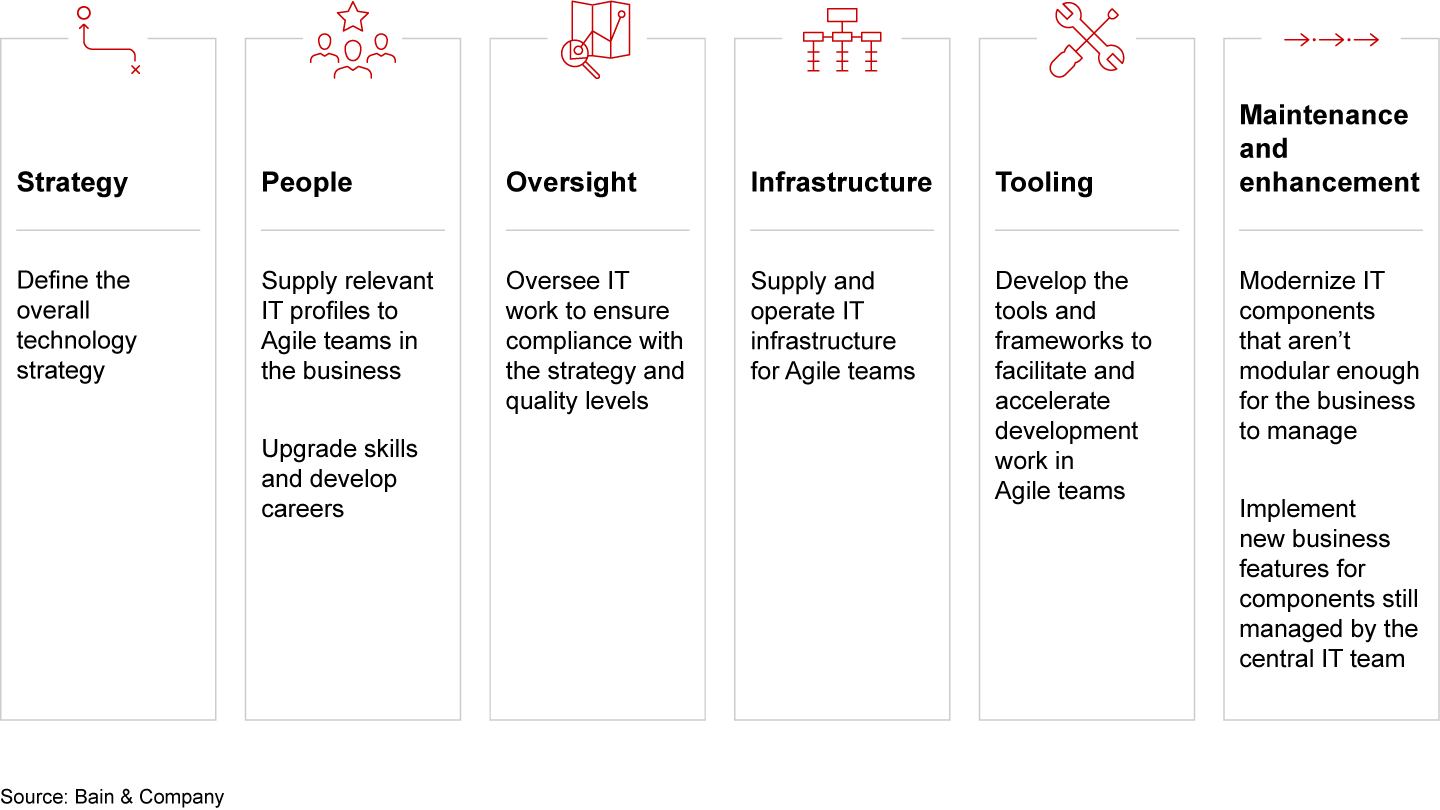
      The role of the IT group evolves as Agile expands across the enterprise
      The role of the IT group evolves as Agile expands across the enterprise
      The role of the IT group evolves as Agile expands across the enterprise

      Agile may have taken root in the IT function of financial services firms, but now it needs to bust through the walls. An end-to-end Agile operating model depends on close collaboration of technology and business units. Strong sponsorship by senior executives will be required to help the organization navigate this transition, but it’s well worth the effort.


      Net Promoter®, NPS® und die NPS-bezogenen Emoticons sind eingetragene Marken von Bain & Company, Inc., Satmetrix Systems, Inc. und Fred Reichheld. Net Promoter Score℠ und Net Promoter System℠ sind Service Marks von Bain & Company, Inc., Satmetrix Systems, Inc. und Fred Reichheld.

      Autoren
      • Fabian Delava
        Former Partner, Brussels
      • Headshot of Yacine Berrada
        Yacine Berrada
        Partner, Paris
      • Headshot of Michael Withers
        Michael Withers
        Partner, Melbourne
      • Headshot of Steve Berez
        Steve Berez
        Advisory Partner, Boston
      Kontaktieren Sie uns
      Verwandte Branchen
      • Bankensektor
      • Finanzdienstleistungen
      • Risikomanagement und Regulierung
      • Versicherungswirtschaft
      Ähnliche Beratungsangebote
      • Agile
      • Informationstechnologie
      Wie wir Sie unterstützen können
      • Technology Operating Model
      Bankensektor
      Building the Foundation for Agentic AI

      Capturing the full potential of agents will require modernizing enterprise architecture.

      Mehr erfahren
      Bankensektor
      Managing Physical Climate Risks in Financial Services

      Experts from Bain and Jupiter Intelligence detail how banks can deal with increasing climate-related challenges.

      Mehr erfahren
      Bankensektor
      Choose to Win: The Five Decisions That Make or Break Banking Modernization

      Banking modernization involves more nuance than the binary-bet caricature of an existential “rip-and-replace” gamble versus a cosmetic refresh.

      Mehr erfahren
      Agile
      An Overlooked Ace: Finding Value in Your Installed Base

      Digital models of installed machinery can improve product performance and predict necessary maintenance.

      Mehr erfahren
      Bankensektor
      AI Won’t Just Cut Costs, It Will Reinvent the Customer Experience

      Beyond efficiency, AI helps create a more personalized experience that delivers a triple play of customer loyalty, employee engagement, and revenue growth.

      Mehr erfahren
      First published in Oktober 2021
      Markierungen
      • Agile
      • Bankensektor
      • Finanzdienstleistungen
      • Informationstechnologie
      • Risikomanagement und Regulierung
      • Technology Operating Model
      • Versicherungswirtschaft

      Wie wir unsere Kunden unterstützt haben

      Strategie From Laggard to Leader: Desjardins Evolves Member Centricity for the Digital Age

      Kundenbeispiel lesen

      Digitalisierung A European Banking Giant Rises to the Fintech Challenge

      Kundenbeispiel lesen

      Nachhaltigkeit Redesigning a Bank’s Climate Strategy for Growth

      Kundenbeispiel lesen

      Möchten Sie mit uns in Kontakt bleiben?

      Wir unterstützen Führungskräfte weltweit, die kritischen Themen in ihrem Unternehmen zu adressieren. Gemeinsam schaffen wir nachhaltige Veränderungen und Ergebnisse.

      Bain Insights. Unsere Perspektive auf die kritischen Themen, mit denen sich international agierende Unternehmen konfrontiert sehen, finden Sie monatlich in Ihrem Postfach.

      *Ich habe die Datenschutzerklärung gelesen und akzeptiere sie.
      Bitte lesen Sie die Datenschutzerklärung und akzeptieren Sie diese.
      Bain & Company
      Contact us Sustainability Accessibility Rechtliche Hinweise Impressum Datenschutz Cookie-Richtlinie Sitemap Log In

      © 1996-2026 Bain & Company, Inc.

      Kontaktieren Sie Bain

      Wie können wir Ihnen helfen?

      • Business inquiry
      • Career information
      • Press relations
      • Partnership request
      • Speaker request
      Alle weltweiten Büros