
Skip to Content
  • Standorte

    Standorte

    North & Latin America
    • Atlanta
    • Austin
    • Bogota
    • Boston
    • Buenos Aires
    • Chicago
    • Dallas
    • Denver
    • Houston
    • Lisbon
    • Los Angeles
    • Mexico City
    • Minneapolis
    • Monterrey
    • Montreal
    • New York
    • Rio de Janeiro
    • San Francisco
    • Santiago
    • São Paulo
    • Seattle
    • Silicon Valley
    • Toronto
    • Washington, DC
    Europe & Africa
    • Amsterdam
    • Athens
    • Berlin
    • Brussels
    • Copenhagen
    • Düsseldorf
    • Frankfurt
    • Helsinki
    • Istanbul
    • Johannesburg
    • Kyiv
    • Lisbon
    • London
    • Madrid
    • Milan
    • München
    • Oslo
    • Paris
    • Rome
    • Stockholm
    • Warsaw
    • Wien
    • Zürich
    Middle East
    • Doha
    • Dubai
    • Riyadh
    Asia & Australia
    • Bangkok
    • Beijing
    • Bengaluru
    • Brisbane
    • Ho Chi Minh City
    • Hong Kong
    • Jakarta
    • Kuala Lumpur
    • Manila
    • Melbourne
    • Mumbai
    • New Delhi
    • Perth
    • Seoul
    • Shanghai
    • Singapore
    • Sydney
    • Tokyo
    Alle Standorte Anzeigen
  • Alumni
  • Presse
  • Newsletter
  • Kontakt
  • DACH-Region | Deutsch

    Wählen Sie Ihre Region und Sprache

    Global
    • Global (English)
    North & Latin America
    • Brazil (Português)
    • Argentina (Español)
    • Canada (Français)
    • Chile (Español)
    • Colombia (Español)
    Europe, Middle East, & Africa
    • France (Français)
    • DACH-Region (Deutsch)
    • Italy (Italiano)
    • Spain (Español)
    • Greece (Elliniká)
    Asia & Australia
    • China (中文版)
    • Korea (한국어)
    • Japan (日本語)
  • Saved items (0)
    Saved items (0)

    You have no saved items.

    Inhalte, für die Sie sich interessieren, werden hier gespeichert und können später gelesen oder weitergeleitet werden.

    Explore Bain Insights
  • Branchenkompetenzen
    Hauptmenü

    Branchenkompetenzen

    • Luft- und Raumfahrt, Verteidigung
    • Agrarwirtschaft
    • Chemieindustrie
    • Infrastruktur und Bauwirtschaft
    • Konsumgüter
    • Finanzdienstleistungen
    • Gesundheitswesen
    • Maschinen- und Anlagenbau
    • Medienwirtschaft
    • Metallindustrie
    • Bergbau
    • Öl und Gas
    • Papier- und Verpackungsindustrie
    • Private Equity
      Branchenkompetenzen
      Private Equity
      • Due Diligence
      • Exit Planning
      • Firm Strategy & Operations
      • Portfolio Value Creation
    • Öffentlicher Sektor und Sozialwesen
    • Einzelhandel
    • Technologie
    • Telekommunikation
    • Transportwesen
    • Reise- und Freizeitbranche
    • Versorgung und erneuerbare Energien
  • Managementkompetenzen
    Hauptmenü

    Managementkompetenzen

    • Customer Experience
    • ESG
    • Innovation
    • M&A
    • Operations
    • People & Organization
    • Private Equity
    • Sales & Marketing
    • Strategie
    • KI, Einblicke und Lösungen
    • Technologie
    • Transformation
  • Digital
  • Publikationen
    Hauptmenü

    Publikationen

    • Branchenthemen
    • Managementthemen
    • Bain-Bücher
    Alle Publikationen
    Ausgewählte Themen
    • Resilienz in der globalen Krise
    • M&A Report
    • Private Equity Podcast
    • Midyear Private Equity Report
    • Agile
    • Engineering Report
    • Digital Transformation
    • Elements of Value®
    • Firm of the Future
    • Nachhaltigkeitsstudie
    • Macro Trends
    • Future of Consumption
    • Weltwirtschaftsforum (WEF)
  • Über uns
    Hauptmenü

    Über uns

    • Was wir bieten
    • Unser Ansatz
    • Unser Team
    • Game Changer Award
    • Female Allstar Board
    • Messbare Ergebnisse (EN)
    • Auszeichnungen
    • Globale Partnerschaften
    • The Mission
    Further: Our global responsibility
    • Vielfalt & Chancengleichheit
    • Soziale Verantwortung
    • Sustainability
    Erfahren Sie mehr zu "Further"
  • Karriere
    Hauptmenü

    Karriere

    • Dein Einstieg
      Karriere
      Dein Einstieg
      • Find Your Place
      • Unsere Arbeitsbereiche
      • Unsere Teams
      • Angebote für Studierende
      • Praktika & Programme
      • Recruiting-Events
    • Arbeiten bei Bain
      Karriere
      Arbeiten bei Bain
      • Blog: Inside Bain
      • Karriere Stories
      • Unsere Bainies
      • Office-Standorte
      • Weiterentwicklung
      • Affinity Groups
      • Deine Benefits
    • Impact Stories
    • Deine Bewerbung
      Karriere
      Deine Bewerbung
      • Das erwartet dich
      • Der Interviewprozess
    FIND JOBS
  • Standorte
    Hauptmenü

    Standorte

    • North & Latin America
      Standorte
      North & Latin America
      • Atlanta
      • Austin
      • Bogota
      • Boston
      • Buenos Aires
      • Chicago
      • Dallas
      • Denver
      • Houston
      • Lisbon
      • Los Angeles
      • Mexico City
      • Minneapolis
      • Monterrey
      • Montreal
      • New York
      • Rio de Janeiro
      • San Francisco
      • Santiago
      • São Paulo
      • Seattle
      • Silicon Valley
      • Toronto
      • Washington, DC
    • Europe & Africa
      Standorte
      Europe & Africa
      • Amsterdam
      • Athens
      • Berlin
      • Brussels
      • Copenhagen
      • Düsseldorf
      • Frankfurt
      • Helsinki
      • Istanbul
      • Johannesburg
      • Kyiv
      • Lisbon
      • London
      • Madrid
      • Milan
      • München
      • Oslo
      • Paris
      • Rome
      • Stockholm
      • Warsaw
      • Wien
      • Zürich
    • Middle East
      Standorte
      Middle East
      • Doha
      • Dubai
      • Riyadh
    • Asia & Australia
      Standorte
      Asia & Australia
      • Bangkok
      • Beijing
      • Bengaluru
      • Brisbane
      • Ho Chi Minh City
      • Hong Kong
      • Jakarta
      • Kuala Lumpur
      • Manila
      • Melbourne
      • Mumbai
      • New Delhi
      • Perth
      • Seoul
      • Shanghai
      • Singapore
      • Sydney
      • Tokyo
    Alle Standorte Anzeigen
  • Alumni
  • Presse
  • Newsletter
  • Kontakt
  • DACH-Region | Deutsch
    Hauptmenü

    Wählen Sie Ihre Region und Sprache

    • Global
      Wählen Sie Ihre Region und Sprache
      Global
      • Global (English)
    • North & Latin America
      Wählen Sie Ihre Region und Sprache
      North & Latin America
      • Brazil (Português)
      • Argentina (Español)
      • Canada (Français)
      • Chile (Español)
      • Colombia (Español)
    • Europe, Middle East, & Africa
      Wählen Sie Ihre Region und Sprache
      Europe, Middle East, & Africa
      • France (Français)
      • DACH-Region (Deutsch)
      • Italy (Italiano)
      • Spain (Español)
      • Greece (Elliniká)
    • Asia & Australia
      Wählen Sie Ihre Region und Sprache
      Asia & Australia
      • China (中文版)
      • Korea (한국어)
      • Japan (日本語)
  • Saved items  (0)
    Hauptmenü
    Saved items (0)

    You have no saved items.

    Inhalte, für die Sie sich interessieren, werden hier gespeichert und können später gelesen oder weitergeleitet werden.

    Explore Bain Insights
  • Branchenkompetenzen
    • Branchenkompetenzen

      • Luft- und Raumfahrt, Verteidigung
      • Agrarwirtschaft
      • Chemieindustrie
      • Infrastruktur und Bauwirtschaft
      • Konsumgüter
      • Finanzdienstleistungen
      • Gesundheitswesen
      • Maschinen- und Anlagenbau
      • Medienwirtschaft
      • Metallindustrie
      • Bergbau
      • Öl und Gas
      • Papier- und Verpackungsindustrie
      • Private Equity
      • Öffentlicher Sektor und Sozialwesen
      • Einzelhandel
      • Technologie
      • Telekommunikation
      • Transportwesen
      • Reise- und Freizeitbranche
      • Versorgung und erneuerbare Energien
  • Managementkompetenzen
    • Managementkompetenzen

      • Customer Experience
      • ESG
      • Innovation
      • M&A
      • Operations
      • People & Organization
      • Private Equity
      • Sales & Marketing
      • Strategie
      • KI, Einblicke und Lösungen
      • Technologie
      • Transformation
  • Digital
  • Publikationen
    • Publikationen

      • Branchenthemen
      • Managementthemen
      • Bain-Bücher
      Alle Publikationen
      Ausgewählte Themen
      • Resilienz in der globalen Krise
      • M&A Report
      • Private Equity Podcast
      • Midyear Private Equity Report
      • Agile
      • Engineering Report
      • Digital Transformation
      • Elements of Value®
      • Firm of the Future
      • Nachhaltigkeitsstudie
      • Macro Trends
      • Future of Consumption
      • Weltwirtschaftsforum (WEF)
  • Über uns
    • Über uns

      • Was wir bieten
      • Unser Ansatz
      • Unser Team
      • Game Changer Award
      • Female Allstar Board
      • Messbare Ergebnisse (EN)
      • Auszeichnungen
      • Globale Partnerschaften
      • The Mission
      Further: Our global responsibility
      • Vielfalt & Chancengleichheit
      • Soziale Verantwortung
      • Sustainability
      Erfahren Sie mehr zu "Further"
  • Karriere
    Häufige Suchanfragen
    • Agil
    • Digital
    • Strategie
    Vorherige Suchanfragen
      Zuletzt besuchte Seiten

      Content added to saved items

      Saved items (0)

      Removed from saved items

      Saved items (0)

      Paper & Packaging Report

      Full Potential Transformation in Paper and Packaging

      Full Potential Transformation in Paper and Packaging

      Boosting profitability, cash flow, top-line growth, and company value.

      Von Pablo Cornicelli, Manuel De Soto, Andrea Isabella, Ilkka Leppävuori, und Elena Tegnér Recio

      • Min. Lesezeit
      }

      Report

      Full Potential Transformation in Paper and Packaging
      en
      Auf einen Blick
      • A full potential transformation can raise a company’s profitability, cash flow, top-line growth, and value to a completely different level.
      • Paper and packaging companies that have achieved a full potential transformation have typically doubled their EBITDA over two to five years.
      • Successful companies embrace clear purpose, full alignment, accountability, and sprint-based prioritization of actions.  

      This article is part of Bain’s 2023 Paper & Packaging Report

      EXPLORE THE REPORT

      How did Fedrigoni Paper more than double its adjusted sales and almost triple its EBITDA in just a few years? Established in 1888, the Italian family-run company has a long and storied history of producing specialty paper and self-adhesive labels. More recently, however, Fedrigoni lost two large international banknote customers, and market dynamics shifted. In 2018, Bain Capital acquired a 90% stake in Fedrigoni for €600 million and helped the Italian company execute a full potential transformation.

      By building scale in existing markets, expanding its geographic scope, and acquiring several Italian companies with a strong European presence, Fedrigoni became one of the top players in self-adhesive labels worldwide. It also embedded sustainability into internal operations and its day-to-day business, developing circular products such as specialty paper made of 40% to 100% recycled material as well as paper combining pulp and alternative fibers such as cotton, hemp, and linen. Finally, it also cut costs and optimized operational excellence. Thanks to these measures and others, investors achieved a five times return on investment with the new valuation of Fedrigoni at €3 billion.

      For every company that has invested at the right time and achieved game-changing operational and commercial results, there have been many more that have faced declining profitability and serious balance sheet issues. Given this wide variation, CEOs and shareholders have prioritized understanding how to generate the most attractive returns and make the most out of their existing production assets.

      “Transformation” is used widely in the business world, and at Bain & Company, a “full potential transformation” is the cross-functional effort to alter the financial, operational, and strategic trajectory of the business. When implemented successfully, this plan can dramatically raise the company’s performance to a completely different level in terms of its profitability, cash flow, top-line growth, and value. This success often leads to an increased ability to make bold new investments in new production capacity and R&D. These days, such transformation plans also often include a concrete sustainability plan that outlines how to get toward lower (or ideally zero) carbon emissions within a given timeline, often through site energy-efficiency savings or investments in non–fossil fuel energy.

      Successful companies articulate a clear purpose and value creation plan or a roadmap to achieve their full potential transformation (see Figure 1). They align fully across the organization and split bigger key initiatives into multiple shorter sprints. Executives meet regularly to ensure that performance is transparent, roadblocks are quickly cleared, and decisions are quickly made. Finally, they ensure that the best talent leads the transformation, and they honestly evaluate where they are missing certain skills, hiring externally to fill those gaps.

      Figure 1
      Value creation levers that accelerate a full potential transformation

      A full potential transformation usually consists of a five-year plan to significantly improve the EBITDA of the company. Everything on this broad agenda cannot be successfully executed at the same time. Instead, successful companies identify and quantify the relevant ways to create value. Three different ways that top-quartile companies Bain has worked with have employed specific value levers as part of their full potential transformation include revamping their portfolio strategy, stepping up their commercial and operational excellence, and improving their performance through cost transformation and next-generation sourcing.

      Revamping portfolio strategy: Leading companies anticipate and react to changing market demands, and they adjust their portfolio accordingly. Early lessons can be learned from paper companies that switched some years ago from declining products such as graphic paper to producing higher-demand packaging products such as carton board or containerboard. Revamping their portfolios often involved divesting or spinning off lower-demand products, closing certain paper mills if they were too old or costly to convert, or transforming machines to produce the higher-demand products.

      Today’s leaders also realize that transforming one’s portfolio means accepting that they will need to close certain plants and make new investments to convert machines into growing and attractive product grades. Finally, leaders will upgrade the commercial organization to effectively sell the new products to new customers. This could entail training sales teams to sell carton board or molded fiber products to fast-moving consumer goods companies, retail chains, or quick-service restaurants, instead of selling graphic paper to publishers.

      Stepping up commercial and operational excellence: Many full-scale transformations rely on improving commercial and operational results across dozens of production sites. One packaging producer, for example, started by setting high ambitions to improve operations vs. the baseline. It began by seeking full transparency of what good looks like on a very granular level. On the operations side, supervisors tracked how workers did on key performance indicator dashboards in every plant for every shift, how the shift changeover was managed, and many other details. They did this to establish their ambition and where certain teams and plants needed to close the gap.

      The company brought in the equipment manufacturers (who also functioned as consultants) to share best practices and help the teams accomplish operational excellence. Finally, it connected those teams focused on operational excellence with the teams working on commercial excellence and sourcing excellence to ensure that operational excellence improvements were not, for instance, negatively impacting the commercial team. Sourcing was looped in early on to help find which materials, recipes, and suppliers were needed to optimize product cost.

      Improving performance through cost transformation and next-generation sourcing: Other companies have improved their cost structure and upgraded sourcing to stay competitive and drive a multiyear transformation. For one company, this included coordinating procurement for key product categories so that every single mill did not negotiate with suppliers separately, but instead, they could take advantage of volume discounts and more strategic dialogues with select suppliers.

      Analyzing the data enabled the company to determine a more efficient balance when choosing among the share of fiber to produce internally, to source from external suppliers, or to purchase on the open market. Big data analysis on varied performance across all products and sites helped manage demand and identify how it could reduce the cost of chemicals and energy within its operations—for example, through calibration of recipes and consumption in the production. As a result, this company managed to reduce costs, improve collaboration between sourcing and key business stakeholders, and upgrade the supplier management and overall sourcing strategy significantly. Sourcing teams were involved early and throughout the full transformation process so as to be more cost efficient if the team were to be sought out to alter the product recipe, and they would rethink sourcing to reduce the quantity of the most expensive ingredients, which are typically chemicals.

      Past Bain project experience shows that most companies undergoing a full potential transformation use several levers in parallel, with the most successful ones (especially in the private equity setting) sequentially improving in all areas (see Figure 2). Operational excellence and commercial excellence were the most commonly targeted levers and showed the highest return. All in all, companies utilizing the full set of levers were able to achieve a roughly two times EBITDA uplift, truly transforming the business in the process.

      Figure 2
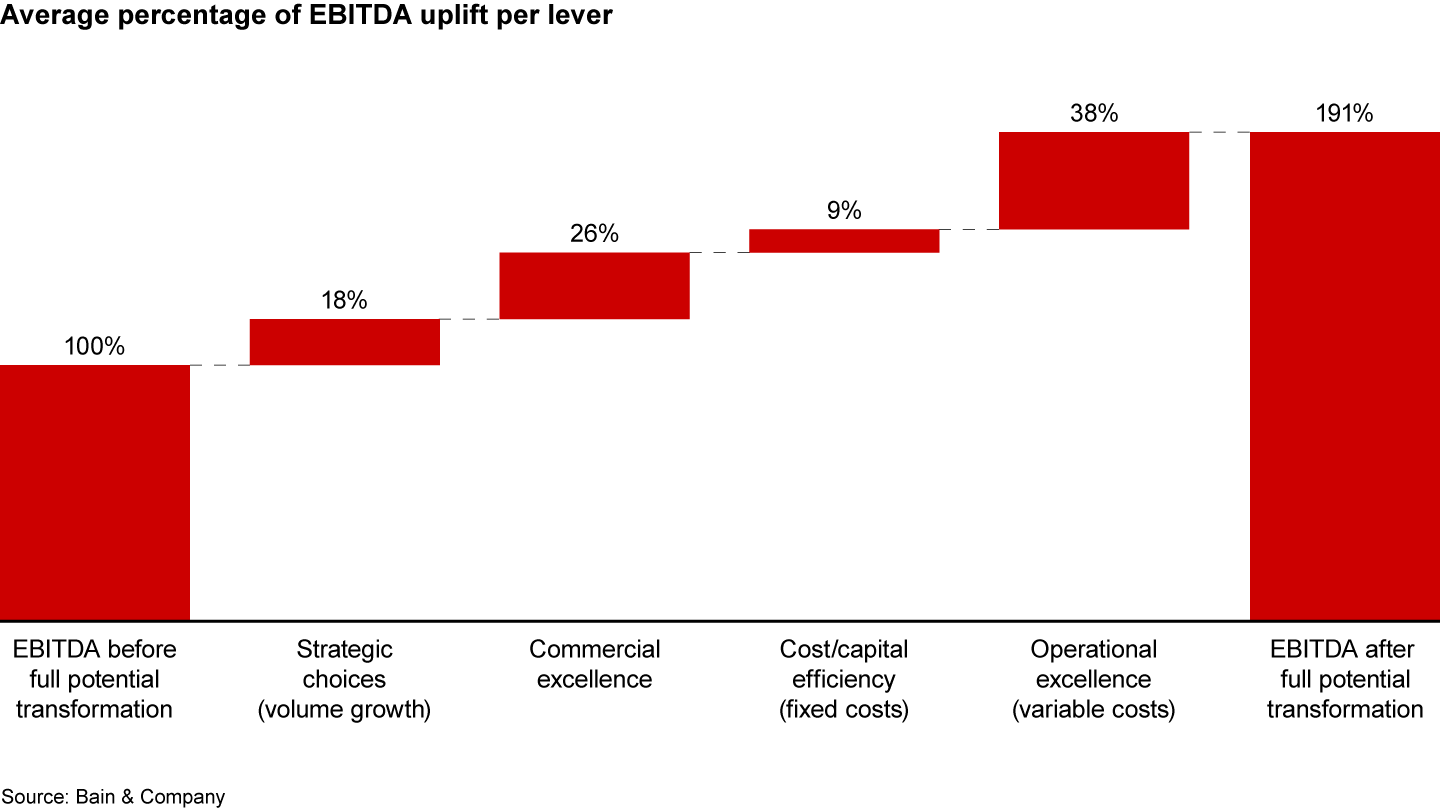
      Improving operational excellence created the most value in past Bain-supported transformations

      How to succeed in a full potential transformation

      Successful companies begin their transformations with a diagnostic phase to establish a starting point, followed by a design phase to specify the actions and planned impact. It is in the implementation stage, however, where the winners emerge. These companies embrace a clear purpose, the principle that talent is king, full alignment and accountability, sprint-based prioritization, performance transparency, and fast decisions.

      Clear purpose: The CEO articulates why the company needs to do things differently, what the world will look like if it succeeds, and the specific motivations for different roles within the organization. Perhaps the company is chronically less profitable than competitors or a new private equity owner is aiming for a successful exit in five years or has an ambition to achieve global leadership through M&A and consolidation. The key is that the leadership team and the broader organization feel motivated to take the journey toward that joint ambition.

      Talent is king: Transformations are disruptive and can lead to attrition as well as new skill requirements. Leaders identify the best talent at the firm to lead the transformation, rather than simply the employees available to do so. These top performers are freed up from other tasks so that they will be the best sponsors to ensure buy-in for the transformation. Looping in top talent before companywide communications can help them feel integrated in leading change. And diversity is reflected at every level of employment—from the factory line to the C-suite.

      Full alignment and accountability: The top team and key profit-and-loss owners embrace the approach and its urgency. Every initiative has clear owners and sponsors, and the broader organization is informed of plans and regularly updated on progress through all-hands town hall–style meetings. A clear sponsorship spine extends through all levels to ensure buy-in and help anticipate risk early on. Employees hear about transformation directly from their managers, who can explain why the change is critical and how it will impact employees’ day-to-day work.

      Sprint-based prioritization: Broad transformations often cover countless different initiatives. To ensure progress, work is split up into multiple shorter sprints, without losing sight of long-term objectives. The most critical enablers and highest-value initiatives are front-loaded and operationalized within 4- to 10-week sprints, during which the working team is onboarded and key improvements are introduced. After the sprint is finished, leaders communicate results to all relevant stakeholders and map them against long-term ambitions.

      Performance transparency: Dashboards showing progress in transformations too often tend to migrate toward showing green lights across, whereas the real point of tracking is to identify issues and react to those quickly. Successful companies seek transparency on performance and a “red is good” mentality in tracking progress. If waste percentages at a converting plant are not dropping, for instance, or if most price increases are leaking out, the leadership team is notified immediately.

      Fast decisions: During well-run transformations, executives meet weekly or biweekly to address how specific roadblocks or delays in a given workstream can be mitigated. For instance, a recipe optimization effort requires a new chemical supplier in order to succeed, or the speed calculation methods across a company’s board machines need to be harmonized or the salespeople cannot charge the correct transportation costs because the data is not available on time. Quick, pragmatic decisions are made to course-correct the initiatives that are struggling, and all employees from the C-suite to the front line accept that sometimes teams make the wrong decisions and need to course-correct.

      Read the Next Section

      The Paper and Packaging Industry Faces a Biodiversity Crisis

      More from the report

      • Navigating Turbulence in Paper and Packaging

      • Full Potential Transformation in Paper and Packaging

      • The Paper and Packaging Industry Faces a Biodiversity Crisis

      • Which Packaging Substrates Are the Most Sustainable?

      • How Paper and Packaging Companies Can Catch Up in Commercial Excellence

      • Putting Sustainability to Work in Paper and Packaging

      • The State of Private Equity and M&A in the Paper and Packaging Industry

      • Sustainable Packaging: What Consumers Want Next from the Paper and Packaging Industry

      • The Mill of the Future

      Read our Paper & Packaging Report 2023

      EXPLORE THE REPORT Download the PDF
      Autoren
      • Headshot of Pablo Cornicelli
        Pablo Cornicelli
        Partner, Madrid
      • Headshot of Manuel De Soto
        Manuel De Soto
        Partner, Madrid
      • Headshot of Andrea Isabella
        Andrea Isabella
        Partner, Milan
      • Headshot of Ilkka Leppävuori
        Ilkka Leppävuori
        Partner, Helsinki
      • Elena Tegnér Recio
        Partner, Stockholm
      Kontaktieren Sie uns
      Verwandte Branchen
      • Forstwirtschaftliche Produkte, Papier und Verpackung
      • Industriegüter und -services
      Paper & Packaging Report
      It’s Time to Rethink Every Link in Your Supply Chain

      A function that once got little attention is now becoming a key differentiator.

      Mehr erfahren
      Paper & Packaging Report
      Sustainability: Less Talk and More Action

      Despite elusive targets, the business case is stronger than ever.

      Mehr erfahren
      Paper & Packaging Report
      Don’t Underestimate the Cost of Overcapacity

      Overcapacity is endemic to the paper and packaging industry, but these actions can help you maintain margins.

      Mehr erfahren
      Paper & Packaging Report
      Transforming Maintenance with Artificial Intelligence

      With little to no capex, companies can turn maintenance into an engine of cash flow.

      Mehr erfahren
      Paper & Packaging Report
      Navigating Turbulence in Paper and Packaging

      Scenario planning can create a dynamic, future-proof strategy.

      Mehr erfahren
      First published in August 2023
      Markierungen
      • Forstwirtschaftliche Produkte, Papier und Verpackung
      • Industriegüter und -services
      • Paper & Packaging Report

      Wie wir unsere Kunden unterstützt haben

      Supply Chain Security Mitigates a Sovereign Wealth Fund’s Construction Disruptions

      Kundenbeispiel lesen

      A Packaging Company Unboxes a New Go-to-Market Strategy

      Kundenbeispiel lesen

      Operations A Paper Company Optimizes Its Industrial Footprint

      Kundenbeispiel lesen

      Möchten Sie mit uns in Kontakt bleiben?

      Wir unterstützen Führungskräfte weltweit, die kritischen Themen in ihrem Unternehmen zu adressieren. Gemeinsam schaffen wir nachhaltige Veränderungen und Ergebnisse.

      Bain Insights. Unsere Perspektive auf die kritischen Themen, mit denen sich international agierende Unternehmen konfrontiert sehen, finden Sie monatlich in Ihrem Postfach.

      *Ich habe die Datenschutzerklärung gelesen und akzeptiere sie.
      Bitte lesen Sie die Datenschutzerklärung und akzeptieren Sie diese.
      Bain & Company
      Contact us Sustainability Accessibility Rechtliche Hinweise Impressum Datenschutz Cookie-Richtlinie Sitemap Log In

      © 1996-2026 Bain & Company, Inc.

      Kontaktieren Sie Bain

      Wie können wir Ihnen helfen?

      • Business inquiry
      • Career information
      • Press relations
      • Partnership request
      • Speaker request
      Alle weltweiten Büros