
Skip to Content
  • Standorte

    Standorte

    North & Latin America
    • Atlanta
    • Austin
    • Bogota
    • Boston
    • Buenos Aires
    • Chicago
    • Dallas
    • Denver
    • Houston
    • Lisbon
    • Los Angeles
    • Mexico City
    • Minneapolis
    • Monterrey
    • Montreal
    • New York
    • Rio de Janeiro
    • San Francisco
    • Santiago
    • São Paulo
    • Seattle
    • Silicon Valley
    • Toronto
    • Washington, DC
    Europe & Africa
    • Amsterdam
    • Athens
    • Berlin
    • Brussels
    • Copenhagen
    • Düsseldorf
    • Frankfurt
    • Helsinki
    • Istanbul
    • Johannesburg
    • Kyiv
    • Lisbon
    • London
    • Madrid
    • Milan
    • München
    • Oslo
    • Paris
    • Rome
    • Stockholm
    • Warsaw
    • Wien
    • Zürich
    Middle East
    • Doha
    • Dubai
    • Riyadh
    Asia & Australia
    • Bangkok
    • Beijing
    • Bengaluru
    • Brisbane
    • Ho Chi Minh City
    • Hong Kong
    • Jakarta
    • Kuala Lumpur
    • Manila
    • Melbourne
    • Mumbai
    • New Delhi
    • Perth
    • Seoul
    • Shanghai
    • Singapore
    • Sydney
    • Tokyo
    Alle Standorte Anzeigen
  • Alumni
  • Presse
  • Newsletter
  • Kontakt
  • DACH-Region | Deutsch

    Wählen Sie Ihre Region und Sprache

    Global
    • Global (English)
    North & Latin America
    • Brazil (Português)
    • Argentina (Español)
    • Canada (Français)
    • Chile (Español)
    • Colombia (Español)
    Europe, Middle East, & Africa
    • France (Français)
    • DACH-Region (Deutsch)
    • Italy (Italiano)
    • Spain (Español)
    • Greece (Elliniká)
    Asia & Australia
    • China (中文版)
    • Korea (한국어)
    • Japan (日本語)
  • Saved items (0)
    Saved items (0)

    You have no saved items.

    Inhalte, für die Sie sich interessieren, werden hier gespeichert und können später gelesen oder weitergeleitet werden.

    Explore Bain Insights
  • Branchenkompetenzen
    Hauptmenü

    Branchenkompetenzen

    • Luft- und Raumfahrt, Verteidigung
    • Agrarwirtschaft
    • Chemieindustrie
    • Infrastruktur und Bauwirtschaft
    • Konsumgüter
    • Finanzdienstleistungen
    • Gesundheitswesen
    • Maschinen- und Anlagenbau
    • Medienwirtschaft
    • Metallindustrie
    • Bergbau
    • Öl und Gas
    • Papier- und Verpackungsindustrie
    • Private Equity
      Branchenkompetenzen
      Private Equity
      • Due Diligence
      • Exit Planning
      • Firm Strategy & Operations
      • Portfolio Value Creation
    • Öffentlicher Sektor und Sozialwesen
    • Einzelhandel
    • Technologie
    • Telekommunikation
    • Transportwesen
    • Reise- und Freizeitbranche
    • Versorgung und erneuerbare Energien
  • Managementkompetenzen
    Hauptmenü

    Managementkompetenzen

    • Customer Experience
    • ESG
    • Innovation
    • M&A
    • Operations
    • People & Organization
    • Private Equity
    • Sales & Marketing
    • Strategie
    • KI, Einblicke und Lösungen
    • Technologie
    • Transformation
  • Digital
  • Publikationen
    Hauptmenü

    Publikationen

    • Branchenthemen
    • Managementthemen
    • Bain-Bücher
    Alle Publikationen
    Ausgewählte Themen
    • Resilienz in der globalen Krise
    • M&A Report
    • Private Equity Podcast
    • Midyear Private Equity Report
    • Agile
    • Engineering Report
    • Digital Transformation
    • Elements of Value®
    • Firm of the Future
    • Nachhaltigkeitsstudie
    • Macro Trends
    • Future of Consumption
    • Weltwirtschaftsforum (WEF)
  • Über uns
    Hauptmenü

    Über uns

    • Was wir bieten
    • Unser Ansatz
    • Unser Team
    • Game Changer Award
    • Female Allstar Board
    • Messbare Ergebnisse (EN)
    • Auszeichnungen
    • Globale Partnerschaften
    • The Mission
    Further: Our global responsibility
    • Vielfalt & Chancengleichheit
    • Soziale Verantwortung
    • Sustainability
    Erfahren Sie mehr zu "Further"
  • Karriere
    Hauptmenü

    Karriere

    • Dein Einstieg
      Karriere
      Dein Einstieg
      • Find Your Place
      • Unsere Arbeitsbereiche
      • Unsere Teams
      • Angebote für Studierende
      • Praktika & Programme
      • Recruiting-Events
    • Arbeiten bei Bain
      Karriere
      Arbeiten bei Bain
      • Karriere Stories
      • Unsere Bainies
      • Office-Standorte
      • Weiterentwicklung
      • Affinity Groups
      • Deine Benefits
    • Impact Stories
    • Deine Bewerbung
      Karriere
      Deine Bewerbung
      • Das erwartet dich
      • Der Interviewprozess
    FIND JOBS
  • Standorte
    Hauptmenü

    Standorte

    • North & Latin America
      Standorte
      North & Latin America
      • Atlanta
      • Austin
      • Bogota
      • Boston
      • Buenos Aires
      • Chicago
      • Dallas
      • Denver
      • Houston
      • Lisbon
      • Los Angeles
      • Mexico City
      • Minneapolis
      • Monterrey
      • Montreal
      • New York
      • Rio de Janeiro
      • San Francisco
      • Santiago
      • São Paulo
      • Seattle
      • Silicon Valley
      • Toronto
      • Washington, DC
    • Europe & Africa
      Standorte
      Europe & Africa
      • Amsterdam
      • Athens
      • Berlin
      • Brussels
      • Copenhagen
      • Düsseldorf
      • Frankfurt
      • Helsinki
      • Istanbul
      • Johannesburg
      • Kyiv
      • Lisbon
      • London
      • Madrid
      • Milan
      • München
      • Oslo
      • Paris
      • Rome
      • Stockholm
      • Warsaw
      • Wien
      • Zürich
    • Middle East
      Standorte
      Middle East
      • Doha
      • Dubai
      • Riyadh
    • Asia & Australia
      Standorte
      Asia & Australia
      • Bangkok
      • Beijing
      • Bengaluru
      • Brisbane
      • Ho Chi Minh City
      • Hong Kong
      • Jakarta
      • Kuala Lumpur
      • Manila
      • Melbourne
      • Mumbai
      • New Delhi
      • Perth
      • Seoul
      • Shanghai
      • Singapore
      • Sydney
      • Tokyo
    Alle Standorte Anzeigen
  • Alumni
  • Presse
  • Newsletter
  • Kontakt
  • DACH-Region | Deutsch
    Hauptmenü

    Wählen Sie Ihre Region und Sprache

    • Global
      Wählen Sie Ihre Region und Sprache
      Global
      • Global (English)
    • North & Latin America
      Wählen Sie Ihre Region und Sprache
      North & Latin America
      • Brazil (Português)
      • Argentina (Español)
      • Canada (Français)
      • Chile (Español)
      • Colombia (Español)
    • Europe, Middle East, & Africa
      Wählen Sie Ihre Region und Sprache
      Europe, Middle East, & Africa
      • France (Français)
      • DACH-Region (Deutsch)
      • Italy (Italiano)
      • Spain (Español)
      • Greece (Elliniká)
    • Asia & Australia
      Wählen Sie Ihre Region und Sprache
      Asia & Australia
      • China (中文版)
      • Korea (한국어)
      • Japan (日本語)
  • Saved items  (0)
    Hauptmenü
    Saved items (0)

    You have no saved items.

    Inhalte, für die Sie sich interessieren, werden hier gespeichert und können später gelesen oder weitergeleitet werden.

    Explore Bain Insights
  • Branchenkompetenzen
    • Branchenkompetenzen

      • Luft- und Raumfahrt, Verteidigung
      • Agrarwirtschaft
      • Chemieindustrie
      • Infrastruktur und Bauwirtschaft
      • Konsumgüter
      • Finanzdienstleistungen
      • Gesundheitswesen
      • Maschinen- und Anlagenbau
      • Medienwirtschaft
      • Metallindustrie
      • Bergbau
      • Öl und Gas
      • Papier- und Verpackungsindustrie
      • Private Equity
      • Öffentlicher Sektor und Sozialwesen
      • Einzelhandel
      • Technologie
      • Telekommunikation
      • Transportwesen
      • Reise- und Freizeitbranche
      • Versorgung und erneuerbare Energien
  • Managementkompetenzen
    • Managementkompetenzen

      • Customer Experience
      • ESG
      • Innovation
      • M&A
      • Operations
      • People & Organization
      • Private Equity
      • Sales & Marketing
      • Strategie
      • KI, Einblicke und Lösungen
      • Technologie
      • Transformation
  • Digital
  • Publikationen
    • Publikationen

      • Branchenthemen
      • Managementthemen
      • Bain-Bücher
      Alle Publikationen
      Ausgewählte Themen
      • Resilienz in der globalen Krise
      • M&A Report
      • Private Equity Podcast
      • Midyear Private Equity Report
      • Agile
      • Engineering Report
      • Digital Transformation
      • Elements of Value®
      • Firm of the Future
      • Nachhaltigkeitsstudie
      • Macro Trends
      • Future of Consumption
      • Weltwirtschaftsforum (WEF)
  • Über uns
    • Über uns

      • Was wir bieten
      • Unser Ansatz
      • Unser Team
      • Game Changer Award
      • Female Allstar Board
      • Messbare Ergebnisse (EN)
      • Auszeichnungen
      • Globale Partnerschaften
      • The Mission
      Further: Our global responsibility
      • Vielfalt & Chancengleichheit
      • Soziale Verantwortung
      • Sustainability
      Erfahren Sie mehr zu "Further"
  • Karriere
    Häufige Suchanfragen
    • Agil
    • Digital
    • Strategie
    Vorherige Suchanfragen
      Zuletzt besuchte Seiten

      Content added to saved items

      Saved items (0)

      Removed from saved items

      Saved items (0)

      Expert Commentary

      How Machine Learning and Natural Language Processing Produce Deeper Survey Insights

      How Machine Learning and Natural Language Processing Produce Deeper Survey Insights

      Analyzing open-ended responses from a large group requires tools emerging from the artificial intelligence revolution.

      Von Ruud Hellemons und Roger Zhu

      • Min. Lesezeit
      }

      Artikel

      How Machine Learning and Natural Language Processing Produce Deeper Survey Insights
      en
      Auf einen Blick
      • When surveys of large numbers of people contain open-ended responses, traditional analytical approaches fall short.
      • However, machine learning and natural language processing can handle the statistical and contextual challenges involved.
      • That’s how a global retailer was able to derive insights about its culture and values from a survey of tens of thousands of employees around the world.

      When assessing consumer or employee sentiment, traditional approaches tend to focus on management interviews, focus groups, and numerically based survey questions as the core basis for insights. On the other hand, open-ended survey text responses have played a sparing role, given the large analytical effort involved.

      The traditional approaches were not sufficient for a global retailer. It wanted to deeply understand employee sentiment and how well employees believed the company and its leaders were living up to the stated values. To understand the root causes, the company worked with Bain to conduct an in-depth diagnostic. The assessment involved management interviews and focus groups, as well as a survey of tens of thousands of frontline and corporate employees in more than 20 languages. The scale of the assessment and the need to understand trends specific to different locations and functions required an in-depth analysis of open-ended survey responses.

      We decided to use machine learning (ML) and natural language processing (NLP) techniques to address several challenges:  

      • Selection bias: Due to the diversity of employees, the retailer wanted to ensure that insights were not solely derived from a small group of interviews and focus group participants, but instead captured a broad range of opinions and experiences.
      • Statistical significance: Given the assessment’s global reach, the insights needed to have a statistically rigorous foundation backed by the survey data.
      • Lack of nuance when analyzing open-ended text: The survey focused on complex themes around culture and ways of working. Any analysis of the free text responses required a much greater degree of analytical rigor than simple word categorizations, in order to effectively capture sentiment.
      • Complexity of language: Analyzing open-ended responses involves relatively sparse textual data. Respondents may refer to the same underlying theme using different language that contains no shared words—for instance, “I think my salary is too low” and “They are not paying me enough.” The methodology employed must be able to recognize and manage this complexity. 
      • Unique context: It has become common practice in text analytics to employ pretrained models to classify open-ended responses, based on a predetermined set of themes, and occasionally refined by manually tagging a limited set of responses as examples for new themes. However, our experience with surveys suggests that each use case has a unique context. That makes it difficult to determine a complete set of themes ahead of the survey. This is particularly true for large global enterprises, given the varying cultural nuances, company-specific language, and geographic variations. Instead, one needs an unopinionated, data-driven approach for determining themes, based on the core data set.

      The approach: Dialect text analytics

      To tackle these challenges, we deployed our Dialect text analytics software to understand, categorize, and produce visualizations for key themes from the survey responses. This software employs recent breakthroughs in language models and ML, and can stand up to the complexities of open-ended responses from large surveys, including spelling errors and very short or incomplete phrases, such as “Pay is good, management not so much.”

      Over the past few years, the “deep learning” revolution in AI and ML has made strides in text analytics, from chatbots to sentiment analysis and text generation. In certain applications, algorithms now match or even exceed human capabilities. Nevertheless, there remains room for improvement in topic modeling to understand common themes mentioned in text. That’s why Bain built a text analytics library, which enable this form of unsupervised analytics.

      The first phase in our approach involves exploratory modeling to detect themes in the data. This unsupervised topic model ensures that the underlying data informs the identification of themes, without bias toward preconceptions and unstated assumptions. This phase generally consists of four steps:

      1. Preprocessing the text: We first apply textual cleaning practices such as removing punctuation, setting words to lower case, filtering out uninformative words, and correcting spelling errors. Even with large-scale surveys, the volume of text can be relatively low for ML purposes compared with other data sources such as online reviews or social media posts. As a result, it is critical to condense the data by recoding verbs and nouns to their lemma (grouped inflectional forms of words). Finally, respondents regularly tend to provide feedback as a compact list of issues (such as “nice colleagues, long working hours”), which requires tokenization to split responses into sentence parts, so that we can attribute a single response to multiple themes.
      2. Training the language model to learn relationships between words: After preprocessing, we transform words in the texts to vectors called “word embeddings,” which convert the text information into numerical inputs and infer meaning by their contextual similarity. Here, it is critical to tailor the embeddings to the business context, as the same word may have dramatically different connotations in different companies and industries.
      3. Running theme detection using an unsupervised clustering algorithm: The unsupervised algorithm clusters the text into themes without initial human intervention, while also allowing model customizations for different survey populations or questions (see Figure 1).
      4. Theme review: Once aggregated, we review the theme clustering identified by the unsupervised algorithm, and corroborate it against interviews, refining if required.
      Figure 1
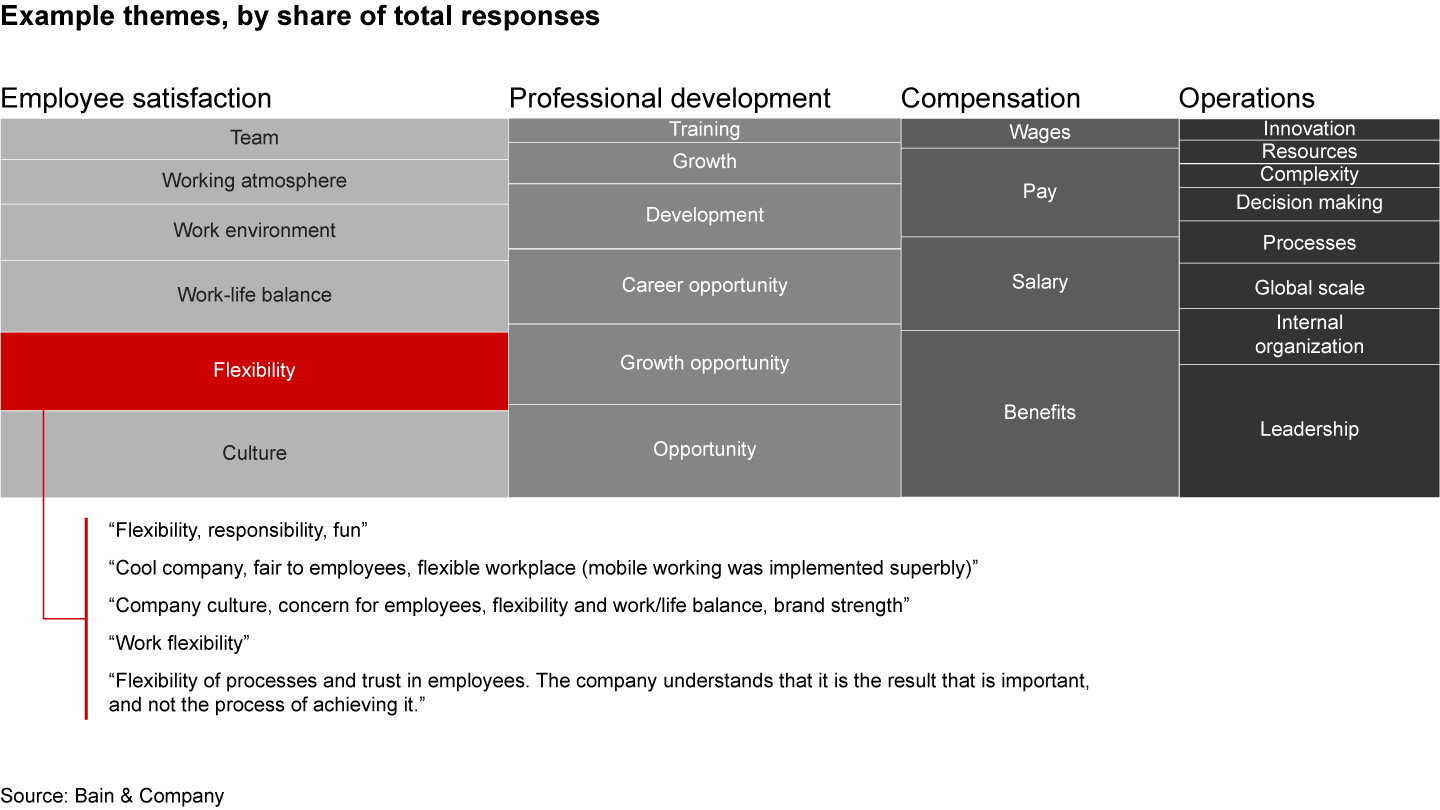
      The algorithm clusters survey responses into themes
      The algorithm clusters survey responses into themes
      The algorithm clusters survey responses into themes

      Following refinement, there is an optional, second step to leverage a supervised ML model that can accurately assign identified themes to new data. At this stage, the theme definitions are fixed, which can be valuable in use cases with frequent data updates, such as regular employee pulse surveys. The Dialect software also can add the corresponding sentiment to each theme in an open-ended response.

      Greater confidence in the insights

      For the retailer, the model created with the Dialect text analytics library identified organizational themes that confirmed and complemented those from management interviews and focus groups. It also provided a level of rigor and detail that allowed for customized insights at a geographic and functional level across 80 summary reports.

      The text analytics work was critical to the success of a major priority for senior executives, establishing confidence in the identified strengths and challenges related to company culture. This enabled the executive team to rapidly align on organizational priorities through a series of workshops. With growing sophistication, emerging text analytics tools will increasingly unlock faster and deeper insights into employee and customer sentiment.

      The authors thank the following colleagues for their help with this expert commentary: Sarah Salzman, Anli Chen, Marion Louvel, Katrijn DePaepe, and Linda Raaijmakers.

      Autoren
      • Headshot of Ruud Hellemons
        Ruud Hellemons
        Director, Data Science, Amsterdam
      • Headshot of Roger Zhu
        Roger Zhu
        Partner, Boston
      Kontaktieren Sie uns
      Ähnliche Beratungsangebote
      • Advanced Analytics
      • Digitalisierung
      Advanced Analytics
      Defining the Intelligent Enterprise

      A recap from DeepLearning.AI’s AI Dev 25 × NYC.

      Mehr erfahren
      Advanced Analytics
      Retailers Have a Secret Weapon in AI-Powered Shopping: Trust

      US consumers would be more comfortable with AI buying on their behalf if a familiar retailer were involved.

      Mehr erfahren
      Advanced Analytics
      Making Friends with Collinearity: How Driver Interactions Can Inform Targeted Interventions

      Driver analysis helps inform decisions on which drivers deserve the greatest effort.

      Mehr erfahren
      Advanced Analytics
      What Business Leaders Need to Know About AI Sovereignty

      Aligning business strategy with national AI priorities is necessary to compete and scale.

      Mehr erfahren
      Advanced Analytics
      Mission Possible: Driver Analysis with Collinear Variables

      Many commonly used methods have serious limitations when assessing the variable importance of collinear drivers.

      Mehr erfahren
      First published in März 2021
      Markierungen
      • Advanced Analytics
      • Advanced Analytics
      • Digitalisierung

      Wie wir unsere Kunden unterstützt haben

      Advanced Analytics A New Demand Forecasting Approach Signals a Bottom-Line Boost

      Kundenbeispiel lesen

      Advanced Analytics Blockchain-enabled Payment Flows: A Payments Company Reviews its Strategy

      Kundenbeispiel lesen

      Digitalisierung Better Forecasts, Less Waste Boost Grupo Bimbo’s Profitability

      Kundenbeispiel lesen

      Möchten Sie mit uns in Kontakt bleiben?

      Wir unterstützen Führungskräfte weltweit, die kritischen Themen in ihrem Unternehmen zu adressieren. Gemeinsam schaffen wir nachhaltige Veränderungen und Ergebnisse.

      Bain Insights. Unsere Perspektive auf die kritischen Themen, mit denen sich international agierende Unternehmen konfrontiert sehen, finden Sie monatlich in Ihrem Postfach.

      *Ich habe die Datenschutzerklärung gelesen und akzeptiere sie.
      Bitte lesen Sie die Datenschutzerklärung und akzeptieren Sie diese.
      Bain & Company
      Contact us Sustainability Accessibility Rechtliche Hinweise Impressum Datenschutz Cookie-Richtlinie Sitemap Log In

      © 1996-2026 Bain & Company, Inc.

      Kontaktieren Sie Bain

      Wie können wir Ihnen helfen?

      • Business inquiry
      • Career information
      • Press relations
      • Partnership request
      • Speaker request
      Alle weltweiten Büros