
Skip to Content
  • Standorte

    Standorte

    North & Latin America
    • Atlanta
    • Austin
    • Bogota
    • Boston
    • Buenos Aires
    • Chicago
    • Dallas
    • Denver
    • Houston
    • Lisbon
    • Los Angeles
    • Mexico City
    • Minneapolis
    • Monterrey
    • Montreal
    • New York
    • Rio de Janeiro
    • San Francisco
    • Santiago
    • São Paulo
    • Seattle
    • Silicon Valley
    • Toronto
    • Washington, DC
    Europe & Africa
    • Amsterdam
    • Athens
    • Berlin
    • Brussels
    • Copenhagen
    • Düsseldorf
    • Frankfurt
    • Helsinki
    • Istanbul
    • Johannesburg
    • Kyiv
    • Lisbon
    • London
    • Madrid
    • Milan
    • München
    • Oslo
    • Paris
    • Rome
    • Stockholm
    • Warsaw
    • Wien
    • Zürich
    Middle East
    • Doha
    • Dubai
    • Riyadh
    Asia & Australia
    • Bangkok
    • Beijing
    • Bengaluru
    • Brisbane
    • Ho Chi Minh City
    • Hong Kong
    • Jakarta
    • Kuala Lumpur
    • Manila
    • Melbourne
    • Mumbai
    • New Delhi
    • Perth
    • Seoul
    • Shanghai
    • Singapore
    • Sydney
    • Tokyo
    Alle Standorte Anzeigen
  • Alumni
  • Presse
  • Newsletter
  • Kontakt
  • DACH-Region | Deutsch

    Wählen Sie Ihre Region und Sprache

    Global
    • Global (English)
    North & Latin America
    • Brazil (Português)
    • Argentina (Español)
    • Canada (Français)
    • Chile (Español)
    • Colombia (Español)
    Europe, Middle East, & Africa
    • France (Français)
    • DACH-Region (Deutsch)
    • Italy (Italiano)
    • Spain (Español)
    • Greece (Elliniká)
    Asia & Australia
    • China (中文版)
    • Korea (한국어)
    • Japan (日本語)
  • Saved items (0)
    Saved items (0)

    You have no saved items.

    Inhalte, für die Sie sich interessieren, werden hier gespeichert und können später gelesen oder weitergeleitet werden.

    Explore Bain Insights
  • Branchenkompetenzen
    Hauptmenü

    Branchenkompetenzen

    • Luft- und Raumfahrt, Verteidigung
    • Agrarwirtschaft
    • Chemieindustrie
    • Infrastruktur und Bauwirtschaft
    • Konsumgüter
    • Finanzdienstleistungen
    • Gesundheitswesen
    • Maschinen- und Anlagenbau
    • Medienwirtschaft
    • Metallindustrie
    • Bergbau
    • Öl und Gas
    • Papier- und Verpackungsindustrie
    • Private Equity
      Branchenkompetenzen
      Private Equity
      • Due Diligence
      • Exit Planning
      • Firm Strategy & Operations
      • Portfolio Value Creation
    • Öffentlicher Sektor und Sozialwesen
    • Einzelhandel
    • Technologie
    • Telekommunikation
    • Transportwesen
    • Reise- und Freizeitbranche
    • Versorgung und erneuerbare Energien
  • Managementkompetenzen
    Hauptmenü

    Managementkompetenzen

    • Customer Experience
    • ESG
    • Innovation
    • M&A
    • Operations
    • People & Organization
    • Private Equity
    • Sales & Marketing
    • Strategie
    • KI, Einblicke und Lösungen
    • Technologie
    • Transformation
  • Digital
  • Publikationen
    Hauptmenü

    Publikationen

    • Branchenthemen
    • Managementthemen
    • Bain-Bücher
    Alle Publikationen
    Ausgewählte Themen
    • Resilienz in der globalen Krise
    • M&A Report
    • Private Equity Podcast
    • Midyear Private Equity Report
    • Agile
    • Engineering Report
    • Digital Transformation
    • Elements of Value®
    • Firm of the Future
    • Nachhaltigkeitsstudie
    • Macro Trends
    • Future of Consumption
    • Weltwirtschaftsforum (WEF)
  • Über uns
    Hauptmenü

    Über uns

    • Was wir bieten
    • Unser Ansatz
    • Unser Team
    • Game Changer Award
    • Female Allstar Board
    • Messbare Ergebnisse (EN)
    • Auszeichnungen
    • Globale Partnerschaften
    • The Mission
    Further: Our global responsibility
    • Vielfalt & Chancengleichheit
    • Soziale Verantwortung
    • Sustainability
    Erfahren Sie mehr zu "Further"
  • Karriere
    Hauptmenü

    Karriere

    • Dein Einstieg
      Karriere
      Dein Einstieg
      • Find Your Place
      • Unsere Arbeitsbereiche
      • Unsere Teams
      • Angebote für Studierende
      • Praktika & Programme
      • Recruiting-Events
    • Arbeiten bei Bain
      Karriere
      Arbeiten bei Bain
      • Blog: Inside Bain
      • Karriere Stories
      • Unsere Bainies
      • Office-Standorte
      • Weiterentwicklung
      • Affinity Groups
      • Deine Benefits
    • Impact Stories
    • Deine Bewerbung
      Karriere
      Deine Bewerbung
      • Das erwartet dich
      • Der Interviewprozess
    FIND JOBS
  • Standorte
    Hauptmenü

    Standorte

    • North & Latin America
      Standorte
      North & Latin America
      • Atlanta
      • Austin
      • Bogota
      • Boston
      • Buenos Aires
      • Chicago
      • Dallas
      • Denver
      • Houston
      • Lisbon
      • Los Angeles
      • Mexico City
      • Minneapolis
      • Monterrey
      • Montreal
      • New York
      • Rio de Janeiro
      • San Francisco
      • Santiago
      • São Paulo
      • Seattle
      • Silicon Valley
      • Toronto
      • Washington, DC
    • Europe & Africa
      Standorte
      Europe & Africa
      • Amsterdam
      • Athens
      • Berlin
      • Brussels
      • Copenhagen
      • Düsseldorf
      • Frankfurt
      • Helsinki
      • Istanbul
      • Johannesburg
      • Kyiv
      • Lisbon
      • London
      • Madrid
      • Milan
      • München
      • Oslo
      • Paris
      • Rome
      • Stockholm
      • Warsaw
      • Wien
      • Zürich
    • Middle East
      Standorte
      Middle East
      • Doha
      • Dubai
      • Riyadh
    • Asia & Australia
      Standorte
      Asia & Australia
      • Bangkok
      • Beijing
      • Bengaluru
      • Brisbane
      • Ho Chi Minh City
      • Hong Kong
      • Jakarta
      • Kuala Lumpur
      • Manila
      • Melbourne
      • Mumbai
      • New Delhi
      • Perth
      • Seoul
      • Shanghai
      • Singapore
      • Sydney
      • Tokyo
    Alle Standorte Anzeigen
  • Alumni
  • Presse
  • Newsletter
  • Kontakt
  • DACH-Region | Deutsch
    Hauptmenü

    Wählen Sie Ihre Region und Sprache

    • Global
      Wählen Sie Ihre Region und Sprache
      Global
      • Global (English)
    • North & Latin America
      Wählen Sie Ihre Region und Sprache
      North & Latin America
      • Brazil (Português)
      • Argentina (Español)
      • Canada (Français)
      • Chile (Español)
      • Colombia (Español)
    • Europe, Middle East, & Africa
      Wählen Sie Ihre Region und Sprache
      Europe, Middle East, & Africa
      • France (Français)
      • DACH-Region (Deutsch)
      • Italy (Italiano)
      • Spain (Español)
      • Greece (Elliniká)
    • Asia & Australia
      Wählen Sie Ihre Region und Sprache
      Asia & Australia
      • China (中文版)
      • Korea (한국어)
      • Japan (日本語)
  • Saved items  (0)
    Hauptmenü
    Saved items (0)

    You have no saved items.

    Inhalte, für die Sie sich interessieren, werden hier gespeichert und können später gelesen oder weitergeleitet werden.

    Explore Bain Insights
  • Branchenkompetenzen
    • Branchenkompetenzen

      • Luft- und Raumfahrt, Verteidigung
      • Agrarwirtschaft
      • Chemieindustrie
      • Infrastruktur und Bauwirtschaft
      • Konsumgüter
      • Finanzdienstleistungen
      • Gesundheitswesen
      • Maschinen- und Anlagenbau
      • Medienwirtschaft
      • Metallindustrie
      • Bergbau
      • Öl und Gas
      • Papier- und Verpackungsindustrie
      • Private Equity
      • Öffentlicher Sektor und Sozialwesen
      • Einzelhandel
      • Technologie
      • Telekommunikation
      • Transportwesen
      • Reise- und Freizeitbranche
      • Versorgung und erneuerbare Energien
  • Managementkompetenzen
    • Managementkompetenzen

      • Customer Experience
      • ESG
      • Innovation
      • M&A
      • Operations
      • People & Organization
      • Private Equity
      • Sales & Marketing
      • Strategie
      • KI, Einblicke und Lösungen
      • Technologie
      • Transformation
  • Digital
  • Publikationen
    • Publikationen

      • Branchenthemen
      • Managementthemen
      • Bain-Bücher
      Alle Publikationen
      Ausgewählte Themen
      • Resilienz in der globalen Krise
      • M&A Report
      • Private Equity Podcast
      • Midyear Private Equity Report
      • Agile
      • Engineering Report
      • Digital Transformation
      • Elements of Value®
      • Firm of the Future
      • Nachhaltigkeitsstudie
      • Macro Trends
      • Future of Consumption
      • Weltwirtschaftsforum (WEF)
  • Über uns
    • Über uns

      • Was wir bieten
      • Unser Ansatz
      • Unser Team
      • Game Changer Award
      • Female Allstar Board
      • Messbare Ergebnisse (EN)
      • Auszeichnungen
      • Globale Partnerschaften
      • The Mission
      Further: Our global responsibility
      • Vielfalt & Chancengleichheit
      • Soziale Verantwortung
      • Sustainability
      Erfahren Sie mehr zu "Further"
  • Karriere
    Häufige Suchanfragen
    • Agil
    • Digital
    • Strategie
    Vorherige Suchanfragen
      Zuletzt besuchte Seiten

      Content added to saved items

      Saved items (0)

      Removed from saved items

      Saved items (0)

      Brief

      Insurgents Are Putting the Consumer Back in Consumer Goods

      Insurgents Are Putting the Consumer Back in Consumer Goods

      How to grow with insurgent brands.

      Von Brian McRoskey, John Blasberg, und Charlotte Apps

      • Min. Lesezeit
      }

      Brief

      Insurgents Are Putting the Consumer Back in Consumer Goods
      en
      Auf einen Blick
      • Insurgent brands will continue to capture a significant share of growth in consumer products—35% by 2025 across the categories that they’ve disrupted. With lower barriers to entry and cost of innovating, insurgents are here to stay.
      • To compete, incumbents cannot continue running their businesses as they have for decades. Yet incumbents cannot simply try to replicate the insurgents’ model for success.
      • The most successful incumbents will rededicate themselves to a purpose-driven consumer focus, rethinking their portfolio strategy as they develop Agile ways of working, asset-light business models and a repeatable model for M&A.

      While there may be no end in sight to the insurgent brands invasion, signs of hope are on the horizon for the large, established consumer goods companies that have been battling insurgents in the war for growth.

      The numbers tell the story. We define insurgents as brands with at least $25 million in sales and that are growing by at least 10 times their category rate over the past five years. Last year, our research found that these brands accounted for less than 2% of the market share across the 45 categories that they have disrupted but that they had captured around 25% of the growth from 2012 to 2016. Two years later, insurgent brands’ share of growth had increased to around 30% of the growth from 2014 to 2018. Our research suggests that their market share will stabilize at 35% by 2025 (see Figure 1).

      Figure 1
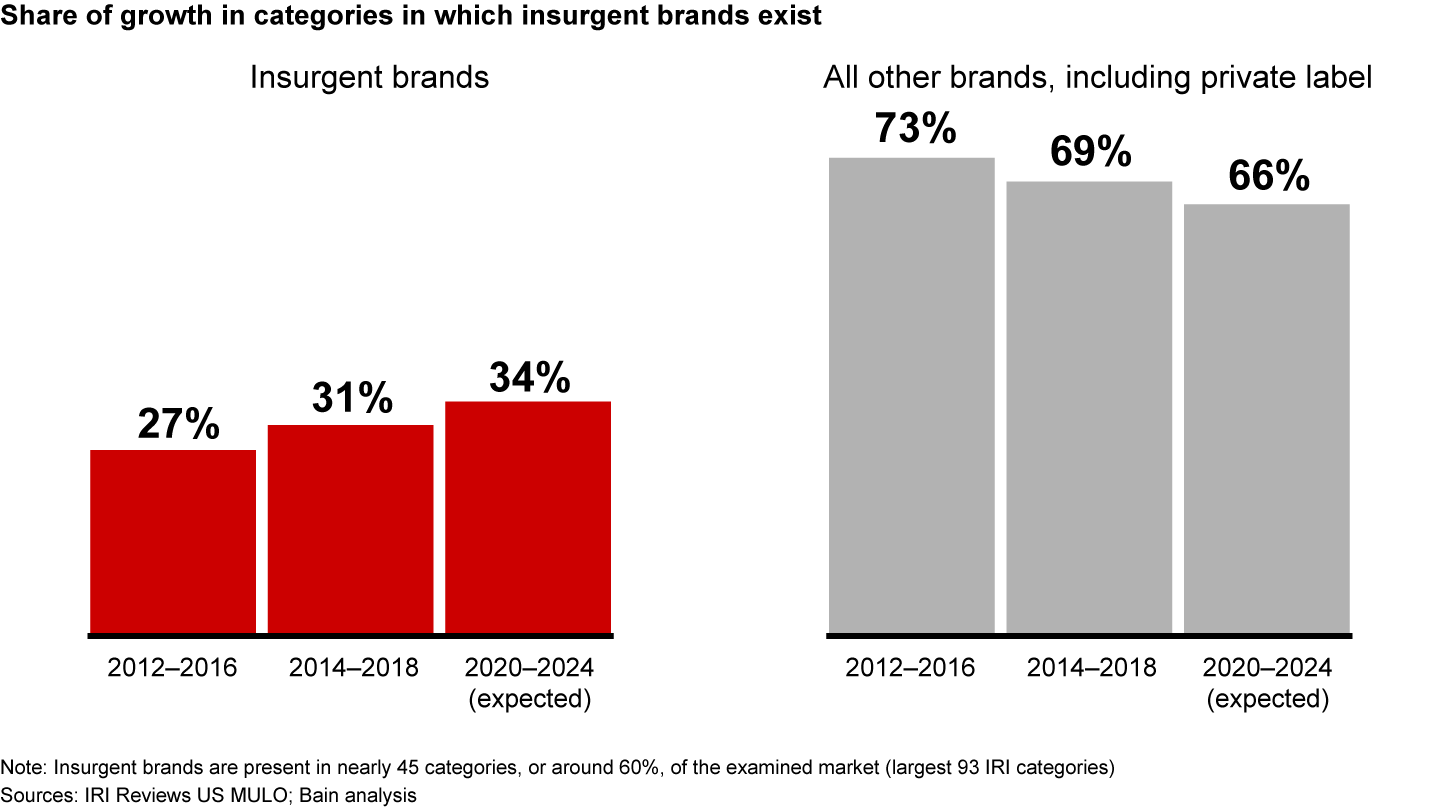
      Insurgent brands continue to capture an outsized share of growth
      Insurgent brands continue to capture an outsized share of growth
      Insurgent brands continue to capture an outsized share of growth

      Our findings offer a double dose of hope for large consumer products companies. It means that industry growth prospects are more promising than many big companies may have believed—when a brand serves its consumers well, they buy. It also means that a blueprint for growth exists as insurgent brands provide continuing lessons to the broader industry in Agile ways of working, asset-light business models and purpose-driven consumer focus. Among billion-dollar consumer goods companies, those that incorporate those lessons will be in a better position to outpace competitors.

      Infographic

      Lessons in Growth from Insurgent Brands

      Large consumer product companies can take valuable insights from fast-growing brands that are shaking up the market.

      What we’ve learned about insurgents

      There’s no question that insurgent brands are here to stay. The barriers to entry and the cost of launching a new brand have never been lower. We found them in roughly half of the 90 categories we analyzed—large and small categories, fragmented and consolidated categories, high-growth and low-growth categories. And they keep coming. New entrants, such as Not Your Mother’s cosmetics and Beyond Meat, are joining their more established counterparts, such as Justin’s and Harry’s, and making gains with natural ingredients, functional benefits and new formats, which reflects high levels of innovation, even in previously disrupted categories. 

      In fact, 41% of the insurgent brands that we identified in 2018 are new to the list. Meanwhile, many brands that were previously on our list but no longer meet the insurgent brands’ growth criteria continue to do well, just at lower levels of relative growth. Sustaining growth at 10 times the category rate is difficult to achieve. Most incumbents would be happy to grow at a fraction of that rate.

      The more we see insurgents gaining ground, the clearer their path to brand growth comes into focus. In some ways, they represent a return to basics for brands—namely, being close to consumers and creating unique offerings that meet consumer needs. At large companies, the combination of scale, cost pressures and bureaucracy have made it difficult to maintain a single-minded focus on the consumer.

      Most rising insurgent brands come with an authentic, passionate and personal story in which the brand addresses a specific unmet consumer need. For Zevia CEO Paddy Spence, it was about eliminating sugar from his diet. For Caulipower founder Gail Becker, it was the lack of gluten-free food options for her children. These compelling value propositions often allow insurgents to price at a premium.

      Insurgent brands achieve early growth primarily through distribution, using effective digital marketing tools to target relevant audiences and maintain strong velocity levels (see Figure 2). Their Agile and asset-light operating model allows them to test and learn as they grow, relying on an ecosystem of partnerships that give them the flexibility to adapt along the way (see the Bain Brief “How Insurgent Brands Are Rewriting the Growth Playbook”). 

      Figure 2
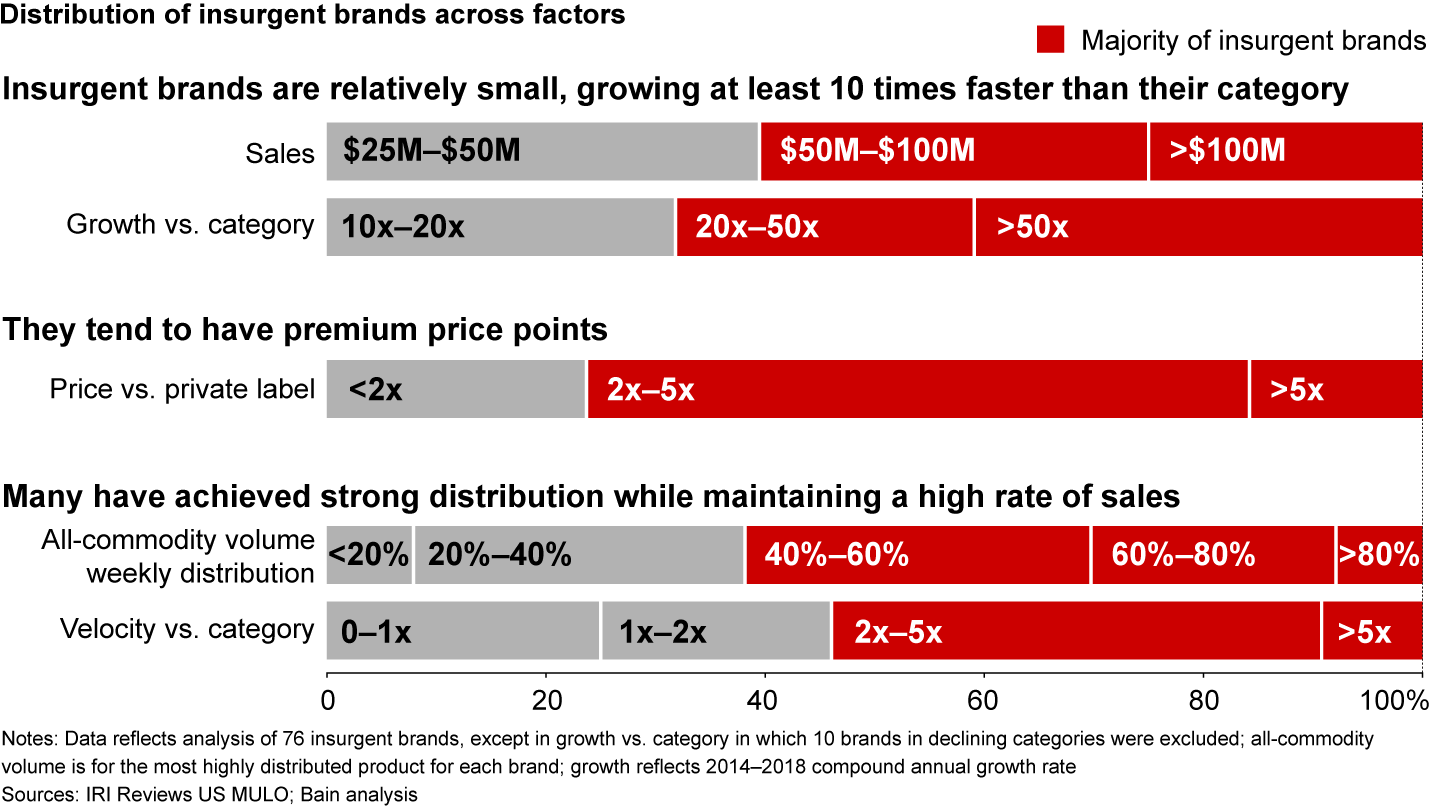
      Insurgent brands are often premium brands with higher velocity levels
      Insurgent brands are often premium brands with higher velocity levels
      Insurgent brands are often premium brands with higher velocity levels

      The best-performing insurgents not only grow distribution but also do so while sustaining velocity via targeted and then scale marketing as they expand their reach. In fact, we found that the brands that were able to maintain their rate of sales while expanding the breadth of their distribution demonstrated the ability to appeal to broader and broader audiences, which enabled them to achieve growth rates four times greater in later years than those brands in which distribution growth outpaced velocity.

      These winning insurgents also concentrate on their most successful products. Insurgents that focus on driving core hero SKUs to full distribution during their expansion phase outperform during the mature phase compared with those that proliferated their SKUs earlier on. BodyArmor reached close to 70% all-commodity volume before introducing new SKUs, and it is now among the companies that defied the odds and continues to meet the high bar that defines insurgents, outpacing growth tenfold or more, even after reaching scale distribution.

      If incumbents have learned anything from insurgents, it is that they cannot continue running their businesses as they have for decades. Yet incumbents cannot simply try to replicate the insurgents’ model for success. Instead, large consumer goods companies need to create a hybrid model that maintains the economics of their existing brands while they develop new approaches that embed insurgent learnings. That will mean focusing on four areas.

      Rediscover the consumer. Among the hallmarks of insurgents is their ability to deliver authentic, purpose-driven brands that serve an unmet consumer need and to maintain a strong and consistent connection with those consumers. Some large consumer goods companies are starting to put the consumer back in the center. Danone’s manifesto to improve people’s health and protect the planet has been adopted by 40 of its brands—brands that are now growing three times faster than the rest of Danone’s portfolio. Unilever is getting closer to its consumers by using artificial intelligence in the 27 data centers it maintains across the globe to synthesize and act on consumer insights from a range of sources, including social listening, customer relationship management and traditional marketing research.

      Rethink brand portfolio strategy. Winning incumbents take a holistic approach to brand portfolio strategy, balancing brands of different sizes in order to meet the future needs of their consumers. For Mondelēz, steady insurgent growth and changing consumer needs has meant managing a more diverse portfolio of products, each with different strategic roles. Global power brands, which comprise 43% of its revenue, help it sustain category leadership, while local jewels, which generate 47% of revenue, are focused on meeting local consumer preferences. Meanwhile, its innovation brands evolve with consumer trends. Brand owners will need to be extremely clear on the different roles each of these brands play, what flexibility they have and what their growth ambitions should be.

      Build repeatable M&A capabilities. Increasingly, large consumer goods companies are turning to M&A to acquire insurgent brands. Acquisitions help incumbents create faster-growing portfolios that leverage scale and breadth of distribution to further grow the insurgent, potentially taking the insurgent brand into other categories or markets. As demonstrated by Bain’s long-term research into M&A performance, the best companies will develop repeatable capabilities for M&A success (see the Bain Brief “New Rules for M&A in Consumer Products”).

      To ensure positive outcomes, acquirers need to be able to articulate why they are the appropriate parent for a particular insurgent brand. What are the incremental and scalable capabilities that can accelerate the target’s growth trajectory? As these acquirers are learning, scope deals, such as those involving the acquisition of insurgent brands, can be hard to get right. Scope deals are more expensive because of higher deal multiples that reflect the superior growth profile of the target assets. They call for new approaches to diligence that rely on more forward-looking assessments of revenue synergies and future value. They also require different approaches to integration to ensure that the acquirer does not crush the acquired asset under its existing weight, suffocating the very culture that led to the acquired brand’s growth.

      Create nimble ways of working. Finally, incumbents need to change their ways of working to be faster and more Agile, they need to accelerate test-and-learn capabilities, and they need to do this across and throughout a billion-dollar corporation. The scope of the challenge is something that cannot be underestimated. Insurgents started small and Agile. But the big task at hand is to take something that is massive, with well-honed structures and processes to manage risk and exert control, and give it a different set of rules—for example, less frequent financial reviews or faster approval processes. Some established companies are successfully embedding Agile in product development and innovation to rapidly test and iterate, as well as leverage partners to improve flexibility and speed. For example, Clorox has used such methods to reduce the time it takes to innovate a new product by 40%.

      New portfolio dynamics require an adaptable operating model. Billion-dollar brands and $25 million brands are different animals; however, both need to have the governance, decision-making processes, organizational structures and incentives that make them nimble.

      Given the low barriers and low cost to build brands and bring products to market, insurgent brands are here to stay. There will continue to be insurgents looking to capture growth by relentlessly upping the game, meeting consumer needs. Incumbents that learn from these insurgents and respond by focusing on these four areas can capture and generate their own growth, creating the consumer products company of the future. The more that incumbents can learn from insurgents, the less they have to fear.

      Brian McRoskey and John Blasberg are Bain & Company partners with the firm’s Consumer Products practice, and they are based in Boston. Charlotte Apps is a Consumer Products practice director based in Toronto. 

      The authors would like to thank Joe Kiernan, Gregorio Colaci and Kevin Sani for their contributions to this work.


      Autoren
      • Headshot of Brian McRoskey
        Brian McRoskey
        Alumni, Boston
      • Headshot of John Blasberg
        John Blasberg
        Partner, Boston
      • Headshot of Charlotte Apps
        Charlotte Apps
        Practice Executive Vice President, Toronto
      Kontaktieren Sie uns
      Verwandte Branchen
      • Consumer-led Brand Growth
      • Konsumgüter
      Insurgent Brands
      Insurgent Brands 2024

      Bain & Company’s eighth annual review recognizes 97 high-growth US consumer products brands, including 48 newcomers to the list.

      Mehr erfahren
      Insurgent Brands
      Insurgent Q&A: Chomps Cofounder Rashid Ali

      “Our retail expansion story isn’t about taking share—it’s about growing the category.”

      Mehr erfahren
      Konsumgüter
      LEAP to Win: A Playbook for Consumer Products Multinational Corporations in India

      Learn how to navigate—and win—in one of the world’s most promising emerging consumer products markets.

      Mehr erfahren
      Insurgent Brands
      Reclaiming Growth in Consumer Products in 2025

      Bain's consumer products experts showcase our 2025 Insurgent Brands list, share Expo West insights, and explore investment opportunities within the sector's evolving landscape.

      Mehr erfahren
      Insurgent Brands
      Insurgent Brands Steal the Spotlight in 2025

      Bain & Company’s ninth annual review recognizes 120 high-growth US consumer products brands that have captured a staggering 39% of growth within their categories, including 43 newcomers to the list.

      Mehr erfahren
      First published in Mai 2019
      Markierungen
      • Consumer-led Brand Growth
      • Insurgent Brands
      • Konsumgüter

      Wie wir unsere Kunden unterstützt haben

      A CPG Player Targets a Promising Adjacent Market for its Legacy Brand

      Kundenbeispiel lesen

      Kundenstrategie und Marketing Designing a Sales Compensation Plan Based on an Unusual Metric

      Kundenbeispiel lesen

      Kundenstrategie und Marketing Food Co. jump-starts growth with return to core brands

      Kundenbeispiel lesen

      Möchten Sie mit uns in Kontakt bleiben?

      Wir unterstützen Führungskräfte weltweit, die kritischen Themen in ihrem Unternehmen zu adressieren. Gemeinsam schaffen wir nachhaltige Veränderungen und Ergebnisse.

      Bain Insights. Unsere Perspektive auf die kritischen Themen, mit denen sich international agierende Unternehmen konfrontiert sehen, finden Sie monatlich in Ihrem Postfach.

      *Ich habe die Datenschutzerklärung gelesen und akzeptiere sie.
      Bitte lesen Sie die Datenschutzerklärung und akzeptieren Sie diese.
      Bain & Company
      Contact us Sustainability Accessibility Rechtliche Hinweise Impressum Datenschutz Cookie-Richtlinie Sitemap Log In

      © 1996-2026 Bain & Company, Inc.

      Kontaktieren Sie Bain

      Wie können wir Ihnen helfen?

      • Business inquiry
      • Career information
      • Press relations
      • Partnership request
      • Speaker request
      Alle weltweiten Büros