

Brief

Auf einen Blick
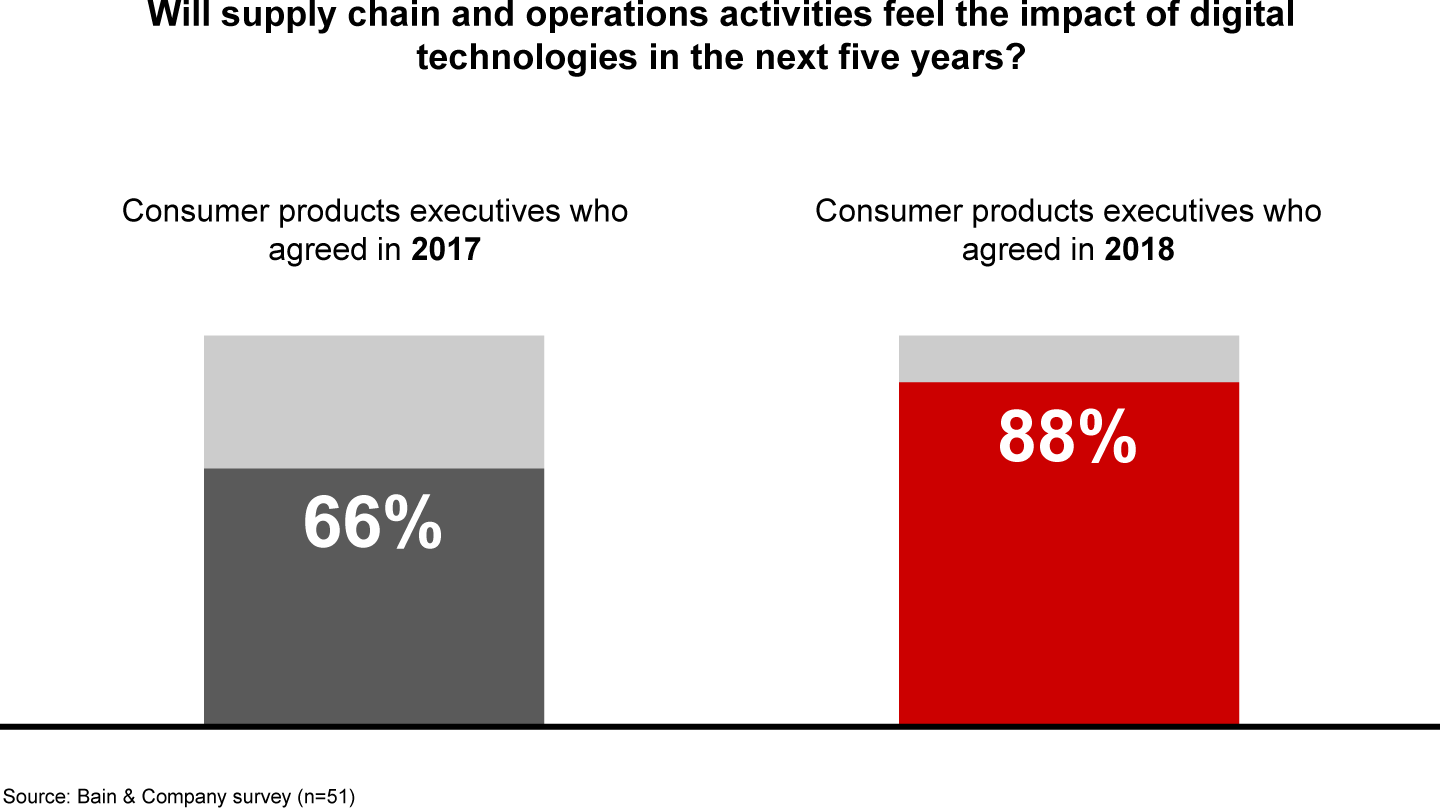
- Consumer products companies are facing massive changes as advanced technologies take root. In a Bain survey, 88% of consumer products executives say their supply chains and operations will feel the impact of those technologies over the next five years.
- Leading companies are reinventing their supply chains to prepare for disruption caused by artificial intelligence and machine learning, voice ordering and autonomous vehicles.
- We encourage executives to follow a today-forward and future-back approach to reinventing their supply chains—that is, determining the steps they can take today to enhance their existing models, assessing likely scenarios that may impact their industries, and determining when and how they can influence or create the future for their companies.
Autonomous trucks already speed down Nevada’s highways, and drones now deliver packages in China’s most remote villages. Once considered the outer reaches of science fiction, these and other futuristic advances are happening faster than most people expected, bringing with them critical decisions for consumer products companies.
Over the past decade, consumer products executives thoughtfully reinvented their supply chains to emphasize long, mass runs in standardized manufacturing facilities, aiming to lower costs and prices. Now, those same business leaders face the challenge of overhauling their supply chains again, this time for a world being transformed by massive technology disruptions, as well as by the rising retailer demands and consumer expectations those technologies have created.
In a recent Bain & Company survey of 51 consumer products executives, we learned that 88% expect their supply chain and operations activities to feel the impact of digital technologies in the next five years, up from 66% just last year (see Figure 1). Unfortunately, relatively few consumer products executives are getting out ahead of the changes they will need to make to their supply chains, in everything from manufacturing to packaging to logistics.
Figure 1

In our perspective, the first step toward reinventing a consumer products supply chain involves taking an unconstrained view of what is possible. We ask executives to take a clean sheet of paper and design a winning supply chain—from scratch. Most traditional supply chain exercises tend to focus on projects, not programs, with today’s capabilities as constraints. The point of our exercise is to consider the integrated whole. Designing to win means painting a scenario in which the company produces its ideal product portfolio with the most collaborative supplier base, employing a perfect labor model and state-of-the-art production equipment, and delivering it via the optimal route to the customer. This process typically sheds new light on how to unlock value, in terms of both supply chain costs and commercial capabilities.
To systematically prepare for the future while also creating it, we encourage consumer products executives to follow a today-forward and future-back approach. Today forward involves determining the steps they can take today to enhance their existing supply chains and address current pain points and opportunities. Future back requires assessing possible scenarios that will have the greatest impact on industry dynamics and then developing plans around that view of the future. The future scenarios need to take into account shifting ecosystems and profit pools, evolving consumer behavior and preferences, disruptive technologies, and new competitors and business models. While the unconstrained view is based on the future-back perspective, it also needs to yield insights from the today-forward view.
With a vision of the future in hand, the best companies make “no-regrets” moves—material steps designed to change their game, such as launching a direct-to-consumer model. At the same time, they pilot new capabilities, such as testing alternative freight-delivery methods. And, they watch for the signposts that should trigger investments in capabilities they might not be able to justify today.
As they face the future, consumer products companies either will disrupt or be disrupted by advances ranging from 3-D printing to robotics. To illustrate the best strategies for supply chain reinvention, we’ll explore how companies can take a today-forward and future-back approach to three of these emerging technologies: artificial intelligence (AI) and machine learning, Alexa and voice ordering, and autonomous vehicles and delivery.
Bain Partner Abhijit Prabhu explains why it is a crucial time for consumer products executives to take a step back and reevaluate their company's supply chain.
Artificial intelligence and machine learning
Today forward. In the first quarter of 2018, nearly 20% of corporate earnings calls included some mention of AI or machine learning. Increasingly, consumer products companies are using these technologies to squeeze inefficiencies out of their supply chains—ensuring that the right inventory is in the right place at the right time, for example, or reducing manufacturing costs with predictive maintenance intelligence. When one company saw how its inaccurate demand forecasts led to excessive returns, it built a machine learning platform that drew on historical order and returns data to continuously improve demand forecasts at the SKU and store levels. The effort reduced returns to the point that the company anticipates an annual payback of hundreds of millions of dollars.
Future back. In the decades ahead, meal consumption will look vastly different, with companies using AI to create highly customized meals that consumers either buy online for delivery or purchase in supermarkets. Some retailers have already made no-regrets moves to bring this future into reality. Walmart recently partnered with Gobble to sell its meal kits online, and Kroger acquired Home Chef earlier this year. Consumer products companies will fight back by using proprietary data to generate AI-driven insights and develop individualized solutions. Nestlé, for example, is seeing rising demand in Japan for its pilot subscription program that allows customers to submit photos of their meals and receive customized nutritional advice. Nestlé Japan CEO Kozo Takaoka hopes the program will grow to $900 million in sales by 2028, possibly through a joint venture or acquisition of a company serving the segment. Meanwhile, companies like wellio are using artificial intelligence to provide customized meal suggestions based on personal health and taste preferences, selected recipes and ingredients consumers have on hand—gathering and interpreting data over time to further understand home chefs’ preferences.
As these shifts play out over the next 10 to 15 years, brands will need to reconfigure legacy supply chains that were built for mass scale, creating new models capable of handling both mass scale and customization. They will leverage predictive analytics to forecast demand by individual consumers. And they will move to much more flexible manufacturing systems, including designing and running smaller manufacturing lines—in some instances, even adopting an extreme asset-light model, outsourcing all manufacturing to nimble third-party manufacturers.
They’ll also postpone customization in the manufacturing process by building smaller facilities closer to consumer demand. We already see companies taking an intermediate step in this direction using advancements like Coca-Cola’s Freestyle soda fountains, found in fast-food restaurants and movie theaters. The machines allow customers to design their own drinks by selecting sizes and custom flavors from a touchscreen.
Alexa and voice ordering
Today forward. As many as 15% of US households own smart speakers, and we expect that figure to grow rapidly. Nearly half of those consumers have made a full end-to-end purchase through their speakers, with even more using them to build their basket before checking out online or through an app. Indeed, most brand executives are aware of the growing role that voice ordering will play in future sales, and they understand the importance of ensuring that their products are recommended by voice algorithms.
While voice ordering is still nascent, savvy brands are preparing their supply chains to meet Amazon’s criteria for becoming Alexa’s recommended brand. They are building more flexibility and responsiveness into their supply chains to guarantee products are on time and in stock, despite volatile and sometimes unpredictable demand. They are also using smaller truckloads and mixed pallets to limit inventory costs in warehouses.
Another big step they are taking: adopting specialized labeling and shipment-friendly packaging to improve operational efficiency and the consumer experience (measured through a combination of user reviews and user returns). Consider how Clorox redesigned its packages for smaller shipments, separating bottle dispensers from the cleaning container to avoid leaks and damage in shipping. Because the products are designed to ship well, they have earned the Amazon’s Choice label. When a consumer asks Alexa for a cleaning product recommendation using a term like “bleach cleaning spray,” a Clorox product is likely to be among the first suggested.
Future back. Voice ordering is the tip of the iceberg; we anticipate a world centered on auto-replenishment. Today, consumers who want to reorder a product without going to a physical store must use a system like Amazon’s Dash Buttons or its Subscribe & Save program. In the future, we expect that a broader ecosystem such as Amazon will know enough about individual consumers to push product replenishments straight to their homes when they need them, either through highly predictive algorithms, sensors or a combination of the two.
To prepare for this future, consumer products companies need to consider several key supply chain implications. The best companies will get ready by aggressively managing their portfolios, rationalizing SKUs that will not win in this new environment. For example, in 2017, natural foods purveyor Hain Celestial streamlined 20% of the SKUs in its US inventory, and Hershey has publicly committed to SKU rationalization. In addition to trimming product lines, companies are designing smart packaging to enable auto-replenishment, using sensors and other technology. They are shifting product packaging from a focus on shelf confrontation to a focus on in-home optimization, using packaging to advertise complementary or new products, for example.
Some are also considering new pathways to shoppers, such as direct-to-consumer businesses, that will help them stay relevant by generating valuable customer data, thus gaining a defensible position against the Amazons of the world. Nestlé’s Nespresso unit helps the company harness consumer data without relying on a third party. Similarly, Unilever’s acquisition of Dollar Shave Club will allow the razor subscription service to expand into other categories, such as shower products and oral care. For its part, Unilever will acquire more consumer data while building up a direct-to-consumer business within its massive traditional consumer products business.
Autonomous vehicles and delivery
Today forward. Grocery delivery continues to face challenges, as labor and transportation costs make the economics unfavorable for many retailers. Today, online purchases, including delivery and “click and collect,” account for only about 3% of US grocery sales. We anticipate online purchases to grow to 10%–25% of the total by 2030. If that occurs, grocers could see their roughly 5% EBIT margins cut nearly in half due to the high costs associated with delivery and click and collect. To help offset some of these costs, retailers are starting to push the burden upstream, demanding lower prices, higher service standards and even drop shipping.
In response, one global brand recently improved both service reliability and its cost position by developing a segmented approach to serve retail customers. The company began providing differentiated levels of service based on the importance of the customer as well as its ability to collaborate for mutual gain. As a result, it expects to deliver best-in-class on-time/in-full delivery to priority customers while reducing inventory by 20% and lowering total network costs by nearly 15%.
Future back. We expect fast delivery (i.e., in under two hours) to become the norm for large portions of the population, particularly in urban and suburban areas. Less costly autonomous vehicles, in combination with robots and drones, could enable the right economics to make pervasive delivery feasible.
The best brands will rethink their end-to-end supply chains even further by designing product packaging that is functional for completely new delivery vehicles—making it lightweight and stackable, for example. They will open micro-facilities near end consumers that can be run with fewer employees and controlled efficiently from a central location. Also, 3-D printing will take off as a manufacturing technology. Already, a Procter & Gamble pilot program uses 3-D printing to create customized Gillette razors, offering consumers a choice of 7 colors and 48 designs. “Earlier this year we introduced a range of new razor products and declared that ‘one size’ does not fit all men when it comes to razors,” said Pankaj Bhalla, P&G’s director for Gillette and Venus North America, in an online statement, adding that the pilot program furthers the company’s commitment to place power in the hands of consumers. In food, meanwhile, Barilla sponsors a pasta-design design competition, seeking innovative shapes for 3-D printing.
Finally, as part of reinventing their supply chains, companies will partner with networks of third-party manufacturers to enable fast delivery. They will also prepare their transport and delivery networks, whether in-house or outsourced, for autonomous vehicles.
Questions to help you get started
Brands cannot do all of this at once, of course. But standing still is not an option. Use the following checklist to assess where your company stands and the actions you need to take.
- What does your end-to-end supply chain need to look like to deliver against your strategy? For example, is your manufacturing and logistics network set up to deliver on evolving customer needs? Using the unconstrained thinking approach, how will emerging technologies impact your category, customers and supply chain?
- Should you launch a direct-to-consumer business—and if so, how will that affect your delivery needs? While companies like Nestlé and Gillette have achieved success with a direct-to-consumer model, most brands still prefer to sell primarily through traditional channels. It’s time to reassess which of your products could lend themselves to direct-to-consumer—that is, where you could differentiate by making such a move—as well as the risks that would create in customer satisfaction and channel conflict.
- Should you remain a manufacturer or instead rely more heavily on third parties? In our experience, most established consumer products companies use third parties for less than 40% of their output, while the winning insurgent brands’ products are frequently 100% co-manufactured. Given the changing landscape, it is important to determine if, based on your core strengths, there’s still an advantage to owning those capabilities or if you would be better served by increasing your partnerships.
- What no-regrets moves should you make today? Too many companies are stuck in analysis paralysis, debating how long it will take the future to arrive. You know the future is going somewhere. It is better to bet on that future now.
- What capabilities should you pilot today before making a large investment? While betting on the future, it’s important to continue taking smaller steps—like retooling a particular product and evaluating the results in six months. You can then decide whether or not to roll out those pilots further.
- Where should you wait while watching for signposts to drive future investment? And what are those signposts? At some point, you will reconfigure your products to be delivered by drones. But how do you know when the time is right? Stay alert to the signposts. For example, if you see Amazon escalating its patent activity around drones or building huge warehouses for them, that’s a sure sign that you should be figuring out how to adapt your packaging.
Abhijit Prabhu and Adam Borchert are partners with Bain & Company in Boston. Both work with the firm’s Consumer Products and Performance Improvement practices.
First published in Dezember 2018