

Brief

Auf einen Blick
- Japanese businesses are buying more companies overseas—and shifting their focus to acquire majority interest in developed-market companies.
- But historically, the success rate for Japan’s outbound deals has been relatively poor, with 25% ending in write-offs, compared with only 5% to 6% of all M&A by US companies.
- To improve the performance of outbound deals, Japanese companies need to clarify their strategic objectives, maintain active and autonomous deal execution, and realize synergies while leveraging the global talent gained through the acquisition. They also need to accumulate—and institutionalize—M&A experience.
Japan is in the midst of a buying spree. The total amount spent by Japanese companies on acquisitions at home or abroad, and by foreign companies buying targets in Japan, reached $205 billion in 2019, a setback from $264 billion in 2018 but still a historically high level. Outbound deals by Japanese companies amounted to more than $77 billion, including a few megadeals, and represented 37% of Asia-Pacific’s total outbound M&A deal value (see Figure 1).
Figure 1
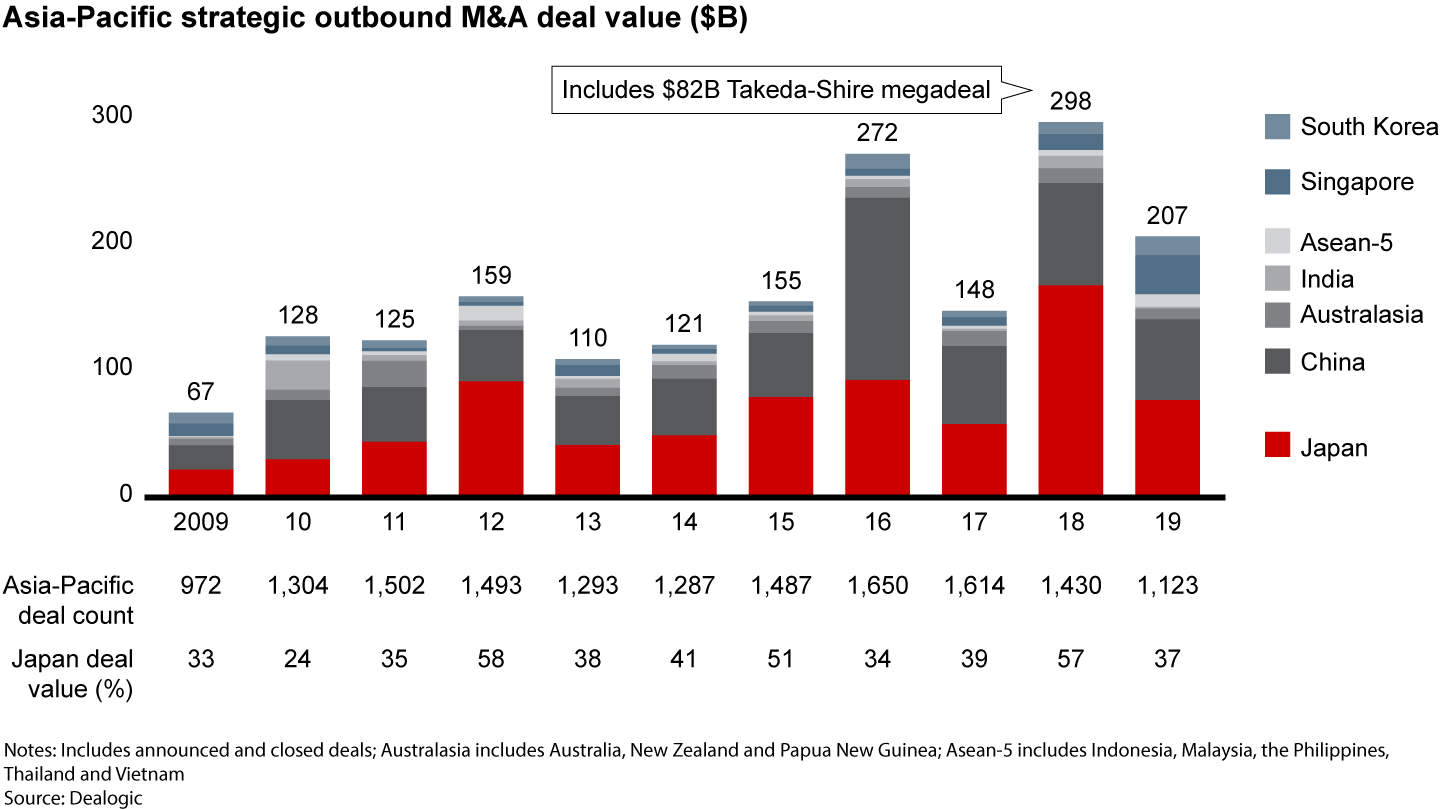

Outbound M&A from Japan has been more popular than domestic deals over the past five years and now accounts for close to 40% of all outbound M&A deal value in Asia, including China and India. There are numerous reasons for this: Japan’s stagnating domestic market, with its relatively low profitability compared with overseas markets; the historically low cost of capital; and mounting shareholder pressure for revenue growth.
As outbound M&A deals continue to be a popular option for Japanese companies, the nature of dealmaking is changing. “Scope” deals to enter a new geography or market, or to gain access to an important capability or technology, now outnumber traditional “scale” deals aimed at generating synergies. Japanese companies are aggressively pursuing more targets in the developed countries of Europe and in the US.
Another big change: More Japanese companies are looking for majority interest. Minority investments now account for less than 10% of all acquisitions. Overall, Japanese companies are less interested in buying small, investing in early-stage businesses or experimenting in emerging countries. Seeking management control in established markets inevitably means going after bigger deals.
But scratch the surface of this M&A boom and you find some lurking challenges. Historically, Japan’s large deals have failed to deliver the expected return, squeezing management and ending in write-offs or even divestment of the acquired business. For example, Japan Post acquired Toll, a major Australian logistics company, for about $5 billion in 2015 but ended with a record deficit in 2017 due to write-offs.
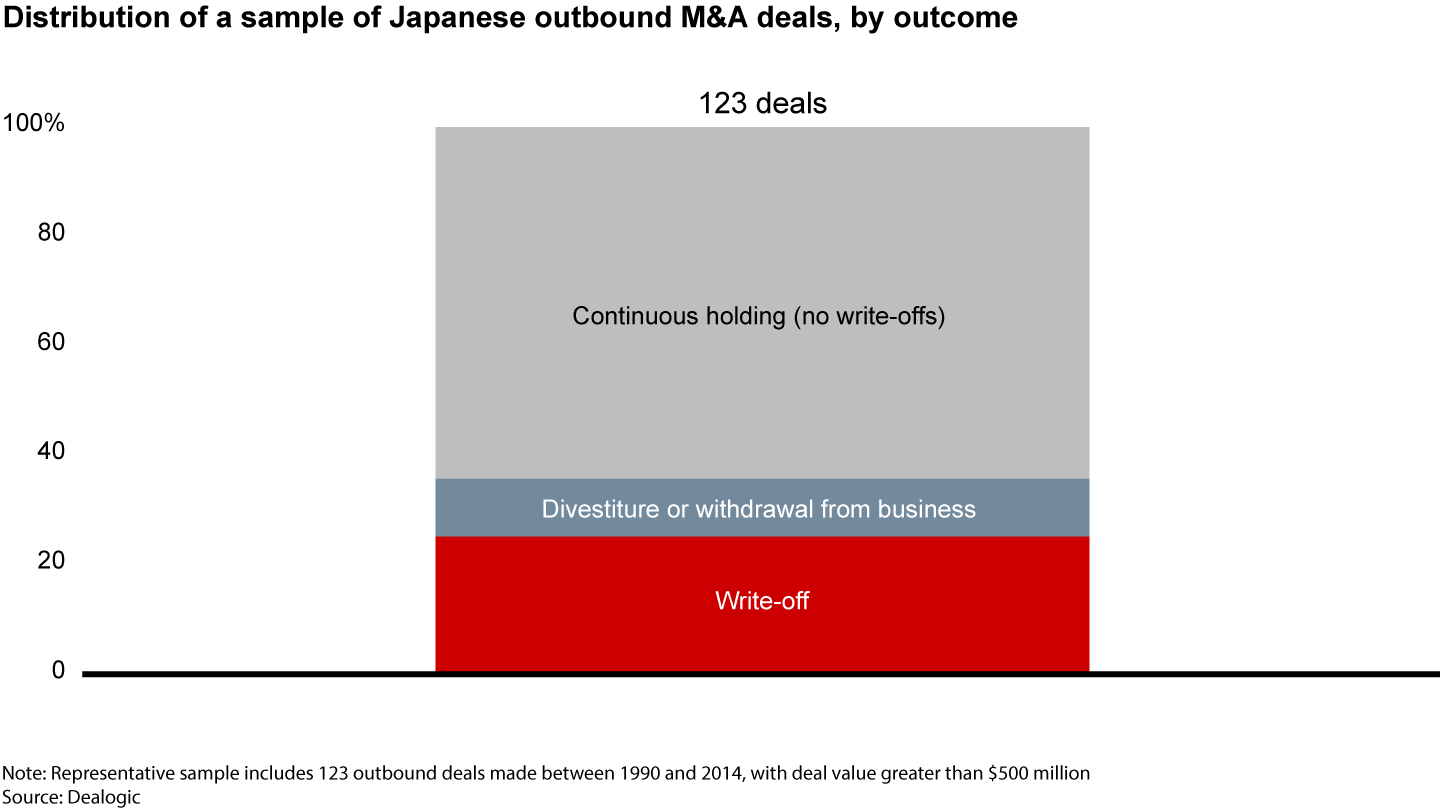
According to Bain’s review of 123 outbound M&A deals made between 1990 and 2014 and worth more than $500 million, around 25% ended up with such write-offs, compared with only 5% to 6% of all M&A by US companies. On top of this, about 10% of Japan’s outbound deals resulted in an ultimate divestment or withdrawal of the acquired company (see Figure 2).
Figure 2

One of the reasons Japanese outbound deals come with a high hurdle for success is that companies typically overpay. Consider that the average premium value of major global acquisitions in the last 10 years was 26%, while that of Japanese outbound M&A during the same period was 34%. Put another way, Japanese companies pay about a 30% higher premium.
In part, the high price stems from the fact that Japanese companies tend to acquire well-established and financially sound foreign businesses, while non-Japanese companies often buy unprofitable foreign businesses in order to increase distribution and sales channels—and come armed with restructuring plans.
Why Japan’s outbound deals fail
To some extent, each failed deal has its own unique story. Sometimes, acquirers don’t adequately determine how they will create value with the deal. In other situations, the acquirer is unable to predict potential issues or is blindsided by shifts in market conditions. That said, we see three overarching reasons why so many of Japan’s outbound deals fall short.
First, there’s the experience factor. Bain’s ongoing research shows that frequent acquirers outperform companies that acquire infrequently. This finding holds up year after year, across industries.
Japanese companies lag their counterparts in other developed nations as frequent acquirers. Our survey of listed developed-market companies with sales of over $500 million determined that Japan had the smallest share of frequent acquirers—17% vs. 43% globally. Japanese companies have limited M&A experience, even at home, where they fully understand the market and culture. That makes the leap to outbound M&A even more challenging. The best acquirers develop experience through small-scale deals, learn from their failures and build their own repeatable M&A model before participating in large-scale deals overseas.
Second, Japanese companies tend to overestimate synergies, without the speed and commitments to deliver them. Scope deals are unlikely to generate synergies because there is little business overlap. In scale deals, the most successful acquirers ensure synergies by streamlining indirect functions. For outbound acquisitions, that may mean reorganizing the acquirer’s headquarters division and relocating overseas, for instance.
Most Japanese companies tend to undervalue these feasible cost synergies. Or they overestimate the risks and difficulty. They may also overestimate revenue synergies from technologies and new product sales. Finally, too many companies make the misstep of developing a synergy plan after the fact, to fit the transaction price.
The third reason that so many Japanese companies fail in outbound deals: Their M&A strategy is not aligned with corporate strategy. Large-scale M&A, especially outbound deals, requires a company to redefine what it is and what it wants to achieve. For example, when a Japanese acquirer pursues a highly successful company in a developed country, it opens itself up to scrutiny. Without a clear and compelling corporate strategy that defines the acquirer as the perfect parent, it will be forced to compete on price.
After all, M&A is just a tool for a broader corporate strategy. Unless the company has defined its desired business model, where and how it plans to win, and how to use M&A to achieve the goal, its acquisitions may result in misalignment, lack of involvement and poor post-acquisition performance.
What it takes to succeed
Despite these common pitfalls, some Japanese companies are setting a standard for success. Based on our surveys, interviews with winning acquirers and work with clients across a range of industries, we have determined how the best Japanese companies outperform in outbound M&A.
Clarify strategic objectives. Like many Japanese consumer products companies, Suntory Beverage & Food and the Asahi Group have strong domestic brands that are less well known globally. Both companies illustrate how a clear vision to acquire winning global brands and overseas sales channels can help a company grow when domestic markets are saturated. For them, growth has meant buying established global brands, with a focus on acquiring management control for the sake of brand control. Further, at both companies, leadership is aligned on the need to acquire the experienced talent behind those global brands.
Unfortunately, too many companies buy targets as a mere stepping-stone in an unclear growth strategy. Or, they make the mistake of buying a company without a solid game plan, for fear they’ll regret it later if they don’t buy now.
Maintain active and autonomous deal execution. The best outbound acquirers reduce the risk of deal failure by following well-defined playbooks for screening, due diligence and negotiations. Among the fundamental questions they address in their playbooks: How much time should we spend on each process? What kind of external experts should we enlist? Which business units should be involved—and how deeply? What areas should be fully reviewed in due diligence? Where should we set the withdrawal line?
Again, a good example is the Asahi Group, which has taken a systematic approach in outbound M&A. Staying close to its core business, it screens for high-quality targets and takes small steps with acquisitions in priority geographies to accumulate capabilities and succeed in large deals. As a result, Asahi has boosted total shareholder return and outperformed its major competitors over the last 10 years.
The best acquirers also maintain a long list of targets and approach candidates proactively, rather than waiting for proposals from investment banks. In scope deals, where synergies cannot be expected, they set prices to achieve attractive ROI as a standalone business.
Meanwhile, some companies say their odds of success increase when they assign a single individual to oversee outbound M&A. That is the case with Recruit Holdings, which has completed more than 20 successful outbound deals. “Overseas M&A planning, negotiations, post-merger integration and business management post-acquisition should be led by the same person,” urges Shogo Ikeuchi, the company’s CHRO, senior managing corporate executive officer and board director. “This enables the company to take a disciplined approach to avoid unreasonable price setting and to reflect the future management perspective at the time of acquisition.”
Realize synergies and leverage talent gained through the acquisition. As challenging as it can be, outbound acquirers need to acknowledge that realizing synergies may require a post-acquisition change in the way they manage. That includes making the most of global talent gained through the acquisition.
Hitachi’s railway business illustrates this point. In 2014, as part of its push for globalization, the company relocated its railroad headquarters to Europe. The move paved the way for its successful acquisition of Italian railway manufacturer AnsaldoBreda a year later. The company sees the relocation and subsequent acquisition as key to Hitachi’s success in global M&A and overseas sales growth.
Indeed, if the strategic objective is to win in the global market, headquarters functions do not need to be located in Japan. Hitachi prepared itself by moving its headquarters and by appointing UK-based executive Alistair Dormer as CEO prior to its Italian acquisition. Even as it improved the acquired business’s technology and operations, it stressed the need to learn from AnsaldoBreda as well. To that end, it put AnsaldoBreda executives on Hitachi Rail’s management team.
Hitachi CFO Mitsuaki Nishiyama now describes the acquisition as the company’s best deal, not only because it significantly boosted sales and margins but also because it delivered a stronger global management team to spur further growth.
Accumulate—and institutionalize—M&A experience. In M&A, nothing trumps cumulative and institutionalized experience. Because overseas scope deals are more challenging than domestic scale deals, the best companies start small with deals at home—or in other countries where they already operate—and learn as they accumulate experience.
As they gain that experience, they share their learnings beyond the short-term project team members to a dedicated business development team, setting the company up for success in more challenging deals. Nidec Corporation, which has made M&A a key part of its growth strategy, systematically learned from its domestic M&A experience, applying those lessons to a succession of global deals. Nidec’s leadership team views this approach as critical to its ongoing M&A success.
The best acquirers identify their bad habits and develop unique M&A playbooks. They create a complete list of their past M&A deals, reviewing what went well throughout the process and what they can learn from each failure. Their playbooks are dynamic, changing as the company gains experience. To institutionalize their learning among midlevel managers, these leading companies include a knowledge-sharing session as part of the training curriculum for new managers. Some companies also strive to improve their divestitures skills before moving into acquisitions, with an eye to better understanding a target’s viewpoint.
Our extensive global research in M&A value creation over the past two decades shows that companies that actively manage their portfolios outperform. They typically are frequent acquirers, and almost 90% of them also divest. These companies generally are the longer-term winners within their industries.
Shintaro Okuno, Shigeki Ichii and Junya Ishikawa are Bain & Company partners based in Tokyo and members of the firm’s Mergers & Acquisitions practice. Philip Leung is a Bain partner based in Shanghai and leads the firm’s Mergers & Acquisitions practice in Asia-Pacific.Takashi Ohara is a principal in Bain’s Tokyo office.
First published in April 2020