
Skip to Content
  • Standorte

    Standorte

    North & Latin America
    • Atlanta
    • Austin
    • Bogota
    • Boston
    • Buenos Aires
    • Chicago
    • Dallas
    • Denver
    • Houston
    • Lisbon
    • Los Angeles
    • Mexico City
    • Minneapolis
    • Monterrey
    • Montreal
    • New York
    • Rio de Janeiro
    • San Francisco
    • Santiago
    • São Paulo
    • Seattle
    • Silicon Valley
    • Toronto
    • Washington, DC
    Europe & Africa
    • Amsterdam
    • Athens
    • Berlin
    • Brussels
    • Copenhagen
    • Düsseldorf
    • Frankfurt
    • Helsinki
    • Istanbul
    • Johannesburg
    • Kyiv
    • Lisbon
    • London
    • Madrid
    • Milan
    • München
    • Oslo
    • Paris
    • Rome
    • Stockholm
    • Warsaw
    • Wien
    • Zürich
    Middle East
    • Doha
    • Dubai
    • Riyadh
    Asia & Australia
    • Bangkok
    • Beijing
    • Bengaluru
    • Brisbane
    • Ho Chi Minh City
    • Hong Kong
    • Jakarta
    • Kuala Lumpur
    • Manila
    • Melbourne
    • Mumbai
    • New Delhi
    • Perth
    • Seoul
    • Shanghai
    • Singapore
    • Sydney
    • Tokyo
    Alle Standorte Anzeigen
  • Alumni
  • Presse
  • Newsletter
  • Kontakt
  • DACH-Region | Deutsch

    Wählen Sie Ihre Region und Sprache

    Global
    • Global (English)
    North & Latin America
    • Brazil (Português)
    • Argentina (Español)
    • Canada (Français)
    • Chile (Español)
    • Colombia (Español)
    Europe, Middle East, & Africa
    • France (Français)
    • DACH-Region (Deutsch)
    • Italy (Italiano)
    • Spain (Español)
    • Greece (Elliniká)
    Asia & Australia
    • China (中文版)
    • Korea (한국어)
    • Japan (日本語)
  • Saved items (0)
    Saved items (0)

    You have no saved items.

    Inhalte, für die Sie sich interessieren, werden hier gespeichert und können später gelesen oder weitergeleitet werden.

    Explore Bain Insights
  • Branchenkompetenzen
    Hauptmenü

    Branchenkompetenzen

    • Luft- und Raumfahrt, Verteidigung
    • Agrarwirtschaft
    • Chemieindustrie
    • Infrastruktur und Bauwirtschaft
    • Konsumgüter
    • Finanzdienstleistungen
    • Gesundheitswesen
    • Maschinen- und Anlagenbau
    • Medienwirtschaft
    • Metallindustrie
    • Bergbau
    • Öl und Gas
    • Papier- und Verpackungsindustrie
    • Private Equity
      Branchenkompetenzen
      Private Equity
      • Due Diligence
      • Exit Planning
      • Firm Strategy & Operations
      • Portfolio Value Creation
    • Öffentlicher Sektor und Sozialwesen
    • Einzelhandel
    • Technologie
    • Telekommunikation
    • Transportwesen
    • Reise- und Freizeitbranche
    • Versorgung und erneuerbare Energien
  • Managementkompetenzen
    Hauptmenü

    Managementkompetenzen

    • Customer Experience
    • ESG
    • Innovation
    • M&A
    • Operations
    • People & Organization
    • Private Equity
    • Sales & Marketing
    • Strategie
    • KI, Einblicke und Lösungen
    • Technologie
    • Transformation
  • Digital
  • Publikationen
    Hauptmenü

    Publikationen

    • Branchenthemen
    • Managementthemen
    • Bain-Bücher
    Alle Publikationen
    Ausgewählte Themen
    • Resilienz in der globalen Krise
    • M&A Report
    • Private Equity Podcast
    • Midyear Private Equity Report
    • Agile
    • Engineering Report
    • Digital Transformation
    • Elements of Value®
    • Firm of the Future
    • Nachhaltigkeitsstudie
    • Macro Trends
    • Future of Consumption
    • Weltwirtschaftsforum (WEF)
  • Über uns
    Hauptmenü

    Über uns

    • Was wir bieten
    • Unser Ansatz
    • Unser Team
    • Game Changer Award
    • Female Allstar Board
    • Messbare Ergebnisse (EN)
    • Auszeichnungen
    • Globale Partnerschaften
    • The Mission
    Further: Our global responsibility
    • Vielfalt & Chancengleichheit
    • Soziale Verantwortung
    • Sustainability
    Erfahren Sie mehr zu "Further"
  • Karriere
    Hauptmenü

    Karriere

    • Dein Einstieg
      Karriere
      Dein Einstieg
      • Find Your Place
      • Unsere Arbeitsbereiche
      • Unsere Teams
      • Angebote für Studierende
      • Praktika & Programme
      • Recruiting-Events
    • Arbeiten bei Bain
      Karriere
      Arbeiten bei Bain
      • Blog: Inside Bain
      • Karriere Stories
      • Unsere Bainies
      • Office-Standorte
      • Weiterentwicklung
      • Affinity Groups
      • Deine Benefits
    • Impact Stories
    • Deine Bewerbung
      Karriere
      Deine Bewerbung
      • Das erwartet dich
      • Der Interviewprozess
    FIND JOBS
  • Standorte
    Hauptmenü

    Standorte

    • North & Latin America
      Standorte
      North & Latin America
      • Atlanta
      • Austin
      • Bogota
      • Boston
      • Buenos Aires
      • Chicago
      • Dallas
      • Denver
      • Houston
      • Lisbon
      • Los Angeles
      • Mexico City
      • Minneapolis
      • Monterrey
      • Montreal
      • New York
      • Rio de Janeiro
      • San Francisco
      • Santiago
      • São Paulo
      • Seattle
      • Silicon Valley
      • Toronto
      • Washington, DC
    • Europe & Africa
      Standorte
      Europe & Africa
      • Amsterdam
      • Athens
      • Berlin
      • Brussels
      • Copenhagen
      • Düsseldorf
      • Frankfurt
      • Helsinki
      • Istanbul
      • Johannesburg
      • Kyiv
      • Lisbon
      • London
      • Madrid
      • Milan
      • München
      • Oslo
      • Paris
      • Rome
      • Stockholm
      • Warsaw
      • Wien
      • Zürich
    • Middle East
      Standorte
      Middle East
      • Doha
      • Dubai
      • Riyadh
    • Asia & Australia
      Standorte
      Asia & Australia
      • Bangkok
      • Beijing
      • Bengaluru
      • Brisbane
      • Ho Chi Minh City
      • Hong Kong
      • Jakarta
      • Kuala Lumpur
      • Manila
      • Melbourne
      • Mumbai
      • New Delhi
      • Perth
      • Seoul
      • Shanghai
      • Singapore
      • Sydney
      • Tokyo
    Alle Standorte Anzeigen
  • Alumni
  • Presse
  • Newsletter
  • Kontakt
  • DACH-Region | Deutsch
    Hauptmenü

    Wählen Sie Ihre Region und Sprache

    • Global
      Wählen Sie Ihre Region und Sprache
      Global
      • Global (English)
    • North & Latin America
      Wählen Sie Ihre Region und Sprache
      North & Latin America
      • Brazil (Português)
      • Argentina (Español)
      • Canada (Français)
      • Chile (Español)
      • Colombia (Español)
    • Europe, Middle East, & Africa
      Wählen Sie Ihre Region und Sprache
      Europe, Middle East, & Africa
      • France (Français)
      • DACH-Region (Deutsch)
      • Italy (Italiano)
      • Spain (Español)
      • Greece (Elliniká)
    • Asia & Australia
      Wählen Sie Ihre Region und Sprache
      Asia & Australia
      • China (中文版)
      • Korea (한국어)
      • Japan (日本語)
  • Saved items  (0)
    Hauptmenü
    Saved items (0)

    You have no saved items.

    Inhalte, für die Sie sich interessieren, werden hier gespeichert und können später gelesen oder weitergeleitet werden.

    Explore Bain Insights
  • Branchenkompetenzen
    • Branchenkompetenzen

      • Luft- und Raumfahrt, Verteidigung
      • Agrarwirtschaft
      • Chemieindustrie
      • Infrastruktur und Bauwirtschaft
      • Konsumgüter
      • Finanzdienstleistungen
      • Gesundheitswesen
      • Maschinen- und Anlagenbau
      • Medienwirtschaft
      • Metallindustrie
      • Bergbau
      • Öl und Gas
      • Papier- und Verpackungsindustrie
      • Private Equity
      • Öffentlicher Sektor und Sozialwesen
      • Einzelhandel
      • Technologie
      • Telekommunikation
      • Transportwesen
      • Reise- und Freizeitbranche
      • Versorgung und erneuerbare Energien
  • Managementkompetenzen
    • Managementkompetenzen

      • Customer Experience
      • ESG
      • Innovation
      • M&A
      • Operations
      • People & Organization
      • Private Equity
      • Sales & Marketing
      • Strategie
      • KI, Einblicke und Lösungen
      • Technologie
      • Transformation
  • Digital
  • Publikationen
    • Publikationen

      • Branchenthemen
      • Managementthemen
      • Bain-Bücher
      Alle Publikationen
      Ausgewählte Themen
      • Resilienz in der globalen Krise
      • M&A Report
      • Private Equity Podcast
      • Midyear Private Equity Report
      • Agile
      • Engineering Report
      • Digital Transformation
      • Elements of Value®
      • Firm of the Future
      • Nachhaltigkeitsstudie
      • Macro Trends
      • Future of Consumption
      • Weltwirtschaftsforum (WEF)
  • Über uns
    • Über uns

      • Was wir bieten
      • Unser Ansatz
      • Unser Team
      • Game Changer Award
      • Female Allstar Board
      • Messbare Ergebnisse (EN)
      • Auszeichnungen
      • Globale Partnerschaften
      • The Mission
      Further: Our global responsibility
      • Vielfalt & Chancengleichheit
      • Soziale Verantwortung
      • Sustainability
      Erfahren Sie mehr zu "Further"
  • Karriere
    Häufige Suchanfragen
    • Agil
    • Digital
    • Strategie
    Vorherige Suchanfragen
      Zuletzt besuchte Seiten

      Content added to saved items

      Saved items (0)

      Removed from saved items

      Saved items (0)

      Brief

      Making biomass part of your energy mix

      Making biomass part of your energy mix

      Biomass offers unique advantages to utilities, but it needs a global supply chain and government subsidies for another decade.

      Von Julian Critchlow and Arnaud Leroi

      • Min. Lesezeit

      Brief

      Making biomass part of your energy mix
      en

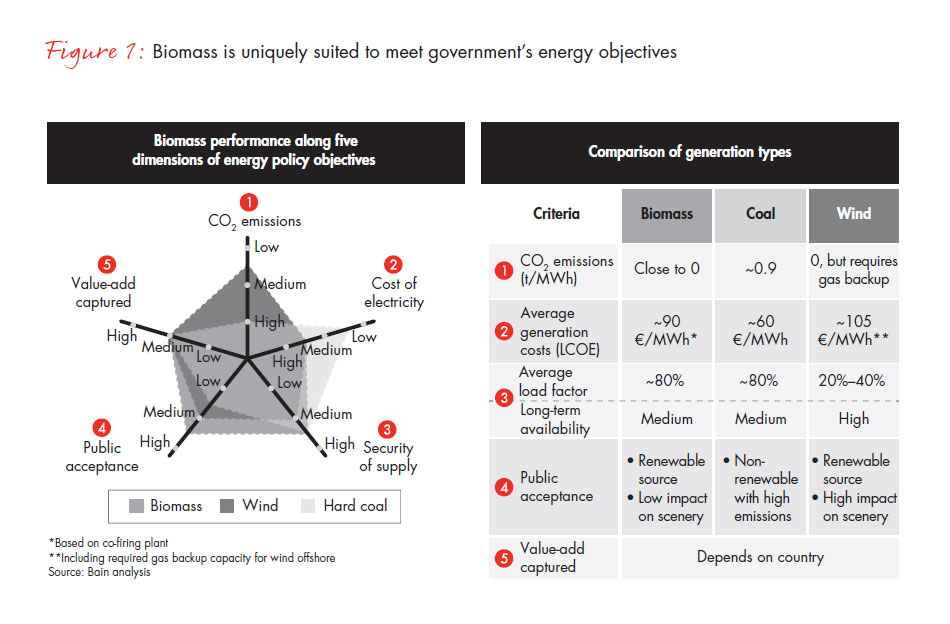
      Biomass as a source for power and heat generation promises to play an important role in the energy mix of the future. Energy derived from biomass—which burns organic material from wood or agricultural residues compressed into pellets—is an attractive, low-carbon option for generating electricity, uniquely qualified to meet governmental energy objectives (see Figure 1). Unlike solar or wind, biomass produces constant power since it doesn’t depend on daylight or the weather. It also offers an opportunity to repurpose existing coal plants that may struggle for profitability in the future as loads decrease and carbon costs soar.

      In spite of this, many utilities still underinvest in the biomass opportunity. A fragmented supply chain and a dependence on subsidies mark it as an underdeveloped industry. However, we expect that by 2020 biomass will be competitive without subsidies, given improved yields of biomass feedstock, learning efficiencies across the industry supply chain and rising carbon and fuel costs for other power sources.

      In the meantime, as the supply chain develops and the industry emerges, utility companies can gain a competitive advantage by positioning themselves to embrace the biomass opportunity. Early movers can shape the supply chain and obtain more favorable agreements from suppliers to secure a reliable feedstock supply. At the same time, they should work with regulators—from the national bodies that determine subsidies to city councils that see the benefit of local jobs—to ensure the development of a profitable industry, which also fulfills governmental energy objectives.

      making-biomass-part-of-your-fig-01_embed

      Biomass is still a subsidy game

      European countries are at risk of not meeting their carbon reduction targets. Conservation and efficiency efforts are failing to meet expectations, and wind and solar sources can meet energy demands only with backup generation from other sources. Biomass offers some unique advantages.

      Power generation from biomass costs about €90 to €100 per megawatt hour—more than the cost of power from cheap fossil fuels with low carbon prices. Subsidies are necessary to make it cost competitive, but only a few countries have put significant biomass subsidies in place. One reason is that most are still focused on supporting wind and solar power. But those renewables need backup generation capacity from coal or gas to power the grid when the wind isn’t blowing or the sun is not shining. Germany, which subsidizes smaller biomass plants but not large-scale generation, added 7.5 gigawatts of new solar photovoltaic generation in 2011, which will require about €20 billion in feed-in-tariff payments, borne by the power consumer.

      Biomass can be a more cost-efficient source of baseload power because it can use existing coal generation infrastructure, with a few adaptations. So the subsidy period is likely to be shorter than for wind and solar. We expect biomass to be cost competitive with coal and gas, which face rising fuel and carbon costs, by 2020 in many countries—a subsidy period of about 10 years.

      Countries subsidize biomass generation in one of two ways:

      • Certificates are based on units of energy produced or purchased, and they can be traded to offset carbon emissions. But when more renewable energy is produced, more certificates are issued, reducing their value.
      • Feed-in tariffs are long-term commitments by governments to purchase energy at a set price, allowing utilities to plan their return on investment. But the system is subject to the winds of political change, and as governments shift their preferences, they can cut tariffs.

      Both carry risks, but we prefer the market-driven approach of certificates because it avoids the starts and stops that cripple young industries like biomass. The UK provides the most comprehensive subsidies today, giving 0.5 renewable obligation certificate1 (ROC) per megawatt hour (MWh) of electricity from co-firing with coal and 1.5 ROCs for dedicated biomass. The Netherlands (which focuses on co-firing) and Italy (focusing on dedicated biomass) provide generous subsidy regimes, too. Utilities in these countries can set the pace of development and secure an early-mover advantage.

      Supply chain is still developing

      The biomass supply chain today is relatively undeveloped, with mostly local and small-scale players. The upstream end—growing feedstock and pelletizing—is particularly fragmented, which necessitates many contracts and complications for utilities. These suppliers vary in professionalism, and some fail to meet contractual agreements.

      This fragmentation means that reliable and affordable supplies and cheap feedstock are hard to secure for biomass generators today. Without subsidies, international sources of biomass continue to go to existing users of fiber, mainly lumber and pulp and paper. However, as utilities convert more large coal plants to biomass, they will need a global supply chain of pelletized feedstock to fuel them.

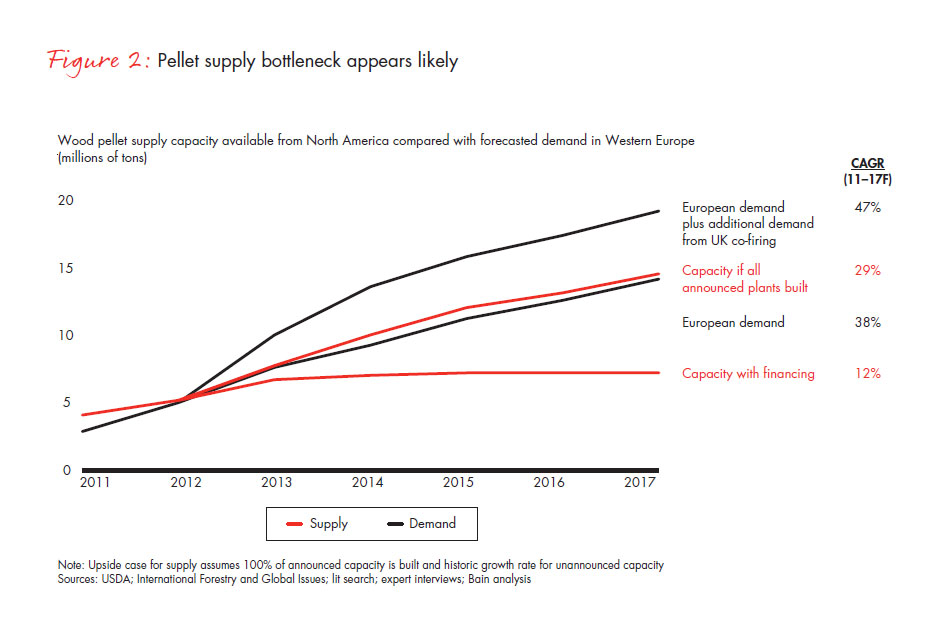
      Once subsidies are in place in more regions, demand could outstrip supply, creating a race for feedstock. If UK co-firing support expands and Germany passes subsidies for large-scale plants, a substantial supply bottleneck is even more probable (see Figure 2). Faced with this risk, utilities should be actively exploring sourcing options.

      making-biomass-part-of-your-fig-02_embed

      Today North America is the only region with a substantial surplus of biomass pellets and a good infrastructure for transportation. Around 10 million metric tons of new capacity was announced in 2010 and 2011, most in the Southeast, where the climate delivers high yields. About half of new capacity still needs financing—an opportunity for utilities to invest to satisfy their increasing demand.

      Russia, with its large forests, offers tremendous potential for feedstock. But its forests lack active management and the country has a poor infrastructure for transportation to its ports and beyond. As a result, Russia currently produces only about 1.5 million metric tons of wood pellets, with another 3 million to 4 million tons expected to come online within two years.

      Latin America is well suited for energy crops like sorghum and switch grass. The land has already been developed for other uses and could be converted to biomass plantations, pelletizing facilities and transportation infrastructure over the next five years.

      Over the longer term, supply may also come from Africa, but it will require significant investments in infrastructure for plantations, processing and transportation. We expect Asia’s supply of feedstock to be consumed entirely by China’s growing energy demand, with no surplus for export.

      Power generators are moving upstream

      The undeveloped nature of growers and pelletizers is leading biomass generators to integrate upstream to avoid potential bottlenecks. Germany’s RWE, which operates biomass plants in the UK and the Netherlands, invested about €120 million in a wood pellet plant in Georgia in the US, to guard against a possible bottleneck in pellets.

      RWE has also invested in several energy crop plantations to secure a long-term supply. In the UK, Drax has built its own straw pellet facility with a 100-kiloton per year capacity near one of its plant sites. Drax has also actively secured long-term contracts with pelletizers in North America and has built dedicated transport, unloading and storage facilities for its pellet supply chain.

      Investments like these signal the start of a truly global biomass supply chain, and they would not have been likely without the safety net of sufficiently high and long-term committed subsidies yielding an appropriate rate of return (an internal rate of return greater than a general hurdle rate of 10%). We don’t expect this vertical integration to last: Within the next five years, we expect the entire biomass industry to mature, resulting in specialization across the supply chain that will push generators back downstream—a trend we have seen in the development of other renewables, including wind and solar photovoltaic.

      Prepare to win in biomass

      To make the most of the biomass opportunity, utilities need a clear strategy and a deep understanding of operations. Based on our work with large and small utilities, biomass generators need to get these four things right.

      Embed biomass strategy into overall strategy. Leading utilities define the role biomass will play in reaching their renewable targets. They calculate how biomass affects their overall abatement cost and carbon emissions footprint. They also evaluate and compare potential investment opportunities, including converting existing plants and finding the best locations for new plants.

      Secure feedstock supply. Securing a reliable and affordable supply of feedstock to keep plants running cost-effectively isn’t easy. But utilities cannot afford to wait for subsidies to stimulate the market; they should start to secure their sources today. Where possible, they should limit involvement and investment by contracting for spare capacity from existing or planned pelletizing plants. When necessary, utilities can invest in new pelletizing plants or even, as a last resort, purchase or build pelletizing plants.

      A balance of local and global suppliers can help utilities ensure a reliable supply. Local suppliers offer several advantages that complement the economic benefits of a large global supply. They can help insulate against global price fluctuations, since local farmers and foresters have fewer options for distribution. Maintaining a local supply also helps with community relations, generating local jobs and business, thus increasing the perception of being socially and locally responsible. Dalkia, the biomass leader in France, set up regional entities for sourcing exclusively with local suppliers and developed several local facilities to transform raw wood residue into wood chips to feed its biomass plants.

      Build up operational capabilities. Utilities will need to supplement their current skills with new capabilities. Pellet storage, for example, represents a significant risk that must be managed carefully. The fire that damaged RWE’s Tilbury Power Station in the UK in February 2012 started in a storage area containing more than 4,000 tons of wood pellets. As utilities ramp up larger plants, storage requirements will grow and so must their capabilities for managing this storage safely. For plant engineering and operations, utilities can employ former coal engineers to run biomass plants, though they will need to be trained in upgrading and maintaining biomass boilers.

      Improve communication with regulators. Two issues tend to dominate communications for utilities working in biomass: subsidies, and local supply and generation. For subsidies, utilities should work with regulators to ensure the right incentive schemes are put in place. They can learn lessons from wind and solar, where lower subsidies would have been more effective. In several countries, such as Germany and Italy, too much support caused bubbles that ultimately damaged long-term development and the public’s perception of those sectors, which undermined governmental energy objectives.

      In supply, strong relationships with local authorities are the key to securing local feedstock supply from forest owners and farmers. Utilities should clearly communicate that biomass creates more local jobs than wind or solar. The sustainability of biomass is also important to emphasize: Responsible feedstock growing poses no competition with food crops or fuel regeneration.

      The unique advantages of biomass to reach governmental energy objectives yield an opportunity for utilities to create value for their shareholders. Securing a reliable and cheap supply of feedstock sufficiently early is the critical requirement for utilities to win.

      Julian Critchlow leads Bain & Company’s Utilities practice in Europe. Arnaud Leroi is a Bain partner in Paris.


      1In summer 2012, one ROC was valued at around £42.


      making-biomass-part-of-your-fig-01_full

      making-biomass-part-of-your-fig-02_full
      Autoren
      • Headshot of Arnaud Leroi
        Arnaud Leroi
        Partner, Paris
      Kontaktieren Sie uns
      Verwandte Branchen
      • Energieversorgung
      • Energiewirtschaft
      Öl und Gas
      How shale tilts the scale

      Big shifts in global gas markets, led by shale development, change the game for exploration and production.

      Mehr erfahren
      Energieversorgung
      Utilities Can Power Growth Through a Better Customer Experience

      Top performers turn everyday interactions into loyalty, lower costs, greater revenue streams, and stronger reputations.

      Mehr erfahren
      Energieversorgung
      Can the US Energy Grid Keep Up with AI Data Centers?

      Our latest forecast projects data centers will consume 9% of US electricity by 2030, straining the grid without new solutions.

      Mehr erfahren
      Energieversorgung
      Sustaining Capital: From Chaos to Discipline

      Fragmented budgets, poor visibility, and missed forecasts are fixable with the right approach.

      Mehr erfahren
      Energieversorgung
      Energy Capital Expenditures: Steady Growth Ahead

      Utilities, oil and gas, and mining will see uneven capex growth through 2027 as companies balance supply security with energy transition goals.

      Mehr erfahren
      First published in Oktober 2012
      Markierungen
      • Energieversorgung
      • Energiewirtschaft

      Wie wir unsere Kunden unterstützt haben

      An Environmental Services Company Captures Massive Savings from a Merger

      Kundenbeispiel lesen

      Performance Improvement Boosting a utility's workforce productivity

      Kundenbeispiel lesen

      Kundenstrategie und Marketing Revitalizing a utility's market position with customer loyalty

      Kundenbeispiel lesen

      Möchten Sie mit uns in Kontakt bleiben?

      Wir unterstützen Führungskräfte weltweit, die kritischen Themen in ihrem Unternehmen zu adressieren. Gemeinsam schaffen wir nachhaltige Veränderungen und Ergebnisse.

      Bain Insights. Unsere Perspektive auf die kritischen Themen, mit denen sich international agierende Unternehmen konfrontiert sehen, finden Sie monatlich in Ihrem Postfach.

      *Ich habe die Datenschutzerklärung gelesen und akzeptiere sie.
      Bitte lesen Sie die Datenschutzerklärung und akzeptieren Sie diese.
      Bain & Company
      Contact us Sustainability Accessibility Rechtliche Hinweise Impressum Datenschutz Cookie-Richtlinie Sitemap Log In

      © 1996-2026 Bain & Company, Inc.

      Kontaktieren Sie Bain

      Wie können wir Ihnen helfen?

      • Business inquiry
      • Career information
      • Press relations
      • Partnership request
      • Speaker request
      Alle weltweiten Büros