
Skip to Content
  • Standorte

    Standorte

    North & Latin America
    • Atlanta
    • Austin
    • Bogota
    • Boston
    • Buenos Aires
    • Chicago
    • Dallas
    • Denver
    • Houston
    • Lisbon
    • Los Angeles
    • Mexico City
    • Minneapolis
    • Monterrey
    • Montreal
    • New York
    • Rio de Janeiro
    • San Francisco
    • Santiago
    • São Paulo
    • Seattle
    • Silicon Valley
    • Toronto
    • Washington, DC
    Europe & Africa
    • Amsterdam
    • Athens
    • Berlin
    • Brussels
    • Copenhagen
    • Düsseldorf
    • Frankfurt
    • Helsinki
    • Istanbul
    • Johannesburg
    • Kyiv
    • Lisbon
    • London
    • Madrid
    • Milan
    • München
    • Oslo
    • Paris
    • Rome
    • Stockholm
    • Warsaw
    • Wien
    • Zürich
    Middle East
    • Doha
    • Dubai
    • Riyadh
    Asia & Australia
    • Bangkok
    • Beijing
    • Bengaluru
    • Brisbane
    • Ho Chi Minh City
    • Hong Kong
    • Jakarta
    • Kuala Lumpur
    • Manila
    • Melbourne
    • Mumbai
    • New Delhi
    • Perth
    • Seoul
    • Shanghai
    • Singapore
    • Sydney
    • Tokyo
    Alle Standorte Anzeigen
  • Alumni
  • Presse
  • Newsletter
  • Kontakt
  • DACH-Region | Deutsch

    Wählen Sie Ihre Region und Sprache

    Global
    • Global (English)
    North & Latin America
    • Brazil (Português)
    • Argentina (Español)
    • Canada (Français)
    • Chile (Español)
    • Colombia (Español)
    Europe, Middle East, & Africa
    • France (Français)
    • DACH-Region (Deutsch)
    • Italy (Italiano)
    • Spain (Español)
    • Greece (Elliniká)
    Asia & Australia
    • China (中文版)
    • Korea (한국어)
    • Japan (日本語)
  • Saved items (0)
    Saved items (0)

    You have no saved items.

    Inhalte, für die Sie sich interessieren, werden hier gespeichert und können später gelesen oder weitergeleitet werden.

    Explore Bain Insights
  • Branchenkompetenzen
    Hauptmenü

    Branchenkompetenzen

    • Luft- und Raumfahrt, Verteidigung
    • Agrarwirtschaft
    • Chemieindustrie
    • Infrastruktur und Bauwirtschaft
    • Konsumgüter
    • Finanzdienstleistungen
    • Gesundheitswesen
    • Maschinen- und Anlagenbau
    • Medienwirtschaft
    • Metallindustrie
    • Bergbau
    • Öl und Gas
    • Papier- und Verpackungsindustrie
    • Private Equity
      Branchenkompetenzen
      Private Equity
      • Due Diligence
      • Exit Planning
      • Firm Strategy & Operations
      • Portfolio Value Creation
    • Öffentlicher Sektor und Sozialwesen
    • Einzelhandel
    • Technologie
    • Telekommunikation
    • Transportwesen
    • Reise- und Freizeitbranche
    • Versorgung und erneuerbare Energien
  • Managementkompetenzen
    Hauptmenü

    Managementkompetenzen

    • Customer Experience
    • ESG
    • Innovation
    • M&A
    • Operations
    • People & Organization
    • Private Equity
    • Sales & Marketing
    • Strategie
    • KI, Einblicke und Lösungen
    • Technologie
    • Transformation
  • Digital
  • Publikationen
    Hauptmenü

    Publikationen

    • Branchenthemen
    • Managementthemen
    • Bain-Bücher
    Alle Publikationen
    Ausgewählte Themen
    • Resilienz in der globalen Krise
    • M&A Report
    • Private Equity Podcast
    • Midyear Private Equity Report
    • Agile
    • Engineering Report
    • Digital Transformation
    • Elements of Value®
    • Firm of the Future
    • Nachhaltigkeitsstudie
    • Macro Trends
    • Future of Consumption
    • Weltwirtschaftsforum (WEF)
  • Über uns
    Hauptmenü

    Über uns

    • Was wir bieten
    • Unser Ansatz
    • Unser Team
    • Game Changer Award
    • Female Allstar Board
    • Messbare Ergebnisse (EN)
    • Auszeichnungen
    • Globale Partnerschaften
    • The Mission
    Further: Our global responsibility
    • Vielfalt & Chancengleichheit
    • Soziale Verantwortung
    • Sustainability
    Erfahren Sie mehr zu "Further"
  • Karriere
    Hauptmenü

    Karriere

    • Dein Einstieg
      Karriere
      Dein Einstieg
      • Find Your Place
      • Unsere Arbeitsbereiche
      • Unsere Teams
      • Angebote für Studierende
      • Praktika & Programme
      • Recruiting-Events
    • Arbeiten bei Bain
      Karriere
      Arbeiten bei Bain
      • Karriere Stories
      • Unsere Bainies
      • Office-Standorte
      • Weiterentwicklung
      • Affinity Groups
      • Deine Benefits
    • Impact Stories
    • Deine Bewerbung
      Karriere
      Deine Bewerbung
      • Das erwartet dich
      • Der Interviewprozess
    FIND JOBS
  • Standorte
    Hauptmenü

    Standorte

    • North & Latin America
      Standorte
      North & Latin America
      • Atlanta
      • Austin
      • Bogota
      • Boston
      • Buenos Aires
      • Chicago
      • Dallas
      • Denver
      • Houston
      • Lisbon
      • Los Angeles
      • Mexico City
      • Minneapolis
      • Monterrey
      • Montreal
      • New York
      • Rio de Janeiro
      • San Francisco
      • Santiago
      • São Paulo
      • Seattle
      • Silicon Valley
      • Toronto
      • Washington, DC
    • Europe & Africa
      Standorte
      Europe & Africa
      • Amsterdam
      • Athens
      • Berlin
      • Brussels
      • Copenhagen
      • Düsseldorf
      • Frankfurt
      • Helsinki
      • Istanbul
      • Johannesburg
      • Kyiv
      • Lisbon
      • London
      • Madrid
      • Milan
      • München
      • Oslo
      • Paris
      • Rome
      • Stockholm
      • Warsaw
      • Wien
      • Zürich
    • Middle East
      Standorte
      Middle East
      • Doha
      • Dubai
      • Riyadh
    • Asia & Australia
      Standorte
      Asia & Australia
      • Bangkok
      • Beijing
      • Bengaluru
      • Brisbane
      • Ho Chi Minh City
      • Hong Kong
      • Jakarta
      • Kuala Lumpur
      • Manila
      • Melbourne
      • Mumbai
      • New Delhi
      • Perth
      • Seoul
      • Shanghai
      • Singapore
      • Sydney
      • Tokyo
    Alle Standorte Anzeigen
  • Alumni
  • Presse
  • Newsletter
  • Kontakt
  • DACH-Region | Deutsch
    Hauptmenü

    Wählen Sie Ihre Region und Sprache

    • Global
      Wählen Sie Ihre Region und Sprache
      Global
      • Global (English)
    • North & Latin America
      Wählen Sie Ihre Region und Sprache
      North & Latin America
      • Brazil (Português)
      • Argentina (Español)
      • Canada (Français)
      • Chile (Español)
      • Colombia (Español)
    • Europe, Middle East, & Africa
      Wählen Sie Ihre Region und Sprache
      Europe, Middle East, & Africa
      • France (Français)
      • DACH-Region (Deutsch)
      • Italy (Italiano)
      • Spain (Español)
      • Greece (Elliniká)
    • Asia & Australia
      Wählen Sie Ihre Region und Sprache
      Asia & Australia
      • China (中文版)
      • Korea (한국어)
      • Japan (日本語)
  • Saved items  (0)
    Hauptmenü
    Saved items (0)

    You have no saved items.

    Inhalte, für die Sie sich interessieren, werden hier gespeichert und können später gelesen oder weitergeleitet werden.

    Explore Bain Insights
  • Branchenkompetenzen
    • Branchenkompetenzen

      • Luft- und Raumfahrt, Verteidigung
      • Agrarwirtschaft
      • Chemieindustrie
      • Infrastruktur und Bauwirtschaft
      • Konsumgüter
      • Finanzdienstleistungen
      • Gesundheitswesen
      • Maschinen- und Anlagenbau
      • Medienwirtschaft
      • Metallindustrie
      • Bergbau
      • Öl und Gas
      • Papier- und Verpackungsindustrie
      • Private Equity
      • Öffentlicher Sektor und Sozialwesen
      • Einzelhandel
      • Technologie
      • Telekommunikation
      • Transportwesen
      • Reise- und Freizeitbranche
      • Versorgung und erneuerbare Energien
  • Managementkompetenzen
    • Managementkompetenzen

      • Customer Experience
      • ESG
      • Innovation
      • M&A
      • Operations
      • People & Organization
      • Private Equity
      • Sales & Marketing
      • Strategie
      • KI, Einblicke und Lösungen
      • Technologie
      • Transformation
  • Digital
  • Publikationen
    • Publikationen

      • Branchenthemen
      • Managementthemen
      • Bain-Bücher
      Alle Publikationen
      Ausgewählte Themen
      • Resilienz in der globalen Krise
      • M&A Report
      • Private Equity Podcast
      • Midyear Private Equity Report
      • Agile
      • Engineering Report
      • Digital Transformation
      • Elements of Value®
      • Firm of the Future
      • Nachhaltigkeitsstudie
      • Macro Trends
      • Future of Consumption
      • Weltwirtschaftsforum (WEF)
  • Über uns
    • Über uns

      • Was wir bieten
      • Unser Ansatz
      • Unser Team
      • Game Changer Award
      • Female Allstar Board
      • Messbare Ergebnisse (EN)
      • Auszeichnungen
      • Globale Partnerschaften
      • The Mission
      Further: Our global responsibility
      • Vielfalt & Chancengleichheit
      • Soziale Verantwortung
      • Sustainability
      Erfahren Sie mehr zu "Further"
  • Karriere
    Häufige Suchanfragen
    • Agil
    • Digital
    • Strategie
    Vorherige Suchanfragen
      Zuletzt besuchte Seiten

      Content added to saved items

      Saved items (0)

      Removed from saved items

      Saved items (0)

      Brief

      Making it personal: Rules for success in product customization

      Making it personal: Rules for success in product customization

      By providing customization, brands raise loyalty at a time when it’s more important than ever.

      Von Elizabeth Spaulding and Christopher Perry

      • Min. Lesezeit

      Brief

      Making it personal: Rules for success in product customization
      en

      Sellers of everything from dress shirts to handbags and even consumer packaged goods are discovering the value of letting customers create their own unique products. Retailers use Big Data to present a personalized set of products to their customers—it’s been a driving force behind Amazon’s success. Now brands are taking personalization a big step forward into mass customization. They are discovering that they can elevate customer loyalty and engagement—and use their customer base as an engine of advocacy to potential buyers.

      Product customization helps brands boost sales on their own websites or gain share on a retailer’s site. For example, Pepperidge Farm customers now design Goldfish crackers, and Jawbone customers configure their own Jambox speakers. Trek enables cyclists to build a bike from the ground up. And Brooks Brothers allows men to create their own suits.

      The opportunity appears to be significant: A Bain survey of more than 1,000 online shoppers found that while less than 10% have tried customization options, 25% to 30% are interested in doing so. While it is hard to gauge the overall potential of customization, if 25% of online sales of footwear were customized, that would equate to a market of $2 billion per year.

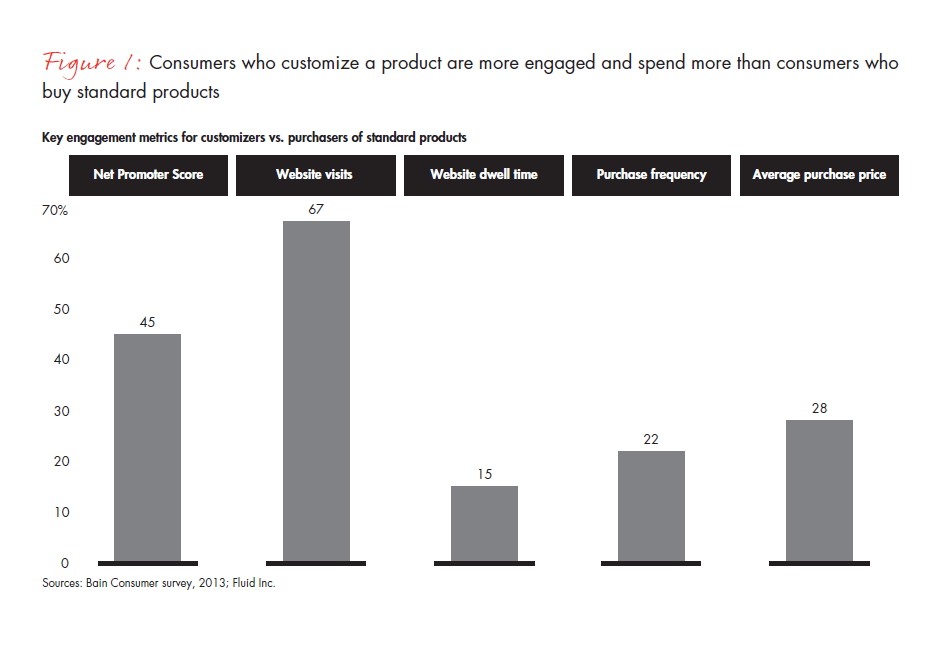
      Beyond the pure size of the opportunity, our survey showed that those customers who had customized a product online engaged more with the company. They visited its website more frequently, stayed on the page longer and were more loyal to the brand (see Figure 1). In footwear, for instance, our research determined that customers who designed their own shoes gave companies a 50% higher Net Promoter ScoreSM (NPS®)—a standard way of measuring customer loyalty—than customers who bought regular products from the same manufacturer. Higher NPS typically translates to higher sales, referrals and lifetime customer value. Ken Seiff, executive vice president of direct and omni-channel marketing at Brooks Brothers, says, “In general, customers who buy customized products are more satisfied and are more valuable. By automating customization using the Web, companies can more easily take a customer segment down to the size of one. In five years this will come to be expected by consumers.”

      making-it-personal-rules-for-success-fig-01_embed

      By providing customization options, brands raise loyalty at a time when it’s more important than ever: In a recent Bain survey of more than 1,200 global executives across a range of industries, 67% believed their customers are becoming less loyal to their brand. Equally, customization helps companies differentiate their products from those of their competitors at a time when the Internet is rapidly creating high price transparency and making it easier for customers to compare products with standard features. According to Google, 49% of mobile phone owners use their device to compare prices, and the number of price comparison apps is increasing. We found that customers are willing to pay 20% more than standard equivalents for customized products—and many companies are successfully charging higher premiums.

      Customization also helps companies reach specific consumers—such as the unpredictable millennial generation shoppers, a group known for their fast- moving preferences. As a growing consumer force, young shoppers demand more individualized products than their older counterparts—they’re not a one-size- fits-all generation. And, due to the proliferation of social media and online publishing, styles and trends change more rapidly than ever before, forcing sellers to keep up with shifting preferences. Companies that offer customization are able to use consumers as merchants—continuously gaining insights from customized designs and finetuning products in a feedback loop that helps companies stay one step ahead of the competition. With each design choice, customers share real-time shopper preferences that go well beyond what they would say in a focus group. For example, what Brooks Brothers learns from its customers in one season is systematically used to help it deliver the next season’s product line.

      “All of this activity points to rapid growth in mass-customization offerings across categories. Early pioneers like Oakley have demonstrated strong consumer demand for customized products, and successfully orchestrated programs are delivering positive ROI and consumer engagement,” according to Kent Deverell, CEO of Fluid, a digital agency and software as a service provider that helps companies launch customization offerings.

      Shoppers are primed for customization just as the capabilities are evolving to serve the market. Technology has advanced to enable flexible, digitally controlled manufacturing processes and to integrate online design capabilities with supply chains. Computing power and bandwidth are now sufficient to accommodate online design without making the experience too cumbersome. Companies like Fluid serve as one-stop shops for e-commerce retailers and brands interested in offering customization to their customers. Ultimately, companies need to develop new muscles, particularly in the materials supply chain, to ensure customization is profitable— but these challenges are increasingly being met.

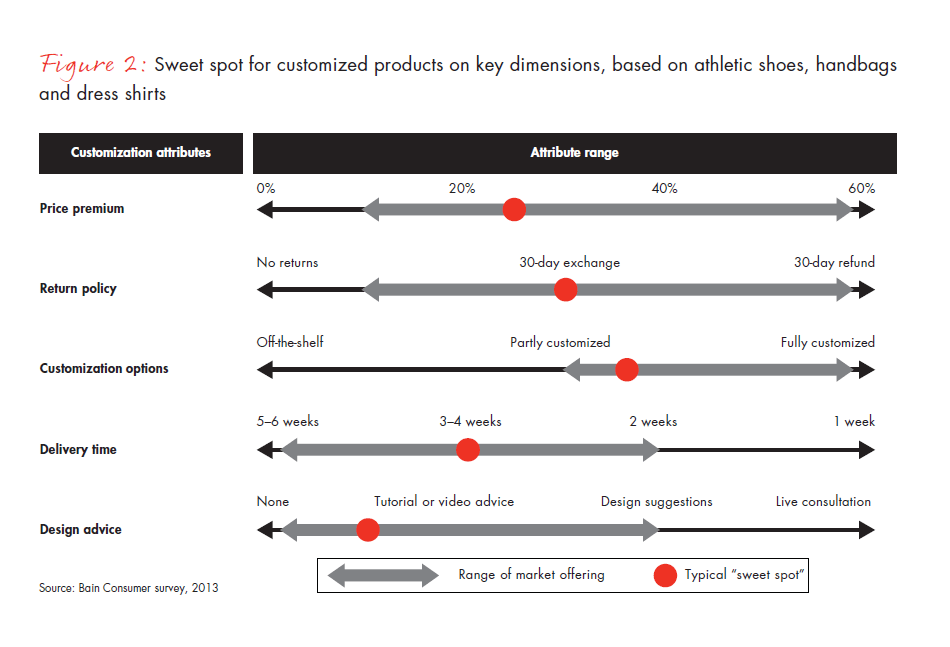
      What companies deliver depends on what their consumers want (see Figure 2). “We originally focused on the fit issues some performance athletes face but found out people aren’t so interested online in fit and sizes,” says Harm Ohlmeyer, chief e-commerce officer at Adidas. “The bigger opportunity was in the design, aesthetic and user-generated content.” Consumer preferences vary from category to category. Bain’s survey found that footwear customers are willing to wait three to four weeks for a product to be delivered, but that interest in customized men’s shirts declined after a two-week wait time. There is one thing that all customers seem to want: the ability to return goods within a reasonable period, typically 30 days. Our survey determined that demand for customization falls off precipitously if consumers think they could be stuck with something they don’t like—even though early adopters of product customization have found that return rates are lower than for standard products.

      making-it-personal-rules-for-success-fig-02_embed

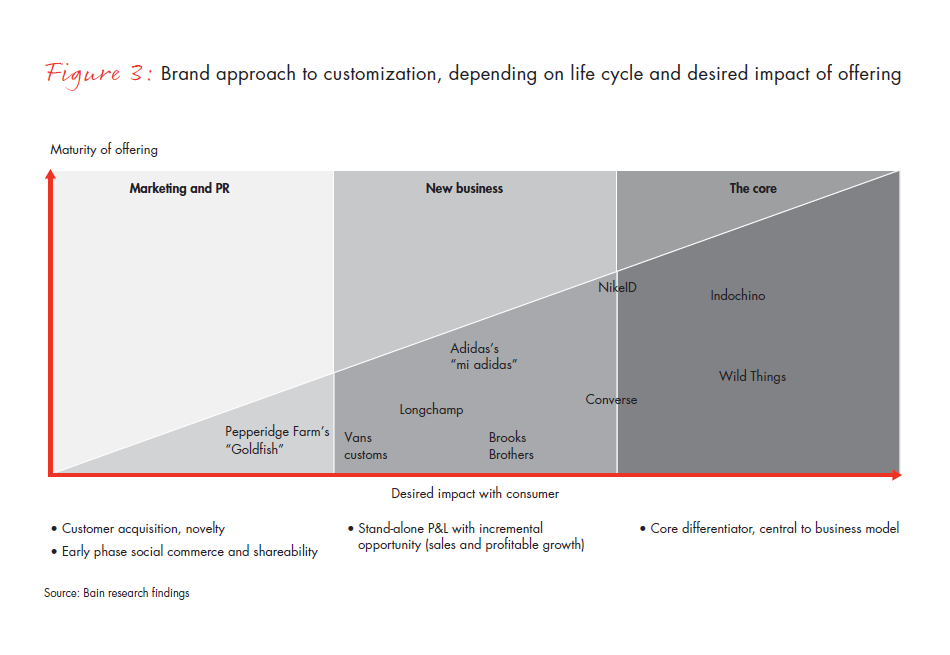
      In addition to tailoring the offering to the customer, success requires stepping back and deciding upfront what a company hopes to get out of entering the customization game. Some companies use it to improve customer acquisition and engagement while others make it a stand-alone business. Knowing the objective helps determine a second major consideration: how much customization to offer (see Figure 3).

      making-it-personal-rules-for-success-fig-03_embed

      All successful companies follow five rules.

      Know what you want. Before testing the waters, companies need to be clear about the strategic value they hope to derive from their customization efforts. When using it primarily to engage with customers and build brand advocacy, the cost is a marketing expense akin to PR, advertising, market research or social media campaigns. Pepperidge Farm’s investment in customizable Goldfish crackers augments its spending on branding, according to digital agency Fluid. Other companies pursue customization of a chosen product line largely for its direct profit potential. That, Fluid claims, is the impetus behind Longchamp’s self-design versions of its iconic Le Pliage tote bag. On the extreme end of the spectrum: building a core business around a customized offering, such as Wild Things has done with its design-your-own Insulight jackets.

      Know how much customization you really need to offer. Some brands allow consumers to design a unique product that will be built to order, with a range of features that can be added. That’s what Indochino does with its custom-designed suits, which are only available online. Other companies succeed by offering minor customization options—adding a monogram to a standard shirt or engraving a name on a briefcase. Some companies only allow customization in fit or design. And others, like Serena & Lily, provide “consumer-choice bundling.” Shoppers at Serena & Lily’s online store design their own bedding combinations. The process may feel personal but it does not involve actual customization: Customers buy existing products that are then collected from a warehouse and shipped to them. For most retailers, it’s the option that makes the most sense—they can sell from a standard product line. Serena & Lily’s average order value is 88% higher for customers who bundle than for customers who buy item by item, according to research by Fluid.

      Make it simple. There’s a risk to customization. Customers need a simple and easy design template as a starting point, as opposed to a blank canvas. If the online design process is too complicated, difficult or unattractive, many potential shoppers will be turned off. They may also reject too many options. That’s why the best companies isolate the number of features that can be tailored. In footwear, that could mean limiting options to the 7 to 10 design choices that are both important to customers and easy to implement.

      Let people share. Companies offering customization options have learned that after consumers invest time in designing their own products, they want to share their creations with friends and relatives. This social aspect helps companies engage with existing customers and, at the same time, draw new customers to their site. Longchamp provides a Facebook application that allows customer-designers to share their handbag creations online. Other companies give customers the ability to create a virtual catalog of all their designs. Companies can make design leaders out of their most creative customers, ranking them based on the number of followers and acknowledging those who are most popular. The North Face has launched a gallery of designs created by customers for its Denali jacket, which serve as inspiration points for others. Jeld-Wen enables real-time, online collaboration for customers to co-create and share customized door designs.

      Enhance the customer experience—and don’t disappoint. Engaging customers through customization raises the stakes. If you’re going to play the game, you need to make the process of designing products enjoyable and the process of returning them seamless.

      As more retailers and brands give their customers the design-it-yourself option, they should see a boost in profitable revenues, stay connected to their best customers and lower costs. Winners will be those that know their objectives, understand how much customization they really need, keep things simple and create a repeatable model for delighting customers again and again.

      Elizabeth Spaulding and Christopher Perry are Bain & Company partners based in San Francisco and members of the firm’s Global Retail practice. 

      Net Promoter® and NPS® are registered trademarks of Bain & Company, Inc., Fred Reichheld and Satmetrix Systems, Inc. 

      Net Promoter SystemSM and Net Promoter ScoreSM are trademarks of Bain & Company, Inc., Fred Reichheld and Satmetrix Systems, Inc.


      making-it-personal-rules-for-success-fig-01_full

      making-it-personal-rules-for-success-fig-02_full

      making-it-personal-rules-for-success-fig-03_full
      Autoren
      • Elizabeth Spaulding
        Former Partner, San Francisco
      • Headshot of Christopher Perry
        Christopher Perry
        Partner, San Francisco
      Kontaktieren Sie uns
      Verwandte Branchen
      • Einzelhandel
      Ähnliche Beratungsangebote
      • Kundenstrategie und Marketing
      The future of shopping

      Successful companies will engage customers through "omnichannel" retailing: a mashup of digital and physical experiences.

      Mehr erfahren
      Kundenstrategie und Marketing
      The Infrastructure Behind a Net Promoter System®

      A good Net Promoter System delivers a ton of useful information about your customers’ experience—but only if you have the operational infrastructure to support it.

      Mehr erfahren
      Accelerated Performance Transformation
      Firing Up the Customer Experience Factory

      How to create experiences that are simple, digital and tuned to what customers value.

      Mehr erfahren
      Einzelhandel
      Agentic AI Commerce Hinges on Consumer Trust

      Security, privacy, and institutional trust are the battlegrounds for AI-led payments.

      Mehr erfahren
      Einzelhandel
      The 2026 Retail Executive Agenda

      Here are letters to the C-suite to help strengthen strategy, catalyze collaboration, and expand value creation in the AI age.

      Mehr erfahren
      First published in September 2013
      Markierungen
      • Einzelhandel
      • Kundenstrategie und Marketing

      Wie wir unsere Kunden unterstützt haben

      Kundenstrategie und Marketing Inspiring retail employees to think and act like owners

      Kundenbeispiel lesen

      Performance Improvement Retailer's performance improvement boosts shareholder value

      Kundenbeispiel lesen

      Digitalisierung Omnichannel strategy boosts fashion company

      Kundenbeispiel lesen

      Möchten Sie mit uns in Kontakt bleiben?

      Wir unterstützen Führungskräfte weltweit, die kritischen Themen in ihrem Unternehmen zu adressieren. Gemeinsam schaffen wir nachhaltige Veränderungen und Ergebnisse.

      Bain Insights. Unsere Perspektive auf die kritischen Themen, mit denen sich international agierende Unternehmen konfrontiert sehen, finden Sie monatlich in Ihrem Postfach.

      *Ich habe die Datenschutzerklärung gelesen und akzeptiere sie.
      Bitte lesen Sie die Datenschutzerklärung und akzeptieren Sie diese.
      Bain & Company
      Contact us Sustainability Accessibility Rechtliche Hinweise Impressum Datenschutz Cookie-Richtlinie Sitemap Log In

      © 1996-2026 Bain & Company, Inc.

      Kontaktieren Sie Bain

      Wie können wir Ihnen helfen?

      • Business inquiry
      • Career information
      • Press relations
      • Partnership request
      • Speaker request
      Alle weltweiten Büros