
Skip to Content
  • Standorte

    Standorte

    North & Latin America
    • Atlanta
    • Austin
    • Bogota
    • Boston
    • Buenos Aires
    • Chicago
    • Dallas
    • Denver
    • Houston
    • Lisbon
    • Los Angeles
    • Mexico City
    • Minneapolis
    • Monterrey
    • Montreal
    • New York
    • Rio de Janeiro
    • San Francisco
    • Santiago
    • São Paulo
    • Seattle
    • Silicon Valley
    • Toronto
    • Washington, DC
    Europe & Africa
    • Amsterdam
    • Athens
    • Berlin
    • Brussels
    • Copenhagen
    • Düsseldorf
    • Frankfurt
    • Helsinki
    • Istanbul
    • Johannesburg
    • Kyiv
    • Lisbon
    • London
    • Madrid
    • Milan
    • München
    • Oslo
    • Paris
    • Rome
    • Stockholm
    • Warsaw
    • Wien
    • Zürich
    Middle East
    • Doha
    • Dubai
    • Riyadh
    Asia & Australia
    • Bangkok
    • Beijing
    • Bengaluru
    • Brisbane
    • Ho Chi Minh City
    • Hong Kong
    • Jakarta
    • Kuala Lumpur
    • Manila
    • Melbourne
    • Mumbai
    • New Delhi
    • Perth
    • Seoul
    • Shanghai
    • Singapore
    • Sydney
    • Tokyo
    Alle Standorte Anzeigen
  • Alumni
  • Presse
  • Newsletter
  • Kontakt
  • DACH-Region | Deutsch

    Wählen Sie Ihre Region und Sprache

    Global
    • Global (English)
    North & Latin America
    • Brazil (Português)
    • Argentina (Español)
    • Canada (Français)
    • Chile (Español)
    • Colombia (Español)
    Europe, Middle East, & Africa
    • France (Français)
    • DACH-Region (Deutsch)
    • Italy (Italiano)
    • Spain (Español)
    • Greece (Elliniká)
    Asia & Australia
    • China (中文版)
    • Korea (한국어)
    • Japan (日本語)
  • Saved items (0)
    Saved items (0)

    You have no saved items.

    Inhalte, für die Sie sich interessieren, werden hier gespeichert und können später gelesen oder weitergeleitet werden.

    Explore Bain Insights
  • Branchenkompetenzen
    Hauptmenü

    Branchenkompetenzen

    • Luft- und Raumfahrt, Verteidigung
    • Agrarwirtschaft
    • Chemieindustrie
    • Infrastruktur und Bauwirtschaft
    • Konsumgüter
    • Finanzdienstleistungen
    • Gesundheitswesen
    • Maschinen- und Anlagenbau
    • Medienwirtschaft
    • Metallindustrie
    • Bergbau
    • Öl und Gas
    • Papier- und Verpackungsindustrie
    • Private Equity
      Branchenkompetenzen
      Private Equity
      • Due Diligence
      • Exit Planning
      • Firm Strategy & Operations
      • Portfolio Value Creation
    • Öffentlicher Sektor und Sozialwesen
    • Einzelhandel
    • Technologie
    • Telekommunikation
    • Transportwesen
    • Reise- und Freizeitbranche
    • Versorgung und erneuerbare Energien
  • Managementkompetenzen
    Hauptmenü

    Managementkompetenzen

    • Customer Experience
    • ESG
    • Innovation
    • M&A
    • Operations
    • People & Organization
    • Private Equity
    • Sales & Marketing
    • Strategie
    • KI, Einblicke und Lösungen
    • Technologie
    • Transformation
  • Digital
  • Publikationen
    Hauptmenü

    Publikationen

    • Branchenthemen
    • Managementthemen
    • Bain-Bücher
    Alle Publikationen
    Ausgewählte Themen
    • Resilienz in der globalen Krise
    • M&A Report
    • Private Equity Podcast
    • Midyear Private Equity Report
    • Agile
    • Engineering Report
    • Digital Transformation
    • Elements of Value®
    • Firm of the Future
    • Nachhaltigkeitsstudie
    • Macro Trends
    • Future of Consumption
    • Weltwirtschaftsforum (WEF)
  • Über uns
    Hauptmenü

    Über uns

    • Was wir bieten
    • Unser Ansatz
    • Unser Team
    • Game Changer Award
    • Female Allstar Board
    • Messbare Ergebnisse (EN)
    • Auszeichnungen
    • Globale Partnerschaften
    • The Mission
    Further: Our global responsibility
    • Vielfalt & Chancengleichheit
    • Soziale Verantwortung
    • Sustainability
    Erfahren Sie mehr zu "Further"
  • Karriere
    Hauptmenü

    Karriere

    • Dein Einstieg
      Karriere
      Dein Einstieg
      • Find Your Place
      • Unsere Arbeitsbereiche
      • Unsere Teams
      • Angebote für Studierende
      • Praktika & Programme
      • Recruiting-Events
    • Arbeiten bei Bain
      Karriere
      Arbeiten bei Bain
      • Blog: Inside Bain
      • Karriere Stories
      • Unsere Bainies
      • Office-Standorte
      • Weiterentwicklung
      • Affinity Groups
      • Deine Benefits
    • Impact Stories
    • Deine Bewerbung
      Karriere
      Deine Bewerbung
      • Das erwartet dich
      • Der Interviewprozess
    FIND JOBS
  • Standorte
    Hauptmenü

    Standorte

    • North & Latin America
      Standorte
      North & Latin America
      • Atlanta
      • Austin
      • Bogota
      • Boston
      • Buenos Aires
      • Chicago
      • Dallas
      • Denver
      • Houston
      • Lisbon
      • Los Angeles
      • Mexico City
      • Minneapolis
      • Monterrey
      • Montreal
      • New York
      • Rio de Janeiro
      • San Francisco
      • Santiago
      • São Paulo
      • Seattle
      • Silicon Valley
      • Toronto
      • Washington, DC
    • Europe & Africa
      Standorte
      Europe & Africa
      • Amsterdam
      • Athens
      • Berlin
      • Brussels
      • Copenhagen
      • Düsseldorf
      • Frankfurt
      • Helsinki
      • Istanbul
      • Johannesburg
      • Kyiv
      • Lisbon
      • London
      • Madrid
      • Milan
      • München
      • Oslo
      • Paris
      • Rome
      • Stockholm
      • Warsaw
      • Wien
      • Zürich
    • Middle East
      Standorte
      Middle East
      • Doha
      • Dubai
      • Riyadh
    • Asia & Australia
      Standorte
      Asia & Australia
      • Bangkok
      • Beijing
      • Bengaluru
      • Brisbane
      • Ho Chi Minh City
      • Hong Kong
      • Jakarta
      • Kuala Lumpur
      • Manila
      • Melbourne
      • Mumbai
      • New Delhi
      • Perth
      • Seoul
      • Shanghai
      • Singapore
      • Sydney
      • Tokyo
    Alle Standorte Anzeigen
  • Alumni
  • Presse
  • Newsletter
  • Kontakt
  • DACH-Region | Deutsch
    Hauptmenü

    Wählen Sie Ihre Region und Sprache

    • Global
      Wählen Sie Ihre Region und Sprache
      Global
      • Global (English)
    • North & Latin America
      Wählen Sie Ihre Region und Sprache
      North & Latin America
      • Brazil (Português)
      • Argentina (Español)
      • Canada (Français)
      • Chile (Español)
      • Colombia (Español)
    • Europe, Middle East, & Africa
      Wählen Sie Ihre Region und Sprache
      Europe, Middle East, & Africa
      • France (Français)
      • DACH-Region (Deutsch)
      • Italy (Italiano)
      • Spain (Español)
      • Greece (Elliniká)
    • Asia & Australia
      Wählen Sie Ihre Region und Sprache
      Asia & Australia
      • China (中文版)
      • Korea (한국어)
      • Japan (日本語)
  • Saved items  (0)
    Hauptmenü
    Saved items (0)

    You have no saved items.

    Inhalte, für die Sie sich interessieren, werden hier gespeichert und können später gelesen oder weitergeleitet werden.

    Explore Bain Insights
  • Branchenkompetenzen
    • Branchenkompetenzen

      • Luft- und Raumfahrt, Verteidigung
      • Agrarwirtschaft
      • Chemieindustrie
      • Infrastruktur und Bauwirtschaft
      • Konsumgüter
      • Finanzdienstleistungen
      • Gesundheitswesen
      • Maschinen- und Anlagenbau
      • Medienwirtschaft
      • Metallindustrie
      • Bergbau
      • Öl und Gas
      • Papier- und Verpackungsindustrie
      • Private Equity
      • Öffentlicher Sektor und Sozialwesen
      • Einzelhandel
      • Technologie
      • Telekommunikation
      • Transportwesen
      • Reise- und Freizeitbranche
      • Versorgung und erneuerbare Energien
  • Managementkompetenzen
    • Managementkompetenzen

      • Customer Experience
      • ESG
      • Innovation
      • M&A
      • Operations
      • People & Organization
      • Private Equity
      • Sales & Marketing
      • Strategie
      • KI, Einblicke und Lösungen
      • Technologie
      • Transformation
  • Digital
  • Publikationen
    • Publikationen

      • Branchenthemen
      • Managementthemen
      • Bain-Bücher
      Alle Publikationen
      Ausgewählte Themen
      • Resilienz in der globalen Krise
      • M&A Report
      • Private Equity Podcast
      • Midyear Private Equity Report
      • Agile
      • Engineering Report
      • Digital Transformation
      • Elements of Value®
      • Firm of the Future
      • Nachhaltigkeitsstudie
      • Macro Trends
      • Future of Consumption
      • Weltwirtschaftsforum (WEF)
  • Über uns
    • Über uns

      • Was wir bieten
      • Unser Ansatz
      • Unser Team
      • Game Changer Award
      • Female Allstar Board
      • Messbare Ergebnisse (EN)
      • Auszeichnungen
      • Globale Partnerschaften
      • The Mission
      Further: Our global responsibility
      • Vielfalt & Chancengleichheit
      • Soziale Verantwortung
      • Sustainability
      Erfahren Sie mehr zu "Further"
  • Karriere
    Häufige Suchanfragen
    • Agil
    • Digital
    • Strategie
    Vorherige Suchanfragen
      Zuletzt besuchte Seiten

      Content added to saved items

      Saved items (0)

      Removed from saved items

      Saved items (0)

      Brief

      Simplify to Grow in Telecommunications

      Simplify to Grow in Telecommunications

      Here's how leading telcos are reducing complexity to improve customer experience and prepare their organizations for future growth.

      Von Mark Bower, Frédéric Debruyne and Jeff Melton

      • Min. Lesezeit

      Brief

      Simplify to Grow in Telecommunications
      en

      Many telecommunications companies have grown exceedingly complex over the years and now find themselves in a dangerous spot: struggling to remain agile while more nimble competitors aggressively court their customers. The dynamism of the sector actually contributes to complexity, as companies frequently launch new products and services, each of which must be integrated with existing products and maintained on the back end with billing and network systems.

      This complexity manifests itself along several dimensions, including product lines, technology and organization. And it comes at a time when telcos cannot afford to alienate customers with a confusing array of product offers, long wait times or inaccurate bills.

      Yet that’s exactly what appears to be happening. Our conversations with telco customers indicate they suffer through a long list of pain points: long waits in retail stores, unclear bills, unresponsive customer service and offers that are difficult to understand. While complexity has built up in the products and services telcos offer, their customers look for simplicity—for example, in a consistent user experience across mobile, online and retail platforms. They want to sign on the same way in each platform, and they want a bill that’s easy to read and shows clearly what they’re paying for.

      Customer dissatisfaction is only one way that complexity hurts companies. Here are others:

      • Call-center teams experience frustration as they try to help frustrated customers navigate a complex array of products, features and billing issues.
      • Sales teams may have difficulty prioritizing the highest-value customers and the products on which to focus their efforts; they also may have difficulty managing the vast array of legacy offers and the customers subscribed to them.
      • Technology teams that keep billing and operating systems working must run at full tilt to manage the overly complex array of offers the company has rolled out over time, with little forethought given to long-term maintenance or reconciliation.
      simplify-to-grow-in-telecommunications-fig-01_embed

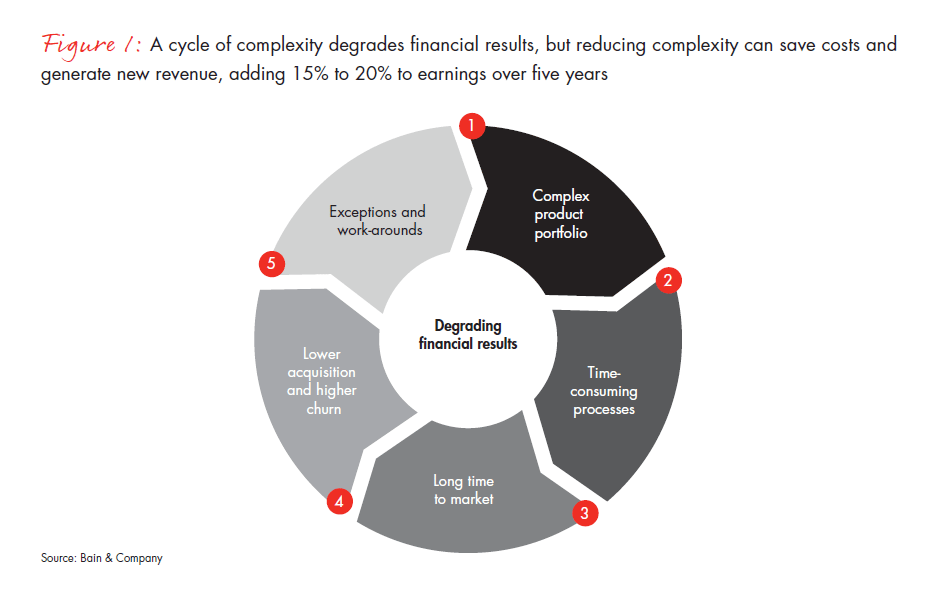
      Taken together, complexity creates a cycle that degrades financial results (see Figure 1). Simplification—while a tremendous challenge to implement—will surely come as a relief to everyone on the front line and beyond who feels the pain of complexity.

      Reasons to change

      Several industry trends are converging to force telcos to simplify or be left behind. Competitors are becoming more agile and releasing new products and services faster than before. More companies are moving into this space by offering online services that replicate phone service, and they are beginning to bundle these successfully with media content.

      Telcos have many reasons to simplify: to improve customer service, to become more agile and thus reduce time to market, and to reduce costs by removing inefficiency.

      Of course, change of this scope is not easy or quick: Transformations can take three to five years, and companies undertaking them need to be prepared for short-term revenue hits as they shed less profitable lines and migrate customers to new ones. As they make these changes, they also need to guard against simply shifting complexity from one part of the organization to another, rather than eliminating it altogether.

      But the payoff can be significant, with earnings rising as much as 20% over five years. Simplifying the portfolio reduces operational costs in call centers (fewer calls, more of them right the first time), in sales channels (faster transactions, more through digital channels), and in network and IT operations. Revenue also grows due to faster times to market, a more effective salesforce, and higher loyalty and lower churn among customers.

      Simplify along five dimensions

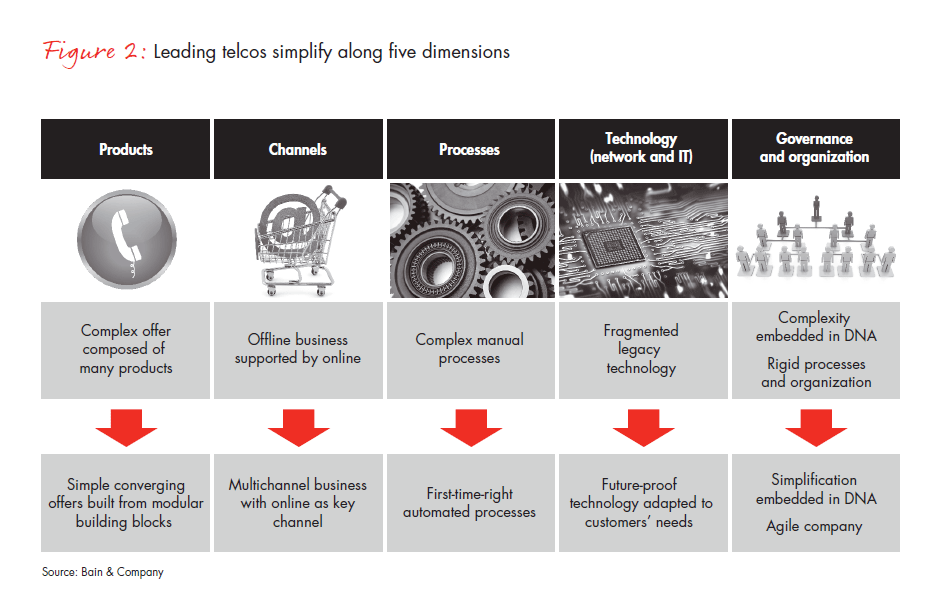
      In our work with incumbent telcos, we find that the most successful transformations tackle complexity along five dimensions (see Figure 2). As a whole, this effort reduces the complexity of the product portfolio and of the operational and sales functions that support it.

      simplify-to-grow-in-telecommunications-fig-02_embed
      • Products. Most telcos carry a complex portfolio of business products and consumer offers, which change frequently. It’s not unusual for a telco to have tens of thousands of combinations of products, options and rules that must be maintained and billed against. Many try to market simpler combinations and hope customers will voluntarily migrate, but that typically takes too long. A more reasonable goal is to define a limited number of combinations—no more than a few hundred—and migrate all customers to them over two years. Over the long term, the telco can capture more savings by decommissioning platforms that support the complex array of combinations.
      • Channels. Many telcos still sell and serve their customers mostly from physical stores. They can reduce complexity and customer frustration by becoming true multichannel organizations with a consistent user experience across stores, online and mobile interfaces. By developing better online systems for businesses and consumers to troubleshoot their own issues and to add or remove services, telcos can reduce the load on call centers, thus allowing call-center personnel to invest more time and care on each customer opportunity.
      • Processes. Simplification also presents an opportunity to automate processes that some companies still handle manually, including some diagnostic and order-to-cash functions. Integrating billing processes across product and service lines creates a more unified customer experience and may also enable bundled offers that weren’t previously available.
      • Technology. As telcos move from outdated, rigid IT platforms to more flexible, modular architectures, they lay the groundwork for more intelligent networking. This intelligence doesn’t come in the form of greater complexity; on the contrary, the goal is to create a simple “agnostic” platform that can support all future products and services together. Technologies such as network function virtualization (NFV) and software-defined networking (SDN) make it possible for telcos to build flexibility and reduce traditional product development barriers as they update their infrastructure.
      • Governance and organization. A key tenet to prevent complexity from creeping back in is to limit the people and functions that can introduce new products and services or change existing ones. Most telcos have a large pool of product managers tasked with developing new offers. But without the right governance rules, they often launch new products that may create more new work—for example, more calls to service centers—or that may require retrofitting of legacy systems. Many also fail to actively manage the decommissioning of old products and offers. Most telcos also need to remove layers and levels of control to simplify and allow them to become more nimble in decision making. Few implement life-cycle management to track products and services. Taking this step would ensure that they are properly decommissioned and removed from systems at the end of their working, profitable run, to help alleviate complex legacy code.

      In this short video, Bain Partner Frédéric Debruyne explains how telcos can simplify to improve customer loyalty and get to market faster with new technologies.

      Addressing the pain

      Simplifying a large, incumbent telecommunications company is obviously tremendously challenging. Layers of legacy products, processes and systems built up over decades are difficult to peel back.

      Telcos can reverse the typical pattern of looking inward at processes by beginning to look outward at customer episodes to identify pain points and eliminate their root causes. Complexity can be hard to spot from a senior manager’s perspective, but it’s usually painfully obvious to the victim, whether that’s a customer, frontline agent, retail sales associate or the software developer confronting the problem. We’ve all heard horror stories about customers spending 45 minutes or longer in stores to activate new services—something that could take only minutes online. That’s a perfect place to start.

      The companies we have worked with organize their transformation around three principles—steps that form a loop of continuous improvement.

      1. Reset. Clean up legacy products, offers and platforms, and migrate customers to new ones. One leading telco set out to migrate customers from a legacy platform that offered more than 30,000 different combinations of products and services to a new platform that offered only about 750. In addition to streamlining the management and operations of this bewildering array of combinations, the simpler platform made it easier to match customers with packages they liked, since there were fewer options to wade through. It also made it more likely that frontline customer service reps could master the details of the most popular options.
      2. Limit. Establish the right mindset, principles and governance rules to prevent complexity from returning. Managers should be careful they are not simply shifting complexity from one part of the organization to another, but rather removing its root causes. Senior managers need to remain committed, and in some cases, traditional thinking has to be flipped on its back. For example, in most organizations, heroes are the people who launch something new. But now it is also important to celebrate people who manage to get rid of unnecessary things.
      3. Reassess. Measure complexity and monitor it so it doesn’t return. As important as it is to clean up legacy complexity, companies have to be careful to redesign their systems to prevent it from creeping back in.

      One way to do this is to simplify the company’s future value proposition. Successful transformations identify the highest potential revenue sources and refocus sales efforts and channel decisions on those opportunities. A current example is dropping old service plans based on minutes and instead grouping customers onto family plans with bulk data limits—a simpler way to think about plans both for the customer and the company.

      Lessons learned

      It’s difficult for any one part of a company to simplify without the entire organization also adjusting its scope. Any telco embarking on an effort to reduce complexity should consider it a companywide transformation requiring executive committee alignment and a top-down vision that clearly defines the simple telco it wants to be. Without sustained sponsorship from the highest levels, the effort cannot succeed.

      Every transformation also requires continuous alignment between the business and the technology and delivery parts of the organization. Workshops can help business and technology people find common terms to talk about products, services and the architecture that supports them. The goal is to empower both sides to clearly articulate a new value proposition, so the technology team can understand the business goals and help the company achieve them.

      Finally, to unlock the full potential of a transformation, executives need to look forward as well as backward. In many ways, it’s easier to look back over decades of complexity and determine how to pare it down to create a more manageable organization. It’s more difficult to build a company that can match the nimble, aggressive market moves of competitors that have no legacy.

      In our view, telcos have little choice but to reduce complexity if they are to continue to compete against fellow incumbents and new attackers. Their current processes create a vicious cycle where a complex product portfolio leads to time-consuming processes for provisioning, sales and customer support. This complexity not only slows time to market but also increases churn, as dissatisfied customers find better options. To counter this churn, product marketers come up with new offers and promotions, often implemented in a panic mode, which in turn lead to even more IT exceptions and work-arounds. These new offers also further complicate the product portfolio. Churn increases, internal processes become more complex, and expensive new product launches lead to degrading financial results. Only a determined effort to break the cycle and simplify the organization can reverse the process.

      Mark Bower is a partner with Bain & Company in Dallas. Frédéric Debruyne is a Bain partner in Brussels. Jeff Melton is a partner in Bain’s Melbourne office, where he leads the firm’s Asia-Pacific Performance Improvement practice. All three work with Bain’s Telecommunications, Media & Technology practice.

      The authors would like to acknowledge the contributions of Bertrand Fallon-Kund, a principal with Bain & Company in Brussels.


      simplify-to-grow-in-telecommunications-fig-01_full

      simplify-to-grow-in-telecommunications-fig-02_full
      Autoren
      • Headshot of Mark Bower
        Mark Bower
        Alumni, Dallas
      • Headshot of Frédéric Debruyne
        Frédéric Debruyne
        Advisory Partner, Brussels
      • Jeff Melton
        Former Partner, Melbourne
      Kontaktieren Sie uns
      Verwandte Branchen
      • Telekommunikation
      Wie wir Sie unterstützen können
      • Zero-based Redesign
      Is It Too Soon to Declare Cable the Winner in the Broadband Wars?

      How telecoms can win back share from their cable competitors.

      Mehr erfahren
      Kundenstrategie und Marketing
      Breaking the Back of Customer Churn

      Five common fallacies derail most churn reduction efforts.

      Mehr erfahren
      Telekommunikation
      Shift to Vertical: David Haines, Group CEO, Flora Food Group

      What does it take to stay connected to your customers when scale and complexity threaten to pull you away? 

      Mehr erfahren
      Zero-based Redesign
      Wealth Management Firms Can Take Out Costs While Reducing Risk and Improving Client Loyalty

      Six tactics allow firms to reduce operating costs by 17% to 38%.

      Mehr erfahren
      Telekommunikation
      Telecommunications M&A

      Deal activity slowed considerably in 2025 amid macroeconomic headwinds and strategic investments in areas such as AI and fiber networks.

      Mehr erfahren
      First published in Juli 2014
      Markierungen
      • Telekommunikation
      • Zero-based Redesign

      Wie wir unsere Kunden unterstützt haben

      Strategie Jump-starting innovation for a telecom solutions provider

      Kundenbeispiel lesen

      Mergers & Acquisitions Post-merger cultural issues jeopardize a deal

      Kundenbeispiel lesen

      Kundenstrategie und Marketing Customer segmentation aligns TelecomCo's growth strategy with consumers' needs

      Kundenbeispiel lesen

      Möchten Sie mit uns in Kontakt bleiben?

      Wir unterstützen Führungskräfte weltweit, die kritischen Themen in ihrem Unternehmen zu adressieren. Gemeinsam schaffen wir nachhaltige Veränderungen und Ergebnisse.

      Bain Insights. Unsere Perspektive auf die kritischen Themen, mit denen sich international agierende Unternehmen konfrontiert sehen, finden Sie monatlich in Ihrem Postfach.

      *Ich habe die Datenschutzerklärung gelesen und akzeptiere sie.
      Bitte lesen Sie die Datenschutzerklärung und akzeptieren Sie diese.
      Bain & Company
      Contact us Sustainability Accessibility Rechtliche Hinweise Impressum Datenschutz Cookie-Richtlinie Sitemap Log In

      © 1996-2026 Bain & Company, Inc.

      Kontaktieren Sie Bain

      Wie können wir Ihnen helfen?

      • Business inquiry
      • Career information
      • Press relations
      • Partnership request
      • Speaker request
      Alle weltweiten Büros