
Skip to Content
  • Standorte

    Standorte

    North & Latin America
    • Atlanta
    • Austin
    • Bogota
    • Boston
    • Buenos Aires
    • Chicago
    • Dallas
    • Denver
    • Houston
    • Lisbon
    • Los Angeles
    • Mexico City
    • Minneapolis
    • Monterrey
    • Montreal
    • New York
    • Rio de Janeiro
    • San Francisco
    • Santiago
    • São Paulo
    • Seattle
    • Silicon Valley
    • Toronto
    • Washington, DC
    Europe & Africa
    • Amsterdam
    • Athens
    • Berlin
    • Brussels
    • Copenhagen
    • Düsseldorf
    • Frankfurt
    • Helsinki
    • Istanbul
    • Johannesburg
    • Kyiv
    • Lisbon
    • London
    • Madrid
    • Milan
    • München
    • Oslo
    • Paris
    • Rome
    • Stockholm
    • Warsaw
    • Wien
    • Zürich
    Middle East
    • Doha
    • Dubai
    • Riyadh
    Asia & Australia
    • Bangkok
    • Beijing
    • Bengaluru
    • Brisbane
    • Ho Chi Minh City
    • Hong Kong
    • Jakarta
    • Kuala Lumpur
    • Manila
    • Melbourne
    • Mumbai
    • New Delhi
    • Perth
    • Seoul
    • Shanghai
    • Singapore
    • Sydney
    • Tokyo
    Alle Standorte Anzeigen
  • Alumni
  • Presse
  • Newsletter
  • Kontakt
  • DACH-Region | Deutsch

    Wählen Sie Ihre Region und Sprache

    Global
    • Global (English)
    North & Latin America
    • Brazil (Português)
    • Argentina (Español)
    • Canada (Français)
    • Chile (Español)
    • Colombia (Español)
    Europe, Middle East, & Africa
    • France (Français)
    • DACH-Region (Deutsch)
    • Italy (Italiano)
    • Spain (Español)
    • Greece (Elliniká)
    Asia & Australia
    • China (中文版)
    • Korea (한국어)
    • Japan (日本語)
  • Saved items (0)
    Saved items (0)

    You have no saved items.

    Inhalte, für die Sie sich interessieren, werden hier gespeichert und können später gelesen oder weitergeleitet werden.

    Explore Bain Insights
  • Branchenkompetenzen
    Hauptmenü

    Branchenkompetenzen

    • Luft- und Raumfahrt, Verteidigung
    • Agrarwirtschaft
    • Chemieindustrie
    • Infrastruktur und Bauwirtschaft
    • Konsumgüter
    • Finanzdienstleistungen
    • Gesundheitswesen
    • Maschinen- und Anlagenbau
    • Medienwirtschaft
    • Metallindustrie
    • Bergbau
    • Öl und Gas
    • Papier- und Verpackungsindustrie
    • Private Equity
      Branchenkompetenzen
      Private Equity
      • Due Diligence
      • Exit Planning
      • Firm Strategy & Operations
      • Portfolio Value Creation
    • Öffentlicher Sektor und Sozialwesen
    • Einzelhandel
    • Technologie
    • Telekommunikation
    • Transportwesen
    • Reise- und Freizeitbranche
    • Versorgung und erneuerbare Energien
  • Managementkompetenzen
    Hauptmenü

    Managementkompetenzen

    • Customer Experience
    • ESG
    • Innovation
    • M&A
    • Operations
    • People & Organization
    • Private Equity
    • Sales & Marketing
    • Strategie
    • KI, Einblicke und Lösungen
    • Technologie
    • Transformation
  • Digital
  • Publikationen
    Hauptmenü

    Publikationen

    • Branchenthemen
    • Managementthemen
    • Bain-Bücher
    Alle Publikationen
    Ausgewählte Themen
    • Resilienz in der globalen Krise
    • M&A Report
    • Private Equity Podcast
    • Midyear Private Equity Report
    • Agile
    • Engineering Report
    • Digital Transformation
    • Elements of Value®
    • Firm of the Future
    • Nachhaltigkeitsstudie
    • Macro Trends
    • Future of Consumption
    • Weltwirtschaftsforum (WEF)
  • Über uns
    Hauptmenü

    Über uns

    • Was wir bieten
    • Unser Ansatz
    • Unser Team
    • Game Changer Award
    • Female Allstar Board
    • Messbare Ergebnisse (EN)
    • Auszeichnungen
    • Globale Partnerschaften
    • The Mission
    Further: Our global responsibility
    • Vielfalt & Chancengleichheit
    • Soziale Verantwortung
    • Sustainability
    Erfahren Sie mehr zu "Further"
  • Karriere
    Hauptmenü

    Karriere

    • Dein Einstieg
      Karriere
      Dein Einstieg
      • Find Your Place
      • Unsere Arbeitsbereiche
      • Unsere Teams
      • Angebote für Studierende
      • Praktika & Programme
      • Recruiting-Events
    • Arbeiten bei Bain
      Karriere
      Arbeiten bei Bain
      • Blog: Inside Bain
      • Karriere Stories
      • Unsere Bainies
      • Office-Standorte
      • Weiterentwicklung
      • Affinity Groups
      • Deine Benefits
    • Impact Stories
    • Deine Bewerbung
      Karriere
      Deine Bewerbung
      • Das erwartet dich
      • Der Interviewprozess
    FIND JOBS
  • Standorte
    Hauptmenü

    Standorte

    • North & Latin America
      Standorte
      North & Latin America
      • Atlanta
      • Austin
      • Bogota
      • Boston
      • Buenos Aires
      • Chicago
      • Dallas
      • Denver
      • Houston
      • Lisbon
      • Los Angeles
      • Mexico City
      • Minneapolis
      • Monterrey
      • Montreal
      • New York
      • Rio de Janeiro
      • San Francisco
      • Santiago
      • São Paulo
      • Seattle
      • Silicon Valley
      • Toronto
      • Washington, DC
    • Europe & Africa
      Standorte
      Europe & Africa
      • Amsterdam
      • Athens
      • Berlin
      • Brussels
      • Copenhagen
      • Düsseldorf
      • Frankfurt
      • Helsinki
      • Istanbul
      • Johannesburg
      • Kyiv
      • Lisbon
      • London
      • Madrid
      • Milan
      • München
      • Oslo
      • Paris
      • Rome
      • Stockholm
      • Warsaw
      • Wien
      • Zürich
    • Middle East
      Standorte
      Middle East
      • Doha
      • Dubai
      • Riyadh
    • Asia & Australia
      Standorte
      Asia & Australia
      • Bangkok
      • Beijing
      • Bengaluru
      • Brisbane
      • Ho Chi Minh City
      • Hong Kong
      • Jakarta
      • Kuala Lumpur
      • Manila
      • Melbourne
      • Mumbai
      • New Delhi
      • Perth
      • Seoul
      • Shanghai
      • Singapore
      • Sydney
      • Tokyo
    Alle Standorte Anzeigen
  • Alumni
  • Presse
  • Newsletter
  • Kontakt
  • DACH-Region | Deutsch
    Hauptmenü

    Wählen Sie Ihre Region und Sprache

    • Global
      Wählen Sie Ihre Region und Sprache
      Global
      • Global (English)
    • North & Latin America
      Wählen Sie Ihre Region und Sprache
      North & Latin America
      • Brazil (Português)
      • Argentina (Español)
      • Canada (Français)
      • Chile (Español)
      • Colombia (Español)
    • Europe, Middle East, & Africa
      Wählen Sie Ihre Region und Sprache
      Europe, Middle East, & Africa
      • France (Français)
      • DACH-Region (Deutsch)
      • Italy (Italiano)
      • Spain (Español)
      • Greece (Elliniká)
    • Asia & Australia
      Wählen Sie Ihre Region und Sprache
      Asia & Australia
      • China (中文版)
      • Korea (한국어)
      • Japan (日本語)
  • Saved items  (0)
    Hauptmenü
    Saved items (0)

    You have no saved items.

    Inhalte, für die Sie sich interessieren, werden hier gespeichert und können später gelesen oder weitergeleitet werden.

    Explore Bain Insights
  • Branchenkompetenzen
    • Branchenkompetenzen

      • Luft- und Raumfahrt, Verteidigung
      • Agrarwirtschaft
      • Chemieindustrie
      • Infrastruktur und Bauwirtschaft
      • Konsumgüter
      • Finanzdienstleistungen
      • Gesundheitswesen
      • Maschinen- und Anlagenbau
      • Medienwirtschaft
      • Metallindustrie
      • Bergbau
      • Öl und Gas
      • Papier- und Verpackungsindustrie
      • Private Equity
      • Öffentlicher Sektor und Sozialwesen
      • Einzelhandel
      • Technologie
      • Telekommunikation
      • Transportwesen
      • Reise- und Freizeitbranche
      • Versorgung und erneuerbare Energien
  • Managementkompetenzen
    • Managementkompetenzen

      • Customer Experience
      • ESG
      • Innovation
      • M&A
      • Operations
      • People & Organization
      • Private Equity
      • Sales & Marketing
      • Strategie
      • KI, Einblicke und Lösungen
      • Technologie
      • Transformation
  • Digital
  • Publikationen
    • Publikationen

      • Branchenthemen
      • Managementthemen
      • Bain-Bücher
      Alle Publikationen
      Ausgewählte Themen
      • Resilienz in der globalen Krise
      • M&A Report
      • Private Equity Podcast
      • Midyear Private Equity Report
      • Agile
      • Engineering Report
      • Digital Transformation
      • Elements of Value®
      • Firm of the Future
      • Nachhaltigkeitsstudie
      • Macro Trends
      • Future of Consumption
      • Weltwirtschaftsforum (WEF)
  • Über uns
    • Über uns

      • Was wir bieten
      • Unser Ansatz
      • Unser Team
      • Game Changer Award
      • Female Allstar Board
      • Messbare Ergebnisse (EN)
      • Auszeichnungen
      • Globale Partnerschaften
      • The Mission
      Further: Our global responsibility
      • Vielfalt & Chancengleichheit
      • Soziale Verantwortung
      • Sustainability
      Erfahren Sie mehr zu "Further"
  • Karriere
    Häufige Suchanfragen
    • Agil
    • Digital
    • Strategie
    Vorherige Suchanfragen
      Zuletzt besuchte Seiten

      Content added to saved items

      Saved items (0)

      Removed from saved items

      Saved items (0)

      Artikel

      The Single Supervisory Mechanism: Think Strategy, Not Just Compliance

      The Single Supervisory Mechanism: Think Strategy, Not Just Compliance

      Banking in Europe becomes more complex with the November 2014 introduction of the Single Supervisory Mechanism (SSM).

      Von Paolo Bordogna and Jan-Alexander Huber

      • Min. Lesezeit

      Artikel

      The Single Supervisory Mechanism: Think Strategy, Not Just Compliance
      en

      Banking in Europe becomes more complex with the November 2014 introduction of the Single Supervisory Mechanism (SSM), overseen by the European Central Bank (ECB). For bankers, the SSM is more than an added layer of regulation. We expect it to cause bankers to shift from simply worrying about compliance to thinking about the new risks and opportunities raised by a lack of capital, liquidity and profitability. Banks now need to present a credible equity story that can thrive in a new, uncharted regulatory environment.

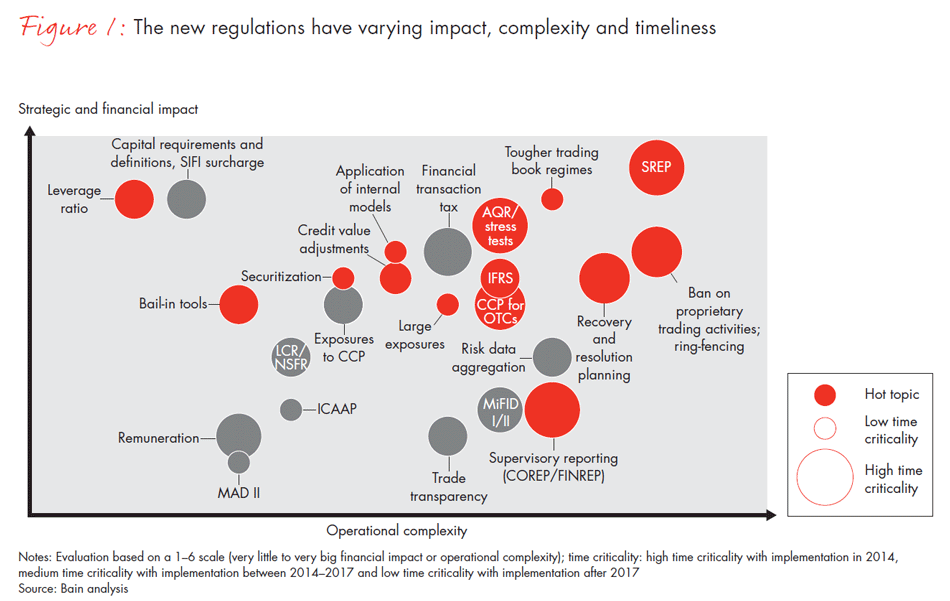
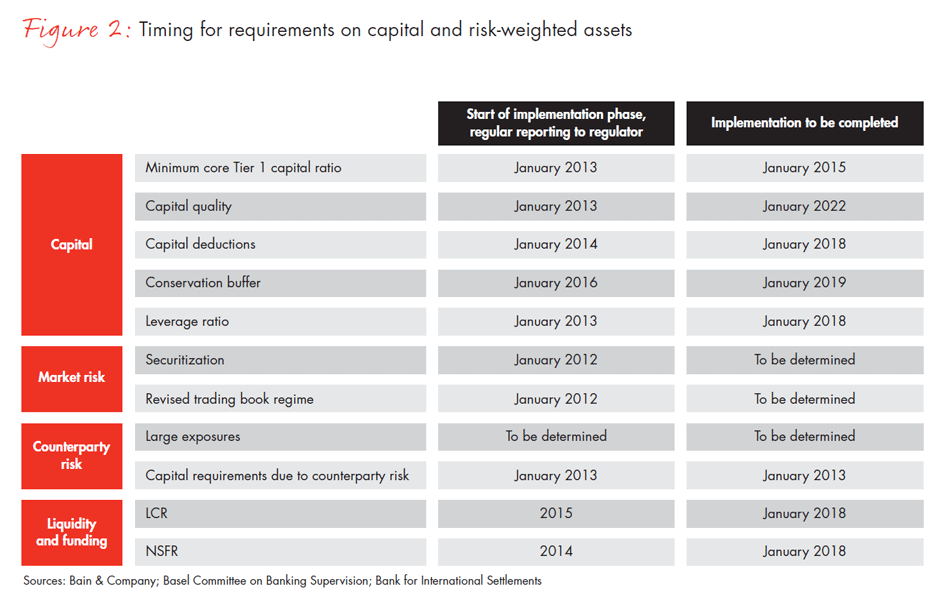
      Stress tests recently completed as part of the European Comprehensive Assessment (ECA) are just the beginning of a major, prolonged exercise. We estimate that more than 100 new regulatory requirements and guidelines will be implemented over the coming months and years (see Figures 1 and 2). They will induce changes in all aspects of banking, from the underlying business model, strategy and profit-and-loss statement to the balance sheet and governance structure. Large banks engaged in capital market activities will experience the most radical changes, as they will need to ring-fence their retail banking activities to shield them from the risks in other businesses. A few banks, such as UBS, have already begun that process.
      single-supervisory-mechanism-fig01_embed

      single-supervisory-mechanism-fig02_embed

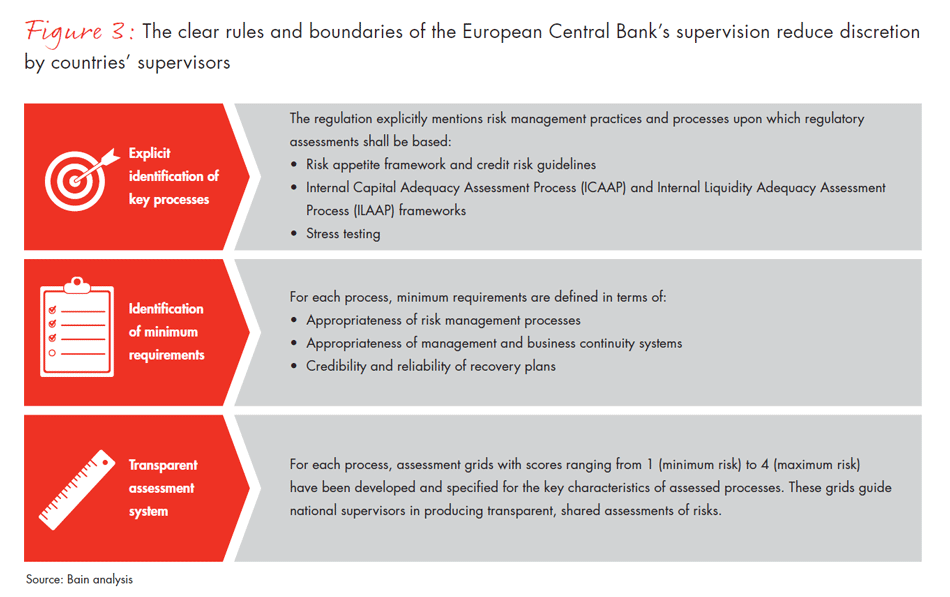
      The ECB will now directly supervise large banks, using the more stringent and transparent Supervisory Review and Evaluation Process (SREP). National authorities will still supervise smaller banks; in practice, though, national regulators will have less discretion, and we expect them to increasingly follow the lead of ECB regulators (see Figure 3).

      single-supervisory-mechanism-fig03_embed

      Departing from traditional after-the-fact analysis, the SSM emphasizes forward-looking scenarios based on how a bank performed in the ECA. A bank’s strategic priorities will depend on the results of the ECA, which serves as due diligence on the bank’s balance sheet. The SSM thus has major implications for strategy, operations, governance and talent.

      Implications for strategy

      Borderline banks cannot afford to deteriorate further and will need to ensure survival. They will need to make a comprehensive plan for evaluating the impacts of management decisions. Banks that performed slightly better will need to turn around their credit management platform, improving data quality, policies, processes, classification and provisioning.

      Healthy banks, on the other hand, have earned regulators’ trust for the moment. They potentially have more leeway over which managerial moves they can make. Many of them should be on the lookout for good M&A opportunities.

      For all banks, regulators will frequently check the business model’s viability and sustainability. In addition to checking the obvious areas of capital allocation, risk appetite and funding requirements, supervisors will test whether banks regularly track backward- and forward-looking key performance indicators (KPIs) to help them steer the business. Essentially, they will be testing whether banks turn their strategies into sustainable business models.

      To date, most banks have played a portfolio game, blending businesses that performed differently at each stage of the economic cycle. This logic will no longer apply. Looking ahead, banks can only afford to keep businesses that have steady cash flow and returns that provide a surplus on the cost of equity. They won’t be able to keep a cyclical or volatile business unless it is heavily overcapitalized to cover the downside risks and prove its viability.

      In turn, many businesses may need to be wound down or spun off. In light of the higher capital requirements, regulators will scrutinize in detail asset-based business, such as real estate, ship and aircraft financing and infrastructure.

      Higher capital buffers complicate life for banks. Fewer than 6% of all banks in Germany, for instance, earn their cost of capital, Bain & Company estimates. Some banks with weaker capital positions and returns on invested capital will depart from these businesses, while hedge funds and other shadow bankers will likely play a greater role.

      Less volatile businesses, like deposits and consumer financing, will increasingly depend on achieving economies of scale to fill the capacity of expensive platforms. Banks will also have to invest to become more transparent in reporting performance metrics to regulators. These imperatives could spur a new phase of M&A for banks that compete in scale-driven businesses.

      Implications for operations

      Operational complexity is bound to increase in the wake of the SSM. For one thing, simulation tools will become more prominent in supporting key decisions and managing conversations and negotiations with regulators. Also, we expect that supervisors’ broader scope during bank visits will lower the credit threshold in files they will scrutinize.

      These changes put a premium on accelerating initiatives to digitize more information and processes. If banks can provide real-time access to client data, they will become more transparent to regulators and improve both effectiveness and efficiency in compliance. Being able to access digital data quickly will allow banks to frequently assess the viability and sustainability of a business.

      Funding the digital transition poses a major challenge to banks that rely on legacy IT systems. Leading banks are freeing up funds by simplifying their products and processes; by migrating basic transactions online; and by redesigning branch formats to reduce staff as well as bad and avoidable volumes.

      Implications for governance and talent

      The new regime implicitly broadens the roles and responsibilities of the chief risk officer and chief financial officer. We expect closer cooperation between these two in most strategic areas, including the risk appetite framework, business plan and capital allocation. They will take the lead in determining which assets and organizational units should be in or out of a specific business.

      Banks must ensure that the chief risk officer and the risk office are truly independent from the business units, as well as from audit and compliance functions. That independence should be clear to regulators.

      The SSM will also entail a shift in the type of staff skills and experience banks need. Banks striving to earn their cost of equity will need to reduce costs, which likely will mean reducing staff in certain areas. At the same time, they’ll need to upgrade functions dealing with supervisory authorities, which may mean hiring more risk analysts, lawyers with economics training and others who can develop new reporting and advanced simulation tools.

      Individuals will be more responsible for specific tasks, and delegating decisions will be less tolerated. More aspects of accountability will be spelled out formally. If entrepreneurial behavior is deemed too risky, the supply of willing talent might shift to the highly conservative end of the spectrum.

      Five ways to succeed with the SSM

      As banks navigate the new regime, five principles can serve as useful guideposts.

      • Scrutinize the value of every activity. Examine in detail whether it is worthwhile to pursue given the new regulations.
      • Separate individual businesses from each other. With regulators checking viability frequently, different businesses should be viewed and improved individually, making them easier to manage and, if needed, sell.
      • Improve the tool kit. Several areas merit investment: first, banking book position-keeping to help understand in advance how the balance sheet is moving; second, building a single granular and flexible point of truth. This will take the form of a directional database of risk and finance KPIs, applied to each organizational level. Banks will need to develop a tool to simulate the integrated effects of different strategies on capital, liquidity and economic performance. They’ll also need to improve their benchmarking of competitors on stress test performance.
      • Anticipate rather than react. Speed and agility increase a bank’s ability to shape its own destiny, just as a fighter pilot can rely on a cycle of observe, orient, decide and act rather than on raw power. It’s better, for instance, for a bank to examine the trade-offs of exiting a business in a strong position, rather than being forced to sell in crisis.
      • Consider recovery and resolution planning an opportunity, not a burden. A living will outlines how a bank would regain viability if it’s under severe financial pressure and the steps regulators will take if the institution fails. As noted above, being forced to react to shortfalls or regulatory enforcements usually destroys value. It’s far better to anticipate future developments, have a Plan B ready and thereby improve the business.

      Strategy, not compliance. Anticipation, not reaction. Functional cooperation, not silos. Digital, not manual. With the advent of the SSM, these will be the hallmarks of banks that stand the best chance of thriving in Europe in the years ahead.


      single-supervisory-mechanism-fig01_full

      single-supervisory-mechanism-fig02_full

      single-supervisory-mechanism-fig03_full
      Autoren
      • Paolo Bordogna
        Alumni, Paris
      • Jan-Frederic Schulz
        Associate Partner, Zürich
      Kontaktieren Sie uns
      Verwandte Branchen
      • Finanzdienstleistungen
      Finanzdienstleistungen
      Customer Loyalty in Retail Banking: Global Edition 2014

      Why customers love the smart fusion of digital and physical assets.

      Mehr erfahren
      Finanzdienstleistungen
      Six Threats Demand a New Playbook for Banks in Wealth and Asset Management

      AI, direct-to-consumer models, and the return of local priorities are redrawing industry lines.

      Mehr erfahren
      Finanzdienstleistungen
      Stay Relevant, Spark Energy: Pedro Arnt, CEO dLocal

      How can a hyperscaler grow at lightning speed without losing its soul? 

      Mehr erfahren
      Finanzdienstleistungen
      Rethinking Transformation: Lawrence Lam on Leading Change at Prudential

      Frankie Leung speaks with Lawrence Lam, CEO of Prudential Hong Kong, about organizational transformation and sustaining change through a people-led approach.

      Mehr erfahren
      Finanzdienstleistungen
      Banking M&A

      As conditions shift, leading banks are fusing scale with scope to create future-ready organizations.

      Mehr erfahren
      First published in Januar 2015
      Markierungen
      • Finanzdienstleistungen

      Wie wir unsere Kunden unterstützt haben

      Nachhaltigkeit Voluntary Carbon Markets: A Bank Moves Early to Seize the Opportunity

      Kundenbeispiel lesen

      Performance Improvement Lean Six Sigma solves a commercial bank's growth problem

      Kundenbeispiel lesen

      Informationstechnologie Bridging the Gap Between Business and Technology

      Kundenbeispiel lesen

      Möchten Sie mit uns in Kontakt bleiben?

      Wir unterstützen Führungskräfte weltweit, die kritischen Themen in ihrem Unternehmen zu adressieren. Gemeinsam schaffen wir nachhaltige Veränderungen und Ergebnisse.

      Bain Insights. Unsere Perspektive auf die kritischen Themen, mit denen sich international agierende Unternehmen konfrontiert sehen, finden Sie monatlich in Ihrem Postfach.

      *Ich habe die Datenschutzerklärung gelesen und akzeptiere sie.
      Bitte lesen Sie die Datenschutzerklärung und akzeptieren Sie diese.
      Bain & Company
      Contact us Sustainability Accessibility Rechtliche Hinweise Impressum Datenschutz Cookie-Richtlinie Sitemap Log In

      © 1996-2026 Bain & Company, Inc.

      Kontaktieren Sie Bain

      Wie können wir Ihnen helfen?

      • Business inquiry
      • Career information
      • Press relations
      • Partnership request
      • Speaker request
      Alle weltweiten Büros