

Brief
Life was a lot simpler when the CEO of a consumer goods company could focus most of his or her attention on marketing to grow a brand. But whether the category is yogurt, detergent or sports drinks, companies are feeling pressure to shift more energy to sales and commercial capabilities. As new channels and store formats emerge in mature markets and modern trade takes root in developing markets, tougher competition is making retailers strive even harder to increase store productivity. Meanwhile, each year sees a rise in the number of shoppers waiting until they’re in the aisle to choose among competing brands in any given category, often making up their minds in just a few seconds and reconsidering their choice every other time they buy. More than ever, controlling the in-store experience is critical for brand growth.
Consumer products executives may realize that getting products listed with the best retailers and placed in the best store locations with the greatest visibility is no less critical than having a distinctive value proposition. But in a world of mounting product and store complexity, these goals are more and more difficult to achieve. With an expanding number of products in their portfolios and shrinking shelf space due to the rise of private labels and smaller retail formats, brands now are competing for the best spots not just against other brands in their category but also against brands in other categories. And sales teams are increasingly pulled away from ensuring their brands are being properly activated in stores to focus on negotiating with centralized trade accounts, leaving sales reps to decide which products to place where and how to properly activate them. Not surprisingly, they often feel ill-equipped to make the right trade-offs. As a result, shelves are cluttered, promotions are inadequately executed, brands struggle to stand out, and sales productivity ratios stagnate—at best.
Consider the case of a personal care company that invested heavily in a four-week promotion for one of its core products. After the promotion period ended, the company did a pulse check and was surprised by the results: Among the stores, the best performers achieved three times the sales uplift than the average, while the underperformers lagged due to delays in implementing the promotion or due to less-than-perfect activation. Some 15% of stores hadn’t even executed the promotion at all. Account managers were unaware of this missed sales opportunity.
How are winners getting it right? Drawing heavily on shopper insights to understand the rules of their category, successful companies zero in on the sales drivers they need to pursue. They use that knowledge to sketch out what an ideal store should look like in order to deliver the greatest results. This is their “picture of success”—a vision of which brands and SKUs to place in each store, where to place them, how many facings, what type of layout and what promotions to activate in a way that will best convince shoppers to buy. They use this vision as the basis for every important decision, from negotiating with key accounts to tracking and compensating sales reps. One invaluable result: The sales capability can be made actionable and measurable, becoming more of a science than an art.
To achieve this result, winning companies typically follow three critical steps. First, they determine which store assets they need to own and lay out a plan to optimize them, rooting guidelines in shopper behavior. Second, they ensure their organization is tightly aligned to develop and deliver that picture of success, taking a store-back approach that ensures nothing will be produced or advertised that won’t truly end up in the store. Finally, they implement best-in-class in-store execution and monitoring systems that guarantee compliance with this picture of success and that deliver sales and market share growth. We’ll look at each of these, one by one.
Identify which critical in-store assets to own and how to optimize them
Leading companies determine which assets in the store—from the actual category shelf and secondary placements to promo slots and signage—they need to control and optimize to outperform rivals. For snacks or gum, this might mean being present at the checkout counter in traditional trade or controlling promotional hot spots in hypermarkets. In non-store settings, the rule is similar. For example, a spirits company would need to have its brands visible behind the bar or mentioned by name on the drinks menu. Regardless of the category or channel, the most available and visible brands will stand out, improving the odds of turning visitors into buyers.
One maker of jam quickly took this lesson to heart. In its market, 75% of jam shoppers know they’ll be buying a product in that category when they enter the store. And yet, the brand’s 30% share of shelf space was significantly lower than its 50% overall market share. Arming its account managers with that information provided them with stronger arguments in negotiations with store owners.
Meanwhile, 89% of jam shoppers in this market know what flavor they want even before coming into the store. For some stores, organizing the jam shelf by flavor rather than by brand or container size could not just increase the brand’s share but grow the category overall for the retailer.
Finally, knowing consumers have a variety of uses for jam, the company also sought the right hot zones for secondary placement. By placing its jam near waffle mix and cold meats, for example, it increased the odds of reaching not only the 75% of shoppers who come into the store knowing they want jam, but also the 25% who don’t—for instance, those who pick up a leg of lamb then say, “Great, I hadn’t thought about buying mint jam, but now that it’s right here….”
It worked. Within four weeks, net sales in pilot stores were outperforming control stores by 15% to 25%.
Plan store back, not marketing forward
Having identified which critical store assets to own and how to use them, winning companies must ensure their organizations are in sync to deliver this vision in the store. From strategy to brand planning, trade marketing and sales, the organization must refocus its business routines to defining and executing against the same ideal store.
Too often companies launch new products that aren’t truly rooted in an understanding of shopping behavior, limiting the effectiveness of in-store assets, overwhelming sales teams with competing category and brand priorities, and creating shopper confusion with cluttered shelves. Or brand managers develop new activation platforms based on consumer insights without seeing what is actually working in the store. These marketing-led brands would be better served to take a store-back approach. That means reengineering their processes by taking stock of constraints in shopper attention, in available store space and in sales execution capacity, and using those constraints to develop brand strategies fit for winning at the point of sale.
This process requires brand teams to have clear touch points with customer teams, forcing them to go back to what actually succeeds in the store in order to define their brand plans. As a result, the best companies know how a new product will be activated in the store well before they approve it. Their product portfolio is based on space availability, their merchandising plans on placement feasibility. Promotional plans and new SKU listings are tied to their top customers’ commercial calendars, with above-the-line and below-the-line investments in sync. Not only does this help a company focus on what can succeed in a particular store, but it also has the benefit of streamlining the organization to what matters most. It ends the days of over-bloated, product-focused organizations.
Remember the personal care company that missed a significant sales opportunity during a four-week promotion? The company put in place a system for constantly tracking its performance store-by-store. The goal was not only to ensure the best promotions are consistently implemented on time and as planned, but also to enable the marketing and sales team to better understand what activities actually work in the store and eliminate hundreds of activities that did not early on.
Deliver consistent and measurable in-store execution
A company may have crafted a great picture of success and put in place the right processes and organization, but it needs a final, critical element to succeed: a system for ensuring that picture is unfailingly activated as intended in the store. Flawless execution directly contributes to sales uplift and market share gains by maximizing consideration at the point of purchase—but it requires nothing less than a true transformation in sales capabilities and activities. (See the Bain Brief “Perfecting Sales Execution.”)
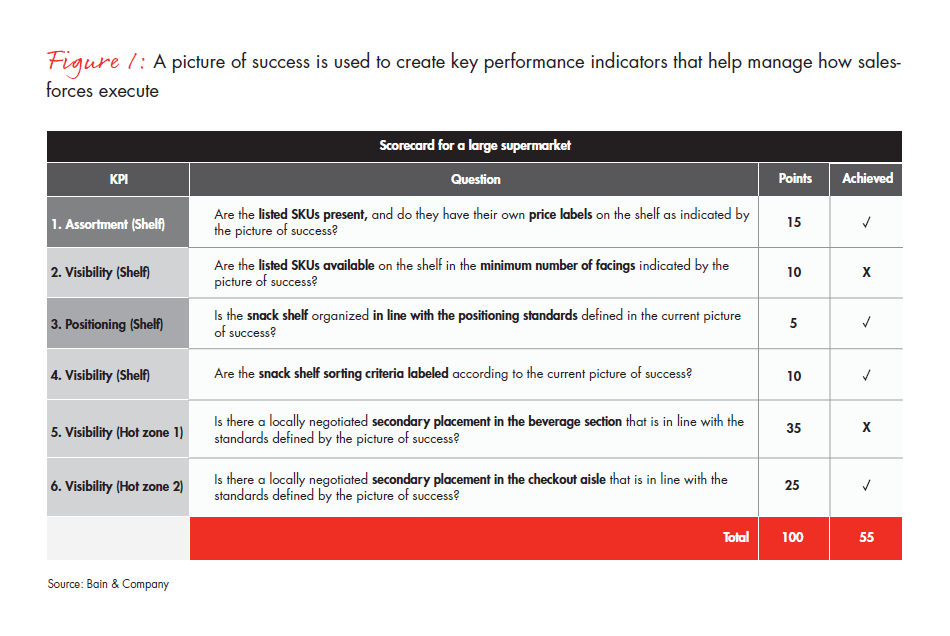
Forward-thinking companies translate their picture of success into prescriptive steps for sales reps to follow before, during and after each store visit to ensure compliance. Scorecards measure how well each sales rep performs in each outlet, focusing on the few specific, measurable key performance indicators that truly matter and on which they can act (see Figure 1). Sell-in activities such as shelf visibility become performance metrics tied to salesforce compensation, replacing output measures such as sales volume, which may feel unattainable or lead to misguided incentives. In more centralized modern trade environments, companies show retailers what’s possible by using their picture of success to articulate the opportunity for category growth overall, using trade terms to ensure that recommendations are implemented. By being clear and prescriptive, companies can use a broad range of technology solutions, such as handheld devices or online portals, to monitor performance, not only increasing sales reps’ in-store effectiveness, but also freeing up time for them to visit and improve more critical stores (see below, “There’s a more efficient way to work with the trade”).
The results can be impressive. In one European market, a food company saw stores that had implemented a sales excellence program achieve 70% more volume uplift than similar non-program stores. Another company saw a similar effort deliver an uplift of more than 15%.
Based on our experience, companies that rediscover the potential inside each store can watch sales grow by an additional 5% to 15% each year. But this improvement needs to be earned again and again. Shopper behavior and the retail environment continually evolve, and even the best picture of success needs to be updated. In the era of super-fast shopper decisions and dwindling shelf space, the store has become a must-win battleground. Brands no longer can afford to stand still—or leave anything to chance. By putting in place routines and systems, and by instilling the right behaviors, consumer goods companies can get their marketing and sales organizations moving swiftly in the same direction—designing and delivering on a single view of what it takes to win over shoppers at the exact moment they decide what to buy.
There’s a more efficient way to work with the trade
Instead of instinctively hiring more sales reps to perform in-store execution activities, consumer goods companies can rely on new ways of connecting with trade customers and monitoring store execution. Store-owner apps, PDA systems, online portals, shopper apps and other innovations allow companies to free up 30% to 40% of their salesforce resources, redeploying them to cover more stores—and more important stores—and to focus on higher-value in-store activities.
A category leader found that its sales reps spent most of their time visiting stores they preferred to call on and performing activities that didn’t really require a physical presence—spending as little as 15% of their time truly negotiating with store owners or managers. To improve performance, the company reprioritized store visits based on size, upside potential and the store’s ability to implement change. For each outlet, required activities and the optimal method of contact were pre-determined.
While sales reps and merchandisers still visit stores for critical tasks, call agents obtain weekly updates on inventory levels; store managers upload orders through an online portal; and innovative digital solutions enlist shoppers to send in photos of shelf execution. With these changes in place, nearly one-third of the field sales resources are freed up to get more stores to a better level of execution—faster. While it cost about $80 to $100 for each sales rep or merchandiser visit, the company achieves many of the same tasks with a $1.50 call or a 70-cent email. The company won two ways: It brought its picture of success to life and, in the process, optimized the deployment of its sales costs for better topline results.
Giovanni Arnese is a Bain & Company partner based in Rome. Sanjay Dhiri is a partner in Bain’s London office. Marcello Tripodo is a Bain partner based in Milan and Nicolas Willemot is a Bain partner in Brussels. All are members of Bain’s Consumer Products practice.
First published in Juni 2014