
Skip to Content
  • Standorte

    Standorte

    North & Latin America
    • Atlanta
    • Austin
    • Bogota
    • Boston
    • Buenos Aires
    • Chicago
    • Dallas
    • Denver
    • Houston
    • Lisbon
    • Los Angeles
    • Mexico City
    • Minneapolis
    • Monterrey
    • Montreal
    • New York
    • Rio de Janeiro
    • San Francisco
    • Santiago
    • São Paulo
    • Seattle
    • Silicon Valley
    • Toronto
    • Washington, DC
    Europe & Africa
    • Amsterdam
    • Athens
    • Berlin
    • Brussels
    • Copenhagen
    • Düsseldorf
    • Frankfurt
    • Helsinki
    • Istanbul
    • Johannesburg
    • Kyiv
    • Lisbon
    • London
    • Madrid
    • Milan
    • München
    • Oslo
    • Paris
    • Rome
    • Stockholm
    • Warsaw
    • Wien
    • Zürich
    Middle East
    • Doha
    • Dubai
    • Riyadh
    Asia & Australia
    • Bangkok
    • Beijing
    • Bengaluru
    • Brisbane
    • Ho Chi Minh City
    • Hong Kong
    • Jakarta
    • Kuala Lumpur
    • Manila
    • Melbourne
    • Mumbai
    • New Delhi
    • Perth
    • Seoul
    • Shanghai
    • Singapore
    • Sydney
    • Tokyo
    Alle Standorte Anzeigen
  • Alumni
  • Presse
  • Newsletter
  • Kontakt
  • DACH-Region | Deutsch

    Wählen Sie Ihre Region und Sprache

    Global
    • Global (English)
    North & Latin America
    • Brazil (Português)
    • Argentina (Español)
    • Canada (Français)
    • Chile (Español)
    • Colombia (Español)
    Europe, Middle East, & Africa
    • France (Français)
    • DACH-Region (Deutsch)
    • Italy (Italiano)
    • Spain (Español)
    • Greece (Elliniká)
    Asia & Australia
    • China (中文版)
    • Korea (한국어)
    • Japan (日本語)
  • Saved items (0)
    Saved items (0)

    You have no saved items.

    Inhalte, für die Sie sich interessieren, werden hier gespeichert und können später gelesen oder weitergeleitet werden.

    Explore Bain Insights
  • Branchenkompetenzen
    Hauptmenü

    Branchenkompetenzen

    • Luft- und Raumfahrt, Verteidigung
    • Agrarwirtschaft
    • Chemieindustrie
    • Infrastruktur und Bauwirtschaft
    • Konsumgüter
    • Finanzdienstleistungen
    • Gesundheitswesen
    • Maschinen- und Anlagenbau
    • Medienwirtschaft
    • Metallindustrie
    • Bergbau
    • Öl und Gas
    • Papier- und Verpackungsindustrie
    • Private Equity
      Branchenkompetenzen
      Private Equity
      • Due Diligence
      • Exit Planning
      • Firm Strategy & Operations
      • Portfolio Value Creation
    • Öffentlicher Sektor und Sozialwesen
    • Einzelhandel
    • Technologie
    • Telekommunikation
    • Transportwesen
    • Reise- und Freizeitbranche
    • Versorgung und erneuerbare Energien
  • Managementkompetenzen
    Hauptmenü

    Managementkompetenzen

    • Customer Experience
    • ESG
    • Innovation
    • M&A
    • Operations
    • People & Organization
    • Private Equity
    • Sales & Marketing
    • Strategie
    • KI, Einblicke und Lösungen
    • Technologie
    • Transformation
  • Digital
  • Publikationen
    Hauptmenü

    Publikationen

    • Branchenthemen
    • Managementthemen
    • Bain-Bücher
    Alle Publikationen
    Ausgewählte Themen
    • Resilienz in der globalen Krise
    • M&A Report
    • Private Equity Podcast
    • Midyear Private Equity Report
    • Agile
    • Engineering Report
    • Digital Transformation
    • Elements of Value®
    • Firm of the Future
    • Nachhaltigkeitsstudie
    • Macro Trends
    • Future of Consumption
    • Weltwirtschaftsforum (WEF)
  • Über uns
    Hauptmenü

    Über uns

    • Was wir bieten
    • Unser Ansatz
    • Unser Team
    • Game Changer Award
    • Female Allstar Board
    • Messbare Ergebnisse (EN)
    • Auszeichnungen
    • Globale Partnerschaften
    • The Mission
    Further: Our global responsibility
    • Vielfalt & Chancengleichheit
    • Soziale Verantwortung
    • Sustainability
    Erfahren Sie mehr zu "Further"
  • Karriere
    Hauptmenü

    Karriere

    • Dein Einstieg
      Karriere
      Dein Einstieg
      • Find Your Place
      • Unsere Arbeitsbereiche
      • Unsere Teams
      • Angebote für Studierende
      • Praktika & Programme
      • Recruiting-Events
    • Arbeiten bei Bain
      Karriere
      Arbeiten bei Bain
      • Karriere Stories
      • Unsere Bainies
      • Office-Standorte
      • Weiterentwicklung
      • Affinity Groups
      • Deine Benefits
    • Impact Stories
    • Deine Bewerbung
      Karriere
      Deine Bewerbung
      • Das erwartet dich
      • Der Interviewprozess
    FIND JOBS
  • Standorte
    Hauptmenü

    Standorte

    • North & Latin America
      Standorte
      North & Latin America
      • Atlanta
      • Austin
      • Bogota
      • Boston
      • Buenos Aires
      • Chicago
      • Dallas
      • Denver
      • Houston
      • Lisbon
      • Los Angeles
      • Mexico City
      • Minneapolis
      • Monterrey
      • Montreal
      • New York
      • Rio de Janeiro
      • San Francisco
      • Santiago
      • São Paulo
      • Seattle
      • Silicon Valley
      • Toronto
      • Washington, DC
    • Europe & Africa
      Standorte
      Europe & Africa
      • Amsterdam
      • Athens
      • Berlin
      • Brussels
      • Copenhagen
      • Düsseldorf
      • Frankfurt
      • Helsinki
      • Istanbul
      • Johannesburg
      • Kyiv
      • Lisbon
      • London
      • Madrid
      • Milan
      • München
      • Oslo
      • Paris
      • Rome
      • Stockholm
      • Warsaw
      • Wien
      • Zürich
    • Middle East
      Standorte
      Middle East
      • Doha
      • Dubai
      • Riyadh
    • Asia & Australia
      Standorte
      Asia & Australia
      • Bangkok
      • Beijing
      • Bengaluru
      • Brisbane
      • Ho Chi Minh City
      • Hong Kong
      • Jakarta
      • Kuala Lumpur
      • Manila
      • Melbourne
      • Mumbai
      • New Delhi
      • Perth
      • Seoul
      • Shanghai
      • Singapore
      • Sydney
      • Tokyo
    Alle Standorte Anzeigen
  • Alumni
  • Presse
  • Newsletter
  • Kontakt
  • DACH-Region | Deutsch
    Hauptmenü

    Wählen Sie Ihre Region und Sprache

    • Global
      Wählen Sie Ihre Region und Sprache
      Global
      • Global (English)
    • North & Latin America
      Wählen Sie Ihre Region und Sprache
      North & Latin America
      • Brazil (Português)
      • Argentina (Español)
      • Canada (Français)
      • Chile (Español)
      • Colombia (Español)
    • Europe, Middle East, & Africa
      Wählen Sie Ihre Region und Sprache
      Europe, Middle East, & Africa
      • France (Français)
      • DACH-Region (Deutsch)
      • Italy (Italiano)
      • Spain (Español)
      • Greece (Elliniká)
    • Asia & Australia
      Wählen Sie Ihre Region und Sprache
      Asia & Australia
      • China (中文版)
      • Korea (한국어)
      • Japan (日本語)
  • Saved items  (0)
    Hauptmenü
    Saved items (0)

    You have no saved items.

    Inhalte, für die Sie sich interessieren, werden hier gespeichert und können später gelesen oder weitergeleitet werden.

    Explore Bain Insights
  • Branchenkompetenzen
    • Branchenkompetenzen

      • Luft- und Raumfahrt, Verteidigung
      • Agrarwirtschaft
      • Chemieindustrie
      • Infrastruktur und Bauwirtschaft
      • Konsumgüter
      • Finanzdienstleistungen
      • Gesundheitswesen
      • Maschinen- und Anlagenbau
      • Medienwirtschaft
      • Metallindustrie
      • Bergbau
      • Öl und Gas
      • Papier- und Verpackungsindustrie
      • Private Equity
      • Öffentlicher Sektor und Sozialwesen
      • Einzelhandel
      • Technologie
      • Telekommunikation
      • Transportwesen
      • Reise- und Freizeitbranche
      • Versorgung und erneuerbare Energien
  • Managementkompetenzen
    • Managementkompetenzen

      • Customer Experience
      • ESG
      • Innovation
      • M&A
      • Operations
      • People & Organization
      • Private Equity
      • Sales & Marketing
      • Strategie
      • KI, Einblicke und Lösungen
      • Technologie
      • Transformation
  • Digital
  • Publikationen
    • Publikationen

      • Branchenthemen
      • Managementthemen
      • Bain-Bücher
      Alle Publikationen
      Ausgewählte Themen
      • Resilienz in der globalen Krise
      • M&A Report
      • Private Equity Podcast
      • Midyear Private Equity Report
      • Agile
      • Engineering Report
      • Digital Transformation
      • Elements of Value®
      • Firm of the Future
      • Nachhaltigkeitsstudie
      • Macro Trends
      • Future of Consumption
      • Weltwirtschaftsforum (WEF)
  • Über uns
    • Über uns

      • Was wir bieten
      • Unser Ansatz
      • Unser Team
      • Game Changer Award
      • Female Allstar Board
      • Messbare Ergebnisse (EN)
      • Auszeichnungen
      • Globale Partnerschaften
      • The Mission
      Further: Our global responsibility
      • Vielfalt & Chancengleichheit
      • Soziale Verantwortung
      • Sustainability
      Erfahren Sie mehr zu "Further"
  • Karriere
    Häufige Suchanfragen
    • Agil
    • Digital
    • Strategie
    Vorherige Suchanfragen
      Zuletzt besuchte Seiten

      Content added to saved items

      Saved items (0)

      Removed from saved items

      Saved items (0)

      Paper & Packaging Report

      Transforming Maintenance with Artificial Intelligence

      Transforming Maintenance with Artificial Intelligence

      With little to no capex, companies can turn maintenance into an engine of cash flow.

      Von Marcos Rutigliano und Ben Grant

      • First published in Januar 2026
      • Min. Lesezeit
      }

      Report

      Transforming Maintenance with Artificial Intelligence
      en
      Auf einen Blick
      • Companies that focus on maintenance typically increase tool-in-hand time by 15 percentage points, leading to an overall reduction in maintenance cost per ton of 17% to 23%.
      • In-house development of new maintenance solutions using generative AI can take as little as a quarter of a year, with a small budget.
      • Assets such as rotating sets and engines have been candidates for more advanced solutions combining sensors and algorithms that learn on the go.

      This article is part of Bain's 2026 Paper & Packaging Report.

      Explore the report

      Maintenance in the paper and packaging industry is an area ripe for both traditional and cutting-edge AI applications. Some of maintenance’s quantitative and mathematical characteristics are best suited for traditional machine learning models, such as predictive maintenance algorithms. In addition, the human-machine interactions of maintenance are well suited for LLM-powered generative AI, such as maintenance copilots that provide real-time instructions to employees by drawing on manuals, ledgers, and sensor prescriptions. Moreover, the cost of installing the sensors that collect the data these advanced models require has fallen precipitously, removing what was once a significant capital barrier.

      As a result, equipment maintenance can generate real value for paper and packaging companies. Reducing downtime can drive higher throughput and therefore revenue. More productive maintenance reduces labor costs. Lower spare parts inventories push working capital down. Finally, well-maintained machines last longer, and capital expenditure drops. 

      Leading companies have already seen real returns from focusing on maintenance. Specifically, they are able to improve overall equipment effectiveness (OEE) in the range of 1 to 2 percentage points by reducing failures and downtime. This may seem small, but the corresponding volume increase, valued at contribution margin, has a significant impact on a company’s EBITDA. When it comes to work productivity, by focusing on maintenance, companies can reduce the mean time to repair a system by 5% to 15%, while tool-in-hand time will typically increase by 15 percentage points, leading to an overall reduction in maintenance cost per ton of 17% to 23%. And finally, spare parts inventories can be reduced by as much as 20% to 40% in cases where they haven’t been optimized in the recent past.

      Three ways to create value

      There are three levers companies can pull to create value using maintenance (see Figure 1).

      Figure 1
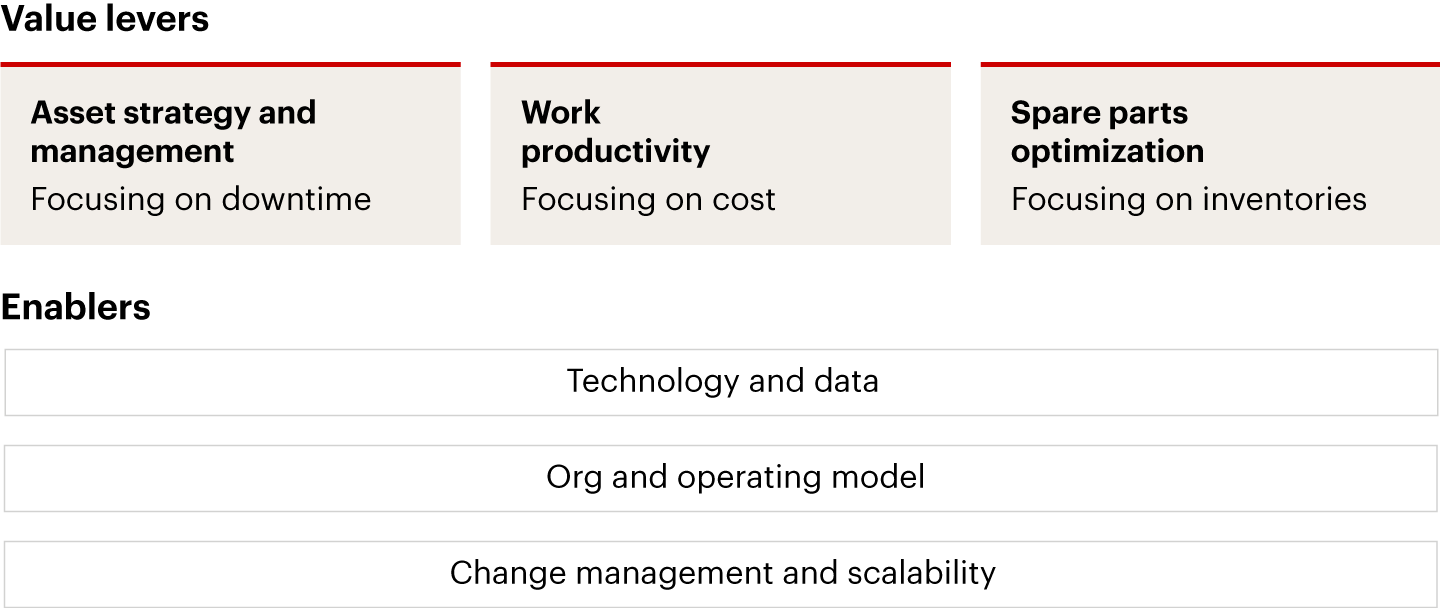
      Smart maintenance is composed of three pillars and underlying enablers
      Quelle Bain & Company

      Asset strategy and management. Up to a decade ago, maintenance could be categorized as either corrective or preventive. More recently, predictive and prescriptive maintenance have come into play at the commercial scale, thanks to sensors that can flag assets that are about to break, allowing for an immediate response.

      Assets that are more common across industrial sectors, such as rotating sets and engines, have been candidates for the most advanced solutions. These technological solutions start with cheaper, basic predictive sensors that shoot alerts whenever a given variable (e.g., temperature) goes above or below predefined thresholds. The issue is that they generate many false positives. To tackle this issue, on the more sophisticated end, AI-powered prescriptive maintenance combines hardware (i.e., sensors) with software (i.e., code/algorithm) that learns on the go. For example, false positives are fed back into the algorithm so that it learns from its mistakes and adapts.

      Work productivity. Reducing maintenance costs depends heavily on improving productivity. Tool-in-hand time (or wrench time) is the key productivity metric. While it’s possible to measure tool-in-hand time automatically, most companies still shadow a sample of employees with a chronometer to understand where they spend their hours.

      Companies that have never measured tool-in-hand before will typically find that about one-third of maintenance time is effectively spent doing maintenance. The other two-thirds is spent on administrative work (e.g., filling out forms and safety documentation, collecting spare parts, registering notes) as well as on meals, transit, etc. Most pulp companies, and industrial companies broadly speaking, face this reality. Typically, when they discover their tool-in-hand time is only about one-third of maintenance time, they focus on eliminating unproductive time while making the productive time more efficient. To increase tool-in-hand time, leading companies deploy solutions that range from more traditional procedures enforcement and process redesign measures to cutting-edge technology, such as voice documentation based on generative AI.

      Spare parts optimization. Managing spare parts is probably the top value-creation lever that has benefited least from recent technologies (e.g., sensors) and gen AI. Companies can, however, leverage machine learning and traditional artificial intelligence to help identify low spare parts inventory and reliably provide replacement parts as quickly as possible when maintenance demands.

      Good spare parts management can also enable higher productivity. One pulp company, for instance, redesigned processes in such a way that the storeroom would deliver spare parts to the client areas instead of getting the maintainers to pick them up, boosting productivity significantly.  

      Enablers: technology, operating model, and change management

      Technology and data. In order to implement such solutions, companies need to answer some key questions, including: How do we connect applications seamlessly to the underlying enterprise resource planning (ERP), cloud, and other systems? What data will be required? Is this data available, or do we need to start collecting it now? What is the data-lake architecture? Master data consistency is also important. It’s not uncommon, for example, that the data ledger in the maintenance module of the ERP system does not match that of the spare parts replenishment module, and companies can spend a few months cleansing data to ensure consistency before implementing their use cases.

      Org and operating model. No program will be successful if people on the shop floor don’t adopt the new processes and tools. The first step is to adjust the operating model to support the new maintenance model. This includes documenting changes in processes, responsibilities, and the organizational structure.

      Change management and scalability. It’s also critical to get people trained and incent them to adopt new tools and processes. To foster this adherence, companies tend to monitor adoption rates, following up on noncompliant groups and ultimately shutting down old processes. Recognizing individuals on the shop floor with specific financial rewards if they adopt early and correctly is also a path, albeit less common. 

      The four stages of a “smart maintenance” program

      The journey to set up and deploy sensors and AI as part of a maintenance program typically consists of four phases (see Figure 2).

      Figure 2
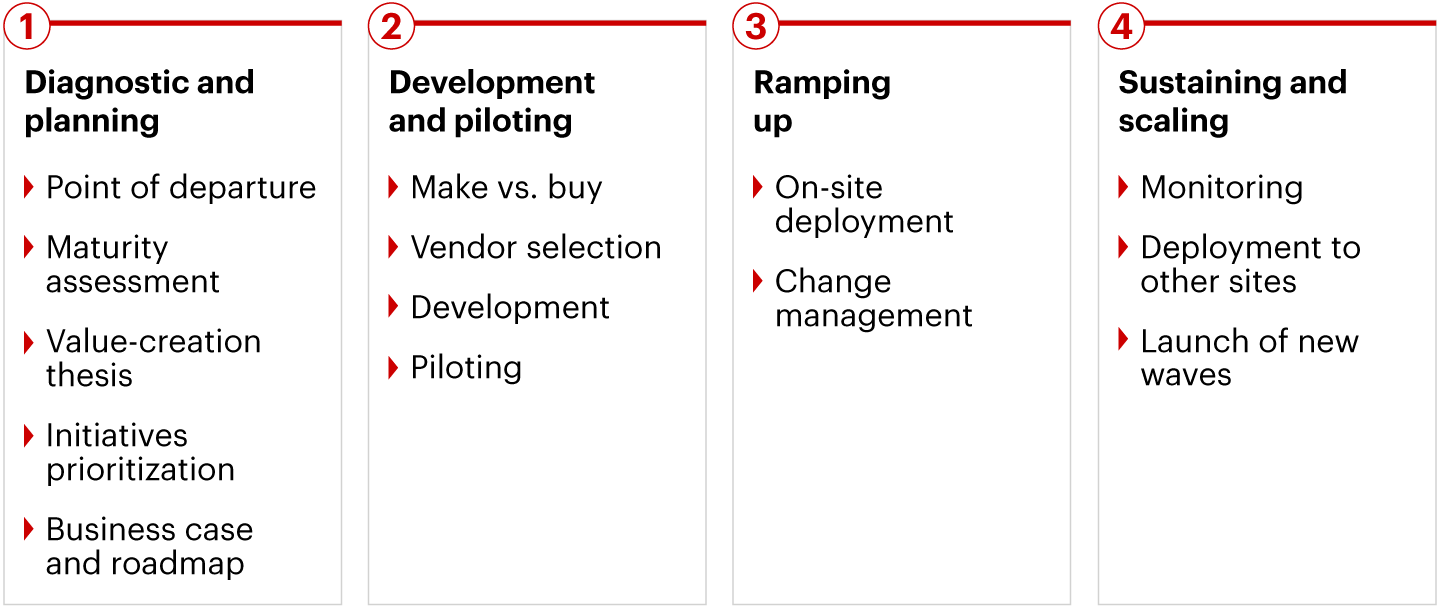
      A “smart maintenance” transformation includes four stages
      Quelle Bain & Company

      1. Diagnostic and planning (3–4 months): The initial period should focus on assessing the company’s point of departure, identifying opportunities, quantifying them, and building the strategy and roadmap ahead. A thorough understanding of the current and historical status of all three pillars—asset strategies, work productivity, and spare parts management—is important and will help determine where value can be created.

      Prioritizing which of these pillars (and which initiatives beneath them) to focus on is key and varies company to company. A glass company, for instance, focused on work productivity and spare parts management, but not on asset strategies. The company had given disproportional importance to OEE historically and had reached very high levels of equipment reliability and low downtime. But it did so at the expense of high maintenance costs as well as a low spare parts inventory.

      2. Development and piloting (6–9 months): This is the part of the journey when solutions are designed in detail and tested. There are basically two tracks here: one for internally developed solutions and the other for market solutions. Naturally, defining which initiatives will go down one path vs. the other is the first step.

      Organic, in-house development used to be lengthy, with no certainty on outcomes. The good news is that generative AI changes the speed and cost of internal development. Whereas development based on automation or traditional analytics would take many months or most likely years, gen AI development can take as little as a quarter of a year, with a small budget.

      For many other types of maintenance solutions, especially those related to sensors, the second piece of good news is that organic development isn’t the only path. With the rapid acceleration in smart maintenance, market vendors now cover a good portion of companies’ prioritized problems.

      3. Ramping up (3–5 months): At this point, solutions that were successful in their pilots receive green lights, and any that failed receive red lights. Now it’s time to ensure on-site deployment of solutions and their adoption. New procedures will be released, potential org changes will be made, trainings will be provided. Various dashboards will gauge—initiative by initiative, area by area—the level of adoption, triggering actions to address adherence to the new ways of working, until the old process or tool is shut down.

      4. Sustaining and scaling: By this stage, the “smart maintenance” project will be nearing a relatively stable state. Yet, close monitoring is crucial. This is also the right time to launch the next wave of initiatives. Companywide, this is the moment when all the novel solutions that have been recently ramped up in plant A will have to start making their way into plants B, C, D, and beyond.

      Maintenance optimization can unlock substantial value, whether it is via increasing throughput or reducing opex, capex, and working capital. The required investment becomes small compared with the upside and continues to drop as solutions gain scale. This has made maintenance a high-return opportunity and a top priority for many paper and packaging executives.  

      Read our 2026 Paper & Packaging Report

      Download the PDF Explore the report

      Read the Next Chapter

      It’s Time to Rethink Every Link in Your Supply Chain

      Resilience and Efficiency

      • Don’t Underestimate the Cost of Overcapacity

      • Transforming Maintenance with Artificial Intelligence

      • It’s Time to Rethink Every Link in Your Supply Chain

      Customer-Led Growth

      • Luxury Packaging: Resolving the Tension Between Creativity and Impact

      • To Make Money, Follow the Money

      • M&A in Paper and Packaging: Bigger but Fewer Deals

      • Battle of the Substrates

      • Sustainability: Less Talk and More Action

      • Chemical Recycling: Plastics Firms Must Move Now or Miss Out

      Autoren
      • Headshot of Marcos Rutigliano
        Marcos Rutigliano
        Partner, São Paulo
      • Headshot of Ben Grant
        Ben Grant
        Partner, Seattle
      Kontaktieren Sie uns
      Verwandte Branchen
      • Forstwirtschaftliche Produkte, Papier und Verpackung
      • Industriegüter und -services
      Ähnliche Beratungsangebote
      • Advanced Analytics
      • Automation
      • Informationstechnologie
      • Performance Improvement
      • Service Operations
      Industriegüter und -services
      How Can AI Be Used in Machinery & Equipment?

      Explore the use cases with the highest potential.

      Mehr erfahren
      Paper & Packaging Report
      Don’t Underestimate the Cost of Overcapacity

      Overcapacity is endemic to the paper and packaging industry, but these actions can help you maintain margins.

      Mehr erfahren
      Paper & Packaging Report
      Sustainability: Less Talk and More Action

      Despite elusive targets, the business case is stronger than ever.

      Mehr erfahren
      Informationstechnologie
      A New Dawn for Automation

      It’s no longer just about saving money. It’s about resilience and gaining an edge.

      Mehr erfahren
      Paper & Packaging Report
      Navigating Turbulence in Paper and Packaging

      Scenario planning can create a dynamic, future-proof strategy.

      Mehr erfahren
      Markierungen
      • Advanced Analytics
      • Automation
      • Forstwirtschaftliche Produkte, Papier und Verpackung
      • Industriegüter und -services
      • Informationstechnologie
      • Paper & Packaging Report
      • Performance Improvement
      • Service Operations

      Wie wir unsere Kunden unterstützt haben

      Supply Chain Security Mitigates a Sovereign Wealth Fund’s Construction Disruptions

      Kundenbeispiel lesen

      A Packaging Company Unboxes a New Go-to-Market Strategy

      Kundenbeispiel lesen

      Operations A Paper Company Optimizes Its Industrial Footprint

      Kundenbeispiel lesen

      Möchten Sie mit uns in Kontakt bleiben?

      Wir unterstützen Führungskräfte weltweit, die kritischen Themen in ihrem Unternehmen zu adressieren. Gemeinsam schaffen wir nachhaltige Veränderungen und Ergebnisse.

      Bain Insights. Unsere Perspektive auf die kritischen Themen, mit denen sich international agierende Unternehmen konfrontiert sehen, finden Sie monatlich in Ihrem Postfach.

      *Ich habe die Datenschutzerklärung gelesen und akzeptiere sie.
      Bitte lesen Sie die Datenschutzerklärung und akzeptieren Sie diese.
      Bain & Company
      Contact us Sustainability Accessibility Rechtliche Hinweise Impressum Datenschutz Cookie-Richtlinie Sitemap Log In

      © 1996-2026 Bain & Company, Inc.

      Kontaktieren Sie Bain

      Wie können wir Ihnen helfen?

      • Business inquiry
      • Career information
      • Press relations
      • Partnership request
      • Speaker request
      Alle weltweiten Büros