
Skip to Content
  • Standorte

    Standorte

    North & Latin America
    • Atlanta
    • Austin
    • Bogota
    • Boston
    • Buenos Aires
    • Chicago
    • Dallas
    • Denver
    • Houston
    • Lisbon
    • Los Angeles
    • Mexico City
    • Minneapolis
    • Monterrey
    • Montreal
    • New York
    • Rio de Janeiro
    • San Francisco
    • Santiago
    • São Paulo
    • Seattle
    • Silicon Valley
    • Toronto
    • Washington, DC
    Europe & Africa
    • Amsterdam
    • Athens
    • Berlin
    • Brussels
    • Copenhagen
    • Düsseldorf
    • Frankfurt
    • Helsinki
    • Istanbul
    • Johannesburg
    • Kyiv
    • Lisbon
    • London
    • Madrid
    • Milan
    • München
    • Oslo
    • Paris
    • Rome
    • Stockholm
    • Warsaw
    • Wien
    • Zürich
    Middle East
    • Doha
    • Dubai
    • Riyadh
    Asia & Australia
    • Bangkok
    • Beijing
    • Bengaluru
    • Brisbane
    • Ho Chi Minh City
    • Hong Kong
    • Jakarta
    • Kuala Lumpur
    • Manila
    • Melbourne
    • Mumbai
    • New Delhi
    • Perth
    • Seoul
    • Shanghai
    • Singapore
    • Sydney
    • Tokyo
    Alle Standorte Anzeigen
  • Alumni
  • Presse
  • Newsletter
  • Kontakt
  • DACH-Region | Deutsch

    Wählen Sie Ihre Region und Sprache

    Global
    • Global (English)
    North & Latin America
    • Brazil (Português)
    • Argentina (Español)
    • Canada (Français)
    • Chile (Español)
    • Colombia (Español)
    Europe, Middle East, & Africa
    • France (Français)
    • DACH-Region (Deutsch)
    • Italy (Italiano)
    • Spain (Español)
    • Greece (Elliniká)
    Asia & Australia
    • China (中文版)
    • Korea (한국어)
    • Japan (日本語)
  • Saved items (0)
    Saved items (0)

    You have no saved items.

    Inhalte, für die Sie sich interessieren, werden hier gespeichert und können später gelesen oder weitergeleitet werden.

    Explore Bain Insights
  • Branchenkompetenzen
    Hauptmenü

    Branchenkompetenzen

    • Luft- und Raumfahrt, Verteidigung
    • Agrarwirtschaft
    • Chemieindustrie
    • Infrastruktur und Bauwirtschaft
    • Konsumgüter
    • Finanzdienstleistungen
    • Gesundheitswesen
    • Maschinen- und Anlagenbau
    • Medienwirtschaft
    • Metallindustrie
    • Bergbau
    • Öl und Gas
    • Papier- und Verpackungsindustrie
    • Private Equity
      Branchenkompetenzen
      Private Equity
      • Due Diligence
      • Exit Planning
      • Firm Strategy & Operations
      • Portfolio Value Creation
    • Öffentlicher Sektor und Sozialwesen
    • Einzelhandel
    • Technologie
    • Telekommunikation
    • Transportwesen
    • Reise- und Freizeitbranche
    • Versorgung und erneuerbare Energien
  • Managementkompetenzen
    Hauptmenü

    Managementkompetenzen

    • Customer Experience
    • ESG
    • Innovation
    • M&A
    • Operations
    • People & Organization
    • Private Equity
    • Sales & Marketing
    • Strategie
    • KI, Einblicke und Lösungen
    • Technologie
    • Transformation
  • Digital
  • Publikationen
    Hauptmenü

    Publikationen

    • Branchenthemen
    • Managementthemen
    • Bain-Bücher
    Alle Publikationen
    Ausgewählte Themen
    • Resilienz in der globalen Krise
    • M&A Report
    • Private Equity Podcast
    • Midyear Private Equity Report
    • Agile
    • Engineering Report
    • Digital Transformation
    • Elements of Value®
    • Firm of the Future
    • Nachhaltigkeitsstudie
    • Macro Trends
    • Future of Consumption
    • Weltwirtschaftsforum (WEF)
  • Über uns
    Hauptmenü

    Über uns

    • Was wir bieten
    • Unser Ansatz
    • Unser Team
    • Game Changer Award
    • Female Allstar Board
    • Messbare Ergebnisse (EN)
    • Auszeichnungen
    • Globale Partnerschaften
    • The Mission
    Further: Our global responsibility
    • Vielfalt & Chancengleichheit
    • Soziale Verantwortung
    • Sustainability
    Erfahren Sie mehr zu "Further"
  • Karriere
    Hauptmenü

    Karriere

    • Dein Einstieg
      Karriere
      Dein Einstieg
      • Find Your Place
      • Unsere Arbeitsbereiche
      • Unsere Teams
      • Angebote für Studierende
      • Praktika & Programme
      • Recruiting-Events
    • Arbeiten bei Bain
      Karriere
      Arbeiten bei Bain
      • Blog: Inside Bain
      • Karriere Stories
      • Unsere Bainies
      • Office-Standorte
      • Weiterentwicklung
      • Affinity Groups
      • Deine Benefits
    • Impact Stories
    • Deine Bewerbung
      Karriere
      Deine Bewerbung
      • Das erwartet dich
      • Der Interviewprozess
    FIND JOBS
  • Standorte
    Hauptmenü

    Standorte

    • North & Latin America
      Standorte
      North & Latin America
      • Atlanta
      • Austin
      • Bogota
      • Boston
      • Buenos Aires
      • Chicago
      • Dallas
      • Denver
      • Houston
      • Lisbon
      • Los Angeles
      • Mexico City
      • Minneapolis
      • Monterrey
      • Montreal
      • New York
      • Rio de Janeiro
      • San Francisco
      • Santiago
      • São Paulo
      • Seattle
      • Silicon Valley
      • Toronto
      • Washington, DC
    • Europe & Africa
      Standorte
      Europe & Africa
      • Amsterdam
      • Athens
      • Berlin
      • Brussels
      • Copenhagen
      • Düsseldorf
      • Frankfurt
      • Helsinki
      • Istanbul
      • Johannesburg
      • Kyiv
      • Lisbon
      • London
      • Madrid
      • Milan
      • München
      • Oslo
      • Paris
      • Rome
      • Stockholm
      • Warsaw
      • Wien
      • Zürich
    • Middle East
      Standorte
      Middle East
      • Doha
      • Dubai
      • Riyadh
    • Asia & Australia
      Standorte
      Asia & Australia
      • Bangkok
      • Beijing
      • Bengaluru
      • Brisbane
      • Ho Chi Minh City
      • Hong Kong
      • Jakarta
      • Kuala Lumpur
      • Manila
      • Melbourne
      • Mumbai
      • New Delhi
      • Perth
      • Seoul
      • Shanghai
      • Singapore
      • Sydney
      • Tokyo
    Alle Standorte Anzeigen
  • Alumni
  • Presse
  • Newsletter
  • Kontakt
  • DACH-Region | Deutsch
    Hauptmenü

    Wählen Sie Ihre Region und Sprache

    • Global
      Wählen Sie Ihre Region und Sprache
      Global
      • Global (English)
    • North & Latin America
      Wählen Sie Ihre Region und Sprache
      North & Latin America
      • Brazil (Português)
      • Argentina (Español)
      • Canada (Français)
      • Chile (Español)
      • Colombia (Español)
    • Europe, Middle East, & Africa
      Wählen Sie Ihre Region und Sprache
      Europe, Middle East, & Africa
      • France (Français)
      • DACH-Region (Deutsch)
      • Italy (Italiano)
      • Spain (Español)
      • Greece (Elliniká)
    • Asia & Australia
      Wählen Sie Ihre Region und Sprache
      Asia & Australia
      • China (中文版)
      • Korea (한국어)
      • Japan (日本語)
  • Saved items  (0)
    Hauptmenü
    Saved items (0)

    You have no saved items.

    Inhalte, für die Sie sich interessieren, werden hier gespeichert und können später gelesen oder weitergeleitet werden.

    Explore Bain Insights
  • Branchenkompetenzen
    • Branchenkompetenzen

      • Luft- und Raumfahrt, Verteidigung
      • Agrarwirtschaft
      • Chemieindustrie
      • Infrastruktur und Bauwirtschaft
      • Konsumgüter
      • Finanzdienstleistungen
      • Gesundheitswesen
      • Maschinen- und Anlagenbau
      • Medienwirtschaft
      • Metallindustrie
      • Bergbau
      • Öl und Gas
      • Papier- und Verpackungsindustrie
      • Private Equity
      • Öffentlicher Sektor und Sozialwesen
      • Einzelhandel
      • Technologie
      • Telekommunikation
      • Transportwesen
      • Reise- und Freizeitbranche
      • Versorgung und erneuerbare Energien
  • Managementkompetenzen
    • Managementkompetenzen

      • Customer Experience
      • ESG
      • Innovation
      • M&A
      • Operations
      • People & Organization
      • Private Equity
      • Sales & Marketing
      • Strategie
      • KI, Einblicke und Lösungen
      • Technologie
      • Transformation
  • Digital
  • Publikationen
    • Publikationen

      • Branchenthemen
      • Managementthemen
      • Bain-Bücher
      Alle Publikationen
      Ausgewählte Themen
      • Resilienz in der globalen Krise
      • M&A Report
      • Private Equity Podcast
      • Midyear Private Equity Report
      • Agile
      • Engineering Report
      • Digital Transformation
      • Elements of Value®
      • Firm of the Future
      • Nachhaltigkeitsstudie
      • Macro Trends
      • Future of Consumption
      • Weltwirtschaftsforum (WEF)
  • Über uns
    • Über uns

      • Was wir bieten
      • Unser Ansatz
      • Unser Team
      • Game Changer Award
      • Female Allstar Board
      • Messbare Ergebnisse (EN)
      • Auszeichnungen
      • Globale Partnerschaften
      • The Mission
      Further: Our global responsibility
      • Vielfalt & Chancengleichheit
      • Soziale Verantwortung
      • Sustainability
      Erfahren Sie mehr zu "Further"
  • Karriere
    Häufige Suchanfragen
    • Agil
    • Digital
    • Strategie
    Vorherige Suchanfragen
      Zuletzt besuchte Seiten

      Content added to saved items

      Saved items (0)

      Removed from saved items

      Saved items (0)

      Brief

      What Big Data Means for Customer Loyalty

      What Big Data Means for Customer Loyalty

      Only humans can fix broken policies or processes, but analytical tools can amplify their reach.

      Von Chris Brahm, Aaron Cheris and Lori Sherer

      • Min. Lesezeit
      }

      Brief

      What Big Data Means for Customer Loyalty
      en

      Big Data analytics tantalize with the promise of nearly automated customer experience programs. Just tune the latest analytics software to your customer interactions and to social media sites, the pitch goes, and you can track and analyze how customers behave, as well as what they think about their experience with your company’s product or service.

      In reality, it’s not that simple. The human dialogue between customers and employees still matters during many of the episodes that customers experience with a company. Sure, algorithms can instantly suggest remedies after a poor interaction or reinforce the company’s brand after a great one. And certain episodes will perform better through digital channels alone, such as simple online transactions. But only humans can fix or improve the underlying processes and policies that make up the customer’s experience, whether digital or physical. Only humans can tease out the nuances of, and empathetically respond to, a customer’s concerns.

      There’s no question that Big Data analytics represent the next big wave of innovation in customer experience and advocacy. These collective technologies give companies powerful new tools to enrich the human dialogue and make it more effective in earning customers’ loyalty. Whereas companies used to analyze small samples of customers at a single point in time, now they can constantly keep a finger on the pulse of virtually all customer perceptions at any time. As early adopters of analytics become proficient with the tools, the gap between loyalty leaders and laggards will likely widen in many markets over the next few years.

      Think of Big Data as the latest in a long evolution of tools and techniques for implementing loyalty-based strategies that started in the 1980s with customer retention programs among pioneering airlines such as American Airlines and credit card companies such as American Express. In the 1990s, Bain & Company described the importance of loyalty in The Loyalty Effect. By the early 2000s, Bain had introduced a key metric of loyalty, the Net Promoter Score®, and pushed the focus beyond retention to incorporate other advantages of loyalty in our work for clients, including a greater emphasis on customer lifetime value in strategy and execution, and smarter customer segmentation. By the early 2010s, we had worked with companies to create and codify a management system that continuously uses customer feedback to improve the experience. The leading edge of customer-centered tools and techniques has continually moved outward.

      Chris Brahm, a partner with Bain's Advanced Analytics practice, discusses how the human element retains an essential role in a customer-centric culture.

      Observe, predict and prescribe


      The explosion of web-based social media in the 2010s intensified interest in the effects of customer advocacy, because it added a rich new vein of customer dialogues from which to learn and it put complaints about the experience on public display for all to see. Now companies can augment surveys of customers after their interactions with ongoing Big Data analytics that have the ability to track customer episodes, predict certain customer behaviors and perceptions, and prescribe how a company should engage with those behaviors to deliver more value to customers.

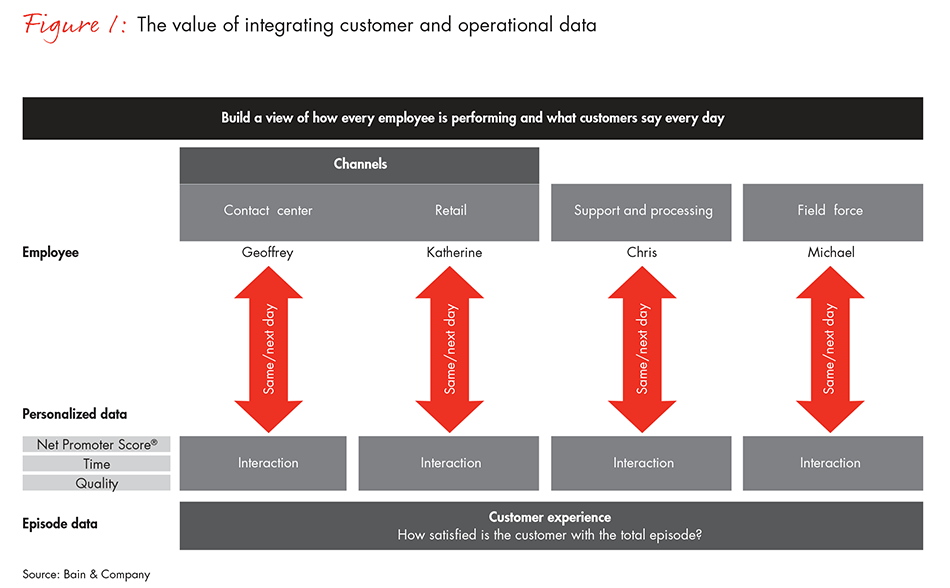
      Observational analytics serve as the foundation for creating a better customer experience (see Figure 1). Many mobile telecom operators, for example, have used analytics to track the patterns of dropped calls, while software-as-a-service providers track their application performance and specific feature usage as basic indicators of the customer’s experience. This instrumentation can cover fine-grained usage patterns and expressed sentiment in human interactions.

      what-big-data-means-for-customer-loyalty-fig01_embed

      Predictive analytics go well beyond the recommendation engines that firms such as Netflix deploy. For example, when a customer goes through a series of negative interactions (such as experiencing long wait times, damaged items or service outages), Big Data analytics can predict the likelihood of that customer becoming a detractor; the customer might reduce purchases, stop visiting a website, or even defect to a competitor. A company also can effectively conduct sentiment analysis of contact center calls in order to make predictions without having to directly survey customers.

      Prescriptive analytics help companies determine the most effective steps after one or more interactions. For example, one of us recently flew business class on Virgin America for the first time in almost a year. The plane was delayed on the tarmac for a half hour. As soon as the flight landed, we received an email from Virgin apologizing for the delay and offering a $50 voucher toward our next Virgin flight.

      Contrast that smart prescription with the way that some airlines handle similar problems. They know about delays—not to mention their old aircraft with uncomfortable seating and poor food—yet they persist in sending surveys after every flight without closing the loop to fix those issues.

      That’s absurd. With so much digital data now available through connections in aircraft, cars, smartphones, televisions and other devices, most companies should know in real time when problems occur and be able to respond proactively.

      The abiding human touch


      Despite the growing sophistication of Big Data and the resulting algorithms, loyalty leaders still rely on hands-on employee involvement. Advanced practitioners of the Net Promoter System®, for instance, loop real-time customer experience data and fresh customer feedback to employee teams. Those teams translate the feedback into action by identifying and launching process improvements that have a positive and material effect on customers’ experiences with the company.

      Team leaders and other staff close the loop by calling back customers who had a bad experience in order to help deal with their concerns. They also speak with some customers who had a good experience to learn more about what made them feel so positive. Talking directly to customers allows the team to understand what real individuals want, rather than speculating or thinking in terms of the average customer. Big Data does not replace this ability to dig into the underlying causes of what individuals perceive, but it can amplify the value by applying the lessons across a very broad base of customers.

      Human dialogue with customers is central to other endeavors as well, including new product design, prototype testing, sales of complex solutions and troubleshooting support. And digital technologies can allow employees to have much higher-quality and often lower-cost interactions with customers in those areas. At many web and mobile software companies, for instance, engineers interact with a small panel of customers via online tools such as those offered by usertesting.com. Seeing and hearing how customers interact with a product in real time shows engineers what they need to do better or differently.

      Big Data then can reinforce and extend some of the fundamental principles around earning customer advocacy.

      • Get the basics of the experience right. Wine.com, a leading online wine retailer, has invested in recommendation algorithms and a convenient digital experience for selection and shipping, but it also encourages customers to chat with sommeliers. These experts help customers learn and explore a broader selection, which has increased customers’ loyalty and lifetime value to the firm.
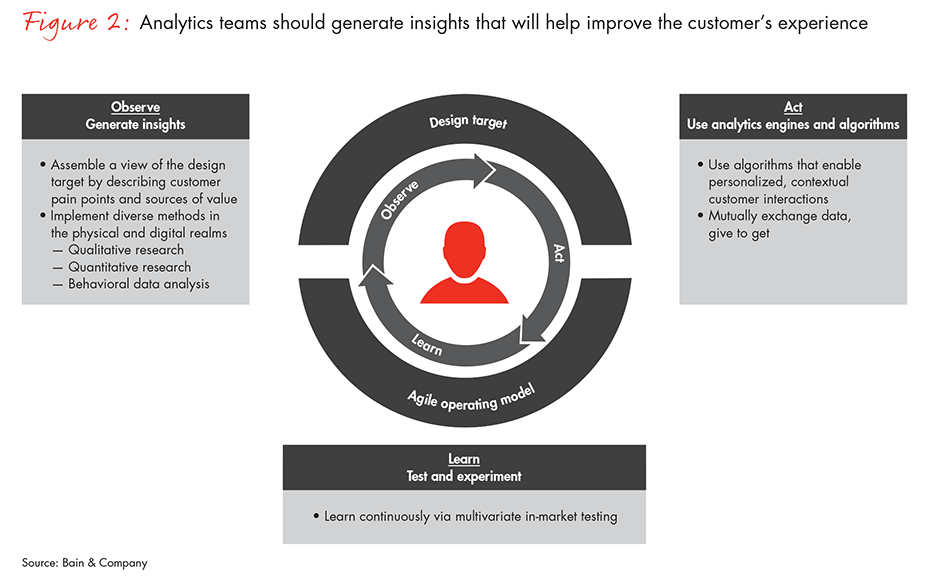
      • More data without action moves a company backward. The data will only be useful if you tie it into customer feedback loops that lead directly to improvements in the relevant experience (see Figure 2). Think of software applications that ask millions of users to report crashes yet never close the loop with those customers or fix the application. The software companies are swimming in experience data but do not use the data to make the relevant improvements.
      • Data itself does not create a customer-centered culture. Many companies have intensely instrumented their experience without truly incorporating the customer’s perspective. The enterprise software industry has an average Net Promoter Score of negative 3 from its customers and even lower scores among end users. The ethos of providing a great end-user experience has not permeated that industry despite the reams of data it collects.
      what-big-data-means-for-customer-loyalty-fig02_embed

      The most effective companies use Big Data analytics to scale up their abilities to serve, tailor and enhance the experience for their customers. They still rely on humans for creativity, making trade-offs and engaging with customers where it matters—that is, in all the areas where human judgment and empathy come into play.

      Chris Brahm is a partner with Bain & Company’s Digital and Advanced Analytics practices. Aaron Cheris is a partner with the Customer Strategy & Marketing practice, and he leads the firm’s Retail practice in the Americas. Both partners are based in San Francisco.

      Net Promoter System® and Net Promoter Score® are registered trademarks of Bain & Company, Inc., Fred Reichheld and Satmetrix Systems, Inc.


      what-big-data-means-for-customer-loyalty-fig01_full

      what-big-data-means-for-customer-loyalty-fig02_full
      Autoren
      • Headshot of Chris Brahm
        Chris Brahm
        Alumni, San Francisco
      • Headshot of Aaron Cheris
        Aaron Cheris
        Partner, San Francisco
      • Headshot of Lori Sherer
        Lori Sherer
        Advisory Partner, San Francisco
      Kontaktieren Sie uns
      Ähnliche Beratungsangebote
      • Advanced Analytics
      • Kundenstrategie und Marketing
      • Net Promoter System®
      Wie wir Sie unterstützen können
      • Net Promoter®
      Digitalisierung
      Die Mathematik, die Magie und der Kunde

      Mad Men war gestern. Marketingspezialisten von heute ähneln eher Mathematikern. Mit ausgeklügelten Instrumenten dringen sie in die Tiefen der Datenanalyse vor und nutzen neue Software.

      Mehr erfahren
      Advanced Analytics
      Lori Sherer: Customer Insights and Analytics in Agile Development

      Bain Partner Lori Sherer discusses the role of insights and analytics in digital customer experience design.

      Mehr erfahren
      Advanced Analytics
      Aaron Cheris: What Big Data Means for Customer Loyalty

      How advanced analytics can help companies observe and predict behavior, and prescribe ways to improve the customer experience.

      Mehr erfahren
      Net Promoter®
      The Future of Feedback: Sometimes You Don't Have to Ask

      Advanced analytics can predict when a customer is happy (or not)—and then help you take action.

      Mehr erfahren
      Net Promoter System®
      How Banks Can Tease Out the Loyalty Metrics That Matter

      Measuring performance on the key episodes for a bank’s customers allows the bank to focus on investments that will improve loyalty—and its economics.

      Mehr erfahren
      First published in August 2016
      Markierungen
      • Advanced Analytics
      • Kundenstrategie und Marketing
      • Net Promoter System®
      • Net Promoter®

      Wie wir unsere Kunden unterstützt haben

      Transformation Turning around a pioneering service for working parents with sick children

      Kundenbeispiel lesen

      Transformation Transformation sparks financial leader's turnaround

      Kundenbeispiel lesen

      Kundenstrategie und Marketing Revitalizing a utility's market position with customer loyalty

      Kundenbeispiel lesen

      Möchten Sie mit uns in Kontakt bleiben?

      Wir unterstützen Führungskräfte weltweit, die kritischen Themen in ihrem Unternehmen zu adressieren. Gemeinsam schaffen wir nachhaltige Veränderungen und Ergebnisse.

      Bain Insights. Unsere Perspektive auf die kritischen Themen, mit denen sich international agierende Unternehmen konfrontiert sehen, finden Sie monatlich in Ihrem Postfach.

      *Ich habe die Datenschutzerklärung gelesen und akzeptiere sie.
      Bitte lesen Sie die Datenschutzerklärung und akzeptieren Sie diese.
      Bain & Company
      Contact us Sustainability Accessibility Rechtliche Hinweise Impressum Datenschutz Cookie-Richtlinie Sitemap Log In

      © 1996-2026 Bain & Company, Inc.

      Kontaktieren Sie Bain

      Wie können wir Ihnen helfen?

      • Business inquiry
      • Career information
      • Press relations
      • Partnership request
      • Speaker request
      Alle weltweiten Büros