
Skip to Content
  • Standorte

    Standorte

    North & Latin America
    • Atlanta
    • Austin
    • Bogota
    • Boston
    • Buenos Aires
    • Chicago
    • Dallas
    • Denver
    • Houston
    • Lisbon
    • Los Angeles
    • Mexico City
    • Minneapolis
    • Monterrey
    • Montreal
    • New York
    • Rio de Janeiro
    • San Francisco
    • Santiago
    • São Paulo
    • Seattle
    • Silicon Valley
    • Toronto
    • Washington, DC
    Europe & Africa
    • Amsterdam
    • Athens
    • Berlin
    • Brussels
    • Copenhagen
    • Düsseldorf
    • Frankfurt
    • Helsinki
    • Istanbul
    • Johannesburg
    • Kyiv
    • Lisbon
    • London
    • Madrid
    • Milan
    • München
    • Oslo
    • Paris
    • Rome
    • Stockholm
    • Warsaw
    • Wien
    • Zürich
    Middle East
    • Doha
    • Dubai
    • Riyadh
    Asia & Australia
    • Bangkok
    • Beijing
    • Bengaluru
    • Brisbane
    • Ho Chi Minh City
    • Hong Kong
    • Jakarta
    • Kuala Lumpur
    • Manila
    • Melbourne
    • Mumbai
    • New Delhi
    • Perth
    • Seoul
    • Shanghai
    • Singapore
    • Sydney
    • Tokyo
    Alle Standorte Anzeigen
  • Alumni
  • Presse
  • Newsletter
  • Kontakt
  • DACH-Region | Deutsch

    Wählen Sie Ihre Region und Sprache

    Global
    • Global (English)
    North & Latin America
    • Brazil (Português)
    • Argentina (Español)
    • Canada (Français)
    • Chile (Español)
    • Colombia (Español)
    Europe, Middle East, & Africa
    • France (Français)
    • DACH-Region (Deutsch)
    • Italy (Italiano)
    • Spain (Español)
    • Greece (Elliniká)
    Asia & Australia
    • China (中文版)
    • Korea (한국어)
    • Japan (日本語)
  • Saved items (0)
    Saved items (0)

    You have no saved items.

    Inhalte, für die Sie sich interessieren, werden hier gespeichert und können später gelesen oder weitergeleitet werden.

    Explore Bain Insights
  • Branchenkompetenzen
    Hauptmenü

    Branchenkompetenzen

    • Luft- und Raumfahrt, Verteidigung
    • Agrarwirtschaft
    • Chemieindustrie
    • Infrastruktur und Bauwirtschaft
    • Konsumgüter
    • Finanzdienstleistungen
    • Gesundheitswesen
    • Maschinen- und Anlagenbau
    • Medienwirtschaft
    • Metallindustrie
    • Bergbau
    • Öl und Gas
    • Papier- und Verpackungsindustrie
    • Private Equity
      Branchenkompetenzen
      Private Equity
      • Due Diligence
      • Exit Planning
      • Firm Strategy & Operations
      • Portfolio Value Creation
    • Öffentlicher Sektor und Sozialwesen
    • Einzelhandel
    • Technologie
    • Telekommunikation
    • Transportwesen
    • Reise- und Freizeitbranche
    • Versorgung und erneuerbare Energien
  • Managementkompetenzen
    Hauptmenü

    Managementkompetenzen

    • Customer Experience
    • ESG
    • Innovation
    • M&A
    • Operations
    • People & Organization
    • Private Equity
    • Sales & Marketing
    • Strategie
    • KI, Einblicke und Lösungen
    • Technologie
    • Transformation
  • Digital
  • Publikationen
    Hauptmenü

    Publikationen

    • Branchenthemen
    • Managementthemen
    • Bain-Bücher
    Alle Publikationen
    Ausgewählte Themen
    • Resilienz in der globalen Krise
    • M&A Report
    • Private Equity Podcast
    • Midyear Private Equity Report
    • Agile
    • Engineering Report
    • Digital Transformation
    • Elements of Value®
    • Firm of the Future
    • Nachhaltigkeitsstudie
    • Macro Trends
    • Future of Consumption
    • Weltwirtschaftsforum (WEF)
  • Über uns
    Hauptmenü

    Über uns

    • Was wir bieten
    • Unser Ansatz
    • Unser Team
    • Game Changer Award
    • Female Allstar Board
    • Messbare Ergebnisse (EN)
    • Auszeichnungen
    • Globale Partnerschaften
    • The Mission
    Further: Our global responsibility
    • Vielfalt & Chancengleichheit
    • Soziale Verantwortung
    • Sustainability
    Erfahren Sie mehr zu "Further"
  • Karriere
    Hauptmenü

    Karriere

    • Dein Einstieg
      Karriere
      Dein Einstieg
      • Find Your Place
      • Unsere Arbeitsbereiche
      • Unsere Teams
      • Angebote für Studierende
      • Praktika & Programme
      • Recruiting-Events
    • Arbeiten bei Bain
      Karriere
      Arbeiten bei Bain
      • Blog: Inside Bain
      • Karriere Stories
      • Unsere Bainies
      • Office-Standorte
      • Weiterentwicklung
      • Affinity Groups
      • Deine Benefits
    • Impact Stories
    • Deine Bewerbung
      Karriere
      Deine Bewerbung
      • Das erwartet dich
      • Der Interviewprozess
    FIND JOBS
  • Standorte
    Hauptmenü

    Standorte

    • North & Latin America
      Standorte
      North & Latin America
      • Atlanta
      • Austin
      • Bogota
      • Boston
      • Buenos Aires
      • Chicago
      • Dallas
      • Denver
      • Houston
      • Lisbon
      • Los Angeles
      • Mexico City
      • Minneapolis
      • Monterrey
      • Montreal
      • New York
      • Rio de Janeiro
      • San Francisco
      • Santiago
      • São Paulo
      • Seattle
      • Silicon Valley
      • Toronto
      • Washington, DC
    • Europe & Africa
      Standorte
      Europe & Africa
      • Amsterdam
      • Athens
      • Berlin
      • Brussels
      • Copenhagen
      • Düsseldorf
      • Frankfurt
      • Helsinki
      • Istanbul
      • Johannesburg
      • Kyiv
      • Lisbon
      • London
      • Madrid
      • Milan
      • München
      • Oslo
      • Paris
      • Rome
      • Stockholm
      • Warsaw
      • Wien
      • Zürich
    • Middle East
      Standorte
      Middle East
      • Doha
      • Dubai
      • Riyadh
    • Asia & Australia
      Standorte
      Asia & Australia
      • Bangkok
      • Beijing
      • Bengaluru
      • Brisbane
      • Ho Chi Minh City
      • Hong Kong
      • Jakarta
      • Kuala Lumpur
      • Manila
      • Melbourne
      • Mumbai
      • New Delhi
      • Perth
      • Seoul
      • Shanghai
      • Singapore
      • Sydney
      • Tokyo
    Alle Standorte Anzeigen
  • Alumni
  • Presse
  • Newsletter
  • Kontakt
  • DACH-Region | Deutsch
    Hauptmenü

    Wählen Sie Ihre Region und Sprache

    • Global
      Wählen Sie Ihre Region und Sprache
      Global
      • Global (English)
    • North & Latin America
      Wählen Sie Ihre Region und Sprache
      North & Latin America
      • Brazil (Português)
      • Argentina (Español)
      • Canada (Français)
      • Chile (Español)
      • Colombia (Español)
    • Europe, Middle East, & Africa
      Wählen Sie Ihre Region und Sprache
      Europe, Middle East, & Africa
      • France (Français)
      • DACH-Region (Deutsch)
      • Italy (Italiano)
      • Spain (Español)
      • Greece (Elliniká)
    • Asia & Australia
      Wählen Sie Ihre Region und Sprache
      Asia & Australia
      • China (中文版)
      • Korea (한국어)
      • Japan (日本語)
  • Saved items  (0)
    Hauptmenü
    Saved items (0)

    You have no saved items.

    Inhalte, für die Sie sich interessieren, werden hier gespeichert und können später gelesen oder weitergeleitet werden.

    Explore Bain Insights
  • Branchenkompetenzen
    • Branchenkompetenzen

      • Luft- und Raumfahrt, Verteidigung
      • Agrarwirtschaft
      • Chemieindustrie
      • Infrastruktur und Bauwirtschaft
      • Konsumgüter
      • Finanzdienstleistungen
      • Gesundheitswesen
      • Maschinen- und Anlagenbau
      • Medienwirtschaft
      • Metallindustrie
      • Bergbau
      • Öl und Gas
      • Papier- und Verpackungsindustrie
      • Private Equity
      • Öffentlicher Sektor und Sozialwesen
      • Einzelhandel
      • Technologie
      • Telekommunikation
      • Transportwesen
      • Reise- und Freizeitbranche
      • Versorgung und erneuerbare Energien
  • Managementkompetenzen
    • Managementkompetenzen

      • Customer Experience
      • ESG
      • Innovation
      • M&A
      • Operations
      • People & Organization
      • Private Equity
      • Sales & Marketing
      • Strategie
      • KI, Einblicke und Lösungen
      • Technologie
      • Transformation
  • Digital
  • Publikationen
    • Publikationen

      • Branchenthemen
      • Managementthemen
      • Bain-Bücher
      Alle Publikationen
      Ausgewählte Themen
      • Resilienz in der globalen Krise
      • M&A Report
      • Private Equity Podcast
      • Midyear Private Equity Report
      • Agile
      • Engineering Report
      • Digital Transformation
      • Elements of Value®
      • Firm of the Future
      • Nachhaltigkeitsstudie
      • Macro Trends
      • Future of Consumption
      • Weltwirtschaftsforum (WEF)
  • Über uns
    • Über uns

      • Was wir bieten
      • Unser Ansatz
      • Unser Team
      • Game Changer Award
      • Female Allstar Board
      • Messbare Ergebnisse (EN)
      • Auszeichnungen
      • Globale Partnerschaften
      • The Mission
      Further: Our global responsibility
      • Vielfalt & Chancengleichheit
      • Soziale Verantwortung
      • Sustainability
      Erfahren Sie mehr zu "Further"
  • Karriere
    Häufige Suchanfragen
    • Agil
    • Digital
    • Strategie
    Vorherige Suchanfragen
      Zuletzt besuchte Seiten

      Content added to saved items

      Saved items (0)

      Removed from saved items

      Saved items (0)

      World Economic Forum
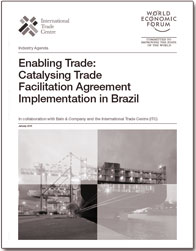
      Enabling Trade: Catalysing Trade Facilitation Agreement Implementation in Brazil

      Enabling Trade: Catalysing Trade Facilitation Agreement Implementation in Brazil

      New border procedures in Brazil have the potential to streamline trade and increase economic growth.

      • Min. Lesezeit

      Artikel

      Enabling Trade: Catalysing Trade Facilitation Agreement Implementation in Brazil
      en
      wef-enabling-trade-tfa-brazil-cover-thumb

      Countries worldwide are implementing measures to facilitate trade, but it will take years for them to benefit from their investments. This report showcases Brazil’s approach to trade facilitation as illustrated by its Single Window project, and highlights other best practices that countries can pursue to successfully implement trade reforms.


      Download the full report

      Countries are implementing trade facilitation measures, but are far from achieving competitiveness

      On average, the Trade Facilitation Agreement (TFA) forged at the World Trade Organization meeting in Bali, Indonesia, in 2013, has been implemented at a combined 39% rate among developing and least-developed countries, with wide variation. The focus has been on measures related to the release and clearance of goods, and to reducing the formalities in movement of goods. The TFA is effective in addressing some major supply chain barriers, but does not use all the available levers for countries to reach full trading potential. The TFA also does not cover some measures recommended in the World Economic Forum’s 2013 report, Enabling Trade: Valuing Growth Opportunities—issues related to telecommunications and transport infrastructure, for instance, and business environment. As a result, TFA implementation, while necessary, in many instances could be insufficient to make certain product segments competitive. The countries that will be the most effective will be those that view trade barriers across the end-to-end value chain in their most important industry, and then tackle those barriers to make the industry competitive. Improving that particular industry sets the stage for improvements in others.

      Single Window implementation is a priority for countries

      A Single Window is an electronic process in which trade and transport companies can provide standardized information and documents to fulfill import, export and transit-related regulatory requirements. Without such an option, companies must separately submit information and documentation to various agencies. The world has 73 Single Windows, but only about 18 countries have systems that connect all relevant government agencies and create a single entry point of information. Among implemented or ongoing projects worldwide, best practices can be found in Singapore, South Korea, Greece, Ecuador and Costa Rica. Each country illustrates a different, yet successful, approach, such as partnerships with the private sector. Enabling Trade: Catalysing Trade Facilitation Agreement Implementation in Brazil thoroughly examines Brazil’s exhaustive efforts to establish a Single Window—which serve as a model for implementation.

      Brazil’s Single Window implementation illustrates important procedures

      Border administration procedures have a major impact on trade in Brazil. In a study of private sector views, published by Brazil’s National Confederation of Industry (or CNI) in 2014, companies raised such issues as too many documents, a lack of communication among agencies, a slow and unpredictable analysis process, and sluggish inspection procedures. To solve many of these problems, Brazil launched its Portal Único or Single Window project in 2014. The goal is to make Brazil’s trade more competitive by increasing the transparency in procedures for all stakeholders and cutting export and import times. Currently, the average time for exports is 13 days and for imports is 17 days. Improved procedures could result in potential cost savings of $1.5 billion annually and could add $24 billion to Brazil’s gross domestic product or GDP, according to recent studies by Fundacao Getulio Vargas (or FGV), a Brazilian think-tank.

      The Portal Único programme demonstrates good practices, including:

      • Brazil has established Portal Único as a state—not a government—project supported by a presidential decree
      • The private sector has been involved since the project’s start, mapping current business processes, identifying current bottlenecks and discussing solutions
      • Brazil set up a managing committee to oversee the project and coordinate the other agencies in the implementation process

      Portal Único will address several border administration issues raised by the private sector. For example, it will directly reduce documentation formalities and automate processes. Moreover, the Single Window will indirectly create appropriate tools to support other projects, such as the authorized economic operators programme.

      Solutions and approaches may vary according to country characteristics, but some common factors contribute to successful implementation

      1. Governments need to prepare an overall structure that encompasses project enforcement, private sector involvement and proper governance. Next, they need to diagnose the main issues that will define the scope and phases of the project and how it connects to other current schemes. Such a diagnostic also is important to mobilize stakeholders and plan efforts. Finally, governments need to execute the plan with the appropriate support and partnership.
      2. Project enforcement: For a long-term, multistakeholder project in the public sector to succeed, the first step is to gather political support at the presidential level and make the project a priority for the country.
      3. Private sector involvement: Involving the private sector at the start in the details of project development is important to shape the solution for end-users and enhance the impact.
      4. Coordinating body: A coordinating body is essential to ensure effective implementation of a multistakeholder project like a Single Window. A supervisory body can align different priorities and approaches, arbitrate when necessary and speed up decisions.
      5. Diagnostic: Key performance indicators (KPIs) and a methodology to verify them must be established. Next, it is necessary to identify and map critical issues that affect the KPIs.
      6. Scope and phases: The stages of the processes must be clarified for all stakeholders, even if some institutions are not involved in some stages.
      7. Integration: It will be productive to have a broader, integrated trade plan that includes other programmes besides the Single Window, and describes how the programmes will help the country to meet its KPIs.
      8. Solution development: The technical solution for a Single Window may not be straightforward. It is beneficial to involve an experienced partner.
      9. The recommendations in the Enabling Trade: Valuing Growth Opportunities report are important to remember: trade will improve only when countries reach a “tipping point” at which it becomes profitable for companies to increase trade, and to create that tipping point requires focusing on more than one element of the value chain.

      Download PDFDownload PDFDownload PDF
      Ähnliche Beratungsangebote
      • Performance Improvement
      Performance Improvement
      Want More Out of Your AI Investments? Think People First

      To unlock AI’s exponential productivity potential, companies must modernize workflow and workforce in tandem.

      Mehr erfahren
      Performance Improvement
      It’s Time to Rethink Every Link in Your Supply Chain

      A function that once got little attention is now becoming a key differentiator.

      Mehr erfahren
      Performance Improvement
      Transforming Maintenance with Artificial Intelligence

      With little to no capex, companies can turn maintenance into an engine of cash flow.

      Mehr erfahren
      Performance Improvement
      Don’t Underestimate the Cost of Overcapacity

      Overcapacity is endemic to the paper and packaging industry, but these actions can help you maintain margins.

      Mehr erfahren
      Performance Improvement
      Stablecoins Could Make Cross-Border Payments Faster, Cheaper, and More Transparent

      Most CFOs are not using stablecoins today, but evolving regulations could reduce risk and create competitive advantage.

      Mehr erfahren
      First published in Januar 2015
      Markierungen
      • Performance Improvement

      Wie wir unsere Kunden unterstützt haben

      Performance Improvement Lean Six Sigma improves plant performance and cuts costs

      Kundenbeispiel lesen

      Performance Improvement Turning around a major newspaper publisher

      Kundenbeispiel lesen

      Performance Improvement Transforming a telecommunications giant

      Kundenbeispiel lesen

      Möchten Sie mit uns in Kontakt bleiben?

      Wir unterstützen Führungskräfte weltweit, die kritischen Themen in ihrem Unternehmen zu adressieren. Gemeinsam schaffen wir nachhaltige Veränderungen und Ergebnisse.

      Bain Insights. Unsere Perspektive auf die kritischen Themen, mit denen sich international agierende Unternehmen konfrontiert sehen, finden Sie monatlich in Ihrem Postfach.

      *Ich habe die Datenschutzerklärung gelesen und akzeptiere sie.
      Bitte lesen Sie die Datenschutzerklärung und akzeptieren Sie diese.
      Bain & Company
      Contact us Sustainability Accessibility Rechtliche Hinweise Impressum Datenschutz Cookie-Richtlinie Sitemap Log In

      © 1996-2026 Bain & Company, Inc.

      Kontaktieren Sie Bain

      Wie können wir Ihnen helfen?

      • Business inquiry
      • Career information
      • Press relations
      • Partnership request
      • Speaker request
      Alle weltweiten Büros