

Brief

In evidenza
- Leading banks outpace laggards by a factor of four in migrating sales and service interactions to digital channels, delivering a better experience and economics.
- It’s crucial to make digital easy and show customers how to self-serve, yet many banks are underinvesting.
- As banks reconfigure branch networks, success hinges on newly skilled and engaged employees, deployed in new roles.
- An iterative “hothouse” approach to developing digitally infused networks is a practical means of connecting the future vision to today’s realities.
Talk about a long slog. Retail banks have been trying to automate consumer transactions for decades, usually for reasons of cost: Each mobile interaction incurs a variable cost of about 10 cents, vs. $4 for a teller or call-agent interaction. Mobile also has half the likelihood of annoying a customer, Bain & Company analysis shows. And in our experience, roughly 60% of branch volume remains bad or avoidable.
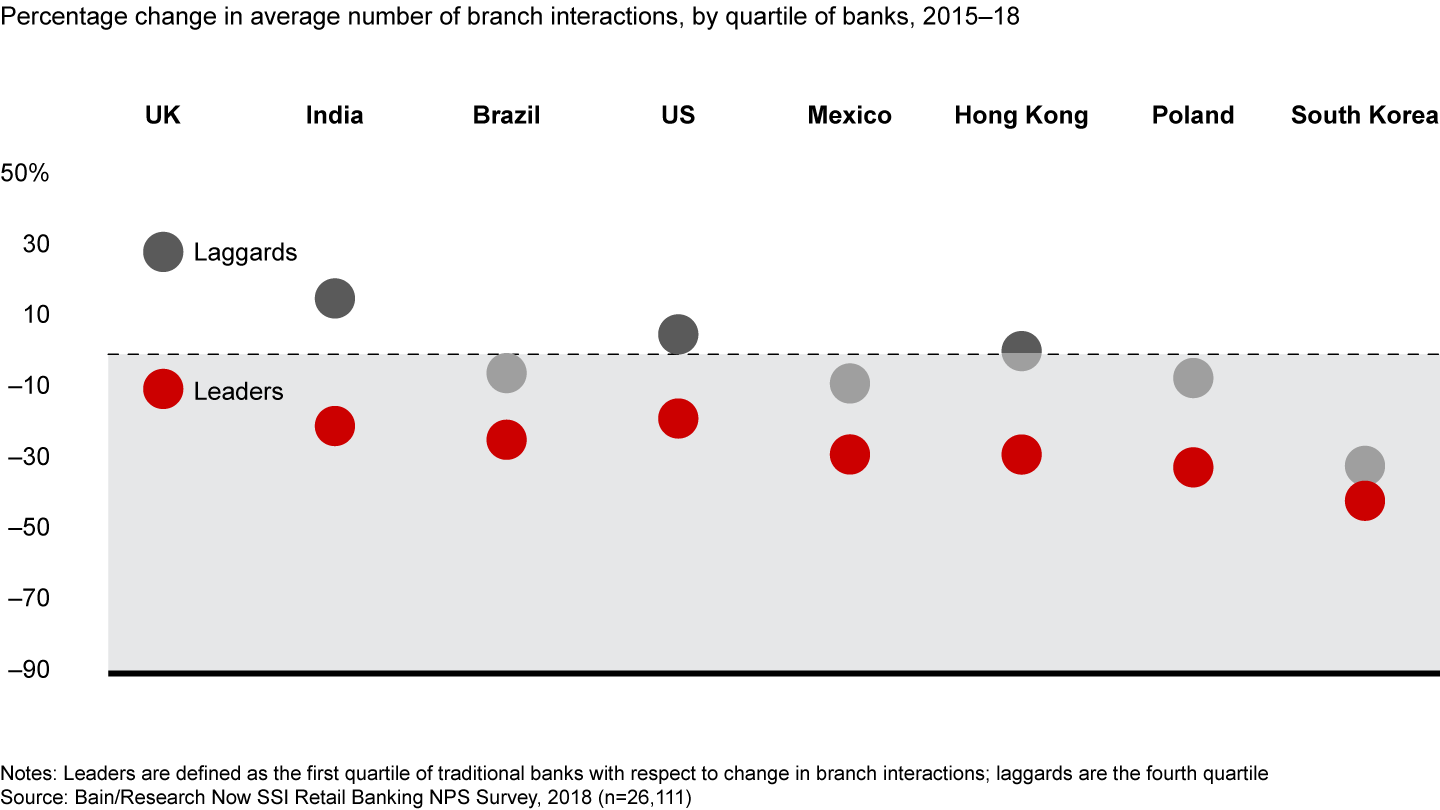
In recent years, the opportunity has expanded beyond cost reduction to enhancement of customers’ overall banking experience. A typical large bank in Europe with more than 1,000 branches could expect to see a 50% lift in per-branch economics (lower costs plus higher revenues) through smart digital migration and branch network restructuring. Yet the pace of change in many markets remains glacial, and banks should not expect customers to migrate to digital all on their own (see Figure 1). While banks benefited from the early adoption of digital tools by more tech-savvy customers, banks now will need greater investment and focus to shift behavior of other groups of customers.
Figure 1

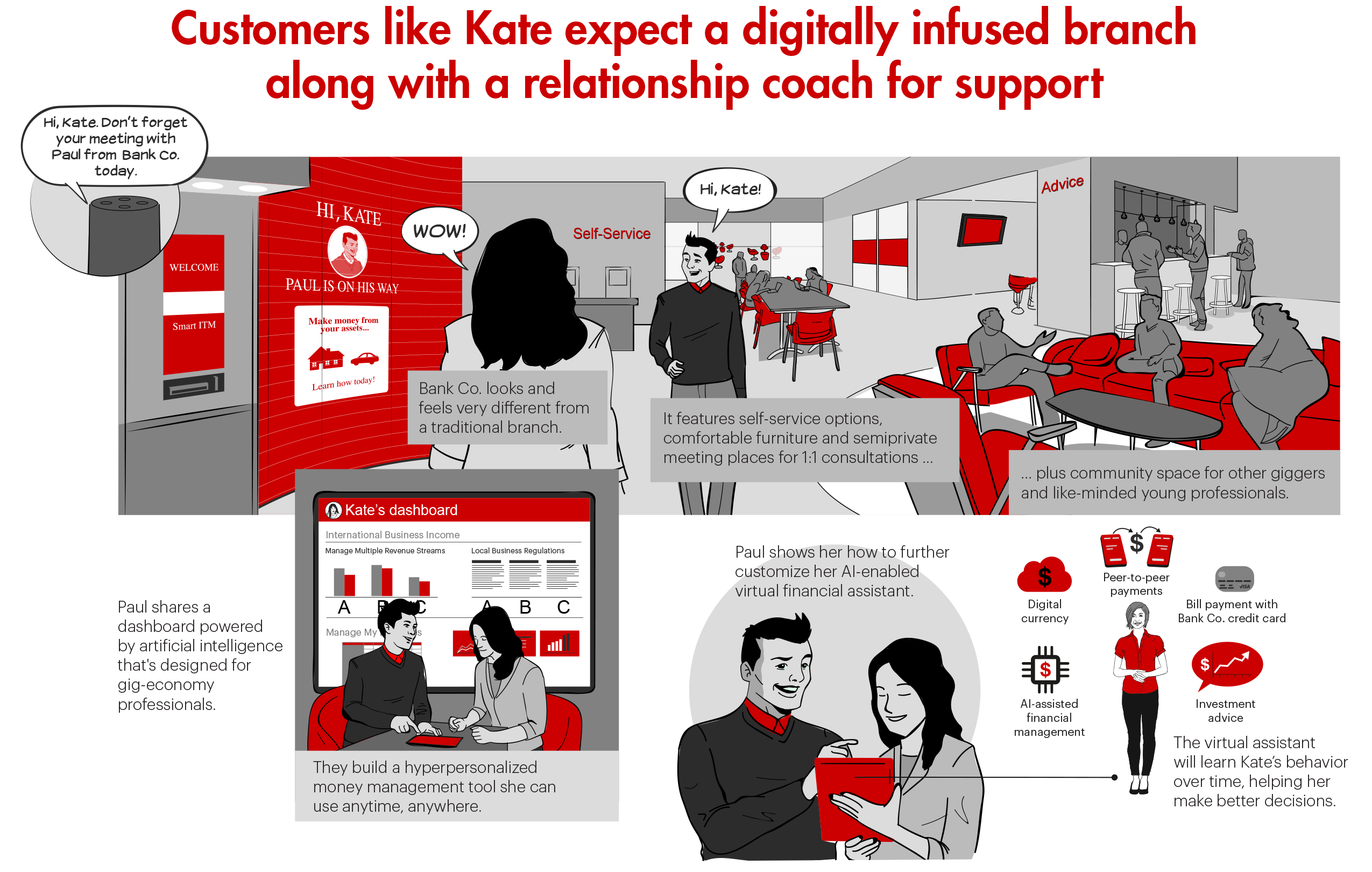
Why do banks need to accelerate the digital transition? Consider a future customer like Kate, a late-20-something working in the gig economy in 2025. She manages multiple income streams and several loans, and just received a substantial inheritance. She interacts with her bank and pays for things mainly through voice-assisted mobile devices, using many digital tools and alerts to manage her money. But she relies on the branch for deeper financial advice and coaching—and she wants these different channels to work together seamlessly (see graphic).

To deliver an experience that Kate and others will value, while also taking cost out of the branch network, leading banks are far outpacing laggards—in the US, for instance, at four times the rate. They have been following a clear, proven playbook along three complementary paths:
- Making digital easy for customers to use, and actively coaching them to migrate;
- Reconfiguring the branch network and formats; and
- Raising employees’ skills, equipping them for digitally infused service and sales, and connecting them as teams dedicated to specific aspects of the experience.
While no bank has completed a transition along all three paths, leading banks have taken significant strides in each area, and they are already reaping benefits from their interventions.
Make digital easy and show customers how
Virtually all banks have been migrating service transactions to digital channels, yet the pace of change and the return on investment vary substantially. The leaders make it easy for customers and take care to help them adopt and use digital tools.
Citibanamex, for instance, took on the bad volume challenge, which is particularly vexing in Mexico. The bank reckoned that its customers and employees were spending 5 billion minutes per year in service transactions at branches, with the vast bulk of that time on the customers’ end. This waste took a toll on the bank’s cost-to-income ratio and ultimately on profits—not to mention customer and employee advocacy. Through a combination of initiatives ranging from simplifying online forms and printing formats, to migrating more transactions to ATMs, to reducing wait time at teller windows, Citibanamex freed up 1 billion minutes—providing a major boost to customer satisfaction and employee advocacy.
Many customers are open to self-service for resolving queries or completing a purchase, if they receive a nudge and a bit of guidance. Branch employees will have to venture out of the cubicle to teach the young how to bank generally, and the old how to self-service bank, through simple demonstrations and interventions that blend education and encouragement—not “Why don’t you use your phone?” but “Would you like to see how you could save time?”
Digital propositions have also taken hold in sales, becoming a major source of leakage for banks. Hidden defection—when a customer purchases an additional banking product from a competing bank or provider—continues to take place everywhere, totaling 22% to 49% of additional products in 2018, depending on the country, our survey analysis finds. Credit cards, loans, insurance and investments are the categories most likely to lure consumers to competitors, whereas the primary bank tends to keep a higher share of low-value deposit accounts. Since many consumers tend to purchase secondary products through digital channels, it follows that banks should ramp up their digital marketing and sales efforts. Making digital sales easy for customers, with coaching for the wary, can alleviate defection.
Even products that are more complex have shifted to a “simple and digital” proposition. Quicken Loans grew from less than 1% of retail mortgage originations in the US in 2008 to almost 6% at the end of 2017. Quicken Loans recently overtook Wells Fargo to become the leading direct-to-consumer mortgage lender in the country. When the company launched Rocket Mortgage, Quicken Loans said it took a team of 500 software developers three years to streamline the mortgage process. That’s a level of investment most banks hesitate to commit to.
Done well, the digital sales migration pays big dividends. Consider DBS in Singapore, which has actively encouraged its customers to shift to its user-friendly digital channels. DBS reports financials separately for digital customers, with digital defined by share of transactions, product purchases or upgrades via digital channels. The bank’s digital customers may cost 1.5 times more to serve than traditional customers, because they have more products and interact more online. But they generate nearly twice the income, because they also have higher-value deposits, loans and investments, and they cost much less to acquire.
Digital coaching will not be a onetime effort but rather a continual challenge, as technologies evolve quickly. Consider the adoption of home voice assistants in the US. It took the devices just 3½ years to reach 30% household adoption after Amazon released its Echo in November 2014, compared with about 5½ years for 30% adoption of smartphones. And a large share of consumers in many countries we surveyed are open to banking through a voice assistant. Clearly, voice-assisted banking is ready to join the coaching agenda.

Pablo Sansuste: Reimagining the Digital Bank Branch of the Future
Bain Partner Pablo Sansuste discusses how leading banks can take three steps to accelerate the digital migration.
Reconfigure the branch network for a digital age
At most banks, roughly one-third of the branch network earns by far the greatest return and should be the focus of investment. This group consists of several branch types: flagship branches serving as brand anchors, showrooms for complex product sales and venues for trusted expert advice; “hub” branches in central locations that are smaller versions of flagships; and specialist branches catering to distinct groups, such as small business owners or retirees.
Another third of the network still matters in many markets, at least in the near term. These “spoke” branches offer basic services such as cash handling, sales support (including video links to product specialists in other offices) and digital education.
The final third includes the weakest links and the first candidates for closure. Some of these branches may need to stay open for political or regional expansion reasons, but most should be shuttered because of irredeemable economics and lack of promise, with employees reassigned to better locations.
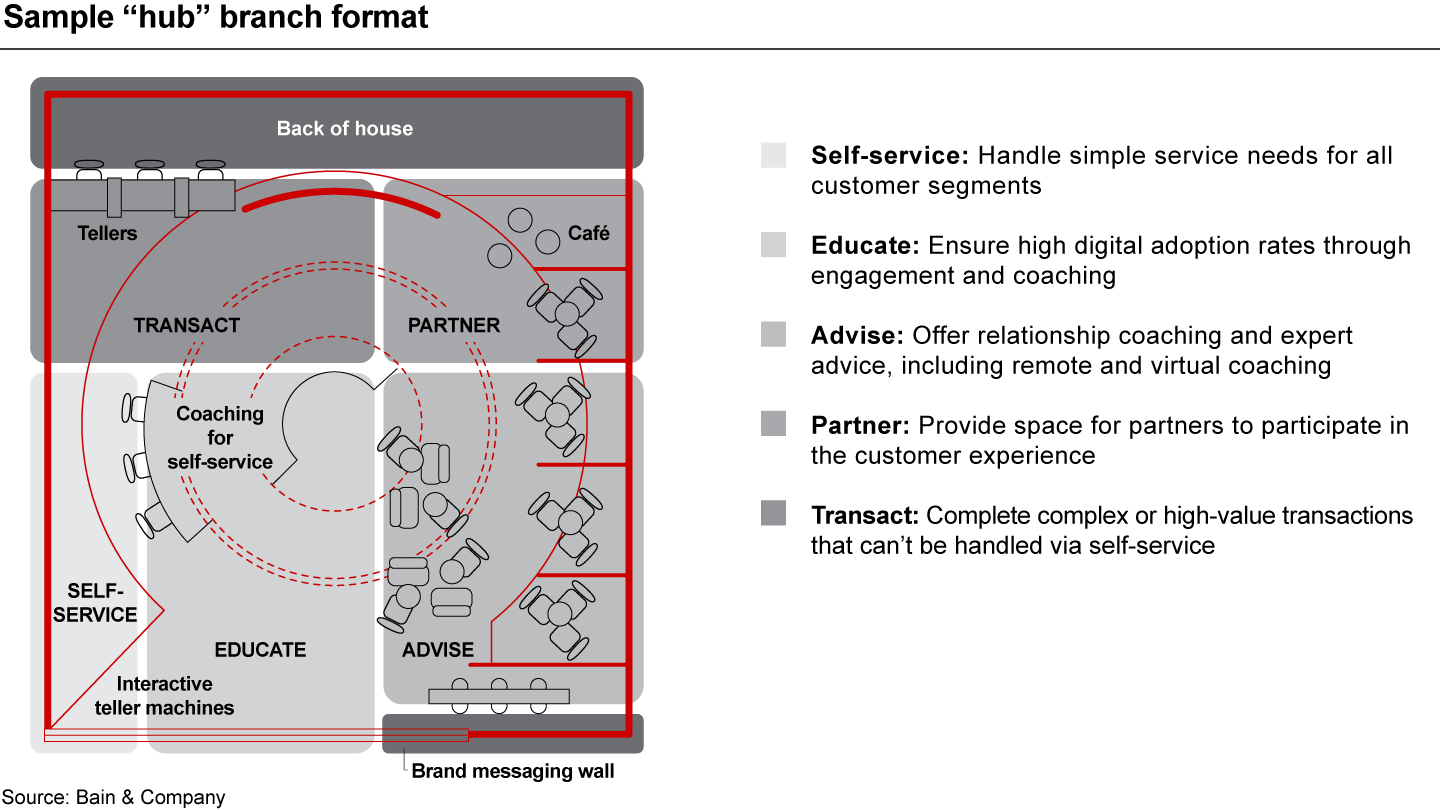
Leading banks have been optimizing the branch footprint by micro-market—a contained region of between 10 and 30 branches. They are shifting to innovative formats that feature five zones (see Figure 2), in a mix that varies depending on the type of branch:
- Self-service, to handle cash and simple service needs for all customer segments
- Educate, to accelerate digital adoption through customer engagement and coaching
- Advise, to provide consultations using product specialists and relationship coaches
- Partner, to allow community partners and screened vendors to make presentations and engage with customers
- Transact, to deal with complex or high-value transactions
Figure 2

Nordea’s branch network in Europe’s Nordic countries, for instance, has evolved from being predominantly full-service to focusing on advisory or service. Deutsche Bank in Germany reduced its branch footprint by 42% between 2010 and 2017, while successfully innovating with new formats focused on advisory and digital solutions. Regional advisory centers providing advice remotely via digital channels, and a larger network of self-service locations, complement the branches.
Redeploy branch employees: from individuals to a team of teams
How a bank manages employees through the branch evolution will make the difference in how fast it can progress. Reducing headcount gradually becomes less important than redeploying employees in ways that will build a superior experience. Employees will play different roles, with many moving from narrow service or sales positions to broader, digitally fluent relationship coaching roles, both within the branch and outside its four walls through video chat and other virtual channels.
With this in mind, banks should start planning for the new skills, training, incentives and behaviors required. The playbook for new employee functions includes training to upgrade skills, both technical and coaching-related (see graphic). Bite-size programs—adopted by a growing number of firms in other industries, including Apple and The Cheesecake Factory—lend themselves to self-paced training on topics such as blockchain and investments.

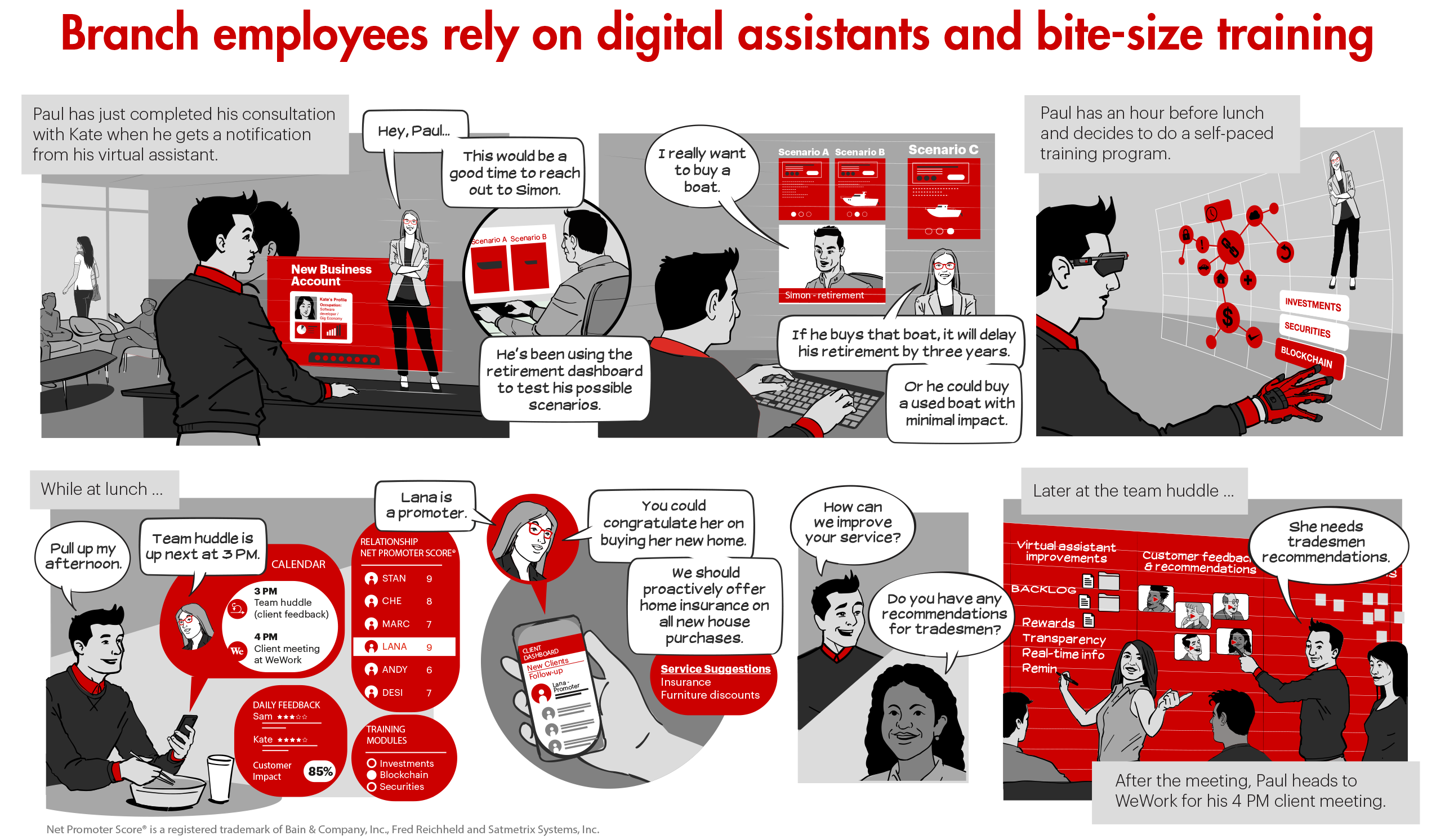
Some leading organizations are moving to a team-of-teams model, in which local-market teams support each other to achieve customer outcomes regardless of channel or product. These local teams serve as sources of learning for central experience teams or centers of excellence. Compared with what most banks are doing today, the model entails quite different ways of working across the organization. And teams will require new types of digital support, ranging from virtual assistants powered by artificial intelligence engines, which can anticipate customer needs and prompt employees to address them, to back-office systems that automate processes and forms.
Grow the new network in a hothouse
Plenty of banks have plans for a digital future, but they often view those plans as distant goals, with current initiatives unrelated to each other. A future-back view is important, so everyone has a common vision—but it’s essential to connect that view to today’s realities.
One practical way to integrate initiatives is through a “hothouse” approach, in which frontline teams design, test and prototype solutions for a micro-market. The iterative nature of a hothouse, informed by feedback from the market, helps to spur rapid changes in customer and employee behavior.
For instance, a hothouse project might aim to improve a bank’s Net Promoter Score® (a key metric of customer loyalty) while taking digital sales from 25% to 50% of total sales in a particular micro-market. Instead of trying to predict the future all at once and restructure in a big bang, the hothouse approach aims for incremental progress through rapid-cycle design sprints. Teams make the offering or service materially different, install a full set of customer and employee changes, launch the initiative in a number of branches, and iterate over time. They then bundle successful ideas and scale them rapidly across the entire network.
Bank branches are by no means dead, but many in their current guises have become obsolete. The network has to change faster and more substantially than most bankers acknowledge. Banks that accelerate their branch transformation can not only mitigate the threat from technology firms but also pass their competitors, delight customers, and achieve stronger, more profitable growth.
Mark Schofield, Nikola Glusac and Peter Stumbles are partners with Bain & Company’s Financial Services practice, and Peter leads the practice in the Asia-Pacific region. They are based, respectively, in Toronto, Berlin and Sydney.
Net Promoter Score® is a registered trademark of Bain & Company, Inc., Fred Reichheld and Satmetrix Systems, Inc.
First published in gennaio 2019