

Founder's Mentality Blog

Many companies ask us for our best-practice examples, which can help spark new ideas or inspire a new perspective on their current situation. But when it comes to designing a transformation journey and creating sustainable results, copying best-practice companies won’t always work—the context in which these companies operate may be very different from your own. As you continue to scale the micro-battles portfolio, you often need to step back and look at the progress of your broader transformation journey and tailor it to the context of your organization.
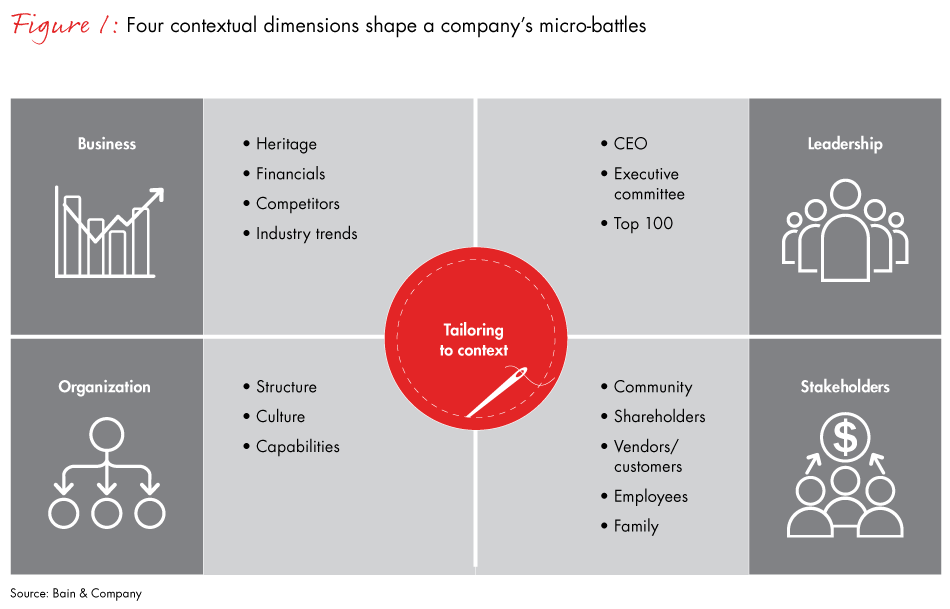
We believe that there are four contextual dimensions (Figure 1) that make your situation unique, and therefore need to be considered when designing the transformation journey and adapting it along the way:
- The business context
- The leadership context
- The stakeholder context
- The organizational context

Micro-battles
Want to learn more about the journey to scale insurgency? Explore the Bain Micro-battles System℠, step by step.
The business context
The first dimension to consider is your business context, which contains four important elements: financials, competitors, heritage and industry trends.
- Financials. How are you doing as a company compared with your peers, or with yourself two to five years ago? Are you in a turnaround, or worse, an almost bankrupt situation? Or are you the market leader trying to move from good to great? What is your market position? How are your financial results? What is your outlook?
- Competitors. Consider the unique value proposition you offer to your customers. How different is it from your current and future competition? Are you dominating and truly differentiating? Or do you need to win back the trust and appreciation of your customer base? Who is the potential industry disruptor—you or your competitor?
- Heritage. What was the founders’ mission and how strongly is that mission reflected in your company today? What specific qualities did the founders instill in the company? Are they still present today?
- Industry trends. How much disruption can you expect? Do you need to anticipate and bake it into your transformation roadmap? Are you in the forefront of the digital revolution, like the technology or telecom industries, or the banking and retail sectors? Or are you in a different phase of the digital s-curve, like the mining or basic materials industries?
Depending on your answers to these questions, the speed and scale required for your transformation will be very different. In addition, your foundation and market position will influence your design approach. As you tailor your micro-battles journey to these needs, think about how you can leverage and scale your strengths, rather than simply fix what is broken.
The leadership context
The second dimension is the leadership of the organization, as they will need to design the journey, lead change and create results. We will examine this at three levels: CEO, executive committee (Exco) and “Top 100.”
- CEO. What is the position and mandate of the CEO? What is his or her tenure? Do you have a brand new CEO with a two- to three-year window ahead to plan and create results? Or a tenured CEO of six to ten years with a solid track record? What’s his or her background in the company? Is the CEO coming from within or from outside of the company? What’s the CEO’s personality? What are the strengths that you should consider leveraging in the journey? As we indicated before, we truly believe that in the Bain Micro-battles SystemSM, it is the CEO who will have to lead from the front. But depending on the background and context of the CEO, the preparation required and approach needed will be very different.
- Exco. When it comes to the Exco, the elements that you often need to consider are team composition and the current levels of trust, as well as the individual and collective strength to lead the transformation. Is the Exco well balanced in terms of qualities and capabilities needed to win and scale in the next three years? Should you diversify and bring in new capabilities? How do you build the required level of trust within the team? How can you move to a high-performing team experience across silos (which will be key to winning in tomorrow’s competitive landscape)? Getting the Exco right is the first step for the CEO. The Exco will be absolutely critical as you test and learn in your micro battle approach and as you scale and amplify the new approach across the organization.
- Top 100. Whatever the number (top 50, 100 or 250), this refers to a broad set of leaders, as individuals and teams, who are responsible for leading the transformation and achieving results. Any organization that embarks on a micro-battles journey will need to have the right set of what we call IQ, EQ, and LQ skills to lead effectively and create sustainable results:
- IQ skills to understand business priorities, solve business problems, and come up with creative business ideas to win in the market place.
- EQ capabilities, or emotional intelligence, to lead teams effectively by empowering others, understanding their personal context and building trust.
- LQ skills, or the leadership capabilities that are unique to humans. What’s driving your own personal behavior? How do you react in moments of stress? What values, belief systems and fears drive (consciously and unconsciously) 90% of your behaviors? What is your purpose in life, and how does this work fulfill it?
Strengthening the set of IQ, EQ and LQ capabilities throughout the leadership spine of your organization—from the Top 100 down to the middle management and front line—is an integral part of supporting your transformation. We often develop what we call a “field and forum approach,” which consists of forums or workshops to co-create the strategy, transformation approach and micro-battles setup. Meanwhile, in the learning center, we facilitate new ways of working between the Exco and micro-battle teams to apply to real “field” cases. This approach develops the qualities and strengths of your leadership team, which will ultimately determine whether you create sustainable results.
The stakeholder context
Every company operates and works with a unique set of stakeholders, which might require a separate set of tailoring interventions and communications to support the journey. You may need to consider several different types of stakeholders, including community, shareholders, family and employees/vendors/customers.
- Community. What community are you serving? How about the community from which you hire your employees? And the community where your customers live? What do you intend to achieve for and with these communities?
- Shareholders. What are the expectations of the shareholders? What is their background with you? How can you manage their expectations? Are activist shareholders content on the risk-return for their invested money? Or are they looking for alternative ways to invest?
- Family. Are you a family-owned business? How do you bring the family, with its additional inherent strengths and complexities, along on your transformation journey?
- Employees/vendors/customers. Do you consider employees, vendors and customers as stakeholders in your journey to become an insurgent leader in your industry? And how do you engage them? How can you make them part of who you are and the strengths you are trying to gain?
The organizational context
Finally, you need to tailor your approach to the organization. Within the organization, you should consider three key dimensions—your structure, your culture and your capabilities.
- Structure. Are you a multinational company active in several continents? Or are you a single-region, single-product operating company? Is your company managed as separate business units with profit and loss responsibility? Or are you working in a well-organized matrix?
- Culture. What is your company culture, and how receptive is that culture to the change journey you are embarking on? What does this mean for your approach? Do your CEO, Exco and Top 100 live up to your values? What cultural shift is required to achieve the desired business results?
- Capabilities. Which capabilities do you have, and which ones are you missing? What do you need to win in tomorrow’s business market? How can you build the required capabilities during your transformation journey?
As Peter Drucker is believed to have said, “Culture eats strategy for breakfast.” You can develop a complete blueprint strategy and tailor it perfectly to your business context. But if your company’s structure, culture and ways of working are not in sync with your goals, you will not create sustainable change.
The journey
In this blog, we provided the types of questions you will need to consider as you tailor your transformation architecture to your organization. As you can see, this is a multidimensional challenge. Properly answering these questions is an art and a science. It requires hard and soft skills, strategic considerations and organizational insight.
In answering these questions, you will form a full picture of the different dimensions of context that make your company unique. You need to consider these contexts not only when you design the change, but also when you adapt the journey as you learn and scale micro-battles across the organization. Use the contexts to identify and build on your strengths—whether that’s people, heritage, culture or unique customer franchise—and scale that strength throughout the organization with your micro-battles portfolio.
Don’t copy and paste what you see others do. Instead, tailor your approach to your unique situation and adapt as you go, using lessons from your transformation and micro-battles successes and failures as a guide.

Interventions: The 10 Most Common
What are the key interventions you need to take micro-battles to full potential?
Bain Micro-battles System℠ is a service mark of Bain & Company, Inc.
Peter Slagt is a partner in the Kuala Lumpur office of Bain & Company and a member of the firm’s Global Results Delivery® practice.
First published in 4月 2018