
Skip to Content
  • Standorte

    Standorte

    North & Latin America
    • Atlanta
    • Austin
    • Bogota
    • Boston
    • Buenos Aires
    • Chicago
    • Dallas
    • Denver
    • Houston
    • Lisbon
    • Los Angeles
    • Mexico City
    • Minneapolis
    • Monterrey
    • Montreal
    • New York
    • Rio de Janeiro
    • San Francisco
    • Santiago
    • São Paulo
    • Seattle
    • Silicon Valley
    • Toronto
    • Washington, DC
    Europe & Africa
    • Amsterdam
    • Athens
    • Berlin
    • Brussels
    • Copenhagen
    • Düsseldorf
    • Frankfurt
    • Helsinki
    • Istanbul
    • Johannesburg
    • Kyiv
    • Lisbon
    • London
    • Madrid
    • Milan
    • München
    • Oslo
    • Paris
    • Rome
    • Stockholm
    • Warsaw
    • Wien
    • Zürich
    Middle East
    • Doha
    • Dubai
    • Riyadh
    Asia & Australia
    • Bangkok
    • Beijing
    • Bengaluru
    • Brisbane
    • Ho Chi Minh City
    • Hong Kong
    • Jakarta
    • Kuala Lumpur
    • Manila
    • Melbourne
    • Mumbai
    • New Delhi
    • Perth
    • Seoul
    • Shanghai
    • Singapore
    • Sydney
    • Tokyo
    Alle Standorte Anzeigen
  • Alumni
  • Presse
  • Newsletter
  • Kontakt
  • DACH-Region | Deutsch

    Wählen Sie Ihre Region und Sprache

    Global
    • Global (English)
    North & Latin America
    • Brazil (Português)
    • Argentina (Español)
    • Canada (Français)
    • Chile (Español)
    • Colombia (Español)
    Europe, Middle East, & Africa
    • France (Français)
    • DACH-Region (Deutsch)
    • Italy (Italiano)
    • Spain (Español)
    • Greece (Elliniká)
    Asia & Australia
    • China (中文版)
    • Korea (한국어)
    • Japan (日本語)
  • Saved items (0)
    Saved items (0)

    You have no saved items.

    Inhalte, für die Sie sich interessieren, werden hier gespeichert und können später gelesen oder weitergeleitet werden.

    Explore Bain Insights
  • Branchenkompetenzen
    Hauptmenü

    Branchenkompetenzen

    • Luft- und Raumfahrt, Verteidigung
    • Agrarwirtschaft
    • Chemieindustrie
    • Infrastruktur und Bauwirtschaft
    • Konsumgüter
    • Finanzdienstleistungen
    • Gesundheitswesen
    • Maschinen- und Anlagenbau
    • Medienwirtschaft
    • Metallindustrie
    • Bergbau
    • Öl und Gas
    • Papier- und Verpackungsindustrie
    • Private Equity
      Branchenkompetenzen
      Private Equity
      • Due Diligence
      • Exit Planning
      • Firm Strategy & Operations
      • Portfolio Value Creation
    • Öffentlicher Sektor und Sozialwesen
    • Einzelhandel
    • Technologie
    • Telekommunikation
    • Transportwesen
    • Reise- und Freizeitbranche
    • Versorgung und erneuerbare Energien
  • Managementkompetenzen
    Hauptmenü

    Managementkompetenzen

    • Customer Experience
    • ESG
    • Innovation
    • M&A
    • Operations
    • People & Organization
    • Private Equity
    • Sales & Marketing
    • Strategie
    • KI, Einblicke und Lösungen
    • Technologie
    • Transformation
  • Digital
  • Publikationen
    Hauptmenü

    Publikationen

    • Branchenthemen
    • Managementthemen
    • Bain-Bücher
    Alle Publikationen
    Ausgewählte Themen
    • Resilienz in der globalen Krise
    • M&A Report
    • Private Equity Podcast
    • Midyear Private Equity Report
    • Agile
    • Engineering Report
    • Digital Transformation
    • Elements of Value®
    • Firm of the Future
    • Nachhaltigkeitsstudie
    • Macro Trends
    • Future of Consumption
    • Weltwirtschaftsforum (WEF)
  • Über uns
    Hauptmenü

    Über uns

    • Was wir bieten
    • Unser Ansatz
    • Unser Team
    • Game Changer Award
    • Female Allstar Board
    • Messbare Ergebnisse (EN)
    • Auszeichnungen
    • Globale Partnerschaften
    • The Mission
    Further: Our global responsibility
    • Vielfalt & Chancengleichheit
    • Soziale Verantwortung
    • Sustainability
    Erfahren Sie mehr zu "Further"
  • Karriere
    Hauptmenü

    Karriere

    • Dein Einstieg
      Karriere
      Dein Einstieg
      • Find Your Place
      • Unsere Arbeitsbereiche
      • Unsere Teams
      • Angebote für Studierende
      • Praktika & Programme
      • Recruiting-Events
    • Arbeiten bei Bain
      Karriere
      Arbeiten bei Bain
      • Karriere Stories
      • Unsere Bainies
      • Office-Standorte
      • Weiterentwicklung
      • Affinity Groups
      • Deine Benefits
    • Impact Stories
    • Deine Bewerbung
      Karriere
      Deine Bewerbung
      • Das erwartet dich
      • Der Interviewprozess
    FIND JOBS
  • Standorte
    Hauptmenü

    Standorte

    • North & Latin America
      Standorte
      North & Latin America
      • Atlanta
      • Austin
      • Bogota
      • Boston
      • Buenos Aires
      • Chicago
      • Dallas
      • Denver
      • Houston
      • Lisbon
      • Los Angeles
      • Mexico City
      • Minneapolis
      • Monterrey
      • Montreal
      • New York
      • Rio de Janeiro
      • San Francisco
      • Santiago
      • São Paulo
      • Seattle
      • Silicon Valley
      • Toronto
      • Washington, DC
    • Europe & Africa
      Standorte
      Europe & Africa
      • Amsterdam
      • Athens
      • Berlin
      • Brussels
      • Copenhagen
      • Düsseldorf
      • Frankfurt
      • Helsinki
      • Istanbul
      • Johannesburg
      • Kyiv
      • Lisbon
      • London
      • Madrid
      • Milan
      • München
      • Oslo
      • Paris
      • Rome
      • Stockholm
      • Warsaw
      • Wien
      • Zürich
    • Middle East
      Standorte
      Middle East
      • Doha
      • Dubai
      • Riyadh
    • Asia & Australia
      Standorte
      Asia & Australia
      • Bangkok
      • Beijing
      • Bengaluru
      • Brisbane
      • Ho Chi Minh City
      • Hong Kong
      • Jakarta
      • Kuala Lumpur
      • Manila
      • Melbourne
      • Mumbai
      • New Delhi
      • Perth
      • Seoul
      • Shanghai
      • Singapore
      • Sydney
      • Tokyo
    Alle Standorte Anzeigen
  • Alumni
  • Presse
  • Newsletter
  • Kontakt
  • DACH-Region | Deutsch
    Hauptmenü

    Wählen Sie Ihre Region und Sprache

    • Global
      Wählen Sie Ihre Region und Sprache
      Global
      • Global (English)
    • North & Latin America
      Wählen Sie Ihre Region und Sprache
      North & Latin America
      • Brazil (Português)
      • Argentina (Español)
      • Canada (Français)
      • Chile (Español)
      • Colombia (Español)
    • Europe, Middle East, & Africa
      Wählen Sie Ihre Region und Sprache
      Europe, Middle East, & Africa
      • France (Français)
      • DACH-Region (Deutsch)
      • Italy (Italiano)
      • Spain (Español)
      • Greece (Elliniká)
    • Asia & Australia
      Wählen Sie Ihre Region und Sprache
      Asia & Australia
      • China (中文版)
      • Korea (한국어)
      • Japan (日本語)
  • Saved items  (0)
    Hauptmenü
    Saved items (0)

    You have no saved items.

    Inhalte, für die Sie sich interessieren, werden hier gespeichert und können später gelesen oder weitergeleitet werden.

    Explore Bain Insights
  • Branchenkompetenzen
    • Branchenkompetenzen

      • Luft- und Raumfahrt, Verteidigung
      • Agrarwirtschaft
      • Chemieindustrie
      • Infrastruktur und Bauwirtschaft
      • Konsumgüter
      • Finanzdienstleistungen
      • Gesundheitswesen
      • Maschinen- und Anlagenbau
      • Medienwirtschaft
      • Metallindustrie
      • Bergbau
      • Öl und Gas
      • Papier- und Verpackungsindustrie
      • Private Equity
      • Öffentlicher Sektor und Sozialwesen
      • Einzelhandel
      • Technologie
      • Telekommunikation
      • Transportwesen
      • Reise- und Freizeitbranche
      • Versorgung und erneuerbare Energien
  • Managementkompetenzen
    • Managementkompetenzen

      • Customer Experience
      • ESG
      • Innovation
      • M&A
      • Operations
      • People & Organization
      • Private Equity
      • Sales & Marketing
      • Strategie
      • KI, Einblicke und Lösungen
      • Technologie
      • Transformation
  • Digital
  • Publikationen
    • Publikationen

      • Branchenthemen
      • Managementthemen
      • Bain-Bücher
      Alle Publikationen
      Ausgewählte Themen
      • Resilienz in der globalen Krise
      • M&A Report
      • Private Equity Podcast
      • Midyear Private Equity Report
      • Agile
      • Engineering Report
      • Digital Transformation
      • Elements of Value®
      • Firm of the Future
      • Nachhaltigkeitsstudie
      • Macro Trends
      • Future of Consumption
      • Weltwirtschaftsforum (WEF)
  • Über uns
    • Über uns

      • Was wir bieten
      • Unser Ansatz
      • Unser Team
      • Game Changer Award
      • Female Allstar Board
      • Messbare Ergebnisse (EN)
      • Auszeichnungen
      • Globale Partnerschaften
      • The Mission
      Further: Our global responsibility
      • Vielfalt & Chancengleichheit
      • Soziale Verantwortung
      • Sustainability
      Erfahren Sie mehr zu "Further"
  • Karriere
    Häufige Suchanfragen
    • Agil
    • Digital
    • Strategie
    Vorherige Suchanfragen
      Zuletzt besuchte Seiten

      Content added to saved items

      Saved items (0)

      Removed from saved items

      Saved items (0)

      Article

      How Customer-Led Category Management Can Transform Retail

      How Customer-Led Category Management Can Transform Retail

      By resetting their commercial models to put customers first, retailers can boost growth and margins.

      Von Mario Häuptli, Karl Zimmermann, und Marc Antonius

      • Min. Lesezeit

      Article

      How Customer-Led Category Management Can Transform Retail

      While the Covid-19 pandemic has had a dramatic impact on retail, to a large degree, it simply exacerbated industry dynamics that had been squeezing already-thin margins for years—for instance, the growth of hard discounters, the importance of value, and the unstoppable rise of online (to name just a few).

      But the pandemic has created a sense of urgency among retailers to reset a challenged business model. For years, many have settled into a doom loop. They have chased sales and margins by expanding product ranges to secure additional funding from brands, making the shopping experience more complex for consumers and increasing supply chain and store operations costs. To boost traffic, they have increased promotions, becoming even more dependent on brand funding to maintain margins. Predictably, the expected sales and profit bumps never materialized.

      There is a better way to go, a powerful, holistic approach to reset category management and craft stronger assortments that will improve margins and spur growth. We call it customer-led category management (CLCM).

      CLCM is rooted in a deep understanding of your core customers, serving as a guiding star to the overall category strategy and assortment decisions. Looking beyond your traditional business boundaries will enable you to take full advantage of market shifts and capture new profit pools. Equipped with powerful data science tools, your merchants can then tackle category-by-category transformation head-on, making bold item-level decisions with confidence.

      This approach requires a bias to action combined with discipline and a rigorous learning system. To truly succeed, it must become a core competency of your organization. We can help. We have a proven track record of helping retailers implement CLCM and reap significant rewards. They have sharpened their value proposition, gained market share in key categories, and rekindled growth—all while building new merchant capabilities (see Figure 1).

      Figure 1
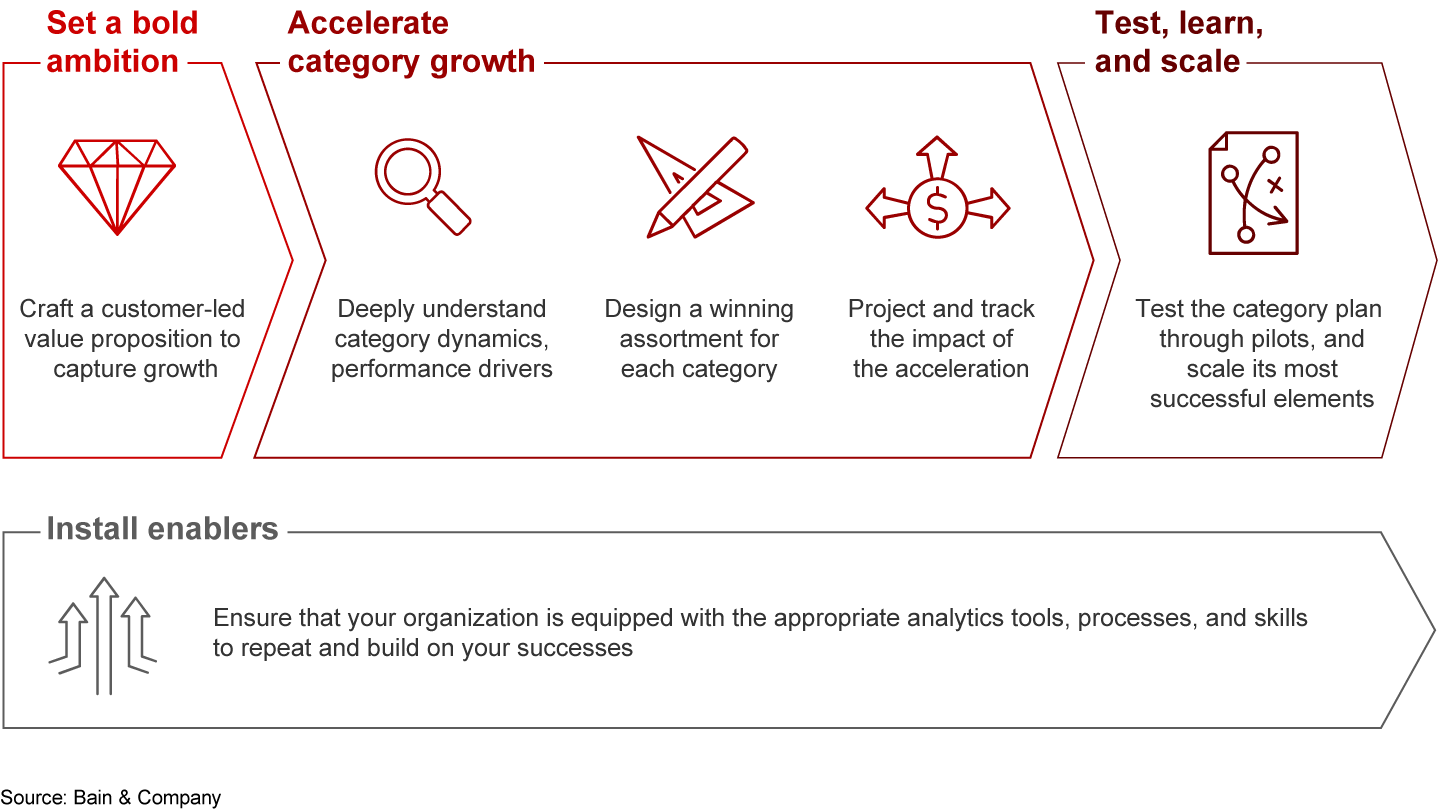
      Customer-led category management has four main elements

      Everything starts with the customer

      Ultimately, customers are the masters of their own wallets, and they will use their buying power to determine market winners and losers. That’s why CLCM starts with the customer.

      Before even thinking about brands and products, merchants should develop a deep understanding of their core customers. To better serve their customers’ preferences, merchants should identify who they are (demographics, attitudes, needs) and analyze how they shop across occasions and within each category. This enables merchants to deliver a distinct value proposition that delights priority customer segments.

      Consider the case of a retailer that was underperforming in salty snacks, a category in which it appeared well positioned to win. We helped the company analyze its customers in detail, using a mix of quantitative and qualitative methods (customer surveys, one-on-one interviews, shopping along, journey mapping, and the like) to paint a vivid picture of who its shoppers are and what they truly care about. That deep understanding enabled the retailer to create meaningful segments with distinct identities and needs. The company realized that its core segment was looking for more variety and excitement in the category, with new options to fit their active lifestyles. The retailer expanded its range of healthy snacks, adding emerging brands with which its core segment connected, and captured a higher share of wallet as a result (see Figure 2).

      Figure 2
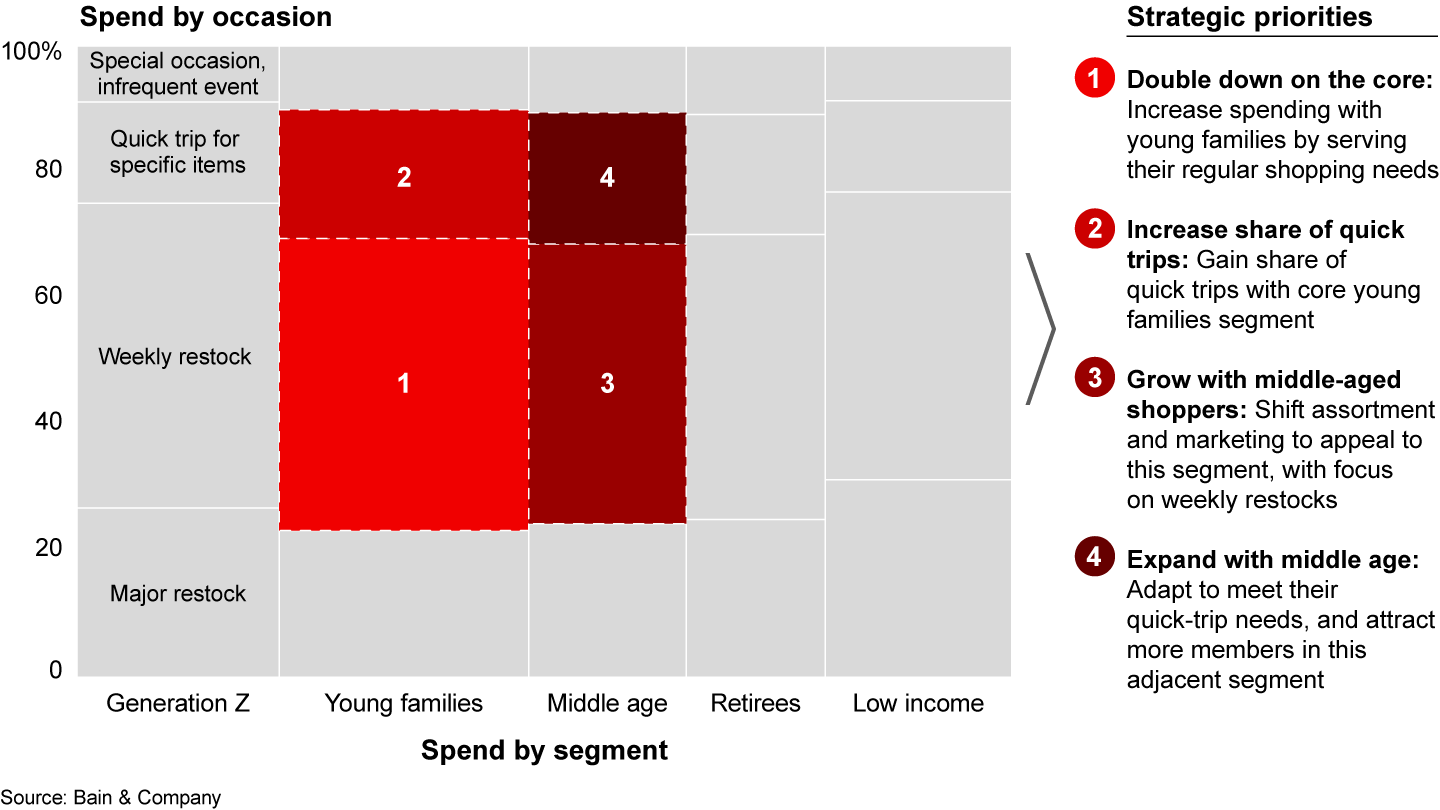
      How one retailer prioritized its customer segments and shopping occasions

      Look beyond your own walls to capture attractive profit pools

      Too many retailers focus only on how to optimize their existing assortment, entirely missing the bigger picture. Rather than think strategically about market shifts and opportunities, they fall into the trap of keeping what they had last year and adding the latest range of extensions pushed by their suppliers. If need be, they make room by simply removing the tail from lower-performing items.

      We believe that assortment choices should be anchored in a holistic understanding of market trends.

      • What market segments and product attributes are growing or shrinking?
      • How important are local products?
      • How much should the assortment change by season?
      • How closely should the digital experience emulate the store experience?

      Retailers can then ask themselves how they are performing against those trends.

      • Are they overindexed or underindexed on growing segments?
      • Are they taking advantage of channel shifts?

      For example, the pandemic and its associated lockdowns have spawned a major channel shift in take-out food. And as restaurants have struggled to meet the growing demand for meals at home, some retailers have seized the opportunity to serve the same need, expanding their prepared foods and ready meals offerings, drawing new customers to their stores, and tapping new profit pools.

      Market perspective helps retailers benchmark their own performance, understand where the opportunities are, and prioritize the categories they need to fix first to address market realities.

      Complement the art of category management with data science

      Executing on strategy depends in large measure on being able to make fast and accurate assortment decisions, including both what to add and what to discontinue. While such decisions require the appropriate blend of art and science, they have long leaned heavily on the former (see Figure 3).

      Figure 3
      We tailor our approach to your needs and capabilities

      Fortunately, retailers have access to more data than ever. Customer data from expansive loyalty programs and online channels, credit card data, mobile data, and web-scraping data can now supplement more traditional financial and market research data sets to paint a 360-degree view of customers and categories. This data-rich approach yields powerful insights into critical questions such as:

      • Which categories draw customers in and back again, and which inspire unplanned purchases?
      • What must-win subcategories really drive growth and profits, and which items truly delight customers, including smaller cohorts?

      When making critical assortment decisions, it’s imperative to apply a combination of analytics that can accurately forecast and measure category outcomes. When a major retailer set out to reduce complexity by simply eliminating a large number of long-tail items, traffic declined as shoppers loyal to those discontinued items filled their carts elsewhere. But when it applied loyalty analytics to its category management approach, it ensured that brands and items with strong followings among select customer cohorts would remain on the shelves.

      One grocer provides an example of successful, analytics-driven simplification. Faced with declining sales of fresh produce, this grocer analyzed customer buying behavior to create a customer decision tree (CDT), enabling it to identify key product fulfillment needs while avoiding duplication. It also improved its price architecture, its promotions strategy, and, guided by the CDT, its merchandising, fixtures, and store operations. The result: Like-for-like sales rose by 3% after years of decline.

      The most advanced retailers we support use predictive analytics, sometimes powered by artificial intelligence (AI), to generate automated assortment recommendations, but they also equip their merchants to make their own decisions. Perhaps more importantly, they treat analytics as a habit, not a one-off effort. The more they embed analytics into their core operations, embrace automation, and foster a data-driven culture, the better and faster they can innovate in response to evolving customer needs.

      That’s why we’ve made predictive and advanced analytics essential components of CLCM. We augment this expertise with Pyxis, an AI-powered data analysis capability that assesses tens of billions of transactions in markets around the world, to reveal powerful insights about consumer behaviors and preferences.

      Create targeted omnichannel assortments

      Successful retailers resist the urge to chase growth through ever-expanding assortments; that approach creates operational inefficiencies and shopper confusion. Instead, they embrace their value proposition and win over customers with an appropriate assortment, not a larger assortment. That requires research and analytics, the ability to test their choices on the ground, and, ultimately, a willingness to take calculated risks.

      But how can retailers achieve the virtues of simplicity while avoiding bland uniformity and losing touch with the customer? CLCM is designed to create intimacy and differentiation by balancing economies of scale with the benefits of localization and personalization.

      In-store customer intimacy can be achieved via localized assortments. One retailer we worked with used shopper data to better match assortment with purchasing behavior via category-specific store clusters. High-end, hyperlocal packaged food brands (artisanal, organic, insurgent) and a premium-sized, higher-quality subrange of its own brand were introduced to stores in affluent clusters, where customers proved willing to explore the category and spend more per purchase. Early pilot results showed a nearly 4% margin increase and improved penetration of its private label.

      Online, retailers can offer a broader range that includes tail-side SKUs and curate them in a completely personalized way based on an individual shopper’s online behavior. This helps maintain a sense of intimacy with consumers without confusing them, even as in-store offerings are streamlined. Online also offers the perfect testing ground for new products before rolling them out onto scarce floor space.

      Develop a faster metabolism

      In our experience, even retail executives who start with the appropriate category transformation plans can stumble on execution. They encounter many hurdles, from the number of steps required and stakeholders involved to inflexible review cycles that slow the pace of innovation and delay results.

      One common mistake is thinking the entire assortment must be reset at once. It doesn’t have to be. A more Agile test-and-learn approach can produce rapid changes one category at a time while introducing valuable learning and de-risking ambitious transformations. The goal is to make your merchandising organization a high-frequency learning machine with a bias toward action.

      We helped one retailer implement an Agile approach to category transformations that yielded positive results in a matter of weeks, not months. Right from the start, the company formed cross-functional teams that included (in addition to merchants) specialists for store operations, finance, customer research, and other areas. Successful pilots generated learning and momentum, and elements that worked well were rapidly scaled. The merchandising organization quickly became much stronger, with category managers empowered and trained to replicate the results on their own, thanks to our capability building program.

      That kind of result doesn’t happen by chance. Successful retailers approach test-and-learn execution with purpose and discipline, building a continuous learning system. Working teams receive a clear mandate and support from top management to drive category changes, and they become accountable for results. Pilots are designed with a clear set of hypotheses about the opportunity and then closely monitored. The guiding philosophy is “experiment, learn, adapt, and scale.” This system enables more frequent category reviews that can address customers’ ever-changing needs.

      Margins and growth restored

      Assortment optimization is often just the start of a broader merchandising transformation. Simplification creates winners and losers, and it provides tremendous leverage in supplier negotiations that should not be wasted. (Our Advanced Retail Buying approach is highly useful in this regard.) The gains made in cost of goods sold can support reinvestment in pricing, promotion, and digital experience (see Figure 4).

      Figure 4
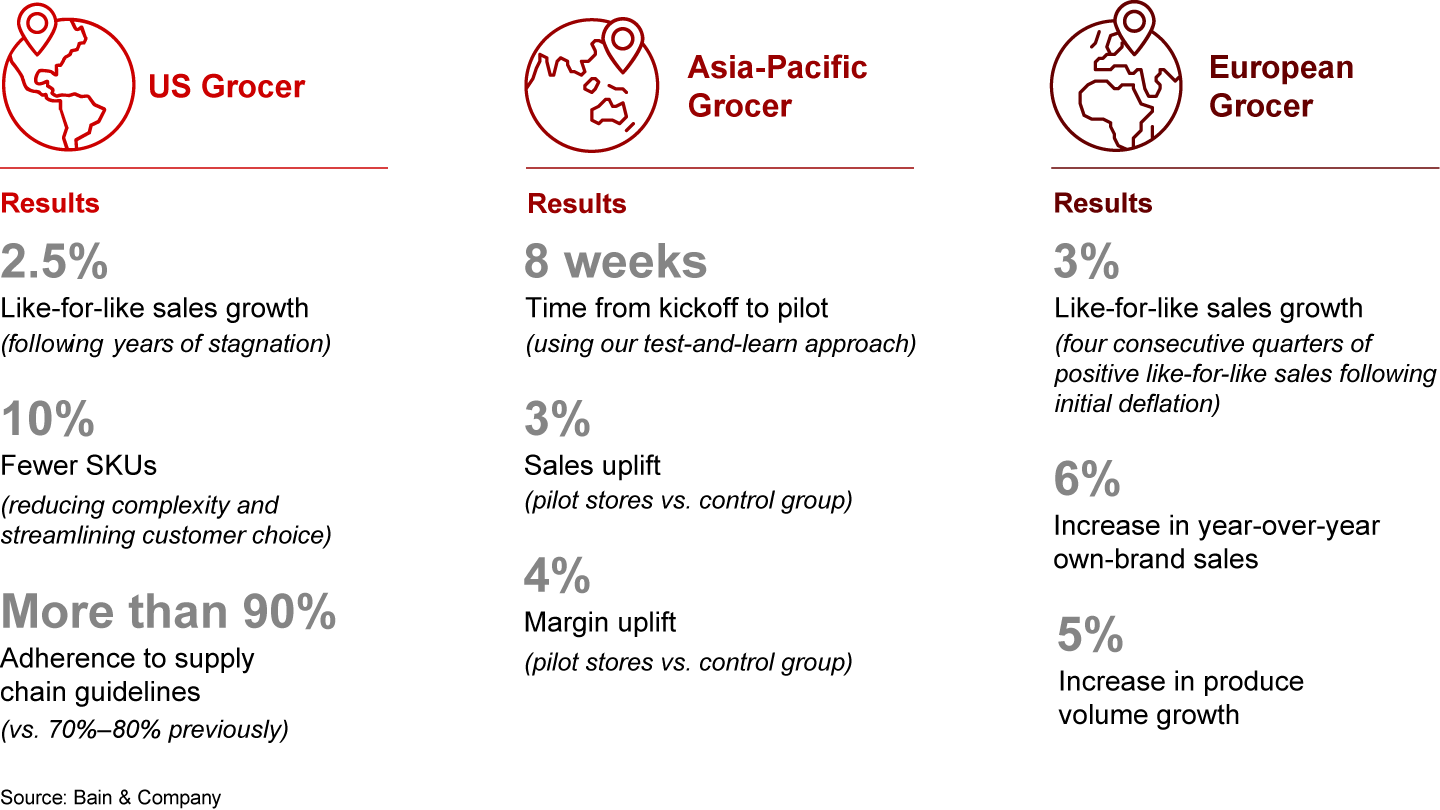
      Customer-led category management has helped many retailers achieve impressive results

      And when flagship categories start to perform again, banners can claim back customer relevance, restoring revenue growth and margin growth. CLCM is a proven approach that has helped grocers and other retailers around the world achieve impressive results. We understand the breadth of challenges facing retailers today, and we bring unmatched expertise to this fresh approach to category management.

      Autoren
      • Headshot of Mario Häuptli
        Mario Häuptli
        Partner, Zürich
      • Headshot of Karl Zimmermann
        Karl Zimmermann
        Partner, Boston
      • Marc Antonius
        Alumni, Toronto
      Kontaktieren Sie uns
      Verwandte Branchen
      • Einzelhandel
      • Grocery
      Ähnliche Beratungsangebote
      • Accelerated Performance Transformation
      • Kundenstrategie und Marketing
      • Transformation
      Transformation
      Virgin Australia airplane taking off with green trees in the background.
      Virgin Australia: From Turbulence to Triumph

      CEO David Emerson discusses how a multifaceted transformation culminated in a stunning IPO.

      Mehr erfahren
      Einzelhandel
      A Grocery Giant Enjoys the Fruits of a Successful Merger Integration

      A new operating model and organizational consolidation delivered the synergies that large retail mergers can provide.

      Mehr erfahren
      Einzelhandel
      A Global Retailer Transforms Technology and Data to Conquer the Digital Future

      Business and technology align to enable stronger data and analytics strategies, clear decision making, and modern work methods.

      Mehr erfahren
      Kundenstrategie und Marketing
      A Manufacturer Catalyzes Growth with Sales Plays

      A combination of new ways of working, improved capabilities, and effective training quickly generated impressive results.

      Mehr erfahren
      Einzelhandel
      Global expansion boosts supermarket earnings and growth

      A leading European supermarket chain asked our team to develop a framework for international expansion. The result: a significant increase in local market share and potential return on sales.

      Mehr erfahren
      First published in Mai 2021
      Markierungen
      • Accelerated Performance Transformation
      • Einzelhandel
      • Grocery
      • Kundenstrategie und Marketing
      • Transformation

      Wie wir unsere Kunden unterstützt haben

      Mergers & Acquisitions A Grocery Giant Enjoys the Fruits of a Successful Merger Integration

      Kundenbeispiel lesen

      Advanced Analytics A Global Retailer Transforms Technology and Data to Conquer the Digital Future

      Kundenbeispiel lesen

      Strategie Global expansion boosts supermarket earnings and growth

      Kundenbeispiel lesen

      Möchten Sie mit uns in Kontakt bleiben?

      Wir unterstützen Führungskräfte weltweit, die kritischen Themen in ihrem Unternehmen zu adressieren. Gemeinsam schaffen wir nachhaltige Veränderungen und Ergebnisse.

      Bain Insights. Unsere Perspektive auf die kritischen Themen, mit denen sich international agierende Unternehmen konfrontiert sehen, finden Sie monatlich in Ihrem Postfach.

      *Ich habe die Datenschutzerklärung gelesen und akzeptiere sie.
      Bitte lesen Sie die Datenschutzerklärung und akzeptieren Sie diese.
      Bain & Company
      Contact us Sustainability Accessibility Rechtliche Hinweise Impressum Datenschutz Cookie-Richtlinie Sitemap Log In

      © 1996-2026 Bain & Company, Inc.

      Kontaktieren Sie Bain

      Wie können wir Ihnen helfen?

      • Business inquiry
      • Career information
      • Press relations
      • Partnership request
      • Speaker request
      Alle weltweiten Büros