
Skip to Content
  • Standorte

    Standorte

    North & Latin America
    • Atlanta
    • Austin
    • Bogota
    • Boston
    • Buenos Aires
    • Chicago
    • Dallas
    • Denver
    • Houston
    • Lisbon
    • Los Angeles
    • Mexico City
    • Minneapolis
    • Monterrey
    • Montreal
    • New York
    • Rio de Janeiro
    • San Francisco
    • Santiago
    • São Paulo
    • Seattle
    • Silicon Valley
    • Toronto
    • Washington, DC
    Europe & Africa
    • Amsterdam
    • Athens
    • Berlin
    • Brussels
    • Copenhagen
    • Düsseldorf
    • Frankfurt
    • Helsinki
    • Istanbul
    • Johannesburg
    • Kyiv
    • Lisbon
    • London
    • Madrid
    • Milan
    • München
    • Oslo
    • Paris
    • Rome
    • Stockholm
    • Warsaw
    • Wien
    • Zürich
    Middle East
    • Doha
    • Dubai
    • Riyadh
    Asia & Australia
    • Bangkok
    • Beijing
    • Bengaluru
    • Brisbane
    • Ho Chi Minh City
    • Hong Kong
    • Jakarta
    • Kuala Lumpur
    • Manila
    • Melbourne
    • Mumbai
    • New Delhi
    • Perth
    • Seoul
    • Shanghai
    • Singapore
    • Sydney
    • Tokyo
    Alle Standorte Anzeigen
  • Alumni
  • Presse
  • Newsletter
  • Kontakt
  • DACH-Region | Deutsch

    Wählen Sie Ihre Region und Sprache

    Global
    • Global (English)
    North & Latin America
    • Brazil (Português)
    • Argentina (Español)
    • Canada (Français)
    • Chile (Español)
    • Colombia (Español)
    Europe, Middle East, & Africa
    • France (Français)
    • DACH-Region (Deutsch)
    • Italy (Italiano)
    • Spain (Español)
    • Greece (Elliniká)
    Asia & Australia
    • China (中文版)
    • Korea (한국어)
    • Japan (日本語)
  • Saved items (0)
    Saved items (0)

    You have no saved items.

    Inhalte, für die Sie sich interessieren, werden hier gespeichert und können später gelesen oder weitergeleitet werden.

    Explore Bain Insights
  • Branchenkompetenzen
    Hauptmenü

    Branchenkompetenzen

    • Luft- und Raumfahrt, Verteidigung
    • Agrarwirtschaft
    • Chemieindustrie
    • Infrastruktur und Bauwirtschaft
    • Konsumgüter
    • Finanzdienstleistungen
    • Gesundheitswesen
    • Maschinen- und Anlagenbau
    • Medienwirtschaft
    • Metallindustrie
    • Bergbau
    • Öl und Gas
    • Papier- und Verpackungsindustrie
    • Private Equity
      Branchenkompetenzen
      Private Equity
      • Due Diligence
      • Exit Planning
      • Firm Strategy & Operations
      • Portfolio Value Creation
    • Öffentlicher Sektor und Sozialwesen
    • Einzelhandel
    • Technologie
    • Telekommunikation
    • Transportwesen
    • Reise- und Freizeitbranche
    • Versorgung und erneuerbare Energien
  • Managementkompetenzen
    Hauptmenü

    Managementkompetenzen

    • Customer Experience
    • ESG
    • Innovation
    • M&A
    • Operations
    • People & Organization
    • Private Equity
    • Sales & Marketing
    • Strategie
    • KI, Einblicke und Lösungen
    • Technologie
    • Transformation
  • Digital
  • Publikationen
    Hauptmenü

    Publikationen

    • Branchenthemen
    • Managementthemen
    • Bain-Bücher
    Alle Publikationen
    Ausgewählte Themen
    • Resilienz in der globalen Krise
    • M&A Report
    • Private Equity Podcast
    • Midyear Private Equity Report
    • Agile
    • Engineering Report
    • Digital Transformation
    • Elements of Value®
    • Firm of the Future
    • Nachhaltigkeitsstudie
    • Macro Trends
    • Future of Consumption
    • Weltwirtschaftsforum (WEF)
  • Über uns
    Hauptmenü

    Über uns

    • Was wir bieten
    • Unser Ansatz
    • Unser Team
    • Game Changer Award
    • Female Allstar Board
    • Messbare Ergebnisse (EN)
    • Auszeichnungen
    • Globale Partnerschaften
    • The Mission
    Further: Our global responsibility
    • Vielfalt & Chancengleichheit
    • Soziale Verantwortung
    • Sustainability
    Erfahren Sie mehr zu "Further"
  • Karriere
    Hauptmenü

    Karriere

    • Dein Einstieg
      Karriere
      Dein Einstieg
      • Find Your Place
      • Unsere Arbeitsbereiche
      • Unsere Teams
      • Angebote für Studierende
      • Praktika & Programme
      • Recruiting-Events
    • Arbeiten bei Bain
      Karriere
      Arbeiten bei Bain
      • Karriere Stories
      • Unsere Bainies
      • Office-Standorte
      • Weiterentwicklung
      • Affinity Groups
      • Deine Benefits
    • Impact Stories
    • Deine Bewerbung
      Karriere
      Deine Bewerbung
      • Das erwartet dich
      • Der Interviewprozess
    FIND JOBS
  • Standorte
    Hauptmenü

    Standorte

    • North & Latin America
      Standorte
      North & Latin America
      • Atlanta
      • Austin
      • Bogota
      • Boston
      • Buenos Aires
      • Chicago
      • Dallas
      • Denver
      • Houston
      • Lisbon
      • Los Angeles
      • Mexico City
      • Minneapolis
      • Monterrey
      • Montreal
      • New York
      • Rio de Janeiro
      • San Francisco
      • Santiago
      • São Paulo
      • Seattle
      • Silicon Valley
      • Toronto
      • Washington, DC
    • Europe & Africa
      Standorte
      Europe & Africa
      • Amsterdam
      • Athens
      • Berlin
      • Brussels
      • Copenhagen
      • Düsseldorf
      • Frankfurt
      • Helsinki
      • Istanbul
      • Johannesburg
      • Kyiv
      • Lisbon
      • London
      • Madrid
      • Milan
      • München
      • Oslo
      • Paris
      • Rome
      • Stockholm
      • Warsaw
      • Wien
      • Zürich
    • Middle East
      Standorte
      Middle East
      • Doha
      • Dubai
      • Riyadh
    • Asia & Australia
      Standorte
      Asia & Australia
      • Bangkok
      • Beijing
      • Bengaluru
      • Brisbane
      • Ho Chi Minh City
      • Hong Kong
      • Jakarta
      • Kuala Lumpur
      • Manila
      • Melbourne
      • Mumbai
      • New Delhi
      • Perth
      • Seoul
      • Shanghai
      • Singapore
      • Sydney
      • Tokyo
    Alle Standorte Anzeigen
  • Alumni
  • Presse
  • Newsletter
  • Kontakt
  • DACH-Region | Deutsch
    Hauptmenü

    Wählen Sie Ihre Region und Sprache

    • Global
      Wählen Sie Ihre Region und Sprache
      Global
      • Global (English)
    • North & Latin America
      Wählen Sie Ihre Region und Sprache
      North & Latin America
      • Brazil (Português)
      • Argentina (Español)
      • Canada (Français)
      • Chile (Español)
      • Colombia (Español)
    • Europe, Middle East, & Africa
      Wählen Sie Ihre Region und Sprache
      Europe, Middle East, & Africa
      • France (Français)
      • DACH-Region (Deutsch)
      • Italy (Italiano)
      • Spain (Español)
      • Greece (Elliniká)
    • Asia & Australia
      Wählen Sie Ihre Region und Sprache
      Asia & Australia
      • China (中文版)
      • Korea (한국어)
      • Japan (日本語)
  • Saved items  (0)
    Hauptmenü
    Saved items (0)

    You have no saved items.

    Inhalte, für die Sie sich interessieren, werden hier gespeichert und können später gelesen oder weitergeleitet werden.

    Explore Bain Insights
  • Branchenkompetenzen
    • Branchenkompetenzen

      • Luft- und Raumfahrt, Verteidigung
      • Agrarwirtschaft
      • Chemieindustrie
      • Infrastruktur und Bauwirtschaft
      • Konsumgüter
      • Finanzdienstleistungen
      • Gesundheitswesen
      • Maschinen- und Anlagenbau
      • Medienwirtschaft
      • Metallindustrie
      • Bergbau
      • Öl und Gas
      • Papier- und Verpackungsindustrie
      • Private Equity
      • Öffentlicher Sektor und Sozialwesen
      • Einzelhandel
      • Technologie
      • Telekommunikation
      • Transportwesen
      • Reise- und Freizeitbranche
      • Versorgung und erneuerbare Energien
  • Managementkompetenzen
    • Managementkompetenzen

      • Customer Experience
      • ESG
      • Innovation
      • M&A
      • Operations
      • People & Organization
      • Private Equity
      • Sales & Marketing
      • Strategie
      • KI, Einblicke und Lösungen
      • Technologie
      • Transformation
  • Digital
  • Publikationen
    • Publikationen

      • Branchenthemen
      • Managementthemen
      • Bain-Bücher
      Alle Publikationen
      Ausgewählte Themen
      • Resilienz in der globalen Krise
      • M&A Report
      • Private Equity Podcast
      • Midyear Private Equity Report
      • Agile
      • Engineering Report
      • Digital Transformation
      • Elements of Value®
      • Firm of the Future
      • Nachhaltigkeitsstudie
      • Macro Trends
      • Future of Consumption
      • Weltwirtschaftsforum (WEF)
  • Über uns
    • Über uns

      • Was wir bieten
      • Unser Ansatz
      • Unser Team
      • Game Changer Award
      • Female Allstar Board
      • Messbare Ergebnisse (EN)
      • Auszeichnungen
      • Globale Partnerschaften
      • The Mission
      Further: Our global responsibility
      • Vielfalt & Chancengleichheit
      • Soziale Verantwortung
      • Sustainability
      Erfahren Sie mehr zu "Further"
  • Karriere
    Häufige Suchanfragen
    • Agil
    • Digital
    • Strategie
    Vorherige Suchanfragen
      Zuletzt besuchte Seiten

      Content added to saved items

      Saved items (0)

      Removed from saved items

      Saved items (0)

      Article

      How To Get the Right Price for Innovation

      How To Get the Right Price for Innovation

      This pragmatic six-step approach can ensure that you reap the rewards of your hard-won advances.

      Von Nimit Mehta, Kara Murphy, und Justin Doshi

      • Min. Lesezeit

      Article

      How To Get the Right Price for Innovation

      Auf einen Blick

      • Setting the right price for a new innovation is not easy, but the bottom-line benefits make the effort well worthwhile.
      • By following this proven framework your company can systematically address the strategic, segmentation, discounting, communication and other elements that should be factored in to this critical decision.
      • To maximize the value, build this approach into your overall launch strategy. 

      We often see companies spend years developing innovations, but only a few hours pricing them. There are many reasons for such an inadequate approach; one of the biggest is discomfort with value pricing. But companies can systematically overcome this reluctance and arrive at an effective value-pricing strategy for innovation by following a six-step model we’ve developed, based on our deep experience in helping companies launch and successfully price a variety of innovations.

      The bottom-line impact of a successful value pricing approach is significant: it can increase cumulative launch margins by at least double digits, compared with a conventional pricing approach.

      Innovation Pricing in Action

      Companies across many industries are already reaping the value of this breakthrough approach
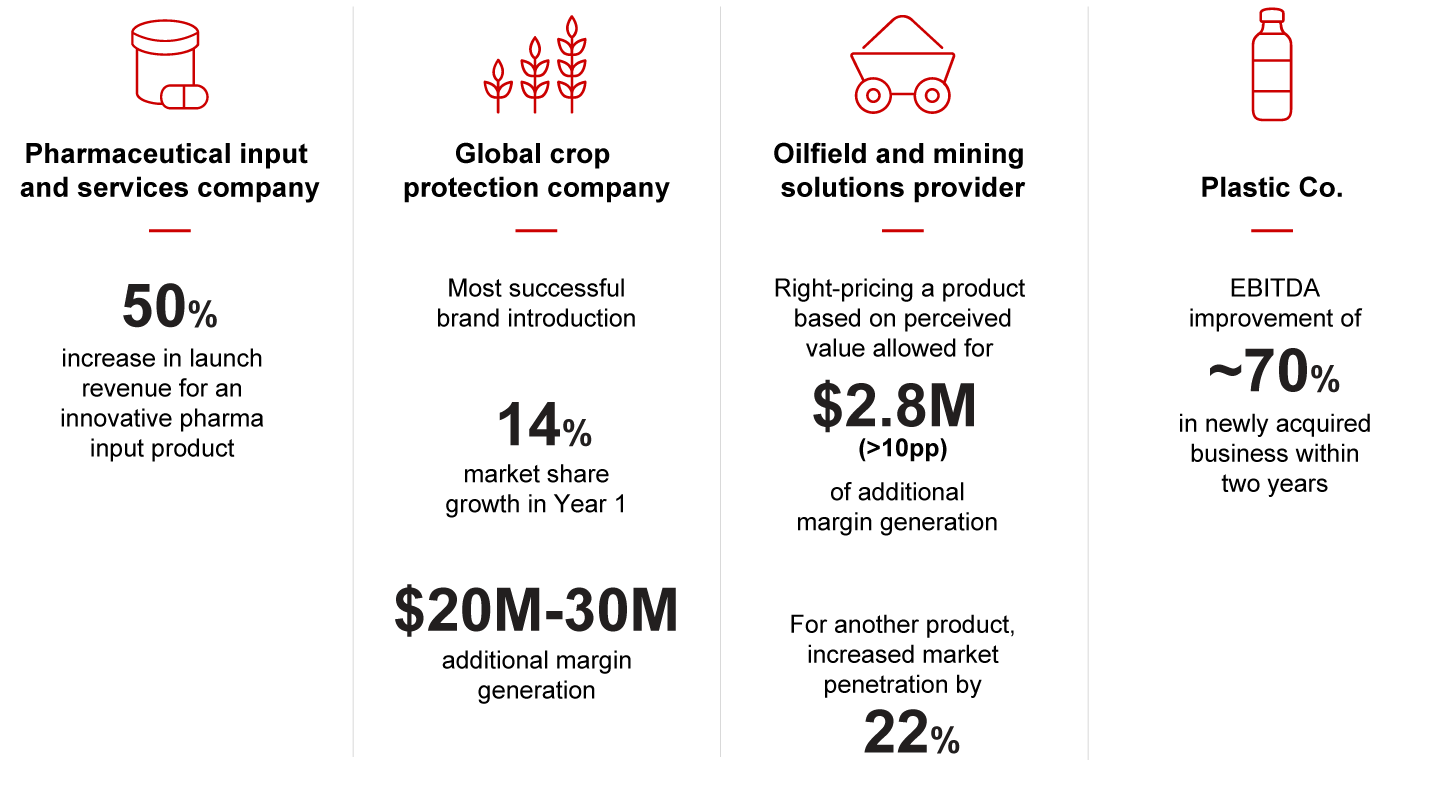
      Organizations that price their innovations well do three things:

      1. Develop a deep understanding of the value their solutions provide to all customer segments
      2. Get their commercial teams fully prepared and excited about the value their solution delivers
      3. Create effective communications, tailored for each segment, to help customers fully appreciate the value of the innovation

      Using our six-step framework, clients have developed the organizational muscle for successful value pricing and have realized the full pricing potential of their innovations.

      Six Steps to Optimal Innovation Pricing

      This framework ensures that you price innovations appropriately and achieve all your strategic goals
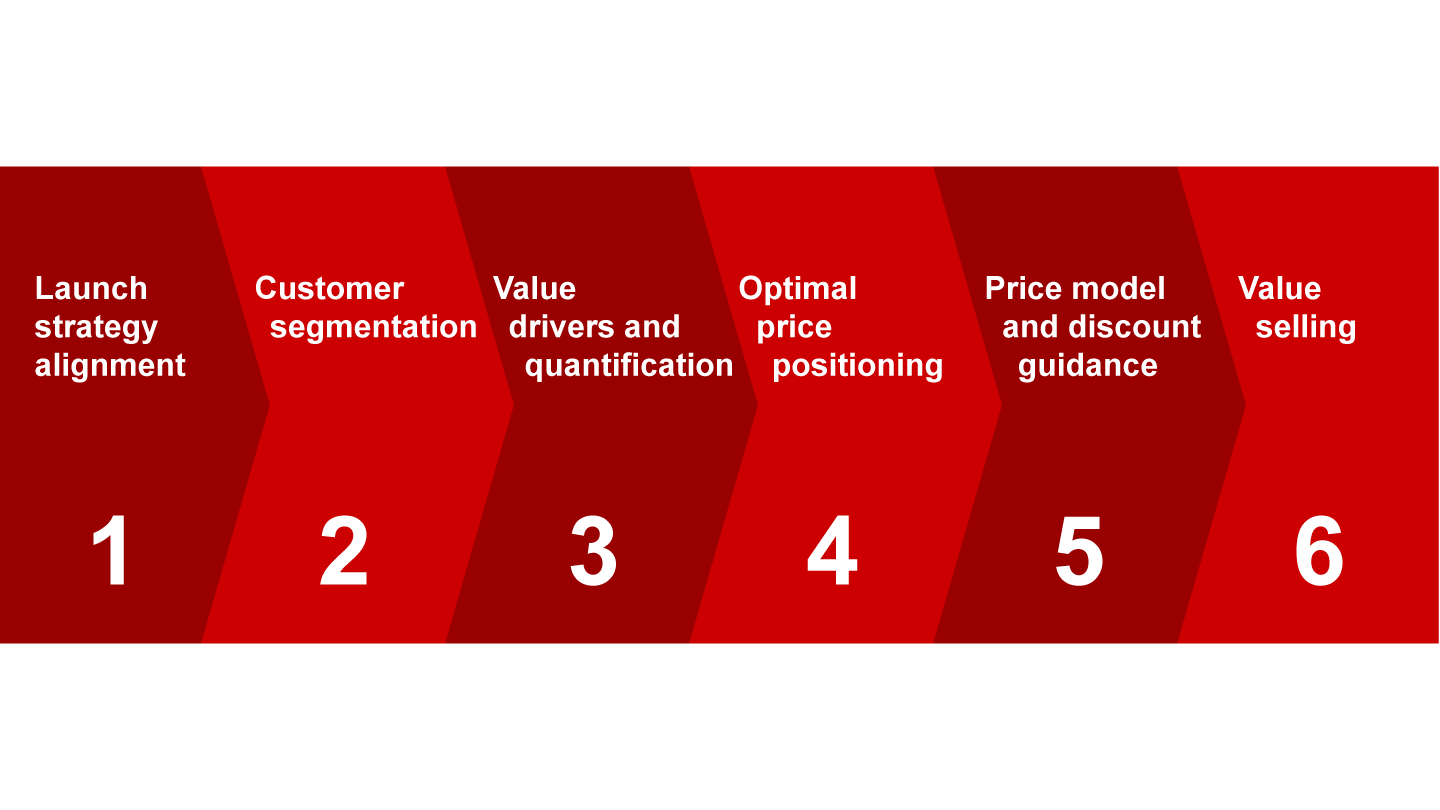
      Step 1: Strategy alignment

      A critical first step is to align the pricing strategy with the overall launch strategy. What’s the launch expected to achieve? Maximize margin? Gain share? Create portfolio pull-through (a halo effect)? Improve the customer experience? Increase capacity utilization?

      Defining the launch objective(s) will determine whether or not value pricing is the right approach. That decision is informed by the following:

      Degree of differentiation. How differentiated is your solution compared with alternatives available in the market? The value-pricing approach yields better results when applied to less commoditized and more differentiated solutions.

      Ease of communication. How easily can customers understand the benefits and value of your solution? Products and solutions requiring complex sales messages across multiple stakeholders will require additional training and capabilities to make value selling succeed.

      Organizational readiness. How ready is the commercial team to shift from its traditional selling model to value selling? How committed is the leadership to fostering the necessary changes in mindset and skill set? Your organization’s confidence in, and ability to execute, a value-selling approach builds over time, which mandates strong commitment from the leadership team.

      Step 2: Customer segmentation

      Different customer segments will perceive the value of your innovation in different ways. Understanding which benefits matter the most for which segment―and by how much―is critical to successful value pricing.

      For example, we worked with an agricultural products company that was launching an innovative herbicide that promised significant increases in crop yields. A segmentation exercise conducted as part of the pricing strategy revealed that certain high-value crops could disproportionately command higher prices. Besides higher crop yield, the herbicide could also improve the produce's quality grade ranking, allowing farmers to charge a premium. Understanding how one customer segment could achieve an added benefit allowed the company to create a more effective pricing strategy and value-communication campaign.

      Step 3: Value drivers and quantification

      You must understand how your innovation maps to the value drivers for each customer segment. This can be challenging, but leading organizations do the following successfully:

      • Understand the economics of your customers' businesses better than your competitors do
      • Collect robust performance benchmark data on competitive offerings
      • Be comfortable with "good-enough" assumptions while calculating the value to customers
      • Enlist champions from different cross-functional areas (marketing, product management, sales, technical services, customer care, and procurement) to validate assumptions and calculations of value drivers
      • Continuously improve value assumptions and calculations based on market feedback

      Your approach to value modeling should address three components.

      1. Define the most applicable competitive alternative to your innovation and benchmark data against that alternative.

        To help you decide the best competitive alternative, you can ask, “What’s the reference in customers' minds when evaluating new solutions?”

      2. List tangible and intangible value drivers and prioritize them based on what matters most to your customers.

        Drivers can include positive and negative differentiators. Always ask, "What is the incremental financial or psychological value derived by customers using our solution over the competitive alternative?" Be exhaustive in listing the drivers, but prioritize them based on the degree of differentiation and relative importance to the customers.

      3. Quantify value for high-priority tangible drivers.

        Different analyses are required to calculate value drivers. An increase in customer revenue results from higher market share or higher sales price, both of which require downstream value chain analysis. A comprehensive approach to identifying and calculating both positive and negative value drivers allows for better sales communication with customers.

      It’s worth noting that a common misconception is that you have to calculate all the drivers. We recommend starting with high-priority value drivers and a reasonable set of assumptions, knowing that you will get better over time. Intangible drivers are difficult to calculate, but we still recommend using them in value communication (to show customers that the total differential value they’re receiving is much higher than the quantifiable calculation indicates).

      Step 4: Optimal price positioning

      Once the value created by the solution is calculated, the biggest question will be how much of this perceived value should be retained in the price? Optimal price positioning should be determined by multiple factors, including the customer and competitive landscape, your overall strategy and your cost structure.

      Price positioning can differ for products and segments to reflect a targeted strategy. For one  company we worked with, two distinct customer segments had very different value derived from the same product. One segment was also much more price-sensitive than the other. So, we carefully designed the  product offer and pricing structure to optimize price-to-value ratio and adoption across both segments.

      Three screens can help decide the optimal price-to-value ratio.

      Customer segment. What portion of the value will be retained by a customer or a segment?  We recommend the following factors to help guide value split:

      • Switching hurdle. How much investment is required (time, resources, regulatory hurdles, etc.) for customers to switch and qualify new material? If the switching hurdle is higher, the customer retains more value.
      • Degree of risk in realizing potential value. If the risks of value realization are higher, the customer retains more value.
      • Ease of communication. How easily can customers understand the value?
      • The magnitude of marginal value. Is the innovation an incremental change over the competitive alternative, rather than a breakthrough or step change?
      • The strategic importance of the customer or the segment. Should the innovation launch be used as a strategic investment opportunity for a customer or a segment?

      Fairness perception. Would premium pricing be perceived as unfair or unethical with customers or stakeholders? (This factor is often ignored while setting a price, but can be the difference between success and failure.)

      Product portfolio. How does the price of this launch impact future launches or existing products in your portfolio? No product launch should be considered in a silo; the price-to-value ratio also depends on your overall portfolio strategy.

      Competition. How might your competitors react to a new product launch? We recommend comprehensive war-gaming exercises to anticipate their reactions. Your ability to capture the price for your offering also depends on competitors' moves after launch. The aforementioned agribusiness that had developed an innovative herbicide anticipated that one of its competitors would launch a low-price product in response. So the company worked with its distributors and customers (retailers and farmers) on programs that guaranteed performance and communicated the superior economic value of its new premium product.

      Step 5: Price model and discount guidance

      Setting the right price model and discount guidance allows you to maximize value capture and minimize margin leakage. Innovative models enable you to capture differentiated value across different segments.

      Price guidance can include variations based on geography, segment and sales channel, and several differentiating dimensions, including package sizes, annual purchase volume or order quantities, multiple portfolio purchases, and more.

      There are some key considerations for pricing structure and discounting guidelines.
      • Discounts must have specific intent. Apply discounts in a targeted way to address specific customer concerns.
      • Fencing criteria must be simple. Discount criteria should be easy to interpret and apply, reducing the risk of value leakage.
      • Discounts don’t stack. Customers cannot apply multiple discounts to a single order, regardless of eligibility.
      • Leadership must oversee large discounts. Senior leadership must approve discounts with significant revenue impact and set approval policies and processes to balance speed and oversight.

      Step 6: Value communication and value selling

      Many value-pricing efforts fail at this step because not enough emphasis is placed on perfecting value communication and preparing the organization for effective value selling. Companies that excel on this step do these things well.

      Involve sales champions from the very beginning of the value-pricing exercise. Sales teams play a critical role in the success or failure of a new launch, but many organizations don’t include them until it’s too late. Identify sales champions ahead of time and have them contribute throughout the process. They should then take active ownership of influencing and training the sales organization in value selling.

      Create strong internal and external communication materials. As you build the commercial team’s confidence in value messaging and pricing, it’s equally important to communicate externally to customers. Internal communication should align with cultural values, provide details and proof points on the product's value drivers, and include market intelligence. External messaging should clearly articulate the new solution’s differentiated benefits and the value these benefits bring to customers. It should generate enough awareness and excitement to spark customer-specific conversations.

      Tailor value messaging for specific customers and segments. What each customer values will vary significantly from one to another, so you need to create customer-specific value propositions. Bear in mind that even within a given customer organization different stakeholders may have different priorities. Successful value communication targets the right value messages to the right stakeholders.

      Enable sales with value-selling training and incentives designed to drive desired behavior. Value-selling capabilities require systematic investments in training and preparation. Initial efforts will require a certain level of handholding for the sales organization, and establishing proper incentives and metrics. We address this need with a variety of tools and training programs to help you position your teams for maximum pricing success. 

      Your company works hard and invests significant resources to develop successful innovations. Following this six-step framework to set the right price can help achieve the full profit potential of your launch strategy.

      Autoren
      • Headshot of Nimit Mehta
        Nimit Mehta
        Partner, New York
      • Headshot of Kara Murphy
        Kara Murphy
        Partner, Boston
      • Headshot of Justin Doshi
        Justin Doshi
        Partner, Atlanta
      Kontaktieren Sie uns
      Ähnliche Beratungsangebote
      • Kundenstrategie und Marketing
      • Pricing
      Wie wir Sie unterstützen können
      • B2B Pricing
      Pharmaindustrie
      How a Pharmaceutical Services Company Mastered the Art of Value Pricing

      Innovative products can, and often should, command premium pricing. Our six-step approach helped the company boost launch revenue by 50%.

      Mehr erfahren
      B2B Pricing
      Pricing games: A technology company develops a winning approach

      We helped a global technology company that specializes in software to reduce the complexity and mystery around their pricing strategy. The work helped generate millions more in income each year.

      Mehr erfahren
      B2B Pricing
      Individual inspecting a jet engine with a laptop, wearing ear protection, in an industrial setting.
      Smart Pricing Helped a Private Equity Firm Unlock More Value

      Simplified segmentation and a focus on sales plays proved pivotal to the deal's success.

      Mehr erfahren
      Pricing
      Designing a Sales Compensation Plan Based on an Unusual Metric

      A supply company that derived significant revenue from vendor discounts and rebates made key changes to capture more revenue from that source.

      Mehr erfahren
      B2B Pricing
      Our Pricing Volatility Playbook Helped a Market Leader Preserve Margins

      IndustrialCo’s customers held a distinct bargaining edge, until the company turned to us for help.

      Mehr erfahren
      Markierungen
      • B2B Pricing
      • Kundenstrategie und Marketing
      • Pricing

      Wie wir unsere Kunden unterstützt haben

      Smart Pricing Helped a Private Equity Firm Unlock More Value

      Kundenbeispiel lesen

      Kundenstrategie und Marketing Our Pricing Volatility Playbook Helped a Market Leader Preserve Margins

      Kundenbeispiel lesen

      Consistent pricing and direct selling boost TechCo’s gross margins

      Kundenbeispiel lesen

      Möchten Sie mit uns in Kontakt bleiben?

      Wir unterstützen Führungskräfte weltweit, die kritischen Themen in ihrem Unternehmen zu adressieren. Gemeinsam schaffen wir nachhaltige Veränderungen und Ergebnisse.

      Bain Insights. Unsere Perspektive auf die kritischen Themen, mit denen sich international agierende Unternehmen konfrontiert sehen, finden Sie monatlich in Ihrem Postfach.

      *Ich habe die Datenschutzerklärung gelesen und akzeptiere sie.
      Bitte lesen Sie die Datenschutzerklärung und akzeptieren Sie diese.
      Bain & Company
      Contact us Sustainability Accessibility Rechtliche Hinweise Impressum Datenschutz Cookie-Richtlinie Sitemap Log In

      © 1996-2026 Bain & Company, Inc.

      Kontaktieren Sie Bain

      Wie können wir Ihnen helfen?

      • Business inquiry
      • Career information
      • Press relations
      • Partnership request
      • Speaker request
      Alle weltweiten Büros