
Skip to Content
  • Standorte

    Standorte

    North & Latin America
    • Atlanta
    • Austin
    • Bogota
    • Boston
    • Buenos Aires
    • Chicago
    • Dallas
    • Denver
    • Houston
    • Lisbon
    • Los Angeles
    • Mexico City
    • Minneapolis
    • Monterrey
    • Montreal
    • New York
    • Rio de Janeiro
    • San Francisco
    • Santiago
    • São Paulo
    • Seattle
    • Silicon Valley
    • Toronto
    • Washington, DC
    Europe & Africa
    • Amsterdam
    • Athens
    • Berlin
    • Brussels
    • Copenhagen
    • Düsseldorf
    • Frankfurt
    • Helsinki
    • Istanbul
    • Johannesburg
    • Kyiv
    • Lisbon
    • London
    • Madrid
    • Milan
    • München
    • Oslo
    • Paris
    • Rome
    • Stockholm
    • Warsaw
    • Wien
    • Zürich
    Middle East
    • Doha
    • Dubai
    • Riyadh
    Asia & Australia
    • Bangkok
    • Beijing
    • Bengaluru
    • Brisbane
    • Ho Chi Minh City
    • Hong Kong
    • Jakarta
    • Kuala Lumpur
    • Manila
    • Melbourne
    • Mumbai
    • New Delhi
    • Perth
    • Seoul
    • Shanghai
    • Singapore
    • Sydney
    • Tokyo
    Alle Standorte Anzeigen
  • Alumni
  • Presse
  • Newsletter
  • Kontakt
  • DACH-Region | Deutsch

    Wählen Sie Ihre Region und Sprache

    Global
    • Global (English)
    North & Latin America
    • Brazil (Português)
    • Argentina (Español)
    • Canada (Français)
    • Chile (Español)
    • Colombia (Español)
    Europe, Middle East, & Africa
    • France (Français)
    • DACH-Region (Deutsch)
    • Italy (Italiano)
    • Spain (Español)
    • Greece (Elliniká)
    Asia & Australia
    • China (中文版)
    • Korea (한국어)
    • Japan (日本語)
  • Saved items (0)
    Saved items (0)

    You have no saved items.

    Inhalte, für die Sie sich interessieren, werden hier gespeichert und können später gelesen oder weitergeleitet werden.

    Explore Bain Insights
  • Branchenkompetenzen
    Hauptmenü

    Branchenkompetenzen

    • Luft- und Raumfahrt, Verteidigung
    • Agrarwirtschaft
    • Chemieindustrie
    • Infrastruktur und Bauwirtschaft
    • Konsumgüter
    • Finanzdienstleistungen
    • Gesundheitswesen
    • Maschinen- und Anlagenbau
    • Medienwirtschaft
    • Metallindustrie
    • Bergbau
    • Öl und Gas
    • Papier- und Verpackungsindustrie
    • Private Equity
      Branchenkompetenzen
      Private Equity
      • Due Diligence
      • Exit Planning
      • Firm Strategy & Operations
      • Portfolio Value Creation
    • Öffentlicher Sektor und Sozialwesen
    • Einzelhandel
    • Technologie
    • Telekommunikation
    • Transportwesen
    • Reise- und Freizeitbranche
    • Versorgung und erneuerbare Energien
  • Managementkompetenzen
    Hauptmenü

    Managementkompetenzen

    • Customer Experience
    • ESG
    • Innovation
    • M&A
    • Operations
    • People & Organization
    • Private Equity
    • Sales & Marketing
    • Strategie
    • KI, Einblicke und Lösungen
    • Technologie
    • Transformation
  • Digital
  • Publikationen
    Hauptmenü

    Publikationen

    • Branchenthemen
    • Managementthemen
    • Bain-Bücher
    Alle Publikationen
    Ausgewählte Themen
    • Resilienz in der globalen Krise
    • M&A Report
    • Private Equity Podcast
    • Midyear Private Equity Report
    • Agile
    • Engineering Report
    • Digital Transformation
    • Elements of Value®
    • Firm of the Future
    • Nachhaltigkeitsstudie
    • Macro Trends
    • Future of Consumption
    • Weltwirtschaftsforum (WEF)
  • Über uns
    Hauptmenü

    Über uns

    • Was wir bieten
    • Unser Ansatz
    • Unser Team
    • Game Changer Award
    • Female Allstar Board
    • Messbare Ergebnisse (EN)
    • Auszeichnungen
    • Globale Partnerschaften
    • The Mission
    Further: Our global responsibility
    • Vielfalt & Chancengleichheit
    • Soziale Verantwortung
    • Sustainability
    Erfahren Sie mehr zu "Further"
  • Karriere
    Hauptmenü

    Karriere

    • Dein Einstieg
      Karriere
      Dein Einstieg
      • Find Your Place
      • Unsere Arbeitsbereiche
      • Unsere Teams
      • Angebote für Studierende
      • Praktika & Programme
      • Recruiting-Events
    • Arbeiten bei Bain
      Karriere
      Arbeiten bei Bain
      • Blog: Inside Bain
      • Karriere Stories
      • Unsere Bainies
      • Office-Standorte
      • Weiterentwicklung
      • Affinity Groups
      • Deine Benefits
    • Impact Stories
    • Deine Bewerbung
      Karriere
      Deine Bewerbung
      • Das erwartet dich
      • Der Interviewprozess
    FIND JOBS
  • Standorte
    Hauptmenü

    Standorte

    • North & Latin America
      Standorte
      North & Latin America
      • Atlanta
      • Austin
      • Bogota
      • Boston
      • Buenos Aires
      • Chicago
      • Dallas
      • Denver
      • Houston
      • Lisbon
      • Los Angeles
      • Mexico City
      • Minneapolis
      • Monterrey
      • Montreal
      • New York
      • Rio de Janeiro
      • San Francisco
      • Santiago
      • São Paulo
      • Seattle
      • Silicon Valley
      • Toronto
      • Washington, DC
    • Europe & Africa
      Standorte
      Europe & Africa
      • Amsterdam
      • Athens
      • Berlin
      • Brussels
      • Copenhagen
      • Düsseldorf
      • Frankfurt
      • Helsinki
      • Istanbul
      • Johannesburg
      • Kyiv
      • Lisbon
      • London
      • Madrid
      • Milan
      • München
      • Oslo
      • Paris
      • Rome
      • Stockholm
      • Warsaw
      • Wien
      • Zürich
    • Middle East
      Standorte
      Middle East
      • Doha
      • Dubai
      • Riyadh
    • Asia & Australia
      Standorte
      Asia & Australia
      • Bangkok
      • Beijing
      • Bengaluru
      • Brisbane
      • Ho Chi Minh City
      • Hong Kong
      • Jakarta
      • Kuala Lumpur
      • Manila
      • Melbourne
      • Mumbai
      • New Delhi
      • Perth
      • Seoul
      • Shanghai
      • Singapore
      • Sydney
      • Tokyo
    Alle Standorte Anzeigen
  • Alumni
  • Presse
  • Newsletter
  • Kontakt
  • DACH-Region | Deutsch
    Hauptmenü

    Wählen Sie Ihre Region und Sprache

    • Global
      Wählen Sie Ihre Region und Sprache
      Global
      • Global (English)
    • North & Latin America
      Wählen Sie Ihre Region und Sprache
      North & Latin America
      • Brazil (Português)
      • Argentina (Español)
      • Canada (Français)
      • Chile (Español)
      • Colombia (Español)
    • Europe, Middle East, & Africa
      Wählen Sie Ihre Region und Sprache
      Europe, Middle East, & Africa
      • France (Français)
      • DACH-Region (Deutsch)
      • Italy (Italiano)
      • Spain (Español)
      • Greece (Elliniká)
    • Asia & Australia
      Wählen Sie Ihre Region und Sprache
      Asia & Australia
      • China (中文版)
      • Korea (한국어)
      • Japan (日本語)
  • Saved items  (0)
    Hauptmenü
    Saved items (0)

    You have no saved items.

    Inhalte, für die Sie sich interessieren, werden hier gespeichert und können später gelesen oder weitergeleitet werden.

    Explore Bain Insights
  • Branchenkompetenzen
    • Branchenkompetenzen

      • Luft- und Raumfahrt, Verteidigung
      • Agrarwirtschaft
      • Chemieindustrie
      • Infrastruktur und Bauwirtschaft
      • Konsumgüter
      • Finanzdienstleistungen
      • Gesundheitswesen
      • Maschinen- und Anlagenbau
      • Medienwirtschaft
      • Metallindustrie
      • Bergbau
      • Öl und Gas
      • Papier- und Verpackungsindustrie
      • Private Equity
      • Öffentlicher Sektor und Sozialwesen
      • Einzelhandel
      • Technologie
      • Telekommunikation
      • Transportwesen
      • Reise- und Freizeitbranche
      • Versorgung und erneuerbare Energien
  • Managementkompetenzen
    • Managementkompetenzen

      • Customer Experience
      • ESG
      • Innovation
      • M&A
      • Operations
      • People & Organization
      • Private Equity
      • Sales & Marketing
      • Strategie
      • KI, Einblicke und Lösungen
      • Technologie
      • Transformation
  • Digital
  • Publikationen
    • Publikationen

      • Branchenthemen
      • Managementthemen
      • Bain-Bücher
      Alle Publikationen
      Ausgewählte Themen
      • Resilienz in der globalen Krise
      • M&A Report
      • Private Equity Podcast
      • Midyear Private Equity Report
      • Agile
      • Engineering Report
      • Digital Transformation
      • Elements of Value®
      • Firm of the Future
      • Nachhaltigkeitsstudie
      • Macro Trends
      • Future of Consumption
      • Weltwirtschaftsforum (WEF)
  • Über uns
    • Über uns

      • Was wir bieten
      • Unser Ansatz
      • Unser Team
      • Game Changer Award
      • Female Allstar Board
      • Messbare Ergebnisse (EN)
      • Auszeichnungen
      • Globale Partnerschaften
      • The Mission
      Further: Our global responsibility
      • Vielfalt & Chancengleichheit
      • Soziale Verantwortung
      • Sustainability
      Erfahren Sie mehr zu "Further"
  • Karriere
    Häufige Suchanfragen
    • Agil
    • Digital
    • Strategie
    Vorherige Suchanfragen
      Zuletzt besuchte Seiten

      Content added to saved items

      Saved items (0)

      Removed from saved items

      Saved items (0)

      Brief

      The $100 Billion Opportunity for Generative AI in P&C Claims Handling

      The $100 Billion Opportunity for Generative AI in P&C Claims Handling

      To improve productivity and the claims experience, insurers will need to scale up the most promising initiatives.

      Von Keith Donnelly, Sean O'Neill, Kara Tolub, Tanja Brettel, und Marcos Bargallo

      • Min. Lesezeit
      }

      Brief

      The $100 Billion Opportunity for Generative AI in P&C Claims Handling
      en
      Auf einen Blick
      • With its heavy procedures and unstructured data, claims handling provides fertile ground for insurers piloting generative AI technology.
      • We estimate that the technology could reduce loss-adjusting expenses by 20% to 25% and leakage by 30% to 50%, creating more than $100 billion in benefits for insurers and customers.
      • But this can only happen if insurers scale up successful initiatives, which will require organizational change and new capabilities.  

      Claims is where the rubber meets the road for insurance companies. Negotiating a claim is a moment of truth for customers, with an outsize influence on whether they become promoters or detractors of the insurer. It is also the most costly insurer operation, thanks to the large pool of employees and the payouts involved. And given the high inflation, supply chain disruptions, and extreme weather events of recent years, costs have been climbing.

      Advances in generative artificial intelligence hold substantial promise to bend the curve on productivity, after years of hopes for robotic process automation and other digital tools that haven’t fully materialized. Now the technology looks set to reduce costs and improve the claims experience for both customers and employees. In addition, it could offer greater integrity and control of core processes by catching exceptions and leakage faster.

      Many companies have begun to experiment with the technology. Zurich is feeding six years of claims data into generative AI models to identify specific causes of loss and improve underwriting. A South American insurer developed a generative AI pilot for claims management that offers voice-to-text transcription to fill out forms, summaries of claims information, drafts of customer communications, and a chatbot to help agents answer queries. Early results are strong, including a productivity increase of up to 50% for the relevant tasks and a potential 40% reduction in leakage. An insurer in Asia-Pacific achieved a similar reduction in coverage-related leakage and a 10- to 20-minute time savings per claim by using generative AI for coverage validation.

      The outlook for creating value in property and casualty (P&C) claims spans several themes:

      • Customer experience. Generative AI assistants will help employees deliver better experiences. Humanlike virtual assistants will be increasingly deployed to deliver on-demand customer service in more complicated situations, tailored to an individual customer’s claim.
      • Claims payout accuracy. Payouts will become more accurate through easier coverage verification, more efficient investigations, and better negotiations based on past case analysis.
      • Adjuster and contact-center agent productivity. Combined with other technologies, generative AI will reduce the time employees spend on administrative tasks and basic handling, freeing them up for more valuable work such as supporting customers and processing complex claims.
      • Litigated claims. Generative AI will quickly summarize demand packages from plaintiffs, helping determine whether to fight or settle based on coverage and jurisdictional histories. As more court and police records are digitized, litigation support will be a rich environment for generative AI.
      • Employee experience. The Covid-19 pandemic contributed to massive turnover in the claims workforce. Further, an ALM Intelligence survey found that nearly one-quarter of US adjusters anticipate retiring within the next few years. Enhanced training provided by generative AI will help inexperienced employees get up to speed more quickly, while copilot assistance will allow for constant active coaching.

      Looking at the cost side of the equation, some 65% of insurers surveyed by Reuters consider technology, including generative AI, the best approach to addressing rising claims costs. We estimate that generative AI at its full potential could lead to a 20% to 25% decrease in P&C claims loss-adjusting expenses. Savings will come in part from enabling handlers to more efficiently locate and connect policy and claimant information. The tools can transcribe calls, nudge handlers, draft follow-up emails, and initiate internal processes. Chatbots or voicebots will augment or replace employees who gather information from claimants in the initial contact and fact-gathering stage.

      In parallel, we anticipate that generative AI will spur a 30% to 50% decrease in total leakage—the difference between what is paid vs. what is owed per the contract, which occurs when adjusters deviate from policy guidelines or when supply chain problems cause unanticipated costs (see Figure 1). Insurers currently address leakage through audits of closed files, but manual audits are tedious and can cover only a sample of files. Generative AI will be able to handle a large volume of past claims and settlements, recognizing patterns useful in guiding veteran adjusters and training new ones.

      Figure 1
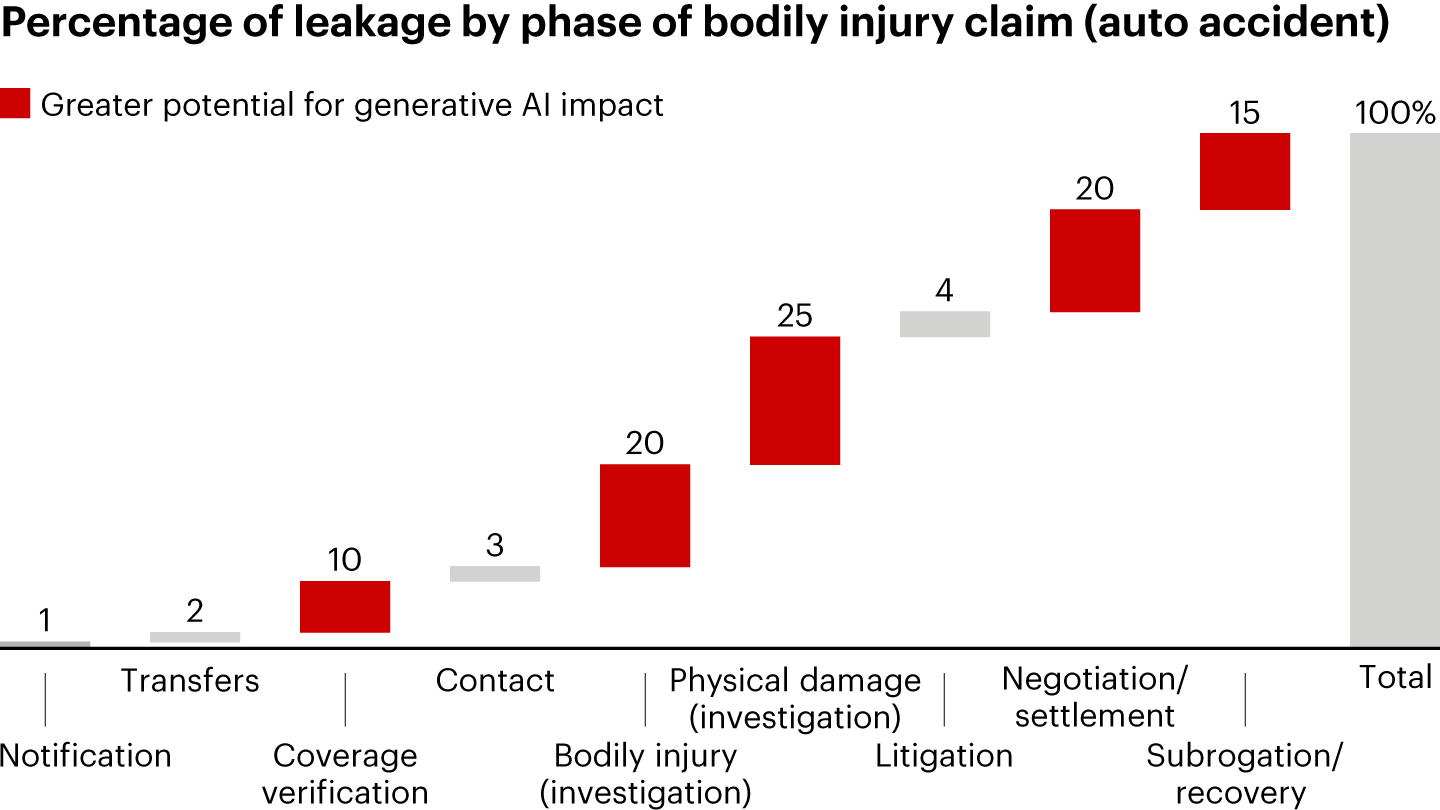
      Generative AI will improve coverage verification, investigation, negotiation, and recoveries
      Quelle Bain & Company

      The technology will access information about policyholder coverage more efficiently, helping reduce instances of indemnity payments to people who lack appropriate coverage. Similarly, fast access to information about past negotiations will make for greater accuracy in current negotiations.

      In total, the decrease in loss-adjusting expenses and leakage could create more than $100 billion in economic benefits globally, shared as insurer profits and lower customer rates. Moreover, the technology could reduce the effort spent on humans monitoring humans, both in terms of typical supervisory spans in claims units and in reviews of files that have been closed, which would become open-file reviews.

      Mind the risks

      To be sure, obtaining these results will take time, a thoughtful strategy, and disciplined execution. Generative AI tools are relatively easy to experiment with but harder to scale up. As with any nascent technology, there are several risks to consider, including concerns around accuracy and fairness; explainability of outputs to employees, customers, and regulators; transparency and traceability of models; fraud attempts with AI-generated photos; and privacy of customer data.

      Accommodating generative AI also involves new ways of working for employees. The claims organization tends to be one of the most entrenched in procedures and practices, operating on an apprenticeship type of model that values proven step-by-step processes. A generative AI copilot that systematizes knowledge may eliminate some of the adjuster’s traditional steps, which could raise concerns among longtime employees.

      Given the risks and sustained investment involved, insurers should start with simple but high-value use cases where risk can be managed with human oversight, such as a knowledge assistant, claims file summaries, or a first-notice-of-loss adjuster assistant. Experience with those use cases will set the stage for rolling out more complex internal use cases and simple external ones, such as adjuster coaching on the job (see Figure 2). Then insurers will be positioned to set up complex external use cases, such as a virtual claims assistant.

      Figure 2
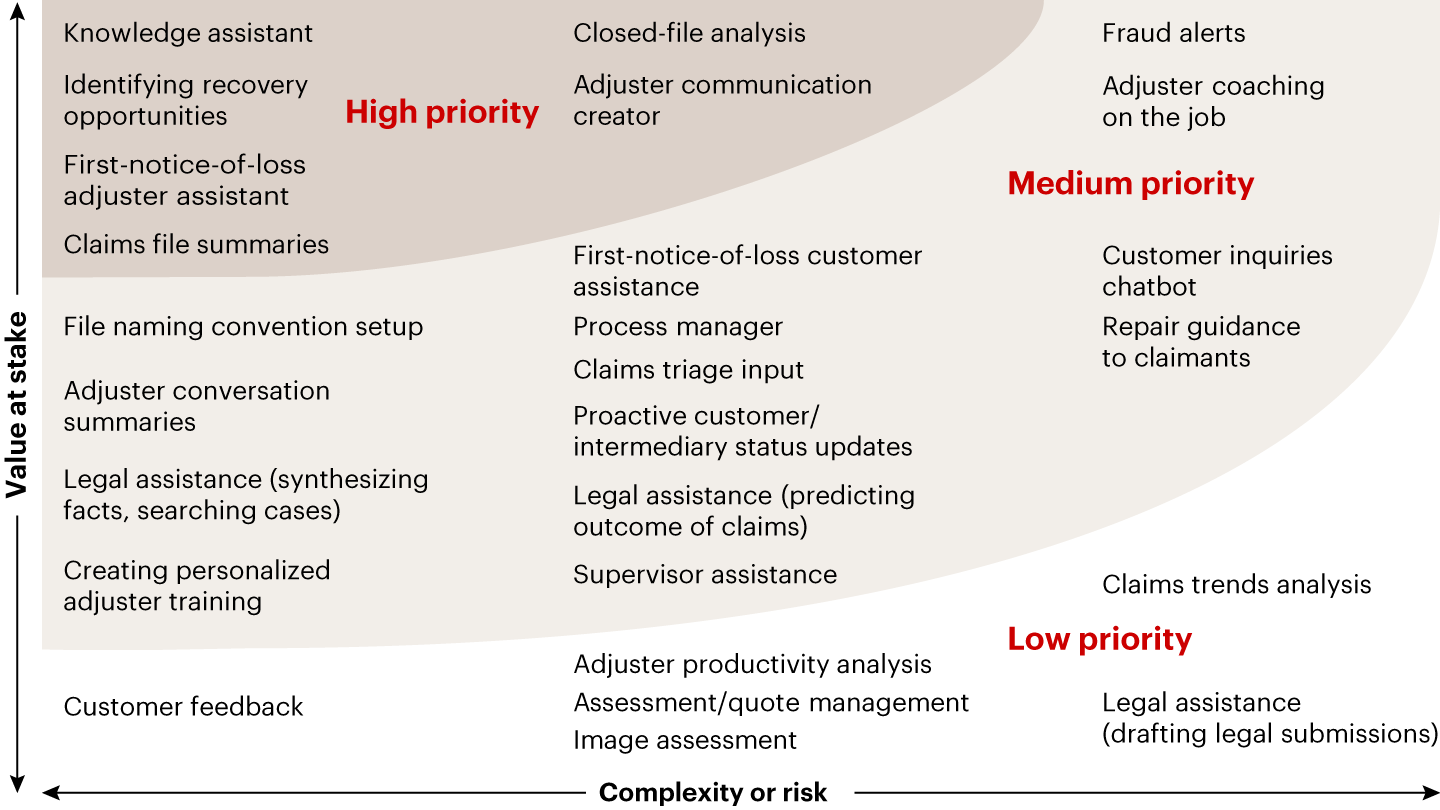
      Value, complexity, and risk should determine the sequence of use cases
      Quelle Bain & Company

      Two routes to scaling up

      With any use case, attaining large scale is essential to realizing substantial benefits. Currently, 41% of financial services companies recently surveyed by Bain & Company are using generative AI at full production, rather than piloting it. Insurers can scale up through two routes:

      • Through similar types of use cases. Once the first use case of an archetype is built, it can be replicated quickly and inexpensively by reusing technologies and methodologies. This avoids a proliferation of shadow IT and makes for faster deployment in all the descendant use cases. A knowledge assistant, for instance, could perform many of the tasks related to policy information, coverage verification, details in the claims file, and new adjuster training.
      • Within a workflow. Combining multiple use cases within a workflow can optimize processes, leading to cost efficiencies and overall improvement in the customer experience. For example, call summarization, call reason analysis, and call insights and follow-up can collectively transform the workload of a claims adjuster and raise productivity. Focusing on one workflow allows organizations to more effectively allocate resources, prioritize initiatives, manage dependencies, and pinpoint accountability.

      How to get started

      For companies that have just launched small pilots, the history of traditional AI and previous technologies suggests guidelines for senior leaders to steer the claims organization.

      Pan for nuggets of gold. Use cases that have clear value, are simple, and meet the organization’s risk tolerance should get the first look. These applications hit the cash register and earn the right to unlock investments for more transformative initiatives.

      Sort out what to build and what to buy. Vendors are incorporating generative AI into their solutions, so claims organizations have to stay abreast of the market, separating fact from fiction and making educated guesses on who the winners and losers will be. With so many established solutions, it can be a waste of time to, for instance, build a summarization tool or a bespoke data extraction tool. Proprietary solutions should be limited to cases of high strategic importance and high complexity or risk, such as employee-facing use cases that significantly improve the customer or employee experience. Cases of lower strategic importance and risk can be handled with third-party solutions.

      Devise rapid experiments using different testing methodologies. A test-and-learn approach informs decisions about how to wring the most value from each initiative. Engage claims managers and frontline employees to test solutions and evaluate them for completeness and accuracy.

      Set up joint business-technical teams. Collaboration is crucial to ensure that solutions meet user needs and are technically feasible. Frontline employees are sensitive to the structure and form of responses. Depending on the type of query, a response should match a set logic flow and include the right degree of detail in the right tone.

      Inspire people to want to adopt. Involve the entire claims team early on and in each step of the process. Besides ongoing training for employees, respected generative AI champions can help accelerate adoption by communicating how the technology can improve ways of working.           

      Imagining a different future

      Plenty of hype surrounds generative AI. However, it’s reasonable and useful for insurers to think big in their ambitions for transforming claims operations.

      Imagine, for instance, if adjusters could use the technology to have a full claims history displayed instantly, along with the ability to search an AI knowledge base and get an initial draft of answers to customers’ questions. They could call up a quick summary of claims file data. And they could rely on a copilot to provide suggestions based on past outcomes.

      Or imagine if claims supervisors could get actionable analytics, tracking indicators, and a rapid read on adjuster responses and tone, as a guide to improve performance.

      Imagine if customers could turn to a chatbot for accurate claims status updates and instant responses to questions.

      Big ambitions can motivate people in claims. Careful execution of experiments, with an eye to scaling up the successes, will keep the organization on track to reaching those ambitions over time. Generative AI is a powerful tool but a tool nonetheless, so striking the right balance between human and machine in allocating work will ultimately determine how much competitive advantage an insurer can build in claims.

      Autoren
      • Headshot of Keith Donnelly
        Keith Donnelly
        Partner, Atlanta
      • Headshot of Sean O'Neill
        Sean O'Neill
        Partner, Chicago
      • Headshot of Kara Tolub
        Kara Tolub
        Associate Partner, Sydney
      • Headshot of Tanja Brettel
        Tanja Brettel
        Practice Executive Vice President, Düsseldorf
      • Headshot of Marcos Bargallo
        Marcos Bargallo
        Partner, Sydney
      Kontaktieren Sie uns
      Verwandte Branchen
      • Finanzdienstleistungen
      • Versicherungswirtschaft
      Ähnliche Beratungsangebote
      • Advanced Analytics
      • Digitalisierung
      • Service Operations
      Wie wir Sie unterstützen können
      • Artificial Intelligence
      • HR Function Advantage
      Artificial Intelligence Insights
      AI Won’t Just Cut Costs, It Will Reinvent the Customer Experience

      Beyond efficiency, AI helps create a more personalized experience that delivers a triple play of customer loyalty, employee engagement, and revenue growth.

      Mehr erfahren
      Artificial Intelligence Insights
      Four Ways Leaders Can Make AI Redesigns Stick

      As companies redesign to scale AI, these four lessons help leaders ensure their organizations actually live the new operating model.

      Mehr erfahren
      Finanzdienstleistungen
      Rethinking Transformation: Lawrence Lam on Leading Change at Prudential

      Frankie Leung speaks with Lawrence Lam, CEO of Prudential Hong Kong, about organizational transformation and sustaining change through a people-led approach.

      Mehr erfahren
      Artificial Intelligence Insights
      HR: The Hidden Accelerator of AI Adoption

      Scaling AI starts with people. Yet only half of companies involve HR in their strategy.

      Mehr erfahren
      Artificial Intelligence Insights
      How Can AI Be Used in Machinery & Equipment?

      Explore the use cases with the highest potential.

      Mehr erfahren
      First published in Oktober 2024
      Markierungen
      • Advanced Analytics
      • Artificial Intelligence
      • Artificial Intelligence Insights
      • CIO Insights
      • Digitalisierung
      • Finanzdienstleistungen
      • HR Function Advantage
      • Service Operations
      • Versicherungswirtschaft

      Wie wir unsere Kunden unterstützt haben

      Digitalisierung Reimagining Insurance for the AI Era

      Kundenbeispiel lesen

      Strategie From Laggard to Leader: Desjardins Evolves Member Centricity for the Digital Age

      Kundenbeispiel lesen

      Kundenstrategie und Marketing Customer focus helps a P&C insurer grow

      Kundenbeispiel lesen

      Möchten Sie mit uns in Kontakt bleiben?

      Wir unterstützen Führungskräfte weltweit, die kritischen Themen in ihrem Unternehmen zu adressieren. Gemeinsam schaffen wir nachhaltige Veränderungen und Ergebnisse.

      Bain Insights. Unsere Perspektive auf die kritischen Themen, mit denen sich international agierende Unternehmen konfrontiert sehen, finden Sie monatlich in Ihrem Postfach.

      *Ich habe die Datenschutzerklärung gelesen und akzeptiere sie.
      Bitte lesen Sie die Datenschutzerklärung und akzeptieren Sie diese.
      Bain & Company
      Contact us Sustainability Accessibility Rechtliche Hinweise Impressum Datenschutz Cookie-Richtlinie Sitemap Log In

      © 1996-2026 Bain & Company, Inc.

      Kontaktieren Sie Bain

      Wie können wir Ihnen helfen?

      • Business inquiry
      • Career information
      • Press relations
      • Partnership request
      • Speaker request
      Alle weltweiten Büros