
Skip to Content
  • Standorte

    Standorte

    North & Latin America
    • Atlanta
    • Austin
    • Bogota
    • Boston
    • Buenos Aires
    • Chicago
    • Dallas
    • Denver
    • Houston
    • Lisbon
    • Los Angeles
    • Mexico City
    • Minneapolis
    • Monterrey
    • Montreal
    • New York
    • Rio de Janeiro
    • San Francisco
    • Santiago
    • São Paulo
    • Seattle
    • Silicon Valley
    • Toronto
    • Washington, DC
    Europe & Africa
    • Amsterdam
    • Athens
    • Berlin
    • Brussels
    • Copenhagen
    • Düsseldorf
    • Frankfurt
    • Helsinki
    • Istanbul
    • Johannesburg
    • Kyiv
    • Lisbon
    • London
    • Madrid
    • Milan
    • München
    • Oslo
    • Paris
    • Rome
    • Stockholm
    • Warsaw
    • Wien
    • Zürich
    Middle East
    • Doha
    • Dubai
    • Riyadh
    Asia & Australia
    • Bangkok
    • Beijing
    • Bengaluru
    • Brisbane
    • Ho Chi Minh City
    • Hong Kong
    • Jakarta
    • Kuala Lumpur
    • Manila
    • Melbourne
    • Mumbai
    • New Delhi
    • Perth
    • Seoul
    • Shanghai
    • Singapore
    • Sydney
    • Tokyo
    Alle Standorte Anzeigen
  • Alumni
  • Presse
  • Newsletter
  • Kontakt
  • DACH-Region | Deutsch

    Wählen Sie Ihre Region und Sprache

    Global
    • Global (English)
    North & Latin America
    • Brazil (Português)
    • Argentina (Español)
    • Canada (Français)
    • Chile (Español)
    • Colombia (Español)
    Europe, Middle East, & Africa
    • France (Français)
    • DACH-Region (Deutsch)
    • Italy (Italiano)
    • Spain (Español)
    • Greece (Elliniká)
    Asia & Australia
    • China (中文版)
    • Korea (한국어)
    • Japan (日本語)
  • Saved items (0)
    Saved items (0)

    You have no saved items.

    Inhalte, für die Sie sich interessieren, werden hier gespeichert und können später gelesen oder weitergeleitet werden.

    Explore Bain Insights
  • Branchenkompetenzen
    Hauptmenü

    Branchenkompetenzen

    • Luft- und Raumfahrt, Verteidigung
    • Agrarwirtschaft
    • Chemieindustrie
    • Infrastruktur und Bauwirtschaft
    • Konsumgüter
    • Finanzdienstleistungen
    • Gesundheitswesen
    • Maschinen- und Anlagenbau
    • Medienwirtschaft
    • Metallindustrie
    • Bergbau
    • Öl und Gas
    • Papier- und Verpackungsindustrie
    • Private Equity
      Branchenkompetenzen
      Private Equity
      • Due Diligence
      • Exit Planning
      • Firm Strategy & Operations
      • Portfolio Value Creation
    • Öffentlicher Sektor und Sozialwesen
    • Einzelhandel
    • Technologie
    • Telekommunikation
    • Transportwesen
    • Reise- und Freizeitbranche
    • Versorgung und erneuerbare Energien
  • Managementkompetenzen
    Hauptmenü

    Managementkompetenzen

    • Customer Experience
    • ESG
    • Innovation
    • M&A
    • Operations
    • People & Organization
    • Private Equity
    • Sales & Marketing
    • Strategie
    • KI, Einblicke und Lösungen
    • Technologie
    • Transformation
  • Digital
  • Publikationen
    Hauptmenü

    Publikationen

    • Branchenthemen
    • Managementthemen
    • Bain-Bücher
    Alle Publikationen
    Ausgewählte Themen
    • Resilienz in der globalen Krise
    • M&A Report
    • Private Equity Podcast
    • Midyear Private Equity Report
    • Agile
    • Engineering Report
    • Digital Transformation
    • Elements of Value®
    • Firm of the Future
    • Nachhaltigkeitsstudie
    • Macro Trends
    • Future of Consumption
    • Weltwirtschaftsforum (WEF)
  • Über uns
    Hauptmenü

    Über uns

    • Was wir bieten
    • Unser Ansatz
    • Unser Team
    • Game Changer Award
    • Female Allstar Board
    • Messbare Ergebnisse (EN)
    • Auszeichnungen
    • Globale Partnerschaften
    • The Mission
    Further: Our global responsibility
    • Vielfalt & Chancengleichheit
    • Soziale Verantwortung
    • Sustainability
    Erfahren Sie mehr zu "Further"
  • Karriere
    Hauptmenü

    Karriere

    • Dein Einstieg
      Karriere
      Dein Einstieg
      • Find Your Place
      • Unsere Arbeitsbereiche
      • Unsere Teams
      • Angebote für Studierende
      • Praktika & Programme
      • Recruiting-Events
    • Arbeiten bei Bain
      Karriere
      Arbeiten bei Bain
      • Karriere Stories
      • Unsere Bainies
      • Office-Standorte
      • Weiterentwicklung
      • Affinity Groups
      • Deine Benefits
    • Impact Stories
    • Deine Bewerbung
      Karriere
      Deine Bewerbung
      • Das erwartet dich
      • Der Interviewprozess
    FIND JOBS
  • Standorte
    Hauptmenü

    Standorte

    • North & Latin America
      Standorte
      North & Latin America
      • Atlanta
      • Austin
      • Bogota
      • Boston
      • Buenos Aires
      • Chicago
      • Dallas
      • Denver
      • Houston
      • Lisbon
      • Los Angeles
      • Mexico City
      • Minneapolis
      • Monterrey
      • Montreal
      • New York
      • Rio de Janeiro
      • San Francisco
      • Santiago
      • São Paulo
      • Seattle
      • Silicon Valley
      • Toronto
      • Washington, DC
    • Europe & Africa
      Standorte
      Europe & Africa
      • Amsterdam
      • Athens
      • Berlin
      • Brussels
      • Copenhagen
      • Düsseldorf
      • Frankfurt
      • Helsinki
      • Istanbul
      • Johannesburg
      • Kyiv
      • Lisbon
      • London
      • Madrid
      • Milan
      • München
      • Oslo
      • Paris
      • Rome
      • Stockholm
      • Warsaw
      • Wien
      • Zürich
    • Middle East
      Standorte
      Middle East
      • Doha
      • Dubai
      • Riyadh
    • Asia & Australia
      Standorte
      Asia & Australia
      • Bangkok
      • Beijing
      • Bengaluru
      • Brisbane
      • Ho Chi Minh City
      • Hong Kong
      • Jakarta
      • Kuala Lumpur
      • Manila
      • Melbourne
      • Mumbai
      • New Delhi
      • Perth
      • Seoul
      • Shanghai
      • Singapore
      • Sydney
      • Tokyo
    Alle Standorte Anzeigen
  • Alumni
  • Presse
  • Newsletter
  • Kontakt
  • DACH-Region | Deutsch
    Hauptmenü

    Wählen Sie Ihre Region und Sprache

    • Global
      Wählen Sie Ihre Region und Sprache
      Global
      • Global (English)
    • North & Latin America
      Wählen Sie Ihre Region und Sprache
      North & Latin America
      • Brazil (Português)
      • Argentina (Español)
      • Canada (Français)
      • Chile (Español)
      • Colombia (Español)
    • Europe, Middle East, & Africa
      Wählen Sie Ihre Region und Sprache
      Europe, Middle East, & Africa
      • France (Français)
      • DACH-Region (Deutsch)
      • Italy (Italiano)
      • Spain (Español)
      • Greece (Elliniká)
    • Asia & Australia
      Wählen Sie Ihre Region und Sprache
      Asia & Australia
      • China (中文版)
      • Korea (한국어)
      • Japan (日本語)
  • Saved items  (0)
    Hauptmenü
    Saved items (0)

    You have no saved items.

    Inhalte, für die Sie sich interessieren, werden hier gespeichert und können später gelesen oder weitergeleitet werden.

    Explore Bain Insights
  • Branchenkompetenzen
    • Branchenkompetenzen

      • Luft- und Raumfahrt, Verteidigung
      • Agrarwirtschaft
      • Chemieindustrie
      • Infrastruktur und Bauwirtschaft
      • Konsumgüter
      • Finanzdienstleistungen
      • Gesundheitswesen
      • Maschinen- und Anlagenbau
      • Medienwirtschaft
      • Metallindustrie
      • Bergbau
      • Öl und Gas
      • Papier- und Verpackungsindustrie
      • Private Equity
      • Öffentlicher Sektor und Sozialwesen
      • Einzelhandel
      • Technologie
      • Telekommunikation
      • Transportwesen
      • Reise- und Freizeitbranche
      • Versorgung und erneuerbare Energien
  • Managementkompetenzen
    • Managementkompetenzen

      • Customer Experience
      • ESG
      • Innovation
      • M&A
      • Operations
      • People & Organization
      • Private Equity
      • Sales & Marketing
      • Strategie
      • KI, Einblicke und Lösungen
      • Technologie
      • Transformation
  • Digital
  • Publikationen
    • Publikationen

      • Branchenthemen
      • Managementthemen
      • Bain-Bücher
      Alle Publikationen
      Ausgewählte Themen
      • Resilienz in der globalen Krise
      • M&A Report
      • Private Equity Podcast
      • Midyear Private Equity Report
      • Agile
      • Engineering Report
      • Digital Transformation
      • Elements of Value®
      • Firm of the Future
      • Nachhaltigkeitsstudie
      • Macro Trends
      • Future of Consumption
      • Weltwirtschaftsforum (WEF)
  • Über uns
    • Über uns

      • Was wir bieten
      • Unser Ansatz
      • Unser Team
      • Game Changer Award
      • Female Allstar Board
      • Messbare Ergebnisse (EN)
      • Auszeichnungen
      • Globale Partnerschaften
      • The Mission
      Further: Our global responsibility
      • Vielfalt & Chancengleichheit
      • Soziale Verantwortung
      • Sustainability
      Erfahren Sie mehr zu "Further"
  • Karriere
    Häufige Suchanfragen
    • Agil
    • Digital
    • Strategie
    Vorherige Suchanfragen
      Zuletzt besuchte Seiten

      Content added to saved items

      Saved items (0)

      Removed from saved items

      Saved items (0)

      Artikel

      Are you ahead of the curve in emerging markets?

      Are you ahead of the curve in emerging markets?

      Companies hoping to profit from the growth of emerging markets must also cope with rapid changes that complicate that goal.

      Von Pankaj Saluja, Mike Booker, Bruno Lannes and Satish Shankar

      • Min. Lesezeit

      Artikel

      Are you ahead of the curve in emerging markets?
      en

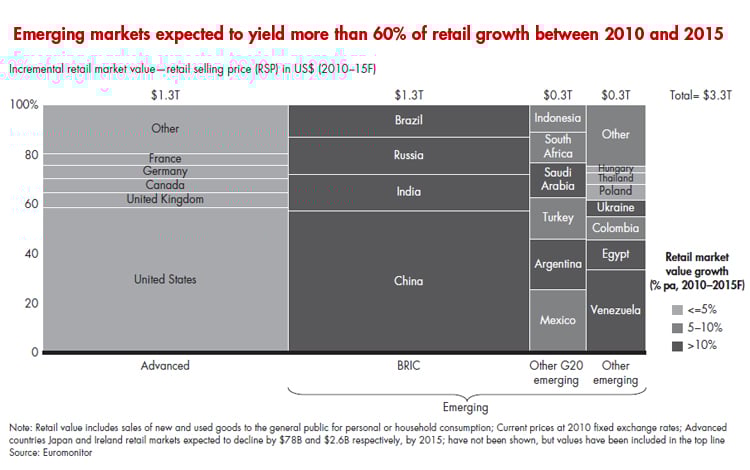
      Companies racing to capture their share of emerging markets’ booming growth find something unexpected: Along with unprecedented expansion, these markets are undergoing rapid changes that make the opportunities trickier to pursue. From China to India to Brazil to Turkey to Vietnam, emerging markets will contribute around 60 percent of all global GDP growth by 2015, compared with just 30 percent for the seven major industrialized nations, based on IMF projections, and more than 60 percent of retail growth, according to Euromonitor. Bain & Company research shows that revenue growth in emerging markets has outpaced global growth by up to 10 times for multinational players, with profitability that’s equal to or higher than global averages. But as these markets quickly evolve, each with its own unique identity, gaining ground will depend on players’ ability to negotiate four critical developments.
      are-you-ahead-of-the-curve-figure-01_embed


      Development 1: Category consolidation is raising the barriers to entry and leadership

      Companies considering the move into emerging markets face a daunting fact: Consolidation is well underway, especially in well-penetrated categories. Already, the top three to five players in most markets control a large share, and their shares are quickly rising. In China’s beer market, the top six beer producers increased their share from 25 percent to 65 percent in eight years by progressively phasing out regional small players. And in Brazil, categories as diverse as yogurt, processed meats and detergents are dominated by two big players with more than 50 percent market share between them.

      There are two major reasons for the consolidation. First, leading multinationals are aggressively pushing for and investing in leadership across large and frontier emerging markets as sales flatten in their traditional strongholds in the West. Many have been in emerging markets for years and are applying lessons learned from the past. For example, Unilever now generates more than 50 percent of all revenues from emerging markets and expects to take it to above 70 percent by 2020. In small, but high-growth markets such as Vietnam, Unilever has already built a strong leadership position in the personal care category, where its sales grew nearly threefold between 2001 and 2010.

      Second, selected emerging local players are getting stronger, especially in categories like food, personal care and household products. Local players, many of which now resemble multinationals, claim one-third of the emerging markets share and typically play one of three competitive cards to win:

      • They pick “insulated” market niches and build defensible positions.
      • They exploit their local knowledge and consumer understanding to gain an edge. Consider how India’s Godrej Consumer Products used its home leadership position and understanding of the hair dye market to globally expand into similar markets such as Africa and Latin America.
      • And local players make the most of their low-cost model and “good enough” quality. Petra’s use of less-expensive compound chocolate ingredients has helped make it the leader in Indonesia.

      It’s to the point where acquisitions—either of local players or other multinationals—may be the only option to build scale in some categories and countries. Kraft knew it would be difficult to gain ground organically in places like China and India, so it turned to acquisitions. Its purchase of Danone’s biscuits business in China and, more recently, of Cadbury, helped Kraft quadruple its revenues in China from 2006 to 2010, while paving the way for its entry into India.

      Facing consolidation and tougher competition, multinational players need to ask some hard questions: If already present, how can they secure their path to leadership? If not present, how to enter or grow—or is it already too late?

      Development 2: Segment and category creation is emerging as an alternative route to success

      When multinationals first discovered emerging markets, it was a place to sell luxury products within their developed- markets portfolios to the tiny segment of consumers who could afford them. Then, as a middle class emerged, they shifted their focus to the growing mainstream. Now, with incomes rising, these companies aggressively moved full circle: expanding the market by selling more value-added and new market offerings in addition to serving the mass market. Purveyors of everything from hair care to food and beverage services are creating new segments and categories. For example, L’Oréal expanded its franchise in India by launching the Garnier haircare brand aimed at consumers who are willing to pay a little above mainstream prices. Diageo, the global spirits maker, spends heavily on marketing, working closely with bars, discos and karaoke lounges across Asia to encourage consumers to try and consume its highmargin scotch, a relatively new category in many Asian markets. Both Diageo and rival Pernod Ricard are making good headway in many of the nontraditional scotch markets like China and India.

      Meanwhile, rising incomes also lift categories at the value end of the market as more consumers move from unbranded products to branded. It’s a shift that reflects brand awareness and deeper distribution networks. For example, at the bottom end, Vietnam’s Masan Consumer grew its share of table sauces from just two percent in 2005 to 36 percent in 2009, according to Euromonitor, largely by branding more of its Nam Ngu sauces and upgrading consumers from unbranded sauces sold in plastic bags in open markets. Whether the products are premium, mass market or value, companies boost their odds of success by finding the deep consumer insights that can help accelerate brand growth and using those insights as the basis of critical strategic decisions.

      Development 3: Modern trade is growing fast, but traditional trade will remain relevant for the foreseeable future

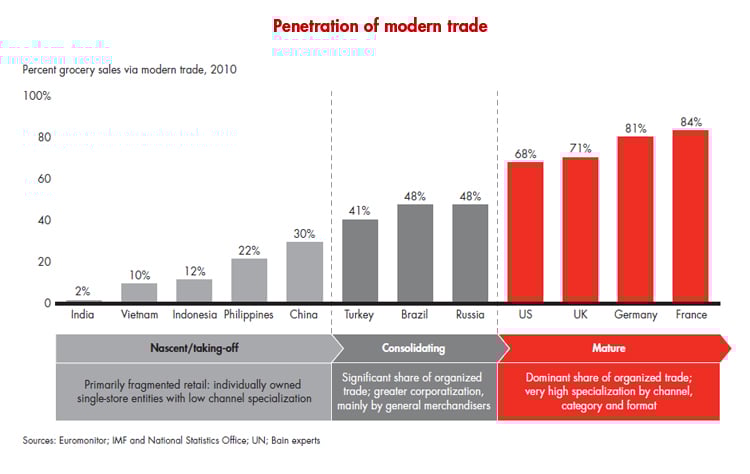
      Modern trade is taking off in emerging markets as consumers evolve, regulatory barriers come down and multinational retailers seek new, high-growth markets. But the pattern of growth is varied.

      Some markets, like Brazil, Russia and China’s more developed cities are becoming saturated, with modern trade representing more than half the total retail share. In others, like Indonesia and Vietnam, modern trade’s share is smaller but growing rapidly. At the other end of the spectrum is India, which continues to be a laggard due to regulatory hurdles.
      are-you-ahead-of-the-curve-figure-02_embed


      The competitive environment also is increasingly intense and challenging. In China, while multinationals have a strong presence, the landscape is still highly fragmented and leading local players are investing to expand and improve customer offerings. For example, six of the country’s top ten grocery retailers are locally owned. As competition heats up between multinationals and domestic companies, global players still are figuring out the most effective ways to customize store formats, localize offerings and develop winning propositions.

      Our research shows that while modern trade will accelerate rapidly, traditional trade, characterized by fragmented mom and pops in widely dispersed locations, won’t lose relevance any time in the near future, especially in the semi-urban and rural areas of emerging economies. To succeed, consumer products companies need one foot in each of the worlds of both modern and traditional trade, creating business models to generate profitable growth in these vastly different channels. They must determine how to best serve both modern and traditional outlets, avoid channel conflict and create an organization to deliver. And they need to develop in-store execution strategies for both channels (see “Perfecting sales execution”).

      Leading foreign companies have successfully built innovative and well-executed route-to-market models that keep pace with their modern trade expansion, while continuing to expand and maintain traditional trade share. For example, Procter & Gamble has separate teams to manage the two channels in China and other emerging markets.

      Development 4: Securing quality supplies at a reasonable cost will be an ongoing major challenge

      As demand outpaces supply in emerging markets, consumer products makers face the real threat of securing quality supplies just as they build both capacity and trained manpower to keep their well-oiled supply chains running. This is especially evident in the food sector, from dairy to fruit juice.

      One solution: establishing strategic partnerships with raw materials suppliers. In recent years, Nestle, Danone and large local players have secured milk supplies in Brazil by initiating programs to ensure the loyalty and successful growth of their core suppliers. They provide technology to increase production and quality, demonstrating how large-scale farming can improve farmer economics.

      Meanwhile, over the past six years, rising commodity costs and currency risk volatility have emerged as key challenges. Winners create capabilities to boost trading skills for exchange-traded products like coffee, manage for currency volatility and modify formulations without compromising the customer value proposition. They also continuously tweak their strategic choices around sourcing and manufacturing locations, where today’s answer might be wrong tomorrow—given changes in local factor costs, exchange rates and tariffs.

      As these four developments unfold, successful companies will be those that excel at identifying and riding the game-changing developments, even proactively shaping them. The approach needs to be tailored based on whether a company is about to enter an emerging market or already is a player.

      For companies looking to enter:

      • Be clear about your rationale for entry and your objectives and be realistic about your chances of success.
      • Pick your battlefields carefully and plan a path to attractive economics and longer-term leadership.
      • Scale matters, but future sustainable competitive positions can be built by identifying and growing underdeveloped markets, categories or segments at the higher or lower end.
      • Partner with or acquire to establish market position and build a tailored route-to-market, supply chain and critical capabilities.

      For leaders or companies gaining ground:

      • Be clear on the relevant arena that will deliver leadership economics. For example, is it all dairy products or just yogurt? Is it national share or regional share?
      • Develop a repeatable formula for establishing leadership, pursuing appropriate segment and category creation opportunities, and facilitating learning from and across emerging-markets.
      • Build innovation and flexibility into your business models to deal with high complexity and the rapid evolution of route-to-market and supply chain networks. This includes building “eco-systems” that reduce costs and risk, while growing critical scale. For example, Unilever and PepsiCo’s joint venture for distributing select products in India increases PepsiCo’s scale and extends the company’s distribution network. The partnership gives Unilever an opportunity to boost iced tea sales, a relatively new category in India.

      Regardless of market position, companies should invest in the right level of resources to reach full market potential, be prepared to “stay the course,” monitor new developments and course correct as required. Organization is a key enabler. Both existing and new players will benefit from nimble, local decision making by empowered local management—as well as local or expatriate leaders who truly understand the culture. Rapid business growth and increased sophistication and complexity call for a systematic approach to developing an HR pipeline with enough of the right people to help the company deliver on its strategy. Companies that lack the ability to assess and fill talent gaps and fix organizational shortcomings can end up ceding growth to a competitor.

      The remarkably fast transformation of emerging markets puts consumer products makers at a historic crossroads. Winning means patiently and carefully charting a course through the complex landscape of countries undergoing explosive growth—while navigating four game-changing developments.


      are-you-ahead-of-the-curve-figure-01_full

      are-you-ahead-of-the-curve-figure-02_full
      Autoren
      • Headshot of Mike Booker
        Mike Booker
        Advisory Partner, Singapore
      • Headshot of Bruno Lannes
        Bruno Lannes
        Advisory Partner, Shanghai
      • Headshot of Satish Shankar
        Satish Shankar
        Partner, Singapore
      Kontaktieren Sie uns
      Verwandte Branchen
      • Konsumgüter
      Konsumgüter
      Perfecting sales execution

      Most companies treat sales like an art, but they are discovering that the sales process needs to become more of a science.

      Mehr erfahren
      Finanzdienstleistungen
      Blockchain-Technologie wird Transaction-Banking revolutionieren

      Die Studie zeigt, in welchem Maß Distributed Ledgers und andere digitale Technologien das Transaction-Banking in den kommenden Jahren verändern werden und wie traditionelle Banken handeln sollten.

      Mehr erfahren
      Konsumgüter
      Shift to Vertical: David Haines, Group CEO, Flora Food Group

      What does it take to stay connected to your customers when scale and complexity threaten to pull you away? 

      Mehr erfahren
      Konsumgüter
      Consumer Products M&A

      In their quest for profitable growth, more companies are divesting brands or buying insurgents.

      Mehr erfahren
      Konsumgüter
      Exploring AI for Packaging Circularity

      AI is already creating value across the packaging lifecycle, from optimising design and reducing material use to improving sorting and traceability.

      Mehr erfahren
      First published in Oktober 2011
      Markierungen
      • Konsumgüter

      Wie wir unsere Kunden unterstützt haben

      Nachhaltigkeit A Personal Care and Cosmetics Brand Charts a Course for Sustainability

      Kundenbeispiel lesen

      Change & Implementation Results360® Propels an Appliance Maker Into a New Era of Growth

      Kundenbeispiel lesen

      Kundenstrategie und Marketing A sweet new branding strategy

      Kundenbeispiel lesen

      Möchten Sie mit uns in Kontakt bleiben?

      Wir unterstützen Führungskräfte weltweit, die kritischen Themen in ihrem Unternehmen zu adressieren. Gemeinsam schaffen wir nachhaltige Veränderungen und Ergebnisse.

      Bain Insights. Unsere Perspektive auf die kritischen Themen, mit denen sich international agierende Unternehmen konfrontiert sehen, finden Sie monatlich in Ihrem Postfach.

      *Ich habe die Datenschutzerklärung gelesen und akzeptiere sie.
      Bitte lesen Sie die Datenschutzerklärung und akzeptieren Sie diese.
      Bain & Company
      Contact us Sustainability Accessibility Rechtliche Hinweise Impressum Datenschutz Cookie-Richtlinie Sitemap Log In

      © 1996-2026 Bain & Company, Inc.

      Kontaktieren Sie Bain

      Wie können wir Ihnen helfen?

      • Business inquiry
      • Career information
      • Press relations
      • Partnership request
      • Speaker request
      Alle weltweiten Büros