
Skip to Content
  • Standorte

    Standorte

    North & Latin America
    • Atlanta
    • Austin
    • Bogota
    • Boston
    • Buenos Aires
    • Chicago
    • Dallas
    • Denver
    • Houston
    • Lisbon
    • Los Angeles
    • Mexico City
    • Minneapolis
    • Monterrey
    • Montreal
    • New York
    • Rio de Janeiro
    • San Francisco
    • Santiago
    • São Paulo
    • Seattle
    • Silicon Valley
    • Toronto
    • Washington, DC
    Europe & Africa
    • Amsterdam
    • Athens
    • Berlin
    • Brussels
    • Copenhagen
    • Düsseldorf
    • Frankfurt
    • Helsinki
    • Istanbul
    • Johannesburg
    • Kyiv
    • Lisbon
    • London
    • Madrid
    • Milan
    • München
    • Oslo
    • Paris
    • Rome
    • Stockholm
    • Warsaw
    • Wien
    • Zürich
    Middle East
    • Doha
    • Dubai
    • Riyadh
    Asia & Australia
    • Bangkok
    • Beijing
    • Bengaluru
    • Brisbane
    • Ho Chi Minh City
    • Hong Kong
    • Jakarta
    • Kuala Lumpur
    • Manila
    • Melbourne
    • Mumbai
    • New Delhi
    • Perth
    • Seoul
    • Shanghai
    • Singapore
    • Sydney
    • Tokyo
    Alle Standorte Anzeigen
  • Alumni
  • Presse
  • Newsletter
  • Kontakt
  • DACH-Region | Deutsch

    Wählen Sie Ihre Region und Sprache

    Global
    • Global (English)
    North & Latin America
    • Brazil (Português)
    • Argentina (Español)
    • Canada (Français)
    • Chile (Español)
    • Colombia (Español)
    Europe, Middle East, & Africa
    • France (Français)
    • DACH-Region (Deutsch)
    • Italy (Italiano)
    • Spain (Español)
    • Greece (Elliniká)
    Asia & Australia
    • China (中文版)
    • Korea (한국어)
    • Japan (日本語)
  • Saved items (0)
    Saved items (0)

    You have no saved items.

    Inhalte, für die Sie sich interessieren, werden hier gespeichert und können später gelesen oder weitergeleitet werden.

    Explore Bain Insights
  • Branchenkompetenzen
    Hauptmenü

    Branchenkompetenzen

    • Luft- und Raumfahrt, Verteidigung
    • Agrarwirtschaft
    • Chemieindustrie
    • Infrastruktur und Bauwirtschaft
    • Konsumgüter
    • Finanzdienstleistungen
    • Gesundheitswesen
    • Maschinen- und Anlagenbau
    • Medienwirtschaft
    • Metallindustrie
    • Bergbau
    • Öl und Gas
    • Papier- und Verpackungsindustrie
    • Private Equity
      Branchenkompetenzen
      Private Equity
      • Due Diligence
      • Exit Planning
      • Firm Strategy & Operations
      • Portfolio Value Creation
    • Öffentlicher Sektor und Sozialwesen
    • Einzelhandel
    • Technologie
    • Telekommunikation
    • Transportwesen
    • Reise- und Freizeitbranche
    • Versorgung und erneuerbare Energien
  • Managementkompetenzen
    Hauptmenü

    Managementkompetenzen

    • Customer Experience
    • ESG
    • Innovation
    • M&A
    • Operations
    • People & Organization
    • Private Equity
    • Sales & Marketing
    • Strategie
    • KI, Einblicke und Lösungen
    • Technologie
    • Transformation
  • Digital
  • Publikationen
    Hauptmenü

    Publikationen

    • Branchenthemen
    • Managementthemen
    • Bain-Bücher
    Alle Publikationen
    Ausgewählte Themen
    • Resilienz in der globalen Krise
    • M&A Report
    • Private Equity Podcast
    • Midyear Private Equity Report
    • Agile
    • Engineering Report
    • Digital Transformation
    • Elements of Value®
    • Firm of the Future
    • Nachhaltigkeitsstudie
    • Macro Trends
    • Future of Consumption
    • Weltwirtschaftsforum (WEF)
  • Über uns
    Hauptmenü

    Über uns

    • Was wir bieten
    • Unser Ansatz
    • Unser Team
    • Game Changer Award
    • Female Allstar Board
    • Messbare Ergebnisse (EN)
    • Auszeichnungen
    • Globale Partnerschaften
    • The Mission
    Further: Our global responsibility
    • Vielfalt & Chancengleichheit
    • Soziale Verantwortung
    • Sustainability
    Erfahren Sie mehr zu "Further"
  • Karriere
    Hauptmenü

    Karriere

    • Dein Einstieg
      Karriere
      Dein Einstieg
      • Find Your Place
      • Unsere Arbeitsbereiche
      • Unsere Teams
      • Angebote für Studierende
      • Praktika & Programme
      • Recruiting-Events
    • Arbeiten bei Bain
      Karriere
      Arbeiten bei Bain
      • Blog: Inside Bain
      • Karriere Stories
      • Unsere Bainies
      • Office-Standorte
      • Weiterentwicklung
      • Affinity Groups
      • Deine Benefits
    • Impact Stories
    • Deine Bewerbung
      Karriere
      Deine Bewerbung
      • Das erwartet dich
      • Der Interviewprozess
    FIND JOBS
  • Standorte
    Hauptmenü

    Standorte

    • North & Latin America
      Standorte
      North & Latin America
      • Atlanta
      • Austin
      • Bogota
      • Boston
      • Buenos Aires
      • Chicago
      • Dallas
      • Denver
      • Houston
      • Lisbon
      • Los Angeles
      • Mexico City
      • Minneapolis
      • Monterrey
      • Montreal
      • New York
      • Rio de Janeiro
      • San Francisco
      • Santiago
      • São Paulo
      • Seattle
      • Silicon Valley
      • Toronto
      • Washington, DC
    • Europe & Africa
      Standorte
      Europe & Africa
      • Amsterdam
      • Athens
      • Berlin
      • Brussels
      • Copenhagen
      • Düsseldorf
      • Frankfurt
      • Helsinki
      • Istanbul
      • Johannesburg
      • Kyiv
      • Lisbon
      • London
      • Madrid
      • Milan
      • München
      • Oslo
      • Paris
      • Rome
      • Stockholm
      • Warsaw
      • Wien
      • Zürich
    • Middle East
      Standorte
      Middle East
      • Doha
      • Dubai
      • Riyadh
    • Asia & Australia
      Standorte
      Asia & Australia
      • Bangkok
      • Beijing
      • Bengaluru
      • Brisbane
      • Ho Chi Minh City
      • Hong Kong
      • Jakarta
      • Kuala Lumpur
      • Manila
      • Melbourne
      • Mumbai
      • New Delhi
      • Perth
      • Seoul
      • Shanghai
      • Singapore
      • Sydney
      • Tokyo
    Alle Standorte Anzeigen
  • Alumni
  • Presse
  • Newsletter
  • Kontakt
  • DACH-Region | Deutsch
    Hauptmenü

    Wählen Sie Ihre Region und Sprache

    • Global
      Wählen Sie Ihre Region und Sprache
      Global
      • Global (English)
    • North & Latin America
      Wählen Sie Ihre Region und Sprache
      North & Latin America
      • Brazil (Português)
      • Argentina (Español)
      • Canada (Français)
      • Chile (Español)
      • Colombia (Español)
    • Europe, Middle East, & Africa
      Wählen Sie Ihre Region und Sprache
      Europe, Middle East, & Africa
      • France (Français)
      • DACH-Region (Deutsch)
      • Italy (Italiano)
      • Spain (Español)
      • Greece (Elliniká)
    • Asia & Australia
      Wählen Sie Ihre Region und Sprache
      Asia & Australia
      • China (中文版)
      • Korea (한국어)
      • Japan (日本語)
  • Saved items  (0)
    Hauptmenü
    Saved items (0)

    You have no saved items.

    Inhalte, für die Sie sich interessieren, werden hier gespeichert und können später gelesen oder weitergeleitet werden.

    Explore Bain Insights
  • Branchenkompetenzen
    • Branchenkompetenzen

      • Luft- und Raumfahrt, Verteidigung
      • Agrarwirtschaft
      • Chemieindustrie
      • Infrastruktur und Bauwirtschaft
      • Konsumgüter
      • Finanzdienstleistungen
      • Gesundheitswesen
      • Maschinen- und Anlagenbau
      • Medienwirtschaft
      • Metallindustrie
      • Bergbau
      • Öl und Gas
      • Papier- und Verpackungsindustrie
      • Private Equity
      • Öffentlicher Sektor und Sozialwesen
      • Einzelhandel
      • Technologie
      • Telekommunikation
      • Transportwesen
      • Reise- und Freizeitbranche
      • Versorgung und erneuerbare Energien
  • Managementkompetenzen
    • Managementkompetenzen

      • Customer Experience
      • ESG
      • Innovation
      • M&A
      • Operations
      • People & Organization
      • Private Equity
      • Sales & Marketing
      • Strategie
      • KI, Einblicke und Lösungen
      • Technologie
      • Transformation
  • Digital
  • Publikationen
    • Publikationen

      • Branchenthemen
      • Managementthemen
      • Bain-Bücher
      Alle Publikationen
      Ausgewählte Themen
      • Resilienz in der globalen Krise
      • M&A Report
      • Private Equity Podcast
      • Midyear Private Equity Report
      • Agile
      • Engineering Report
      • Digital Transformation
      • Elements of Value®
      • Firm of the Future
      • Nachhaltigkeitsstudie
      • Macro Trends
      • Future of Consumption
      • Weltwirtschaftsforum (WEF)
  • Über uns
    • Über uns

      • Was wir bieten
      • Unser Ansatz
      • Unser Team
      • Game Changer Award
      • Female Allstar Board
      • Messbare Ergebnisse (EN)
      • Auszeichnungen
      • Globale Partnerschaften
      • The Mission
      Further: Our global responsibility
      • Vielfalt & Chancengleichheit
      • Soziale Verantwortung
      • Sustainability
      Erfahren Sie mehr zu "Further"
  • Karriere
    Häufige Suchanfragen
    • Agil
    • Digital
    • Strategie
    Vorherige Suchanfragen
      Zuletzt besuchte Seiten

      Content added to saved items

      Saved items (0)

      Removed from saved items

      Saved items (0)

      Brief

      Breakthrough Design for a Better Customer Experience and Better Economics

      Breakthrough Design for a Better Customer Experience and Better Economics

      Great design goes beyond the digital veneer to coordinate the company's employees, partners, physical channels and economic objectives.

      Von Richard Hawker, Jeff Melton, James Wright, Maureen Burns and Jens Engelhardt

      • Min. Lesezeit
      }

      Brief

      Breakthrough Design for a Better Customer Experience and Better Economics
      de
      Auf einen Blick
      • Creating memorable customer experiences requires design that, from the start, addresses how to reliably deliver at scale.
      • Effective design goes far beyond the digital veneer to incorporate all the people and processes involved in a particular customer episode, whether they are customer-facing or backstage.
      • Economics also matter, and economic imperatives create a constraint that can serve as fuel for better designs.

      Customer experiences ranging from the ordinary, in the moment ("Alexa, order me a pizza") to the life-changing ("Will my health insurance cover this procedure?") share a common trait: Their success hinges on excellent design. And the discipline of design, while not new to business, has ascended as more companies have shifted from transactional product sales to ongoing services, with the goal of creating longer relationships with customers. For example, many software products have advanced from single shrink-wrapped items to subscription services that continually release new improvements and features.

      In the experience economy, customers' expectations keep rising for what constitutes an acceptable experience—much less an exceptional one. Customers expect an easy, highly personal experience from their bank, telecommunications carrier, healthcare provider, retailer or car dealer, accessible in multiple channels but increasingly centered on the smartphone. Management teams are under pressure to deliver at an ever-lower cost and at a pace that matches customers' expectations.

      While the effect of design has been hard to measure, suggestive links between design and business performance do exist. The Design Management Institute found that design-led, publicly traded companies outperformed the S&P 500 by 211% over the 10 years ending in 2015.

      Jeff Melton, a partner in Bain’s Performance Improvement practice who leads the firm's Service Design and Operations work, explains how responding to customer experience challenges requires designing episodes that are outstanding for the customer and reliable for the company.

      Belief in the power of experience design has spread, but acting on that belief has proven difficult. A Bain & Company global survey of 425 service delivery professionals in 2017 found that 60% erroneously believed that a better customer experience increases overall costs. Established companies face three broad challenges to delivering effective design:

      • Customers don't stand still. With technology opening so many new avenues for purchase, usage or communication, it's difficult for any organization to stay ahead of customers' expectations. Our survey found that respondents' top challenge over the past two years was "changing customer expectations."
      • The universe of connection points is expanding. Customers may find it useful to interact in more digital and human channels, but this injects complexity into the task of delivering seamless, consistent service. It also exacerbates the challenge of mobilizing assets and capabilities that cross organizational silos.
      • New technology is both a blessing and a curse. Too often, companies spend money and resources to hastily launch a new mobile application solely because their competitors have one in market, giving short shrift to the underlying design rationale. They then wonder why the anticipated returns fail to materialize.

      Creating memorable, iconic experiences requires design that, from the start, addresses how to reliably deliver at scale. Leading firms draw from experience that has stood the test of time but has adapted to the realities of a digital world. They have improved the pace and quality of design by following four principles.

      1. Put the customer "episode" front and center.


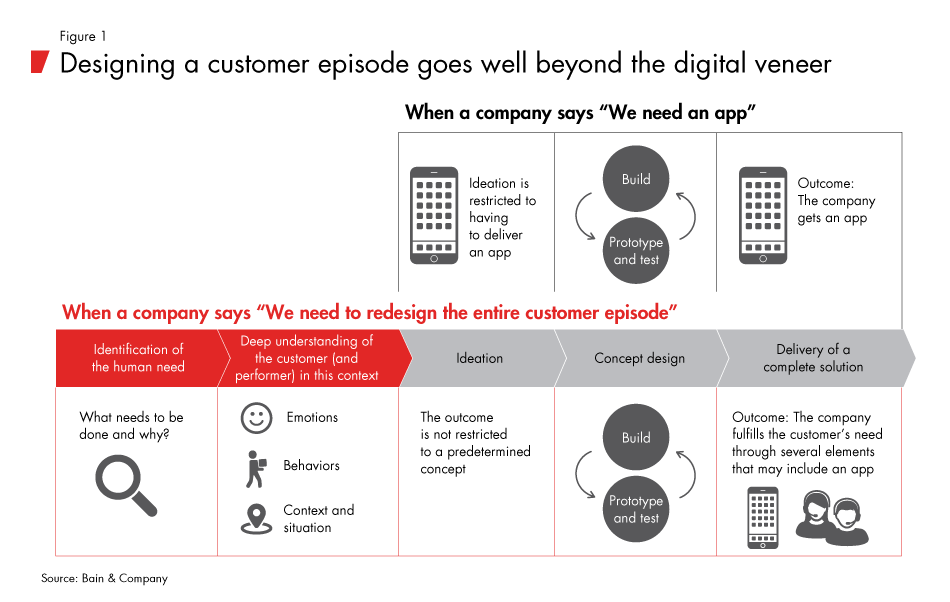
      From the customer's perspective, the value of an experience goes well beyond the functional benefits of a given product. Customers will find value in the emotional elements of an offering, such as the ability to make connections, organize one's life or feel more confident addressing tricky or unfamiliar services. Human-centered design furthers these potent elements, and a growing number of firms have found the most authentic and practical design unit to be the customer episode. An episode consists of all the activities that customers and the provider perform to fulfill the customer's needs. Episodes range from simple interactions ("I need to change my password") to multi-step, multi-party endeavors ("I need finance to buy a house" or "I need to move broadband to my new place"). Customers assess their experience more on the basis of episodes than on individual touchpoints (see Figure 1).

      Breakthrough_Design_for_a_Better_Customer_Experience-fig01_embed

      Some leading firms approach large-scale design efforts by creating a clear taxonomy of episodes, determining how they fit together and what people, capabilities and systems need to be joined up within each episode. For example, a North American retail bank now organizes its departments according to major episodes and runs improvement projects through Agile sprints that systematically test and refine episode features. One cross-functional team refined the "I want to transfer my balance" episode, generating a tenfold increase in the overall response rate and volume of customers, worth an additional $20 million per year of revenues.

      2. Design to cover your performers and your economics.


      The best design devotes ample attention to employees, contractors and partners who will actually deliver the experience. (With the advent of artificial intelligence, the notion of performers will increasingly extend to machines, requiring their own design focus.) Giving each of these performers the right tools, and removing barriers in their way, goes a long way to raising their motivation and the quality of the experience.

      An Asian energy retailer recently designed a new electricity product incorporating several innovative features. The energy retailer realized that the product's success depended on redesigning how contact-center agents would field customers' questions about product features. During the design effort, the episode team created separate online interfaces for agents that mirrored the look and feel of what the customer saw, so that it was simpler for agents to take customers through the features. These agents also joined the design team from the start to ensure that designs made it easy and desirable for this group to sell and serve the new product.

      Executing an episode clearly has cost implications, yet the economics of an episode are largely ignored by designers, or at best relegated to another group of people for post-design execution. That's a mistake. Economic imperatives create a constraint that can serve as fuel for better designs. Several years ago, the Australian broadband Internet sector went through structural change when the Australian government decided to build and operate a nationwide, fiber-based access network. One incumbent operator realized that each of its selling and serving episodes for fixed-line broadband would become unprofitable and could frustrate customers unless the company dramatically changed how it delivered these episodes. The operator set about redesigning the episodes, with each design team charged with reaching aggressive cost and customer improvement targets. Tension between these ambitious targets forced teams to uncover new ways of selling and serving the products. After many rapid iterations, the teams' designs attained the targets that ensured the operator could remain viable.

      3. Design for onstage and backstage.


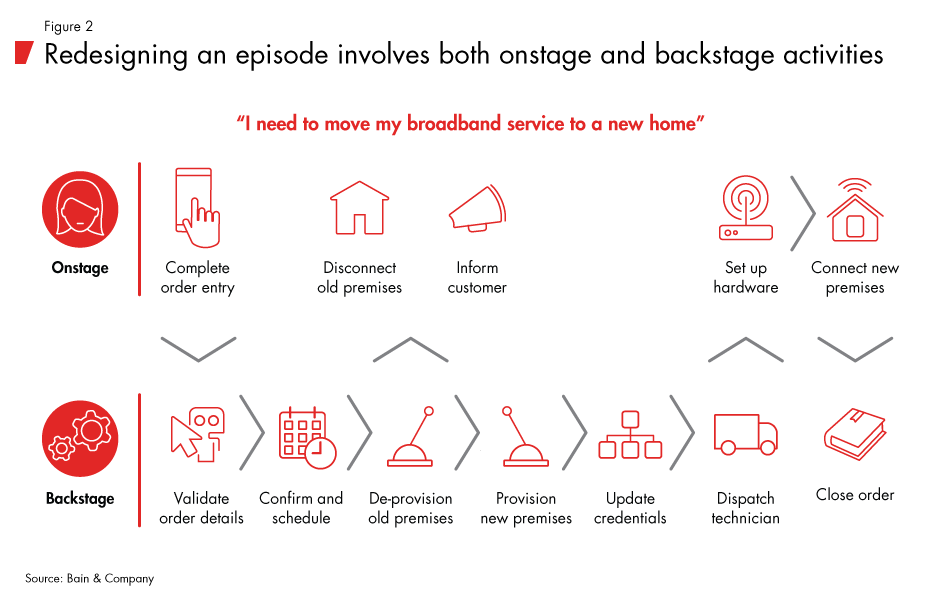
      Design obviously covers what customers see, hear and touch. Besides these onstage parts of the experience, companies must also design the backstage work—the processes, policies, capabilities and systems required to deliver a great overall experience reliably and at scale. The trick is to simultaneously design onstage and backstage elements so that customer and economic outcomes remain both ambitious and achievable (see Figure 2).

      Breakthrough_Design_for_a_Better_Customer_Experience-fig02_embed

      Work design is where operational gremlins reveal themselves. Well-intended managers might focus narrowly on performance metrics, without noticing the effect on the experience. For example, building in delays between steps for end-of-day batch processing might be an efficient way to increase throughput, but it will inadvertently create a buffer that conceals failure, such as a defective service or data errors. That, in turn, makes it difficult to find and fix root causes. By designing out sources of waste, such as oversupply of labor, backstage operations can run at the pace and error tolerance expected by customers, particularly as new technologies take a greater role in fulfilling customer needs. Think of ordering pizza through Amazon's Alexa—the hidden magic of the experience turns on a well-designed, almost flawless, backstage operation.

      4. Adapt the organization to support the new design.


      Before performers and systems can deliver an exceptional service experience, the organization in which they operate may itself need to be redesigned.

      Consider the common case of a company launching a new self-service app for general information queries, which would steer more complicated inquiries to qualified call agents. This has organizational implications: On the one hand, fewer agents would be needed as more customers use the app. On the other hand, agents will need higher skills as the remaining calls now include a greater share of difficult inquiries. These changes entail a redesign of call routing technology, call queue architecture, performer role types, performance metrics and targets, agent recruitment, training and tools. The company should address and execute these design imperatives before the service goes live.

      Key questions to guide the design plan


      Designing remarkable customer episodes that also improve a company's economics requires a mix of capabilities that are carefully choreographed to reliably deliver the new episodes at scale. Before starting the design process, senior managers can answer a useful set of questions:

      • Have we spelled out an ambition that then cascades to customer, performer and economic outcomes?
      • Do we have an episode "game board" that outlines the full design scope by customer segment, product group and episode?
      • How do we perform on each episode across customer, performer, operational and financial dimensions, and what standards do we aspire to? Do we have performance-based scenarios of what it will take to achieve our ambition?
      • What key capabilities should underpin new designs?
      • What taxonomy translates the challenge into design units and prioritizes by size of opportunity?
      • Is there a common approach that design teams can use?

      Clear-eyed answers to these questions form the basis for designing remarkable customer episodes with better economics.

      Richard Hawker is an expert principal in service design and Jeff Melton is a partner and global leader of design and service operations with Bain & Company's Performance Improvement practice. James Wright is an expert vice president and Maureen Burns and Jens Engelhardt are partners with Bain's Customer Strategy & Marketing practice. They are based, respectively, in Melbourne, Melbourne, New York, Boston and Zurich.


      Breakthrough_Design_for_a_Better_Customer_Experience-fig01_full

      Breakthrough_Design_for_a_Better_Customer_Experience-fig02_full
      Autoren
      • Jeff Melton
        Former Partner, Melbourne
      • James Wright
        Partner, New York
      • Headshot of Maureen Burns
        Maureen Burns
        Partner, Boston
      • Headshot of Jens Engelhardt
        Jens Engelhardt
        Partner, Zürich
      Kontaktieren Sie uns
      Ähnliche Beratungsangebote
      • Accelerated Performance Transformation
      • Customer Episode Design
      Kundenstrategie und Marketing
      Erfolgsfaktor Kundenerlebnis

      Die Zeiten sind vorbei, in denen sich Unternehmen allein auf die Entwicklung neuer Produktmerkmale oder die Verbesserung des Kundenservices konzentrieren konnten.

      Mehr erfahren
      Accelerated Performance Transformation
      Firing Up the Customer Experience Factory

      How to create experiences that are simple, digital and tuned to what customers value.

      Mehr erfahren
      Accelerated Performance Transformation
      Don’t Underestimate the Cost of Overcapacity

      Overcapacity is endemic to the paper and packaging industry, but these actions can help you maintain margins.

      Mehr erfahren
      Accelerated Performance Transformation
      Automotive Profitability: How OEM and Supplier Margins Are Faring

      The post-pandemic profit surge has reversed, as OEM margins have fallen more than 50% since 2023.

      Mehr erfahren
      Accelerated Performance Transformation
      AI Won’t Just Cut Costs, It Will Reinvent the Customer Experience

      Beyond efficiency, AI helps create a more personalized experience that delivers a triple play of customer loyalty, employee engagement, and revenue growth.

      Mehr erfahren
      First published in Juni 2018
      Markierungen
      • Accelerated Performance Transformation
      • Customer Episode Design

      Wie wir unsere Kunden unterstützt haben

      Digitalisierung A Chemical Company’s Transformation Reduces Support Function Costs by 25%

      Kundenbeispiel lesen

      A BPO Leader Embraces Automation to Transform Its Cost Structure

      Kundenbeispiel lesen

      Kundenstrategie und Marketing Answering the call for better service

      Kundenbeispiel lesen

      Möchten Sie mit uns in Kontakt bleiben?

      Wir unterstützen Führungskräfte weltweit, die kritischen Themen in ihrem Unternehmen zu adressieren. Gemeinsam schaffen wir nachhaltige Veränderungen und Ergebnisse.

      Bain Insights. Unsere Perspektive auf die kritischen Themen, mit denen sich international agierende Unternehmen konfrontiert sehen, finden Sie monatlich in Ihrem Postfach.

      *Ich habe die Datenschutzerklärung gelesen und akzeptiere sie.
      Bitte lesen Sie die Datenschutzerklärung und akzeptieren Sie diese.
      Bain & Company
      Contact us Sustainability Accessibility Rechtliche Hinweise Impressum Datenschutz Cookie-Richtlinie Sitemap Log In

      © 1996-2026 Bain & Company, Inc.

      Kontaktieren Sie Bain

      Wie können wir Ihnen helfen?

      • Business inquiry
      • Career information
      • Press relations
      • Partnership request
      • Speaker request
      Alle weltweiten Büros