
Skip to Content
  • Standorte

    Standorte

    North & Latin America
    • Atlanta
    • Austin
    • Bogota
    • Boston
    • Buenos Aires
    • Chicago
    • Dallas
    • Denver
    • Houston
    • Lisbon
    • Los Angeles
    • Mexico City
    • Minneapolis
    • Monterrey
    • Montreal
    • New York
    • Rio de Janeiro
    • San Francisco
    • Santiago
    • São Paulo
    • Seattle
    • Silicon Valley
    • Toronto
    • Washington, DC
    Europe & Africa
    • Amsterdam
    • Athens
    • Berlin
    • Brussels
    • Copenhagen
    • Düsseldorf
    • Frankfurt
    • Helsinki
    • Istanbul
    • Johannesburg
    • Kyiv
    • Lisbon
    • London
    • Madrid
    • Milan
    • München
    • Oslo
    • Paris
    • Rome
    • Stockholm
    • Warsaw
    • Wien
    • Zürich
    Middle East
    • Doha
    • Dubai
    • Riyadh
    Asia & Australia
    • Bangkok
    • Beijing
    • Bengaluru
    • Brisbane
    • Ho Chi Minh City
    • Hong Kong
    • Jakarta
    • Kuala Lumpur
    • Manila
    • Melbourne
    • Mumbai
    • New Delhi
    • Perth
    • Seoul
    • Shanghai
    • Singapore
    • Sydney
    • Tokyo
    Alle Standorte Anzeigen
  • Alumni
  • Presse
  • Newsletter
  • Kontakt
  • DACH-Region | Deutsch

    Wählen Sie Ihre Region und Sprache

    Global
    • Global (English)
    North & Latin America
    • Brazil (Português)
    • Argentina (Español)
    • Canada (Français)
    • Chile (Español)
    • Colombia (Español)
    Europe, Middle East, & Africa
    • France (Français)
    • DACH-Region (Deutsch)
    • Italy (Italiano)
    • Spain (Español)
    • Greece (Elliniká)
    Asia & Australia
    • China (中文版)
    • Korea (한국어)
    • Japan (日本語)
  • Saved items (0)
    Saved items (0)

    You have no saved items.

    Inhalte, für die Sie sich interessieren, werden hier gespeichert und können später gelesen oder weitergeleitet werden.

    Explore Bain Insights
  • Branchenkompetenzen
    Hauptmenü

    Branchenkompetenzen

    • Luft- und Raumfahrt, Verteidigung
    • Agrarwirtschaft
    • Chemieindustrie
    • Infrastruktur und Bauwirtschaft
    • Konsumgüter
    • Finanzdienstleistungen
    • Gesundheitswesen
    • Maschinen- und Anlagenbau
    • Medienwirtschaft
    • Metallindustrie
    • Bergbau
    • Öl und Gas
    • Papier- und Verpackungsindustrie
    • Private Equity
      Branchenkompetenzen
      Private Equity
      • Due Diligence
      • Exit Planning
      • Firm Strategy & Operations
      • Portfolio Value Creation
    • Öffentlicher Sektor und Sozialwesen
    • Einzelhandel
    • Technologie
    • Telekommunikation
    • Transportwesen
    • Reise- und Freizeitbranche
    • Versorgung und erneuerbare Energien
  • Managementkompetenzen
    Hauptmenü

    Managementkompetenzen

    • Customer Experience
    • ESG
    • Innovation
    • M&A
    • Operations
    • People & Organization
    • Private Equity
    • Sales & Marketing
    • Strategie
    • KI, Einblicke und Lösungen
    • Technologie
    • Transformation
  • Digital
  • Publikationen
    Hauptmenü

    Publikationen

    • Branchenthemen
    • Managementthemen
    • Bain-Bücher
    Alle Publikationen
    Ausgewählte Themen
    • Resilienz in der globalen Krise
    • M&A Report
    • Private Equity Podcast
    • Midyear Private Equity Report
    • Agile
    • Engineering Report
    • Digital Transformation
    • Elements of Value®
    • Firm of the Future
    • Nachhaltigkeitsstudie
    • Macro Trends
    • Future of Consumption
    • Weltwirtschaftsforum (WEF)
  • Über uns
    Hauptmenü

    Über uns

    • Was wir bieten
    • Unser Ansatz
    • Unser Team
    • Game Changer Award
    • Female Allstar Board
    • Messbare Ergebnisse (EN)
    • Auszeichnungen
    • Globale Partnerschaften
    • The Mission
    Further: Our global responsibility
    • Vielfalt & Chancengleichheit
    • Soziale Verantwortung
    • Sustainability
    Erfahren Sie mehr zu "Further"
  • Karriere
    Hauptmenü

    Karriere

    • Dein Einstieg
      Karriere
      Dein Einstieg
      • Find Your Place
      • Unsere Arbeitsbereiche
      • Unsere Teams
      • Angebote für Studierende
      • Praktika & Programme
      • Recruiting-Events
    • Arbeiten bei Bain
      Karriere
      Arbeiten bei Bain
      • Blog: Inside Bain
      • Karriere Stories
      • Unsere Bainies
      • Office-Standorte
      • Weiterentwicklung
      • Affinity Groups
      • Deine Benefits
    • Impact Stories
    • Deine Bewerbung
      Karriere
      Deine Bewerbung
      • Das erwartet dich
      • Der Interviewprozess
    FIND JOBS
  • Standorte
    Hauptmenü

    Standorte

    • North & Latin America
      Standorte
      North & Latin America
      • Atlanta
      • Austin
      • Bogota
      • Boston
      • Buenos Aires
      • Chicago
      • Dallas
      • Denver
      • Houston
      • Lisbon
      • Los Angeles
      • Mexico City
      • Minneapolis
      • Monterrey
      • Montreal
      • New York
      • Rio de Janeiro
      • San Francisco
      • Santiago
      • São Paulo
      • Seattle
      • Silicon Valley
      • Toronto
      • Washington, DC
    • Europe & Africa
      Standorte
      Europe & Africa
      • Amsterdam
      • Athens
      • Berlin
      • Brussels
      • Copenhagen
      • Düsseldorf
      • Frankfurt
      • Helsinki
      • Istanbul
      • Johannesburg
      • Kyiv
      • Lisbon
      • London
      • Madrid
      • Milan
      • München
      • Oslo
      • Paris
      • Rome
      • Stockholm
      • Warsaw
      • Wien
      • Zürich
    • Middle East
      Standorte
      Middle East
      • Doha
      • Dubai
      • Riyadh
    • Asia & Australia
      Standorte
      Asia & Australia
      • Bangkok
      • Beijing
      • Bengaluru
      • Brisbane
      • Ho Chi Minh City
      • Hong Kong
      • Jakarta
      • Kuala Lumpur
      • Manila
      • Melbourne
      • Mumbai
      • New Delhi
      • Perth
      • Seoul
      • Shanghai
      • Singapore
      • Sydney
      • Tokyo
    Alle Standorte Anzeigen
  • Alumni
  • Presse
  • Newsletter
  • Kontakt
  • DACH-Region | Deutsch
    Hauptmenü

    Wählen Sie Ihre Region und Sprache

    • Global
      Wählen Sie Ihre Region und Sprache
      Global
      • Global (English)
    • North & Latin America
      Wählen Sie Ihre Region und Sprache
      North & Latin America
      • Brazil (Português)
      • Argentina (Español)
      • Canada (Français)
      • Chile (Español)
      • Colombia (Español)
    • Europe, Middle East, & Africa
      Wählen Sie Ihre Region und Sprache
      Europe, Middle East, & Africa
      • France (Français)
      • DACH-Region (Deutsch)
      • Italy (Italiano)
      • Spain (Español)
      • Greece (Elliniká)
    • Asia & Australia
      Wählen Sie Ihre Region und Sprache
      Asia & Australia
      • China (中文版)
      • Korea (한국어)
      • Japan (日本語)
  • Saved items  (0)
    Hauptmenü
    Saved items (0)

    You have no saved items.

    Inhalte, für die Sie sich interessieren, werden hier gespeichert und können später gelesen oder weitergeleitet werden.

    Explore Bain Insights
  • Branchenkompetenzen
    • Branchenkompetenzen

      • Luft- und Raumfahrt, Verteidigung
      • Agrarwirtschaft
      • Chemieindustrie
      • Infrastruktur und Bauwirtschaft
      • Konsumgüter
      • Finanzdienstleistungen
      • Gesundheitswesen
      • Maschinen- und Anlagenbau
      • Medienwirtschaft
      • Metallindustrie
      • Bergbau
      • Öl und Gas
      • Papier- und Verpackungsindustrie
      • Private Equity
      • Öffentlicher Sektor und Sozialwesen
      • Einzelhandel
      • Technologie
      • Telekommunikation
      • Transportwesen
      • Reise- und Freizeitbranche
      • Versorgung und erneuerbare Energien
  • Managementkompetenzen
    • Managementkompetenzen

      • Customer Experience
      • ESG
      • Innovation
      • M&A
      • Operations
      • People & Organization
      • Private Equity
      • Sales & Marketing
      • Strategie
      • KI, Einblicke und Lösungen
      • Technologie
      • Transformation
  • Digital
  • Publikationen
    • Publikationen

      • Branchenthemen
      • Managementthemen
      • Bain-Bücher
      Alle Publikationen
      Ausgewählte Themen
      • Resilienz in der globalen Krise
      • M&A Report
      • Private Equity Podcast
      • Midyear Private Equity Report
      • Agile
      • Engineering Report
      • Digital Transformation
      • Elements of Value®
      • Firm of the Future
      • Nachhaltigkeitsstudie
      • Macro Trends
      • Future of Consumption
      • Weltwirtschaftsforum (WEF)
  • Über uns
    • Über uns

      • Was wir bieten
      • Unser Ansatz
      • Unser Team
      • Game Changer Award
      • Female Allstar Board
      • Messbare Ergebnisse (EN)
      • Auszeichnungen
      • Globale Partnerschaften
      • The Mission
      Further: Our global responsibility
      • Vielfalt & Chancengleichheit
      • Soziale Verantwortung
      • Sustainability
      Erfahren Sie mehr zu "Further"
  • Karriere
    Häufige Suchanfragen
    • Agil
    • Digital
    • Strategie
    Vorherige Suchanfragen
      Zuletzt besuchte Seiten

      Content added to saved items

      Saved items (0)

      Removed from saved items

      Saved items (0)

      Brief

      Diverging Paths: Banks’ Health Varied Widely Going into Covid-19

      Diverging Paths: Banks’ Health Varied Widely Going into Covid-19

      The playbook for an individual bank’s next moves will depend on its financial health.

      Von João Soares

      • Min. Lesezeit
      }

      Brief

      Diverging Paths: Banks’ Health Varied Widely Going into Covid-19
      en
      Auf einen Blick
      • Individual banks and country banking systems had disparate starting points going into the coronavirus pandemic.
      • Our health check at the end of 2019 sorts them into four categories: winners, weaker business model, weaker balance sheet and highest concern. During past crises, many banks with weaker balance sheets degraded to the highest-concern category.
      • A bank’s starting point determines how it should navigate the current crisis. A multicountry bank, for example, needs to understand its operations in detail so that it can repair the subsidiaries in weak countries.
      • Vulnerable banks will have to focus on aggressive cost cutting and divestment of risky assets, plus some mix of acquiring more deposits and accelerating their digital transition.

      The fallout from Covid-19 presents banks with a challenge as severe as the global financial crisis of 2008. Some employees and customers have contracted the disease, and all have had their lives otherwise disrupted to some extent. As businesses shut down and national economies contracted, banks are dealing with a sudden rise in deferred loan payments and potential defaults.

      For Our Clients

      Macro Surveillance Platform

      For more detail on the business implications of coronavirus from Bain’s Macro Trends Group, log on to the Macro Surveillance Platform. Learn more about the platform >

      Going into the pandemic, however, individual banks and countries had disparate starting points. That has varied implications for how banks should navigate the current downturn and uncertainty once the rate of new coronavirus cases abates.

      Most banks in Hong Kong and Sweden, for instance, were much healthier at year-end 2019 than those in Greece, Italy and India (see Figure 1). Disparities also exist within countries: Most North American banks had profitable business models going into the crisis, but many had less resilient balance sheets, because their capital adequacy scores had deteriorated since 2016 (see Figure 2).

      Figure 1
      National banking systems entered the Covid-19 crisis with disparate levels of resilience and strength of business model
      National banking systems entered the Covid-19 crisis with disparate levels of resilience and strength of business model
      National banking systems entered the Covid-19 crisis with disparate levels of resilience and strength of business model
      Figure 2
      Most North American banks have had profitable business models, but many have had weaker capital positions than European banks
      Most North American banks have had profitable business models, but many have had weaker capital positions than European banks
      Most North American banks have had profitable business models, but many have had weaker capital positions than European banks

      Understanding the nature of their own starting points will allow bankers to identify the right moves to emerge from the crisis in a stronger position, or at least intact—and in the worst cases, able to arrange a sale at the most favorable terms possible. Depending on the health of their balance sheets and income statements, they should follow different playbooks.

      These conclusions emerge from Bain & Company’s latest health check of the banking system, covering over 500 banks. Our scoring model, which relies on data from Fitch Solutions, derives from two dimensions (see “How the scoring model works,” below):

      • Profitability and efficiency
      • Asset and liability health (here, we give a relatively heavy weighting to asset quality as essential for future earnings)

      The health check provides a uniquely integrated view, which stands in contrast to looking only at a balance sheet or income statement. Based on the combination of the critical financial ratios, we calculate a score for each bank and place it in one of four categories (see Figures 3 and 4).

      Figure 3
      Banks sorted into four categories of overall health at the end of 2019
      Banks sorted into four categories of overall health at the end of 2019
      Banks sorted into four categories of overall health at the end of 2019
      Figure 4
      The performance gaps are even starker among individual banks
      The performance gaps are even starker among individual banks
      The performance gaps are even starker among individual banks

      Winners. Twenty-six percent of the banks attained this strong position by the end of 2019. Some Scandinavian and Middle Eastern banks outperformed on all financial indicators. Historically, winners tend to have greater customer loyalty, which leads to stronger economics. We analyzed bank stocks in the eurozone, and investors there rewarded these banks with a price-to-book ratio an average of 50 points higher than those in the weakest, “highest-concern” category.

      The playbook for banks in this group centers on extending their advantage. They should shore up their liquidity and prepare for a wave of nonperforming loans caused by the pandemic and subsequent lockdowns. They can afford to determine how profit pools have shifted and adjust their offerings to go after the most attractive ones. They can accelerate investments in digital tools and channels that will earn greater customer loyalty. Winners also can pursue M&A aggressively at a time when prices may be relatively low.

      Weaker business model. Banks in this category account for 15% of the total, consisting primarily of German and Irish banks.

      Their playbook should focus first on enhancing pricing disciplines in order to improve net interest margin. These banks may need to further shrink their branch networks, as part of aggressive cost reductions. In tandem, they have an urgent need to hunt for profitable customer segments, products and geographies.

      Weaker balance sheet. Some 45% of the banks have a priority to improve their weak balance sheets. Over the years, banks in this category have shown vulnerabilities not yet fully reflected in profit-and-loss statements. During crises in the past, many of these banks degraded to the highest-concern category.

      Raising liquidity is their central task. To avoid having to be bailed out, vulnerable banks should work to rebalance their lending portfolio to lower-risk assets, and manage their existing book of assets to release capital. One no-regrets move is to restructure nonperforming loans, and then be proactive—if a bank does not have a dynamic early warning system, it should build one now. Lagging banks can help stabilize their funding mix by increasing customer deposits and reducing the reliance on wholesale funding.

      Highest concern. Of the total base of banks in the analysis, 14% flash a high-risk signal. About 70% of banks in this category are concentrated in just five countries. And nine banks with more than $200 billion in assets fell into this category.

      Virtually all banks that disappeared or were nationalized over the past decade fell into the highest-concern category. To avoid that fate, many of the playbook moves noted in the other categories apply here. Foremost is gaining liquidity and raising capital by divesting assets.

      How country health comes into play

      Country aggregates matter to the health of each bank. A single-country bank in the highest-concern category should consider itself near collapse, even if most of its country peers fall in the winners category.

      A different challenge faces a single-country bank in the winners category, if many of its country peers fall in the highest-concern group. It should calibrate its growth ambitions, because there will be a war for deposits and severe distress that affects country debt ratings and the ability to access international markets. Spain and Italy encountered this situation during the global financial crisis.

      A multicountry bank needs to understand its country operations in detail so that it can repair the subsidiaries in weak countries. Otherwise, damaged banks in those countries will want to tap the parent for funds—all at the same time. Hoping for the best is not an option here; acting quickly to repair the weakest subsidiary banks is essential.

      With the coronavirus triggering a downturn and likely a recession, more borrowers will have difficulty repaying their loans. If history is any guide, and depending on the severity of the downturn, several of the banks in the highest-concern group could disappear, most likely by absorption. A few large banks with weaker balance sheets that have sailed under the radar due to their strong in-year performance could be on the ropes as well.

      Yet history also shows that banks can improve their position. Although interest margins will remain safe, owing to low central bank interest rates, banks will improve their position not by lending their way out of the crisis, but instead through a blend of various initiatives. They will have to focus on aggressive cost cutting and divestment of risky assets. They will need to adjust their funding mix by shedding wholesale funding and acquiring more deposits. And as banks inspect their costly operating models, the push for digital channels, tools and processes will take on greater importance.

      Banks across the globe entered the pandemic crisis with disparate levels of resilience and strength of their business model. Each bank’s course of action to navigate through the crisis depends on its starting position on the matrix. But all CEOs and management teams should review and adjust their long-term strategy to deal with the crisis and its aftermath while they still have time.


      How the scoring model works

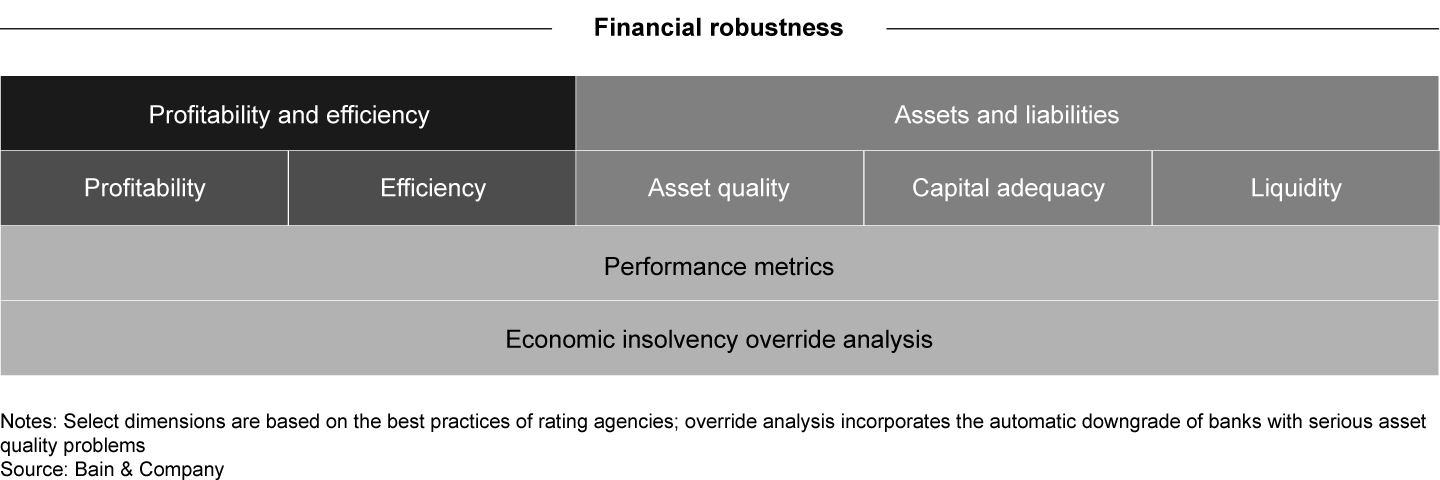
      The scoring model in Bain’s health check of the banking system gathers data in five main areas, with the heaviest weighting on asset quality (see figure).

      Winners and Walking Wounded
      Winners and Walking Wounded

      Profitability. The key determinant of sustainable success or failure, it measures the ability to create economic value and to preserve or improve risk protection for creditors. Performance metrics include preprovision income as a percentage of risk-weighted assets and net income as a percentage of risk-weighted assets.

      Efficiency. Cost containment is a strategic focal point; it allows banks to satisfy stakeholders’ requirements without overly aggressive risk taking. Performance metrics include operating expenses as a percentage of net revenue.

      Asset quality. A main factor in future earnings and capital generation or erosion, loan quality is a key to determining a bank’s stability. Nonperforming loans predict future losses. Performance metrics as a percentage of gross loans include problem loans, loan-loss provisions and corporate loans.

      Capital adequacy. Banks typically fail due to losses in the loan portfolio, poor business models or fraud—all of which lead to a decline in capital. In the case of low profitability, capital is the most important buffer for absorbing risk costs. Performance metrics include Tier 1 capital as a percentage of risk-weighted assets and tangible common equity as a percentage of average risk-weighted assets.

      Liquidity. Illiquidity is often a proximate cause of failure as banks may no longer be able to finance themselves under pressure. Access to market funding may not be based on long-term relationships, but rather on creditworthiness. Performance metrics include gross loans as a percentage of total deposits (the loan-to-deposit ratio) and total debt net of liquid assets as a percentage of total assets.

      Related Insights

      Coronavirus

      The global Covid-19 pandemic has extracted a terrible human toll and spurred sweeping changes in the world economy. Across industries, executives have begun reassessing their strategies and repositioning their companies to thrive now and in the world beyond coronavirus.

      The author would like to thank Sunvi Aggarwal, John Campbell, Sonal Chawla, Christy de Gooyer, Sahiba Gambhir, Neeraja Krishnadas and Yogendra Patel for their assistance in preparing this brief.

      Autoren
      • Headshot of João Soares
        João Soares
        Partner, New York
      Kontaktieren Sie uns
      Verwandte Branchen
      • Bankensektor
      • Finanzdienstleistungen
      Ähnliche Beratungsangebote
      • Accelerated Performance Transformation
      • Operations
      • Performance Improvement
      • Product & Portfolio Management
      Wie wir Sie unterstützen können
      • Digital Transformation
      Finanzdienstleistungen
      Wealth Management Firms Can Take Out Costs While Reducing Risk and Improving Client Loyalty

      Six tactics allow firms to reduce operating costs by 17% to 38%.

      Mehr erfahren
      Coronavirus
      Cash Management Practices to Weather a Downturn

      Take an honest look at the business, and decide where to improve.

      Mehr erfahren
      Finanzdienstleistungen
      Six Threats Demand a New Playbook for Banks in Wealth and Asset Management

      AI, direct-to-consumer models, and the return of local priorities are redrawing industry lines.

      Mehr erfahren
      Digital Transformation
      The New AI Stack: Speed, Scale, and Real-World ROI

      AWS re:Invent 2025 demonstrated how agents, fine-tuned models, and custom silicon are redefining performance and productivity for enterprises.

      Mehr erfahren
      Performance Improvement
      Don’t Underestimate the Cost of Overcapacity

      Overcapacity is endemic to the paper and packaging industry, but these actions can help you maintain margins.

      Mehr erfahren
      First published in Mai 2020
      Markierungen
      • Accelerated Performance Transformation
      • Bankensektor
      • Coronavirus
      • Digital Transformation
      • Finanzdienstleistungen
      • Operations
      • Performance Improvement
      • Product & Portfolio Management

      Wie wir unsere Kunden unterstützt haben

      Strategie A Bold New Strategy Restores a Bank to a Leadership Position

      Kundenbeispiel lesen

      Nachhaltigkeit Redesigning a Bank’s Climate Strategy for Growth

      Kundenbeispiel lesen

      Change & Implementation The change process unlocks potential and profits

      Kundenbeispiel lesen

      Möchten Sie mit uns in Kontakt bleiben?

      Wir unterstützen Führungskräfte weltweit, die kritischen Themen in ihrem Unternehmen zu adressieren. Gemeinsam schaffen wir nachhaltige Veränderungen und Ergebnisse.

      Bain Insights. Unsere Perspektive auf die kritischen Themen, mit denen sich international agierende Unternehmen konfrontiert sehen, finden Sie monatlich in Ihrem Postfach.

      *Ich habe die Datenschutzerklärung gelesen und akzeptiere sie.
      Bitte lesen Sie die Datenschutzerklärung und akzeptieren Sie diese.
      Bain & Company
      Contact us Sustainability Accessibility Rechtliche Hinweise Impressum Datenschutz Cookie-Richtlinie Sitemap Log In

      © 1996-2026 Bain & Company, Inc.

      Kontaktieren Sie Bain

      Wie können wir Ihnen helfen?

      • Business inquiry
      • Career information
      • Press relations
      • Partnership request
      • Speaker request
      Alle weltweiten Büros