
Skip to Content
  • Standorte

    Standorte

    North & Latin America
    • Atlanta
    • Austin
    • Bogota
    • Boston
    • Buenos Aires
    • Chicago
    • Dallas
    • Denver
    • Houston
    • Lisbon
    • Los Angeles
    • Mexico City
    • Minneapolis
    • Monterrey
    • Montreal
    • New York
    • Rio de Janeiro
    • San Francisco
    • Santiago
    • São Paulo
    • Seattle
    • Silicon Valley
    • Toronto
    • Washington, DC
    Europe & Africa
    • Amsterdam
    • Athens
    • Berlin
    • Brussels
    • Copenhagen
    • Düsseldorf
    • Frankfurt
    • Helsinki
    • Istanbul
    • Johannesburg
    • Kyiv
    • Lisbon
    • London
    • Madrid
    • Milan
    • München
    • Oslo
    • Paris
    • Rome
    • Stockholm
    • Warsaw
    • Wien
    • Zürich
    Middle East
    • Doha
    • Dubai
    • Riyadh
    Asia & Australia
    • Bangkok
    • Beijing
    • Bengaluru
    • Brisbane
    • Ho Chi Minh City
    • Hong Kong
    • Jakarta
    • Kuala Lumpur
    • Manila
    • Melbourne
    • Mumbai
    • New Delhi
    • Perth
    • Seoul
    • Shanghai
    • Singapore
    • Sydney
    • Tokyo
    Alle Standorte Anzeigen
  • Alumni
  • Presse
  • Newsletter
  • Kontakt
  • DACH-Region | Deutsch

    Wählen Sie Ihre Region und Sprache

    Global
    • Global (English)
    North & Latin America
    • Brazil (Português)
    • Argentina (Español)
    • Canada (Français)
    • Chile (Español)
    • Colombia (Español)
    Europe, Middle East, & Africa
    • France (Français)
    • DACH-Region (Deutsch)
    • Italy (Italiano)
    • Spain (Español)
    • Greece (Elliniká)
    Asia & Australia
    • China (中文版)
    • Korea (한국어)
    • Japan (日本語)
  • Saved items (0)
    Saved items (0)

    You have no saved items.

    Inhalte, für die Sie sich interessieren, werden hier gespeichert und können später gelesen oder weitergeleitet werden.

    Explore Bain Insights
  • Branchenkompetenzen
    Hauptmenü

    Branchenkompetenzen

    • Luft- und Raumfahrt, Verteidigung
    • Agrarwirtschaft
    • Chemieindustrie
    • Infrastruktur und Bauwirtschaft
    • Konsumgüter
    • Finanzdienstleistungen
    • Gesundheitswesen
    • Maschinen- und Anlagenbau
    • Medienwirtschaft
    • Metallindustrie
    • Bergbau
    • Öl und Gas
    • Papier- und Verpackungsindustrie
    • Private Equity
      Branchenkompetenzen
      Private Equity
      • Due Diligence
      • Exit Planning
      • Firm Strategy & Operations
      • Portfolio Value Creation
    • Öffentlicher Sektor und Sozialwesen
    • Einzelhandel
    • Technologie
    • Telekommunikation
    • Transportwesen
    • Reise- und Freizeitbranche
    • Versorgung und erneuerbare Energien
  • Managementkompetenzen
    Hauptmenü

    Managementkompetenzen

    • Customer Experience
    • ESG
    • Innovation
    • M&A
    • Operations
    • People & Organization
    • Private Equity
    • Sales & Marketing
    • Strategie
    • KI, Einblicke und Lösungen
    • Technologie
    • Transformation
  • Digital
  • Publikationen
    Hauptmenü

    Publikationen

    • Branchenthemen
    • Managementthemen
    • Bain-Bücher
    Alle Publikationen
    Ausgewählte Themen
    • Resilienz in der globalen Krise
    • M&A Report
    • Private Equity Podcast
    • Midyear Private Equity Report
    • Agile
    • Engineering Report
    • Digital Transformation
    • Elements of Value®
    • Firm of the Future
    • Nachhaltigkeitsstudie
    • Macro Trends
    • Future of Consumption
    • Weltwirtschaftsforum (WEF)
  • Über uns
    Hauptmenü

    Über uns

    • Was wir bieten
    • Unser Ansatz
    • Unser Team
    • Game Changer Award
    • Female Allstar Board
    • Messbare Ergebnisse (EN)
    • Auszeichnungen
    • Globale Partnerschaften
    • The Mission
    Further: Our global responsibility
    • Vielfalt & Chancengleichheit
    • Soziale Verantwortung
    • Sustainability
    Erfahren Sie mehr zu "Further"
  • Karriere
    Hauptmenü

    Karriere

    • Dein Einstieg
      Karriere
      Dein Einstieg
      • Find Your Place
      • Unsere Arbeitsbereiche
      • Unsere Teams
      • Angebote für Studierende
      • Praktika & Programme
      • Recruiting-Events
    • Arbeiten bei Bain
      Karriere
      Arbeiten bei Bain
      • Blog: Inside Bain
      • Karriere Stories
      • Unsere Bainies
      • Office-Standorte
      • Weiterentwicklung
      • Affinity Groups
      • Deine Benefits
    • Impact Stories
    • Deine Bewerbung
      Karriere
      Deine Bewerbung
      • Das erwartet dich
      • Der Interviewprozess
    FIND JOBS
  • Standorte
    Hauptmenü

    Standorte

    • North & Latin America
      Standorte
      North & Latin America
      • Atlanta
      • Austin
      • Bogota
      • Boston
      • Buenos Aires
      • Chicago
      • Dallas
      • Denver
      • Houston
      • Lisbon
      • Los Angeles
      • Mexico City
      • Minneapolis
      • Monterrey
      • Montreal
      • New York
      • Rio de Janeiro
      • San Francisco
      • Santiago
      • São Paulo
      • Seattle
      • Silicon Valley
      • Toronto
      • Washington, DC
    • Europe & Africa
      Standorte
      Europe & Africa
      • Amsterdam
      • Athens
      • Berlin
      • Brussels
      • Copenhagen
      • Düsseldorf
      • Frankfurt
      • Helsinki
      • Istanbul
      • Johannesburg
      • Kyiv
      • Lisbon
      • London
      • Madrid
      • Milan
      • München
      • Oslo
      • Paris
      • Rome
      • Stockholm
      • Warsaw
      • Wien
      • Zürich
    • Middle East
      Standorte
      Middle East
      • Doha
      • Dubai
      • Riyadh
    • Asia & Australia
      Standorte
      Asia & Australia
      • Bangkok
      • Beijing
      • Bengaluru
      • Brisbane
      • Ho Chi Minh City
      • Hong Kong
      • Jakarta
      • Kuala Lumpur
      • Manila
      • Melbourne
      • Mumbai
      • New Delhi
      • Perth
      • Seoul
      • Shanghai
      • Singapore
      • Sydney
      • Tokyo
    Alle Standorte Anzeigen
  • Alumni
  • Presse
  • Newsletter
  • Kontakt
  • DACH-Region | Deutsch
    Hauptmenü

    Wählen Sie Ihre Region und Sprache

    • Global
      Wählen Sie Ihre Region und Sprache
      Global
      • Global (English)
    • North & Latin America
      Wählen Sie Ihre Region und Sprache
      North & Latin America
      • Brazil (Português)
      • Argentina (Español)
      • Canada (Français)
      • Chile (Español)
      • Colombia (Español)
    • Europe, Middle East, & Africa
      Wählen Sie Ihre Region und Sprache
      Europe, Middle East, & Africa
      • France (Français)
      • DACH-Region (Deutsch)
      • Italy (Italiano)
      • Spain (Español)
      • Greece (Elliniká)
    • Asia & Australia
      Wählen Sie Ihre Region und Sprache
      Asia & Australia
      • China (中文版)
      • Korea (한국어)
      • Japan (日本語)
  • Saved items  (0)
    Hauptmenü
    Saved items (0)

    You have no saved items.

    Inhalte, für die Sie sich interessieren, werden hier gespeichert und können später gelesen oder weitergeleitet werden.

    Explore Bain Insights
  • Branchenkompetenzen
    • Branchenkompetenzen

      • Luft- und Raumfahrt, Verteidigung
      • Agrarwirtschaft
      • Chemieindustrie
      • Infrastruktur und Bauwirtschaft
      • Konsumgüter
      • Finanzdienstleistungen
      • Gesundheitswesen
      • Maschinen- und Anlagenbau
      • Medienwirtschaft
      • Metallindustrie
      • Bergbau
      • Öl und Gas
      • Papier- und Verpackungsindustrie
      • Private Equity
      • Öffentlicher Sektor und Sozialwesen
      • Einzelhandel
      • Technologie
      • Telekommunikation
      • Transportwesen
      • Reise- und Freizeitbranche
      • Versorgung und erneuerbare Energien
  • Managementkompetenzen
    • Managementkompetenzen

      • Customer Experience
      • ESG
      • Innovation
      • M&A
      • Operations
      • People & Organization
      • Private Equity
      • Sales & Marketing
      • Strategie
      • KI, Einblicke und Lösungen
      • Technologie
      • Transformation
  • Digital
  • Publikationen
    • Publikationen

      • Branchenthemen
      • Managementthemen
      • Bain-Bücher
      Alle Publikationen
      Ausgewählte Themen
      • Resilienz in der globalen Krise
      • M&A Report
      • Private Equity Podcast
      • Midyear Private Equity Report
      • Agile
      • Engineering Report
      • Digital Transformation
      • Elements of Value®
      • Firm of the Future
      • Nachhaltigkeitsstudie
      • Macro Trends
      • Future of Consumption
      • Weltwirtschaftsforum (WEF)
  • Über uns
    • Über uns

      • Was wir bieten
      • Unser Ansatz
      • Unser Team
      • Game Changer Award
      • Female Allstar Board
      • Messbare Ergebnisse (EN)
      • Auszeichnungen
      • Globale Partnerschaften
      • The Mission
      Further: Our global responsibility
      • Vielfalt & Chancengleichheit
      • Soziale Verantwortung
      • Sustainability
      Erfahren Sie mehr zu "Further"
  • Karriere
    Häufige Suchanfragen
    • Agil
    • Digital
    • Strategie
    Vorherige Suchanfragen
      Zuletzt besuchte Seiten

      Content added to saved items

      Saved items (0)

      Removed from saved items

      Saved items (0)

      Brief

      How Big Brands Can Prepare for US Grocery's Tectonic Shifts

      How Big Brands Can Prepare for US Grocery's Tectonic Shifts

      As US consumer trends shift and grocers react, consumer goods companies face massive risks to their growth and profit formulas.

      Von Adam Borchert, Stephen Caine, François Faelli and Charlotte Apps

      • Min. Lesezeit
      }

      Brief

      How Big Brands Can Prepare for US Grocery's Tectonic Shifts
      en

      Consumer goods companies expecting to achieve ongoing 2% to 4% annual top-line organic growth in the US are waking up to a disturbing reality. Turbulent retailing trends mean that unless they drastically rethink their strategies, brands could be hard pressed to capture even one-third of this growth, while up to 30% of their margins could be at risk.

      Consumer attitudes and shopper behaviors have put consumer goods companies at a crossroads. Americans are defining value in new ways by embracing private labels, demanding low prices and, in rising numbers, migrating away from larger-known brands in favor of fresh and less-processed foods. And consumers are increasingly going online to purchase their groceries.

      Adam Borchert, a partner in Bain's Consumer Products practice, shares what midsize and big grocers are doing to drive traffic, respond to changes in consumer preferences and find the greatest opportunities, while preserving profitability.

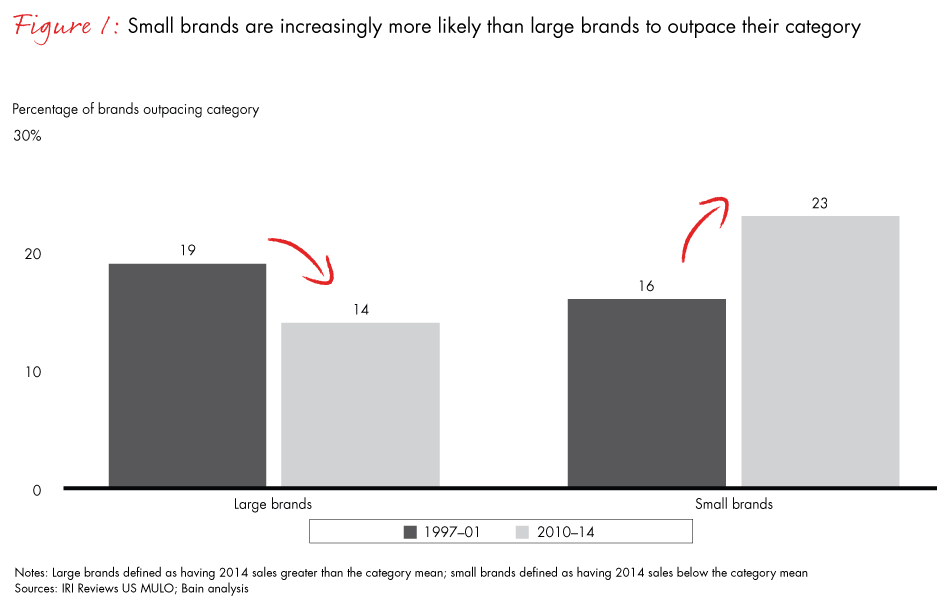
      Consider how US consumers are enthusiastically buying small brands that appeal to numerous health choices, food allergies, ethnic tastes, local origin and other preferences. Small consumer goods manufacturers (those ranked below the top 100 consumer goods companies in 2015 sales) captured 64% of growth in branded goods in 2010 to 2015. Bain & Company research found that 15 years ago large brands were more likely than small brands to outgrow their categories consistently year-over-year. Today, small brands have the edge as 23% of them outpaced their category growth every year from 2010 to 2014, compared with only 14% of larger brands (see Figure 1). A flood of funding—coupled with plug-and-play e-commerce models and viral marketing—has dramatically lowered the barriers to market entry and growth for smaller brands. With many of them using online distribution platforms, traditional channels aren’t reaping the full benefits of this growth.

      These trends are significantly changing the US grocery landscape. Drug, dollar, discount and online players have boosted their food offerings. In discount, ALDI continues its US expansion as Lidl prepares to aggressively enter the market, both relying on private label strategies to fuel their growth. At the premium end of the market, specialty retailers such as Sprouts will continue to outpace the industry’s growth by offering healthier and fresh alternatives. At the same time, e-commerce continues to accelerate as online grocery grows nearly 15% each year in the US.

      us-retail-trends-fig01_embed

      Traditional grocers react—and big brands feel the pressure


      With the world around them shifting, traditional grocery channels—supermarkets and convenience stores that once were the source of reliable growth for consumer packaged goods—will continue to see their share positions erode. To defend their share, they’re devoting more store space to fresh food, prepared food and smaller brands that cater to consumer tastes, while expanding their private label offerings to boost margins and create greater differentiation. To stay competitive, they’re lowering shelf prices, while investing to expand into e-commerce and improved service models.

      All of this costs money and comes at a time when most traditional grocers’ top lines are hurting. In response, traditional grocers are aggressively cutting costs to make their P&Ls work—carrying less inventory, squeezing savings out of their supply chains and trimming labor costs. Meanwhile, consolidation trends will continue as retailers seek additional ways to improve costs through scale.

      What does this mean for large, established consumer goods companies? Major changes. If brands do nothing, our analysis suggests many companies will struggle to see growth rates that reach 1%, a phenomenon some have already begun to experience. So as they battle to defend their share of a shrinking pie, gone are the days when big brands can grow in tandem with traditional grocers, ruling the roost with outsized ad budgets, large salesforces and far-reaching supply chains.

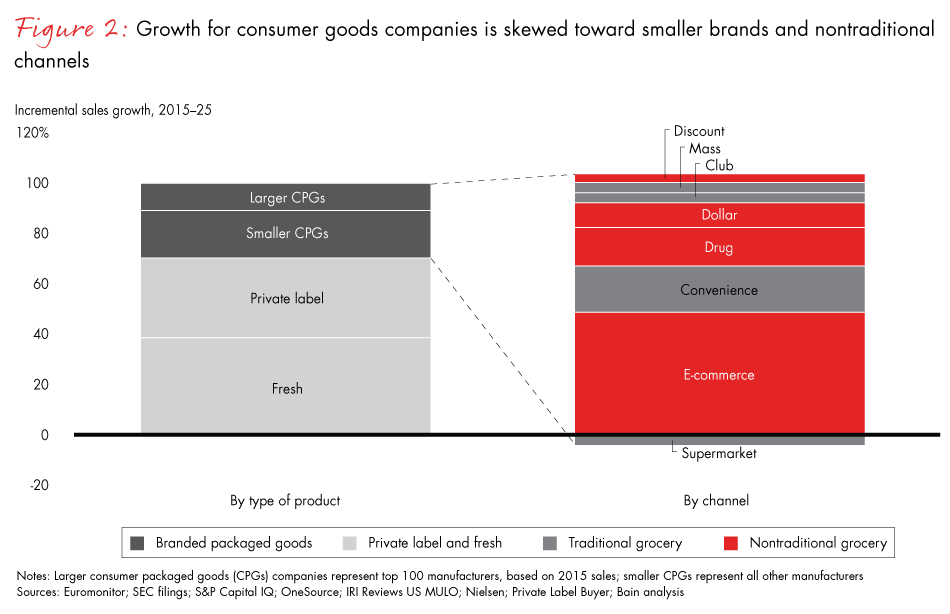
      In once-dependable traditional grocery channels, the vast majority of growth for branded consumer goods companies will have to come from stealing share in center-store categories even as branded goods fight with private labels, fresh food and small brands for shelf space. And most companies will find themselves under-penetrated in key growth channels (see Figure 2). Many lack the capabilities and service models to win in dollar and discount, and particularly in e-commerce (see the Bain Brief, “Winning the Race for Digital Commerce”).

      us-retail-trends-fig02_embed

      The bottom line: up to 30% of margins could be at risk. Consumer goods companies will face tougher trade negotiations and more price pressures as their key customers find themselves in trouble. They will be asked for more responsive supply chains with improved delivery speed, frequency and flexibility. They’ll be expected to provide shelf-ready casings, pack sizes tailored to store formats and more timely delivery schedules among other requirements. And the demands will mount as retailers further consolidate to gain strength through scale.

      To position themselves for this emerging future, brands must attack these challenges on two fronts: First, reignite growth with the winners among traditional grocers but do so without overinvesting. At the same time, shift resources to win in new channels of growth. We’ve identified five imperatives to help large consumer products companies survive and thrive in this evolving retail landscape.

      Determine how much risk—or upside—you’ll have from channel shifts. We use the term “gravitational math.” If all the current trends continue for five years, doing nothing will result in inevitable downward pressure on share, growth and margin for most bigger consumer goods companies. Why? They already have lower shares and margins in faster-growing channels and will inceasingly face the share implications of shifts to private label and fresh food in traditional channels. So before setting a plan to respond, it’s best to invest in understanding your company’s future channel exposure. How much of your retail shelf space could you lose? How much incremental consumer spending can you realistically expect to capture, and what do you need to achieve in terms of share gains to hit your targets? All of this requires a brutally honest assessment of the business—evaluating it as a private equity fund would, while understanding your specific category dynamics.

      Decide where you should strategically focus to win. In traditional channels, identify retailers that know how to defend themselves—those that will emerge as leaders—and dramatically reduce your costs to serve them. When it comes to new channels, carefully weigh the opportunities and risks. For example, in e-commerce, should you partner with pure plays, sell directly to consumers or neither? Should you play in channels like deep discount, which could affect your brand image and your ability to maintain pricing and margins across the board?

      Redesign commercial and operational capabilities to win in both battlegrounds. Traditional grocers’ demands will change and new channels will have different supply chain and sales requirements. As a result, winning share with leaders in traditional grocery will require greater collaboration, including tighter joint business planning aimed at ensuring perfect sales execution, day in and day out (see the Bain Brief, “Perfecting Sales Execution”). Tougher data-driven negotiations will place even greater importance on revenue management and pricing capabilities. Supply chains set up to deliver long batches and full pallets to large distribution centers will be ill-equipped for high-growth channels demanding multi-brand, multi-product pallets. Similarly, sales organizations can no longer be designed just for large accounts. They’ll need the flexibility to serve the varying needs of different channels. In some cases that could mean light-touch sales organizations that rely extensively on technology. And more cross-functional teaming will be critical to collaborate with retailers such as Amazon, which demands bespoke solutions for innovation and supply chain priorities in its commercial discussions.

      Build stronger and simpler product portfolios tailored to your channels. With your customer base shifting, you’ll need to assess how your product portfolio stacks up to serve the chosen mix of new and traditional channels. In traditional channels, where shelf space for branded goods is becoming increasingly competitive, rethink your portfolios to focus on your most productive, top-selling products, or “hero” SKUs (see the Bain Brief, “Growth Through Simplicity: How the Best Consumer Goods Players Are Getting Bigger by Getting Smaller”). This will protect you from losing shelf space to competitors, while increasing your sales through broader distribution of high-performing SKUs. A global drinks manufacturer found that offering a core subset of key SKUs consistently across outlets enabled it to obtain a higher percentage of sales than its current assortments could achieve. Implementing the recommended assortment of these top SKUs in pilot outlets resulted in up to a 15% increase in share in those outlets.

      Infografik

      Big Brands Confront Big Changes at US Grocers

      Large brands can take five steps to thrive in the shifting grocery landscape.

      And the mounting popularity of small brands raises another fundamental portfolio question: Are you able to compete with these newcomers? If not, can you successfully innovate and launch your own alternative brands or selectively acquire and grow emerging small players alongside your portfolio of larger brands? Can you do it without overpaying or destroying the magic?

      Get ahead of the mounting cost demands. Consumer goods companies will need to pare more costs in order to free up the resources needed to invest in growth. This is especially challenging when you invest in new growth channels ahead of revenues. Based on our experience, winning companies take a private equity approach to zero-base their entire cost structure. They align their costs with areas of growth while freeing up costs in assets, spending and organizations geared to serving traditional grocers. This disciplined approach inhibits costs from creeping back in.

      The channel shifts and consumer trends that are upending US grocers could have dire consequences for brands that are left unprepared. The best consumer goods companies will control their own destiny. They’ll sustain their performance by choosing the right mix of traditional and new channels and then thoughtfully reallocate their resources to build the capabilities and portfolios required to win. That’s how they’ll find solid ground amid the shaky grocery landscape.


      Meanwhile, in Europe


      While traditional US grocers may feel beleaguered, they have much rosier prospects than their European counterparts.

      Grocery retail profit pools are shrinking in Europe, and traditional retailers are taking actions that could forever change the ability of consumer goods companies to capture their historical share of profits and growth. Given operational and social constraints, packaged goods suppliers remain the primary area that retailers can squeeze for more profit. As a result, as much as 45% of the margins of consumer goods companies are at stake in Europe, based on our estimates.

      Some of what’s at play has yet to be seen in the US. For example, to salvage what they can of an eroding profit pool, European retailers have resorted to aggressive vendor and price management, in particular, through mergers, cross-border negotiations and service agreements.

      Such moves are making the US market—with its growth prospects and more constructive trade environment—look structurally more attractive than Europe for global consumer goods executives.

      Adam Borchert is a Bain & Company partner based in Boston and a member of the firm’s Consumer Products practice. Stephen Caine is a partner based in Chicago and a member of Bain’s Retail practice. François Faelli is a partner based in Brussels; he leads the firm’s Consumer Products practice in Europe, the Middle East and Africa. Charlotte Apps, who is based in Toronto, is a practice area manager for Bain’s Consumer Products and Retail practices in the Americas.


      us-retail-trends-fig01_full

      us-retail-trends-fig02_full
      Autoren
      • Headshot of Adam Borchert
        Adam Borchert
        Partner, Boston
      • Headshot of Stephen Caine
        Stephen Caine
        Partner, Chicago
      • Headshot of François Faelli
        François Faelli
        Partner, Brussels
      • Headshot of Charlotte Apps
        Charlotte Apps
        Practice Executive Vice President, Toronto
      Kontaktieren Sie uns
      Verwandte Branchen
      • Einzelhandel
      • Konsumgüter
      Ähnliche Beratungsangebote
      • Strategie
      Wie wir Sie unterstützen können
      • Omnichannel Strategy
      Einzelhandel
      Aldi und Lidl mischen den US-amerikanischen Lebensmittelmarkt auf

      Vier Mythen über Discounter

      Mehr erfahren
      Konsumgüter
      Winning the Race for Digital Commerce

      With much of the growth now coming from online sales, brands need to follow four basic rules to capture their share.

      Mehr erfahren
      Konsumgüter
      Robin Bartling: Perfecting Sales Execution

      Large brands can take five steps to take advantage of their scale advantage in sales and distribution.

      Mehr erfahren
      Tektonische Veränderungen im Einzelhandel
      Big Brands Confront Big Changes at US Grocers

      Large brands can take five steps to thrive in the shifting grocery landscape.

      Mehr erfahren
      Konsumgüter
      US Consumer Health Update

      Upper-income earners seem to be adopting a defensive position but are not yet reporting negative spending intentions.

      Mehr erfahren
      First published in März 2017
      Markierungen
      • COO insights
      • Einzelhandel
      • Konsumgüter
      • Kosten
      • Omnichannel Strategy
      • Strategie
      • Tektonische Veränderungen im Einzelhandel

      Wie wir unsere Kunden unterstützt haben

      Nachhaltigkeit A Manufacturer Vows to “Push to Zero” Carbon Emissions

      Kundenbeispiel lesen

      Digitalisierung Omnichannel strategy boosts fashion company

      Kundenbeispiel lesen

      Strategie Focus on core delivers growth for retailer

      Kundenbeispiel lesen

      Möchten Sie mit uns in Kontakt bleiben?

      Wir unterstützen Führungskräfte weltweit, die kritischen Themen in ihrem Unternehmen zu adressieren. Gemeinsam schaffen wir nachhaltige Veränderungen und Ergebnisse.

      Bain Insights. Unsere Perspektive auf die kritischen Themen, mit denen sich international agierende Unternehmen konfrontiert sehen, finden Sie monatlich in Ihrem Postfach.

      *Ich habe die Datenschutzerklärung gelesen und akzeptiere sie.
      Bitte lesen Sie die Datenschutzerklärung und akzeptieren Sie diese.
      Bain & Company
      Contact us Sustainability Accessibility Rechtliche Hinweise Impressum Datenschutz Cookie-Richtlinie Sitemap Log In

      © 1996-2026 Bain & Company, Inc.

      Kontaktieren Sie Bain

      Wie können wir Ihnen helfen?

      • Business inquiry
      • Career information
      • Press relations
      • Partnership request
      • Speaker request
      Alle weltweiten Büros