
Skip to Content
  • Standorte

    Standorte

    North & Latin America
    • Atlanta
    • Austin
    • Bogota
    • Boston
    • Buenos Aires
    • Chicago
    • Dallas
    • Denver
    • Houston
    • Lisbon
    • Los Angeles
    • Mexico City
    • Minneapolis
    • Monterrey
    • Montreal
    • New York
    • Rio de Janeiro
    • San Francisco
    • Santiago
    • São Paulo
    • Seattle
    • Silicon Valley
    • Toronto
    • Washington, DC
    Europe & Africa
    • Amsterdam
    • Athens
    • Berlin
    • Brussels
    • Copenhagen
    • Düsseldorf
    • Frankfurt
    • Helsinki
    • Istanbul
    • Johannesburg
    • Kyiv
    • Lisbon
    • London
    • Madrid
    • Milan
    • München
    • Oslo
    • Paris
    • Rome
    • Stockholm
    • Warsaw
    • Wien
    • Zürich
    Middle East
    • Doha
    • Dubai
    • Riyadh
    Asia & Australia
    • Bangkok
    • Beijing
    • Bengaluru
    • Brisbane
    • Ho Chi Minh City
    • Hong Kong
    • Jakarta
    • Kuala Lumpur
    • Manila
    • Melbourne
    • Mumbai
    • New Delhi
    • Perth
    • Seoul
    • Shanghai
    • Singapore
    • Sydney
    • Tokyo
    Alle Standorte Anzeigen
  • Alumni
  • Presse
  • Newsletter
  • Kontakt
  • DACH-Region | Deutsch

    Wählen Sie Ihre Region und Sprache

    Global
    • Global (English)
    North & Latin America
    • Brazil (Português)
    • Argentina (Español)
    • Canada (Français)
    • Chile (Español)
    • Colombia (Español)
    Europe, Middle East, & Africa
    • France (Français)
    • DACH-Region (Deutsch)
    • Italy (Italiano)
    • Spain (Español)
    • Greece (Elliniká)
    Asia & Australia
    • China (中文版)
    • Korea (한국어)
    • Japan (日本語)
  • Saved items (0)
    Saved items (0)

    You have no saved items.

    Inhalte, für die Sie sich interessieren, werden hier gespeichert und können später gelesen oder weitergeleitet werden.

    Explore Bain Insights
  • Branchenkompetenzen
    Hauptmenü

    Branchenkompetenzen

    • Luft- und Raumfahrt, Verteidigung
    • Agrarwirtschaft
    • Chemieindustrie
    • Infrastruktur und Bauwirtschaft
    • Konsumgüter
    • Finanzdienstleistungen
    • Gesundheitswesen
    • Maschinen- und Anlagenbau
    • Medienwirtschaft
    • Metallindustrie
    • Bergbau
    • Öl und Gas
    • Papier- und Verpackungsindustrie
    • Private Equity
      Branchenkompetenzen
      Private Equity
      • Due Diligence
      • Exit Planning
      • Firm Strategy & Operations
      • Portfolio Value Creation
    • Öffentlicher Sektor und Sozialwesen
    • Einzelhandel
    • Technologie
    • Telekommunikation
    • Transportwesen
    • Reise- und Freizeitbranche
    • Versorgung und erneuerbare Energien
  • Managementkompetenzen
    Hauptmenü

    Managementkompetenzen

    • Customer Experience
    • ESG
    • Innovation
    • M&A
    • Operations
    • People & Organization
    • Private Equity
    • Sales & Marketing
    • Strategie
    • KI, Einblicke und Lösungen
    • Technologie
    • Transformation
  • Digital
  • Publikationen
    Hauptmenü

    Publikationen

    • Branchenthemen
    • Managementthemen
    • Bain-Bücher
    Alle Publikationen
    Ausgewählte Themen
    • Resilienz in der globalen Krise
    • M&A Report
    • Private Equity Podcast
    • Midyear Private Equity Report
    • Agile
    • Engineering Report
    • Digital Transformation
    • Elements of Value®
    • Firm of the Future
    • Nachhaltigkeitsstudie
    • Macro Trends
    • Future of Consumption
    • Weltwirtschaftsforum (WEF)
  • Über uns
    Hauptmenü

    Über uns

    • Was wir bieten
    • Unser Ansatz
    • Unser Team
    • Game Changer Award
    • Female Allstar Board
    • Messbare Ergebnisse (EN)
    • Auszeichnungen
    • Globale Partnerschaften
    • The Mission
    Further: Our global responsibility
    • Vielfalt & Chancengleichheit
    • Soziale Verantwortung
    • Sustainability
    Erfahren Sie mehr zu "Further"
  • Karriere
    Hauptmenü

    Karriere

    • Dein Einstieg
      Karriere
      Dein Einstieg
      • Find Your Place
      • Unsere Arbeitsbereiche
      • Unsere Teams
      • Angebote für Studierende
      • Praktika & Programme
      • Recruiting-Events
    • Arbeiten bei Bain
      Karriere
      Arbeiten bei Bain
      • Blog: Inside Bain
      • Karriere Stories
      • Unsere Bainies
      • Office-Standorte
      • Weiterentwicklung
      • Affinity Groups
      • Deine Benefits
    • Impact Stories
    • Deine Bewerbung
      Karriere
      Deine Bewerbung
      • Das erwartet dich
      • Der Interviewprozess
    FIND JOBS
  • Standorte
    Hauptmenü

    Standorte

    • North & Latin America
      Standorte
      North & Latin America
      • Atlanta
      • Austin
      • Bogota
      • Boston
      • Buenos Aires
      • Chicago
      • Dallas
      • Denver
      • Houston
      • Lisbon
      • Los Angeles
      • Mexico City
      • Minneapolis
      • Monterrey
      • Montreal
      • New York
      • Rio de Janeiro
      • San Francisco
      • Santiago
      • São Paulo
      • Seattle
      • Silicon Valley
      • Toronto
      • Washington, DC
    • Europe & Africa
      Standorte
      Europe & Africa
      • Amsterdam
      • Athens
      • Berlin
      • Brussels
      • Copenhagen
      • Düsseldorf
      • Frankfurt
      • Helsinki
      • Istanbul
      • Johannesburg
      • Kyiv
      • Lisbon
      • London
      • Madrid
      • Milan
      • München
      • Oslo
      • Paris
      • Rome
      • Stockholm
      • Warsaw
      • Wien
      • Zürich
    • Middle East
      Standorte
      Middle East
      • Doha
      • Dubai
      • Riyadh
    • Asia & Australia
      Standorte
      Asia & Australia
      • Bangkok
      • Beijing
      • Bengaluru
      • Brisbane
      • Ho Chi Minh City
      • Hong Kong
      • Jakarta
      • Kuala Lumpur
      • Manila
      • Melbourne
      • Mumbai
      • New Delhi
      • Perth
      • Seoul
      • Shanghai
      • Singapore
      • Sydney
      • Tokyo
    Alle Standorte Anzeigen
  • Alumni
  • Presse
  • Newsletter
  • Kontakt
  • DACH-Region | Deutsch
    Hauptmenü

    Wählen Sie Ihre Region und Sprache

    • Global
      Wählen Sie Ihre Region und Sprache
      Global
      • Global (English)
    • North & Latin America
      Wählen Sie Ihre Region und Sprache
      North & Latin America
      • Brazil (Português)
      • Argentina (Español)
      • Canada (Français)
      • Chile (Español)
      • Colombia (Español)
    • Europe, Middle East, & Africa
      Wählen Sie Ihre Region und Sprache
      Europe, Middle East, & Africa
      • France (Français)
      • DACH-Region (Deutsch)
      • Italy (Italiano)
      • Spain (Español)
      • Greece (Elliniká)
    • Asia & Australia
      Wählen Sie Ihre Region und Sprache
      Asia & Australia
      • China (中文版)
      • Korea (한국어)
      • Japan (日本語)
  • Saved items  (0)
    Hauptmenü
    Saved items (0)

    You have no saved items.

    Inhalte, für die Sie sich interessieren, werden hier gespeichert und können später gelesen oder weitergeleitet werden.

    Explore Bain Insights
  • Branchenkompetenzen
    • Branchenkompetenzen

      • Luft- und Raumfahrt, Verteidigung
      • Agrarwirtschaft
      • Chemieindustrie
      • Infrastruktur und Bauwirtschaft
      • Konsumgüter
      • Finanzdienstleistungen
      • Gesundheitswesen
      • Maschinen- und Anlagenbau
      • Medienwirtschaft
      • Metallindustrie
      • Bergbau
      • Öl und Gas
      • Papier- und Verpackungsindustrie
      • Private Equity
      • Öffentlicher Sektor und Sozialwesen
      • Einzelhandel
      • Technologie
      • Telekommunikation
      • Transportwesen
      • Reise- und Freizeitbranche
      • Versorgung und erneuerbare Energien
  • Managementkompetenzen
    • Managementkompetenzen

      • Customer Experience
      • ESG
      • Innovation
      • M&A
      • Operations
      • People & Organization
      • Private Equity
      • Sales & Marketing
      • Strategie
      • KI, Einblicke und Lösungen
      • Technologie
      • Transformation
  • Digital
  • Publikationen
    • Publikationen

      • Branchenthemen
      • Managementthemen
      • Bain-Bücher
      Alle Publikationen
      Ausgewählte Themen
      • Resilienz in der globalen Krise
      • M&A Report
      • Private Equity Podcast
      • Midyear Private Equity Report
      • Agile
      • Engineering Report
      • Digital Transformation
      • Elements of Value®
      • Firm of the Future
      • Nachhaltigkeitsstudie
      • Macro Trends
      • Future of Consumption
      • Weltwirtschaftsforum (WEF)
  • Über uns
    • Über uns

      • Was wir bieten
      • Unser Ansatz
      • Unser Team
      • Game Changer Award
      • Female Allstar Board
      • Messbare Ergebnisse (EN)
      • Auszeichnungen
      • Globale Partnerschaften
      • The Mission
      Further: Our global responsibility
      • Vielfalt & Chancengleichheit
      • Soziale Verantwortung
      • Sustainability
      Erfahren Sie mehr zu "Further"
  • Karriere
    Häufige Suchanfragen
    • Agil
    • Digital
    • Strategie
    Vorherige Suchanfragen
      Zuletzt besuchte Seiten

      Content added to saved items

      Saved items (0)

      Removed from saved items

      Saved items (0)

      Brief

      Repeatable M&A in Consumer Goods

      Repeatable M&A in Consumer Goods

      Mergers and acquisitions deliver better results for consumer goods companies than for companies in other industries. Why, then, are so many consumer goods companies settling for occasional deals instead of building a repeatable model for doing lots of them—and doing them right?

      Von Matthew Meacham, Jean-Charles van den Branden, Henrik Poppe and David Harding

      • Min. Lesezeit

      Brief

      Repeatable M&A in Consumer Goods
      en

      Traditionally, investors looking for consistent returns could reliably turn to consumer products companies to put their money to work. And why not? These companies once had a formula for creating profitable growth: Delight consumers with innovations, expand into exciting new international markets and add to their stables by buying up-and-coming new brands.

      But something has changed. Most consumer products companies recently have adopted the fashionable trend of stepping up share repurchases and dividends. According to a Bloomberg analysis in the fall of 2014, S&P 500 companies were on track to spend 95% of their collective profits in 2014 on dividends and share buybacks, with consumer goods companies fully active.

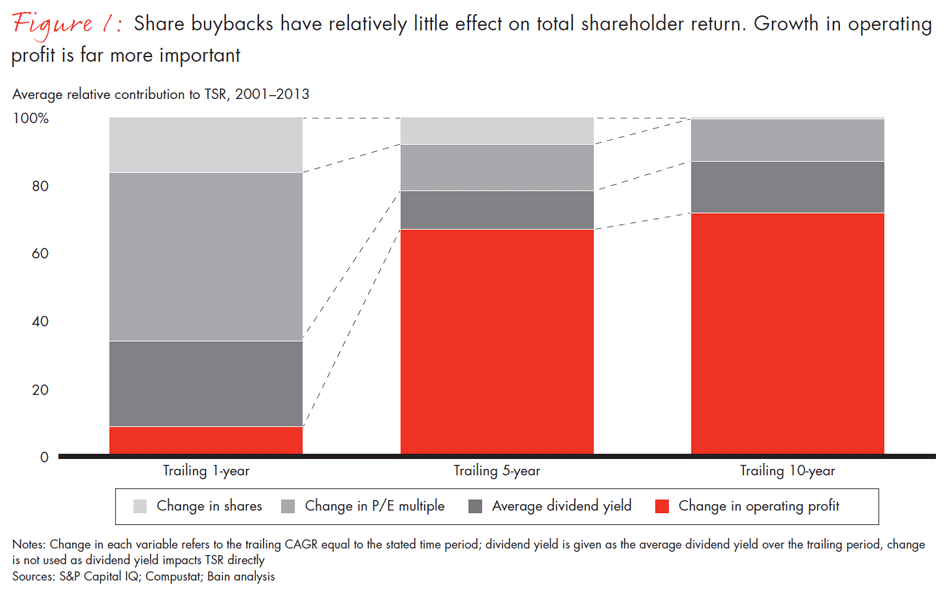
      At some level this makes sense. After all, who can fault the wisdom of returning money to shareholders? In fact, several activist investors have taken stakes in consumer goods companies making exactly this argument. The problem is, buying back shares is a bit of a sugar high (see Figure 1). It may help short-term earnings per share, but in the long term it does nothing to deliver above-average total shareholder returns (TSR), defined as stock price changes assuming reinvestment of cash dividends.

      Bain & Company analysis shows that growing operating earnings is the only way to spur long-term TSR. And the one thing that spurs operating earnings growth: systematic reinvestment into the business.

      repeatable-ma-in-consumer-goods-fig01_embed

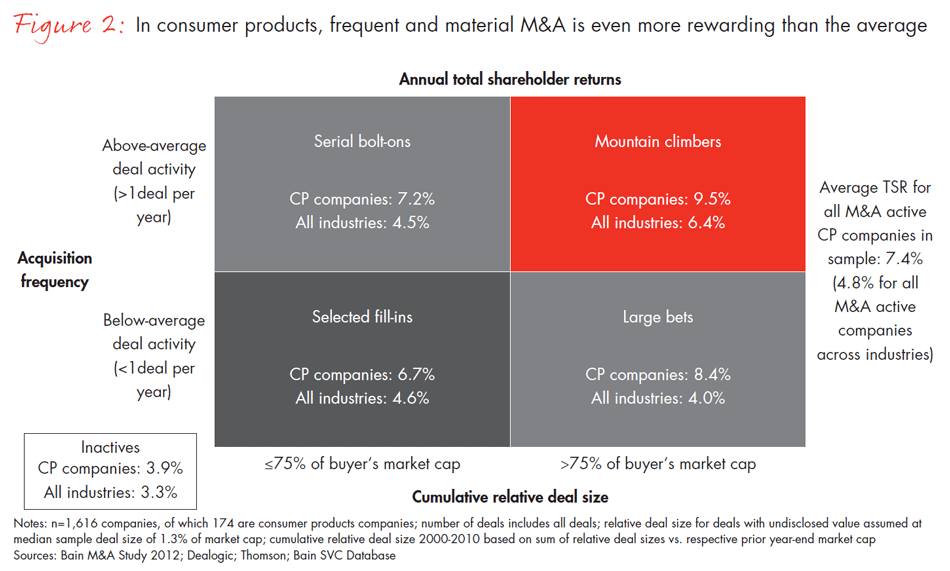
      Like their counterparts in other industries, consumer products companies now sit on record levels of cash, and investing in M&A happens to be a particularly attractive option for them. In Bain’s study of 1,600 companies across all industries, we observed that the rewards of M&A were indeed greater for consumer products companies than for the average company (see Figure 2). Consumer products companies that engaged in M&A during the period from 2000 through 2010 turned in an average annual TSR of 7.4%, while the average for all companies was 4.8%. Our research also determined that the bigger and more frequent the deals, the better the long-term results. Those companies making acquisitions that added a large amount of their market cap did the best. In general, the more a company’s market cap came from its acquisition, the better its performance was likely to be. Large-scale and frequent acquirers—we call these companies “Mountain climbers”—outperformed companies that occasionally engaged in M&A or sit on the sidelines. As a group, Mountain climbers achieved an average annual TSR of 9.5%.

      repeatable-ma-in-consumer-goods-fig02_embed

      Repeatable Models® in M&A

      It’s logical: Companies that make more acquisitions are more often likely to identify the right targets, to develop the capabilities required to vet deals better and faster, and to form the organizational muscles to more effectively integrate acquisitions. Essentially, leading acquirers develop what we call Repeatable Models for M&A. They create a learning system that helps them build a unique, proprietary set of M&A skills and capabilities that are deeply rooted in their strategy and applied repeatedly to new deals. They sustain institutional investment in their M&A capability, much as if they were building a marketing or manufacturing function from scratch.

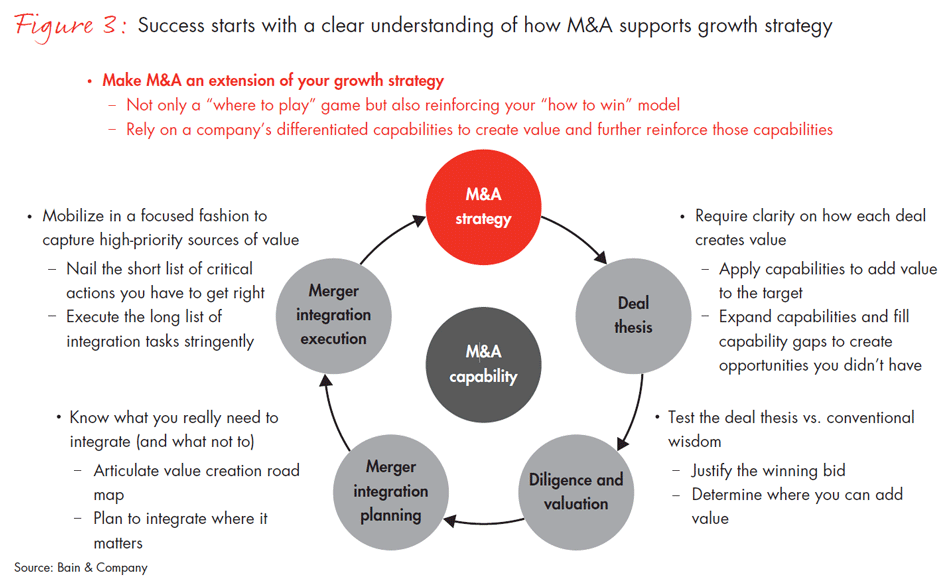
      These M&A leaders create a system for identifying, evaluating, closing and integrating good deals (see Figure 3). They maintain a clear understanding of how M&A will support their growth strategy in alignment with their organic efforts, not only in where to play but also in how to win. They search hard for merger or acquisition candidates that will add to their operating profit, fueling balanced growth. They pursue nearly as many “scope” deals as “scale” deals, moving into adjacent markets as well as expanding their share of existing markets. And these companies create a deal thesis—developed and applied in the context of their overall strategy—and apply a unique value-creation plan that allows them to pay more but get better returns out of a deal than their competition.

      repeatable-ma-in-consumer-goods-fig03_embed

      Some acquirers focus on a proprietary way of optimizing costs. Others have a track record for using newly acquired platforms with established wholesaler and distribution networks to build global brands. Others have a unique way to scale innovations. But it is always the same core capability in their organic strategy that they also apply to their M&A agenda. By relying on their strengths, not only will they get higher returns than the average acquirer, but they will also build on their experience to become even better at what they are already good at—and increase the edge they have over rivals.

      Successful acquirers also plan carefully for merger integration, determining what must be integrated and what can be kept separate, based on where they expect to create value. Finally, they mobilize to capture value, quickly nailing the short list of critical actions and effectively executing the much longer list of broader integration tasks.

      Jean-Charles van den Branden, a partner in Bain's Consumer Products practice, discusses four elements of a successful repeatable model for consumer product companies.

      Companies need to put five elements in place to build this kind of M&A capability:

      A strong business development office at the center, typically with close links to the strategy group, CEO and board. The business development office should ensure a strong, ongoing connection between M&A and strategy, linking the company’s accumulated deal-making experience to its core capabilities. The business development office is responsible for working with M&A service providers and maintaining liaisons with business units. It also measures and tracks the results of each deal, essentially creating an M&A learning organization.

      Shared accountability for new business activity between the business units and corporate. Business units can come to corporate with ideas for deals, and business unit leaders should be tasked with identifying new M&A opportunities to pursue in their respective business lines. While the M&A process should be centrally led, the integration process should be largely local.

      A commitment to differentiated deal thesis and due diligence. Many companies don’t start due diligence on an acquisition target until they receive an offering memorandum from an investment bank. But there are benefits to developing a deal wish list based on the company’s generic value-creation thesis and systematically assessing potential acquisitions before they are actively shopped. That way, executives have a sophisticated point of view on the asset’s value when it comes on the market. Such a disciplined process leads to a higher percentage of proprietary deals. The best companies also plan post-merger integration from the beginning. To maintain discipline during the entire process, they link due diligence to an investment thesis at all times.

      Integration where it matters. The integration process is fundamentally different for scale deals than for scope deals. But any integration has to focus on the sources of value, talent and capability retention and the processes upon which each party depends. Experienced acquirers understand the merger integration paradox: A few big things matter, but the details will kill you. And they know that functional groups left unchecked can become a serious liability in any post-merger integration. Veteran acquirers invest to build a repeatable integration model, typically using the momentum of the integration to optimize the merged business in parallel with the integration. Indeed, the disruptive nature of M&A and the integration process opens up the opportunity to implement a broad performance improvement agenda across the organization (see the Bain Brief “Why some merging companies become synergy overachievers”). The most successful acquirers evaluate each integration and determine what they will do differently next time. They build a playbook and invest in building the skills of their integration experts. In effect, they make integration a core competency, and it enables them to beat the M&A odds time after time.

      Reliance on good change management principles. People create a big risk for any acquisition. They typically undergo an intense emotional cycle, with fear and uncertainty swinging abruptly to unbridled optimism and then back again to pessimism. Experienced acquirers understand this natural rhythm and manage the risks involved. Bain has developed a battle-tested Results Delivery® framework along 15 dimensions that makes change risks measurable, manageable and predictable (see the Bain Brief “Results Delivery: Managing the highs and lows of change”).

      As consumer goods companies plot paths for their futures, they know that nothing beats a mix of organic and inorganic growth. Companies that build Repeatable Models that systematically rely on—and reinforce—their unique capabilities will achieve the best results. Instead of using their record levels of cash to repurchase shares for short-term gains, they’re reinvesting in the business to build companies that will grow and thrive for decades. Repeatable Models® and Results Delivery® are registered trademarks of Bain & Company, Inc.

      Matthew Meacham is a Bain & Company partner in London, where he leads the Global Consumer Products practice. Jean-Charles van den Branden is a partner based in Brussels. Henrik Poppe is a partner in Oslo and co-leader of Bain’s Corporate Finance practice. Based in Boston, David Harding is co-leader in of Bain’s Global M&A practice.

      Repeatable Models® and Results Delivery® are registered trademarks of Bain & Company, Inc.


      repeatable-ma-in-consumer-goods-fig01_full

      repeatable-ma-in-consumer-goods-fig02_full

      repeatable-ma-in-consumer-goods-fig03_full
      Autoren
      • Headshot of Matthew Meacham
        Matthew Meacham
        Advisory Partner, London
      • Headshot of Jean-Charles van den Branden
        Jean-Charles van den Branden
        Partner, Brussels
      • Headshot of David Harding
        David Harding
        Advisory Partner, Boston
      Kontaktieren Sie uns
      Verwandte Branchen
      • Konsumgüter
      Mergers & Acquisitions
      Warum einige Unternehmen ihre Synergieziele noch übertreffen

      Es ist ein offenes Geheimnis, dass viele M&A-Deals ihre zunächst angekündigten Synergieziele nicht erreichen.

      Mehr erfahren
      Change & Implementation
      Results Delivery: Die Höhen und Tiefen des Wandels meistern

      Auf den Etappen von Veränderungsprozessen treten unterschiedliche kognitive Verzerrungen in einer vorhersehbaren Abfolge von Stimmungen und Haltungen auf. Diese Zustände beeinflussen die Art und Weise, in der Mitarbeiter Informationen verarbeiten und zahlreiche andere Faktoren, die Urteilsvermögen und Entscheidungen beeinflussen.

      Mehr erfahren
      Konsumgüter
      Insurgent Q&A: Chomps Cofounder Rashid Ali

      “Our retail expansion story isn’t about taking share—it’s about growing the category.”

      Mehr erfahren
      Konsumgüter
      Shift to Vertical: David Haines, Group CEO, Flora Food Group

      What does it take to stay connected to your customers when scale and complexity threaten to pull you away? 

      Mehr erfahren
      Konsumgüter
      Consumer Products M&A

      In their quest for profitable growth, more companies are divesting brands or buying insurgents.

      Mehr erfahren
      First published in März 2015
      Markierungen
      • Konsumgüter

      Wie wir unsere Kunden unterstützt haben

      Digitalisierung A Strategic Separation Enables New Growth for GSK and Haleon

      Kundenbeispiel lesen

      Kundenstrategie und Marketing Food Co. jump-starts growth with return to core brands

      Kundenbeispiel lesen

      Strategie Focus on core delivers growth for retailer

      Kundenbeispiel lesen

      Möchten Sie mit uns in Kontakt bleiben?

      Wir unterstützen Führungskräfte weltweit, die kritischen Themen in ihrem Unternehmen zu adressieren. Gemeinsam schaffen wir nachhaltige Veränderungen und Ergebnisse.

      Bain Insights. Unsere Perspektive auf die kritischen Themen, mit denen sich international agierende Unternehmen konfrontiert sehen, finden Sie monatlich in Ihrem Postfach.

      *Ich habe die Datenschutzerklärung gelesen und akzeptiere sie.
      Bitte lesen Sie die Datenschutzerklärung und akzeptieren Sie diese.
      Bain & Company
      Contact us Sustainability Accessibility Rechtliche Hinweise Impressum Datenschutz Cookie-Richtlinie Sitemap Log In

      © 1996-2026 Bain & Company, Inc.

      Kontaktieren Sie Bain

      Wie können wir Ihnen helfen?

      • Business inquiry
      • Career information
      • Press relations
      • Partnership request
      • Speaker request
      Alle weltweiten Büros