
Skip to Content
  • Standorte

    Standorte

    North & Latin America
    • Atlanta
    • Austin
    • Bogota
    • Boston
    • Buenos Aires
    • Chicago
    • Dallas
    • Denver
    • Houston
    • Lisbon
    • Los Angeles
    • Mexico City
    • Minneapolis
    • Monterrey
    • Montreal
    • New York
    • Rio de Janeiro
    • San Francisco
    • Santiago
    • São Paulo
    • Seattle
    • Silicon Valley
    • Toronto
    • Washington, DC
    Europe & Africa
    • Amsterdam
    • Athens
    • Berlin
    • Brussels
    • Copenhagen
    • Düsseldorf
    • Frankfurt
    • Helsinki
    • Istanbul
    • Johannesburg
    • Kyiv
    • Lisbon
    • London
    • Madrid
    • Milan
    • München
    • Oslo
    • Paris
    • Rome
    • Stockholm
    • Warsaw
    • Wien
    • Zürich
    Middle East
    • Doha
    • Dubai
    • Riyadh
    Asia & Australia
    • Bangkok
    • Beijing
    • Bengaluru
    • Brisbane
    • Ho Chi Minh City
    • Hong Kong
    • Jakarta
    • Kuala Lumpur
    • Manila
    • Melbourne
    • Mumbai
    • New Delhi
    • Perth
    • Seoul
    • Shanghai
    • Singapore
    • Sydney
    • Tokyo
    Alle Standorte Anzeigen
  • Alumni
  • Presse
  • Newsletter
  • Kontakt
  • DACH-Region | Deutsch

    Wählen Sie Ihre Region und Sprache

    Global
    • Global (English)
    North & Latin America
    • Brazil (Português)
    • Argentina (Español)
    • Canada (Français)
    • Chile (Español)
    • Colombia (Español)
    Europe, Middle East, & Africa
    • France (Français)
    • DACH-Region (Deutsch)
    • Italy (Italiano)
    • Spain (Español)
    • Greece (Elliniká)
    Asia & Australia
    • China (中文版)
    • Korea (한국어)
    • Japan (日本語)
  • Saved items (0)
    Saved items (0)

    You have no saved items.

    Inhalte, für die Sie sich interessieren, werden hier gespeichert und können später gelesen oder weitergeleitet werden.

    Explore Bain Insights
  • Branchenkompetenzen
    Hauptmenü

    Branchenkompetenzen

    • Luft- und Raumfahrt, Verteidigung
    • Agrarwirtschaft
    • Chemieindustrie
    • Infrastruktur und Bauwirtschaft
    • Konsumgüter
    • Finanzdienstleistungen
    • Gesundheitswesen
    • Maschinen- und Anlagenbau
    • Medienwirtschaft
    • Metallindustrie
    • Bergbau
    • Öl und Gas
    • Papier- und Verpackungsindustrie
    • Private Equity
      Branchenkompetenzen
      Private Equity
      • Due Diligence
      • Exit Planning
      • Firm Strategy & Operations
      • Portfolio Value Creation
    • Öffentlicher Sektor und Sozialwesen
    • Einzelhandel
    • Technologie
    • Telekommunikation
    • Transportwesen
    • Reise- und Freizeitbranche
    • Versorgung und erneuerbare Energien
  • Managementkompetenzen
    Hauptmenü

    Managementkompetenzen

    • Customer Experience
    • ESG
    • Innovation
    • M&A
    • Operations
    • People & Organization
    • Private Equity
    • Sales & Marketing
    • Strategie
    • KI, Einblicke und Lösungen
    • Technologie
    • Transformation
  • Digital
  • Publikationen
    Hauptmenü

    Publikationen

    • Branchenthemen
    • Managementthemen
    • Bain-Bücher
    Alle Publikationen
    Ausgewählte Themen
    • Resilienz in der globalen Krise
    • M&A Report
    • Private Equity Podcast
    • Midyear Private Equity Report
    • Agile
    • Engineering Report
    • Digital Transformation
    • Elements of Value®
    • Firm of the Future
    • Nachhaltigkeitsstudie
    • Macro Trends
    • Future of Consumption
    • Weltwirtschaftsforum (WEF)
  • Über uns
    Hauptmenü

    Über uns

    • Was wir bieten
    • Unser Ansatz
    • Unser Team
    • Game Changer Award
    • Female Allstar Board
    • Messbare Ergebnisse (EN)
    • Auszeichnungen
    • Globale Partnerschaften
    • The Mission
    Further: Our global responsibility
    • Vielfalt & Chancengleichheit
    • Soziale Verantwortung
    • Sustainability
    Erfahren Sie mehr zu "Further"
  • Karriere
    Hauptmenü

    Karriere

    • Dein Einstieg
      Karriere
      Dein Einstieg
      • Find Your Place
      • Unsere Arbeitsbereiche
      • Unsere Teams
      • Angebote für Studierende
      • Praktika & Programme
      • Recruiting-Events
    • Arbeiten bei Bain
      Karriere
      Arbeiten bei Bain
      • Karriere Stories
      • Unsere Bainies
      • Office-Standorte
      • Weiterentwicklung
      • Affinity Groups
      • Deine Benefits
    • Impact Stories
    • Deine Bewerbung
      Karriere
      Deine Bewerbung
      • Das erwartet dich
      • Der Interviewprozess
    FIND JOBS
  • Standorte
    Hauptmenü

    Standorte

    • North & Latin America
      Standorte
      North & Latin America
      • Atlanta
      • Austin
      • Bogota
      • Boston
      • Buenos Aires
      • Chicago
      • Dallas
      • Denver
      • Houston
      • Lisbon
      • Los Angeles
      • Mexico City
      • Minneapolis
      • Monterrey
      • Montreal
      • New York
      • Rio de Janeiro
      • San Francisco
      • Santiago
      • São Paulo
      • Seattle
      • Silicon Valley
      • Toronto
      • Washington, DC
    • Europe & Africa
      Standorte
      Europe & Africa
      • Amsterdam
      • Athens
      • Berlin
      • Brussels
      • Copenhagen
      • Düsseldorf
      • Frankfurt
      • Helsinki
      • Istanbul
      • Johannesburg
      • Kyiv
      • Lisbon
      • London
      • Madrid
      • Milan
      • München
      • Oslo
      • Paris
      • Rome
      • Stockholm
      • Warsaw
      • Wien
      • Zürich
    • Middle East
      Standorte
      Middle East
      • Doha
      • Dubai
      • Riyadh
    • Asia & Australia
      Standorte
      Asia & Australia
      • Bangkok
      • Beijing
      • Bengaluru
      • Brisbane
      • Ho Chi Minh City
      • Hong Kong
      • Jakarta
      • Kuala Lumpur
      • Manila
      • Melbourne
      • Mumbai
      • New Delhi
      • Perth
      • Seoul
      • Shanghai
      • Singapore
      • Sydney
      • Tokyo
    Alle Standorte Anzeigen
  • Alumni
  • Presse
  • Newsletter
  • Kontakt
  • DACH-Region | Deutsch
    Hauptmenü

    Wählen Sie Ihre Region und Sprache

    • Global
      Wählen Sie Ihre Region und Sprache
      Global
      • Global (English)
    • North & Latin America
      Wählen Sie Ihre Region und Sprache
      North & Latin America
      • Brazil (Português)
      • Argentina (Español)
      • Canada (Français)
      • Chile (Español)
      • Colombia (Español)
    • Europe, Middle East, & Africa
      Wählen Sie Ihre Region und Sprache
      Europe, Middle East, & Africa
      • France (Français)
      • DACH-Region (Deutsch)
      • Italy (Italiano)
      • Spain (Español)
      • Greece (Elliniká)
    • Asia & Australia
      Wählen Sie Ihre Region und Sprache
      Asia & Australia
      • China (中文版)
      • Korea (한국어)
      • Japan (日本語)
  • Saved items  (0)
    Hauptmenü
    Saved items (0)

    You have no saved items.

    Inhalte, für die Sie sich interessieren, werden hier gespeichert und können später gelesen oder weitergeleitet werden.

    Explore Bain Insights
  • Branchenkompetenzen
    • Branchenkompetenzen

      • Luft- und Raumfahrt, Verteidigung
      • Agrarwirtschaft
      • Chemieindustrie
      • Infrastruktur und Bauwirtschaft
      • Konsumgüter
      • Finanzdienstleistungen
      • Gesundheitswesen
      • Maschinen- und Anlagenbau
      • Medienwirtschaft
      • Metallindustrie
      • Bergbau
      • Öl und Gas
      • Papier- und Verpackungsindustrie
      • Private Equity
      • Öffentlicher Sektor und Sozialwesen
      • Einzelhandel
      • Technologie
      • Telekommunikation
      • Transportwesen
      • Reise- und Freizeitbranche
      • Versorgung und erneuerbare Energien
  • Managementkompetenzen
    • Managementkompetenzen

      • Customer Experience
      • ESG
      • Innovation
      • M&A
      • Operations
      • People & Organization
      • Private Equity
      • Sales & Marketing
      • Strategie
      • KI, Einblicke und Lösungen
      • Technologie
      • Transformation
  • Digital
  • Publikationen
    • Publikationen

      • Branchenthemen
      • Managementthemen
      • Bain-Bücher
      Alle Publikationen
      Ausgewählte Themen
      • Resilienz in der globalen Krise
      • M&A Report
      • Private Equity Podcast
      • Midyear Private Equity Report
      • Agile
      • Engineering Report
      • Digital Transformation
      • Elements of Value®
      • Firm of the Future
      • Nachhaltigkeitsstudie
      • Macro Trends
      • Future of Consumption
      • Weltwirtschaftsforum (WEF)
  • Über uns
    • Über uns

      • Was wir bieten
      • Unser Ansatz
      • Unser Team
      • Game Changer Award
      • Female Allstar Board
      • Messbare Ergebnisse (EN)
      • Auszeichnungen
      • Globale Partnerschaften
      • The Mission
      Further: Our global responsibility
      • Vielfalt & Chancengleichheit
      • Soziale Verantwortung
      • Sustainability
      Erfahren Sie mehr zu "Further"
  • Karriere
    Häufige Suchanfragen
    • Agil
    • Digital
    • Strategie
    Vorherige Suchanfragen
      Zuletzt besuchte Seiten

      Content added to saved items

      Saved items (0)

      Removed from saved items

      Saved items (0)

      Brief

      The Economics of Loyalty

      The Economics of Loyalty

      Just how valuable are your most valuable customers?

      Von Rob Markey and Fred Reichheld

      • Min. Lesezeit

      Brief

      The Economics of Loyalty
      en

      If you are a commercial banker, you know intuitively that some of your customers are worth far more to your business than others. The best customers maintain higher deposit and loan balances, use more banking services and stay with you for a long time. They are loyal, enthusiastic advocates of your bank, singing your praises to friends and colleagues. They are promoters.

      Say you run a chain of hotels. You know that your best customers are the guests who visit your properties time after time, spend a lot of money because they value the amenities and services your hotels offer and recommend your hotels to other travelers. They treat your hotel staff well. Those customers, too, are promoters. 

      Here’s the challenge: Do you know how much more valuable these customers are than others? Do you know what it might be worth to turn another 10% or 20% of your customers into promoters? Unless you can answer such questions, you are flying blind. You can’t know how much to invest in the efforts and initiatives that will create and retain more of these valuable customers.

      The Net Promoter System® provides a method of answering these questions so you can invest with confidence that your efforts will yield profitable growth. It works in banking, hospitality, industrial services or almost any other industry. Net Promoter® companies regularly survey their customers, asking them the “ultimate question,” which is typically: On a zero-to-10 scale, how likely is it that you would recommend this company to a friend or colleague? Companies then sort their customers into promoters (9s and 10s), passives (7s and 8s), and detractors (everybody else). They then confirm what other companies have consistently found: Each category of customers exhibits significantly different patterns of behavior, with corresponding effects on profitability that can be quantified with some precision.

      With careful analysis, companies can not only estimate the relative profitability of promoters, passives and detractors, they can also estimate the impact of proposed actions and initiatives on company performance, providing guidance to investments in improving customer performance.

      Rob Markey, global practice leader of Bain's Customer Strategy & Marketing practice, explains how companies use the Net Promoter SystemSM to understand the needs of their most valuable customers.


      The lifetime value of different groups

      The first step is to calculate the lifetime value of an average customer. (If you’re not sure how to do this, you can get a brief refresher course at www.netpromotersystem.com/lifetimevalue.) The fundamental idea is to tally up all the cash flows attributable to the life of a typical customer relationship and put them in today’s dollars. Next, using the lifetime value of an average customer as a baseline, you can tally up the differences in lifetime value for promoters, passives and detractors based on the ways their respective behaviors produce differences in revenue and cost. The following list describes several characteristics that distinguish the categories:

      • Retention rate. Detractors generally defect at higher rates than promoters, which means that they have shorter and less profitable relationships with a company. Use the retention rate of each group to calculate the average lifetime of promoters, passives and detractors.
      • Pricing. Promoters are often less price sensitive than other customers. They were attracted in the first place by the value they saw in your products and services. They rarely need a huge promotion to trigger their purchases. The opposite is generally true for detractors. To estimate differences in price realization, you’ll need to examine the market basket of goods or services purchased by promoters and detractors over a six- to twelve-month period so you can calculate the margin on each basket, keeping track of discounts and price concessions. (Note: Some companies have chosen to offer their best deals to their most loyal customers, which can change price realization and skew the results of this sort of analysis.)
      • Annual spending. Promoters increase their purchases faster than detractors. Your share of their category spending increases as promoters choose your products over competitors, upgrade to higher-priced products or services and respond with enthusiasm to new offerings.
      • Cost efficiencies. Promoters typically cost less to serve. They complain less often and they are responsible for fewer credit losses. They bring you more new customers, reducing your sales, marketing, advertising and other customer acquisition costs. Because promoters have longer customer lifetimes, their acquisition and startup costs can be spread over more years of lifetime revenue. And their higher propensity to upgrade to premium products and services often increases the margins on their business.
      • Word of mouth. The financial impact of positive or negative word of mouth is usually significantly greater than leaders realize. Although it isn’t easy to do, you can estimate the effect of positive and negative word of mouth. Begin by quantifying (by survey if necessary) the proportion of new customers who selected your firm because of reputation or referral. The lifetime value of these new customers, including any savings in sales or marketing expense, should be allocated to promoters. (More than 80% of positive referrals come from promoters.) Detractors, meanwhile, are responsible for more than 80% of negative word of mouth, and the cost of this drag on growth should be allocated to them. 

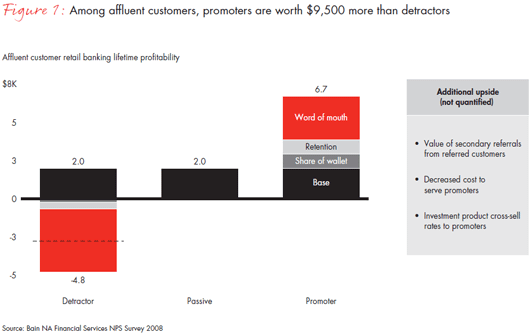
      A team of Bain researchers studying affluent banking customers found significant differences in all such profit-driving behaviors among promoters, passives and detractors. Promoters give their primary bank almost 45% more of their household deposit balances than detractors do. They buy, on average, 25% more products from the bank than detractors, and their mix of products skews toward more profitable checking and savings accounts. Attrition rates among promoters average only one-third those for detractors. Promoters make nearly seven times as many positive referrals as detractors.

      To estimate the financial impact of these behaviors, team members used industry-average net interest margins on deposits and loans and industry-average overhead and other costs to create an average retail bank profit-and- loss (P&L) statement. They then converted this to an average customer-level P&L by simple division. Next, they plugged promoter, passive and detractor behavior into a simple model to estimate the financial impact of their different behaviors, converting them to lifetime value by discounting the future cash flows. Based on that analysis, a promoter is worth roughly $9,500 more to a bank than a detractor (see Figure 1). In fact, detractors have a negative lifetime value: They actually destroy value for shareholders and employees.

      li-the-economics-of-loyalty-fig-01_embed

      The analysis still leaves some elements of value unaccounted for. For example, our work shows that the new customers referred by promoters are significantly more likely to become promoters themselves, and are therefore more valuable than the average new customer. Similarly, our work with Bain clients shows that detractors cost significantly more to serve than promoters. They put more demands on call centers, raise more problems that need to be resolved and are less likely to use self-service tools, such as online banking. When we work with our clients, we typically estimate and allocate these additional cost differences, further improving the precision of the estimated value differences.

      The link between loyalty and growth

      This micro view of customer economics provides a foundation for cost-benefit analyses of investment decisions aimed at building stronger customer relationships. Leaders need a macro view as well, however. They must be able to determine how valuable it would be to improve overall customer loyalty as measured by Net Promoter Scores. That enables them to set goals for improvement and to hold executives accountable for achieving that improvement.

      In this case, the appropriate method is to determine your overall Net Promoter Score® (NPS®) relative to competitors. The most rigorous approach requires what market researchers call a double-blind research design, where the customers remain anonymous and the researchers don’t reveal who is sponsoring the survey. This minimizes bias both in the sample itself and in the way customers respond to the survey. After you have calculated each competitor’s score, you can determine your company’s relative NPS by subtracting your best competitor’s score from your own. Then you can compare relative NPS with growth rates.

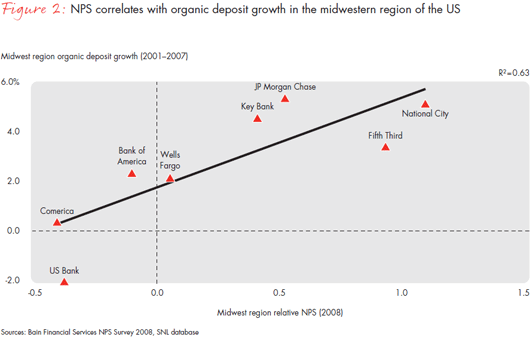
      The Bain team that examined North American banking customers also studied the relationship between the same banks’ NPS and organic growth. It found that differences in relative Net Promoter scores within a region explained most of the differences in relative growth rates of retail deposits. It’s essential in any such study, of course, to define the relevant competitive set carefully. For example, Bank of America competes against TD Bank in the northeastern US but not in the western part of the country, where TD Bank has no branches. Moreover, the strength of the retail operations of Bank of America or Wells Fargo might differ significantly from one region to another, since these banks to a significant extent are composed of acquisitions made in recent years. The team controlled the effect of mergers and acquisitions by removing the gain resulting from them from the bank’s overall growth. Finally, because bank revenue is so dependent on interest rates, and because interest rates fluctuate so dramatically, the team used retail deposit balances (which are publicly reported) as an indicator of organic growth.

      The results of the analysis can be seen in figure 2, which plots relative NPS versus growth among banks in the Midwest region of the US. The bank example, of course, is only one industry. But as we have worked with Bain clients, members of the NPS Loyalty Forum and others over the past several years, we have learned that the relationship between NPS and organic growth within a closely defined competitive set is quite strong for most businesses.

      li-the-economics-of-loyalty-fig-02_embed

      A number of large corporations around the world have performed similar analyses for their own businesses, correlating Net Promoter scores with relative growth. The electronics and consumer products company Philips compared its scores against those of competitors for each carefully defined business and region—shavers in China, for instance. Philips found that the median growth rate of businesses in NPS leadership positions was eight percentage points above the rate of competitors in that market. Where Philips trailed all its direct competitors, growth was slower than the competition by five percentage points. Philips executives, knowing from this kind of analysis what loyalty improvements are worth, have set a goal to have 50 percent of the company’s businesses in NPS leadership positions by 2015.

      Relative Net Promoter scores do not explain relative growth in every industry or situation, because factors other than customer loyalty can play an important role. But scores are a powerful predictor of growth in most situations, and will help you quantify the value of investing in greater customer loyalty. The payoff, typically, is far greater than current accounting might otherwise suggest. That’s why many companies still systematically underfund investments that could produce superior loyalty. For those that take the time to run these numbers, however, the results are very real: better, targeted investments in loyal customers: the best engine of sustainable, profitable growth.

      Fred Reichheld and Rob Markey are authors of the bestseller The Ultimate Question 2.0: How Net Promoter Companies Thrive in a Customer-Driven World. Markey is a partner and director in Bain & Company’s New York office and leads the firm’s Global Customer Strategy and Marketing practice. Reichheld is a Fellow at Bain & Company. He is the bestselling author of three other books on loyalty published by Harvard Business Review Press, including The Loyalty Effect, Loyalty Rules! and The Ultimate Question, as well as numerous articles published in Harvard Business Review.

      Autoren
      • Headshot of Rob Markey
        Rob Markey
        Advisory Partner, Boston
      • Headshot of Fred Reichheld
        Fred Reichheld
        Bain Fellow, Boston
      Kontaktieren Sie uns
      Ähnliche Beratungsangebote
      • Kundenstrategie und Marketing
      • Net Promoter System®
      • Service Operations
      Wie wir Sie unterstützen können
      • Net Promoter®
      Kundenstrategie und Marketing
      Net Promoter System®: Creating a reliable metric

      How to compile accurate, trustworthy scores week in and week out.

      Mehr erfahren
      Kundenstrategie und Marketing
      Is That Customer Worth Your Time?

      Allocate time with customers based on analytics, not gut instinct.

      Mehr erfahren
      Kundenstrategie und Marketing
      Aaron Cheris: The economics of loyalty

      Understanding the economics of customer loyalty can help guide a company's loyalty, says Partner Aaron Cheris in this short video.

      Mehr erfahren
      Loyalität
      Transforming a Company by Learning to Love Customers

      How to become customer-friendly, using the Net Promoter System at the core of a broad transformation.

      Mehr erfahren
      Loyalität
      After Years of Customer Loyalty Programs in Insurance, What Works, and What’s Next?

      Based on Bain’s 10 years of research, five themes describe the progress and challenges of earning customers’ advocacy in an increasingly digital experience.

      Mehr erfahren
      First published in März 2012
      Markierungen
      • Kundenstrategie und Marketing
      • Loyalität
      • Net Promoter System®
      • Net Promoter®
      • Service Operations

      Wie wir unsere Kunden unterstützt haben

      Resetting Shared Services to Save $75 Million

      Kundenbeispiel lesen

      Transformation Transformation sparks financial leader's turnaround

      Kundenbeispiel lesen

      Transformation Turning around a pioneering service for working parents with sick children

      Kundenbeispiel lesen

      Möchten Sie mit uns in Kontakt bleiben?

      Wir unterstützen Führungskräfte weltweit, die kritischen Themen in ihrem Unternehmen zu adressieren. Gemeinsam schaffen wir nachhaltige Veränderungen und Ergebnisse.

      Bain Insights. Unsere Perspektive auf die kritischen Themen, mit denen sich international agierende Unternehmen konfrontiert sehen, finden Sie monatlich in Ihrem Postfach.

      *Ich habe die Datenschutzerklärung gelesen und akzeptiere sie.
      Bitte lesen Sie die Datenschutzerklärung und akzeptieren Sie diese.
      Bain & Company
      Contact us Sustainability Accessibility Rechtliche Hinweise Impressum Datenschutz Cookie-Richtlinie Sitemap Log In

      © 1996-2026 Bain & Company, Inc.

      Kontaktieren Sie Bain

      Wie können wir Ihnen helfen?

      • Business inquiry
      • Career information
      • Press relations
      • Partnership request
      • Speaker request
      Alle weltweiten Büros