
Skip to Content
  • Standorte

    Standorte

    North & Latin America
    • Atlanta
    • Austin
    • Bogota
    • Boston
    • Buenos Aires
    • Chicago
    • Dallas
    • Denver
    • Houston
    • Lisbon
    • Los Angeles
    • Mexico City
    • Minneapolis
    • Monterrey
    • Montreal
    • New York
    • Rio de Janeiro
    • San Francisco
    • Santiago
    • São Paulo
    • Seattle
    • Silicon Valley
    • Toronto
    • Washington, DC
    Europe & Africa
    • Amsterdam
    • Athens
    • Berlin
    • Brussels
    • Copenhagen
    • Düsseldorf
    • Frankfurt
    • Helsinki
    • Istanbul
    • Johannesburg
    • Kyiv
    • Lisbon
    • London
    • Madrid
    • Milan
    • München
    • Oslo
    • Paris
    • Rome
    • Stockholm
    • Warsaw
    • Wien
    • Zürich
    Middle East
    • Doha
    • Dubai
    • Riyadh
    Asia & Australia
    • Bangkok
    • Beijing
    • Bengaluru
    • Brisbane
    • Ho Chi Minh City
    • Hong Kong
    • Jakarta
    • Kuala Lumpur
    • Manila
    • Melbourne
    • Mumbai
    • New Delhi
    • Perth
    • Seoul
    • Shanghai
    • Singapore
    • Sydney
    • Tokyo
    Alle Standorte Anzeigen
  • Alumni
  • Presse
  • Newsletter
  • Kontakt
  • DACH-Region | Deutsch

    Wählen Sie Ihre Region und Sprache

    Global
    • Global (English)
    North & Latin America
    • Brazil (Português)
    • Argentina (Español)
    • Canada (Français)
    • Chile (Español)
    • Colombia (Español)
    Europe, Middle East, & Africa
    • France (Français)
    • DACH-Region (Deutsch)
    • Italy (Italiano)
    • Spain (Español)
    • Greece (Elliniká)
    Asia & Australia
    • China (中文版)
    • Korea (한국어)
    • Japan (日本語)
  • Saved items (0)
    Saved items (0)

    You have no saved items.

    Inhalte, für die Sie sich interessieren, werden hier gespeichert und können später gelesen oder weitergeleitet werden.

    Explore Bain Insights
  • Branchenkompetenzen
    Hauptmenü

    Branchenkompetenzen

    • Luft- und Raumfahrt, Verteidigung
    • Agrarwirtschaft
    • Chemieindustrie
    • Infrastruktur und Bauwirtschaft
    • Konsumgüter
    • Finanzdienstleistungen
    • Gesundheitswesen
    • Maschinen- und Anlagenbau
    • Medienwirtschaft
    • Metallindustrie
    • Bergbau
    • Öl und Gas
    • Papier- und Verpackungsindustrie
    • Private Equity
      Branchenkompetenzen
      Private Equity
      • Due Diligence
      • Exit Planning
      • Firm Strategy & Operations
      • Portfolio Value Creation
    • Öffentlicher Sektor und Sozialwesen
    • Einzelhandel
    • Technologie
    • Telekommunikation
    • Transportwesen
    • Reise- und Freizeitbranche
    • Versorgung und erneuerbare Energien
  • Managementkompetenzen
    Hauptmenü

    Managementkompetenzen

    • Customer Experience
    • ESG
    • Innovation
    • M&A
    • Operations
    • People & Organization
    • Private Equity
    • Sales & Marketing
    • Strategie
    • KI, Einblicke und Lösungen
    • Technologie
    • Transformation
  • Digital
  • Publikationen
    Hauptmenü

    Publikationen

    • Branchenthemen
    • Managementthemen
    • Bain-Bücher
    Alle Publikationen
    Ausgewählte Themen
    • Resilienz in der globalen Krise
    • M&A Report
    • Private Equity Podcast
    • Midyear Private Equity Report
    • Agile
    • Engineering Report
    • Digital Transformation
    • Elements of Value®
    • Firm of the Future
    • Nachhaltigkeitsstudie
    • Macro Trends
    • Future of Consumption
    • Weltwirtschaftsforum (WEF)
  • Über uns
    Hauptmenü

    Über uns

    • Was wir bieten
    • Unser Ansatz
    • Unser Team
    • Game Changer Award
    • Female Allstar Board
    • Messbare Ergebnisse (EN)
    • Auszeichnungen
    • Globale Partnerschaften
    • The Mission
    Further: Our global responsibility
    • Vielfalt & Chancengleichheit
    • Soziale Verantwortung
    • Sustainability
    Erfahren Sie mehr zu "Further"
  • Karriere
    Hauptmenü

    Karriere

    • Dein Einstieg
      Karriere
      Dein Einstieg
      • Find Your Place
      • Unsere Arbeitsbereiche
      • Unsere Teams
      • Angebote für Studierende
      • Praktika & Programme
      • Recruiting-Events
    • Arbeiten bei Bain
      Karriere
      Arbeiten bei Bain
      • Blog: Inside Bain
      • Karriere Stories
      • Unsere Bainies
      • Office-Standorte
      • Weiterentwicklung
      • Affinity Groups
      • Deine Benefits
    • Impact Stories
    • Deine Bewerbung
      Karriere
      Deine Bewerbung
      • Das erwartet dich
      • Der Interviewprozess
    FIND JOBS
  • Standorte
    Hauptmenü

    Standorte

    • North & Latin America
      Standorte
      North & Latin America
      • Atlanta
      • Austin
      • Bogota
      • Boston
      • Buenos Aires
      • Chicago
      • Dallas
      • Denver
      • Houston
      • Lisbon
      • Los Angeles
      • Mexico City
      • Minneapolis
      • Monterrey
      • Montreal
      • New York
      • Rio de Janeiro
      • San Francisco
      • Santiago
      • São Paulo
      • Seattle
      • Silicon Valley
      • Toronto
      • Washington, DC
    • Europe & Africa
      Standorte
      Europe & Africa
      • Amsterdam
      • Athens
      • Berlin
      • Brussels
      • Copenhagen
      • Düsseldorf
      • Frankfurt
      • Helsinki
      • Istanbul
      • Johannesburg
      • Kyiv
      • Lisbon
      • London
      • Madrid
      • Milan
      • München
      • Oslo
      • Paris
      • Rome
      • Stockholm
      • Warsaw
      • Wien
      • Zürich
    • Middle East
      Standorte
      Middle East
      • Doha
      • Dubai
      • Riyadh
    • Asia & Australia
      Standorte
      Asia & Australia
      • Bangkok
      • Beijing
      • Bengaluru
      • Brisbane
      • Ho Chi Minh City
      • Hong Kong
      • Jakarta
      • Kuala Lumpur
      • Manila
      • Melbourne
      • Mumbai
      • New Delhi
      • Perth
      • Seoul
      • Shanghai
      • Singapore
      • Sydney
      • Tokyo
    Alle Standorte Anzeigen
  • Alumni
  • Presse
  • Newsletter
  • Kontakt
  • DACH-Region | Deutsch
    Hauptmenü

    Wählen Sie Ihre Region und Sprache

    • Global
      Wählen Sie Ihre Region und Sprache
      Global
      • Global (English)
    • North & Latin America
      Wählen Sie Ihre Region und Sprache
      North & Latin America
      • Brazil (Português)
      • Argentina (Español)
      • Canada (Français)
      • Chile (Español)
      • Colombia (Español)
    • Europe, Middle East, & Africa
      Wählen Sie Ihre Region und Sprache
      Europe, Middle East, & Africa
      • France (Français)
      • DACH-Region (Deutsch)
      • Italy (Italiano)
      • Spain (Español)
      • Greece (Elliniká)
    • Asia & Australia
      Wählen Sie Ihre Region und Sprache
      Asia & Australia
      • China (中文版)
      • Korea (한국어)
      • Japan (日本語)
  • Saved items  (0)
    Hauptmenü
    Saved items (0)

    You have no saved items.

    Inhalte, für die Sie sich interessieren, werden hier gespeichert und können später gelesen oder weitergeleitet werden.

    Explore Bain Insights
  • Branchenkompetenzen
    • Branchenkompetenzen

      • Luft- und Raumfahrt, Verteidigung
      • Agrarwirtschaft
      • Chemieindustrie
      • Infrastruktur und Bauwirtschaft
      • Konsumgüter
      • Finanzdienstleistungen
      • Gesundheitswesen
      • Maschinen- und Anlagenbau
      • Medienwirtschaft
      • Metallindustrie
      • Bergbau
      • Öl und Gas
      • Papier- und Verpackungsindustrie
      • Private Equity
      • Öffentlicher Sektor und Sozialwesen
      • Einzelhandel
      • Technologie
      • Telekommunikation
      • Transportwesen
      • Reise- und Freizeitbranche
      • Versorgung und erneuerbare Energien
  • Managementkompetenzen
    • Managementkompetenzen

      • Customer Experience
      • ESG
      • Innovation
      • M&A
      • Operations
      • People & Organization
      • Private Equity
      • Sales & Marketing
      • Strategie
      • KI, Einblicke und Lösungen
      • Technologie
      • Transformation
  • Digital
  • Publikationen
    • Publikationen

      • Branchenthemen
      • Managementthemen
      • Bain-Bücher
      Alle Publikationen
      Ausgewählte Themen
      • Resilienz in der globalen Krise
      • M&A Report
      • Private Equity Podcast
      • Midyear Private Equity Report
      • Agile
      • Engineering Report
      • Digital Transformation
      • Elements of Value®
      • Firm of the Future
      • Nachhaltigkeitsstudie
      • Macro Trends
      • Future of Consumption
      • Weltwirtschaftsforum (WEF)
  • Über uns
    • Über uns

      • Was wir bieten
      • Unser Ansatz
      • Unser Team
      • Game Changer Award
      • Female Allstar Board
      • Messbare Ergebnisse (EN)
      • Auszeichnungen
      • Globale Partnerschaften
      • The Mission
      Further: Our global responsibility
      • Vielfalt & Chancengleichheit
      • Soziale Verantwortung
      • Sustainability
      Erfahren Sie mehr zu "Further"
  • Karriere
    Häufige Suchanfragen
    • Agil
    • Digital
    • Strategie
    Vorherige Suchanfragen
      Zuletzt besuchte Seiten

      Content added to saved items

      Saved items (0)

      Removed from saved items

      Saved items (0)

      Global Healthcare Private Equity Report

      Life Sciences: White-Hot Competition to Win the Right Deals

      Life Sciences: White-Hot Competition to Win the Right Deals

      More funds are on the hunt, but a small group of dealmakers account for most of the activity.

      Von Matt Sullivan, Anshul Rana, Christoph Schlegel, Nirad Jain, Kara Murphy, Franz-Robert Klingan, Dmitry Podpolny, Alex Boulton, und Vikram Kapur

      • Min. Lesezeit
      }

      Report

      Life Sciences: White-Hot Competition to Win the Right Deals
      en
      At a Glance
      • Biopharma and life sciences tools are attractive: Within these two subsectors, more than 600 healthcare buyout deals have been executed over the past five years globally, fueled by strong end-market growth tailwinds, recession resistance, and attractive returns for private equity. Given that these trends are expected to continue, executing coherent deal strategy in biopharma and life sciences tools has become a must-have for US/EU funds.
      • Subsectors within life sciences matter: Out of the roughly 410 US/EU biopharma and life sciences tools buyouts executed over the past five-and-a-half years, more than 80% have been in eight subsectors, each with a different set of dynamics.
      • Concentrated dealmakers, long tail of participants: About 65% of biopharma and life sciences tools deals in the US and Europe were conducted by around 50 funds with a large amount of midmarket participation.
      • Lessons learned from dealmakers: Funds that have a repeatable approach to closing deals have a very sharp perspective on “where to play” and “how to win” and have flexed the type of deal they are prepared to do to be successful. Differentiation in subsectors is increasingly driven by the quality of science and depth of expertise in a specific disease or technology.

      This article is part of Bain's 2023 Global Healthcare Private Equity and M&A Report.

      EXPLORE THE REPORT

      The life sciences deal market—that is, marketed biopharma products and the ecosystem of companies supporting their research, development, and commercialization—has been an attractive place for private equity (PE) to put capital to work. These markets—which include life sciences tools (LSTs), diagnostics (Dx), lab services, outsourced biopharma services, and pharma software/IT—are historically recession resistant and have all been driven by strong end-market growth tailwinds. These sectors have also seen strong returns within healthcare, which itself is an attractive industry vertical.

      Given all of these dynamics, the volume of PE dealmaking has increased significantly in this area, and it has become a must-win sector for funds. Deal volume in the past five years in biopharma and life sciences tools has increased 115% compared with the previous five-year period (see Figure 1). Payer, provider, and medtech deal activity increased only 55% across those same two time periods. We count 650 unique buyout deals globally for life sciences assets completed since 2018 (excluding preclinical and clinical stage therapeutic investments given their risk/return profile).

      Figure 1
      Deal growth in the life sciences sector outpaced other sectors over the past decade

      The internal rate of return (IRR) for life sciences deals over the past 10 years has been around 25%, with the top quartile achieving more than 50% IRR across biopharma products and services and life sciences tools and services. The variance in returns in life sciences sectors is also wider than other healthcare investment areas, highlighting the effects of technology and regulatory risk embedded in these investments and the value of specialization in mitigating those risks. These deals tend to be earlier in the life cycle of an asset, and therefore bear a spikier risk/return profile.

      Placing the right bets: Subsectors within biopharma and life sciences tools matter

      A sector-by-sector analysis of the deals done in the US and Europe reveals that eight subsectors represent the vast majority (85%–90%) of the deals done within private equity (see Figure 2). Given that each sector has very different business models, sets of assets, and winning investment theses, it is our strong belief that funds need to develop a custom view on which assets they are going to “hunt” for.

      Out of the roughly 410 unique life sciences deals completed for US/EU assets between 2017 and mid-2022, 75%–80% were pharma-related; the remaining 20%–25% were in life sciences tools or diagnostics. Within biopharma deals, there were five major sectors of activity that each represented at least 25 deals—contract research organizations (CROs); contract development and manufacturing company (CDMOs)/contract packing organizations/distribution businesses; commercial pharma products; commercialization services; and pharma IT. Within life sciences tools, two major sectors of activity represented at least 25 deals—reagents/instruments/tools and diagnostics. Clinical lab services represented a smaller number of deals completed but were mostly all in the EU.

      Figure 2
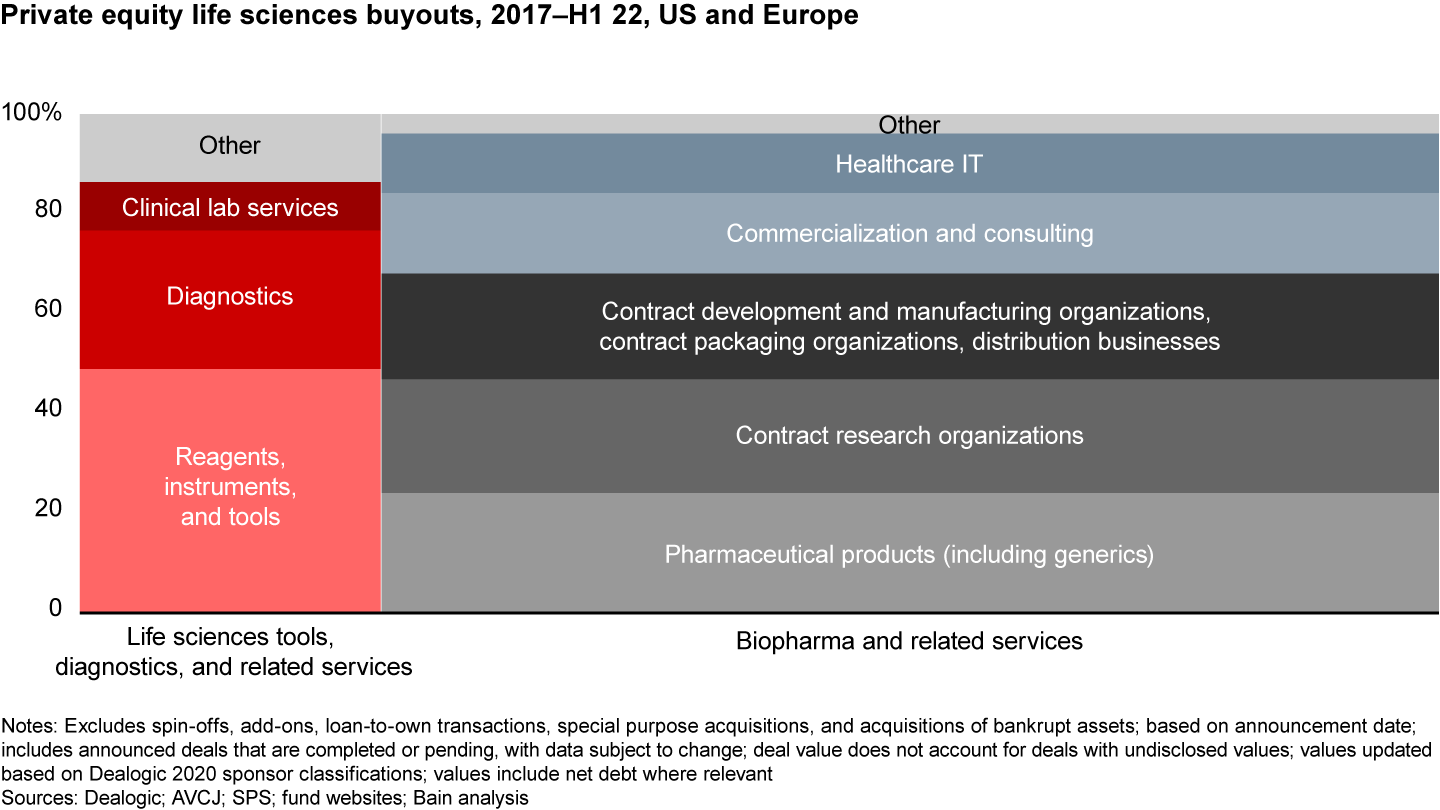
      The overwhelming majority of life sciences buyout activity occurred in eight categories

      Life sciences landscape: Despite upside, biopharma and life sciences tools remain fragmented, challenging spaces to play

      Private equity buyout participation in biopharma and the life sciences tools subsector is widespread, with around 200 funds participating in around 410 unique deals. However, there is a concentration of high-velocity PE dealmakers who are responsible for most of the activity. A large fraction of dealmakers are the midmarket life sciences specialists, although some large-cap funds have been high-velocity dealmakers as well.

      There were roughly 460 PE transactions for US- and European-based biopharma and life sciences tools assets between 2017 and the end of the first half of 2022. Roughly 410 were “unique” deals, and roughly 50 deals were multifund. In total, around 200 private equity firms participated in at least one life sciences deal, and around 170 of those made one to two investments during that time.

      The number of unique funds participating in a life sciences deal increased from about 45 in 2017 to around 80 in 2021, reflecting not only the presence of more “hunters,” but also the increased productivity/activity of funds focusing on life sciences as a sector. Some 45 to 50 private equity firms were responsible for 290 deals (65%) of those closed (at least three-plus closed deals).

      Midmarket PE funds with a life sciences focus represent 40%–50% of the top 50 dealmakers (which include Arsenal Capital Partners, Ampersand Capital Partners, GHO, ArchiMed). Some large-cap PE funds each closed four-plus life sciences deals—Carlyle, EQT, Astorg, GTCR, Nordic Capital, Advent, Blackstone, and KKR.

      As the level of interest in biopharma and life sciences tools investments has increased, we have also observed changes in the deal processes—exacerbated by the boom in post-Covid dealmaking—and changes in the underlying nature of the businesses being acquired that have created additional complications for potential investors:

      Auction processes: Sellers used auction processes with larger pools of bidders, shortened bid periods, and limited access to management data to drive more aggressive valuations and outcomes.

      Competition with strategics: Rapid maturation and inflection points in demand related to areas such as cell and gene therapy created intense interest from strategic buyers for smaller assets that historically have traded sponsor to sponsor, driving multiples higher and creating a scarcity of available assets:

      • This phenomenon was acutely felt at the intersection of LSTs and manufacturing, with Thermo Fisher Scientific and Catalent acquiring viral vector CDMOs Brammer Bio and Paragon Bioservices, respectively, and companies like Thermo Fisher, Sartorius, and Cytiva (Danaher) aggressively acquiring bioprocessing specialists with unique offerings for cell and gene therapy applications such as PeproTech (cytokines for research and good manufacturing practices) and BIA Separations (viral vector-focused chromatography technology).

      Diligence complexity: Differentiation in subsectors is increasingly driven by the quality of science and depth of expertise in a specific disease or technology, and thus more challenging for many investors to evaluate.

      Together, these challenges have raised the bar for private equity firms to execute successful investments within the biopharma and life sciences tools landscape. Funds that have closed five or more deals in biopharma and life sciences tools often have focused teams, great relationships with venture capital and small-cap-focused feeder funds, and a willingness to participate in more deals at smaller ticket sizes with a higher risk profile.

      Lessons learned from dealmakers: Sponsors can mitigate the challenges within biopharma and life sciences

      Analysis of life sciences deal activity reveals the ways in which dealmakers have been thoughtful about where to play and how to win. They have deployed a set of strategies to overcome some of the main challenges we see in life sciences deal participation for private equity:

      Networking: Build and utilize a wide network of outside advisers with scientific and commercial acumen to proactively vet scientific trends, identify subsectors of focus and gem assets within those areas, and prioritize deal strategies and value creation opportunities early in the investment process.

      Talent strategy: Deal teams with scientific backgrounds (PhDs, MDs) focused on the life sciences sector—and sometimes subsectors within life sciences—can overcome scientific, technical, and regulatory expertise hurdles needed to build conviction on a theme and target early in a process (or preprocess) and effectively prewire and manage challenging dynamics with generalist investment committees to ensure competitive positioning in processes.

      Portfolio effects: Dealmakers often double down and make multiple investments within a sector and across subsectors to leverage shared, collective expertise and employ pattern recognition to create value across their platforms:

      • Arsenal Capital has built scale platforms across multiple areas of the outsourced services market (WCG in institutional review board and clinical trial support; Certara in software-aided drug discovery; CellCarta in biomarker and related lab services; Lumanity in commercialization).
      • GHO has made a series of separate investments in a range of distinctive CDMOs (such as Ardena, FairJourney Biologics, RoslinCT, and Sanner).

      Risk profile: While the risk profile of preclinical/clinical stage assets is addressable only for a subset of PE funds, some large-cap funds have been building out capabilities to support investment in this area.

      Flexibility: Given vendor fragmentation, scale asset scarcity, and rich valuation multiples on category leaders, dealmakers have gotten creative in their structures to access a wider range of deals. Examples include:

      • Platform building: Behrman Capital used tuck-in acquisitions to help its CRO Emmes build a set of unique capabilities that helped transform the business from a government-focused CRO to a specialty CRO serving industry sponsors.
      • Public-to-private: Gurnet Point Capital and Patient Square Capital took Radius Health private to invigorate the trajectory of its commercial-stage osteoporosis asset, Tymlos, while sharpening the focus of its pipeline and reducing noncore development costs.
      • Technology/growth bets: KKR has acquired through its Gamma Biosciences platform five earlier-stage companies that provide a variety of innovative biomanufacturing materials or equipment utilized in manufacturing of advanced therapeutics like cell and gene therapies.

      Forging a path forward for private equity: Sponsors will need to define their unique strategies

      We continue to believe that life sciences will be a long-term attractive place for private equity to participate, although there may be some nearer-term noise given the factors currently impacting the economy and the biotech funding-cycle dynamics. That said, it is not an easy place for funds to navigate successfully. We believe that funds have to wrestle with a number of questions to define their strategy:

      • What is our participation model in life sciences deals?
        • Are we looking for only the premium, category leader assets? Are we prepared to dig deep to meet valuation expectations? Do we know, or are we tracking, the assets that are likely to come to market in the next few years? Are we developing unique angles around the deal thesis to invigorate the next wave of growth?
        • Are we going to compete with life sciences specialists and invest early in technology/growth/platform bets? If yes, what’s our strategy to build our internal competencies and processes, along with external advisory teams? Are we going to use innovative deal strategies to put money to work?
      • Which of the life sciences subsectors are we participating in (and which are we not)?
        • What are our unique investment thesis and connections in the space? How can we keep ahead of the competition as more funds enter the space? How can we avoid spending time on deals that are going to be fought over fiercely?
      • Can we stretch the “type” of deal we do to cover a broader range of transactions?
        • Would a public-private, or a carve-out, or a growth-equity investment fund ever be on the table? Would we ever stretch into biopharma therapeutics?

      Given the opportunities for compelling returns within life sciences, the bar is high to win the right deals as competition for these assets holds strong and valuations have run up, even within the current macro context. Clearly defining a life sciences strategy—where a fund will choose to play and what gives that fund a right to win—will be critical, both in the face of a downturn and beyond.

      Read the Next Section

      Value-Based Care: Opportunities Expand

      Read our 2023 Global Healthcare Private Equity and M&A Report

      Download the PDF EXPLORE THE REPORT
      Autoren
      • Headshot of Matt Sullivan
        Matt Sullivan
        Partner, San Francisco
      • Anshul Rana
        Partner, Boston
      • Headshot of Christoph Schlegel
        Christoph Schlegel
        Alumni, Frankfurt
      • Headshot of Nirad Jain
        Nirad Jain
        Partner, New York
      • Headshot of Kara Murphy
        Kara Murphy
        Partner, Boston
      • Headshot of Franz-Robert Klingan
        Franz-Robert Klingan
        Partner, Wien
      • Headshot of Dmitry Podpolny
        Dmitry Podpolny
        Partner, London
      • Headshot of Alex Boulton
        Alex Boulton
        Partner, Singapore
      • Headshot of Vikram Kapur
        Vikram Kapur
        Partner, Singapore
      Kontaktieren Sie uns
      Verwandte Branchen
      • Gesundheitswesen
      • Private Equity
      Global Healthcare Private Equity Report
      What Differentiates Winning Healthcare IT Investments

      Amidst continued high-valuation multiples and competitive deal processes, a disciplined focus on value-creation levers distinguishes winning bids and successful exits.

      Mehr erfahren
      Global Healthcare Private Equity Report
      Healthcare Private Equity Market 2025: Resurgence and Record Growth

      Healthcare private equity investment posted a very strong year for deal value and volume, paired with a strong rebound in exits.

      Mehr erfahren
      Global Healthcare Private Equity Report
      Playing the Long Game in Pharma Services

      While uncertainty persists, many investors have focused on gem assets and attractive subsectors, with an eye toward value creation.

      Mehr erfahren
      Global Healthcare Private Equity Report
      New Models of Value Creation for Physician Groups

      Investors are retooling their physician group approach, building performance-driven platforms for the long term and positioning assets for strategic exits.

      Mehr erfahren
      Global Healthcare Private Equity Report
      Healthcare Private Equity Market 2024: Year in Review and Outlook

      Despite high borrowing costs and extended hold times in 2024, dealmaking roared ahead, marking the second-highest year on record.

      Mehr erfahren

      Overview

      • Welcome Letter: Healthcare Private Equity Is Down but Not Out

      • Healthcare Private Equity Market 2022: The Year in Review

      Hot Topics

      • Healthcare Private Equity in a Downturn

      • Provider Information Technology: Mind the Gap

      • Corporate M&A: Pressing “Pause”

      • Exits: Economic Environment Shapes Landscape

      • Life Sciences: White-Hot Competition to Win the Right Deals

      • Value-Based Care: Opportunities Expand

      • Healthcare Private Equity Outlook: 2023 and Beyond

      Regions

      • North America: Strong Start, Weak End for Healthcare Private Equity Megadeals

      • Europe: Healthcare Private Equity's First Six Months Flattened by Weak Second Half

      • Asia-Pacific: Growing Signs of Healthcare Private Equity Strength and Maturity

      Sectors

      • Biopharma: Healthcare Private Equity Scores a Record Year in Deal Value

      • Providers: Healthcare Private Equity Narrows Its Deal Focus

      • Payers: After Two Bumper Years, Healthcare Private Equity Payer Buyouts Grew Scarce

      • Medtech: Healthcare Private Equity Deals Bounced Back to End 2022

      • Life Sciences Tools: Carve-outs, Mature Assets, and Innovative Growth Draw Interest

      • Healthcare IT: Two Very Different Half Years

      First published in April 2023
      Markierungen
      • Gesundheitswesen
      • Global Healthcare Private Equity Report
      • Private Equity

      Wie wir unsere Kunden unterstützt haben

      Nachhaltigkeit A Paper Company Takes Bold Steps to Make Sustainability a Source of Profits

      Kundenbeispiel lesen

      Strategie Pharma oncology growth strategy

      Kundenbeispiel lesen

      Strategie Review focuses biotech on portfolio potential

      Kundenbeispiel lesen

      Möchten Sie mit uns in Kontakt bleiben?

      Wir unterstützen Führungskräfte weltweit, die kritischen Themen in ihrem Unternehmen zu adressieren. Gemeinsam schaffen wir nachhaltige Veränderungen und Ergebnisse.

      Bain Insights. Unsere Perspektive auf die kritischen Themen, mit denen sich international agierende Unternehmen konfrontiert sehen, finden Sie monatlich in Ihrem Postfach.

      *Ich habe die Datenschutzerklärung gelesen und akzeptiere sie.
      Bitte lesen Sie die Datenschutzerklärung und akzeptieren Sie diese.
      Bain & Company
      Contact us Sustainability Accessibility Rechtliche Hinweise Impressum Datenschutz Cookie-Richtlinie Sitemap Log In

      © 1996-2026 Bain & Company, Inc.

      Kontaktieren Sie Bain

      Wie können wir Ihnen helfen?

      • Business inquiry
      • Career information
      • Press relations
      • Partnership request
      • Speaker request
      Alle weltweiten Büros