


Skip to Content
  • オフィス

    オフィス

    北米・南米
    • Atlanta
    • Austin
    • Bogota
    • Boston
    • Buenos Aires
    • Chicago
    • Dallas
    • Denver
    • Houston
    • Los Angeles
    • Mexico City
    • Minneapolis
    • Monterrey
    • Montreal
    • New York
    • Rio de Janeiro
    • San Francisco
    • Santiago
    • São Paulo
    • Seattle
    • Silicon Valley
    • Toronto
    • Washington, DC
    ヨーロッパ・中東・アフリカ
    • Amsterdam
    • Athens
    • Berlin
    • Brussels
    • Copenhagen
    • Doha
    • Dubai
    • Dusseldorf
    • Frankfurt
    • Helsinki
    • Istanbul
    • Johannesburg
    • Kyiv
    • Lisbon
    • London
    • Madrid
    • Milan
    • Munich
    • Oslo
    • Paris
    • Riyadh
    • Rome
    • Stockholm
    • Vienna
    • Warsaw
    • Zurich
    アジア・オーストラリア
    • Bangkok
    • Beijing
    • Bengaluru
    • Brisbane
    • Ho Chi Minh City
    • Hong Kong
    • Jakarta
    • Kuala Lumpur
    • Manila
    • Melbourne
    • Mumbai
    • New Delhi
    • Perth
    • Shanghai
    • Singapore
    • Sydney
    • Tokyo
    全てのオフィス
  • アルムナイ
  • メディア
  • お問い合わせ
  • 東京オフィス
  • Japan | 日本語

    地域と言語を選択

    グローバル
    • Global (English)
    北米・南米
    • Brazil (Português)
    • Argentina (Español)
    • Canada (Français)
    • Chile (Español)
    • Colombia (Español)
    ヨーロッパ・中東・アフリカ
    • France (Français)
    • DACH Region (Deutsch)
    • Italy (Italiano)
    • Spain (Español)
    • Greece (Elliniká)
    アジア・オーストラリア
    • China (中文版)
    • Korea (한국어)
    • Japan (日本語)
  • Saved items (0)
    Saved items (0)

    You have no saved items.

    後で閲読、共有できるようにするためにブックマークしてください

    Explore Bain Insights
  • 業界別プラクティス
    メインメニュー

    業界別プラクティス

    • 航空宇宙、防衛、政府関連
    • 農業
    • 自動車
    • 化学製品
    • インフラ、建設
    • 消費財
    • 金融サービス
    • ヘルスケア
    • 産業機械、設備
    • メディア、エンターテインメント
    • 金属
    • 採掘・鉱業
    • 石油、ガス
    • 紙、パッケージ
    • プライベートエクイティ
    • 公共、社会セクター
    • 小売
    • テクノロジー
    • 通信
    • 交通
    • 観光産業
    • 公益事業、再生可能エネルギー
  • 機能別プラクティス
    メインメニュー

    機能別プラクティス

    • カスタマー・エクスペリエンス
    • サステイナビリティ、 社会貢献
    • Innovation
    • 企業買収、合併 (M&A)
    • オペレーション
    • 組織
    • プライベートエクイティ
    • マーケティング・営業
    • 戦略
    • アドバンスド・アナリティクス
    • Technology
    • フルポテンシャル・トランスフォーメーション
  • デジタル
  • 知見/レポート
  • ベイン・アンド・カンパニーについて
    メインメニュー

    ベイン・アンド・カンパニーについて

    • ベインの信条
    • 活動内容
    • 社員とリーダーシップ
    • プレス・メディア情報
    • クライアントの結果
    • 受賞歴
    • パートナーシップを結んでいる団体
    Further: Our global responsibility
    • ダイバーシティ
    • 社会貢献
    • サステイナビリティへの取り組み
    • 世界経済フォーラム(WEF)
    Learn more about Further
  • キャリア
    メインメニュー

    キャリア

    • ベインで働く
      キャリア
      ベインで働く
      • Find Your Place
      • ベインで活躍する機会
      • ベインのチーム体制
      • 学生向けページ
      • インターンシップ
      • 採用イベント
    • ベインでの体験
      キャリア
      ベインでの体験
      • Blog: Inside Bain
      • キャリアストーリー
      • 社員紹介
      • Where We Work
      • 成長を後押しするサポート体制
      • アフィニティ・グループ
      • 福利厚生
    • Impact Stories
    • 採用情報
      キャリア
      採用情報
      • 採用プロセス
      • 面接内容
    FIND JOBS
  • オフィス
    メインメニュー

    オフィス

    • 北米・南米
      オフィス
      北米・南米
      • Atlanta
      • Austin
      • Bogota
      • Boston
      • Buenos Aires
      • Chicago
      • Dallas
      • Denver
      • Houston
      • Los Angeles
      • Mexico City
      • Minneapolis
      • Monterrey
      • Montreal
      • New York
      • Rio de Janeiro
      • San Francisco
      • Santiago
      • São Paulo
      • Seattle
      • Silicon Valley
      • Toronto
      • Washington, DC
    • ヨーロッパ・中東・アフリカ
      オフィス
      ヨーロッパ・中東・アフリカ
      • Amsterdam
      • Athens
      • Berlin
      • Brussels
      • Copenhagen
      • Doha
      • Dubai
      • Dusseldorf
      • Frankfurt
      • Helsinki
      • Istanbul
      • Johannesburg
      • Kyiv
      • Lisbon
      • London
      • Madrid
      • Milan
      • Munich
      • Oslo
      • Paris
      • Riyadh
      • Rome
      • Stockholm
      • Vienna
      • Warsaw
      • Zurich
    • アジア・オーストラリア
      オフィス
      アジア・オーストラリア
      • Bangkok
      • Beijing
      • Bengaluru
      • Brisbane
      • Ho Chi Minh City
      • Hong Kong
      • Jakarta
      • Kuala Lumpur
      • Manila
      • Melbourne
      • Mumbai
      • New Delhi
      • Perth
      • Shanghai
      • Singapore
      • Sydney
      • Tokyo
    全てのオフィス
  • アルムナイ
  • メディア
  • お問い合わせ
  • 東京オフィス
  • Japan | 日本語
    メインメニュー

    地域と言語を選択

    • グローバル
      地域と言語を選択
      グローバル
      • Global (English)
    • 北米・南米
      地域と言語を選択
      北米・南米
      • Brazil (Português)
      • Argentina (Español)
      • Canada (Français)
      • Chile (Español)
      • Colombia (Español)
    • ヨーロッパ・中東・アフリカ
      地域と言語を選択
      ヨーロッパ・中東・アフリカ
      • France (Français)
      • DACH Region (Deutsch)
      • Italy (Italiano)
      • Spain (Español)
      • Greece (Elliniká)
    • アジア・オーストラリア
      地域と言語を選択
      アジア・オーストラリア
      • China (中文版)
      • Korea (한국어)
      • Japan (日本語)
  • Saved items  (0)
    メインメニュー
    Saved items (0)

    You have no saved items.

    後で閲読、共有できるようにするためにブックマークしてください

    Explore Bain Insights
  • 業界別プラクティス
    • 業界別プラクティス

      • 航空宇宙、防衛、政府関連
      • 農業
      • 自動車
      • 化学製品
      • インフラ、建設
      • 消費財
      • 金融サービス
      • ヘルスケア
      • 産業機械、設備
      • メディア、エンターテインメント
      • 金属
      • 採掘・鉱業
      • 石油、ガス
      • 紙、パッケージ
      • プライベートエクイティ
      • 公共、社会セクター
      • 小売
      • テクノロジー
      • 通信
      • 交通
      • 観光産業
      • 公益事業、再生可能エネルギー
  • 機能別プラクティス
    • 機能別プラクティス

      • カスタマー・エクスペリエンス
      • サステイナビリティ、 社会貢献
      • Innovation
      • 企業買収、合併 (M&A)
      • オペレーション
      • 組織
      • プライベートエクイティ
      • マーケティング・営業
      • 戦略
      • アドバンスド・アナリティクス
      • Technology
      • フルポテンシャル・トランスフォーメーション
  • デジタル
  • 知見/レポート
  • ベイン・アンド・カンパニーについて
    • ベイン・アンド・カンパニーについて

      • ベインの信条
      • 活動内容
      • 社員とリーダーシップ
      • プレス・メディア情報
      • クライアントの結果
      • 受賞歴
      • パートナーシップを結んでいる団体
      Further: Our global responsibility
      • ダイバーシティ
      • 社会貢献
      • サステイナビリティへの取り組み
      • 世界経済フォーラム(WEF)
      Learn more about Further
  • キャリア
    人気検索キーワード
    • デジタル
    • 戦略
    前回の検索
      最近訪れたページ

      Content added to saved items

      Saved items (0)

      Removed from saved items

      Saved items (0)

      Reinventing Industrial Strategy: Building Supply Chains for Today’s World

      Reinventing Industrial Strategy: Building Supply Chains for Today’s World

      Most companies are limping along with an approach designed for a different era. Here’s how to change that.

      著者:Andy Capanyola, Jim Wininger, Shafik Wazzan, and Chris Rolfe

      • min read
      Reinventing Industrial Strategy: Building Supply Chains for Today’s World

      For decades, industrial companies operated in a remarkably stable environment. Globalization expanded markets. Labor and capital were abundant. Supply chains were optimized for scale, efficiency, and cost—often anchored in low-cost regions and designed around lean, just-in-time principles.

      That world no longer exists.

      Today’s operating environment is defined by disruption: geopolitical tension, trade fragmentation, labor scarcity, rapid technological change, and persistent demand volatility (see Figure 1). The assumptions that once underpinned supply chain design—predictability, global fluidity, and cost primacy—have been fundamentally upended.

      Figure 1
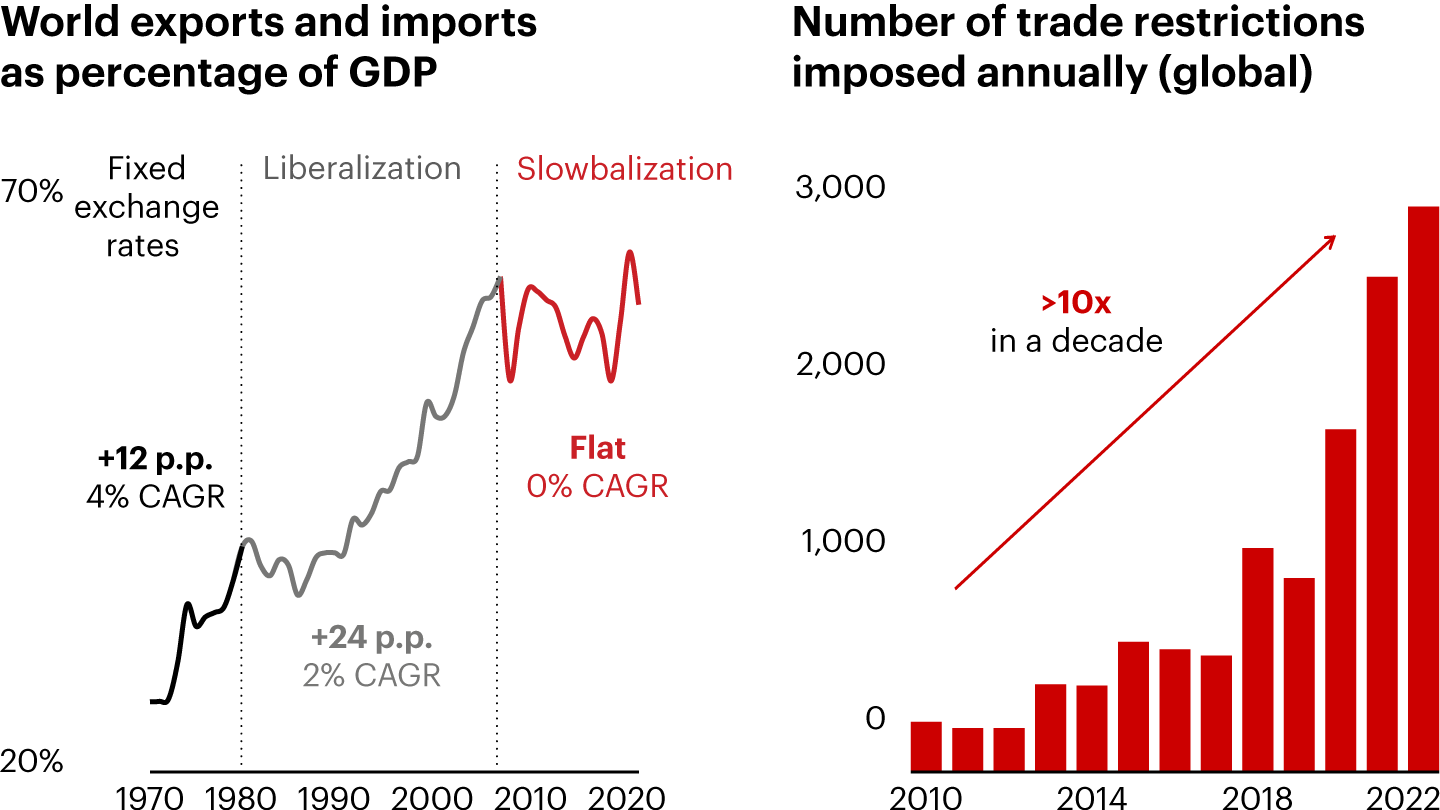
      注 Sources: Global Trade Alert; World Bank (as of year-end 2023)

      In their place, a new set of priorities is emerging. Companies increasingly value resilience, responsiveness, and regional proximity. Advances in automation are reshaping manufacturing economics, while AI and digital technologies are accelerating both opportunity and complexity.

      The result is a profound shift in how industrial companies must compete. Supply chains built for yesterday’s conditions are now misaligned with today’s realities (see Figure 2). They are too rigid, too complex, and too slow to adapt.

      Figure 2
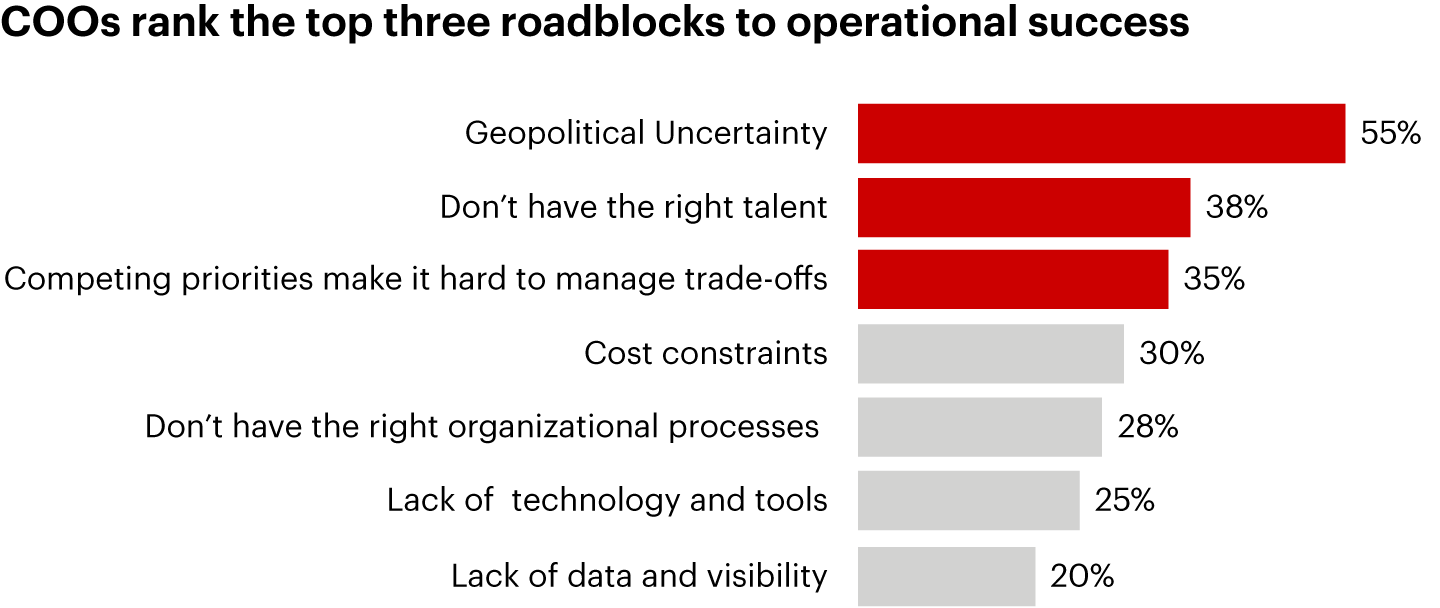
      出所 Source: Bain Ops Reinvention COO Survey 2024 (n=40)

      Incremental improvement is no longer enough. To win, companies must rethink not just how they operate but how operations support strategy.

      From supply chains to industrial strategy

      In many organizations, supply chain decisions have evolved separately from enterprise strategy. They continue to treat the supply chain as an execution engine—a function focused on cost, service, and working capital—and so they often adopt a piecemeal approach to optimization. They improve forecasting, or lower sourcing costs, or make incremental network adjustments, but those improvements rarely add up to a coherent reinvention. The result is a growing disconnect between business ambition and operational design, which erodes competitiveness in today’s volatile environment.  

      Leading companies are taking a different approach.

      They are elevating the supply chain from a cost center to a strategic asset—one that shapes how they compete, where they play, and how they win. Rather than optimizing individual levers, they make deliberate, end-to-end choices about how operations support enterprise ambition.

      We call this industrial strategy.

      At its core, industrial strategy links enterprise ambition, competitive positioning, and macro realities to supply chain design. It forces explicit trade-offs—between cost and resilience, scale and flexibility, global efficiency and regional responsiveness—and aligns decisions across the value chain, from product design through manufacturing and distribution.

      When done well, it becomes a source of competitive advantage, enabling faster growth, more reliable service, and structurally better economics.

      Few companies have built this capability. Most remain anchored in a model designed for a different era. The opportunity, for those willing to rethink it, is significant.

      Why leaders must act now

      The case for rethinking industrial strategy is not just defensive; it is one of the largest remaining sources of competitive advantage for industrial companies. Companies that take an end-to-end approach—aligning supply chain design with enterprise strategy—unlock step-change results.

      The impact is both broad and durable. On the cost side, an integrated industrial strategy can reset the cost base and release significant working capital, through product simplification, network redesign, make-vs.-buy optimization, and aligned procurement strategies.

      But the more powerful effect is on growth. When supply chains are designed as a source of advantage, companies respond faster to demand shifts, launch products more quickly, and serve customers more reliably. Lead times shrink, service improves, and availability increases, driving share gains that competitors struggle to match.

      These benefits compound over time. A strategy-aligned supply chain is inherently more adaptable—able to absorb shocks and evolve without constant reinvention.

      The alternative is increasingly costly. Companies that continue to optimize legacy models often become locked into complex, inflexible networks and are unable to respond when conditions change. In today’s more volatile world, this is not simply inefficient. It’s a structural disadvantage.

      Industrial leaders face a clear choice: Continue squeezing out incremental gains from a legacy model, or redesign operations to create lasting competitive advantage.

      The elements of a winning industrial strategy

      Leading companies do not approach industrial strategy as a series of isolated improvements. They take an integrated, end-to-end view and make deliberate choices about how operations can enable competitive advantage.

      In our experience, the most effective industrial strategies are built around four essential elements.

      1. Start with enterprise ambition, not operational optimization

      Industrial strategy begins with clarity on what the business is trying to achieve.

      Too often, organizations try to optimize for everything at once: lowest cost, highest service, maximum flexibility. In practice, these objectives are in tension. Without clear priorities, supply chains become overengineered and slow to respond.

      Leading companies define what they need to win on—cost leadership, service excellence, speed, or resilience—and align operations accordingly. This requires explicit trade-offs. The goal is not a perfect model but a coherent one. When the ambition is clear, decisions become simpler, faster, and more aligned.

      2. Make bold, integrated choices across the value chain

      With ambition defined, companies must translate it into coordinated design decisions. Many fall short because they make decisions in silos. Leaders take an integrated view across four areas.

      • Product design: Align engineering with cost, value, and sustainability priorities. 
      • Value chain ownership: Decide what to build vs. outsource based on strategic importance. 
      • Procurement strategy: Structure the supplier ecosystem for cost, risk, and innovation. 
      • Manufacturing and distribution network: Design the footprint to balance scale, flexibility, resilience, and proximity. 

      Individually, each decision matters. Together, they define how the company competes.

      Leaders evaluate these choices as a portfolio, prioritizing based on total value and strategic fit, not isolated business cases.

      3. Connect strategy to day-to-day execution

      Even the best strategy fails if it does not translate into operational reality.

      In many organizations, supplier contracts, planning processes, capital allocation, and performance metrics evolve independently, which undermines strategy.

      Leaders close this gap by tightly linking strategy to execution. Planning aligns to strategic priorities, supplier agreements reinforce desired behaviors, capital follows value, and metrics drive the right cross-functional trade-offs.

      The result is an operating system in which daily decisions reinforce strategic direction.

      4. Build a system that evolves with the business

      Industrial strategy is not a one-time exercise—it must continuously adapt.

      Leading companies build feedback loops between front-line performance and strategy. They use scenario planning to anticipate disruption, and they deploy digital tools, including AI, to improve visibility and decision making.

      They also invest in the capabilities required to sustain this model: cross-functional talent, strong management systems, and clear governance.

      The result is an evergreen industrial strategy that evolves as the business and environment change.

      How we can help

      As macro complexities have intensified, it’s become increasingly clear that when supply chains are not tied to end-to-end strategic positioning, competitiveness suffers. But companies that tightly link strategy to operations consistently achieve superior outcomes. They not only improve adaptability and resilience but boost top-line growth through faster launches and higher service levels, gain market share thanks to superior delivery reliability and lead times, and improve customer NPS® scores by providing better fulfillment accuracy and response times.

      We’ve helped thousands of companies develop an unconstrained, end-to-end program to transform industrial strategy. Our clients average 17x ROI on industrial transformations and are significantly more likely to sustain those results once the project ends. From supply chain reinvention to capital projects acceleration and much more, our operations consulting expertise is unmatched both in breadth and impact.

      Industrial leaders have a choice: Continue optimizing a model built for yesterday’s conditions, or build a resilient, strategically aligned supply chain that not only conquers today’s turbulence but provides a lasting competitive edge.


      Net Promoter®, NPS®, and the NPS-related emoticons are registered trademarks of Bain & Company, Inc., Satmetrix Systems, Inc., and Fred Reichheld. Net Promoter Score℠ and Net Promoter System℠ are service marks of Bain & Company, Inc., Satmetrix Systems, Inc., and Fred Reichheld.

      NPS Prism® is a registered trademark of Bain & Company, Inc.

      著者
      • Headshot of Andy Capanyola
        Andy Capanyola
        パートナー, Atlanta
      • Headshot of Jim Wininger
        Jim Wininger
        パートナー, Atlanta
      • Headshot of Shafik Wazzan
        Shafik Wazzan
        アソシエイト パートナー, Boston
      • Chris Rolfe
        Practice Senior Manager, Boston
      関連業種
      • Building Products & Technologies
      • Metals
      • 航空宇宙、防衛、政府関連
      • 産業機械
      • 産業財、サービス
      • 自動車
      • 林産品(林業)、紙、パッケージ
      関連するコンサルティングサービス
      • オペレーション
      • サプライチェーン
      産業財、サービス
      Don't give customers options they don't want

      At a top car company, we implemented customer-driven complexity reduction by focusing on the most profitable combinations and markets. The result: $75 million in first-year savings.

      詳細
      産業財、サービス
      A Steel Company Seeks to Regain Market Leadership

      A host of factors bumped SteelCo from its dominant position. We helped it chart a new path forward.

      詳細
      産業財、サービス
      Robotic arms and conveyor belts sorting and moving boxes in an automated warehouse.
      A Conglomerate Charts a New Global Strategy

      An initial focus on operating model inspired a broader portfolio review that proved transformative.

      詳細
      サプライチェーン
      Turning bottlenecks into growth opportunities

      We determined that the lowest-cost growth strategy for this medical supply company was to expand the existing plant, doubling production capacity while deferring expensive plans to build a new plant.

      詳細
      産業財、サービス
      Tata Steel Helps Home Builders Break New Ground

      A unique e-commerce platform extends the company’s reach into the consumer market.

      詳細
      Tags
      • Building Products & Technologies
      • Metals
      • オペレーション
      • サプライチェーン
      • 航空宇宙、防衛、政府関連
      • 産業機械
      • 産業財、サービス
      • 自動車
      • 林産品(林業)、紙、パッケージ

      クライアント支援事例

      戦略 A Steel Company Seeks to Regain Market Leadership

      ケーススタディを見る

      戦略 A Conglomerate Charts a New Global Strategy

      ケーススタディを見る

      Digital Tata Steel Helps Home Builders Break New Ground

      ケーススタディを見る

      お気軽にご連絡下さい

      私達は、グローバルに活躍する経営者が抱える最重要経営課題に対して、厳しい競争環境の中でも成長し続け、「結果」を出すために支援しています。

      ベインの知見。競争が激化するグローバルビジネス環境で、日々直面するであろう問題について論じている知見を毎月お届けします。

      *プライバシーポリシーの内容を確認し、合意しました。

      プライバシーポリシーをご確認頂き、合意頂けますようお願い致します。
      Bain & Company
      お問い合わせ Sustainability Accessibility Terms of use Privacy Cookie Policy Sitemap Log In

      © 1996-2026 Bain & Company, Inc.

      お問い合わせ

      How can we help you?

      • ビジネスについて
      • プレス報道について
      • 採用について
      全てのオフィス